




Abstract
Composite beams have a wide application in building and bridge engineering because of their advantages of mechanical properties, constructability and economic performance. Unlike static characteristics, the methods of studying the dynamic characteristics of partial-interaction composite beams were limited, especially dynamic stiffness matrix method. In this article, the dynamic stiffness matrix of partial-interaction composite beams was derived based on the assumption of the Euler–Bernoulli beam theory, and then it was used to predict the frequencies of the free vibration of the single-span composite beams with various boundary conditions or different axial forces. The corresponding vibration modes and buckling loads were also obtained. From the comparison with the existing results, the numerical results obtained by the proposed method agreed reasonably with those in the literatures. The dynamic stiffness matrix method is an accurate method which can determine natural vibration frequencies and vibration mode shapes in any precision theoretically. As a result, when the higher precision or natural frequencies of higher order are required, the dynamic stiffness matrix method is superior when compared to other approximate and numerical methods. The dynamic stiffness matrix method can also be combined with the finite-element method to calculate the free vibration frequencies and natural mode shapes of composite beams in complex conditions.
Introduction
Composite beams have a wide application in building and bridge engineering because of their advantages of mechanical properties, constructability and economic performance. They often have to withstand all kinds of dynamic loads, so it is necessary to have an in-depth research on the dynamic characteristics of composite beams. The dynamic stiffness matrix (DSM) method is an effective method for solving the problem of dynamic characteristics. It was proposed in the early 1940s. After decades of development, it has been a powerful tool for solving engineering problems in structural vibration, particularly when higher natural frequencies and better accuracies are required. 1 The DSM method is usually referred to as an accurate method because it precisely solves the differential equations of the structure and is different from the traditional finite-element method or other approximate methods which are required to assume the displacement or other physical quantities beforehand. Theoretically, the DSM method can determine natural vibration frequencies and vibration mode shapes in any precision, and it also can obtain accurate results without considering the number of the elements. The DSM has the property of element mass and element stiffness at the same time. It is composed of the analytical solution of the differential equations. DSM is the transcendental function of frequency. Therefore, this kind of problem is often referred to as transcendental eigenproblem.
More and more researches pay attention on the DSM method since it was proposed in the early 1940s. Around 1970, Williams and Wittrick2,3 proposed the well-known Williams–Wittrick algorithm to solve natural vibration frequencies of the structure using the DSM method. In 1977, Hopper and Williams 4 proposed a method to calculate natural mode shapes. To get the natural mode shapes, a method in which subspace iteration was utilized in conjunction with a frequency-dependent mass and stiffness formulation was described and applied to framed structures by Richards and Leung. 5 In 1993, Leung 6 proposed the DSM method of the non-conservative loads to analyze thin-walled structures under the influence of a follower axial force and an in-plane moment. Shortly afterwards, a computer-assisted analytical method was introduced for any structural members, the differential governing equations of which were expressible in matrix polynomial form by Leung and Zeng. 7 In 1994, Ye and Williams 8 discussed the range of eigenvalues. A general theory of development of the DSM of a structural element was outlined by Banerjee 9 in 1997. In 2000, Chan and Williams 10 analyzed the orthonormalization conditions for the modes of piecewise continuous structures obtained by the transcendental stiffness matrix method and showed how they can be extended to orthonormalize any set of coincident modes. In 2002, Williams et al. 11 had a thorough discussion on the mathematical and physical concepts in the eigenproblem of the DSM method.
Since 1990, there have been more and more researches on laminated beams with the DSM method. The DSM method was developed to predict the free vibration characteristics of composite beams for which the bending and torsional displacements were (materially) coupled by Banerjee and Williams 12 in 1995. Then, Banerjee and Williams 13 considered the effects of shear deformation and rotation inertia. In 1998, Banerjee 14 considered the effect of axial forces based on the results. In 2005, Banerjee and Sobey 15 examined the free vibration characteristics of a three-layered sandwich beam with the DSM method.
However, the recently developed DSM of Banerjee and Sobey 15 did not account for the interlayer slips of the three-layered sandwich beam. In 2007, Xu and Wu 16 examined the two-dimensional analytical solution of simply supported composite beams with interlayer slips. They then discussed the static, dynamic, and buckling characteristics of partial-interaction composite members using Timoshenko’s beam theory, in which the analytical solutions were derived under different boundary conditions. 17 On the basis, Wu et al. 18 examined the dynamic characteristics of composite beam under axial force and gave the exact formula for calculating the free vibration frequency. In 2008, Xu and Wu 19 examined free vibration and buckling of composite beams with interlayer slip by two-dimensional theory. Recently, Nguyen et al. 20 developed an exact dynamic analysis procedure for the free vibration of shear-deformable two-layer beams with interlayer slip, and the effect of transverse shear deformation of two layers was taken into account. Accordingly, the main improvement of the proposed model, when compared to Wu et al. 18 model, allows the layers to have independent shear strains which depend on their shear modulus. In 2013, Chakrabarti et al. 21 adopted one-dimensional finite-element model based on a higher order beam theory to examine the dynamic response of composite beams with partial interaction and considered the effect of partial shear interaction between the adjacent layers, as well as the transverse shear deformation of the beam. However, according to the authors’ knowledge, the DSM of composite beam with interlayer slip has not been reported.
Based on the assumption of Euler–Bernoulli beam theory, this article deduced the DSM of the composite beams with interlayer slips with axial force. An analytical expression of the DSM of the composite beams was also given by the help of MATLAB. Finally, according to DSM method, for the composite beam without axial force, the free vibration frequencies of the composite beams under four boundary conditions were demonstrated; for the composite beam with axial force, the vibration frequencies of simply supported composite beams under different axial forces were obtained. The corresponding vibration modes and buckling loads were also obtained. The numerical results agreed with those in the literatures very well.
DSM
Xu and Chen
22
proposed the differential equations of the free vibration of composite beams with interlayer slips under the effect with axial force


where

where

where


Eliminating

where


and
The general solutions of equation (7) are based on the root characteristic of its eigen-equation

The six roots of equation (10) are


where

where

The expressions for the bending moment


where



The positive direction is shown in Figure 1

Sign convention for positive bending moment (M), shear force (Q), and axial force (N).
To obtain the DSM of an element of composite beams, the internal force for both ends of the element can be expressed in terms of the displacements

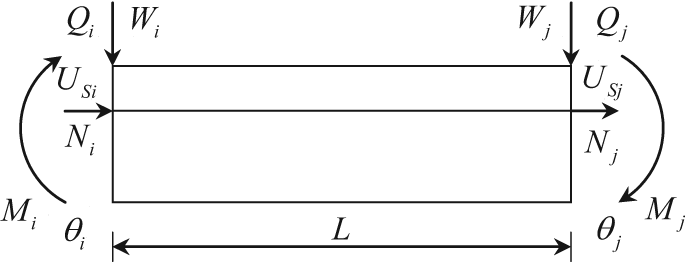
End conditions for forces and displacements of the beam element.
From equations (11)–(14) and equation (21), the displacements of an element of composite beams at the two ends can be rendered in terms of the parameters

where

and
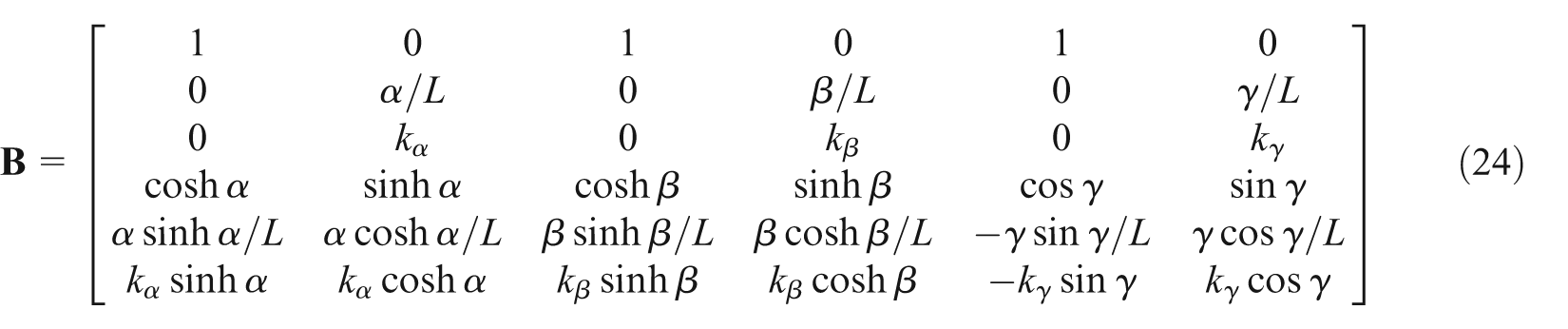
Similarly, the internal forces of an element of composite beams at the two ends can also be represented by the parameters

where


From equations (22) and (25), the parameters

where the matrix

Applications
Free vibration frequencies
In general, each of the two ends of the beam has three different kinds of boundary conditions, that is, simply supported (S), clamped (C), and free (F) cases. They are combined to make four cases in practice, that is, SS, CC, CF, and CS, in which SS, for instance, means both ends are simply supported. 23
If a composite beam is simply supported at the two ends, the boundary conditions are

Substituting equation (30) into equation (28) gives

where

This is the characteristic equation of the free vibration of partial-interaction composite beams, from which the natural frequencies
Modal shapes
After the frequencies are obtained, the corresponding modal shapes can be computed by the following procedure. First, substituting equation (30) into equations (11), (15), and (17) gives

Then, the solved frequencies are substituted into equation (33), and non-trivial solution of the coefficients
Critical loads of buckling
equation (32) is also the characteristic equation of the buckling of partial-interaction composite beams if the frequency
Numerical examples
In order to validate the proposed DSM, the composite beams used by Xu and Wu 17 and Shen et al. 24 were used. For composite beams without axial force, frequencies of free vibration of those composite beams under different boundary conditions were calculated. The results were compared with those of Xu and Wu 17 and Shen et al. 24 For the composite beams with axial force, vibration frequencies of simply supported composite beams with different axial forces were calculated, and the results were compared with those of Wu et al. 18 and Shen et al. 25 The corresponding vibration modes and buckling loads were also obtained and compared with those of Xu and Wu. 17 Table 1 shows the free vibration frequencies of composite beams under four boundary conditions. Table 2 shows the vibration frequencies of the composite beams under four axial forces. Table 3 shows the first five buckling loads under four boundary conditions. Figure 3 shows the first four deflection mode shapes of the SS beam. Figure 4 shows the first four relative slip mode shapes of the SS beam. Figure 5 shows the first four deflection mode shapes of the SC beam. Figure 6 shows the first four relative slip mode shapes of the SC beam. It is shown that the results of this article are in line with the existing results, which indicates the feasibility of the proposed DSM method.
The first 10 flexural frequencies without axial force (rad/s).

The first 10 flexural frequencies with different axial forces (rad/s).

The first five buckling loads under four boundary conditions (kN).


The first four deflection mode shapes of the SS beam.

The first four relative slip mode shapes of the SS beam.
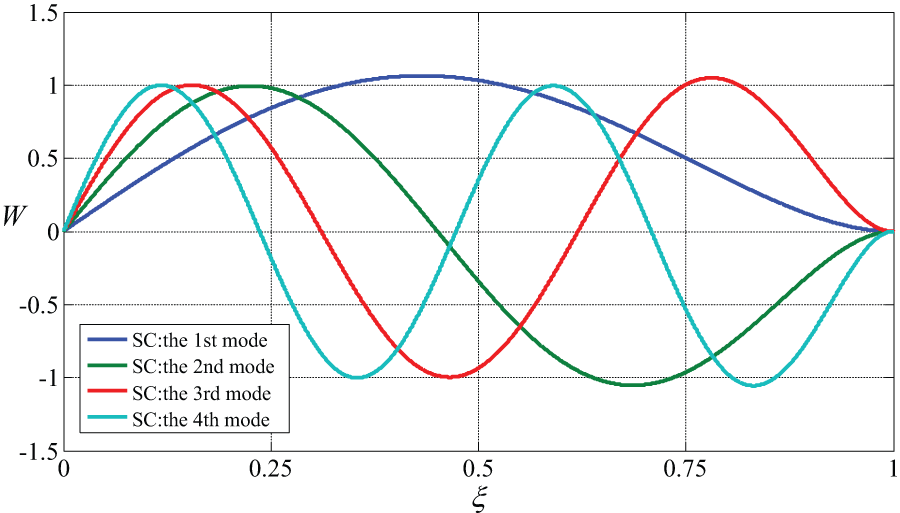
The first four deflection mode shapes of the SC beam.

The first four relative slip mode shapes of the SC beam.
Conclusion
Based on the assumption of Euler–Bernoulli beam theory, the DSM of composite beams with interlayer slips with axial force was determined. Furthermore, an accurate solution for free vibration frequency of composite beams without axial force under different boundary conditions and vibration frequency of simply supported composite beams under different axial forces were obtained. The corresponding vibration modes and buckling loads were also obtained. The results in this article may provide a reference for other approximate methods or numerical methods.
Footnotes
Academic Editor: Yu-Fei Wu
Declaration of conflicting interests
The authors declare that there is no conflict of interest.
Funding
This work is supported by the National Natural Science Foundation of China (Nos 11172266 and 51478422) and partly supported by the National Natural Science Foundation of Zhejiang Province, China (No. LY12A02001)