




Abstract
Porous metal materials are widely used in noise control with high sound pressure applications such as aircraft engine liners and combustion chambers for rocket engines due to their excellent performance of sound absorption characteristics and distinguished advantages in heat resistance, lightness, and stiffness. Understanding the effect of sound pressure on the acoustic properties of these materials is crucial when attempting to predict silencer performance. In this article, we experimentally investigate the sound absorption characteristics of porous metal materials at high sound pressure level. The effects of material parameters on the sound absorption characteristics of porous metal materials under high sound pressure level are further explored experimentally. Measurements are carried out by using a standard impedance tube that has been modified to accommodate sound pressure level of up to 150 dB. The experimental results show that with the increase in sound pressure level, the effect of sound pressure level on the sound absorption characteristics yields different variation regularities in different frequencies. The sound absorption performance of porous metal materials increases with the increase in sound pressure level in low frequency, which is reasonably consistent with the theoretical results. Under high sound pressure level, the sound absorption characteristics are significantly dependent upon the material parameters such as the metal fiber diameter, the material porosity, and the material thickness. It could provide a reliable experimental validation for the applications of porous metal materials in the area of vibration and noise control at high sound pressure levels.
Keywords
Introduction
Over the last two decades, the propagation characteristics of acoustic waves in porous metal materials have attracted considerable attention due to their abundant physics and potential engineering applications.1–4 Porous metal materials are a new type of structural multifunctional materials, and they can demonstrate various novel physical properties; in particular, the sound absorption characteristics under extreme conditions, such as high sound pressure level and high temperature. Due to their excellent performance of sound absorption characteristics and distinguished advantages in heat resistance, lightness, and stiffness, porous metal materials are widely used in noise control at high sound pressure applications such as aircraft engine liners and combustion chambers for rocket engines.5–8
A large number of studies have been conducted on the propagation characteristics of acoustic waves in porous metal materials.9–16 Biot9,10 theoretically investigated the propagation of stress waves in a porous elastic solid containing compressible viscous fluid. The emphasis of the present treatment was on the materials where fluid and solid are of comparable densities as, for instance, in the case of water-saturated rock. Attenborough 11 investigated the acoustical characteristics of porous materials by introducing physically measurable microstructural constants rather than phenomenological bulk parameters that might be frequency dependent. Utsuno et al. 12 proposed an improved two-cavity method to measure the characteristic impedance and propagation constant of porous materials. The characteristic impedance and propagation constant can be measured easily over a broad frequency range by using the transfer function method. Kirby and Cummings 13 presented a semi-empirical prediction method for fibrous media, which not only yields physically reasonable predictions for the bulk properties at arbitrarily low frequencies but also is in good agreement with measured data at higher frequencies. Lu et al. 14 presented an experimental study on the sound-absorbing capacity of commercially available cast aluminum alloy foams. Enhanced sound absorption capacity can be achieved by subjecting the foams to either rolling or compression, whereby the cell faces partly break to enable air particles penetrating in and out of the interior cellular structure. Wang and Torng 15 experimentally investigated the sound absorption characteristics of porous fibrous material. The flow resistivity and the absorption coefficient are the important parameters that are determined. Han et al. 16 studied the sound absorption behavior of the open-celled Al foams manufactured by the infiltration process. The results show that the sound dissipation mechanisms in the open-celled foams are principally viscous and thermal losses when there is no air-gap backing and predominantly Helmholtz resonant absorption when there is an air-gap backing.
Obviously, earlier studies on porous metal materials are mainly concentrated on the sound absorption characteristics under normal condition. In addition to the sound absorption characteristics under normal condition, increased attention has been focused on the sound absorption characteristics under high sound pressure level and high temperature.17–21 Wang et al. 17 studied the sound absorption properties of porous metals at high sound pressure levels. A method of deriving the nonlinear static flow resistance for highly porous fibrous metals was proposed by solving Oseen’s equation to take account of the inertia effect, validated by experiments of airflow measurement. Sun et al. 18 investigated the sound absorption properties of fibrous metal materials at high temperature. The high temperature effects on acoustic parameters were studied by thermodynamics theories and variable property heat transfer. Cuiyun et al. 19 studied the sound absorption properties of porous zeolite with macropores by two analytical models, Delany–Bazley model and Johnson–Allard model. Wu et al. 20 presented a quantitative theoretical model to investigate the sound-absorbing property of porous metal materials with high temperature and high sound pressure based on Kolmogorov turbulence theory. Williams et al. 21 experimentally investigated the effect of temperature on the acoustic properties of porous metal materials. However, experimental research on the sound absorption characteristics of porous metal materials at high sound pressure levels has been scarcely carried out.
In this article, we experimentally investigate the sound absorption characteristics of porous metal materials at high sound pressure levels by using a standard impedance tube that has been modified to accommodate sound pressure level of up to 150 dB. The effects of material parameters on the sound absorption characteristics of porous metal materials under high sound pressure level are further explored experimentally. The experimental results show that the sound absorption performance of porous metal materials increases with the increase in sound pressure level, which is in good agreement with the theoretical results. Under high sound pressure level, the sound absorption characteristics are significantly dependent upon material parameters such as the metal fiber diameter, the material porosity, and the material thickness. Our experimental research could provide a reliable experimental validation for the applications of porous metal materials in the area of vibration and noise control at high sound pressure levels.
Experimental apparatus
Figure 1(a) and (b), respectively, illustrates the macro/micro structures of the porous metal material. There are inertial range and inertial sub-range in a quasi-periodic structure element of porous metal materials. The porous metal materials have a large number of anomalous pores, and the experimental approach has to be applied to analyze their physical properties.
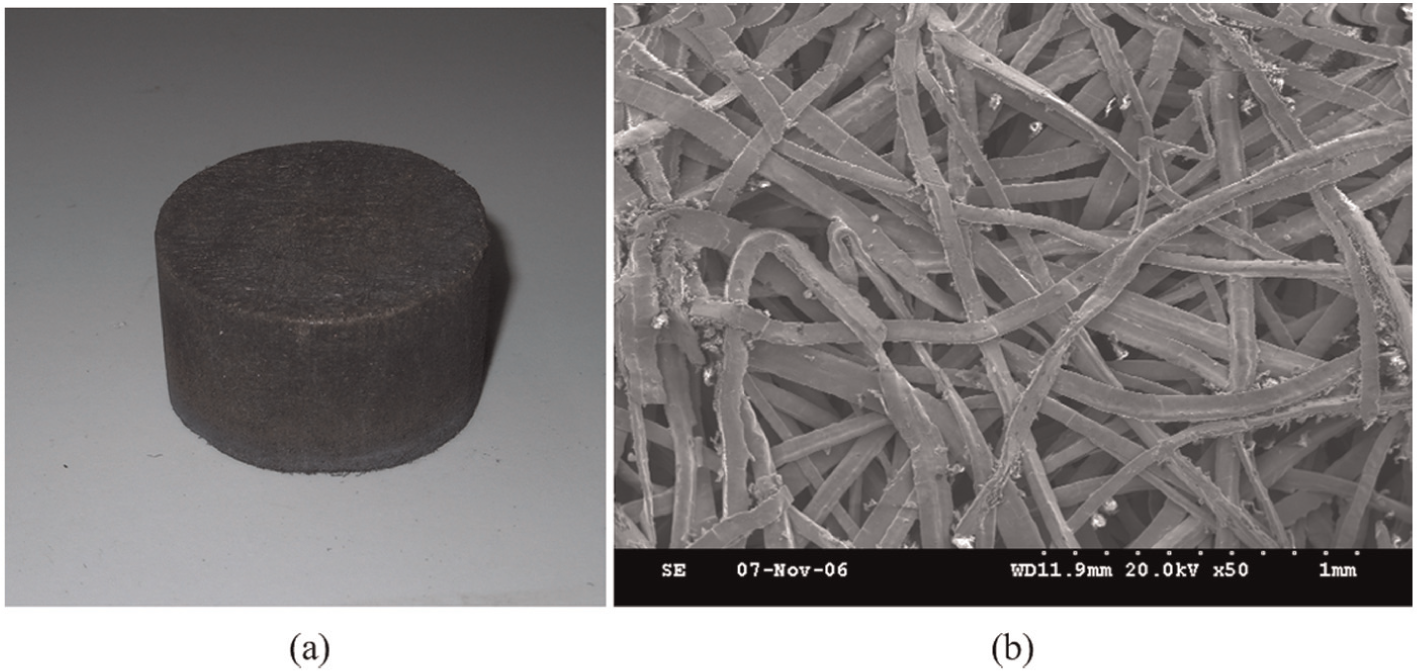
(a) The macrostructure of the porous metal materials and (b) the microstructure of the porous metal materials.
The experiments undertaken here are based on the impedance tube methodology described in China Standard GB/T 18696-2: 2002. 22 In order to experimentally investigate the sound absorption characteristics of porous metal materials at high sound pressure levels, we design an impedance tube test platform at high sound pressure level as shown schematically in Figure 2. Accordingly, a steel impedance tube of inner diameter 50 mm and length 950 mm is used, resulting in a nominal frequency measuring range of 1000–3800 Hz. Tapered pipe is applied here to enhance the sound pressure level and obtain a nominal sound pressure level range of 125–150 dB. Two B&K type 4182 probe microphones are used to measure sound pressure and these are placed 30 mm apart, with the first microphone placed 50 mm from the sample face. m+p test system and SmartOffice software (m+p International, Germany) are employed in the experiments.

Experimental apparatus at high sound pressure level.
As we know, the impedance tube methodology described in China Standard GB/T 18696-2: 2002 is based on the plane wave characteristic of acoustic wave in impedance tube. In order to validate the plane wave characteristic in impedance tube under high sound pressure level, we measured the sound pressure level distribution of the impedance tube as shown in Figure 3. One can observe that the sound pressure level distribution of the impedance tube under high sound pressure level maintains consistency and satisfies the requirement of plane wave characteristic in impedance tube.

Sound pressure level distribution of the impedance tube.
Results and discussion
In this article, we consider six different material samples, and the structure parameters are illustrated in Table 1. These test specimens are provided by northwest nonferrous metal academe. 23 To illustrate the acoustic wave propagation and sound absorption characteristics in the porous metal materials at high pressure levels, some experimental measurements are carried out based on the experimental apparatus at high sound pressure levels.
Structure parameters of material samples.

Effect of the sound pressure level on the sound absorption coefficient
Figure 4(a) and (b) illustrates the surface acoustic resistance and surface acoustic reactance of material sample 1 at different high sound pressure levels, respectively. It can be observed that when the sound pressure level is lower than 139 dB, the surface acoustic resistance and surface acoustic reactance of material sample 1 remain unchanged. With the increase in sound pressure level, the surface acoustic resistance and surface acoustic reactance increase in low frequency. However, the high sound pressure levels have no effect on the surface acoustic resistance and surface acoustic reactance in high frequency.

(a) The surface acoustic resistance and (b) surface acoustic reactance of material sample 1 at different high sound pressure levels.
To investigate the effect of sound pressure level on the sound absorption characteristics of porous metal materials, we measured the sound absorption coefficients of material sample 1 at different high sound pressure levels ranging from 125 to 150 dB, as shown in Figure 5. One can observe that the sound absorption coefficients of porous metal materials at different high sound pressure levels yield similar variation trend. When the sound pressure level is lower than 139 dB, the sound absorption coefficients of material sample 1 remain unchanged. With the increase in sound pressure level, the effect of sound pressure level on the sound absorption characteristics yields different variation regularities in different frequencies. Significantly, with the increase in sound pressure level, the sound absorption coefficients increase in low frequency. However, the high sound pressure levels have no effect on the sound absorption coefficients in high frequency. This phenomenon can be explained that with the increase in sound pressure level, the flow velocity increases, the nonlinear effect of porous metal materials enhances, the static flow resistance ratio can no longer be considered as constant but is related to the flow velocity, and the surface acoustic resistance and surface acoustic reactance increase, resulting in the increase in the sound absorption coefficients.
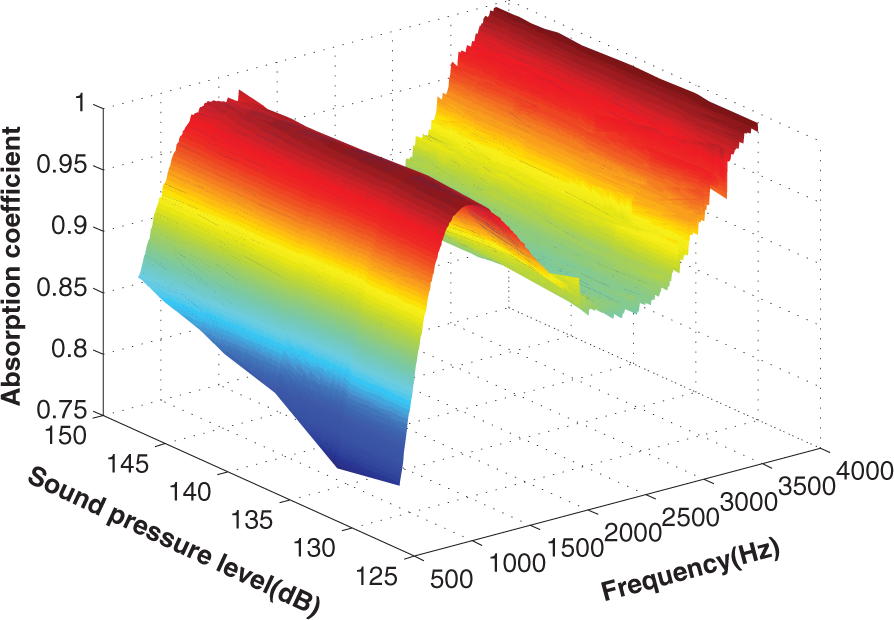
The sound absorption characteristics of material sample 1 at different high sound pressure levels.
Effect of the structure parameters on the sound absorption coefficient
To experimentally investigate the effect of the structure parameters on the sound absorption coefficient at high sound pressure levels, the sound absorption coefficients of six different material samples at high sound pressure level of 150 dB are measured and compared, respectively. Keeping the porosity ϕ = 85%, the sample diameter D = 50 mm, and the sample thickness h = 50 mm, the effect of the fiber diameter d on the sound absorption coefficients at high sound pressure level is experimentally investigated as shown in Figure 6(a). We can see that the fiber diameter has a significant influence on the sound absorption coefficients of porous metal materials at high sound pressure level. Under high sound pressure level, the sound absorption performance enhances with the decrease in the fiber diameter. On the one hand, with the decrease in the fiber diameter, the interior pores of porous metal materials decrease, and the flow resistance ratio increases. On the other hand, with the decrease in the fiber diameter, the number of the interior pore increases, and the interior contact area increases. Significantly, the energy dissipation will increase with the increase in the flow resistance ratio and interior contact area, resulting in the increase in sound absorption coefficients. Keeping the fiber diameter d = 50 µm, the sample diameter D = 50 mm, and the sample thickness h = 50 mm, the effect of the porosity ϕ on the sound absorption coefficients at high sound pressure level is experimentally carried out as shown in Figure 6(b). It can be observed that the porosity plays an important role in the sound absorption performance of porous metal materials at high sound pressure level. Under high sound pressure level, with the increase in the porosity, the sound absorption performance enhances in low frequency (1000–2400 Hz) while weakens in high frequency (2400–4000 Hz). With the increase in the porosity, the surface acoustic impedance of porous metal materials is closer to the acoustic impedance of air, and acoustic wave can be easier to propagate into porous metal materials. Moreover, with the increase in the porosity, the internal average aperture increases and the interior contact area increases, resulting in the increase in sound absorption coefficients. In addition, with the fiber diameter d = 50 µm, the porosity ϕ = 93%, and the sample diameter D = 50 mm, the effect of the sample thickness h on the sound absorption coefficients at high sound pressure level is experimentally presented as shown in Figure 6(c). One can observe that the sample thickness plays a crucial role in the sound absorption coefficients of porous metal materials at high sound pressure level. Under high sound pressure level, with the increase in the sample thickness, the sound absorption performance of porous metal materials in low frequency can be significantly improved and the frequency at first peak decreases and shifts to low frequency. Moreover, the effect of the air layer on the sound absorption coefficients at high sound pressure level is further explored experimentally as illustrated in Figure 6(d), while the fiber diameter d = 50 µm, the porosity ϕ = 85%, the sample diameter D = 50 mm, and the sample thickness h = 25 mm remained unchanged. It can be found that the air layer has an important influence on the sound absorption coefficients of porous metal materials at high sound pressure level. With the introduction of air layer, the sound absorption performance of porous metal materials in low frequency can be significantly improved. When the air layer is introduced into the back of the materials, the sample thickness can be enlarged equivalently, resulting in the improvement of the sound absorption performance of porous metal materials.
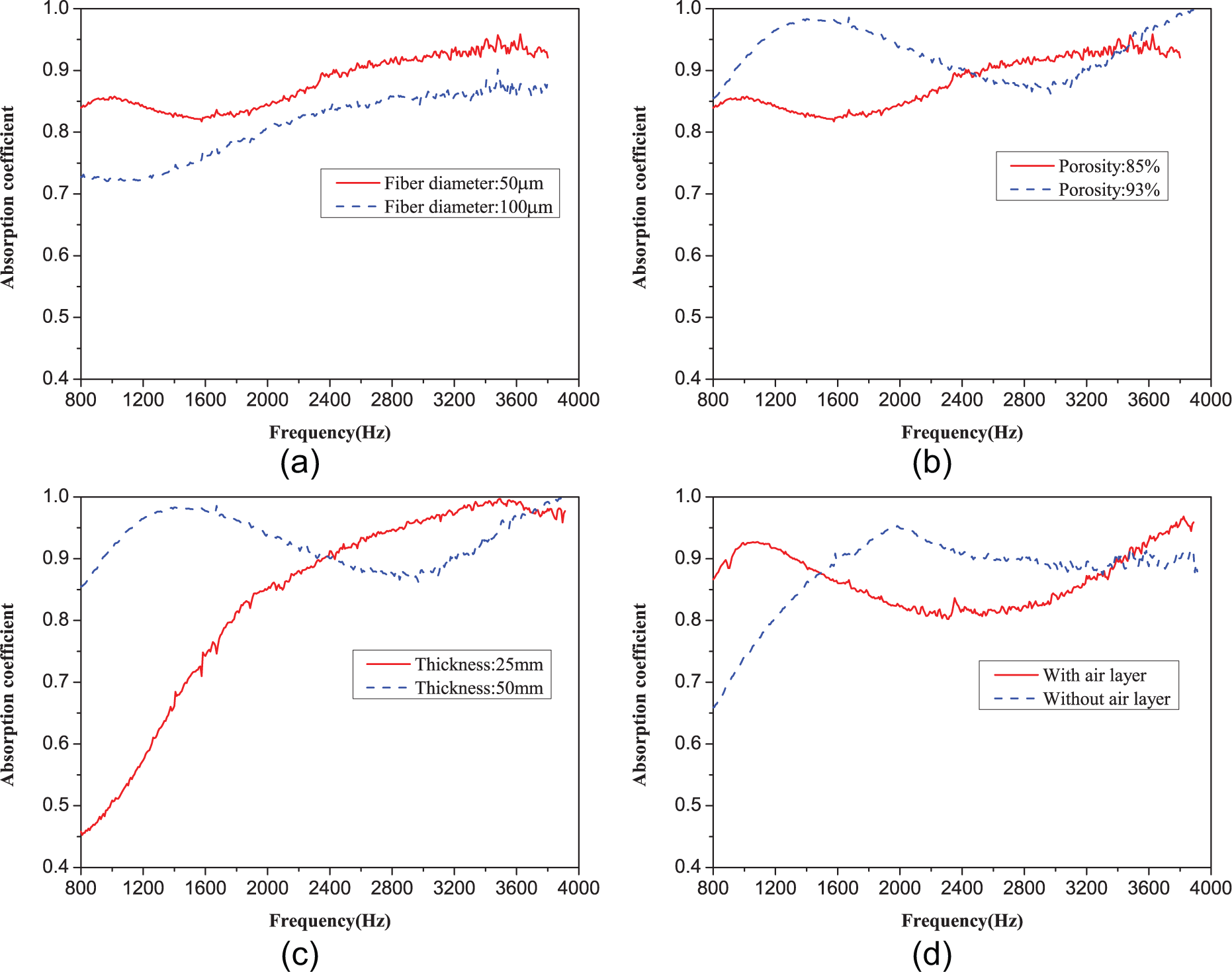
Effect of the structure parameters on the sound absorption coefficient at sound pressure level of 150 dB: (a) fiber diameter, (b) porosity, (c) thickness, and (d) air layer.
Conclusion
In this article, we experimentally investigate the sound absorption characteristics of porous metal materials at high sound pressure levels. The effects of material parameters on the sound absorption characteristics of porous metal materials under high sound pressure level are further explored experimentally. The measurements are carried out by using a standard impedance tube that has been modified to accommodate sound pressure level of up to 150 dB. The experimental results show that the sound absorption performance of porous metal materials increases with the increase in sound pressure level, which is in reasonably consistent with the theoretical results. With the increase in sound pressure level, the flow velocity increases, the nonlinear effect of porous metal materials enhances, the static flow resistance ratio can no longer be considered as constant but is related to the flow velocity and the surface acoustic resistance and surface acoustic reactance increase, resulting in the increase in the sound absorption coefficients. Under high sound pressure level, the sound absorption characteristics are significantly dependent upon material parameters such as the metal fiber diameter, the material porosity, and the material thickness. It could provide a reliable experimental validation for the applications of porous metal materials in the area of vibration and noise control at high sound pressure levels.
Footnotes
Academic Editor: Guoqiang Li
Declaration of conflicting interests
The authors declare that there is no conflict of interests.
Funding
The authors gratefully acknowledge financial support from the National Basic Research Program of China (No. 2011CB610306), the Project of National Natural Science Foundation of China (No. 51275377) and Collaborative Innovation Center of Suzhou Nano Science and Technology, and Fundamental Research Funds for the Central Universities.