




Abstract
It is important to identify the relationship between the starting requirements and the structure parameters of the diesel free piston linear alternator on the structural design stage. In this article, the forces applied on the moving part during the starting process are analyzed, and an oscillation model is established. The numerical simulation results of the oscillation model are presented, and the energy-transfer mechanism is analyzed. Then, the oscillation model is simplified by utilizing the energy balance theory. Expressions of the achieved starting frequency and required starting force are derived and the effects of different design variables on them are investigated. The results show that the achieved compression ratio is determined by the energy balance between the friction consumption and the energy supplied by the starting force. The starting frequency achieved and starting force required are associated with the cylinder bore, the moving mass, and effective stroke of the engine, which can be applied to the matching design and optimization of the prototype.
Introduction
With the background of the worldwide shortages of energy supplies and environmental degradation, new energy and power plants have become research hotspots. This provides development space for the free piston linear alternator (FPLA). The FPLA is a combination of the free piston engine and the linear electric machine, converting the piston’s kinetic energy directly into electricity power. The piston’s motion is not restricted by the crankshaft mechanism, which is different from the conventional combustion engines. This gives the free piston engine distinctive characteristics such as variable compression ratio and simplified mechanism.1,2 The free piston engine can optimize the combustion process with the advantage of the variable compression ratio, leading to higher part-load efficiency and possible multi-fuel operation.1,3 Since the linear package contains fewer moving parts compared with conventional crankshaft machine, the FPLA has the advantages including lower friction loss, higher reliability, lower cost, and more durability.4–7 It is a simpler and more efficient energy conversion device compared with the conventional crankshaft internal combustion engine. 8
However, the structure change has brought new challenges, of which a crucial one in the operation of the FPLA is to start the engine. 7 As it has no flywheel, crankshaft, or any mechanical coupling, the free piston engine cannot be started by an ordinary starter motor. To start the free piston engine, electrical power is supplied to the linear electric machine to drive the translator oscillate, operating the linear electric machine as a motor.3,9,10 In most cases, however, the drive force is not big enough to start free piston engine in one stroke. Then, an oscillation starting approach is proposed, which has been accepted in most FPLA concepts currently.11–17 In this approach, the mechanical resonance and the air-spring character of the gas inside the cylinder are utilized by driving the piston moving back and forth until it reaches the required compression ratio.
The matching relationship between the linear electric machine and the free piston engine is a vital factor in the modeling and designing of a new engine, not only for high load operation but also for successful engine start-up. A number of previous researches concentrate on design, simulation, and experiment of the matching relationship for steady-state operation.9,10,18 However, limited study has been conducted to investigate the matching relationship for engine start-up.
The purpose of this article is to identify the relationship between the structure parameters of the FPLA and the requirements to start the engine. An oscillation model is presented to describe the piston motion during the starting process, and the energy-transfer mechanism is analyzed. By utilizing the energy balance theory, the oscillation model is simplified. An expression of the required starting force is derived based on the simplified model, which can be used as a constraint condition for parameter matching design. The effects of different design variables on the achieved starting frequency and required starting force are investigated. This work presents a useful method for the understanding of the parameters matching and the further optimization.
Configuration of the FPLA
Figure 1 shows the configuration of a two-stroke diesel FPLA considered in this article. A linear electric machine is integrated in the middle of two opposed pistons connected by a connecting rod. The permanent magnet is mounted on the connecting rod as the translator and the coils are radially arranged in the stator. The engine has only one moving part, rigidly connecting the translator and the two pistons equipped with a compression ring, which allows the piston to oscillate freely between the two double-ended cylinders. To simplify the model, it is defined that when one cylinder is at the start of the compression process, the cylinder on the other side is just at the beginning of its exhaust process. As illustrated in Figure 1, the moving part is at the middle of the stroke at the beginning. It is obvious that the effective stroke is half of the total stroke. The electric machine is designed to operate as a linear alternator as well as a starting motor. When the electric machine is operated as a linear alternator, combustion occurs alternately in each cylinder, driving the moving part back and forth, and electricity is generated from the coils, which will be absorbed by the external load. When operated as a starting motor, the current is injected into the stator coils and a sustaining thrust pushing on the translator is generated. The amplitude and phase of the thrust are proportionate to the injected current, which can be controlled by the analytic signal from a motion control card.

Diesel FPLA configuration.
Forces on the moving part
For the FPLA, the motion of the piston during the starting process is not mechanically constrained but emerged as a result of real-time balance of the gas force in cylinder, starting force, inertia force, and friction force. 19 Applying Newton’s second law gives

where

Free body diagram of FPLA.
Starting force
According to the starting method introduced in this article, the electric machine is used as a starting motor. Although the starting force is produced by the injection of electrical current, it is also considered as a mechanical force with constant amplitude. It is controlled by a motion control card with velocity detection to ensure that the starting force is always in the same direction with the piston velocity. Thus, the starting force can be expressed as

where
Gas pressure
In the absence of combustion, the free piston engine exhibits an air-spring behavior. It is assumed that the mass loss past the piston rings and the energy loss of heat transfer are ignored. The cylinder pressure is only affected by the cylinder volume change caused by the movement of the piston. When the piston moves between its top dead center (TDC) and exhaust port, the cylinder can be assumed as a closed system. The compression and expansion processes of the gas in the cylinder are adiabatic processes. When exhaust port is opened by the piston, the pressure in the cylinder is assumed to be the same with the ambient pressure. The gas pressure in each cylinder can be expressed as a piecewise continuous function
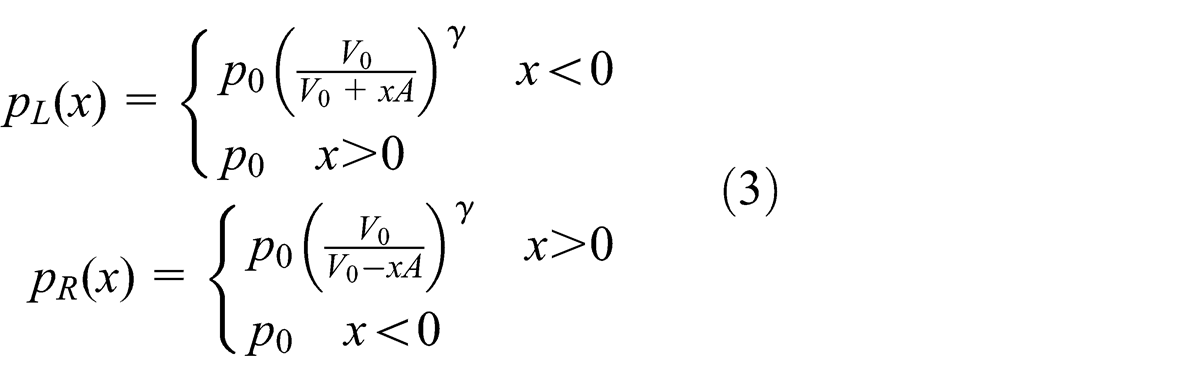
where
Friction force
The free piston engine does not employ any crankshaft mechanism, and the purely linear motion leads to a very low-side force on the piston. Therefore, piston ring and cylinder liner mating is the only friction pair in the system. The friction force is modeled by including both static and viscous components 20

where
Starting process analysis
In the absence of combustion, the gas inside the cylinder is compressed and expands as an air-spring system, absorbing and dissipating energy, respectively. The FPLA can be considered as a nonlinear oscillation system with single freedom. 8 Equation (1) can be rewritten as

where


The
In order to investigate the oscillation characteristics of the FPLA during the starting process, the dynamic equation (5) is solved using a numerical simulation program in MATLAB/Simulink. Before running the program, the main parameters of the FPLA prototype and the initial values are first entered into the program. The values used are listed in Table 1.
Parameters of the FPLA.
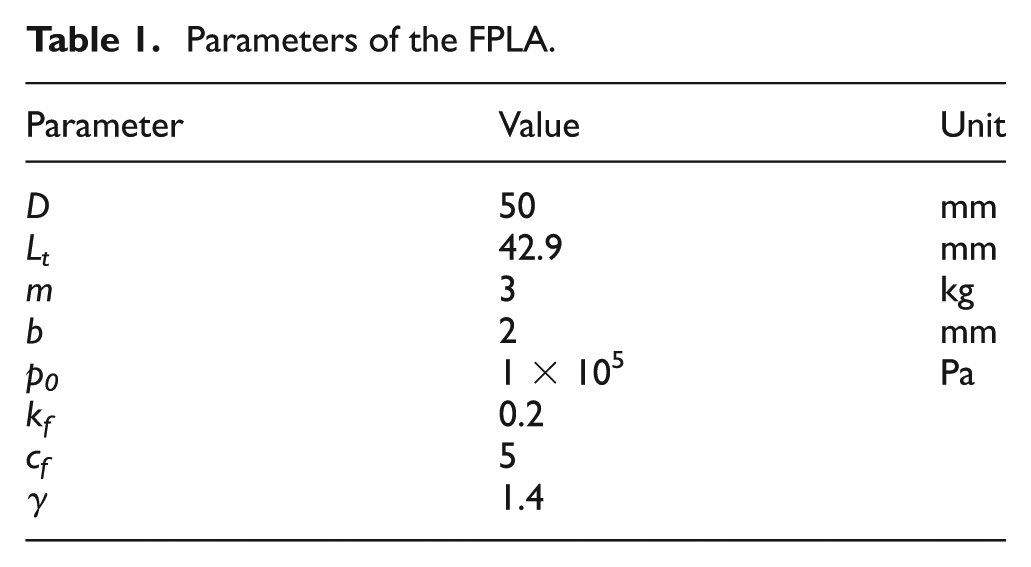
Figure 3 shows the simulation result with the starting force of 50 N. It is observed that the piston oscillation becomes stable with the constant starting force. An energy balance analysis is then carried out for a better understanding of system behavior during the starting process.

Starting force and piston displacement.
As the direction of the starting force is always the same with the velocity of the pistons, the starting force part of the generalized damping is always doing positive work. It means that the energy is supplied by the starting force. The friction force part of the generalized damping is always doing negative work, which means that it consumes energy all the time.
At the beginning of the starting process, the displacement amplitude is small and the operating frequency is low. It means that the piston’s mean speed and the compression pressures for each cycle are low. The energy consumed by the friction is less than the work done by the starting force in each cycle, and the system only takes on negative damped oscillation. The displacement amplitude and the operating frequency increase cycle by cycle. Meanwhile, the compression energy of the system is accumulated until the work done by the motoring force is exactly consumed by the friction in each circle. Finally, the system reaches its stable amplitude oscillation state. The displacement amplitude and the oscillation frequency remain unchanged. The final achieved compression ratio is determined by the energy balance.
The final achieved compression ratios using different magnitudes of starting force are shown in Figure 4. Obviously, the final achieved compression ratio is higher with larger starting force. If it is not big enough to initiate combustion, the FPLA cannot be started successfully. Therefore, the starting force provided by the electric machine should be designed to be high enough to meet the requirement of the compression ratio for a successful start-up.

Achieved compression ratio and starting frequency.
The relationship between the structure parameters and the starting requirements
For better starting performance, maximum sustaining thrust produced by the linear electric machine is generally used as the starting force. For a diesel FPLA, the starting force is required to be high enough to meet the compression ratio requirement for the compression ignition. Thus, the selection and design of electric machine are restricted by the starting force requirement influenced by the structure parameters of the free piston engine. In addition, under the same final achieved compression ratio, different structure parameters correspond to different starting frequencies, which also influence starting performance. In order to solve the matching problem, it is of importance to investigate the effects of structure design variables on the starting requirements during the FPLA design process. For the further analysis, some simplifications have been made by the energy balance theory in this section.
Analytic calculation
When the system reaches the stable amplitude oscillation during the starting process, the compression ratio does not rise any more. As the piston oscillation is a periodic oscillation and the amplitude remains unchanged, an equivalent stiffness can be used instead of the generalized stiffness. 8 The calculation of the equivalent stiffness is based on the equality of the energy consumed by the generalized stiffness in one stroke. The equivalent stiffness is calculated by

where

The energy transfers to-and-fro of the free piston every stroke is complete and no energy storage is available. The work done by the starting force is exactly consumed by the friction for each stroke. That is, the energy consumed and supplied in one stroke by the generalized damping should be equal. It can be found as below

Then, we can obtain the following expression

where

Based on equation (12), a frequency response characteristic of the oscillation system is given. The oscillation frequency is only decided by the mass and the equivalent stiffness. It can be found as below


Thus, the following equation can be derived from equations (9), (11), (13), and (14)

The structure parameter of the FPLA prototype is presented in Table 1. The final achieved compression ratios with different starting forces are calculated by equation (15) and the corresponding achieved starting frequencies are calculated by equation (13). In order to validate the proposed method, the analytic calculations are compared with the data from numerical simulation. The comparison results indicate that both show good agreement with each other, as shown in Figure 4. It is able to predict the real trends for varying structure design parameters in subsequent analyses.
For diesel engine, the compression ratio of 15 is a typical requirement to ensure self-ignition of the air–fuel mixture. In this article, it is considered as a prerequisite to start the engine. In equations (13) and (15), the compression ratio of 15 is adopted. As a result, the calculated frequency is the final achieved starting frequency and the calculated starting force is the required starting force. The achieved starting frequency must be high enough to start the engine successfully. Meanwhile, the required starting force must be lower than the starting force produced by the linear alternator. Both the two requirements above should be considered in the process of the FPLA design and the matching of its main structural parameters.
Influencing factors
From equations (13) and (15), it shows clearly that the final achieved starting frequency and the required starting force are related to structure parameters such as the cylinder bore, the moving mass, and effective stroke. By changing the value of these parameters, respectively, this section further observes the corresponding changes of the achieved starting frequency and required starting force. Then, the laws of the correlations are analyzed. For convenience, the design variables are represented as relative values to the parameters in Table 1.
The calculations of the achieved starting frequency with different design variables are demonstrated in Figure 5. As shown, the achieved starting frequency is linearly proportional to the bore of the free piston engine. This is because larger cylinder bore leads to stiffer air-spring and the frequency increases with the equivalent stiffness. Moreover, a longer effective stroke will lead to lower the achieved starting frequency. Therefore, adopting a smaller stroke to bore ratio of the free piston engine is beneficial to increase the achieved starting frequency.

Factors of achieved starting frequency.
The in-cylinder gas exhibits an air-spring behavior, and the moving mass is therefore of significant influence to the starting frequency. It is obvious that higher moving mass leads to lower the achieved starting frequency, as shown in Figure 5. In general, larger linear alternator is always coupled with heavier translator. Therefore, if the structure parameters of the FPLA are fixed, adopting larger linear electric alternator will decrease the achieved starting frequency.
The calculations of required starting forces with different design variables are illustrated in Figure 6. It is observed that the required starting force is in linear relationship with the bore of the free piston engine. Larger cylinder bore leads to larger contacting area of the friction pair. If the friction loss in one working cycle increases, the electric machine should provide higher starting force to overcome the friction force. When all the other parameters are fixed, the higher starting force is required to be provided by the electric machine if the bore is larger. As shown, enlarging the effective stroke leads to higher required starting force, but the effect is not significant. Therefore, adopting a higher stroke-to-bore ratio of the free piston engine is beneficial to reducing the demand for the starting force.

Factors of required starting force.
In the stable amplitude oscillation state, the kinetic energy of the moving part and the compression energy of the air in each cylinder are converted to each other cycle by cycle. During this process, the starting force applied on the moving mass is used to overcome the friction force only. As mentioned above, higher moving mass leads to lower starting frequency, which also leads to lower viscous friction loss, thus the required starting force is smaller. In addition, for larger size of linear alternator, the output thrust is higher. Therefore, adopting larger linear alternator is much easier to meet the requirements of the starting force.
Furthermore, the parameters matching should not only meet the starting requirements but also achieve the power matching between the free piston engine and the electric machine during the design process. The former one plays an important role as a constraint condition, which can provide references to the further research on parameter matching design.
Conclusion
An oscillation model is presented to describe the piston dynamics during the starting process of a diesel FPLA. It is analyzed that the final achieved compression ratio is determined by the energy balance between the friction consumption and the energy supplied by the starting force. The oscillation model is simplified by utilizing the energy balance theory. Expressions of the achieved starting frequency and required starting force are derived, and the effects of different design variables on them are investigated. The results are summarized as below:
The achieved starting frequency and required starting force are in linear relationship with the bore of the free piston engine.
Adopting a higher stroke-to-bore ratio of the free piston engine is beneficial to reduce the demand for the starting force, but decreases the achieved starting frequency.
Adopting a larger linear alternator is much easier to meet the requirements of the starting force, but decreases the achieved starting frequency due to the heavier translator.
Footnotes
Academic Editor: Jia-Jang Wu
Declaration of conflicting interests
The authors declare that there is no conflict of interests regarding the publication of this article.
Funding
This project was supported by the Programmes of Introducing Talents of Discipline to Universities of China (B12022) and National Nature Science Foundation of China (51006010). We would like to thank the sponsors.