



Abstract
We introduce the periodic composite materials, so-called phononic crystals, to the flexible mechanical arms systems. Due to the transfer matrix method and the Bloch theorem, the theoretical solution of band structure of the two-link model is deduced and then verified by the frequency response by the finite element method. The influence of the included angle of arms to vibration characteristics is analyzed. The frequency response of the two-link flexible arms with/without phononic crystals is investigated. The results illustrate that, by using the periodic composite materials, some frequency ranges with strong attenuation can be obtained. This study provides a new way to eliminate vibrations in flexible mechanical arms.
Introduction
The mechanical arms system is widely used in engineering. Compared with the traditional heavy rigid mechanical arms system, the flexible mechanical arms system has evident advantages because of its wider application, faster response speed, higher payload-to-robot-weight ratio and efficiency, and safer operation due to reduced inertia.1,2 Therefore, the flexible mechanical arms system is compatibly and widely used in the fields of aerospace,3–6 manufactory, 7 national defense, 8 and so on.
However, the greatest disadvantage of the flexible mechanical arms systems is the vibration problem due to their long, slender, and light arms. For instance, in some “fast-speed moving” or “high precision need” working conditions, much additional time should be spent to eliminate the vibration.9–11 In the self-propelled howitzer (SPH), the flexible mechanical arms system is applied to the device which used to auto-load. The vibration caused by the impact of bullet and the recoil of howitzer would affect the whole circulation time in loading and decrease the firing rate of SPH. 8 In the field of aerospace, the flexible mechanical arms are used to assemble and maintain the space station. This task requires a very high absolute positional accuracy. Considering that much time has to be wasted to eliminate the residual vibration in arms because of the small damping factor in the outer space environment, the whole task may last decades, hours, or even more.5,6 Furthermore, vibration may cause fatigue damage and internal resonances which could decrease the service life. Therefore, it is important and necessary to study the vibration in flexible mechanical arms system and find the effective method to control, reduce, and eliminate the vibration in it. The modeling of the flexible arms is generally based on Euler–Bernoulli beam or Timoshenko beam model with some mathematical methods such as the assumed modes method,12,13 lamped parameter method,14,15 and finite element method (FEM). 16 And some advanced techniques have been developed to control the vibration, including passive control, 17 self-turning control, 18 and regular proportional–integral–derivative (PID) control. 19 Although these techniques help to improve the accuracy and efficiency of the flexible arms, the problem of eliminating vibration in the flexible arms still exists. To the authors’ knowledge and relevant published articles,1,2 the flexible arms system with composite materials is less considered.
Recently, the characteristic that some frequency ranges of elastic wave cannot transmit in phononic crystals (PCs) has caused much attention. These frequency ranges are defined as phononic band gaps (BGs). From changing the composites and their geometric forms, adjustable BGs can be obtained. Several theoretical methods have been developed to calculate the BGs, such as the plane wave expansion method (PWEM), 20 transfer matrix method (TMM),21–23 finite difference time domain method (FDTDM),24,25 multiple scattering theory (MST), 26 and lumped-mass method (LMM). 27 The BGs’ property of PCs provides a new way to reduce and isolate vibrations in engineering. PCs have wide potential applications such as noise control, new acoustic device, wireless communication,28–30 vibration attenuation in beam, and beam-foundation systems and plate.31–36
Inspired by the concept of PCs, we introduce the periodic composite materials to the flexible mechanical arms system, which would be a potential way to eliminate the vibration in mechanical arms system. In this article, first, we present the detailed derivation based on TMM and calculate the band structure in the mechanical arms with PCs as a theoretical solution. Then, the corresponding frequency response of the research model is calculated to verify the theoretical results, and the influence of the included angle of arms to vibration characteristics is also analyzed. Finally, we draw the conclusion.
Theory
Research model
The two-link mechanical arms model OAB, which is shown in Figure 1, is a basic framework of flexible mechanical arms system with arms and joint. The joint A is simplified as a rigid connection. In this model, OA and AB arms are replaced by a kind of PCs. In this research, the PC is a two-component periodic material composed of materials X and Y. When the axial or flexural vibration propagates from point O to point B, the vibration at point A should be decomposed as the axial and flexural vibrations simultaneously according to the included angle of arms

Model of two-link flexible mechanical arms with PCs. OA (L) arm has
It is true that the present two-link flexible mechanical arms model is quiet simple from the actual arm. Considering the vibration transmission exists globally in normal mechanical arms while the phenomenon of vibration isolation is inspired by PC structure, we simplify the other part, for example, the actuator at point A, as a rigid connection and focus on the arms with the introduction of PCs. In the view of mechanical concept, it is acceptable.
The TMM for two-link mechanical arms with PCs
For a single arm, considering the homogeneous slender rod, let

where
Substituting the harmonic solution

where
Considering the axial force

The matrix form of

or

Neglecting the effects of the shear deformation and rotary inertia, let

where
Substituting the harmonic solution

where
The first, second, and third derivatives of

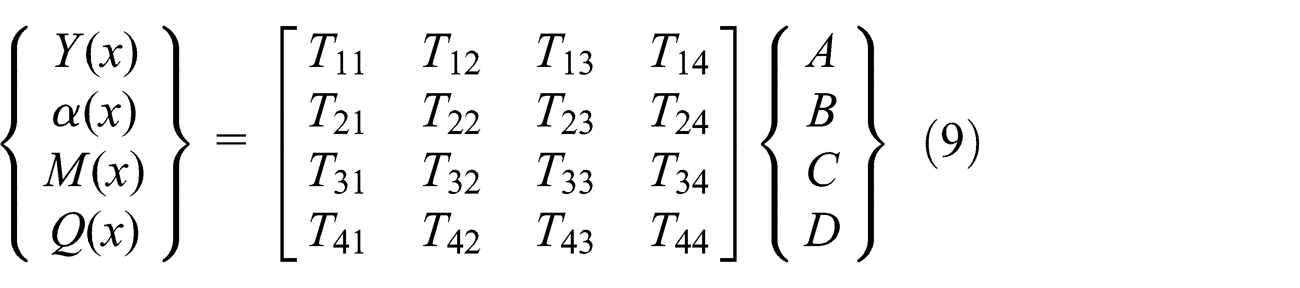
In Euler beam, the amplitudes of the rotation angle, bending moment, and shearing force are given as
where
or

Then, we can consider the axial and flexural vibrations simultaneously as

or

where
According to equation (12) and the model OAB, the vibration state parameter vector of the segment composed of material X in the nth primitive cell can be written as
The continuities of the axial displacement, axial force, flexural displacement, rotation angle, bending moment, and shearing force at the interface of nth and

Thus, we obtain

So the transfer matrix of a primitive cell is

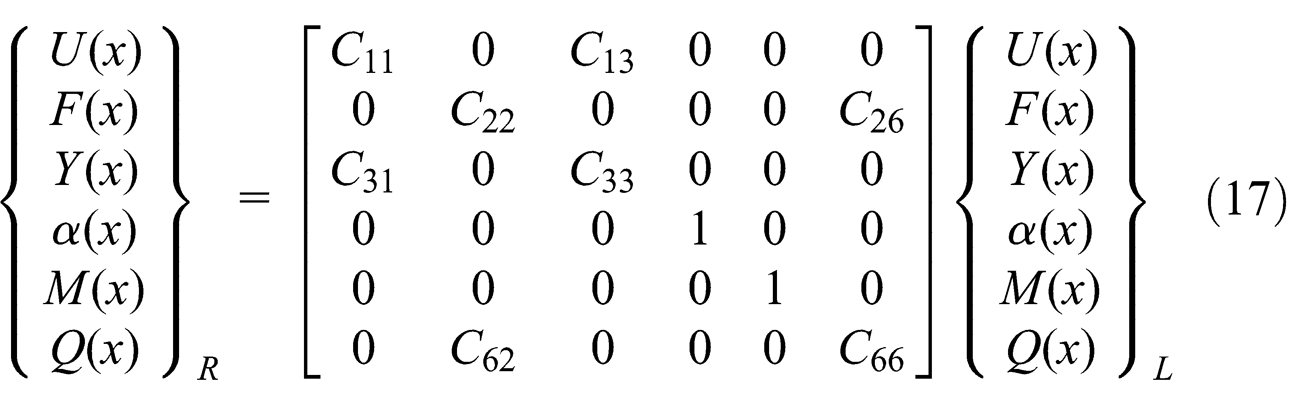
At joint A, according to the equilibrium of forces and bending moment, as well as the continuities of arms displacement and rotation, we obtain

where
They can be written in the matrix form as
where
or

For the model OAB which contains

For the ideal PC structure, in the nth primitive cell, we can get

where
Considering the periodicity of the infinite structure along the axial direction, using the Bloch theorem, we obtain

where
Substituting equation (21) into equation (20) gives an eigenvalue problem which contains the dispersion relationship of the axial and flexural vibrations

For a given circular frequency
When calculating band structure by the Bloch theorem, the object model is an ideal PC model with infinite cells. Therefore, the contour ideal PC model would be twisted when the included angle is not equal to 180°. To solve this problem, this model is simplified as a straight beam with infinite cells to calculate its band structure. This means that it is an approximate solution without the influence of the angle. Thus, we use FEM in the following to calculate the frequency response. This process is analyzed to verify the above result by TMM and the Bloch theory, as well as to study the influence of the angle.
Generally, the excitation applied to one end of the model in plane OAB in Figure 1 would lead to the axial and flexural vibrations for the models with any included angle. Therefore, we could get the axial and flexural vibration BGs of the single arm, respectively, overlap them, and then the BGs of the two-link mechanical arms model would be given by the frequency ranges which do not have both the axial and flexural vibrations.
Results and discussion
Validation
We choose two materials, aluminum (material X) and wolfram (material Y). The parameters are, respectively, ρX = 2730 kg/m3, E X = 77.6 GPa, G X = 28.8 GPa, ρ Y = 19,100 kg/m3, E Y = 354.1 GPa, and G Y = 131.1 GPa. The geometric parameters are given as l X = l Y = 0.5 m, b X = b Y = 0.05 m, and h X = h Y = 0.05 m. Note that the example is used to illustrate the BGs while the materials including their geometric parameters for the actual arm can be considered widely.
We calculate the band structures of the two-link mechanical arms model by equation (22) in the range of 0–2000 Hz. The results are shown in Figure 2.

Band structures of the two-link mechanical arms model with PCs. BGs of (a) axial and (b) flexural vibrations are represented by shaded areas.
Figure 2 shows the band structures of the axial and flexural vibrations in the range of 0–2000 Hz. There are one axial BG and seven flexural BGs which are the shadow areas separated from the horizontal axis and curves. The comparison of the ranges of the axial BG and first three flexural BGs are shown in Table 1.
BG ranges given by TMM and frequency response (Hz).

BG: band gap; TMM: transfer matrix method.
Then, we calculate the frequency response of the two-link mechanical arms model with 10 cells (
Figure 3 shows the frequency responses of the two-link mechanical arms model with PC which has the included angle of 180°. One axial BG and five flexural BGs exist in the range of 0–2000 Hz.

Frequency responses of the two-link mechanical arms model with PC which has the included angle of 180°.
The details of the frequency range of axial BG and first three flexural BGs are analyzed in Table 1. It is clear that the BG ranges given by TMM and frequency responses by FEM are in good agreement. Therefore, the above-mentioned TMM used to deduce and calculate the band structure of two-link mechanical arms model is verified to be correct.
Influence of the included angle of arms
Generally, the included angle between two arms might be changed in working conditions. Thus, it is necessary to study the influence of the included angle in the two-link mechanical arms model with PCs. We maintain the material parameters and geometric parameters and then calculate the frequency responses of the two-link modes with different included angles chosen from 60° to 180° in the range of 0–2000 Hz. The results are shown in Figures 4 and 5.

Frequency responses of the two-link mechanical arms models with PCs which have the included angles of 60°, 90°, 120°, 150°, and 180° under axial vibrations.

Frequency responses of the two-link mechanical arms models with PCs which have the included angles of 60°, 90°, 120°, 150°, and 180° under flexural vibrations.
Figure 4 shows the frequency responses of the models which have the included angles of 60°, 90°, 120°, 150°, and 180° under axial vibrations. For comparison and analysis, the frequency ranges and maximum attenuation values of the first two BGs are shown in Table 2. We can see that the BG range does not change much with the change in included angle. Following the increase in the included angle, the maximum attenuation value of each BG increases first and then decreases. The attenuation has maximum value in the case of included angle with 90°.
Ranges and maximum attenuation values of BGs of the two-link mechanical arms model with PCs under axial vibrations.

BG: band gap; PCs: phononic crystals.
Figure 5 shows the frequency responses of the models which have the included angles of 60°, 90°, 120°, 150°, and 180° under flexural vibrations. The frequency ranges and maximum attenuation values of first three BGs are shown in Table 3. We obtain the same conclusions as the above case under axial vibrations.
Ranges and maximum attenuation values of BGs of the two-link mechanical arms model with PCs under flexural vibrations.

BG: band gap; PCs: phononic crystals.
In a word, the two-link mechanical arms model with PCs has stable attenuation behavior in working conditions with different included angles while the maximum attenuation value of each BG would be affected by the included angle. When the transfer between axial vibration and flexural vibration happens in joint A, this rigid joint cannot isolate vibrations. The present numerical simulation calibrated this empirical conclusion. Study shows that it is available to get the BGs of the two-link mechanical arms model with PCs by overlapping the axial and flexural vibration BGs of single PC arm. Thus, if we calculate OA and AB, respectively, and make them overlapped, the result will stay the same.
Comparison of the two-link mechanical arms models with homogeneous material and PCs
To illustrate the effectiveness of PCs in vibration elimination, furthermore, we calculate the frequency response of the two-link mechanical arms model with homogeneous material which is constituted with material X. The model and geometric parameters are all kept the same as the above cases. The included angle is 120°. The comparison of the frequency responses of the homogeneous case and PC case under axial and flexural vibrations is, respectively, shown in Figures 6 and 7.

Frequency responses of the two-link mechanical arms models with homogeneous material and PCs under axial vibrations.

Frequency responses of the two-link mechanical arms models with homogeneous material and PCs under flexural vibrations.
Figures 6 and 7 show clearly that no BGs exist in the case with homogeneous material while BGs with strong attenuation can be observed in the model with PCs. Thus, the effectiveness of PCs is confirmed significantly. The introduction of PCs to the two-link flexible mechanical arms system is proved to be an effective way to eliminate the vibrations in it.
Once the BGs are verified in the two-link mechanical arms with PCs, the BGs can be easily adjusted by the selection of different materials, geometry of the materials, and length ratio of the segments. This is a general accepted controlling method of PCs, and more detailed discussion can be found in our former research, as well as other scientists’. We can use this general method to obtain the adjustable BGs.
Conclusion
We introduce the PCs to the flexible two-link mechanical arms system and study the vibration characteristics of the new model. We calculate the band structures and frequency response by TMM and FEM, respectively. The influence of the included angle of arms and the comparison between models with PCs and homogeneous material are both discussed. We show the effectiveness in vibration elimination by using PCs for the flexible mechanical arms system. This study proposed an available method to control and eliminate the vibrations in flexible mechanical arms.
Compared with other research about PCs, the main difference about the flexible two-link mechanical arms system with PCs is the changeable included angle. It is concluded as follows:
BGs with strong attenuation exist in the two-link mechanical arms model with PCs while the model with homogeneous material does not have this dynamic behavior.
There is no obvious relationship between the included angle of arms and the range of BGs.
With the increase in the included angle, the attenuation value of each BG first increases and then decreases. The BGs with maximum attenuation value can be obtained in the case of included angle with 90°.
It is a preliminary research in the application of PC structure in flexible arms. Some more extended research including Timoshenko model, the influence of actuators, and etc might be considered to approach to actual arms.
Footnotes
Academic Editor: Pietro Scandura
Declaration of conflicting interests
The authors declare that there is no conflict of interest.
Funding
This work was supported by the National Natural Science Foundation of China (Nos 51278167, 51479089 and 51479051), the Natural Science Foundation of Jiangsu province (No. BK20131374), and the Fundamental Research Funds for the Central Universities of China (No. 2014B28614).