



Abstract
The structural model of the thin-walled laminated beams with integral shape memory alloy active fibers and accounting for geometrically nonlinear is presented in this article. The structural modeling is split into two parts: a two-dimensional analysis over the cross section and a geometrically nonlinear analysis of a beam along the beam span. The variational asymptotic method is used to formulate the force–deformation relationship equations taking into account the presence of active shape memory alloy fibers distributed along the cross section of the beam. The geometrically nonlinear governing equations are derived using variational principle and based on the von Kármán-type nonlinear strain–displacement relations. The equations are then solved using Galerkin’s method and an incremental Newton–Raphson method. The validation for the proposed model has been carried out by comparison of the present results with those available in the literature. The results show that significant extension, bending, and twisting coupled nonlinear deflections occur during the phase transformation due to shape memory alloy actuation. The effects of the volume fraction of the shape memory alloy fiber and ply angle are also addressed.
Keywords
Introduction
During the past three decades, great progress has been made on the researches related to the utilization of shape memory alloy (SMA) in developing smart material structures for deformation, buckling, and vibration control.1,2
For the composite thin-walled structures with high strength and large flexibility such as airplane plate or panel and wind turbine blade, the geometric nonlinear effect resulted from large deformation cannot be ignored. In fact, the nonlinear deformation can be important in calculating the dynamic response and stability of wind turbine blade around that static deformation position. 3 In order to accurately predict the behavior of these structures, especially for composite active blade with SMA actuated, it is necessary to consider geometric nonlinearity and develop nonlinear theories capable of capturing active actuated effects which significantly influence the static and dynamic behaviors of the composite thin-walled structures.
Based on von Kármán plate theory, Chu 4 presented the nonlinear finite element model for the SMA fiber-reinforced composite plate with large deflection and studied the suppression of the flutter of panels. Zou 5 derived the incremental finite element equation for the nonlinear composite laminate embedded with SMA fibers on the basis of the virtual work principle, and the bending, thermo-buckling, and post-buckling issues of the SMA fiber-reinforced composite laminate under transverse loading were discussed. Dano and Hyer 6 studied the effect of SMA on the snap-through characteristics of the nonlinear unsymmetric fiber-reinforced composite laminate with large deflections. They developed the approximate theory to analyze the snap-through characteristics of the unsymmetric fiber-reinforced composite laminate activated by SMA wires, where the mechanical properties of the laminate are predicted with the assumed strain–displacement field, Rayleigh–Ritz method, and the virtual work principle, and the variation of snap-through with the temperature was obtained through solving relevant simultaneous equations and the equation describing SMA properties. Park et al.7,8 developed the finite element model of composite supersonic plates under nonlinear vibration and nonlinear flutter using the von Kármán plate theory, the one-order shearing deformation plate theory, and the first-order piston theory. The boundary problems of thermo-post-buckling nonlinear vibration and flutter were then investigated for the SMA fiber-reinforced composite plate under thermal and aerodynamic loading. Cho and Kim 9 studied the deformation of the nonlinear composite plate with two-way shape memory effect with the theory of the one-order shearing deformation plate with large deflections and the thermo-mechanical constitutive equation proposed by Lagoudas et al. Based on the nonlinear theory of symmetrically laminated anisotropic plates, Ren and Sun 10 studied the free and forced vibration of the SMA fiber-reinforced composite laminates with large deflections.
Composite thin-walled beams, as a class of representative mechanical structures, are being increasingly used in wind turbine blades, helicopter rotor blades. Chandra 11 developed an active shape control analytical model of bending–torsion coupled composite beams using SMA actuation. SMA bender elements trained to memorize bending shape were used to induce bending and twisting deformations in composite beams. Ghomshei et al. 12 presented a mathematical model for analysis of SMA layer or elastomer three-dimensional laminated composite box beam that consists of SMA layers and elastomer. He et al. 13 presented an analytical model of thin tube with SMA wires winded and pasted on the outside surfaces of the thin wall tube. Ren et al.14,15 developed a formulation for the active deformation analysis of closed-section composite thin-walled beams with SMA fibers embedded. The general form of constitutive relation was applied to the case of extension–twist coupling and bending–twist coupling, respectively. The free vibration of the rotating composite thin-walled beams with SMA fiber actuation is studied by Ren et al. 16 It is shown that the SMA fiber volume and initial strain have a significant effect on the vibration behavior of rotating composite thin-walled beams. The actuation performance of SMA fibers is found to be closely related to the rotation speeds and ply angle. All of these above-mentioned works have been confined to the linear structures.
Studies concerned with the geometrically nonlinear analysis of composite thin-walled closed-section members are presently being addressed.17–22 In this direction, Cesnik et al. 17 presented the variational asymptotic method (VAM) for modeling of nonlinear beams. Bhaskar and Librescu 18 presented a geometrically nonlinear theory for thin-walled composite beams. A geometrically nonlinear analysis for thin-walled composite beams with arbitrary lay-ups under various types of loadings has been presented by Vo and Lee; 19 this model is based on the nonasymptotically correct beam structural modeling theory of Rehfield. 23 The twist actuation frequency response and aeroelastic analysis of the advanced active twist rotor (AATR) blade were conducted by Park and Kim. 20 VAM was adopted for the derivation of the nonlinear model for thin-walled composite beams in this study. Although the equations of motion were derived with geometric nonlinearity, only the linear terms were considered in numerical simulation. The free vibration of the rotating composite thin-walled beams undergoing large deformations is studied by Ren et al. 21 The study exhibits the effect of the fiber orientation and rotating speed on nonlinear natural frequency versus amplitude curves. The developed model can be capable of describing nonlinear free vibration behaviors of rotating composite thin-walled beam with large deformations. Stemple and Lee 22 presented a finite element formulation. The theory accounted for the warping effect of composite beams undergoing large deflection or finite rotation.
It is evident from the above discussion that even though the active deformation analysis for SMA composite plate or panel with geometric nonlinearity and SMA composite linear thin-walled beams has been conducted, no work is available till today concerning geometric nonlinear static modeling of the SMA composite thin-walled beams.
The present work is aimed at developing an analytical model for the SMA fiber composite thin-walled beam undergoing geometrically nonlinear deformations. The VAM is used to analyze the 2D cross section, accounting for the presence of active SMA fibers distributed along the cross section of the beam. Using this method, the basic three-dimensional, geometrically nonlinear elasticity problem can be separated into a linear two-dimensional cross-sectional analysis and a nonlinear one-dimensional global analysis along the beam span. The general nonlinear governing equations with arbitrary laminate stacking sequences for the beam are derived based on the principle of virtual work. The nonlinear ordinary differential equations of equilibrium are transformed into approximating algebraic equations by the Galerkin’s method. The resulting nonlinear algebraic equations are solved by means of an incremental Newton–Raphson (N-R) method. The analysis is applied to the circumferentially antisymmetric stiffness (CAS) configurations. Numerical results are obtained for SMA fiber-reinforced thin-walled composite box beam subjected to a vertical load to investigate the effect of the actuation temperature, the volume fraction, and the fiber orientation of the SMA fiber on structural nonlinear response behavior.
Structural modeling
Consider the slender thin-walled elastic cylindrical shell given in Figure 1. The length of the beam is denoted by L, its thickness by h, the radius of curvature by r, and the maximum cross-sectional dimension by d. It is assumed that
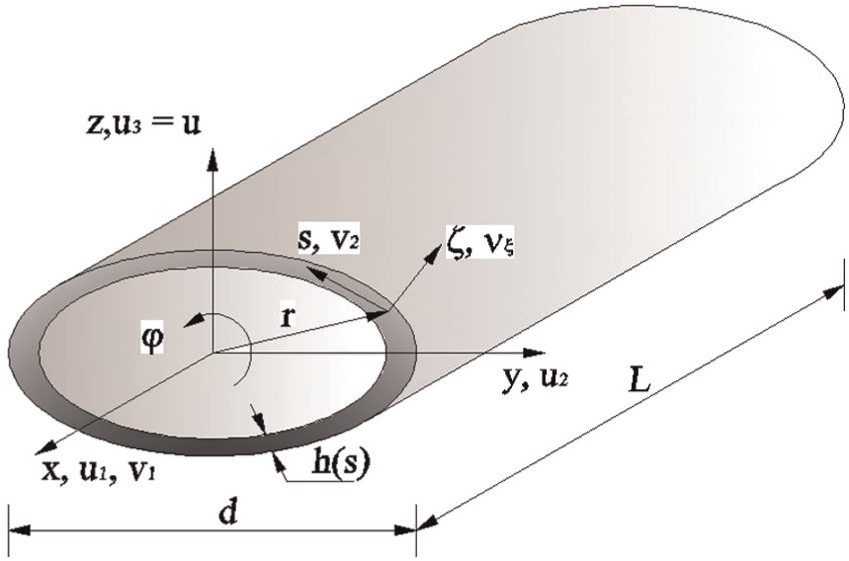
Single-cell composite thin-walled beam.
As seen in Figure 1,
Two-dimensional cross-sectional analysis
The modeling of the beam is separated into a two-dimensional analysis of the cross section and a one-dimensional beam nonlinear analysis along the beam. The two-dimensional analysis of the cross section for an anisotropic thin-walled single beam with embedded SMA fibers is carried out on a variational-asymptotical formulation. 14,15
Assume that SMA fibers are orientated along the arbitrarily direction. From Tanaka and Nagaki’s constitutive relation for SMA layers, the axial direction stress

where
For M → A transformation with ξ 0 = 1, the linear model for the phase transformation is expressed as

where
From equations (1) and (2), it yields

where

In the above equation,
The general expressions for the resultants due to the phase transformation




where superscript SMA represents the forces or moments associated with the SMA actuation;
One-dimensional beam analysis
The displacement field in the local frame denoted

where
The function
The following von Kármán-type nonlinear strain–displacement relations are used

where
Substituting equation (9) into equation (10), we obtain

The nonlinear equilibrium equations for the thin-walled beam are based on the principle of virtual work, which can be written as

where δU and δW are the variations of the strain energy and external work, respectively, which are derived in the following.
The strain energy of the SMA fiber composite thin-walled beam includes the strain energy due to the deformation of the beam and the strain energy due to the SMA actuation. The variation of the strain energy for the beam due to deformation can be written as

where
The constitutive equations for a generic anisotropic cross section under plane-stress condition are expressed as

where
After substituting equations (11) and (14) into equation (13), the variation of the strain energy can be written as

According to the definition of the generalized internal beam forces, the following expressions can be obtained

where

where
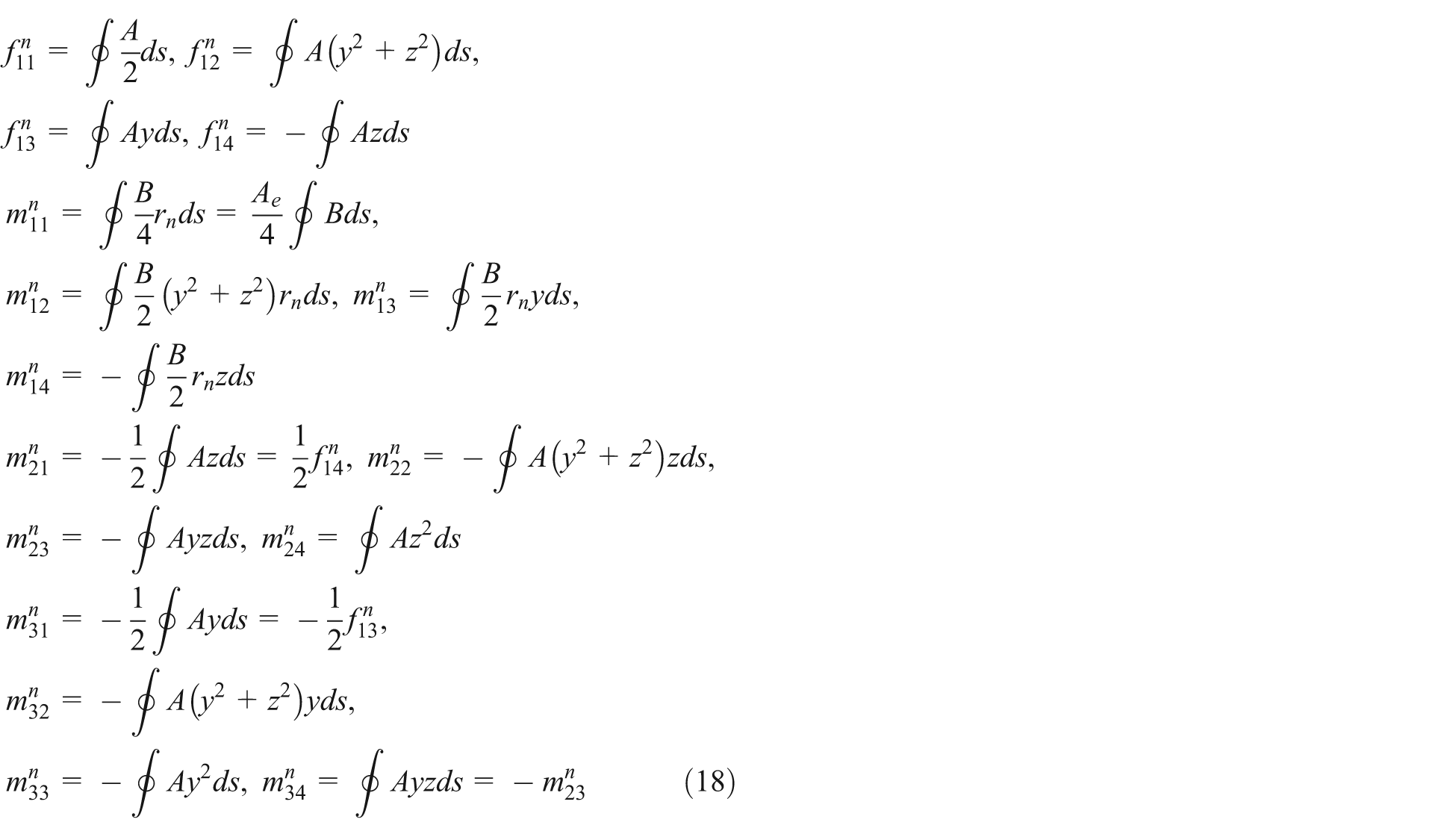
On the other hand, the variation of the strain energy due to the SMA actuation is written as

where superscript
The variation of total strain energy for the beam can be represented as

Finally, the variation of the work by external loads is considered as

where Fx , Fy , and Fz are forces acting in the x, y, and z directions and Mx is torsional moment.
According to the principle that the variation of the total potential energy is zero, the variation equation of the present theory for the beams is given by

where

The nonlinear equilibrium equations of the SMA fiber composite thin-walled beam can be obtained by integrating the derivatives of the varied quantities by parts and letting the coefficients of δu 1, δu 2, δu 3, and δφ be zero

The coupled governing differential equations are nonlinear ordinary differential equations. In general, the exact solutions are not available. In order to obtain the numerical results of the beam, Galerkin’s method is adopted to discretize the nonlinear equilibrium equations.
Galerkin’s formulation
The bending and torsion deflections are first expressed in terms of a series of displacement amplitudes and displacement functions

where

Substituting these expressions into equation (24) and using Galerkin’s method, the nonlinear ordinary differential equations can be reduced to 4 N nonlinear algebraic equations in

where
The approximated solutions of the nonlinear algebraic equation (27) can be obtained using the N-R iteration scheme. A schematic description of numerical computation process of the presented model is shown in Figure 2.

Diagram of numerical computation procedure.
Numerical results
Comparisons with available results
A cantilevered box beam made of SMA fiber hybrid composite material is subjected to a vertical force at the tip. The lay-up of the CAS beam is described as

Configuration of CAS beam.

Variation of the vertical displacement and the angle of twist versus fiber ply angle for a composite box beam with SMA fibers.
Next, the geometrically nonlinear cantilever com-posite box beam without SMA fiber is considered. The geometric properties of the beam are as follows: length = 254 cm, cross-sectional exterior width = 9.906 cm, cross-sectional exterior height = 9.906 cm, and the box beam’s thickness = 0.256 cm. The beam is subjected to a tip vertical load of 1.78 kN. The lamination of this beam consists of eight laminae of equal thickness as follows:

Variation of the vertical displacement versus ply angle.
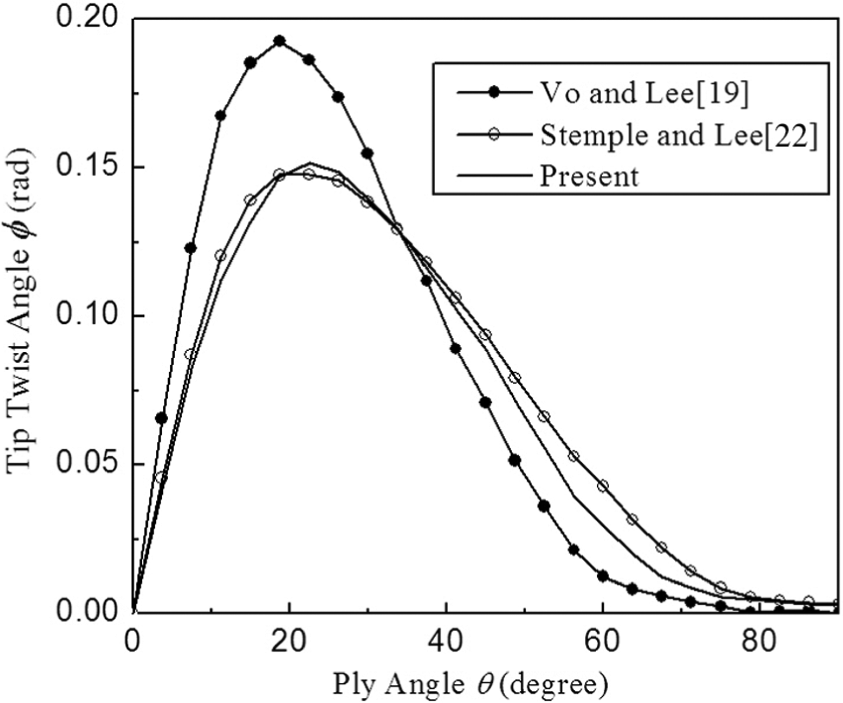
Variation of the angle of twist versus ply angle.
Numerical examples and discussion
Numerical results are presented for the NiTi/graphite/epoxy cantilevered box beam shown in Figure 7. The material system with geometry and properties of the beam is given in Table 1. For the CAS configuration beam shown in Figure 3, the linear and nonlinear deformations of the beam are calculated under a tip vertical load of 1 N.

Thin-walled box beam embedded with SMA fibers.
Cantilevered box beam geometry and properties.

m: composite medium; s: SMA; SMA: shape memory alloy.
In solving equation (27) using Galerkin’s method, it is found that the number of displacement functions N = 6 gives suitably converged solutions. So, for all results presented in this article, N = 6 unless otherwise specified.
The effect of the actuation temperature on the structural nonlinear responses of the CAS beam configuration for the given volume fraction of the SMA fiber (Vs = 0.1) is shown in Figure 8. The results obtained from linear theory are also given for the purpose of comparison. Figure 8 shows that when actuation temperature T = 20°C, NiTi fibers are total in martensite for the range of the ply angles. When actuation temperature T = 50°C, NiTi fibers are actuated, and the phase transformation from martensite to austenite occurs for the range of the ply angles. When actuation temperature T = 57°C, the case of coexistence of martensite and austenite occurs in the different ranges of the ply angles. In other words, when the ply angle

Influence of SMA fiber actuation temperature on the tip displacement and the angle of twist.
Figure 9 shows the effect of the volume fraction of the SMA fibers on the tip displacement and the twist angle. It can be seen from Figure 9 that the tip axial displacement is affected obviously by the volume fraction of SMA fibers for small ply angles. In addition, both the tip twist angle and the horizontal displacement show evident changes when the ply angle is 40°. And the vertical bending shows evident changes when the ply angle is 90°.

Influence of SMA fiber volume on the tip displacement and the angle of twist.
Figure 10 shows the distributions of the linear and nonlinear deformations along the beam span, for the different actuation temperatures, in the case of given the ply angle. As it can be seen, the influence of the actuation temperature is found to be significant for the nonlinear responses as compared with the linear one.
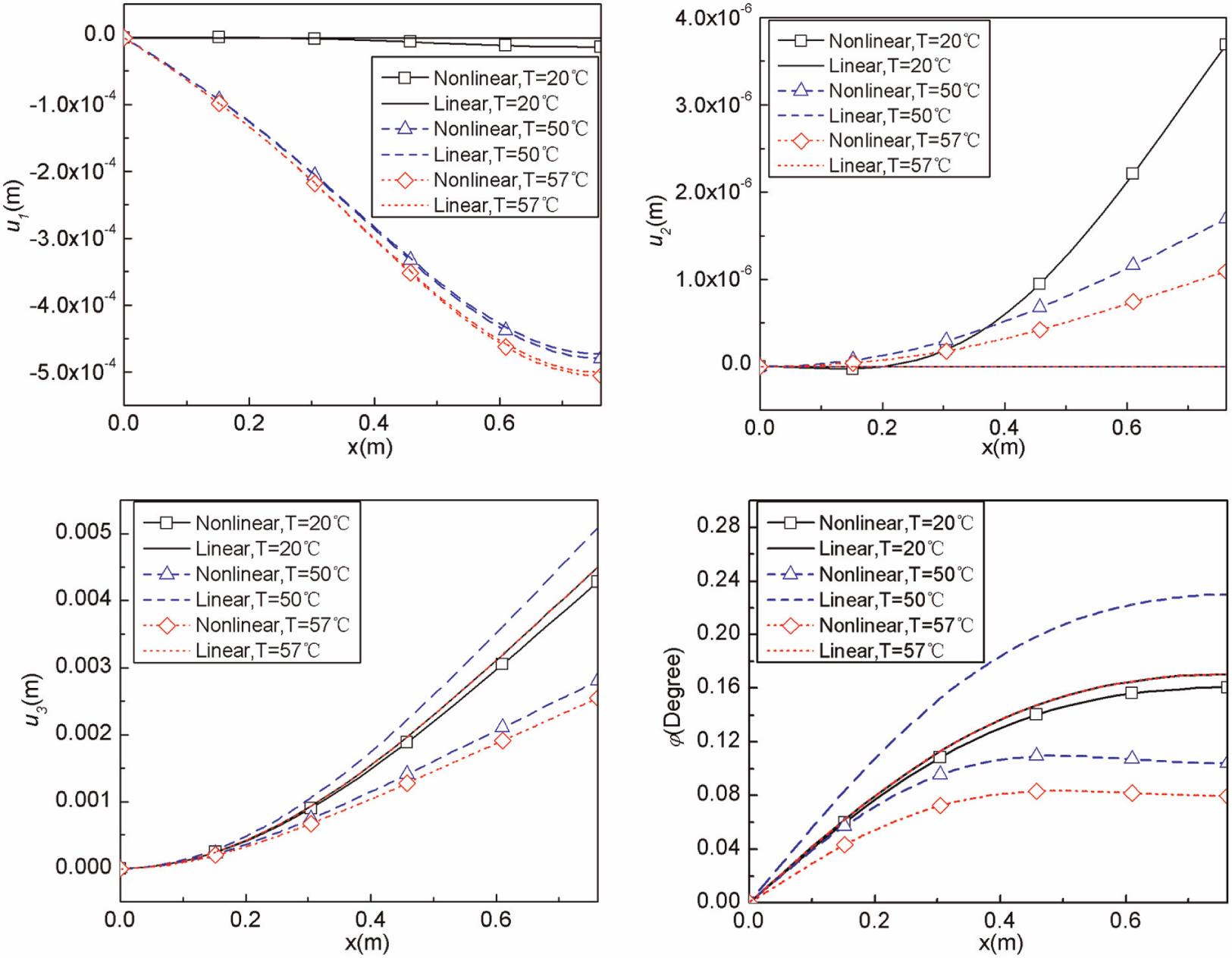
Variation of the displacements and the angle of twist along the beam span for different actuation temperatures.
Figure 11 shows the distributions of the displacement response along the beam span, with the variant SMA fiber volume fractions, in the case when the ply angle is given. The results clearly demonstrate the effect of the SMA fiber volume fraction on the nonlinear deformation of the beam as seen in Figure 9.
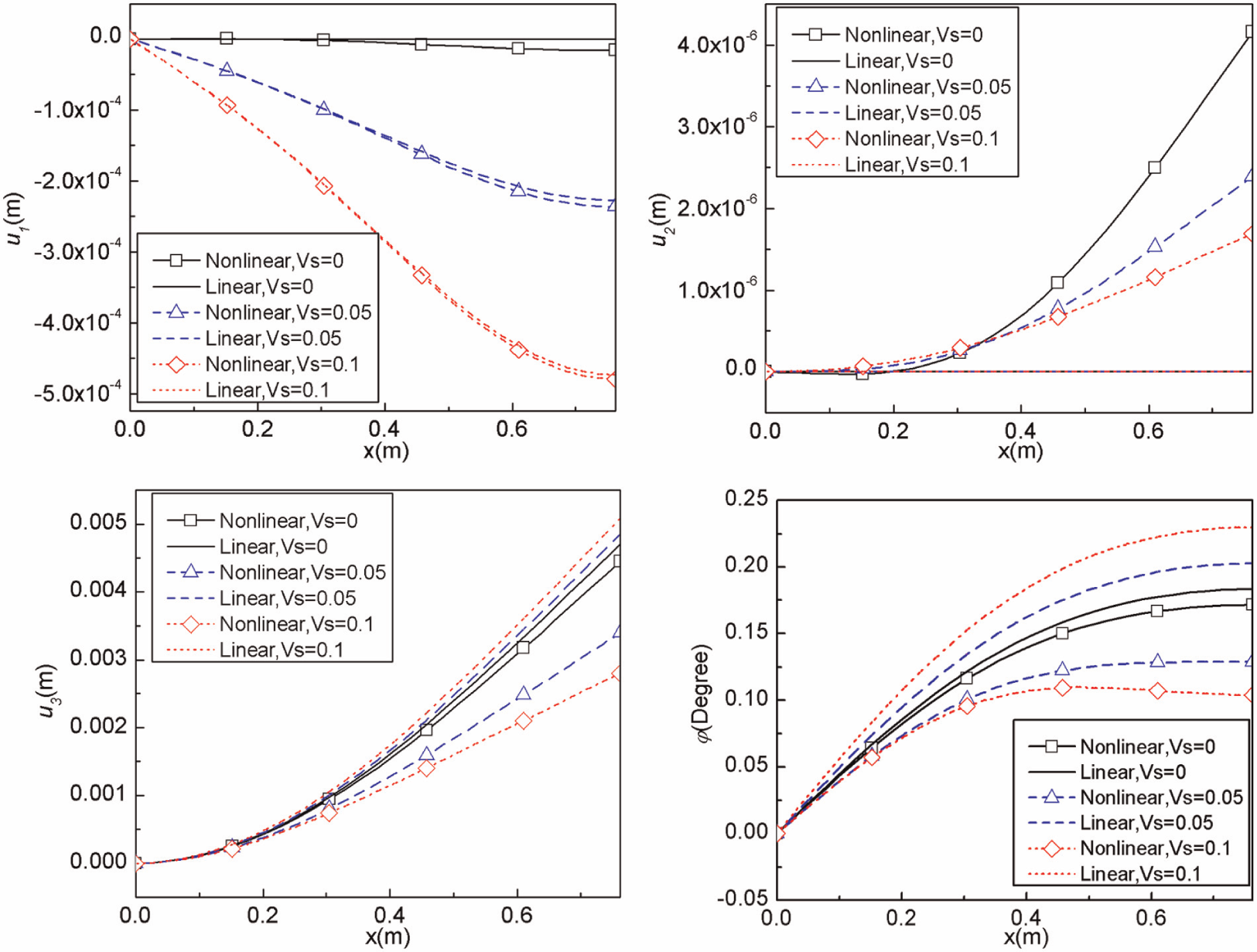
Variation of the displacements and the angle of twist along the beam span for different SMA fiber volume fractions.
Summary and conclusion
A geometrically nonlinear model for the static of single-cell composite cross-sectional thin-walled beam incorporating SMA active fibers is developed. The nonlinear structural responses under the SMA-induced strain are calculated for the SMA fiber hybrid composite box beam that is in the form of a cantilever beam. The following conclusions can be drawn from this study:
The developed model provides means of predicting the geometric nonlinear response of composite thin-walled beam with integrated SMA fiber.
SMA fiber volume fraction and actuation temperature significantly affect the nonlinear static deflections of the beam. It is observed that when the SMA fiber volume or the actuation temperature of SMA fiber increases, the nonlinear static deflections decrease for SMA fiber ply angle from 0° to 60°, and this trend is exactly opposite for the case of SMA fiber ply angle from 60° to 90°.
By comparison with the case when SMA fibers are not actuated (i.e. when actuation temperature T = 20°C or volume fraction of the SMA fiber Vs = 0.0), it clearly appears that the induced nonlinear deflections of the beam are significant during the phase transformation due to SMA actuation. The effect of SMA active actuation is closely related to the SMA fiber ply angle.
The geometrical nonlinear can cause additional defections (e.g. the horizontal displacement at the box beam tip u 2), which is never seen in linear case as the nonlinear coupling term is not present. Therefore, the influence of geometrical nonlinear on the development of the deflections should be carefully considered in the analysis and design of these active structures.
Footnotes
Appendix 1
Academic Editor: Fakher Chaari
Declaration of conflicting interests
The authors declare that there is no conflict of interest.
Funding
This work was financially supported by the National Natural Science Foundation of China under the projects no. 11272190 and no. 10972124, the Shandong Province Natural Science Foundation of China under the project no. ZR2011EEM031, and the Promotive Research Fund for Excellent Young and Middle-aged Scientists of Shandong Province under the project no. BS2010CL016.