




Abstract
Steady double-diffusive mixed convection in an enclosure with side venting and discrete heat and contaminant sources is numerically studied under supplying upside and returning downside (STRB) mode and returning upside and supplying downside mode (RTSB), respectively. The parameters governing the fluid flow include the Grashof number Gr (102–106), Reynolds number Re (100–500), supplying or returning distance H 1/HT (0–2), Prandtl number Pr (0.7), buoyancy ratio N, and Schmidt number Sc. Effects of Gr, Re, and H 1/HT on the flow patterns, thermal, and species transports were numerically investigated concerning STRB and RTSB modes. Fluid flow, heat, and species transports in the enclosure are visualized and analyzed by the contours of stream function, heat function, and mass function, respectively. Air age was also presented to evaluate the freshness of the enclosed fluid. Averaged Nusselt number of the heat source and Sherwood number of the contaminant source are power-law correlated with Gr, Re, and H 1/HT for two ventilation modes, respectively. The correlations demonstrate that the ratio of averaged Nusselt number to Sherwood number was approximately approaching unity, independent of ventilation modes and values of H 1/HT . This investigation could benefit the future design of room ventilation and thermal removals from the electronic chips.
Keywords
Introduction
Fluid flow, heat, and mass transfer inside enclosures were extensively studied in the past, and a large amount of results has been reported in the literatures.1,2 Among these, the double-diffusive natural convection driven by concentration gradient and temperature gradient was emphasized. Double-diffusive convection is encountered in many practical engineering applications, such as crystal growth applied to semiconductors, melting and solidification processes in binary mixtures, storage of liquefied gases, underground infiltration of pollutants, and many others. The majority of the studies dealing with double-diffusive natural convection have been restricted to rectangular enclosures subject to horizontal thermal and concentration gradients.3,4 When external forced flow is imposed on the flow, the mixed convection or the double-diffusive mixed convection will be encountered, especially in cooling of electronic circuitry, positioning of heating elements in furnaces, and ventilation in enclosures,5–7 which is complex for the interactions between the buoyancy-induced fluid flow and external forced convection.
On the other hand, indoor air quality of increased concern also motivates this study. Prior to the 1970s, problems with indoor air quality in residences and the non-industrial workspace were occasionally investigated, but the level of interest was low.8,9 Indoor air quality is of increasing concern, and the terms “sick building syndrome” or “sick house syndrome” are now creeping into our everyday vocabulary. This is because modern office buildings and houses are constructed from the viewpoint of energy conservation with a high degree of air tightness and thermal insulation and with new construction materials, but this occasionally leads to the insufficient consideration for the ventilation of room air. 10 To develop methods of coping with the indoor air pollution, a wide range of studies have been performed on emission and diffusion of contaminants from new construction materials.11,12 The concentration of a pollutant indoors depends on the relationship between the volume of air contained in the indoor space, the rate of production or release of the pollutant, the rate of removal of the pollutant from the air, the rate of air exchange with the outside atmosphere, and the outdoor pollutant concentration. 13
In order to improve working or living environment, the air-conditioners or air-handling systems are adopted. There are two traditional room air-conditioning (RAC) models: the split room air-conditioner (SRAC) and the window-type room air-conditioner (WRAC). 14 Both have little incoming fresh air and lower quality of the indoor air. Relative to the individual air-conditioner, the independent fresh air system with central air-conditioning (CAC) plant was used more broadly. 15 Lin and Deng 10 have found that the air exhausted from indoors to outdoors through the ventilation outlet in a WRAC is air that has just been cooled by the cooling coil (evaporator). Therefore, ventilation modes generalized from different air-conditioning models (CAC, SRAC, and WRAC) should be provided. From the air flow in the enclosure, the differences among the various air-conditioning models mainly exist in the positions of supply opening and return opening, and distance of both openings is constant for the given conditioners. Detailed ventilation modes induced by the room air-conditioner would be given later. In order to evaluate and analyze the transport properties of the continuum flow in a system, one of the most effective and straightforward methods is to analyze the velocity distributions or the streamlines. In addition, great efforts have been made to explore the various parameters available for ventilation flows.16–20 According to Sandberg, 16 the scale should meet two criteria when using it to characterize a ventilation flow system, that is, it should be generally able to assess system performance under different operating conditions, and it should be measurable. These two criteria are not always met. In particular, some scales are difficult to measure in experiments, such as the local purging flow rate 17 and some other scales. 18 While in Peng et al., 19 the local scales including the local purging effectiveness of inlet, the local contaminant-accumulating index, and the expected contaminant dispersion index were proposed. A new effectiveness of the exhaust opening index effectiveness of contaminant ventilation was introduced by Hayashi et al. 20 In conclusion, most of the existing scales were originally devised in terms of concentration at a steady state and/or time-dependent concentration sequence recorded by means of tracer experiments. That is to say, these parameters are associated with air age or imaginary tracer experiment. 21 On the other hand, the flow and heat/mass transfer structures of double-diffusive mixed convection cannot be obtained by these parameters other than streamlines.
Fortunately, Kimura and Bejan 22 proposed a new visualization way for convection heat transport, heatline. In the past decades, the streamlines, heatlines, and masslines are unified and extended to natural, forced, or mixed convective transport in porous media, reacting flows, and anisotropic media.23–25 Interestingly, Zhao and colleagues26,27 have applied the concept of heatline/massline to study double-diffusive natural convection in the porous or fluid saturated enclosures. The heatline and massline represent non-crossed conduits for flow of heat and species, respectively, and thus their shapes give a global picture of heat and species transport, in much the same way as the streamlines provide information on mass flow in single-component systems.
In this article, the streamlines, heatlines, and masslines are presented to visualize the fluid flow, heat, and mass transportation structures and to evaluate the actual freshness of air in the enclosure under different ventilation modes induced by air-conditioner.
Physical model and ventilation modes
The geometric model under analysis in this study is depicted schematically in Figure 1, where a rectangular two-dimensional enclosure is filled with a fluid (air) containing a pollutant whose mass transfer occurs under the influence of the gravity field. The enclosure simplified from unfurnished room is of aspect ratio Ar (L/H), which is set constant. The dimensions of heat source centered on the right vertical wall and contaminant source lying on the floor are HT and LC , respectively. The distance between the bottom-right corner of enclosure and the left side of contaminant source is LD . Supplying opening and exhausting opening are set on the left wall according to the usual installation of air-conditioner or air distribution system10,14,28,29 in office room or residential room; the two openings are separated at constant distance, H/3. Each opening has the same height, H/30.

Geometric description of vented enclosure and general distributions of openings, heat and contaminant sources, and interpretation of the basic ventilation modes (STRB and RTSB): (a) ventilation enclosure, (b) STRB, and (c) RTSB.
The plates of heating source and contaminant source are maintained at constant high temperature th and constant high concentration ch . Other surfaces of walls are adiabatic and impermeable. Fresh and cold air produced by air-conditioner or unit is supplied from the inlet on the left sidewall with velocity uin , temperature tin , and concentration cin (tin < th, cin < ch ). Two kinds of convection could be observed in the slot ventilated enclosure. One is double-diffusion natural convection induced by internal buoyancy forces from temperature gradient and concentration gradient. The other is external mechanical-driven forced convection.
Two kinds of room ventilation modes are included, that is, STRB represents that the supplying is on the upside and the returning on the downside, and RTSB represents that the returning is on the upside and the supplying on the downside, as illustrated in Figure 1(b) and (c). Upper opening (Open 1) is directly deviating H 1 from the ceiling wall, while the lower opening (Open 2) is shifting H 2 from the floor.
Mathematical model and its model assumptions
Fluid is assumed incompressible, and the pollutant gas, which represents general pollutant gas inside the room, for example, CO2 and volatile organic compounds (VOCs) including formaldehyde, is mixed well with the air. This mixture is the Newton–Fourier fluid that fills the enclosure, which flows in laminar regime and does not experience any phase change, and the Dufour effect and Soret effect are negligible. All the thermo-physical properties of the fluid are constant, except the density in the buoyancy term in the momentum equations following Boussinesq approximation. From the ρ = ρ(t, c), thermodynamics can introduce that volumetric thermal expansion

In this study, the thermal expansion coefficient βt is positive for the assumption that density of the fluid decreases as the temperature increases, and the volumetric mass expansion coefficient βc is also positive for the assumption that when the indoor contaminants are lighter than the air, the concentration of the fluid mixture decreases as the concentration of contaminants increases. Depending on these assumptions, double-diffusive mixed convection inside the enclosure is modeled by the following dimensionless equations:30–36
Continuity equation

Momentum equations


Energy equation
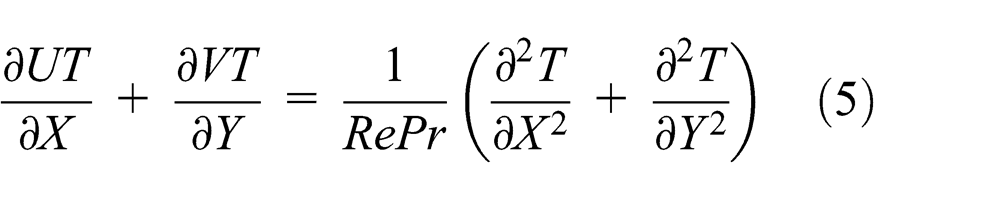
Concentration equation

In the process of non-dimensional formulations, HT, uin , Δt (Δt = th − tin ), and Δc (Δc = ch − cin ) are used as characteristic scales for length, velocity, temperature, and concentration, respectively. Then, the dimensionless variables can be expressed as

Corresponding governing parameters are listed as follows
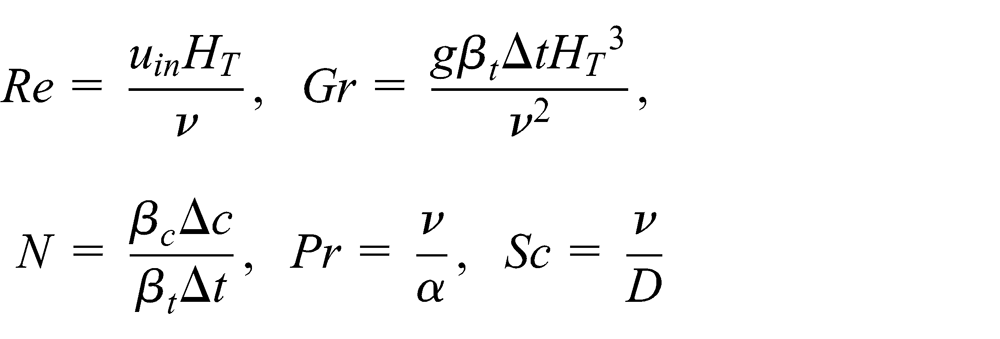
Prandtl number Pr and Grashof number Gr are frequently encountered when the pure natural convection heat transfer in enclosures was studied. Buoyancy ratio N and Schmidt number Sc arise as the double-diffusive natural convection problems.
Indoor air age can be obtained by tracer gas technique or computational fluid dynamics (numerical methods). 19 For the tracer gas technique, a tracer gas is released in a predefined mode, and the change of tracer gas concentration with time is measured to obtain the air age. 17 Although this method is reliable, it is time consuming and expensive. As an alternative, the following transport equation is numerically solved to obtain the age of the room air18,19
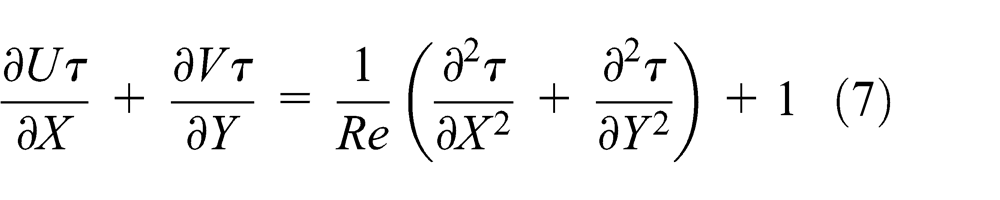
where the dimensionless air age τ is defined by the relation τ = uin
·τ
*/HT
. The boundary conditions set for the present investigation could be expressed as follows: (1) Solid Walls: U = V = 0, T = 1.0 for the heat source on the left sidewall, and
Evaluation and visualization of convective fluid transport
Global heat and mass transfer rates could be defined, respectively, as

The subscript Local means any location that is normal to the surface of walls. In order to illustrate the influence of the governing dimensionless parameters and boundary conditions over the flow structure through the dimensionless streamlines; over the temperature and concentration fields analyzed through their contour plots, respectively; and over the heat and mass transfer taking place through the dimensionless heatlines and masslines, respectively, plots of these convective transport parameters should be provided and analyzed. Stream function, heat function, and mass function are defined as follows22,25,30


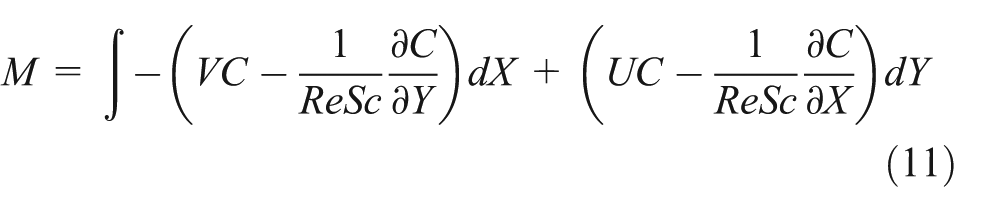
If the velocity, temperature, and concentration are known by solving the governing equations (2) to (6), then the stream function ψ, heat function Hf , and mass function M can be obtained by integrating equations (9), (10), and (11), respectively.
Numerical procedures and code verification
Aforementioned governing equations (2) to (7) are discretized by the finite volume method (FVM) on a staggered grid system.31,32 Second-order central difference scheme (CDS) is implemented for the convection and diffusion terms, and deferred-correction is adopted in the discretization of convection terms to avoid oscillation. 32 The resulting algebraic equations are solved by a line-by-line procedure, combining the tri-diagonal matrix algorithm (TDMA) and the successive over-relaxation (SOR) iteration. The Semi-Implicit Method for Pressure-Linked Equations (SIMPLE) algorithm is used to deal with the linkage between the pressure and the velocity.
The validation of present computer code has been verified for the mixed convection in a lid-driven square cavity with stable vertical temperature gradient problem by Iwatsu et al. 33 As can be seen from Table 1, there is a good agreement for average Nusselt numbers obtained in this study when compared to those of Iwatsu et al. 33
The Nusselt number Nu at the top lid-driven wall (Pr = 0.71, N = 0.00).

Numerical experiments were performed in order to check the grid independence of the solutions. Five different grid sizes (161 × 121, 121 × 81, 81 × 61, 61 × 41, and 41 × 31) were used as L/H is 5/3 in Figure 1(a) and the grid was clustered toward the side walls in order to simulate the boundary layers along the surfaces of heat and contaminant sources. After comparison, 81 × 61 grid points were adopted for gird-free solution throughout the calculations in this study. This grid dimension has shown a negligible deviation in Nusselt number (0.35%) and Sherwood number (0.25%). The convergence criterion of
Results and discussion
In this work, parameters of L/H, HT /H, and LC /HT are maintained constants of 5/3, 1/3, and 1, respectively. The properties of room air mixture are assumed constant; 0.71 is set both for Pr and Sc. Buoyancy ratio N is also set constant, that is, N = 1.0. Therefore, ventilation modes (STRB and RTSB), supplying/returning position H 1 (0–2H/3), Reynolds number Re (100–500), and Grashof number Gr (102–106) will be investigated in the following sections.
Effect of H1 on the fluid flow, heat, and species transport structures
Three cases are presented in Figures 2–4, respectively, for H 1 = 0, H/3, and 2H/3 separately. Gr and Re are maintained at 102 and 500, respectively. For H 1 = 0, the contours of stream function, heat function, mass function, age of air, temperature, and concentration are presented in Figure 2. In (4S1), which represents the streamline of the fluid flow for the ventilation mode STRB, two clockwise flowing eddies are generated by supplying air flow and left anti-clockwise eddy induced by the inner thermal and solutal buoyancy forces. On the other hand, contours of heat functions indicate that heat fluxes released from the left heat source firstly move upward and late descend towards the central region. In (4S2), which stands for the heatline for the ventilation mode STRB, minus values of heat function mean that heat emitted from the left heat source flows toward the right outlet, whereas positive values of heat function mean thermal transports from the left to right. Similar transportation structures are observed for the contaminant transport (shown in (4S3)). Observing from (4S5) and (4S6), thermal and contaminant dispersions are clustering in the vicinities of the heat source and contaminant source. The region occupied by the left-clockwise eddy is filled with fresh air, while other regions are filled by the stale air.

Visualization by streamline, heatline, and massline and contour distributions of age of air, temperature, and concentration for STRB (4S1 to 4S6) and RTSB (4R1 to 4R6) modes, Re = 500, Gr = 102, H 1/HT = 0.0.
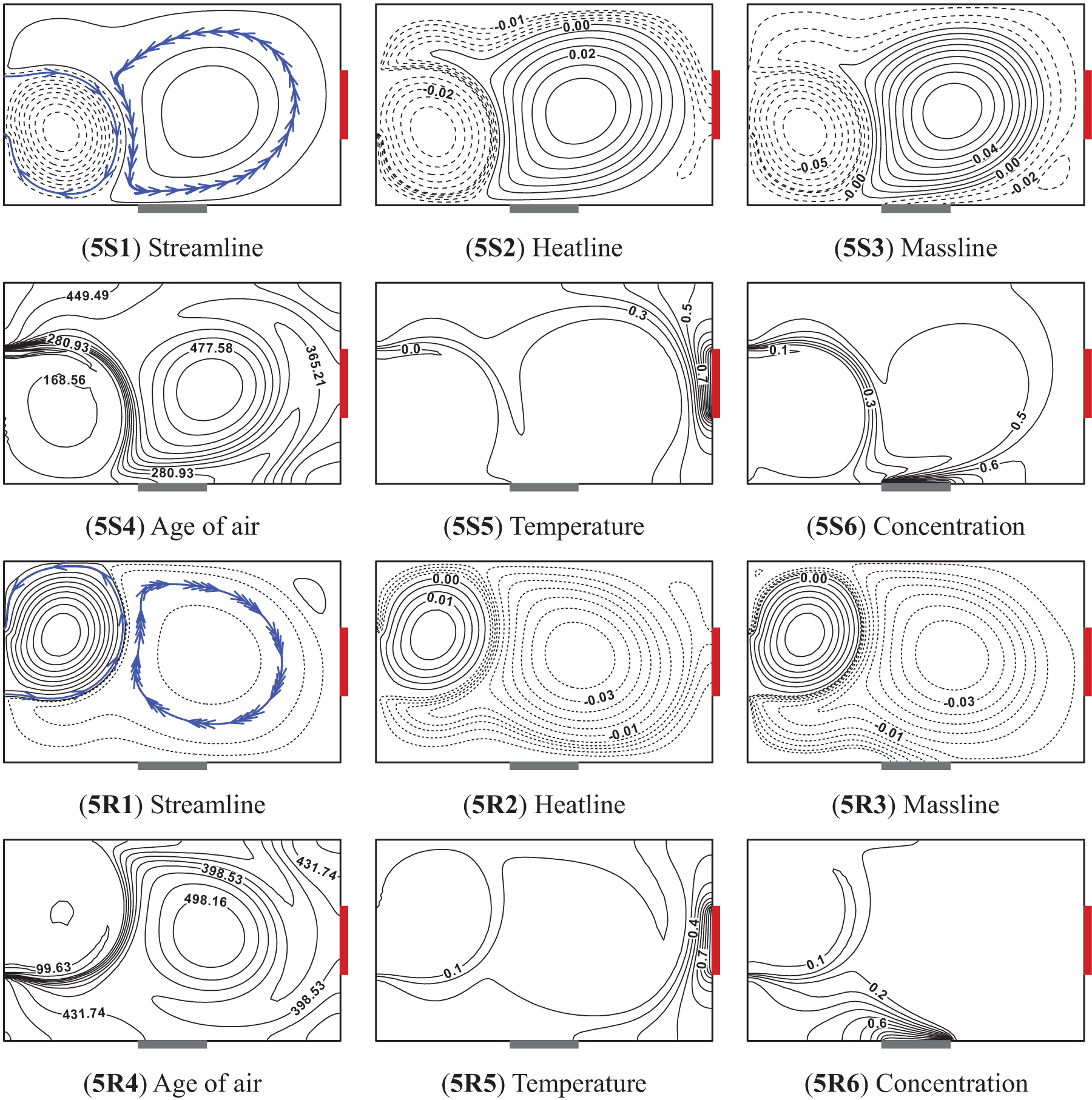
Visualization by streamline, heatline, and massline and contour distributions of age of air, temperature, and concentration for STRB (5S1 to 5S6) and RTSB (5R1 to 5R6) modes, Re = 500, Gr = 102, H 1/HT = 1.0.

Visualization by streamline, heatline, and massline and contour distributions of age of air, temperature, and concentration for STRB (6S1 to 6S6) and RTSB (6R1 to 6R6) modes, Re = 500, Gr = 102, H 1/HT = 2.0.
When RTSB mode was operated, similar trends were observed. Flow eddy governed by the forced convection and shown in (4R1) shrinks, that is, an eddy of relatively smaller size is presented. Two eddies of relatively large size were produced by the solutal and thermal buoyant forces, respectively. Masslines (4R3) show that a straight passage for mass transport was established, while heatlines (4R2) do present little difference from that in (4S2). Essentially, thermal buoyancy force is opposing with solutal buoyant force and could inhibit such expansion of flow eddies. Observing from the age of air, stale air is almost predominant inside the space.
As H 1/HT promotes to 1.0, flow patterns are illustrated in Figure 3. Observing from (5S1), right flow eddy expands as the buoyant forces are opposing with the external supplying wind force. Age of air shown in (5S4) indicates that the fluid filled inside the left eddy is fresh, while its region gradually shrinks. When RTSB mode operates, the left flow eddy in (5R1) expands inside the space. While in (4R1), the size of the left flow eddy is smaller than that in (5R1). Flow eddies resulting from the horizontal contaminant source are not stable and they could become clockwise eddies or anti-clockwise ones, which will depend on the combination with that thermal circulation. Heatlines and masslines both are moving downward and then sweeping the floor to the left wall, and finally flowing upward to the inlet.
As H 1/HT turns to 2.0, flow results are provided in Figure 4. First, the dominant forced convection pushes the short-circuit eddy. Under this case, the solutal buoyant force has produced two eddies, that is, right one opposing with external flow and the one opposing with thermal flow. Masslines presented in (4S3) (Figure 2) and (5S3) (Figure 3) show similar structure inside the right space. Room air age in (6S4) shows that room air inside the enclosure is not fresh. Comparing figures of (4S4) (Figure 2), (5S4) (Figure 3), and (6S4) (Figure 4), fresh air decays along with the increased H 1, which is due to the shrinkage of left air flow eddy.
As RTSB mode was operated, the flow eddies in (6R1) expanded around the supplying and returning openings. In such situation, fresh air could occupy large space with increasing H 1. Actually, solutal buoyancy force is opposing with the supplying air flow, which is independent from the geometric parameter of H 1. Therefore, with increasing strength of supplying flow rates, convection produced by the solutal buoyant force is inhibited and gradually transferred to the thermal convective flow. Contours of temperature in (6R5) still cluster in the neighborhood of heat source, but thermal stratification is observed in the right space.
Effect of Reynolds number on the fluid flow, thermal, and species transports
H 1/HT is maintained at 1.0, while Gr equals to 102. Corresponding contour results are presented in Figures 5 and 6. As STRB mode was operated, natural convection was predominant in the whole enclosure. At the same time, the major flow eddy is assisted by the solutal buoyant force and the thermal buoyant force. Right flow eddy gradually decays with increasing Re, shown in Figures 3 and 5 (5S1). Intensity of the left flow eddy induced by the supplying air flow increases with Reynolds number. Accordingly, the values of heat function and mass function increase positively with Re. Essentially, natural convection aided by thermal and solutal buoyant forces opposes the forced convection by the external supplying force, which formulates almost similar structures of heat and contaminant flows.

Visualization by streamline, heatline, and massline for STRB mode, Re = 10–400, Gr = 102, H 1/HT = 1.0.

Visualization by streamline, heatline, and massline for RTSB mode, Re = 10–400, Gr = 102, H 1/HT = 1.0
As RTSB mode was operated, natural convection was still predominant in the whole enclosure. When Re increases up to 200, as shown in Figure 6, thermal flow descends down first and then moves with the forced convection into the outlet. When Re is far lower than 200, the stable clockwise flow eddy was induced by the solutal convection. Counter-clockwise flow eddy could increase not only in size but also in strength, with increasing Reynolds number. Observing from these figures, natural convection could be maintained predominant until Re beyond 100 under RTSB, and it could be done until Re exceeds
Effect of Gr on the fluid flow, thermal, and species transport structures
Here, H 1/HT and Re are maintained at 1.0 and 500, respectively. Fluid flow results are presented in Figures 7 and 8. As the STRB mode was operated, supplying cold air jet is opposing with the natural convection induced from the solutal and thermal buoyancy forces. Nu and Sh do increase little along with Gr (102 to 104); while Gr increases to 106, the fluid flow could possibly transit into turbulence, and the heat and mass transfer rates are greatly strengthened. When RTSB mode is implemented, simulated results are shown in Figures 3 and 8 (5R1, 5R2, and 5R3), for different Gr numbers (1.0 to 1.0 × 10⁴). External supplying force could combine with thermal buoyancy force under RTSB mode, while the solutal buoyancy force shows multiplicities. As Gr is low (1.0 to 1.0 × 10³), opposing buoyancy effects induce the natural convection, which could be illuminated by the heatlines descending down and traveling to the floor. Heat transfer rate is weakened by the opposing natural convection. Simultaneously, shown in Figure 9, Nu decreases with increasing Gr. On the other hand, contaminant transport rate increases little with Gr until Gr exceeds 103, which is also indicated in Figure 9. As Gr exceeds 103, strength of thermal convection increases, while the solutal flow bifurcates, one opposing with the supplying forced convection and the other aiding with the thermal convection. Solutal convection is greatly inhibited by the supplying air jet and thermal convection, and its multiple effects have resulted in great fluctuation of mass transfer rates.

Visualization by streamline, heatline, and massline for STRB mode, Gr = 1.0 to 1.0 × 10⁴, Re = 500, H 1/HT = 1.0.

Visualization by streamline, heatline, and massline for RTSB mode, Gr = 1.0 to 1.0 × 10⁴, Re = 500, H 1/HT = 1.0.

Overall heat and mass transfer rates of the heat and contaminant sources as functions of Grashof number with RTSB mode (Re = 500, H 1/HT = 1.0).
Function of Nusselt number and Sherwood number
The heat and mass transport is usually quantified by the global Nusselt and Sherwood numbers as defined in equation (8). Results of calculated Nusselt number and Sherwood number are provided in Figures 10 and 11, respectively. For the STRB mode, Nu increases with Gr and Re; while for the RTSB mode, Nu increases with the Gr, which is independent from H 1. Least-square fits of Nu to different governing parameters are provided in following relations of (12), (13), and (14)


Variations of Nusselt number along with Gr (102–106) and Re (100, 300 and 500) when different supplying positions (H 1 is 0, H/3 or 2H/3) are set: (a) STRB and (b) RTSB.
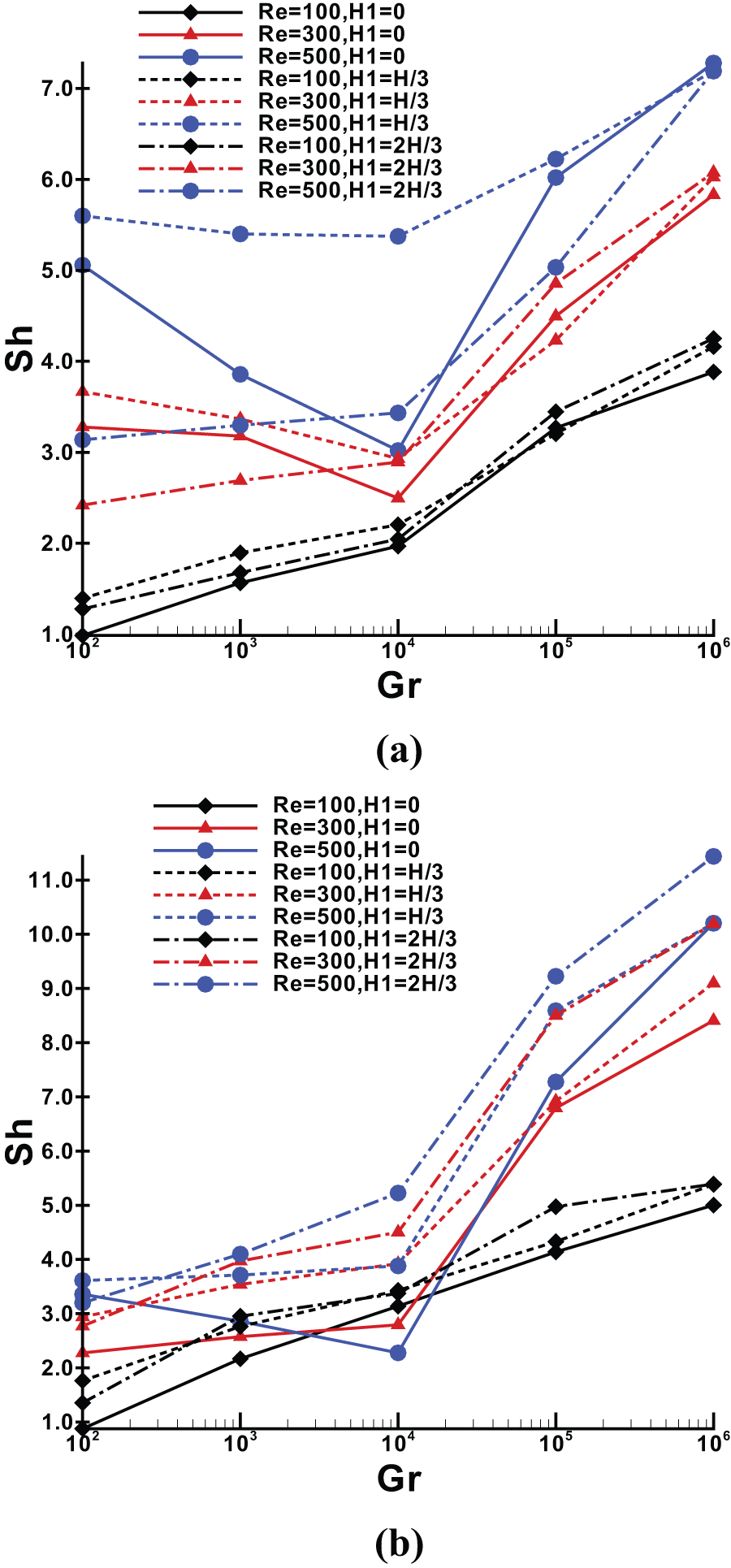
Variations of Sherwood number along with Gr (102–106) and Re (100, 300 and 500) when different supplying positions (H 1 is 0, H/3 or 2H/3) are set: (a) STRB and (b) RTSB.
The above equation is suitable for 102 ≤ Gr ≤ 106, 100 ≤ Re ≤ 500, 0 < H 1 ≤ 2H/3 (0 < H 1/HT ≤ 2), and STRB mode is operated

The above equation is valid for 102 ≤ Gr ≤ 106, 100 ≤ Re ≤ 500, 0 < H 1 ≤ 2H/3 (0 < H 1/HT ≤ 2), and RTSB mode is operated. Furthermore, the correlation of ratio of average Nu for both modes can be obtained as follows

This is valid for 102 ≤ Gr ≤ 106, 100 ≤ Re≤ 500, 0 < H 1 ≤ 2H/3 (0 < H 1/HT ≤ 2). One can observe that the ratio of Nu STRB/Nu RTSB is mainly affected by Gr and Re, while it is independent from the position of supplying/returning openings.
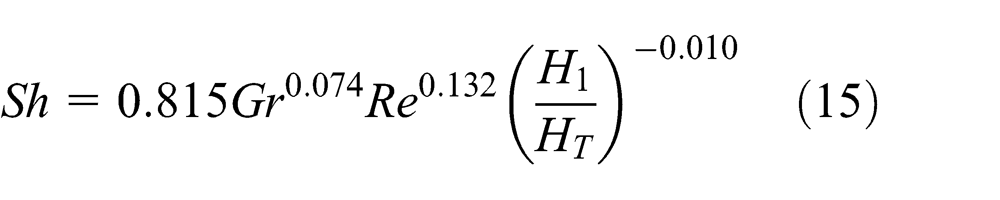
Figure 11 shows the detailed variation of Sh with the Gr, H 1, and Re under STRB and RTSB modes. Least-square correlation of Sh with Gr, Re, and H 1/HT is shown in equation (15) for the STRB mode, and it is valid for 102 ≤ Gr ≤ 106, 100 ≤ Re ≤ 500, 0 < H 1 ≤ 2H/3 (0 < H 1/HT ≤ 2)
Sherwood number shows a positive function of Gr and Re, while it is influenced little by the distance of supplying opening to the top wall. When RTSB mode is operated, shown in Figure 11(b), Sh increases with the Gr and Re. It could be fitted to the relation
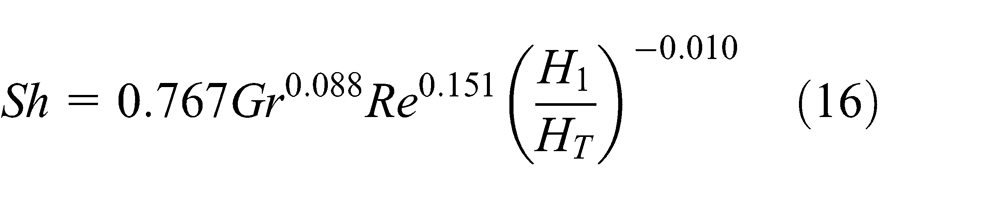
It is valid for 102 ≤ Gr ≤ 106, 100 ≤ Re ≤ 500, 0 < H 1 ≤ 2H/3 (0 < H 1/HT ≤ 2). Furthermore, ratio of Sh STRB/Sh RTSB could be fitted by the following relation

It is valid for 102 ≤ Gr ≤ 106, 100 ≤ Re ≤ 500, 0 < H 1 ≤ 2H/3 (0 < H 1/HT ≤ 2). One could observe that the ratio is independent from the supplying/outlet position. Furthermore, ratio of combined heat and mass transfer rates could be obtained by the following expression
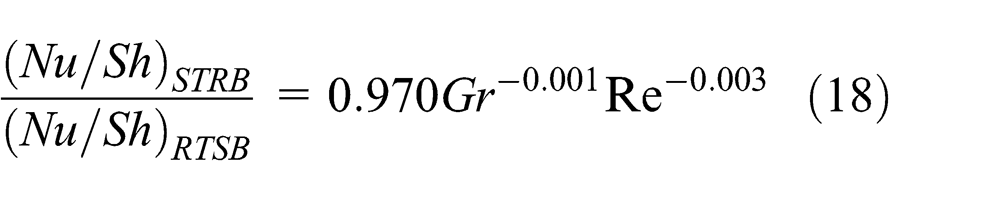
Depending on this relation, one could observe that heat transfer rate almost approaches mass transfer rate, whether STRB or RTSB mode was operated.
Conclusion
Double-diffusive mixed convection in the slot ventilated enclosure has been investigated in this work. The global Nusselt number on surface of heat source and Sherwood number on surface of contaminant source are correlated with Gr, Re, and supplying/returning position H 1 under STRB and RTSB modes, respectively.
First, the H 1/HT has almost little effect on the Nu and Sh numbers. The increasing intensity of heat source (Gr) and supplying velocity (Re) could promote the Nu number of heat source and Sh number of contaminant source under RTSB mode, whereas inhibit it under STRB mode. The ratio of combined heat and mass transfer is also set up in equation (18), which demonstrates that mass transfer strength on the horizontal contaminant source surface to that of heat transfer on the vertical heat source surface was almost equivalent whether STRB or RTSB mode was operated.
The obtained streamline, heatline, and massline for the double-diffusive mixed convection transportation problem under analysis are shown to be a very effective way to visualize the paths followed by fluid, heat, and contaminant in the enclosure. From the pathlines, one can directly observe the interactions of external mechanical-driven force and inner solutal/thermal buoyant force, and on their opposing or aiding effects.
In what concerns the air-conditioner or unit position of transport structures and air age distributions, some trends are found. For STRB mode, the thermal buoyant force from vertical heat source aids the solutal buoyant force induced by horizontal contaminant source when H 1 is lower. As H 1/HT was maintained at 2.0, the solutal buoyant force from contaminant source opposes with external supplying force and thermal buoyant force. For RTSB mode, the solutal buoyant force always opposed with both the external ventilation force and the thermal buoyant force. Region of fresh air could shrink with the increased H 1 for the STRB mode, and it could expand with increased H 1 for the RTSB mode.
Double-diffusive transport structures were heavily influenced by the Reynolds number. As the STRB mode was operated, natural convection aided by thermal and solutal buoyancy forces is opposing with the external forced convection. When RTSB mode was operated, natural convection is predominant in the whole enclosure as the value of Re is low, while the anti-clockwise forced convection gradually strengthens, with increasing Re number.
Strength of heat and mass sources can essentially influence the transport structures of fluid, heat, and contaminant. As STRB mode was operated, the external forced convection opposed the inner convection aided by the solutal and thermal buoyant forces. When RTSB mode was put into operation and Gr is maintained at the range of 1.0 to 1.0 × 10³, Nusselt number of heat source shows decreasing trend with Gr. As Gr exceeds 103, the thermal buoyancy convection is strengthened such that it opposes with the external supplying forced convection.
Footnotes
Appendix 1
Academic Editor: Michal Kuciej
Declaration of conflicting interests
The authors declare that there is no conflict of interest.
Funding
This research was financially supported by the Thousand Youth Talents Plan from the Organization Department of CCP Central Committee (Wuhan University, China, Grant No. 208273259), Hunan Provincial Natural Science Foundation for Distinguished Young Scholars supported by Hunan Provincial Government (Grant No. 14JJ1002, Multiple fluid mechanisms of urban ventilation and its safety through source identification), the Natural Science Foundation of China (NSFC, Grant No. 51208192, Instability theory and inverse convection design of air flow patterns in the large space; NSFC, Grant No. 51304233, Multi-physics diffusion of leaked natural gas and backward time inverse identification of leakage sources), Twelve-Five National Supportive Plan from Ministry of Science and Technology of P.R. China (Grant No. 2011BAJ03B07), and the National Key Basic Research Program of China (973 Program, Grant No. 2014CB239203). The authors also gratefully acknowledge the financial support of Hong Kong Scholar Program (Grant No. XJ2013042), Fundamental Research Funding Programme for National Key Universities in China, China Postdoctoral Science Foundation (Grant No. 2014M560593), and Qingdao Postdoctoral Science Foundation.