Based on the surface piezoelectricity theory and first-order shear deformation theory, the surface effect on the axisymmetric wave propagating in piezoelectric cylindrical shells is analyzed. The Gurtin–Murdoch theory is utilized to get the nontraditional boundary conditions and constitutive equations of the surface, in company with classical governing equations of the bulk, from which the basic formulations are obtained. Numerical results show that the surface layer has a profound effect on wave characteristics in nanostructure at a higher mode.
With the flourishing development and growing needs of nanoscience and nanotechnology in the 21 century, the surface effect on the mechanics of nanomaterials has received an ever-increasing interest.1–5 Methods for simulating size-dependent phenomenon at nano-scales include the continuum model, experimental method, and molecular method. But among the various research tools, the continuum surface model is a good alternative to better understand the surface effect on mechanical behavior of the nano structures. As everyone knows, the effect of the surface stress can be neglected in the classical theory. However, the elastic behavior of nano structures whose characteristic length is in nanometer range has been beyond capture since the continuum elasticity contains no intrinsic length scale.
The generalized continuum model was first presented by Gurtin and Murdoch6 (GM theory). In this theory, the equilibrium and constitutive equations of the bulk material are the same as those in classical elasticity, but with nontraditional boundary conditions to ensure the dynamic balance of the surface. Thus, within GM theory, the boundary conditions and constitutive relations of the surface, along with classical governing equations of the bulk, constitute the basic formulations of any nano-sized body with surface effect. The GM theory has been widely used to study the mechanical responses of nano structures. For instance, Liu and Rajapakse7 discussed the static and dynamic responses in nano beams, Assadi et al.8 analyzed the size-dependent dynamic response in nano plates. Detailed introduction concerning the continuum model with surface effect can refer to reviews.9,10
To study the surface effect on piezoelectric structures, Huang and Yu11 added the electric field variables into the surface energy density expression, creatively extended the GM theory to the piezoelectric bodies, and established the vital theoretical basis for studying the mechanical behavior of piezoelectric nano structures. Based on the model proposed by Huang and Yu, Pan et al.12 completed the phenomenological continuum theory of surface piezoelectricity to consider the linear superficial interplay between electricity and elasticity; Yan and Jiang13,14 performed the static bending, vibration, and buckling analysis in piezoelectric nano plates with surface effect.
The surface effect on the propagation of elastic waves was first analyzed by Gurtin and Murdoch.15–17 These studies show that the wave propagation behavior is extremely sensitive to the surface material properties: Rayleigh wave becomes dispersive due to the surface stress; however, in the classical theory, the wave velocity is independent on frequency (i.e. nondispersion). Recently, many researchers investigated the wave motion in nano structures. Chakraborty18 studied Lamb wave propagating in micro-nano elastic structures with flat surface/interface, and the special negative dispersion phenomenon was observed. Li and Lee19 discussed Love wave propagating in a nano-coating. Liu et al.20 performed the SH wave problem in nano films, and a special symmetric mode was found due to the surface effect. Chen21,22 treated the effect of surface layer on BG wave, and Love and Rayleigh–Lamb wave propagating in piezoelectric structures. Zhang et al.23,24 explored the surface effect on SH wave propagating in piezoelectric nano plates.
Research on surface effect in piezoelectric nano structures mostly focused on plate structures. However, piezoelectric nano-tubes or nano-shells also play an important role in engineering science. To the author’s best knowledge, the relevant research on wave propagation in piezoelectric nano-shells with surface effect is very limited, except the work of Zhang et al.,25 where only the free vibration problem was considered, and some typos can be found. On the basis of existing literature data, we carried out studies in an effort to axisymmetric wave propagation in the piezoelectric cylindrical shells. Numerical examples will show the effect of surface parameters on the dispersion curves, phase velocity curves, and frequency variations.
Basic equations
In the classical piezoelectricity theory, the constitutive equations, the strain–displacement, and electric potential relations, the equations of motion and conservation of charge are, respectively
where , , , , , and are stresses, strains, displacements, electric displacements, electric field, and electric potential, respectively, where material parameters , , , and are elastic, piezoelectric, dielectric constants, and density of the bulk, respectively. The tensor symbol denotes the covariant derivative in this article. We adopt the subscripts range over 1, 2, and 3, and range over 1 and 2 in the entire article.
Unlike the classical piezoelectricity, the constitutive relations11 and the equations of motion6 for the surface layer are written as
where and are the surface stresses and electric displacements, and and are the surface residual stresses and electric displacements, , , , and are surface elastic, surface piezoelectric, surface dielectric constants, and surface mass density, respectively. The geometric equations and electric potential relations (equations (2)) are also valid for surface layer.
According to Huang and Yu,11 the residual part is constant in general whose space derivative is 0. Hence, the residual stresses and electrical displacements of the surface layer will be omitted in the following for simplicity. So our main concern is how the surface piezoelectricity affects the dynamic behavior of the piezoelectric cylindrical nano-shells.
Formulation of two-dimensional theory
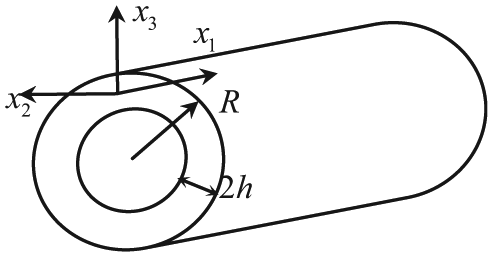
Figure 1 shows the geometry and coordinate system of an infinite-long thin shell with thickness and outer radius . The orthogonal coordinate system () is fixed at the middle surface of the cylindrical shell. is the axial direction, the circumferential direction, and the radial direction.
A cylindrical piezoelectric shell.
Based on the first-order theory, the mechanical displacements are
where , , and are the extensional, flexural, and thickness-shear components, respectively, and , (). Though the thickness stretch or contraction components and are included in equation (6), they can be eliminated through stress relaxation process. The strains and electrical potential are in the form of
With the basic field quantities written as equations (6) and (7), the governing equations of the shell can be obtained by integrating over the thickness direction, as follows
where (n = 0, 1, 2), represents the equivalent force term applied by the surface layer at the bulk boundaries .
We utilized the effective boundary conditions to incorporate the surface effect. The effective boundary conditions are, in fact, taking the effect of the surface layer as external forces exerting on the bulk. At the surfaces , the equilibrium equations are25
Using the continuity conditions of the displacements at , equation (11) can be rewritten as
Similarly, the charge equations are derived
Now the geometric and electric potential equations (7), the equations of motion (13), and the charge equations (14) are obtained, meanwhile revisions on the constitutive relations are also needed. Since the object investigated is an ultra-thin shell, the stress relaxation approximation of vanishing normal stress is assumed. Then the reduced constitutive relations yield
where , , and .
Now the general two-dimensional basic equations are all presented in tensor form; the definite equations will predict the only solution with given boundary conditions. In the subsequent sections, all field quantities undeclared have to be treated as the same physical quantities.
Basic equations of cylindrical shells with surface effect
For axisymmetric wave propagating in piezoelectric cylindrical shells, one considers and in the general equations of section “Formulation of two-dimensional theory,” yielding the geometric and electric potential relations25
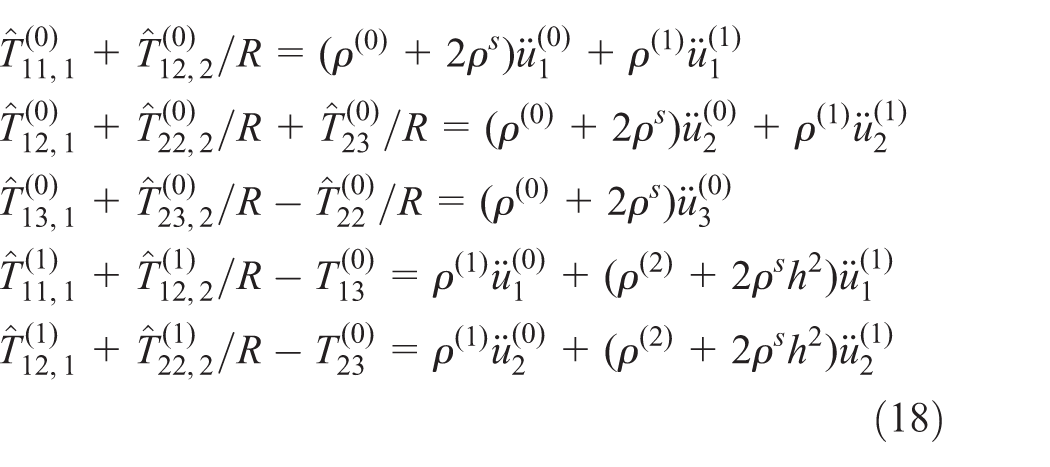
The governing equations of the cylindrical piezoelectric shell are presented as
where , and hence, the second and fifth equations are abandoned due to the axisymmetric assumption.
The charge equations are written as
where .
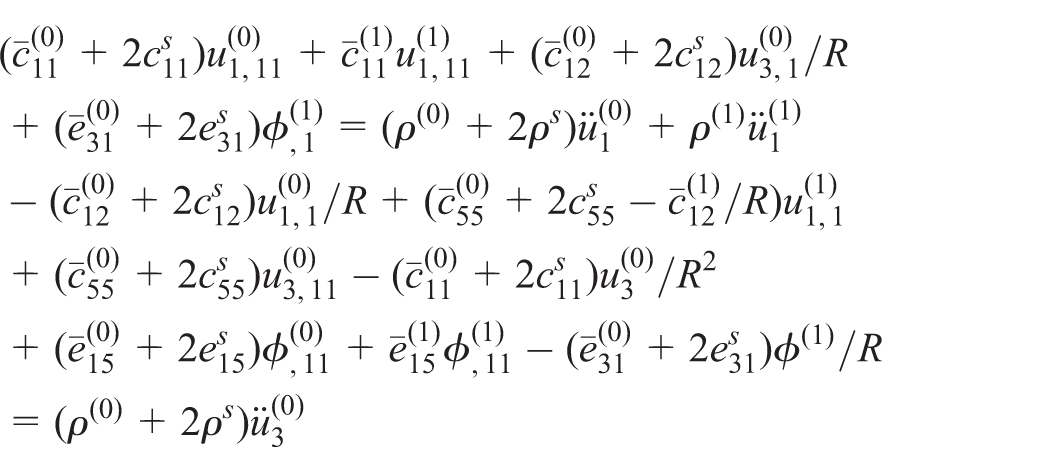
The effective resultant forces can be determined by combining equations (9), (12), and (15), and the substitution of the resultant forces into equation (18) yields
Similarly, the governing equations of the electric field can be expressed as
For open circuit, the electric displacements are equal to 0 at the surfaces , that is, . For short circuit, and , thus one can deduce .
For wave propagating in axial direction, one assumes
where is the wave number in direction, and is the angular frequency.
Substituting equation (22) into equations (20) and (21), one obtains the frequency equations for open circuit condition
The frequency equations for short circuit condition are omitted here for the sake of simplicity.
Results and discussion
In order to validate the present analysis for cylindrical shells, the comparisons with the free vibration problem presented by Lam and Qian26 and Liu et al.27 are shown in Table 1. Unlike the wave propagation problem, the cylindrical shells are laminated with limited length L. The stacking sequence of the laminated shell is [90/0/90], and the non-dimensional frequency parameter is . It can be seen that the present values are consistent with those of other references even for a short and thick cylindrical shell, which verifies the validity of the present analysis. It is worth mentioning that the first-order shear deformation theory is also utilized in Lam and Qian26 and Liu et al.27
Comparison of the first natural frequencies of the lami- nated composite cylindrical shell with simply supported boundary conditions (m = 1, h/R = 0.2, , ).
On the basis of previous formulation, we studied the axisymmetric wave propagating in piezoelectric shells in the presence of surface effect. In the following examples, the piezoelectric cylindrical shell composed of is considered. The material properties are given as follows28: c11 = 166 GPa, c12 = 77 GPa, c13 = 78 GPa, c33 = 162 GPa, c44 = 43 GPa, , , , , , and the mass density .29 For the surface material properties, we use a simple but reasonable approach proposed by Gurtin and Murdoch6 and Zhang et al.23 The surface material constants are equal to the corresponding bulk material constants multiplied by the material intrinsic length .
In Figures 2–6, the dimensionless frequency, wave number, and phase velocity are adopted: , , , and geometry parameter is . Figure 2 shows the phase velocity curves for electric short-circuited conditions, with fixed . In Figure 2, the effect of surface stress on the phase velocity is investigated, and the first two spectra are displayed for h0 = 0, 10, and 20 nm. It can be seen that the phase velocity increases/decreases monotonically with the frequency. The first branches for three different cases almost overlap together, while the higher branches decrease drastically with increasing at lower frequencies. When is larger than 1.5, both two branches approach to constant values. Hence, one can conclude that the branches are dispersive at lower frequencies and become nondispersive at higher frequencies. And distinguishingly, the surface layer affects predominantly the higher mode in low-frequency range: the surface effect tends to decrease the frequency.
Phase velocity curves for short circuit ().
Dispersion curves for short circuit ().
versus for open circuit (, ).
versus for short circuit (, ).
versus for open circuit (, ).
Figure 3 presents the dispersion curves for short circuit with , in which blue, red, and black dotted curves represent h0 = 0, 10, and 20 nm, respectively. The branches for real wave number correspond to the propagating modes, while those for imaginary wave number correspond to the evanescent waves or nonpropagating modes, that is, a disturbance that will spatially decrease in amplitude (see in equation (22)). The branches for purely imaginary wave number change from a near semicircle to a flat semiellipse due to the surface effect. For each , two branches are exhibited in the computation interval for real wave number. Similar to Figure 2, the higher curves for different are diverse from each other, while the lowest branches are indistinguishable. One can deduce that the strengthening of surface effect (increasing ) makes two branches approach closer, and the mode transformation (an intersection zone)30 is more likely to happen, which may be useful in nano sensors. So the surface effect must be taken into consideration when nano-sized structures are analyzed.
The frequencies for K = 0 are known as cutoff frequencies in the elastodynamics, at which some of the evanescent waves (purely imaginary branches) start propagating (purely real branches) and all the points of the waveguide vibrate in phase. It is seen that the first branch of propagating wave in Figure 3 has a zero and a nonzero cutoff frequency, and a backward wave occurs in the first branch.30 For a given mode, the cutoff frequencies are decreased with the increase of (see inset of Figure 3).
Figures 4 and 5 present the curves of frequency versus for electric open and short circuits, respectively. The blue solid line and red dash line represent the case with or without surface effect, respectively. It is clearly displayed that the dimensionless frequency at the nano-scale is size dependent: when is larger than 100, the surface effect is weak and can be neglected, but when decreases, the surface effect affects the frequency drastically and cannot be ignored anymore.
The curves of relative difference versus are plotted in Figure 6 for open circuit, where is the frequency considering surface effect, and is the frequency without surface effect. Similar to Figures 4 and 5, when is small, such as 10, the relative difference is up to 12%, so the surface effect plays a vital role in nano-scale shells.
Conclusion
We carried out a research of surface effect on axisymmetric wave propagating in piezoelectric nano-shells. The results for axisymmetric wave propagation show that the surface effect has a considerable effect on wave dispersion spectra at the nano-scale, making the first two branches approach closer. Further investigation has revealed that when the thickness of the shell is comparable to that of the surface layer, the surface effect would play a significant role in dynamic behavior of the structure. These findings will provide a solid theoretical basis for optimal design of piezoelectric nano structures.
Footnotes
Academic Editor: Yu-Fei Wu
Declaration of conflicting interests
The author declares that there is no conflict of interest.
Funding
The work was supported by the Natural Science Foundation of China (No. 11402002).
LimCWHeLH. Size-dependent nonlinear response of thin elastic films with nano-scale thickness. Int J Mech Sci2004; 46: 1715–1726.
3.
WangGFWangTJFengXQ. Surface effects on the diffraction of plane compressional waves by a nanosized circular hole. Appl Phys Lett2006; 89: 231923.
4.
LüCFLimCWChenWQ. Size-dependent elastic behavior of FGM ultra-thin films based on generalized refined theory. Int J Solids Struct2009; 46: 1176–1185.
5.
HuangGYKangYL. Acoustic vibrations of a circular nanowire by considering the effect of surface. J Appl Phys2011; 110: 023526.
6.
GurtinMEMurdochAI. A continuum theory of elastic material surfaces. Arch Ration Mech Anal1975; 57(4): 291–323.
7.
LiuCRajapakseRKND. Continuum models incorporating surface energy for static and dynamic response of nano scale beams. IEEE T Nanotechnol2010; 9: 422–430.
DuanHLWangJKarihalooBL. Theory of elasticity at the nanoscale. Adv Appl Mech2009; 42: 1–63.
10.
WangJXHuangZDuanH. Surface stress effect in mechanics of nanostructured materials. Acta Mech Solida Sin2011; 24(1): 52–82.
11.
HuangGYYuSW. Effect of surface piezoelectricity on the electromechanical behavior of a piezoelectric ring. Phys Status Solidi B2006; 243: R22–R24.
12.
PanXHYuSWFengXQ. A continuum theory of surface piezoelectricity for nanodielectrics. Sci China Ser G2011; 54: 564–573.
13.
YanZJiangLY. Surface effects on the electroelastic responses of a thin piezoelectric plate with nanoscale thickness. J Phys D Appl Phys2012; 45: 255401 (9 pp.).
14.
YanZJiangLY. Vibration and buckling analysis of a piezoelectric nanoplate considering surface effects and in-plane constraints. Proc R Soc A2012; 468: 3458–3475.
15.
GurtinMEMurdochAI. Effect of surface stress on wave propagation in solids. J Appl Phys1976; 47: 4414.
16.
MurdochAI. The propagation of surface waves in bodies with material boundaries. J Mech Phys Solids1976; 24: 137–146.
17.
MurdochAI. The effect of interfacial stress on the propagation of stoneley waves. J Sound Vib1977; 50: 1–11.
18.
ChakrabortyA. The effect of surface stress on the propagation of Lamb waves. Ultrasonics2010; 50: 645–649.
19.
LiYDLeeKY. Size-dependent behavior of love wave propagation in a nanocoating. Mod Phys Lett B2010; 24: 3015.
20.
LiuHLiuHYangJL. Surface effects on the propagation of shear horizontal waves in thin films with nano-scale thickness. Physica E2013; 49: 13–17.
21.
ChenWQ. Surface effect on Bleustein-Gulyaev wave in a piezoelectric half-space. Theor Appl Mech Lett2011; 1: 041001.
22.
ChenWQ. Chapter 9. Wave propagation in piezoelectric plate with surface effect. In: FangDNWangJChenWQ (eds) Analysis of piezoelectric structures and devices. Beijing, China: Higher Education Press, 2013, pp.287–310.
23.
ZhangCLChenWQZhangC. On propagation of anti-plane shear waves in piezoelectric plates with surface effect. Phys Lett A2012; 376: 3281–3286.
24.
ZhangLLLiuJXFangXQ. Size-dependent dispersion characteristics in piezoelectric nanoplates with surface effects. Physica E2014; 57: 169–174.
25.
ZhangCLZhuJChenWQ. Two-dimensional theory of piezoelectric shells considering surface effect. Eur J Mech A: Solid2014; 43: 109–117.
26.
LamKYQianW. Free vibration of symmetric angle-ply thick laminated composite cylindrical shells. Compos Part B: Eng2000; 31: 345–354.
27.
LiuCCLiFMHuangWH. Transient wave propagation and early short time transient responses of laminated composite cylindrical shells. Compos Struct2011; 93: 2587–2597.
28.
ZhouYYLüCFChenWQ. Bulk wave propagation in layered piezomagnetic/piezoelectric plates with initial stresses or interface imperfections. Compos Struct2012; 94(9): 2736–2745.
29.
BerlingcourtDACurranDRJaffeH. Piezoelectric and piezomagnetic materials and their function in transducers. Phys Acoustics1964; 1: 169–270.
30.
ZhouYYChenWQLüCF. Elastic waves in multiferroic cylinders of sectorial cross-section. Compos Part B: Eng2012; 43(8): 3001–3008.