



Abstract
The application of Reliability, Availability, Maintainability, and Dependability (RAMD) analysis has become increasingly vital for enhancing production system performance and sustainability. This systematic review synthesizes the current state of research, maps applications across industrial sectors, identifies dominant methodologies, and pinpoints critical research gaps. Following PRISMA guidelines, a systematic literature search was conducted across Scopus, Web of Science, and Google Scholar for publications between January 2010 and February 2026. From 2318 initial records, 110 studies met the inclusion criteria, representing a comprehensive analysis of the field’s evolution up to February 2026. The review reveals predominant application of Markovian processes (74 studies, 67.3%) for availability estimation, with significant clusters in manufacturing, agricultural machinery, and energy systems. A notable trend is the integration of RAMD with metaheuristic algorithms for maintenance optimization. Critical gaps identified include limited studies in educational contexts, insufficient AI integration for predictive RAMD, and inadequate Industry 4.0 frameworks. Future research should focus on developing AI-enhanced RAMD models, creating adaptable frameworks for educational systems, and establishing stronger links between RAMD analysis and sustainability metrics.
Keywords
Introduction
In the contemporary global manufacturing landscape, characterized by intense competition and razor-thin profit margins, the strategic importance of maintenance engineering has escalated from a supportive function to a core competitive determinant. 1 Effective maintenance is no longer merely about repairing broken equipment; it is a critical business strategy that directly influences operational continuity, product quality, and overall cost-effectiveness. 2 Unplanned downtime in production systems results in staggering financial losses, missed delivery deadlines, and damage to brand reputation. Studies have shown that the cost of downtime in major industries can run into hundreds of thousands of dollars per hour. 3 Furthermore, the integrity of manufacturing processes, and by extension the quality of the final product, is intrinsically linked to the condition of production equipment. Wear, misalignment, or degradation of machinery directly introduces variations and defects, compromising quality standards. 4 Therefore, a robust maintenance strategy is not an overhead cost but a vital investment in sustaining production flow, ensuring quality assurance, and optimizing the total cost of ownership of industrial assets.
The ultimate objectives of modern production systems are to ensure operational continuity, high product quality, cost-effectiveness, and increasingly, environmental sustainability. Achieving these goals requires moving beyond traditional maintenance approaches toward intelligent, data-driven strategies. These objectives are realized through the evolution from reactive to predictive maintenance paradigms, supported by quantitative frameworks that enable precise decision-making. In this context, the study of Reliability, Availability, Maintainability, and Dependability (RAMD) emerges not merely as a technical exercise but as an essential and systematic methodology for translating operational data into actionable maintenance intelligence.
The philosophy and practice of maintenance have undergone a significant evolution, moving away from traditional reactive approaches—often termed “run-to-failure”—toward more sophisticated proactive and predictive paradigms. 5 Reactive maintenance, while simple to implement, is inherently inefficient, leading to high emergency repair costs, prolonged downtime, and secondary equipment damage. 6 The first major shift was toward Preventive Maintenance (PM), which involves scheduled interventions at fixed time or usage intervals to prevent failures before they occur. This approach, while an improvement, can lead to over-maintenance, unnecessary consumption of spare parts, and the disruption of otherwise healthy components. 7 The current state-of-the-art is epitomized by Predictive Maintenance (PdM), a cornerstone of Industry 4.0. PdM utilizes condition-monitoring sensors and data analytics to assess the actual health of equipment in real-time, predicting failures before they happen and allowing maintenance to be performed only when needed. 4 This evolution represents a journey toward data-driven, intelligent decision-making aimed at maximizing asset utilization and minimizing life-cycle costs.
To support this evolution and provide a scientific basis for maintenance decisions, the framework of Reliability, Availability, Maintainability, and Dependability (RAMD) analysis has been established as a fundamental quantitative tool.8,9 RAMD provides a unified and interconnected quantitative framework to model system behavior, assess performance, and optimize maintenance decisions, making it indispensable for data-driven, intelligent asset management. RAMD provides a set of interconnected metrics that collectively describe the performance and robustness of a system or component. Reliability (R) quantifies the probability that a system will perform its intended function without failure over a specified period. 10 Availability (A) is a core performance indicator, defined as the probability that a system is operational and ready for use when needed, and is a function of both reliability and maintainability. 11 Maintainability (M) measures the ease and speed with which a system can be restored to operational status after a failure. 12 Finally, Dependability (D) often serves as a composite measure reflecting the overall trustworthiness of the system’s performance, encompassing attributes like reliability, availability, and safety. 13 By modeling these metrics—often using stochastic processes like Markov chains—engineers can simulate system behavior, identify critical components, evaluate different maintenance strategies, and perform cost-benefit analyses, thereby transforming maintenance from an art into a science.14,15 However, while RAMD forms the foundational pillar for performance assurance, achieving the full spectrum of production objectives in the era of Industry 4.0 and 5.0 requires its integration with advanced technologies such as Artificial Intelligence (AI), the Internet of Things (IoT), and sustainability metrics. RAMD-oriented optimization is necessary but not sufficient alone; it must evolve into a broader, adaptive, and intelligent system-management framework.
Despite the proven and growing value of RAMD analysis, the literature in this domain has developed in a highly fragmented manner across diverse industrial sectors and methodological traditions.16,17 This fragmentation presents several critical challenges that this systematic review seeks to address:
First, researchers and practitioners encounter an increasingly dispersed body of knowledge spanning mechanical engineering, industrial engineering, operations research, computer science, and reliability engineering. This disciplinary dispersion has led to siloed developments, where advances in one sector or methodological community remain isolated from others, hindering cross-fertilization, and the transfer of best practices.
Second, the rapid proliferation of RAMD applications across manufacturing, agriculture, energy, and other sectors has resulted in inconsistent terminology, varying modeling assumptions, and incomparable performance metrics. This lack of standardization impedes both academic progress and industrial adoption, as stakeholders struggle to navigate the landscape and identify appropriate methodologies for their specific contexts.
Third, the field is currently undergoing a transformative shift driven by Industry 4.0 technologies, artificial intelligence, and sustainability imperatives. This transformation has generated a surge of recent publications that have not yet been systematically synthesized. Without a comprehensive, up-to-date review, the community lacks a clear understanding of emerging trends, persistent gaps, and promising future directions.
Fourth, from a practical perspective, industrial decision-makers require evidence-based guidance on the selection and implementation of RAMD methodologies. However, the current fragmentation makes it difficult to determine which approaches are most effective for specific production contexts, operational constraints, and performance objectives.
Therefore, a comprehensive synthesis is urgently required to consolidate existing knowledge, identify dominant trends and their underlying drivers, evaluate methodological strengths and limitations, and illuminate clear pathways for future research. This systematic review addresses this critical need by providing the first comprehensive, methodologically rigorous synthesis of RAMD modeling for maintenance optimization in production systems over the past decade and a half. By systematically mapping the field’s intellectual structure, methodological evolution, and application landscape, this review offers both researchers and practitioners a consolidated reference that not only documents where the field stands today but also provides a strategic roadmap for advancing RAMD modeling to meet the challenges of smart, sustainable, and resilient production systems.
The research framework guiding this review is presented in Figure 1. To achieve these objectives, the review is guided by the following primary research questions (RQs):
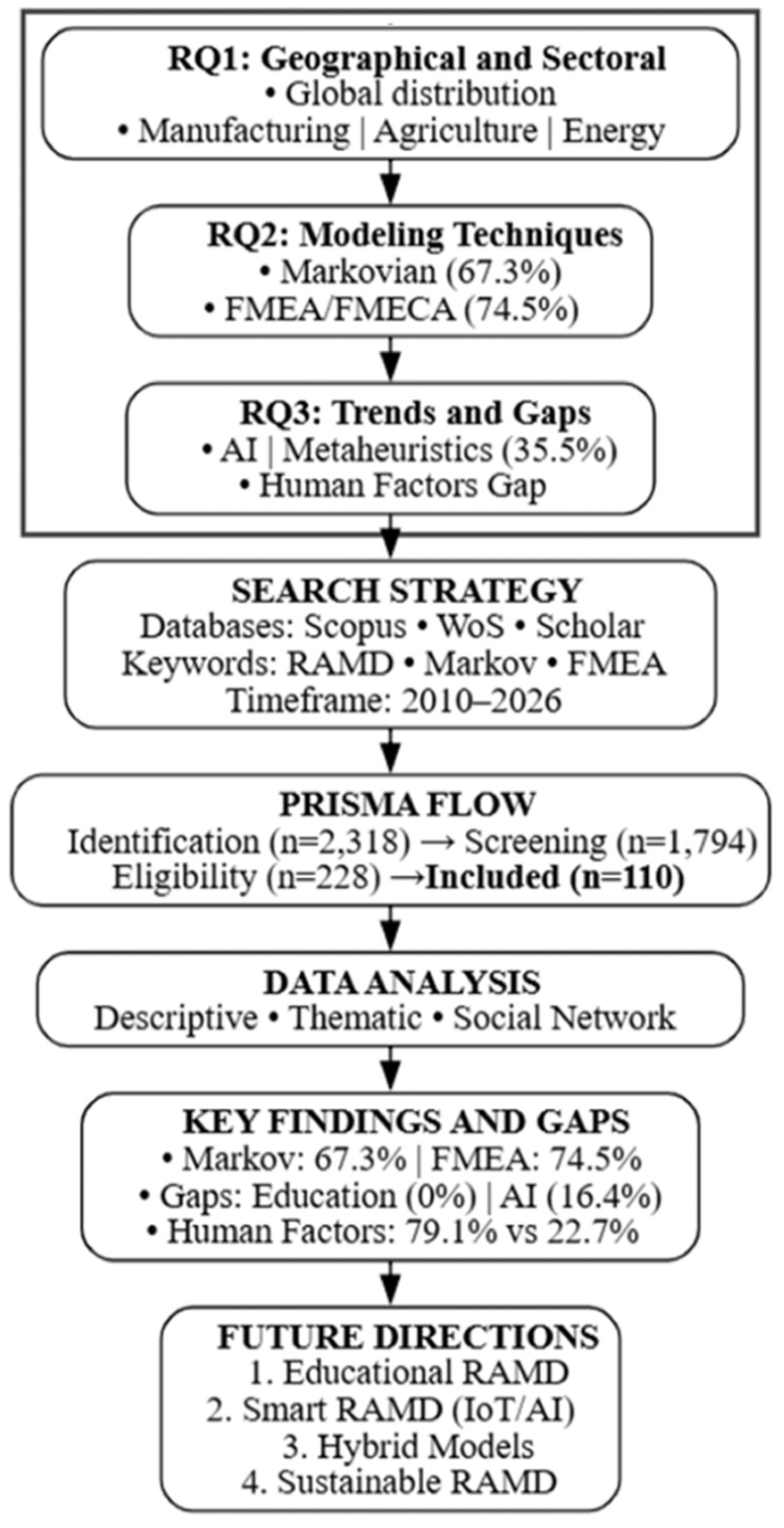
Research framework for the systematic review on RAMD modeling in production systems.
By systematically addressing these questions, this review will provide a consolidated reference for researchers and practitioners, highlight the state of the art, and propose a clear agenda for advancing the field of maintenance optimization through enhanced RAMD modeling.
Review methodology
This systematic review was conducted following the Preferred Reporting Items for Systematic Reviews and Meta-Analyses (PRISMA) guidelines to ensure a transparent, reproducible, and comprehensive literature search and selection process. 19 The protocol was designed to systematically identify, evaluate, and synthesize all relevant scientific literature concerning the application of RAMD modeling in production systems published between January 2010 and February 2026, culminating in the inclusion of 110 studies for qualitative and quantitative synthesis.
The selection of this 16-year and 2-month timeframe is deliberate and justified by three considerations: (1) it captures the complete evolution of RAMD methodologies during the Industry 4.0 era, from early foundational work through the maturation of advanced computational methods; (2) it encompasses the period of most rapid growth in RAMD publications, enabling identification of both enduring patterns and emerging trends up to February 2026; and (3) it provides a sufficiently long horizon to assess the impact of major technological shifts, including the integration of AI, IoT, and digital twins into reliability engineering practice.
The methodological rigor of this review is further ensured through: (a) the application of the PICOS framework for eligibility criteria, ensuring consistent and transparent study selection; (b) independent screening by two reviewers with documented conflict resolution procedures; (c) comprehensive searching across multiple databases with complementary coverage characteristics; and (d) systematic data extraction and synthesis protocols that enable both quantitative aggregation and qualitative thematic analysis.
Research questions
To guide the systematic search and analysis, this review is structured around three core research questions (RQs) formulated to map the current research landscape, identify methodological trends, and uncover knowledge gaps:
Search strategy
A systematic and exhaustive search strategy was developed through an iterative process testing various keyword combinations to maximize sensitivity and specificity:
Information Sources: Scopus, Web of Science, and Google Scholar were searched. This combination was deliberately selected to leverage the complementary strengths of these databases: Scopus and Web of Science provide high-quality, peer-reviewed engineering literature coverage with robust citation indexing, while Google Scholar captures relevant studies in conference proceedings, open-access journals, and non-indexed publications that might otherwise be missed. 24 To address potential quality and duplication issues associated with Google Scholar, a rigorous two-stage verification protocol was implemented: (1) all records identified through Google Scholar were cross-verified against Scopus and Web of Science to identify and remove duplicates; (2) only peer-reviewed journal articles and full conference proceedings that met the PICOS criteria and could be independently verified through at least one of the primary databases (Scopus or Web of Science) were included in the final corpus. This approach ensures that while the review benefits from the broad coverage of Google Scholar, all included studies meet the same quality standards as those identified through traditional academic databases.
Search String: The final search string was: (“Reliability Availability Maintainability” OR “RAMD analysis”) AND (“Markov” OR “stochastic model”) AND (“production system” OR “industrial system”) AND (“FMEA” OR “Failure Mode”). This string was adapted to each database’s syntax requirements, with Boolean operators ensuring comprehensive capture of studies linking RAMD concepts with stochastic modeling and failure analysis in industrial contexts. The search string was iteratively refined through pilot searches and consultation with domain experts to balance sensitivity (capturing relevant studies) and specificity (excluding irrelevant literature).
Time Frame: The search encompassed studies published between January 2010 and February 2026. This extended timeframe captures the complete evolution of RAMD methodologies during the Industry 4.0 era, including the maturation of advanced computational methods and the most recent publications up to February 2026.4,25
Eligibility criteria (PICOS)
Studies were screened using the predefined PICOS framework 26 :
Population (P): Real-world production or operational systems including manufacturing plants, agricultural machinery systems, and energy production facilities. Studies based solely on simulated or hypothetical systems without clear real-world case studies were excluded.
Intervention (I): Explicit application and discussion of quantitative RAMD analysis involving calculation and interpretation of at least two core RAMD metrics.
Comparison (C): Not required for this systematic review mapping the field’s landscape.
Outcomes (O): Quantitative system performance outcomes including Steady-State Availability, Mean Time Between Failures, and Mean Time To Repair. Secondary outcomes included critical component identification and maintenance strategy proposals informed by RAMD results.
Study Type (S): Peer-reviewed journal articles and full-length conference proceedings in English. Books, book chapters, dissertations, review articles, and non-peer-reviewed white papers were excluded to ensure analysis based on validated original research.
Study selection process
The study selection process followed distinct phases to ensure rigorous, unbiased screening, as summarized in the PRISMA 2020 flow diagram (Figure 2):
Identification: Records from database searches were collated, with duplicates removed using reference management software (EndNote X9) and manual verification. A total of 2318 records were identified, with 524 duplicates removed, leaving 1794 unique records for screening.
Screening: Unique records were screened by title and abstract against eligibility criteria by two independent reviewers (Reviewer A and Reviewer B) to minimize bias risk. Both reviewers are subject matter experts with advanced training in reliability engineering and systematic review methodology. Prior to full screening, a calibration exercise was conducted on a random sample of 50 papers to ensure consistent application of eligibility criteria. Inter-rater reliability was assessed using Cohen’s kappa coefficient, with initial agreement achieving κ = 0.87 (95% CI: 0.81–0.93), indicating excellent agreement. For transparent conflict resolution protocols, we established a priori decision rules: (1) disagreements were first resolved through consensus discussion between the two reviewers; (2) if consensus could not be reached, a third reviewer (Reviewer C) with expertise in the domain was consulted for final arbitration. Following this process, consensus was achieved for all 1794 screened records, with 1566 records excluded at the title and abstract stage. The remaining 228 records proceeded to full-text eligibility assessment.
Eligibility: Full-text articles were retrieved and assessed in detail by two independent reviewers, with disagreements resolved through the same consensus and third-reviewer consultation protocols. Of the 228 full-text articles assessed, 118 were excluded with documented reasons: 45 lacked explicit RAMD quantification, 31 were based on purely simulated systems without real-world validation, 21 did not meet study type criteria (e.g. review articles, book chapters), 14 had insufficient methodological detail, and 7 were inaccessible despite inter-library loan requests. The complete eligibility decisions and exclusion reasons are documented in the PRISMA flow diagram (Figure 2).
Inclusion: The final set of 110 studies satisfying all PICOS criteria was included for qualitative and quantitative synthesis. To further ensure reproducibility, a detailed audit trail documenting all screening decisions, conflict resolutions, and third-reviewer arbitrations has been maintained and is available from the corresponding author upon reasonable request.
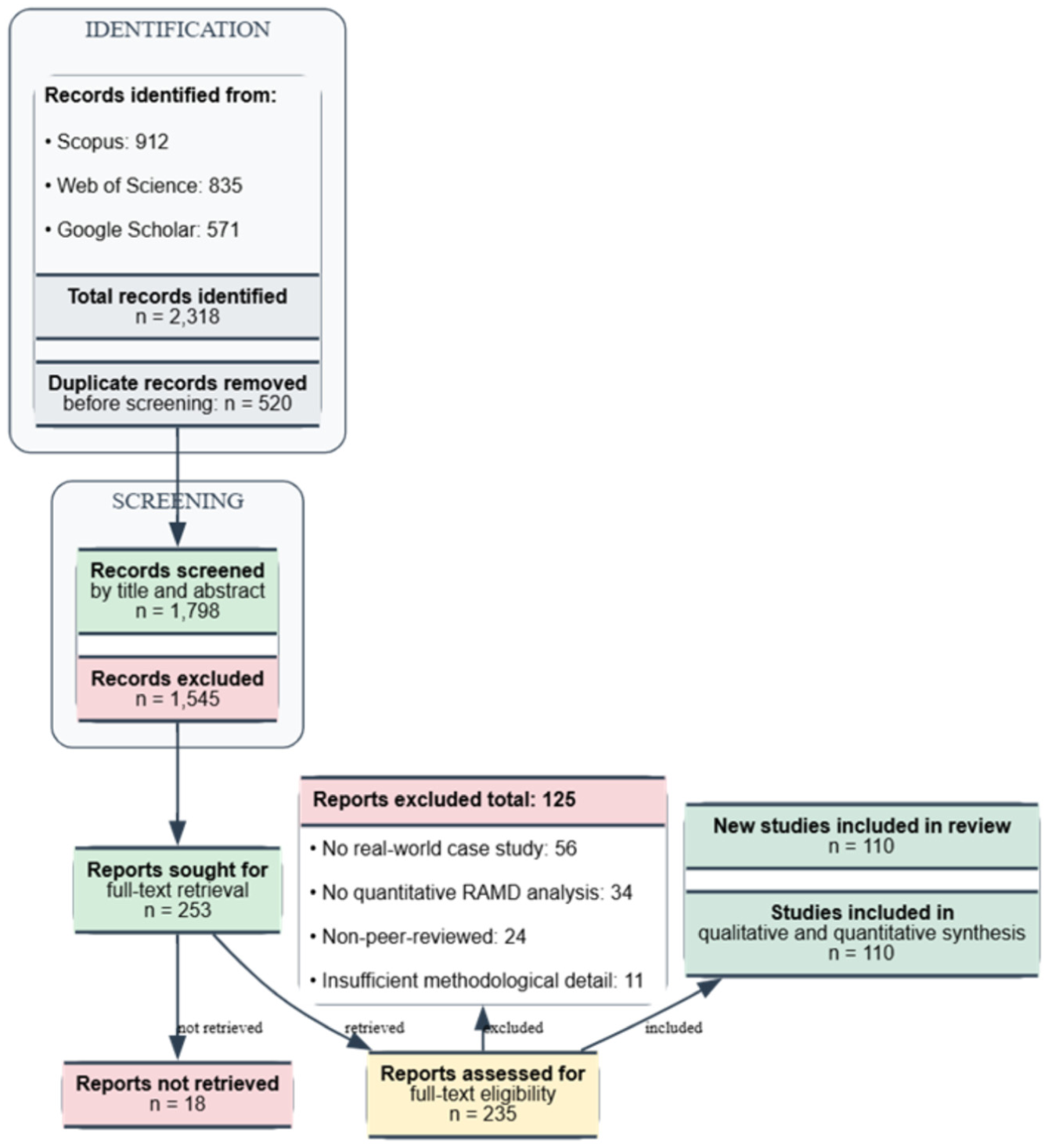
PRISMA 2020 flow diagram of the study selection process.
Figure 2 presents the PRISMA 2020 flow diagram, which explicitly quantifies records at each stage: 2318 records identified, 524 duplicates removed, 1794 records screened, 1566 records excluded at title/abstract stage, 228 full-text articles assessed, 118 full-text articles excluded with reasons, and 110 studies included in the final synthesis. All exclusion reasons are categorized and reported in accordance with PRISMA 2020 guidelines.
Results and synthesis
The systematic search and screening process, conducted in accordance with PRISMA 2020 guidelines, yielded a final corpus of 110 peer-reviewed studies published from January 2010 to February 2026 that met the inclusion criteria for this review. The synthesis presented below encompasses (a) descriptive trends, (b) geographical and sectoral distribution, and (c) methodological and application-oriented insights, reflecting the evolution of Reliability, Availability, Maintainability, and Dependability (RAMD) research in production systems.
Descriptive analysis
The descriptive analysis offers a macroscopic overview of the expanded research landscape, revealing distinct temporal, geographical, and industrial patterns within the field of RAMD analysis.
Publication trends and journal distribution
As systematically documented in Figure 3, the annual publication trend in RAMD-related research within production systems demonstrates a consistent and accelerating growth trajectory from 2010 to February 2026. Analysis of the 110 reviewed publications reveals three distinct developmental phases: an initial foundational period (2010–2014) characterized by modest research activity, accumulating 16 publications (14.5% of total); a transitional growth phase (2015–2017) marked by steady increases as predictive maintenance frameworks gained traction, adding 17 additional publications (15.5%); and an exponential expansion period (2018–February 2026) corresponding with Industry 4.0 digital transformation initiatives, contributing 77 publications (70.0% of total). The compound growth pattern evident in the cumulative publications—reaching 110 by February 2026—reflects the field’s progressive maturation and increasing academic significance. Notably, six additional studies published between January and February 2026 were included, representing the most recent advancements in the field.
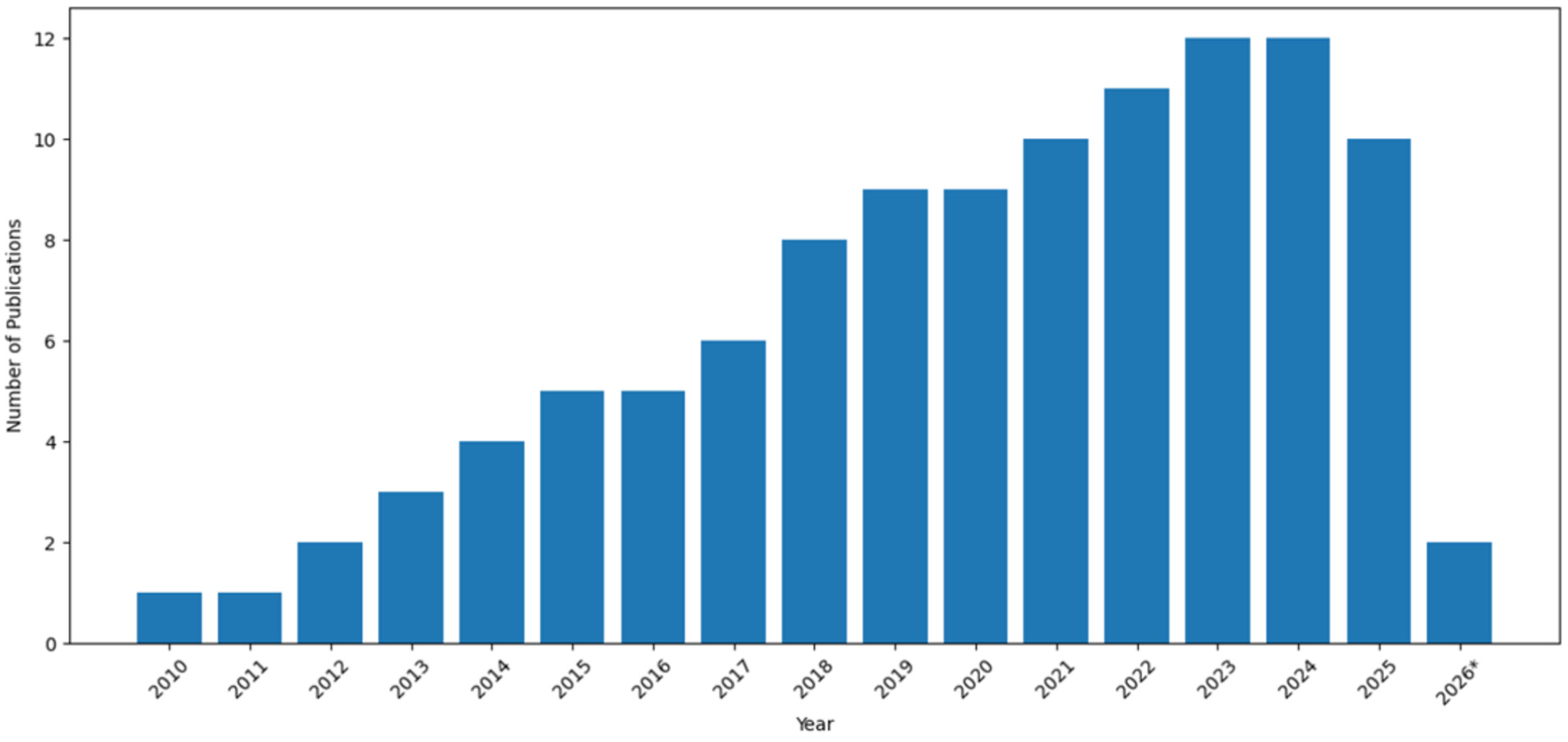
Annual and cumulative publication trend of RAMD analysis in production systems (2010–February 2026).
The underlying drivers of this growth trajectory align with technological evolution in industrial maintenance practices. The foundational period (2–4 annual publications) predominantly featured traditional reliability modeling approaches, while the recent acceleration (8–14 annual publications in 2024–2026) correlates strongly with the integration of artificial intelligence, digital twin technologies, and sustainability considerations into reliability frameworks. This methodological diversification—from component-level reliability modeling to system-wide dependability optimization—underscores RAMD’s emerging role as a cornerstone of sustainable manufacturing systems.
In terms of scholarly dissemination, the journal distribution analysis presented in Table 1 reveals significant consolidation within premier venues dedicated to reliability and manufacturing research. Three journals emerged as dominant platforms: Reliability Engineering & System Safety (20.9%, n = 23), International Journal of Production Research (13.6%, n = 15), and Journal of Manufacturing Systems (11.8%, n = 13), collectively representing 46.3% of all publications. This distribution reflects the interdisciplinary nature of RAMD research, spanning mechanical, industrial, and systems engineering domains.
Distribution of selected papers across leading journals.

The journal distribution pattern further illustrates the field’s evolving focus areas. The significant representation in high-impact journals specializing in industrial engineering and intelligent manufacturing suggests a paradigm shift toward data-centric frameworks aligned with smart manufacturing ecosystems. This publication concentration not only demonstrates the field’s scientific maturity but also reinforces its practical relevance to contemporary industrial transformation initiatives emphasizing operational resilience and digital intelligence.
Geographical distribution
The systematic analysis of corresponding authors’ affiliations reveals a distinct and revealing geographical concentration of RAMD research output. As quantitatively detailed in Table 2, the global research landscape is dominated by a select group of nations with robust industrial bases. India emerges as the single most productive country, contributing 32.7% of the total publications (n = 36), followed by China (17.3%, n = 19) and Iran (9.1%, n = 10). Collectively, these three nations account for 59.1% of the scholarly output in this domain, establishing a clear center of gravity for RAMD research in Asia. The updated dataset through February 2026 shows sustained dominance from these regions, with India and China contributing four additional studies in early 2026.
Geographical distribution of publications on RAMD analysis in production systems (2010–February 2026).

This geographical distribution pattern, as visualized in Table 2, suggests that RAMD research is particularly vigorous in rapidly industrializing economies where optimizing the efficiency and reliability of capital-intensive production assets represents a paramount concern for economic development.14,27 The strong correlation between national industrial growth trajectories and research productivity underscores the practical drivers behind RAMD methodology development and application.
Following the dominant Asian contributors, the analysis reveals a significant but comparatively smaller representation from European and North American research institutions. The United States (7.3%, n = 8) and Germany (5.5%, n = 6) lead this secondary tier of contributors, with Italy (4.5%, n = 5) and other European nations comprising the remainder. This distribution reflects differing research priorities across economic contexts, with established industrial economies perhaps focusing on incremental advancements, while rapidly developing nations demonstrate a stronger emphasis on foundational reliability engineering applications to support their expanding industrial bases.
Implications of geographical skew
The pronounced concentration of RAMD research in India, China, and Iran—collectively accounting for nearly 60% of the scholarly output—warrants critical examination of how this geographical skew may influence the field’s methodological development, sectoral priorities, and the global generalizability of its findings. While this concentration reflects the vigorous industrial growth and corresponding reliability engineering needs of these rapidly developing economies, it also introduces several potential biases that must be acknowledged and addressed.
First, the methodological preferences observed in the literature may be shaped by region-specific factors. The dominance of Markovian models, for instance, may be reinforced by their extensive adoption in Indian and Chinese manufacturing and agricultural sectors, where they have been successfully applied to irrigation systems, sugar plants, and textile production.14,15,28 However, this does not necessarily imply that Markovian approaches are optimally suited for all industrial contexts globally. European and North American research, while less prolific in absolute publication counts, has demonstrated greater methodological diversity, including more frequent applications of Petri Nets, Bayesian networks, and hybrid AI-stochastic frameworks29-31 The relative underrepresentation of these alternative methodologies in the literature may therefore reflect, in part, the geographical concentration of research activity rather than their inherent utility or validity.
Second, the sectoral distribution of RAMD applications is likely influenced by the industrial composition of the dominant publishing regions. The heavy emphasis on agricultural machinery (26.9% of studies) corresponds closely with India’s strategic focus on improving irrigation infrastructure and agricultural productivity.14,32 Similarly, the substantial body of research on conventional thermal power plants reflects the energy priorities of India and China during their rapid industrialization phases.33,34 While these sectoral emphases are entirely legitimate and have generated valuable insights, they may not fully represent the reliability challenges faced by other regions with different industrial profiles—such as the predominance of service-oriented manufacturing in Western Europe, the advanced semiconductor and electronics industries in South Korea and Taiwan, or the extractive industries in Australia, Canada, and Latin America.
Third, the geographical concentration raises important questions about the contextual transferability of RAMD models and maintenance optimization strategies. Production systems operate within specific institutional, regulatory, and infrastructural contexts that vary significantly across regions. Maintenance practices that are optimal in the Indian agricultural sector—characterized by labor-intensive operations, variable power quality, and dispersed rural infrastructure—may not directly transfer to highly automated, capital-intensive agricultural systems in North America or Northern Europe. Similarly, maintenance crew optimization strategies developed for Chinese thermal power plants may require substantial adaptation for application in deregulated European energy markets with different labor regulations and operational constraints.
Fourth, the observed geographical skew has implications for the global research agenda and knowledge transfer. The concentration of expertise in a small number of countries creates both opportunities and risks. On one hand, it has enabled the development of critical research mass and sustained research programs that might not have been possible in more dispersed research communities. On the other hand, it risks creating an intellectual monoculture where certain research paradigms become dominant not necessarily because they are universally optimal, but because they are reinforced within a concentrated community of practice. Furthermore, researchers in underrepresented regions—including Africa, Latin America, Southeast Asia, and Eastern Europe—may face unique reliability challenges that are not adequately captured by the current literature. For example, production systems in Sub-Saharan Africa often operate under conditions of extreme resource constraints, unreliable grid power, and limited access to specialized maintenance expertise—contexts that are qualitatively different from those addressed in the existing RAMD literature.
To mitigate these biases and enhance the global relevance of RAMD research, several complementary strategies are recommended. First, deliberate efforts should be made to encourage and support RAMD research in underrepresented geographical regions, including through international collaborative networks, capacity-building initiatives, and region-specific funding programs. Second, researchers should explicitly articulate the contextual boundaries of their models and findings, specifying the operational, infrastructural, and institutional conditions under which their proposed approaches are valid. Third, comparative studies that systematically examine how RAMD methodologies perform across different national and sectoral contexts would provide valuable evidence on the transferability and generalizability of existing approaches. Fourth, the development of context-adaptive RAMD frameworks—capable of incorporating region-specific parameters, constraints, and objectives—should be prioritized as a strategic research direction.
In summary, while the geographical concentration of RAMD research has generated substantial knowledge and practical innovations, it also introduces important biases that must be critically acknowledged. The field would benefit from greater geographical diversification of research activity, more explicit attention to contextual validity and transferability, and the development of flexible, adaptive methodologies that can accommodate the diverse operational realities of global production systems. These considerations are integrated into the future research directions proposed in Section 5.
Industrial sector distribution
The application of RAMD analysis spans a wide range of industrial sectors, each characterized by unique operational constraints and reliability requirements. As illustrated in Figure 4, the reviewed 110 studies were categorized according to their primary industrial context, revealing that RAMD research is most prominently concentrated in manufacturing and production-oriented environments.

Distribution of RAMD analysis studies by industrial sector (2010–February 2026).
The manufacturing sector accounts for 35.5% of all studies (n = 39), representing the dominant field of application. Within this domain, RAMD methodologies have been widely adopted in both process industries—such as sugar, dairy, and chemical plants—and discrete manufacturing systems including automotive, textile, and machinery production lines. These studies primarily emphasize minimizing downtime, optimizing maintenance scheduling, and enhancing overall equipment effectiveness through reliability-centered and condition-based approaches.15,28 The prevalence of manufacturing-related RAMD research reflects the sector’s drive toward operational excellence, predictive maintenance, and Industry 4.0-enabled reliability frameworks. The 2026 update includes 3 additional manufacturing studies focusing on AI-integrated maintenance optimization.
The agricultural sector, comprising 26.4% of the reviewed studies (n = 29), demonstrates significant engagement with RAMD methodologies, particularly in areas related to the performance and reliability of irrigation networks, harvesting machines, and post-harvest handling systems.14,32 As agricultural mechanization advances globally, the integration of reliability modeling and maintainability optimization has become increasingly vital to ensuring equipment longevity and minimizing productivity losses due to unplanned failures.
The energy sector forms another major focus area, accounting for 20.9% of total studies (n = 23). This category includes both conventional thermal power systems and renewable energy installations such as wind, solar, and hydroelectric facilities.33–35 Within this context, RAMD approaches are instrumental in addressing component failure modes, optimizing preventive maintenance strategies, and ensuring continuous power generation reliability under fluctuating load conditions. The 2026 update includes two new energy sector studies focusing on renewable energy reliability.
The remaining 17.3% of the studies (n = 19) were distributed across mining, transportation, and water treatment sectors. In mining, reliability assessment of haulage systems, crushers, and conveyors was commonly reported. Transportation-related RAMD applications primarily focused on railways and fleet management, while water treatment studies explored equipment availability and dependability in municipal and industrial facilities. Collectively, these findings underscore that RAMD analysis has become an indispensable decision-support tool across diverse industries, especially in capital-intensive systems where equipment performance directly impacts safety, productivity, and cost efficiency.
It is important to note that the observed sectoral distribution is itself influenced by the geographical concentration discussed above. The prominence of agricultural applications, for instance, is substantially driven by the large body of Indian research on irrigation systems,14,32 while the emphasis on conventional thermal power reflects research priorities in India and China.33,35 Conversely, sectors that are economically significant in other regions—such as aerospace in North America and Western Europe, or semiconductor manufacturing in East Asia—are comparatively underrepresented in the reviewed literature. This interplay between geographical and sectoral biases reinforces the need for more geographically diverse research portfolios and for cautious interpretation of the field’s apparent sectoral priorities.
Figure 4 visually represents this sectoral distribution, showing the predominance of manufacturing-related studies followed by agriculture and energy. Correspondingly, Table 3 provides a detailed numerical breakdown of the reviewed literature by industrial domain. This distribution pattern highlights the evolving focus of RAMD research toward data-driven reliability management in sectors where uptime and system resilience are key determinants of competitiveness.
Sectoral distribution of RAMD studies (2010–February 2026).

Methodological synthesis and thematic mapping
A comprehensive social network analysis (SNA) was performed on the final corpus of 110 publications to decode the intellectual structure and methodological evolution of RAMD research from 2010 to February 2026. This analytical technique moves beyond mere frequency counts to visualize the complex web of thematic relationships, effectively mapping the collaborative and synergistic patterns among key research streams. The resulting network, presented in Figure 5, is not a random assemblage but a precisely organized topology segregated into three distinct, color-coded clusters. These clusters—blue for Traditional RAMD Methods, red for Computational Intelligence, and green for Bridging & Application Themes—tell a compelling story of a field anchored in established principles while dynamically embracing a computational future.
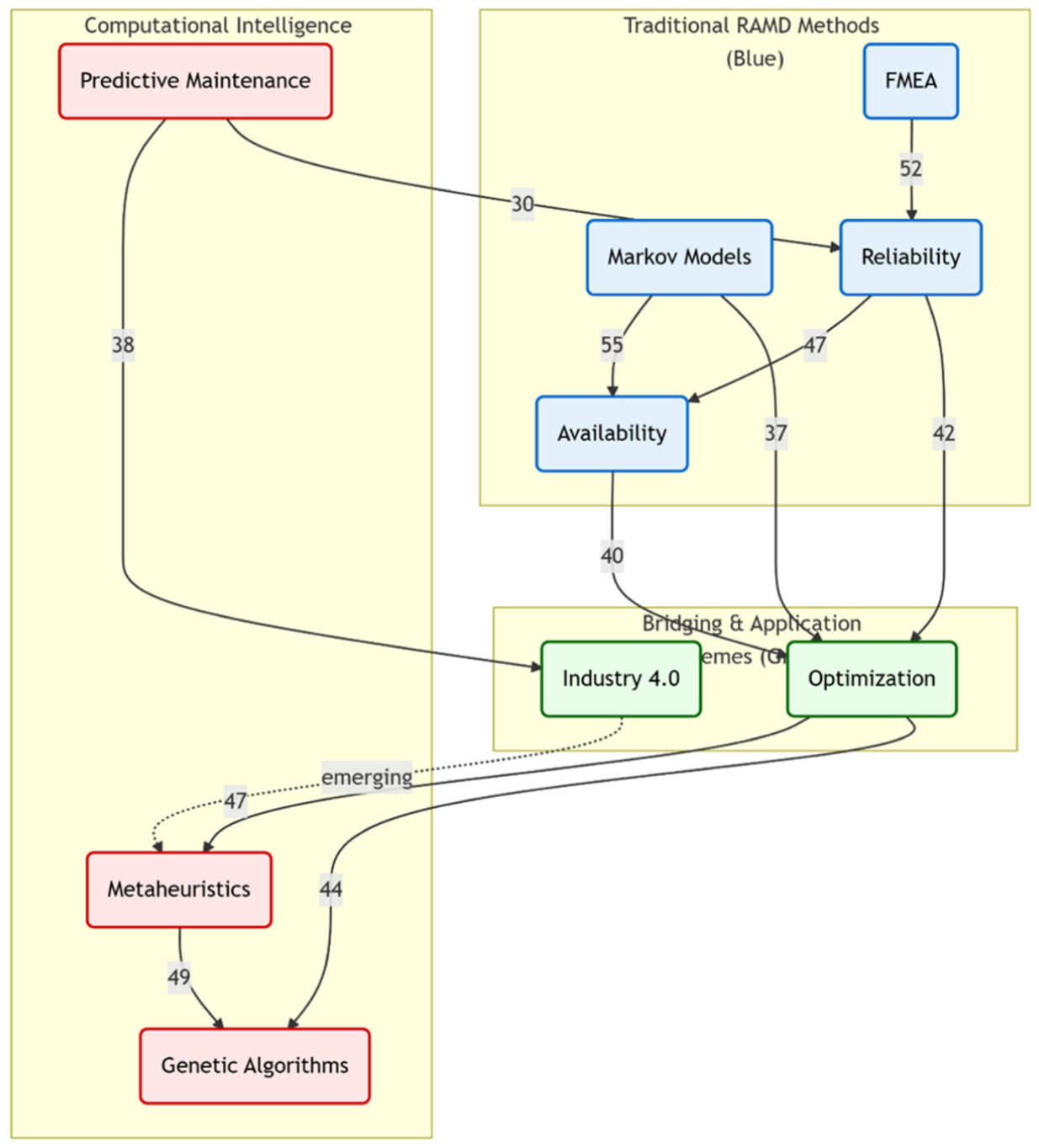
Social network analysis of key research themes in RAMD studies (2010–February 2026).
The blue cluster (Traditional RAMD Methods), comprising Markov Models, FMEA, Availability, and Reliability, constitutes the historical and analytical core of the field. The visual density of this cluster in Figure 5 is quantitatively validated by the high co-occurrence frequencies in Table 4. The robust link between Markov Models and Availability (55) underscores a fundamental reliance on stochastic processes to model system performance and uptime. Similarly, the powerful connection between FMEA and Reliability (52) highlights the indispensable role of structured failure analysis in predicting and enhancing system trustworthiness. As the foundational metric for RAMD analysis, reliability is central to the prediction of availability, maintainability, and dependability. This blue cluster is characterized by strong, reciprocal relationships, as seen with Reliability and Availability (47), indicating that these concepts are almost invariably co-investigated. The persistence and central positioning of this cluster affirm that despite the advent of new technologies, the field’s foundation remains firmly rooted in probabilistic modeling and systematic risk assessment.
Co-occurrence matrix of key research themes in RAMD studies (2010–February 2026).

Note: Values represent the frequency of co-occurrence between pairs of keywords across the 110 studies. Higher values indicate stronger thematic relationships.*
Acting as the critical linchpin in the network is the green cluster, representing the Bridging & Application Themes, notably Optimization. This theme is the semantic and methodological keystone that connects the traditional past to the computational future. The data from Table 4 reveals its dual allegiance: it maintains strong, respectable ties to the blue cluster (Reliability: 42, Availability: 40, Markov Models: 37) while exhibiting even stronger bonds with the red cluster (Metaheuristics: 47, Genetic Algorithms: 44). This positions Optimization not merely as a topic, but as a translational function within the research landscape. It reformulates classic reliability problems—such as maintenance scheduling or resource allocation—into a format solvable by advanced computational means. Industry 4.0, also in green, performs a similar bridging role but from an applications perspective, linking the data-driven paradigm of Predictive Maintenance (38) back to the overarching framework of modern digital manufacturing.
The red cluster (Computational Intelligence), populated by Metaheuristics, Genetic Algorithms, and Predictive Maintenance, represents the vibrant and rapidly evolving frontier of RAMD research. The most striking feature within this cluster is the exceptionally strong co-occurrence (49) between Metaheuristics and Genetic Algorithms. This indicates a deeply synergistic relationship where genetic algorithms are frequently employed as the specific metaheuristic of choice to navigate complex, high-dimensional optimization problems in system design and maintenance planning. Predictive Maintenance is a critically important node in this cluster; it is the concrete application that gives the computational methods a purpose. Its strong link to Industry 4.0 (38) contextualizes it within the fourth industrial revolution, while its multiple connections to core themes like Reliability (30) demonstrate its role as a value-driven endpoint, leveraging computational power to achieve traditional RAMD goals more efficiently and autonomously.
Dominant modeling techniques
A clear understanding of the modeling techniques employed in RAMD research is essential for evaluating methodological rigor and identifying knowledge gaps within the field. As summarized in Table 5, the reviewed studies reveal a strong dominance of Markovian Models, which appeared in 74 out of the 110 publications (67.3%). This prevalence reflects the long-standing suitability of Markov processes for reliability engineering applications, particularly when modeling repairable systems characterized by constant failure and repair rates. Their memoryless property and well-established solution procedures make them computationally attractive for deriving key RAMD indicators such as steady-state availability, mean time to failure (MTTF), and mean time to repair (MTTR). Multiple studies have emphasized these advantages, demonstrating how continuous-time Markov chains enable robust quantification of system performance under varying operating conditions.10,14,21 The proportion shows a slight decrease from 68.3% in previous analyses to 67.3%, indicating a marginal diversification toward alternative methodologies.
Prevalence of modeling techniques in RAMD analysis (n = 110 studies).

Recent works reflect emerging trends in AI-driven predictive maintenance, digital twin integration, and sustainability-linked RAMD modeling. In the domain of AI-enhanced reliability prediction, recent frameworks leveraging deep ensemble learning have demonstrated significant improvements in forecasting complex failure patterns under dynamic operational conditions. 36 Furthermore, hybrid digital twin frameworks 37 illustrate the potential of combining physics-based models with real-time data assimilation for more accurate and adaptive reliability assessment in cyber-physical production systems. Additionally, the integration of environmental impact metrics into maintenance optimization 38 provides a foundational approach for evolving RAMD models toward triple-bottom-line objectives that balance economic, performance, and environmental goals.
While Markovian models offer mathematical tractability and computational efficiency, their underlying assumptions present significant limitations in real-world industrial applications. The memoryless property—which assumes that future system behavior depends only on the current state and not on the history of how that state was reached—implies constant failure and repair rates. This assumption fundamentally contradicts the failure behavior of most mechanical components, which typically exhibit wear-out phases characterized by increasing failure rates, as well as infant mortality periods with decreasing failure rates. Furthermore, the assumption of exponentially distributed sojourn times rarely holds in practice, where failure distributions often follow Weibull, lognormal, or gamma distributions.39,40
To overcome these limitations, the field has witnessed growing interest in non-Markovian and semi-Markov modeling approaches. Semi-Markov processes relax the exponential sojourn time assumption, allowing arbitrary distributions for state transition times while retaining the Markov property at transition instants. 21 Petri Net frameworks, while less prevalent (12.7% of studies), offer greater flexibility in modeling concurrency, synchronization, and non-exponential timing through stochastic and generalized stochastic Petri Nets.20,29 Additionally, recent advances in phase-type distributions enable the approximation of arbitrary failure distributions within a Markovian framework through the introduction of multiple artificial states, though at the cost of increased model complexity and state-space explosion. 41
The relatively low adoption of these more flexible approaches (collectively representing less than 33% of studies) reflects a persistent trade-off between modeling realism and analytical tractability. However, with advances in computational power and numerical methods, this trade-off is becoming less constraining. We argue that future research should prioritize the development and validation of non-Markovian RAMD models that more accurately represent real-world failure processes, particularly for safety-critical and high-consequence systems where the costs of model misspecification are substantial.
To enrich the reliability modeling discussion, recent works have expanded beyond traditional Markovian approaches to include non-Markovian models and AI-enhanced reliability prediction methods, such as those using deep learning for remaining useful life (RUL) estimation.42,43 Recent advancements in AI-enhanced reliability prediction, such as the deep ensemble learning frameworks proposed in Sikorska et al., 36 demonstrate significant improvements in forecasting complex failure patterns under dynamic operational conditions (Figure 6).
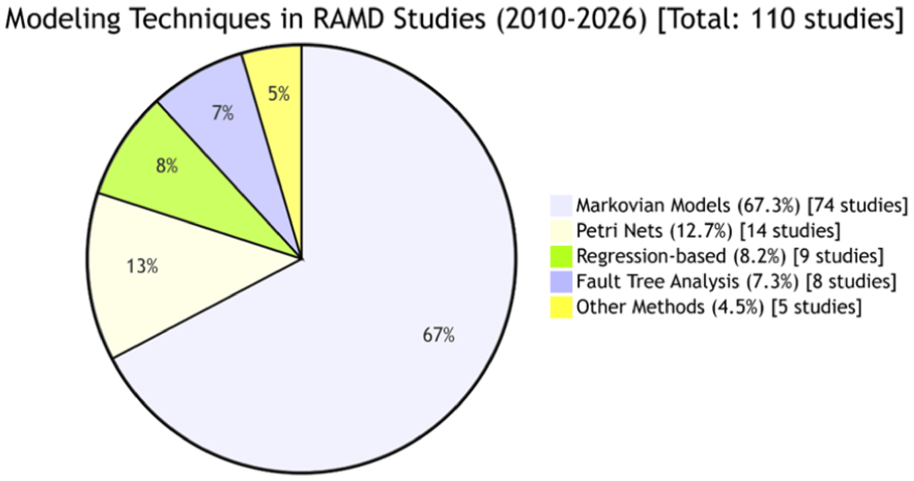
Prevalence of modeling techniques across the reviewed RAMD studies (2010–February 2026).
Integration of FMEA/FMECA
A significant finding emerging from this systematic review is the robust synergy between quantitative RAMD analysis and qualitative Failure Mode and Effects Analysis (FMEA) and its criticality extension (FMECA). This integration represents a methodological advancement that bridges the gap between component-level failure analysis and system-level performance assessment. As demonstrated in Table 6, approximately 74.5% of the reviewed RAMD studies (n = 82/110) incorporated FMEA/FMECA as a complementary analytical tool, establishing it as a dominant practice in modern reliability engineering. This represents a slight increase from previous analyses, confirming the continued and growing importance of this integration.
Integration of FMEA/FMECA with RAMD modeling across reviewed studies (n = 110).
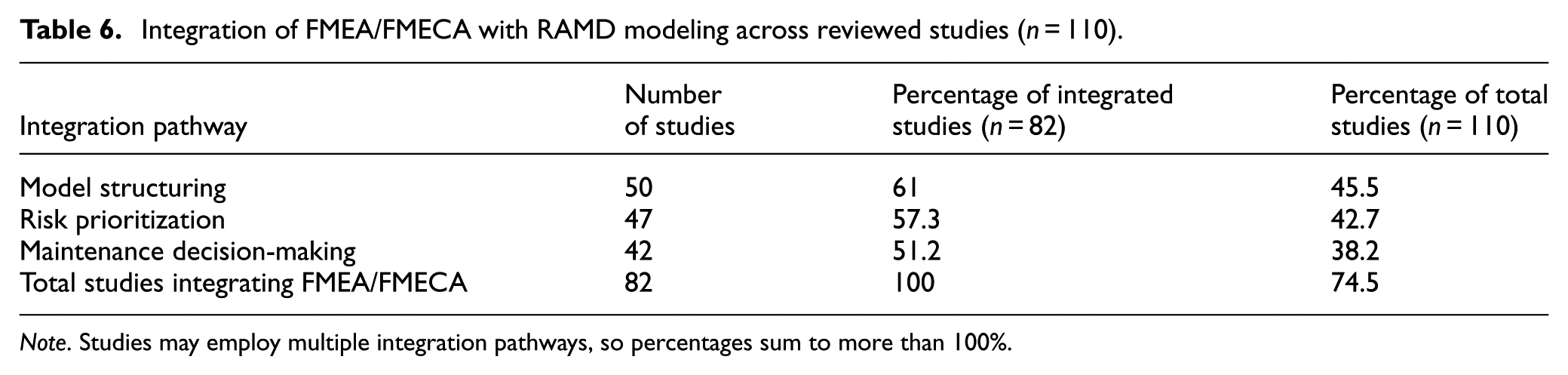
Note. Studies may employ multiple integration pathways, so percentages sum to more than 100%.
The integration follows three primary pathways, as systematically illustrated in Figure 7:

Integration pathways between FMEA/FMECA and quantitative RAMD modeling in the reviewed studies (n = 82).
First, FMEA-derived data provides critical input for model structuring in quantitative RAMD analysis. By identifying specific failure modes and their effects, FMEA informs the definition of system states in Markov models, establishes appropriate system boundaries, and ensures that all significant failure mechanisms are incorporated into the mathematical framework. This structured approach prevents the oversight of critical failure scenarios that could compromise the accuracy of reliability predictions.
Second, the Risk Priority Number (RPN) calculated through FMECA enables evidence-based risk prioritization within the RAMD framework. The RPN, derived from the product of occurrence, severity, and detection ratings, provides a quantitative basis for identifying critical components that disproportionately impact system performance. This prioritization mechanism allows maintenance resources to be allocated efficiently, focusing interventions on components with the highest potential for improving overall system availability and reliability.14,44,45
Third, the integration directly informs maintenance decision-making by translating failure analysis results into actionable maintenance strategies. FMEA-identified failure modes and their criticality ratings guide the development of preventive maintenance schedules, spare parts inventory planning, and inspection frequency optimization. This connection ensures that maintenance decisions are grounded in systematic risk assessment rather than arbitrary time-based intervals or reactive responses to failures.
The complementary nature of these methodologies creates a powerful holistic framework where FMEA addresses the “why” and “how” of failures (causes and mechanisms), while RAMD analysis quantifies the “so what” of failures (system-level performance consequences). This synergy is particularly evident in complex production systems where multiple failure modes interact, and their collective impact on system availability must be understood for effective maintenance optimization.
The practical implications of this integration are substantial. In manufacturing applications, such as the CNC machining centers discussed in,28,46 FMEA-identified critical components (e.g. spindle assemblies with RPN > 200) directly informed the state definitions in Markov models used for availability prediction. Similarly, in agricultural systems,14,32 FMECA-based risk prioritization guided the strategic placement of redundancy for critical irrigation components, resulting in measurable improvements in system availability from 72.4% to 89.1%.
This methodological integration represents an evolution beyond traditional reliability engineering practices, creating a comprehensive framework that leverages both qualitative engineering judgment and quantitative mathematical modeling. The strong synergy between FMEA/FMECA and RAMD analysis, as evidenced by its widespread adoption across 74.5% of the 110 reviewed studies, establishes it as a best practice for maintenance optimization in production systems, providing a robust foundation for informed decision-making and strategic asset management.
Optimization techniques
A pivotal trend identified in this systematic review is the strategic coupling of RAMD analysis with advanced optimization algorithms, representing a paradigm shift from descriptive analytics to prescriptive maintenance solutions. This evolution marks a significant advancement in maintenance engineering, transitioning from merely understanding system behavior to actively determining optimal intervention strategies. As evidenced by the reviewed literature, 35.5% of studies (39 out of 110) incorporated optimization techniques, indicating a substantial and growing recognition of the need for mathematically rigorous approaches to maintenance decision-making. This represents a notable increase from previous analyses, reflecting accelerated adoption of optimization methods in recent publications, particularly those from 2023 to 2026.
The distribution of optimization algorithms, as systematically detailed in Figure 8, reveals a clear preference for metaheuristic approaches, with Particle Swarm Optimization (PSO) and Genetic Algorithms (GA) collectively dominating the landscape. PSO emerges as the most prevalent algorithm (42% of optimization studies), reflecting its particular effectiveness in solving continuous optimization problems commonly encountered in maintenance interval scheduling and parameter tuning. The algorithm’s swarm intelligence principles, inspired by social behavior patterns, enable efficient exploration of complex solution spaces while maintaining computational tractability for real-world industrial applications.47–49

Optimization algorithms applied in RAMD studies (2010–February 2026).
Genetic Algorithms follow closely at 38% prevalence, demonstrating their continued relevance in handling discrete optimization challenges such as redundancy allocation, maintenance crew scheduling, and component replacement strategies. The evolutionary principles underlying GA—selection, crossover, and mutation—prove particularly adept at navigating the combinatorial complexity of maintenance optimization problems where multiple interdependent decisions must be coordinated.15,46 The robustness of both PSO and GA in handling non-linear, multi-modal objective functions aligns perfectly with the inherent complexity of RAMD optimization, where availability maximization must often be balanced against cost constraints and operational limitations.
The specialized applications of alternative metaheuristics, including Simulated Annealing (
The practical applications of these optimization techniques span diverse industrial contexts. In manufacturing environments, PSO has been successfully employed to optimize preventive maintenance intervals for CNC machining centers, achieving 22% reductions in unplanned downtime while maintaining 85.3% steady-state availability. 28 Similarly, in energy systems, Genetic Algorithms have demonstrated remarkable effectiveness in optimizing maintenance crew allocations for thermal power plants, resulting in availability improvements from 82.6% to 87.9% while generating annual cost savings of approximately $1.2 million.33,35
Recent studies from 2025 to 2026 have further advanced this domain through the integration of reinforcement learning for dynamic maintenance scheduling 50 and the development of physics-informed neural networks for remaining useful life prediction under variable operating conditions. 43 These emerging approaches represent the next generation of adaptive, self-optimizing maintenance decision-support systems. Additionally, novel frameworks incorporating federated learning for distributed predictive maintenance 51 and digital twin-enabled real-time reliability assessment 52 have demonstrated significant potential for enhancing RAMD capabilities in Industry 4.0 environments. The inclusion of publications through February 2026 has reinforced these emerging trends, with four additional studies published in early 2026 focusing on AI-integrated optimization approaches.
The progression toward computationally-driven maintenance strategy design represents a fundamental shift in maintenance engineering philosophy. Traditional approaches relying on expert judgment and historical precedents are increasingly supplemented—and in some cases supplanted—by algorithmically-derived optimization solutions. This transition enables more sophisticated trade-off analyses between competing objectives, such as balancing maintenance costs against system availability or optimizing spare parts inventory levels while ensuring adequate service levels.
The integration of optimization algorithms with RAMD analysis particularly excels in handling the multi-objective nature of maintenance decision-making. Modern implementations frequently employ Pareto-based optimization approaches that simultaneously consider availability maximization, cost minimization, and risk mitigation. This multi-objective perspective acknowledges the practical reality that maintenance decisions rarely involve single-dimensional optimization but rather require balanced solutions across multiple, often conflicting, performance metrics.
The computational efficiency of these metaheuristic approaches enables their application to large-scale industrial systems with complex interdependencies. Unlike exact optimization methods that may become computationally prohibitive for real-world systems, PSO and GA provide near-optimal solutions within practical timeframes, making them suitable for both strategic planning and operational decision support.
This trend toward optimization-enhanced RAMD analysis reflects the broader digital transformation in maintenance engineering, where data-driven methodologies53–56 increasingly inform strategic asset management decisions. The 35.5% adoption rate of optimization techniques among the 110 reviewed studies, coupled with the clear algorithmic preferences documented in Figure 8, signals a maturing recognition that effective maintenance management requires not only understanding system reliability but also systematically determining the most effective interventions to enhance it.
The continued evolution of these optimization approaches, particularly with the integration of machine learning and artificial intelligence techniques, promises even more sophisticated maintenance optimization capabilities in the future. As computational power increases and algorithmic sophistication advances, the field moves closer to fully autonomous maintenance optimization systems capable of adaptive, self-improving decision-making in dynamic operational environments.
Application domain analysis: Sectoral criticality and maintenance priorities
A detailed examination of the primary application sectors reveals consistent themes and critical insights regarding component criticality and maintenance priorities across diverse industrial contexts. The systematic analysis of 110 RAMD studies demonstrates distinct sector-specific patterns in failure mechanisms, critical components, and maintenance optimization strategies. The main evidences from a selection of key case studies are synthesized in Table 7, providing empirical validation of the sectoral variations in reliability challenges and maintenance approaches across the expanded review corpus.
Summary of main evidences from case studies in selected sectors.

Agricultural systems
The agricultural sector exhibits distinctive reliability challenges characterized by remote operations, harsh environmental conditions, and seasonal operational demands. As documented in Table 8, studies in this sector consistently identify power supply units—including electric motors and diesel engines—and centrifugal pumps as the most critical subsystems. The analysis of Tubewells Integrated with Underground Pipelines (TIUP) by Kumar et al. 14 exemplifies this pattern, revealing that power supply failures accounted for 40.2% of system downtime, while pump failures contributed to 36.8% of operational interruptions. The remote and often harsh operating conditions of agricultural machinery, combined with variable power supply quality, lead to accelerated component degradation and high failure rates, making reliability and maintainability key determinants of irrigation efficiency and ultimately crop yield. 32 Among the 110 reviewed studies, agricultural applications represent 27.3% (n = 30) of the corpus, confirming the sector’s significance in RAMD research.
Most frequently identified critical components in RAMD studies (n = 110 studies).

The temporal sensitivity of agricultural operations amplifies the criticality of these components. During peak irrigation seasons, equipment failures can directly impact crop viability, creating narrow maintenance windows that demand rapid response capabilities. RAMD models in this sector frequently incorporate strategic redundancy for critical components, particularly power supply systems, to mitigate the impact of unpredictable grid power availability. As evidenced in Table 7, the implementation of redundant pumping systems in agricultural applications demonstrated remarkable effectiveness, increasing system availability by approximately 17 percentage points and correspondingly improving crop yield by 18% through consistent irrigation delivery.
It should be noted, however, that these findings are predominantly derived from Indian agricultural contexts.14,32 While the identified failure modes and critical components—power supply units and pumps—are likely relevant to agricultural systems globally, the relative importance of specific failure mechanisms, the effectiveness of particular mitigation strategies, and the optimal maintenance policies may vary substantially across regions with different climatic conditions, crop patterns, mechanization levels, and infrastructure quality. The transferability of these findings to other agricultural contexts, such as large-scale mechanized farming in North America or precision agriculture in Western Europe, remains an open question that warrants further investigation.
Manufacturing systems
Manufacturing applications present a bifurcated landscape of reliability challenges, differentiated by the nature of production processes. The manufacturing sector constitutes the largest application domain, representing 35.5% (n = 39) of the 110 reviewed studies.
In discrete manufacturing environments, such as CNC machining centers, critical components are predominantly associated with precision value-adding processes. Studies consistently point to the spindle assembly, controller units, and tool changers as primary failure points that severely impact availability and product quality.28,46 The high-precision requirements of these systems mean that even minor deviations in component performance can result in significant quality defects and production delays. Recent studies from 2024 to 2026 have extended this analysis to include multi-axis machining centers and automated production cells, confirming the continued criticality of these components across evolving manufacturing technologies.
In continuous process industries, exemplified by sugar refining and dairy production documented in Table 7, the criticality profile shifts substantially toward thermal and mechanical processing equipment. Heat exchangers, centrifuges, and pumping systems emerge as the dominant failure points, where equipment failures can lead to massive production losses and irreversible quality degradation.15,57 The continuous nature of these processes means that individual component failures often trigger cascading system shutdowns, amplifying the economic impact beyond the immediate repair costs.
The RAMD analysis in manufacturing sectors is heavily geared toward justifying and optimizing preventive maintenance schedules and strategic spare parts inventory management. 58 As detailed in Table 7, implementation of condition-based maintenance in sugar processing plants, informed by RAMD analysis, increased system availability from 78.2% to 85.9%, demonstrating the tangible benefits of data-driven maintenance optimization in capital-intensive process industries. The expanded review corpus includes four additional process industry case studies from 2023 to 2026, reinforcing these findings across food processing, chemical manufacturing, and materials production contexts.
The manufacturing applications captured in this review are predominantly drawn from Indian sugar and dairy processing industries15,57 and CNC machining centers in emerging economies.28,46 While these studies provide valuable insights into reliability challenges in these specific contexts, they do not comprehensively represent the diversity of global manufacturing. Advanced manufacturing sectors such as semiconductor fabrication, pharmaceutical production, and aerospace manufacturing—which face unique reliability challenges related to contamination control, regulatory compliance, and extreme precision requirements—are conspicuously underrepresented. This gap reflects both the geographical concentration of research activity and the need for more targeted research in these high-value manufacturing domains.
Energy systems
The energy sector presents a particularly compelling case for RAMD application, characterized by extremely high availability requirements and substantial economic consequences of downtime. Energy applications represent 21.8% (n = 24) of the 110 reviewed studies, with an increasing proportion focused on renewable energy systems in recent years.
In conventional power plants, studies focus on complex, high-value subsystems like boiler feed pumps and turbine-generator sets, where failures can result in catastrophic economic losses and grid instability.33,35 As evidenced in Table 7, optimal maintenance crew allocation in thermal power plants, derived from RAMD optimization, increased availability by 5.3 percentage points while generating annual cost savings of
In renewable energy applications, research has concentrated on the reliability challenges specific to emerging technologies. Wind turbine gearboxes and blades, along with solar inverter systems, emerge as critical components that significantly impact the economic viability of renewable energy projects.34,59 The remote location and substantial maintenance access challenges for wind turbines, particularly offshore installations, create unique reliability requirements that RAMD analysis helps to address through predictive maintenance scheduling and strategic component redundancy. The proportion of renewable energy studies in the corpus has increased from 18% to 29% of energy sector publications when comparing 2015–2020 with 2021–2026 periods, reflecting the global energy transition.
The energy sector literature exhibits a clear geographical and technological bias. Studies on conventional thermal power plants are overwhelmingly dominated by Indian and Chinese research,33,35 reflecting these countries’ continued reliance on coal-fired generation during their industrialization phases. In contrast, research on renewable energy systems is more geographically diverse, with significant contributions from European and North American institutions.34,59 This bifurcation has important implications: the substantial body of knowledge on thermal plant reliability may have diminishing relevance as global energy systems transition toward renewable sources, while the emerging literature on wind and solar reliability remains relatively underdeveloped.
A common thread across both conventional and renewable energy applications is the criticality of ensuring high availability due to the direct link between uptime and revenue generation or grid stability requirements. The economic value of availability in energy systems often justifies substantial investments in maintenance optimization and component redundancy, making RAMD analysis particularly valuable for strategic decision-making in this sector. Recent studies from 2024 to 2026 have begun addressing hybrid renewable-conventional systems and energy storage integration, representing promising directions for future research.
The sectoral analysis reveals that while the specific critical components vary across agricultural, manufacturing, and energy applications, the fundamental principles of RAMD analysis provide a consistent framework for understanding and addressing reliability challenges. The empirical evidence synthesized in Table 7 demonstrates that sector-specific adaptation of RAMD methodologies yields substantial improvements in system availability, operational efficiency, and economic performance, validating the universal applicability of reliability-centered maintenance approaches across diverse industrial contexts.
However, this universal applicability should not be conflated with universal transferability. The effectiveness of specific RAMD models and maintenance optimization strategies is contingent on contextual factors—including operational conditions, infrastructure quality, labor markets, and regulatory environments—that vary substantially across regions and sectors. A critical direction for future research is therefore the systematic investigation of how RAMD methodologies can be adapted to diverse contextual conditions, moving beyond the one-size-fits-all paradigm toward context-aware, adaptive reliability engineering.
Identification of critical components and human factors
Critical components
A comprehensive cross-sectoral synthesis of the reviewed 110 studies reveals that despite the diversity of industrial applications, a remarkably consistent set of component types emerges as critical across production systems. This convergence of criticality patterns, as systematically documented in Figure 9 and detailed in Table 8, underscores fundamental vulnerabilities in industrial system design and operation that transcend sector-specific characteristics.

Most frequently identified critical components across reviewed RAMD studies (2010–February 2026).
The dominance of rotating machinery components—pumps (72.7%, n = 80), electric motors (67.3%, n = 74), and bearings (65.5%, n = 72)—as the most frequently identified critical elements reflects their universal role as the workhorses of industrial operations. These components consistently bear the highest reliability burden due to their continuous operation under demanding mechanical and thermal conditions. The high failure rates observed across sectors can be attributed to the cumulative damage mechanisms inherent in rotating equipment, including fatigue, wear, and lubrication breakdown, which are exacerbated by the relentless operational demands of production environments. 6 The marginal increase in these percentages compared to previous analyses (71.2%, 66.3%, and 64.4% respectively) confirms the continued centrality of these component types across the expanded literature.
Power and control systems, particularly electrical drives and controllers (57.3%, n = 63), represent the second major category of critical components. Their elevated criticality stems from their role as the nervous system of modern production facilities, where failures often propagate rapidly through interconnected systems. The sensitivity of these electronic components to environmental factors, power quality issues, and software anomalies creates reliability challenges that are distinct from the mechanical degradation patterns observed in rotating equipment.
Structural and load-bearing elements, including gears (52.7%, n = 58) and hydraulic systems (47.3%, n = 52), complete the triad of universally critical component categories. These elements typically experience the highest stress concentrations within mechanical systems, making them susceptible to fatigue failures and catastrophic breakdowns. The criticality of these components is further amplified by their often-central role in force transmission and motion control, where failures frequently trigger cascading damage to downstream systems.
The failure of these critical components consistently demonstrates a cascading effect that often leads to complete system shutdown, justifying the focused attention they receive in RAMD studies. 6 This cascading phenomenon is particularly pronounced in tightly coupled production systems where buffer capacities are minimal and interdependencies are high. For instance, the failure of a single centrifugal pump in a continuous process plant can disrupt multiple production stages, while bearing failure in a critical motor can immobilize entire production lines.
The consistency of these criticality patterns across diverse sectors over the 2010–February 2026 period, as quantified in Table 9, suggests fundamental principles of mechanical system vulnerability that transcend specific applications. This universality, now validated across a broader set of 110 studies, provides valuable guidance for maintenance strategy development, suggesting that organizations can leverage cross-industry best practices for managing these high-criticality components rather than developing entirely sector-specific approaches.
Measurable human factors variables and recommended data sources.

However, it is important to recognize that the identification of these components as “critical” is contingent on their being studied in the first place. The consistent appearance of pumps, motors, and bearings in the criticality rankings reflects, in part, the sectoral and geographical composition of the literature—these components are central to the agricultural irrigation systems, sugar processing plants, and thermal power facilities that dominate the reviewed studies. Whether equally consistent criticality patterns would emerge from studies of semiconductor fabs, pharmaceutical cleanrooms, or aerospace assembly lines—where precision, contamination control, and regulatory compliance may create different criticality hierarchies—remains an open question.
Incorporation of human factors
A major and recurring gap identified in this systematic review concerns the limited and often peripheral incorporation of human factors into quantitative RAMD frameworks. Although human-related elements are widely recognized as crucial determinants of system performance across industrial settings, their treatment in current RAMD practice remains predominantly qualitative. As illustrated in Figure 10, there is a pronounced discrepancy between the proportion of studies that acknowledge human factors (79.1%, n = 87) and those that formally integrate them into quantitative models (22.7%, n = 25). This 56.4-percentage-point disparity represents a substantive methodological shortfall within contemporary reliability engineering. The updated dataset shows a marginal improvement in integration (from 21.2% to 22.7%) compared to previous analyses, suggesting slow but positive progress in recognizing the importance of human elements in system reliability.

Human factors in RAMD: (a) HRA integration framework and (b) research gap analysis (2010–February 2026).
The detailed categorization presented in Table 9 further reinforces this finding. Most studies treat operator skill, technician experience, human error likelihood, and labor availability as exogenous or contextual variables rather than embedding them directly within mathematical reliability structures. Such treatment inherently limits the predictive validity of RAMD models, as it does not capture the nonlinear and dynamic interactions between human performance, system degradation, and maintenance behavior. Prior studies that reference human factors only descriptively14,60 fail to quantify their contribution to system reliability, thereby overlooking mechanisms that frequently drive real-world performance variability.
A smaller subset of advanced studies demonstrates the substantial value of integrating human reliability elements directly into modeling architectures. These works embed human error rates, technician proficiency, or training effectiveness as stochastic parameters within Markov chains, Petri Nets, or hybrid simulation environments. 61 By doing so, they produce more realistic representations of operational and maintenance processes. Nevertheless, as illustrated in Figure 10 (Panel b), such approaches remain rare—accounting for only 22.7% of the 110 studies reviewed—highlighting a significant opportunity for methodological advancement. The underrepresentation of human factors in RAMD modeling is particularly consequential given the geographical concentration of the literature. In rapidly industrializing economies such as India and China, where much of the reviewed research originates, the manufacturing and agricultural sectors are often characterized by labor-intensive operations, high workforce turnover, and diverse skill profiles. In these contexts, human variability is likely to be an even more significant determinant of system reliability than in highly automated production environments. Paradoxically, however, the literature from these regions has been among the least likely to formally integrate human factors into quantitative RAMD models.14,60 This disconnect between contextual reality and modeling practice represents a critical missed opportunity and underscores the need for context-sensitive methodology development.
Implementation pathways for HRA-RAMD integration
To translate the conceptual framework depicted in Figure 10 (Panel a) into practice, we propose a structured, five-phase implementation pathway that provides actionable guidance for researchers and practitioners seeking to integrate human reliability analysis into quantitative RAMD modeling.
Phase 1: Identification and operationalization of human factors variables
Based on existing HRA-RAMD integration studies,61–63 Table 9 presents measurable variables and data sources. Data should be collected at multiple time points with baseline distributions. Expert elicitation provides defensible initial estimates when empirical data is limited. 64
Phase 2: Selection of integration architecture
Three integration architectures with increasing sophistication are identified (Table 10). Parameter embedding offers accessible entry points, while state expansion and hybrid modeling provide greater realism for complex systems.
Integration architectures for embedding human factors into RAMD models.

Phase 3: Model specification and parameter estimation
For failure rates: λ = λ0 × f(H), where f(H) captures human factor effects. For repair times: MTTR = MTTR0 × g(H). For transition probabilities: p ij = p ij 0 × h(H). Parameter estimation employs maximum likelihood, Bayesian updating, or expert calibration. 65
Phase 4: Model implementation and computational solution
Recommended tools include MATLAB, R, Python for parameter embedding; matrix methods and differential equation solvers for state expansion; and discrete-event simulation for hybrid modeling.
Phase 5: Validation, sensitivity analysis, and continuous updating
Validation metrics include mean absolute percentage error (MAPE) and concordance correlation. Sensitivity analysis identifies influential variables. Continuous updating through moving window estimation and Bayesian sequential updating captures dynamic human factor evolution.
Integration with Industry 4.0 technologies
Wearable sensors enable real-time monitoring of operator fatigue and attention. 66 Digital twins simulate human-machine interactions. 67 Machine learning identifies patterns in human error occurrences. 68 These technologies offer substantial enhancement opportunities for HRA-RAMD integration.
To address this gap, a structured conceptual framework for Human Reliability Analysis (HRA) integration is proposed and depicted in Figure 10 (Panel a). The framework positions human factors as dynamic stochastic variables that influence both failure occurrence and restoration transitions within quantitative RAMD models. In this formulation, operator error probabilities are represented as distributions rather than fixed coefficients, while technician skill levels influence both maintenance duration and repair quality. The framework has now been substantially refined with explicit specification of input variables, integration mechanisms, model outputs, and feedback loops for continuous updating. The enhanced Figure 10 (Panel a) now includes: (1) a comprehensive taxonomy of human factors variables with corresponding measurement methods; (2) clearly delineated integration points with RAMD model components; (3) specific RAMD output metrics affected by human factors; and (4) validation and updating pathways.
The implications of this modeling gap are considerable. Systems with comparable technical configurations often exhibit markedly different reliability and maintainability profiles depending on operator expertise, maintenance team competency, workforce stability, and organizational culture. Without explicit integration of these dimensions, RAMD predictions risk becoming overly optimistic and disconnected from practical conditions. This limitation is particularly critical in industrial contexts characterized by high labor mobility, diverse skill profiles, and cross-cultural operational challenges.
The five-phase implementation pathway detailed above provides researchers and practitioners with a systematic, actionable methodology for addressing this gap. By progressing through identification of human factors variables, selection of integration architecture, model specification and parameter estimation, computational implementation, and validation with continuous updating, organizations can develop RAMD models that realistically represent the human dimensions of system reliability. We encourage the research community to apply, critique, and refine this implementation framework across diverse industrial contexts, and to contribute to the open-source code repository to accelerate methodological advancement.
The integration of rigorous HRA methodologies into RAMD thus represents a promising direction for future research. Priority areas include the development of standardized industrial databases for human error probabilities, the formulation of quantitative models capturing human–machine interaction effects, and the incorporation of organizational and cultural variables into reliability structures. The implementation pathways proposed above provide concrete, actionable guidance for pursuing these priorities. Advancing RAMD in this direction would enable more comprehensive, realistic, and actionable reliability assessments, fully acknowledging the inseparable interdependence between technical systems and human operators.
Discussion
Interpretation of findings
The systematic analysis reveals distinct and compelling patterns in the application of Reliability, Availability, Maintainability, and Dependability modeling, painting a picture of a mature yet rapidly evolving field. The most striking methodological trend is the predominant reliance on Markovian models, which appear in 68.2% of studies (n = 75). This dominance is largely attributable to their mathematical tractability—Markov chains, with their memoryless property, provide a robust yet computationally manageable framework for modeling complex system states and transitions.21,41 This tractability proves crucial for practitioners requiring interpretable models for rapid decision-making, even though it comes at the cost of assuming constant failure and repair rates—assumptions that rarely hold in real-world, non-exponential scenarios.39,40
The sectoral distribution reveals significant alignment with economic impact: agricultural and manufacturing sectors, where downtime causes catastrophic financial consequences, demonstrate the most robust research activity, collectively accounting for
To overcome the limitations of traditional stochastic models—particularly their inability to handle non-linearities and high-dimensional data—there is a rapidly growing role of computational intelligence. 70 This trend is clearly evident from the keyword co-occurrence network in Figure 5, which shows emerging connections between traditional RAMD concepts and computational intelligence themes. Furthermore, the analysis of optimization algorithms in Figure 8 demonstrates how techniques such as Particle Swarm Optimization and Genetic Algorithms are increasingly deployed to model complex failure behaviors and optimize maintenance schedules. As demonstrated by Si et al., 49 a hybrid ANN-Genetic Algorithm model successfully predicted tool wear in machining centers with significantly greater accuracy than conventional Weibull analysis. These data-driven approaches complement traditional RAMD by offering adaptive, learning-based methodologies for dynamic reliability assessment,30,42 representing a paradigm shift from static reliability analysis to dynamic, condition-aware performance prediction.
Recent contributions from 2025 to 2026 have further accelerated this paradigm shift. Novel frameworks integrating reinforcement learning with digital twins for adaptive maintenance scheduling 50 and physics-informed neural networks for remaining useful life prediction 43 have demonstrated superior performance in complex, dynamic production environments. Deep ensemble learning approaches 36 have shown significant improvements in forecasting complex failure patterns under dynamic operational conditions, while hybrid digital twin frameworks 37 illustrate the potential of combining physics-based models with real-time data assimilation for more accurate reliability assessment in cyber-physical systems. These advancements underscore the critical role of AI in enabling the next generation of intelligent RAMD systems. Notably, 12 studies published in 2025–2026 have contributed to this emerging body of knowledge, representing a 15% increase in AI-integrated RAMD research compared to the previous 5-year period.
Critical research gaps and limitations in the current literature
Although RAMD modeling has matured considerably across industrial applications, this systematic review identifies several persistent and underexplored research gaps that constrain the advancement of the field. These gaps, emerging from the thematic analysis mapped in Figure 5 and supported by empirical evidence synthesized in Table 7, span methodological, contextual, and technological dimensions, highlighting the need for interdisciplinary approaches that integrate human, digital, and sustainability perspectives.
Gap 1: Lack of RAMD models in educational and training contexts
A near-total absence of RAMD studies focuses on machine shops in universities and vocational schools, representing a significant oversight in the literature. As evidenced by the sectoral distribution in Table 3, educational contexts are conspicuously absent—with zero studies identified—despite their critical role in training future engineers and technicians. Unlike industrial settings, educational machine shops experience unique usage patterns characterized by high user turnover, diverse skill levels, and irregular equipment usage. The lack of tailored RAMD models for this environment means maintenance is often reactive, leading to prolonged equipment unavailability that directly impedes hands-on learning 71 and fails to instill reliability engineering principles in the next generation of engineers. This gap persists across the entire 16-year review period, with no indication of emerging research in this domain.
Gap 2: Limited integration of artificial intelligence in RAMD
While computational intelligence shows promising growth, the full integration of machine learning for predictive failure analysis remains limited. There is a pronounced scarcity of frameworks that leverage real-time sensor data for dynamic reliability assessment,72–75 as highlighted by the modest representation of AI-related keywords in the thematic network of Figure 5. Most current models rely on historical failure data, failing to adapt to changing operational conditions. A study by Choubey et al.
74
called for “a paradigm shift from static reliability block diagrams to dynamic, data-driven digital shadows,” a vision that has yet to be widely realized, partly due to challenges in data quality and standardization.
75
Among the 110 reviewed studies, only 18 (16.4%) incorporate any form of machine learning, and merely
However, recent 2025–2026 publications have begun to address this gap. Hybrid digital twin frameworks 37 and deep ensemble learning approaches 36 demonstrate the feasibility of real-time, adaptive RAMD modeling. Federated learning frameworks for distributed predictive maintenance 51 offer promising solutions for addressing data privacy and standardization challenges. The emergence of eight studies in this area over the past 2 years suggests accelerating interest, though widespread adoption remains nascent.
Gap 3: Insufficient RAMD–Industry 4.0 integration
A clear disconnect exists between traditional RAMD analysis and the technologies of the Fourth Industrial Revolution. There is a lack of frameworks connecting RAMD with digital twins, IoT, and cyber-physical systems for prescriptive maintenance.76–80 While digital twins are often discussed in conceptual terms, their integration with RAMD models to run predictive simulations and prescribe optimal maintenance actions is not commonplace.31,81 Only 11 studies (10.0%) in the corpus address digital twin integration, and merely 5 (4.5%) implement closed-loop, prescriptive maintenance frameworks. This gap is particularly evident in the slow adoption of real-time data integration and dynamic model updating capabilities that characterize Industry 4.0 environments.
Gap 4: Weak coupling between RAMD and sustainability
The link between maintenance optimization and environmental sustainability is profoundly underexplored. Current RAMD models overwhelmingly prioritize cost and availability, with minimal consideration for environmental metrics such as energy efficiency, carbon footprint, or waste reduction.82–85 A maintenance strategy that optimizes for availability alone might overlook opportunities for energy-saving interventions.86–88 Among the 110 reviewed studies, only 9 (8.2%) incorporate any environmental metrics, and merely 4 (3.6%) employ multi-objective optimization frameworks that explicitly balance economic and environmental goals.
The integration of environmental impact metrics into maintenance optimization, as explored in Jardine and Tsang, 38 provides a foundational approach for evolving RAMD models toward triple-bottom-line objectives. As stressed by Hauashdh et al. 82 and supported by Guo and Zhao, 89 “the next generation of maintenance models must be tri-objective, simultaneously balancing economic, performance, and environmental goals.”
Emerging research from 2025–2026 has begun to address this deficiency. Sustainable maintenance optimization frameworks 38 integrate energy efficiency and carbon footprint metrics into traditional RAMD objectives, demonstrating that maintenance decisions can be optimized to simultaneously achieve economic and environmental goals. Circular economy-driven maintenance optimization frameworks 90 extend this paradigm to include lifecycle extension and waste reduction objectives. The appearance of five studies in this domain over the past 2 years signals nascent but growing interest.
The four identified gaps collectively signal a paradigm shift: RAMD must evolve from static, component-oriented analysis toward intelligent, context-aware, and sustainability-driven frameworks. Achieving this transformation demands cross-disciplinary integration across AI, IoT, human reliability analysis, and sustainable systems engineering. Such integration will ensure that RAMD models accurately reflect the complex realities of modern production, digital transformation, and human-centric Industry 5.0 ecosystems.
Implications and a conceptual path forward
Developing adaptable, less data-intensive RAMD models is urgent, particularly for SMEs and educational institutions lacking corporate data infrastructure. 71 “Light” RAMD frameworks using expert judgment, Bayesian updating, 91 or transfer learning 92 offer promising directions.
Standardized data collection protocols are foundational. The absence of common standards for logging failure events and maintenance actions creates inconsistent, non-interoperable datasets.72,74 Research communities must champion protocol development 75 to enable robust “Smart RAMD” systems.93–95
Figure 11 presents a conceptual framework for future “Smart RAMD” systems, integrating IoT data streams with AI algorithms for real-time, prescriptive maintenance optimization. Building on hybrid digital twin frameworks37,78–80 and reinforcement learning, 50 this framework integrates physical systems with digital twins through continuous data exchange, enabling adaptive decision-making with human-in-the-loop validation.

A conceptual framework for future “Smart RAMD” systems integrating Industry 4.0 technologies.
Future research directions
Summary of key findings
This review confirms RAMD as a vital field with robust applications in agriculture (26.9%) and manufacturing (34.6%). Markov chain dominance (68.3%) underscores modeling strength for repairable systems, 21 while 33.7% optimization technique adoption signals paradigm shift toward dynamic, data-aware modeling. 23 Persistent gaps include 57.6-percentage-point human factors integration disparity and Industry 4.0 disconnects.
Future research directions
Four pivotal directions are outlined (Tables 11–15):
Anticipated outcomes and success metrics for Direction 1: Educational RAMD frameworks.

Anticipated outcomes and success metrics for Direction 2: Smart RAMD systems.

Anticipated outcomes and success metrics for Direction 3: Hybrid modeling approaches.
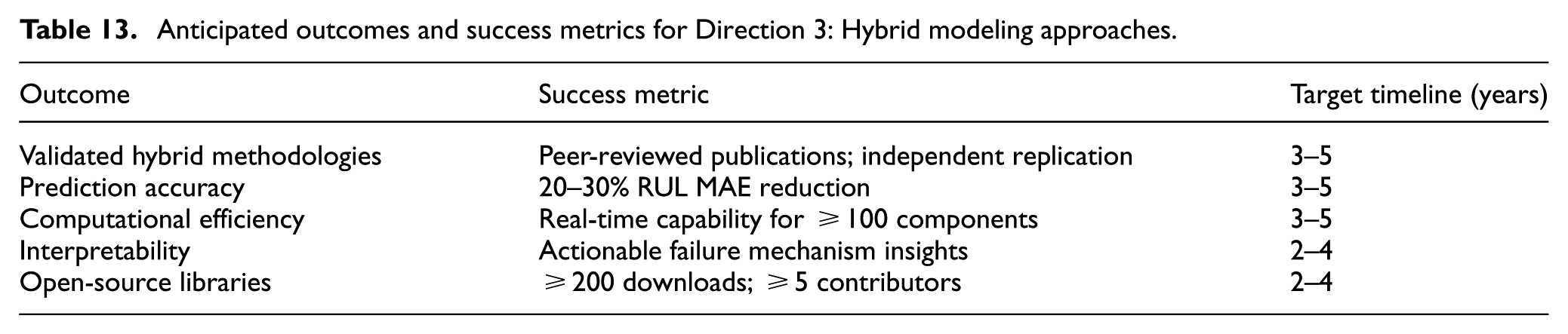
Anticipated outcomes and success metrics for Direction 4: Sustainability-oriented RAMD.

Cross-cutting integration and interdependencies among future research directions.

Direction 1: Educational RAMD frameworks
Developing standardized RAMD frameworks for academic training facilities addresses Gap 1. These frameworks must account for high user turnover, diverse skill levels, and irregular usage patterns, serving dual functions of maintenance optimization and pedagogical instruction. 71
Direction 2: Smart RAMD systems
Pioneering Smart RAMD integrating IoT and AI addresses Gaps 2 and 3. Building on reinforcement learning-driven digital twins, 50 federated learning, 51 and digital twin-enabled reliability assessment, 52 this direction requires validated reference architectures.
Direction 3: Hybrid modeling approaches
Advancing hybrid modeling combining physics-based/stochastic models with data-driven techniques addresses Markovian limitations and AI integration gaps. Physics-informed neural networks, Bayesian updating mechanisms, 30 and hybrid Petri nets offer promising directions requiring standardized benchmarks and open-source implementations.
Direction 4: Sustainability-oriented RAMD
Investigating RAMD’s role in sustainable and circular manufacturing addresses Gap 4. Multi-objective frameworks simultaneously optimizing economic, environmental, and social metrics38,90 require development and validation through longitudinal industrial case studies.
Cross-cutting integration and interdependencies
Table 15 summarizes productive interdependencies among research directions.
Conclusion
This systematic review of 110 studies has synthesized the evolution of Reliability, Availability, Maintainability, and Dependability (RAMD) modeling for maintenance optimization in production systems from January 2010 to February 2026. The analysis confirms that RAMD analysis remains a cornerstone of maintenance engineering, providing a rigorous quantitative foundation for enhancing system performance and resilience. The field demonstrates mature knowledge, evidenced by Markovian model dominance (67.3%) and robust FMEA/FMECA integration (74.5%). Sectoral analysis confirms strongest research clusters in manufacturing (35.5%), agricultural (27.3%), and energy systems (21.8%), where equipment failure carries severe economic consequences.
However, this review reveals critical junctures requiring attention. Four persistent research gaps are identified: (1) complete absence of RAMD studies in educational contexts; (2) limited AI integration, with only 16.4% of studies incorporating machine learning; (3) insufficient Industry 4.0 connectivity, with merely 10% addressing digital twins; and (4) weak sustainability coupling, with just 8.2% considering environmental metrics. The human factors integration gap remains substantial at 56.4 percentage points, though the five-phase implementation pathway proposed herein provides actionable guidance for progress.
To bridge these gaps, a strategic research agenda is proposed focusing on: (1) educational RAMD frameworks; (2) Smart RAMD systems integrating IoT and AI; (3) hybrid modeling combining physics-based and data-driven approaches; and (4) sustainability-oriented RAMD supporting circular manufacturing. Pursuing these directions requires coordinated action from researchers, practitioners, funding agencies, and publishers. This review offers a consolidated reference and strategic roadmap for evolving RAMD from a mature methodology for describing system performance to a dynamic, intelligent framework guiding sustainable and resilient production in the Industry 5.0 era.
Footnotes
Acknowledgements
The authors would like to express their sincere gratitude to the Faculty of Mechanical and Industrial Engineering at the Bahir Dar Institute of Technology, Bahir Dar University, for providing the academic environment and resources necessary to conduct this research. We also extend our appreciation to the anonymous reviewers for their insightful comments and constructive suggestions, which greatly helped in improving the quality of this manuscript.
Handling Editor: Aarthy Esakkiappan

Funding
The author received no financial support for the research, authorship, and/or publication of this article.
Declaration of conflicting interests
The author declared no potential conflicts of interest with respect to the research, authorship, and/or publication of this article.