



Abstract
This article examines how the geometric parameters of bulldozer blades affect operational performance. The study compares standard moldboards with adaptive blades featuring articulated sections and flexible inserts. Key characteristics of both traditional and flexible-insert blades are described, along with the experimental methodology applied to assess their performance. The research highlights approaches to increasing efficiency and reducing bulldozer energy consumption. A notable improvement is achieved with blades that have a variable cutting angle or a flexible front surface. Such elements represent complex mechanical systems whose parameters can be optimized under different working conditions. The work emphasizes enhancing bulldozer equipment within traditional technological frameworks, which involve relatively low costs compared to full machine modernization. The study analyzes soil movement resistance along the blade and cutting resistance under changing curvature. A theoretical assessment is provided for flat blades with flexible front inserts, supported by experimental results identifying optimal parameters for variable-curvature and variable-angle blades. Tests on physical models further confirm these findings. This research was supported by the Science Committee of the Ministry of Science and Higher Education of the Republic of Kazakhstan under grant AP22684640 –“Development of an Articulated Bulldozer Blade Design with Multi-Level Geometric Adjustment.”
Keywords
Introduction
An analysis of the mechanization of earthwork production in construction from 2015 to the present indicates that a significant portion of these operations (30%–35%) is carried out using various types of bulldozers and bulldozer blades, including an adaptable shape. 1
One of the promising directions for improving their efficiency at the current stage remains the enhancement of working elements, which significantly increases bulldozer productivity with relatively low additional capital investment.2–4
The development of bulldozer equipment follows several directions, one of which involves improving the blade shape in plan view. This optimization increases the volume of the prismoidal soil mass being dragged while reducing soil losses into lateral ridges and decreasing the energy consumption of the working process, for example, the use of articulated moldboards with obliquely positioned side sections or moldboards with a flexible insert.
This approach complements the trend of increasing the number of bulldozers mounted on high-power tractors.
The improvement of the most common non-rotating (frontal) moldboards is characterized by the development of new, well-proven, and efficient semi-spherical and spherical moldboards with various modifications. Their frontal surface consists of three sections: a central section positioned perpendicular to the bulldozer’s direction of movement and two outer sections angled forward relative to the central section. 5
The efficiency of spherical blades largely depends on several specific features of their interaction with soil, which must be considered when determining the main design parameters and their application areas. However, research on these aspects remains ongoing, as certain issues require further investigation. 6 These include the specialization of bulldozer working equipment, the improvement of blade surface profiles and blade shapes in plan view, the application of devices that reduce soil loss during excavation and transportation, and the development of working elements capable of optimizing parameters during operation depending on soil conditions.7–9
Various researchers emphasize the importance of improving the working process technology. For bulldozers, this can be achieved by reducing the energy consumption of excavation through improvements in the blade’s surface profile and plan-view shape. However, implementing a single optimal blade shape is challenging, as it must be adaptable to varying soil conditions and types of earthworks. The blade must not only meet the requirements for excavation operations but also for soil transportation, as its shape significantly influences bulldozer efficiency.
Currently, one of the most promising approaches to intensifying the bulldozer’s working process involves improving blade shape while utilizing traditional soil processing methods (cutting and excavation), where energy is transmitted to the blade through the propulsion system.
The development and implementation of non-rotating spherical bulldozer blades with multi-level geometric adjustments enable the realization of this approach using relatively simple means. The refinement of blade shape in plan view with multi-level geometric adjustments aims to reduce the energy consumption of the bulldozer working process while ensuring the movement of an increased prismoidal soil mass with minimal soil loss into lateral ridges.10–13
Influence of bulldozer blade geometric parameters on its performance
Issues related to the influence of geometric parameters of a bulldozer blade on its performance are among the most extensively studied topics since the advent of bulldozers. Consequently, they often require brief clarifications which, although obvious to specialists, facilitate the evaluation of new designs and their comparison with conventional constructions. The main distinction of the proposed design lies in the fact that, in traditional blades, the position (inclination) of the cutting edge and the curvature of the blade surface are structurally fixed. Such blades represent a rigid structure with constant parameters, the position of which relative to the ground surface during excavation is set by the operator and remains virtually unchanged throughout the entire soil-cutting cycle.
In contrast, a blade with a flexible moldboard surface is universal in design, combining the capability to simultaneously vary the blade inclination (cutting angle) and modify the curvature of the blade along its height. In this configuration, the blade profile conforms to the shape of the rising soil chip formed during excavation. Achieving such conformity reduces the energy required to overcome the resistance to chip movement and, ultimately, decreases the overall energy consumption of the soil-cutting process.
In certain cases, such as when deeper penetration is required, the curvature of the moldboard surface R can be forcibly adjusted using hydraulic cylinders. This enables stepless regulation of the cutting angle, thereby altering the shape of the removed soil chip and its sliding resistance along the blade surface. This effect is achieved through transverse bending of the blade, which may additionally increase the dragged soil prism.
The application of a flexible frontal surface on bulldozer blade working bodies ensures self-optimization of the moldboard profile during upward movement of the soil chip, reducing excavation energy consumption and leading to increased operational productivity. Well-known experimental and theoretical studies conducted by researchers such as A.N. Zelenin, V.I. Balovnev, A.A. Yarkin, G.N. Karasev, and others have demonstrated that all parameters of the bulldozer blade profile significantly affect the process of soil accumulation, the size and volume of the prismoidal soil mass being dragged, as well as the energy consumption of excavation and soil transportation. This effect becomes more pronounced when the soil structure is disturbed but remains valid for all moldboard profiles, including adaptable ones.3,4,14–16
If the blade profile parameters do not correspond to the soil conditions, the excavation process may occur without the movement of soil chips along the blade surface or with intermittent movement. The prismoidal mass may increase due to the fountain-like ejection of cut soil into the already accumulated soil mass or through the heaving of the entire soil volume in one or multiple zones. In such cases, the blade surface becomes almost entirely covered with soil. Most often, an improper excavation process is accompanied by soil spilling over the top edge of the blade. Similar phenomena may also occur if the blade height or cutting depth does not match the tractive effort of the base machine.17–20 Therefore, designers continue to develop bulldozer moldboards capable of adapting as efficiently as possible to various soil conditions.
The primary parameters of the blade profile include (Figure 1): B – blade length; H0– blade height without a deflector, or the vertical distance between the cutting edge of the central blade and the upper edge of the blade; α– cutting angle in the blade primary position (the angle between the horizontal plane and the front face of the cutting blades); β– overturning angle in the blade primary position, or the angle between the horizontal plane and the tangent to the upper edge of the blade; ε– for a standard moldboard – inclination angle in the blade primary position, or the angle between the horizontal plane and the line connecting the upper edge of the blade with the cutting edge of the central blade; for an adaptable moldboard – the installation angle of the side section in the vertical plane or the angle between the section plane and the horizontal plane; ε0– the installation angle of the hinge axes in the vertical plane parallel to the symmetry plane, where ε0 = 90° − γ0.

Geometric parameters: (a) traditional moldboard and (b) adaptive bulldozer moldboard with variable geometry.
Additional parameters of the blade profile include 21 :
H0′– blade height with a deflector, or the vertical distance between the upper edge of the deflector at its center and the cutting edge of the central blade; βk– deflector installation angle in the blade primary position, or the angle between the horizontal plane and the plane of the deflector; θ0– rear angle in the blade primary position, or the angle between the horizontal plane and the line connecting the cutting edge of the central blade with the most protruding structural element at the bottom on the rear side of the blade;
In Figure 2, it is clearly visible that when the side edges of the adaptive articulated bulldozer moldboard fold relative to the obliquely positioned hinges, the outer angles of the side sections rise above the horizontal, transforming the central section of the moldboard into a protruding central blade. This moldboard adaptation is particularly suitable for areas with varying soil strength.

Diagram of the main parameters of the articulated adaptive bulldozer moldboard with variable geometry.
The influence of each of the aforementioned parameters on the performance of the bulldozer blade has been determined.
The cutting angle significantly affects the excavation process and its energy consumption, as it determines the force required to separate soil from the mass and the vertical pressure needed for penetration at the cutting edge of the blade. 26
Depending on the cutting angle, different degrees of resistance force concentration occur at the lower part of the blade, influencing the formation and movement of the soil mass along the blade surface.27–30
Small cutting angles facilitate soil separation from the mass but make penetration difficult, as the possible specific pressure on the cutting edge decreases. The transition from the cutting section to the main blade surface becomes excessively steep, leading to soil adhesion and disrupting the chip formation and movement process. 31
Large cutting angles simplify blade penetration into the soil but significantly increase the force required to separate the soil from the mass and form a chip.
Existing blade designs, bulldozing technologies (such as trench excavation with abrupt slope changes), and materials used for blade cutting edges do not allow the use of very small cutting angles. Instead of the optimal 45°, a range of 50°–55° is recommended. 32
A cutting angle smaller than 55° may have a positive effect under certain soil conditions when other parameters are adjusted accordingly. However, in such cases, the specific vertical pressure on the blade cutting edge decreases significantly, reducing its penetration capability in heavy soil conditions. 33
Given the current structural solutions for the lower part of the blade and its cutting edges, it is not recommended to use a cutting angle smaller than 45°. The upper limit of the cutting angle for free blade penetration is 60°.
Adjusting the cutting angle – along with the overturning and inclination angles – during operation ensures effective blade performance.34,35 The recommended adjustment range for the cutting angle is ±20° for forced adjustment, ±5° for manual adjustment (Figure 3).

Examples of bulldozer moldboard configurations: (a) in the vertical plane and (b) in the horizontal plane.
Practical studies have shown that at moldboard rotation angles between 25° and 35°, the soil is poorly displaced to the side. In such cases, a bulldozer with a rotating blade has an advantage over a bulldozer with a non-rotating blade only in certain specialized tasks, such as terracing, excavation on slopes, and similar operations.
The soil is satisfactorily displaced only at blade rotation angles of 40°–45° and higher, which allow for the continuous movement of the bulldozer along the work front while performing various operations, including trench backfilling, leveling of embankments, spoil piles, and other similar tasks.
In the transport position, the forward shift of the bulldozer pressure center from the midpoint of the track support surface should not exceed 1/6 of the total track support length when the rippers are engaged. 36
For bulldozers with a rotating blade, a blade rotation angle of 40°–45° or more is recommended. Smaller angles should only be used if excessive pressure center displacement is unacceptable.
Determination of resistance to soil movement along the bulldozer blade and cutting resistance with curvature variation
The chip pressure on the moldboard depends on the physical and mechanical properties of the soil, the size of the dragging prism, and the moldboard profile shape, including adaptable designs.
Cutting resistance and the energy consumption of soil excavation are significantly influenced by the processes occurring as the cut soil moves within and ahead of the working element.
Professor V.I. Balovnev, in his research, conducted a comprehensive theoretical analysis of these processes. Through analytical methods, he derived a formula for determining the resistance to soil movement along the curved surface inside and ahead of the working element. The theoretical formulations were experimentally validated, confirming their accuracy.
For practical calculations, a generalized dependence for determining resistance to soil movement along a cylindrical sliding surface was recommended.

where δ– external friction angle; ρ– internal friction angle; H – height of the resistance surface; R – radius of curvature
The obtained dependency (1) provides a more substantiated basis for modernizing or selecting the sliding surface shape to achieve minimal resistance and better adaptation to the current soil conditions. 37
Analysis of equation (1) enabled the determination of soil movement resistance for various sliding surfaces, specifically curvature at the bottom, curvature at the top (Figure 4).

Dependence of resistance force on blade curvature
A reduction in the energy consumption of the excavation process can be achieved through the improvement of earthmoving machine working tools and their operating modes. This is accomplished by studying the interaction between the working tool and the soil. From the beginning of the 20th century to the present day, numerous studies have been conducted on soil-cutting processes, making it possible to establish the fundamental relationships for determining the resistance to motion of earthmoving machines and to develop recommendations for improving their working tools.
The pioneers of research into the interaction between earthmoving tools and soil did not have access to computer-based calculations; however, their experimental studies enabled the formulation of empirical equations for estimating cutting and digging resistances for specific blade types.
Nevertheless, empirical approaches have a significant limitation: for new working tools, experimental studies must be repeated and new empirical coefficients determined. In the equations proposed by N.G. Dombrovsky for calculating soil cutting and digging resistance, a specific cutting resistance coefficient multiplied by the cross-sectional area of the soil chip was used, while the physical nature of the process was not explicitly described. A.N. Zelenin proposed incorporating parameters such as blade width, cutting depth, cutting angle, blade thickness, and sharpening angle into the calculations, and suggested using the number of impacts measured by the DORNII dynamic penetrometer as the main indicator of soil strength.
A.N. Zelenin, followed by V.I. Balovnev and other researchers (Yu.A. Vetrov, K.A. Artemyev), proposed determining digging resistance forces using corrective analytical coefficients that account for the blade curvature radius, cutting angles, and angles of external and internal friction for each new blade design. In blades with a flexible moldboard surface, all of these parameters vary with changes in soil properties. Therefore, accounting for variations in the parameters affecting the final resistance forces is most conveniently performed (by analogy with A.N. Zelenin’s approach) using analytical coefficients Ai describing the pressure of the cut soil along the sliding surface:
A1 is determined analytically as a function of the cutting angle and the angles of external and internal friction between soil–soil and soil–metal interfaces, and varies for each of the three excavation modes of a bulldozer blade.
A2 is determined analytically as a function of the angles of external and internal friction and the blade blunting angle α
zt
within the range
The blunting angle of a bulldozer blade (which may also be referred to as the cutting or sharpening angle) is one of the key parameters determining operational efficiency. It characterizes the sharpness of the blade’s lower edge during soil penetration. This angle varies depending on blade type, bulldozer model, and soil conditions, typically ranging from 20° to 30°, and may be smaller for harder soils to facilitate penetration. Together with inclination and skew angles, it influences the formation of the soil drag prism, the volume of material moved, and the traction force required, thus forming the blade’s geometric parameters. The blunting angle is not fixed but is selected and adjusted during operation to achieve maximum efficiency based on soil conditions; smaller angles improve penetration but increase blade wear.
A3 is determined analytically as a function of the cutting angle and the external friction angle, which varies depending on the curvature radius of the moldboard surface.
A4 is determined analytically as a function of changes in the external and internal friction angles during soil chip movement along a blade with a variable curvature radius RRR.
Resistance to the movement of the soil layer along the newly developed flat moldboard with a flexible insert can be determined by simplifying Professor V. I. Balovnev’s formula for calculating resistance along a sliding surface with curvature at the bottom 38 :

Formula (2) allows for the determination of resistance to soil layer movement along the newly developed flat moldboard with a flexible insert under varying α and β angles, rather than only for a moldboard with fixed angles.
By incorporating recommendations provided by A.A. Yarkin, along with equation (2) and the schematic diagram in Figure 5, a modified formula was derived to calculate the resistance to soil movement along the new surface of a flat blade with a flexible insert, accounting for variations in angles α and β.
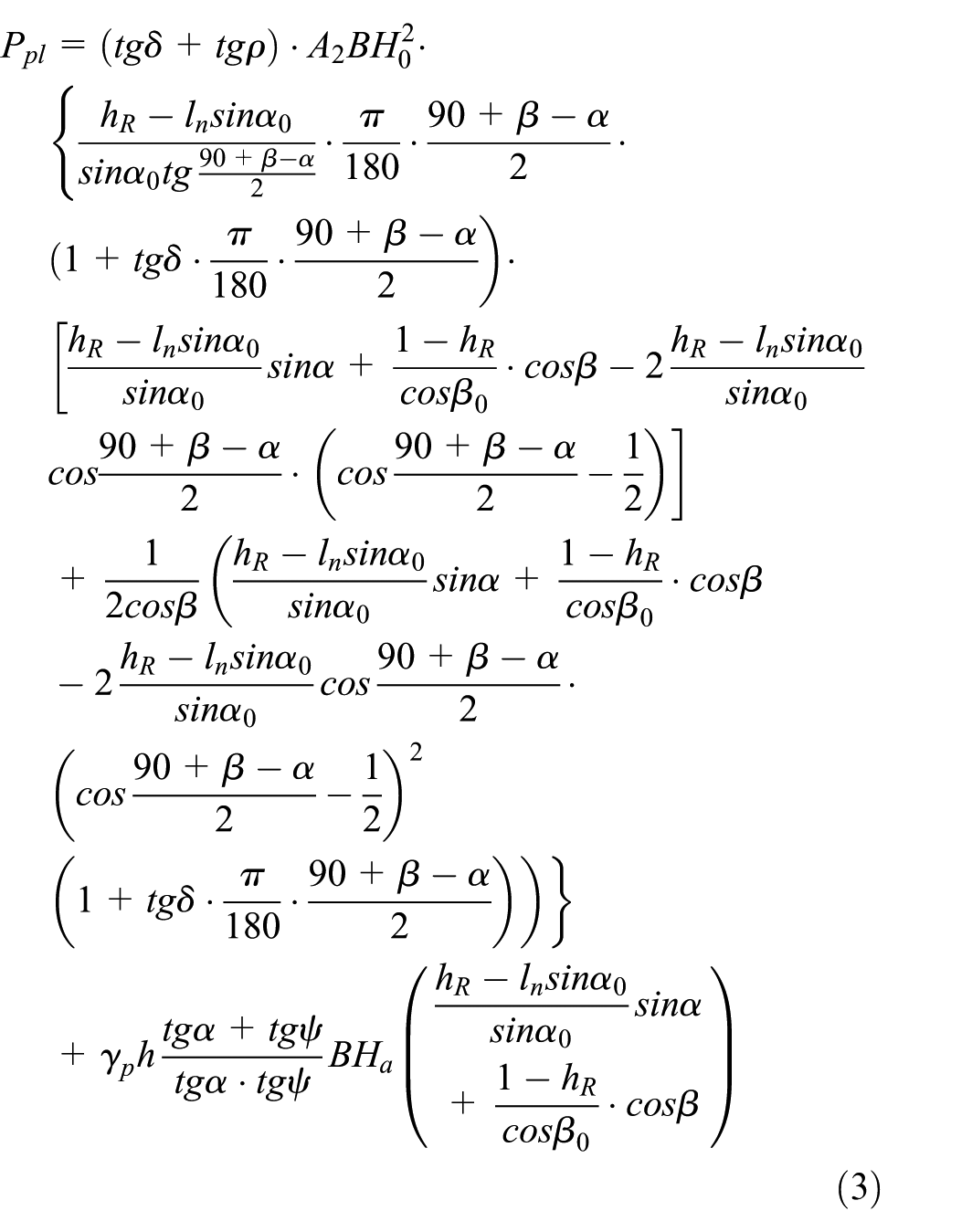
where α0– optimal cutting angle; α– current cutting angle; β0– optimal overturning angle; β– current overturning angle; H – blade height at optimal angles α0 and β0;h R – distance from the point of application of the resultant force to the cutting edge of the blade; h – cutting depth; l – blade length.

Geometric parameters of the newly developed flat blade with a flexible insert: α0– optimal cutting angle; α– current cutting angle; β0– optimal overturning angle; β– current overturning angle; H0– height at optimal angles α0 and β0;H0t– current blade height; hR– height of the application point of the resultant digging force; hsch– distance from the hinge to the end of the blade; ln– knife length; R0– radius of curvature at optimal angles α0 and β0; R_t – current radius of curvature; Hprt– current height of the straight section of the blade; Hkrt– current height of the curved section of the blade; H0max– maximum possible blade height when α ≠ 0 and β = 0.
Other notations are as previously defined. The geometric parameters of newly developed flat blade with a flexible insert are shown in Figure 5.
The resistance to soil movement along the blade is a key component of the total cutting resistance, which is determined using the methodology developed by Professor V.I. Balovnev. 3

where C – soil cohesion; γ– soil bulk density; Q – width of the displaced soil mass; A1– analytical coefficient.
Experimental studies using physical models of bulldozer equipment
The experimental research program comparing the articulated and the newly developed flat blade with a flexible insert to the traditional blade was divided into two stages.
The first stage of the program involved a screening experiment, aimed at determining the influence of the cutting angle (α) and overturning angle (β; ψ0 for the moldboard with a flexible insert) on the energy consumption of the excavation process using a flat blade. At this stage, experimental design theory was not applied. 39
The experiments were conducted in soil conditions characterized by dynamic densitometer impact count (DorNII construction): C = 6 impacts and moisture content: ω = 7%–8%.
Excavation was performed at a constant depth (h) to study the formation of the prismoidal soil mass being dragged. Excavation depth (h) varied within h = 5, 15, 30 mm. Model movement speed: 17 cm/s. Set values for angles: cutting angle (α): 30°, 55°, 70°; overturning angle (β): 0°, 7°, 15°, 30°.
Experiments for the traditional blade were conducted under the same soil conditions and cutting depths. The cutting angle remained constant at α = 55°, which corresponds to real operating conditions for such equipment.40,41
During the experiments, the following parameters were measured: excavation force (Pk), weight of the prismoidal soil mass in front of the blade, soil losses into lateral ridges and excavation path length.
The efficiency of the excavation process for each blade was evaluated based on its energy consumption under identical soil conditions, which were maintained using an equivalent soil model whose parameters remained constant throughout all experimental series.
The models of the developed soil were represented by three types:
dry sand with hardness C m = 1 impact and moisture content ω = 0%;
medium loam with C m = 7 impacts and ω = 6%–7%;
stiff loam with C m = 14 impacts and ω = 7%.
The excavation depth varied within the range of 5–25 mm. Blade models were used to excavate the first two soil types listed above at a cutting depth of h = 15 mm. The efficiency of the excavation process using a blade model with a sectional flexible insert and a protruding central knife (PCN; Figure 12b), compared with a blade with a solid flexible insert and PCN, was evaluated during the excavation of stiff soil with C m = 14 impacts at a cutting depth of h = 20 mm. For all experiments, the same excavation speed V = 0.15 m/s was adopted in order to assess the energy consumption of all blade designs under identical operating conditions.
Experimental repeatability required identical initial conditions to ensure reproducibility of the soil parameters. Dry sand retained its properties, such as moisture and hardness, over time; however, medium and stiff loams tended to dry during preliminary tests, requiring significant effort to maintain their initial properties. To eliminate this effect between experiments, an equivalent material simulating natural soil and maintaining stable properties throughout the experiments was used.
The adopted physical modeling methodology enables the study of interaction processes between the investigated blade design and soil using scaled models.
To ensure identical soil conditions with constant moisture and hardness in the multifactorial experiment, modeling was carried out using an equivalent soil medium. Similarity of its stress–strain state under the action of the model blade to that of the full-scale soil requires satisfaction of multiple similarity criteria: τ/(
Due to the complexity of producing equivalent materials that satisfy all similarity criteria, approximate modeling methods are most commonly applied. In this case, the primary parameter used to characterize soil strength similarity, with some approximation, is the number of impacts measured by a dynamic penetrometer (Tables 1 and 2).
Particle-size distribution of the equivalent soil.

Physical and mechanical properties of the equivalent soil.
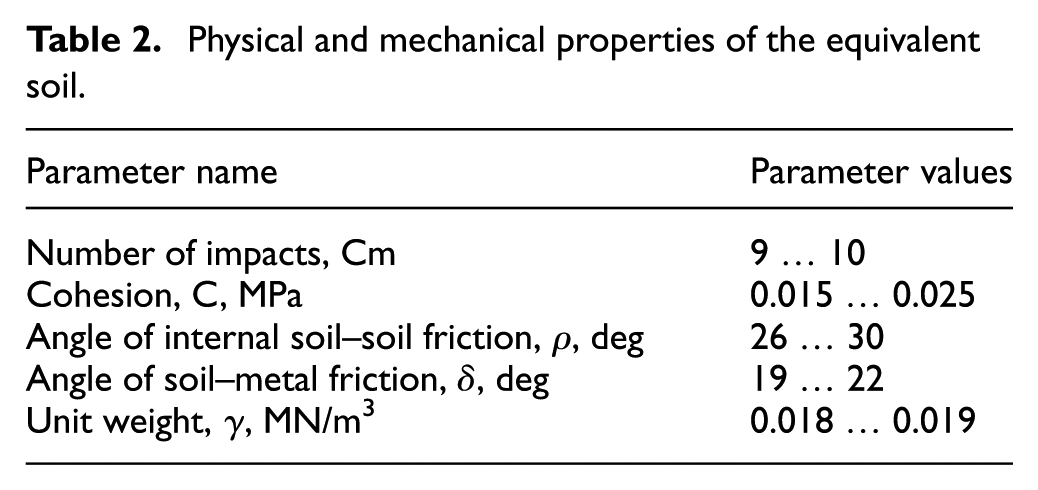
The stability of the reported characteristics was ensured by appropriate preparation of the natural soil model before each experiment when conducting identical experimental procedures with different bulldozer working tools, in accordance with the following procedure:
uniform loosening of the soil model (using rakes) to a depth of 0.25–0.30 m;
layer-by-layer compaction of the soil model using a manual vibrating plate until the required density was achieved, determined by the number of impacts of the dynamic penetrometer C m = 9–10.
The output parameters were defined as the vertical (Pv) and horizontal (Pg) components of the digging force, the mass of the dragged soil prism (mpr), the ratio of the horizontal digging force component to the mass of the dragged prism (Pg/mpr), the mass of soil losses to side windrows (mbv), the inclination angle of the resultant digging force (γ), the height of the dragged prism (Hpr), and the energy consumption of the excavation process (A0).
Using ZetLab strain-gauge measurement equipment, the vertical and horizontal components of the digging force, time (t), digging distance, and the instantaneous cutting angle were recorded. The cutting depth (h) and the parameters of the dragged soil prism were measured using linear measuring instruments.
The mass of the soil in the dragged prism and the side windrows was determined by weighing, assuming a steady-state regime at shallow cutting depths.
The second stage of the study involved determining the influence of variations in the cutting angle during excavation, cutting depth, and soil strength on the digging force components, soil losses to side windrows, the mass and height of the dragged prism, and the specific energy consumption. The cutting angle was varied during excavation over a cutting length of 0.4 m, after which further movement of the blade model was carried out at a cutting angle of
The mass of soil losses to the side windrows was measured by weighing at intervals of 0.05 m.
Based on the data obtained from the experimental studies and their subsequent processing, the following dependency graphs were constructed: dependency of the prismoidal soil mass weight (Gpr) at the final excavation stage on the overturning angle (β) for different cutting depths (h; Figure 6); dependency of excavation energy consumption on the overturning angle (β; Figure 7); dependency of excavation energy consumption (E) on the cutting angle (α; Figure 8); dependency of the energy efficiency coefficient (Kee) on the cutting angle (α; Figure 9).

Dependency of the prismoidal soil mass Gpr weight on the overturning angle β: 1 – traditional blade at α = 55°; 2 – flat blade with a flexible insert at α = 30°; 3 – flat blade with a flexible insert at α = 55°.

Dependency of excavation energy consumption Ek on the overturning angle β: 1 – traditional blade at α = 55°; 2 – flat blade with a flexible insert at α = 30°; 3 – flat blade with a flexible insert at α = 55°.

Dependency of excavation energy consumption Ek on the cutting angle α, for: 1 – h = 30 mm; 2 – h = 15 mm; 3 – h = 5 mm.

Dependency of the energy efficiency coefficient Kee on the cutting angle a, for: 1 – h = 30 mm; 2 – h = 15 mm; 3 – h = 5 mm.
In this study, the energy consumption of the excavation process is understood as the work of the force required to overcome the resistance of the excavated soil (Pk), necessary to accumulate a unit volume of soil (Vpr) forming the prismoidal soil mass at the final stage of the excavation process:

Accordingly, the energy efficiency coefficient (Kee) can be expressed as follows:

In addition to the screening experiment aimed at determining a qualitative picture of the phenomena occurring during excavation with the newly developed flat blade with a flexible insert and a traditional blade, a qualitative experiment was conducted. In one case, thin layers of colored chalk were embedded at various depths. In another case, colored layers were placed across the different widths of the blade. As the excavation process progressed, the dragging prism was exposed, and the colored layers provided insights into prism formation and the chip path through the accumulated prism. The results of this experiment, captured through high-speed photography, are presented in Figure 10.

High-speed photograph of soil chip path passage through the prismoidal soil mass for a flat blade with a flexible insert at α = 30° and β = 30°.
Figure 10 confirms the observed pattern of phenomena and displacements occurring during the excavation of soil layers of a given height and transverse profile by a bulldozer blade. Several soil layers were interspersed with colored chalk, which makes the trajectories of these layers clearly visible in the side view as they move in front of the blade, along the blade surface, and within the collapse zone. All layers follow nearly identical trajectories and slide along the blade without mixing.
The validity (reliability) of the presented data on the movement of the cut soil layers along the bulldozer blade with specified parameters is determined, in this case, by their layer-by-layer correspondence to the physical properties of the soil, the radius of curvature of the blade and its geometric parameters, as well as the actual operating conditions.
For the soil movement data along the bulldozer blade to be considered valid, they must be based not only on theoretical calculations but also account for real operating conditions and be confirmed by accurate measurements of key process parameters. Therefore, the observed behavior and motion of the soil chip along a blade surface of a given curvature make it possible to select blade parameters and curvature that correspond to the minimum resistance to sliding of the soil along the blade.
During the experiments, ambient temperature and soil condition (dry, moist, frozen) were taken into account and recorded. A series of experiments was conducted for each soil type. The experimental data are logically consistent and correspond to generally accepted engineering calculations, strain-gauge measurements, equipment characteristics, and operating conditions.
The photograph in Figure 10 clearly shows the integrated positioning of soil layers before cutting by the bulldozer blade, during movement along the blade surface, and during collapse of the soil chip into the dragged prism. In addition, markings of the soil channel are clearly visible behind the soil prism in the photograph, enabling precise repositioning of material layers for repeated experiments.
The analysis of experimental data and the qualitative study of prismoidal soil mass formation revealed the influence of the cutting angle (α) and overturning angle (β) on the excavation process when using the newly developed flat blade with a flexible insert. A comparison between the newly developed flat blade with a flexible insert and the traditional blade was conducted. Experimental results showed that the excavation energy consumption for the newly developed flat blade with a flexible insert is higher than that of the traditional blade at cutting angles α = 30°–60° and overturning angles β < 15°. In this case, the efficiency coefficient (Kee) at β = 7° and α = 30° varies between 15% and 5% at different excavation depths (Figure 9).
The effect of the overturning angle (β) on excavation resistance is illustrated in Figures 6 and 7.
The qualitative experiment analysis allowed for a more precise justification of the increase in excavation energy consumption as a function of the overturning angle (β < 15° and β ≈ 0°). As the overturning angle (β) increases, the soil chip, passing through the prismoidal soil mass along the front plate of the blade, undergoes significant deformation due to bending forces (Figure 11). These deformations contribute to the increased excavation energy consumption. The cutting angle (α) also affects the curvature of the blade. A smaller α results in greater blade curvature, leading to higher excavation energy consumption. At large β and small α, the prismoidal soil mass spreads out, further increasing excavation energy consumption.13,16,19

Bulldozer blade with a flexible frontal surface: 1 – flexible fore-blade (insert); 2 – damping element; 3 – spring-loaded beams; 4 – cutting edge; 5 – rigid blade.
The device operates as follows. During bulldozer motion, the flexible fore-blade (1) comes into contact with the soil and, under the action of cutting resistance and soil sliding along the blade surface, undergoes elastic bending and curvature of the blade profile. The flexible fore-blade (1) is designed as an elastic metal plate or as a set of hingedly connected segments, enabling bending under external loads generated by soil movement (sliding) along the blade. It is hingedly mounted on spring-loaded pushing beams (3) and connected to a damping element (2) operating in compression–tension.
The pressure acting on the blade surface increases with the soil–blade sliding resistance and is transmitted to the damping element (2), which deforms and provides automatic correction of the curvature angle of the flexible surface. The damping element (2) is implemented as an elastic force-feedback mechanism (e.g. spring-based, rubber–metal, pneumatic, or combined), installed between the fore-blade and the bulldozer frame with the capability of longitudinal displacement through articulated movable joints.
When soil resistance to movement along the blade surface increases (e.g. when entering a dense soil layer), the damping element (2) compresses under the increased load, causing load-dependent bending and rotation of the flexible fore-blade (1) about the hinge on the spring-loaded pushing beams (3).
As the blade surface curvature increases, the cutting angle decreases, which reduces digging resistance and prevents bulldozer slippage.
When soil sliding resistance decreases (e.g. during transition to a loose soil layer), the elastic restoring force of the damping element (2) returns the fore-blade (1) to its initial position, restoring the optimal attack angle and the predefined curvature of the blade surface.
Behind the flexible fore-blade (1), a rigid limiting blade (5) is positioned. It absorbs residual forces, limits excessive deformation of the fore-blade, and guides the soil mass along the blade surface with minimal sliding resistance due to controlled variation of the blade curvature.
A cutting edge (4) is mounted along the lower edge of the rigid blade (5) and directly interacts with the excavated soil.
Thus, the device operates in an automatic mechanical self-regulation mode without requiring hydraulic or electrical control systems. This provides reduced energy consumption during soil excavation and transportation, decreased vibration and impact loads, increased durability of working equipment components, and improved surface profiling and finishing quality.
The rigid limiting blade (5) with the cutting edge performs soil accumulation and transportation functions while restricting the bending stroke of the fore-blade and preventing its overload. Overall, this design ensures adaptive blade operation synchronized with changing soil properties and resistance forces during soil transport along the blade surface.
The change in excavation energy consumption as a function of excavation depth is shown in Figures 8 and 9.
At overturning angles (β) equal to or close to zero, the slight increase in excavation energy consumption is explained by the differences in soil mass formation compared to cases where β ≥ 7°. In this scenario, the soil chip slides along the blade surface, rising to a significant height (up to 1.5H of the blade at greater excavation depths). Subsequently, soil collapse occurs, leading to increased soil losses and higher excavation energy consumption.
At overturning angles of β = 7° and a cutting angle of α = 55°, the soil mass formation process is similar to that of a traditional blade.
The difference in soil mass formation lies in the movement of the soil chip. In a traditional blade, the soil chip slides along the entire surface of the blade. In the newly developed flat blade with a flexible insert, the soil chip remains in contact with the blade up to its midpoint, after which it separates from the blade surface. This modified movement pattern reduces soil friction against the metal surface, thereby decreasing the excavation energy consumption for the flat blade by 3–5% compared to the traditional blade, when both have a cutting angle of α = 55°.
Study of blades during excavation along a trajectory
The goal of the second stage of the experimental research program was to determine the influence of the cutting angle (α) and soil strength (C) on excavation energy consumption when operating bulldozer blade models along a trajectory.
The first excavation trajectory pattern was chosen as the reference trajectory for the experiments. The trajectory parameters were obtained using sensors from the experimental test stand, processed via a computer system, and then automatically controlled by the test stand software (SW), ensuring that they remained constant throughout the experiment.4–6
The following excavation trajectory parameters were defined:
(a) Horizontal movement speed of the model: V9 = 170 mm/s.
(b) Model penetration speed: Vv = 25 mm/s.
(c) Excavation path length, determined by the full formation of the prismoidal soil mass: Lk = 70 cm.
(d) Model penetration time: t z = 1 s.
(e) Model withdrawal time:
The experiments with the newly developed flat blade with a flexible insert were conducted at a constant overturning angle of β = 7°, as this was determined to be the most optimal overturning angle.
To determine the influence of the cutting angle (α) and soil strength (C) on excavation energy consumption along the trajectory, the experimental design method was applied. Specifically, a second-order rotatable design was chosen.
The rotatable design is suitable when experiment boundaries are best defined as a sphere, meaning that the researcher is primarily interested in describing the response surface near the experiment center.
The main limitation of the rotatable design is that experimental points do not fall at the cube corners but are instead positioned on the surface of a sphere inscribed within the cube. As a result, the cube corners remain unused, which can affect the accuracy of the model in some cases. As the number of factors (K) increases, the volume of unused cube corners also increases.
Therefore, rotatable designs are not recommended when K > 5, where K is the number of factors in the experiment. 10
In second-order rotatable planning, a full factorial experiment (FFE) is extended to a second-order design by adding a specific number of “star” and central points to the “core” of the FFE. The FFE matrix is used as the “core” of the second-order rotatable design, provided that K ≤ 5. “Star” points are positioned along the coordinate axes, defining the “star arm length” (the distance from the central point to the “star” point along each coordinate axis).
The number of central points is chosen to ensure model adequacy validation.
To execute the rotatable design and conduct the experiments, it is necessary to determine the factor variation levels (Table 3), construct the experimental design matrix (Table 4).
Levels of factor variation in the experiment.

Experimental planning matrix.

The optimization criterion was defined as the energy consumption of the excavation process when operating blades along a trajectory. The excavation energy values were recalculated using the formula
The results of the experimental studies of the blade models were recorded in the working matrix (Table 2).
Using the experimental data and equation (7), the regression coefficients for the equations were obtained. The significance test of these coefficients indicated that the interaction coefficient b12 (mutual influence of factors) was insignificant.
The final equations were verified for adequacy using equation (8). Since the computed values for the traditional and flat blade equations were less than the tabulated
Equation for the traditional blade:

Equation for the newly developed flat blade with a flexible insert

The values of the factors in the star points were found using the relationships

The final regression equations were compiled for a traditional blade:

and for the newly developed adaptive blade with a flexible insert:

α– cutting angle (deg);
β– overturning angle (deg);
C– soil strength (soil density), expressed as the number of impacts of the DORNII dynamic penetrometer;
E– energy consumption of the excavation process, t m/m3 (tonne-meter per cubic meter).This parameter characterizes the amount of energy (mechanical work) required to excavate and move one cubic meter of soil. It reflects the work (energy expended as force over distance) necessary to displace a unit volume of soil. The higher this value, the more difficult the excavation process, depending on soil type, moisture content, blade profile, and machine settings. It represents the energy per unit volume of soil expended by the bulldozer to overcome soil cutting resistance and transport the material. This indicator is a measure of bulldozing efficiency, showing how much effort the machine expends to move each cubic meter of soil.
E T – energy consumption for a conventional blade;
E A – energy consumption for an adaptive blade with a flexible insert.
Based on the results of the experiments and the adequate equations obtained, the dependences of the change in digging force on the set path for a given digging trajectory (Figure 12), the change in the energy intensity of the digging process on the cutting angle (Figure 13) and on the soil density (Figure 14) were constructed.

Dependence of change in digging resistance when a bulldozer blade operates along a trajectory on the digging length: 1 – theoretical curve of change in digging resistance with a traditional blade; 2 – experimental curve of change in digging resistance with a traditional blade; 3 – experimental curve of digging resistance variation for the newly developed flat moldboard with a flexible insert.

Dependence of energy intensity of the digging process when blades operate along a trajectory on the change in cutting angle: 1 – traditional blade; 2 – the newly developed flat blade with flexible insert.
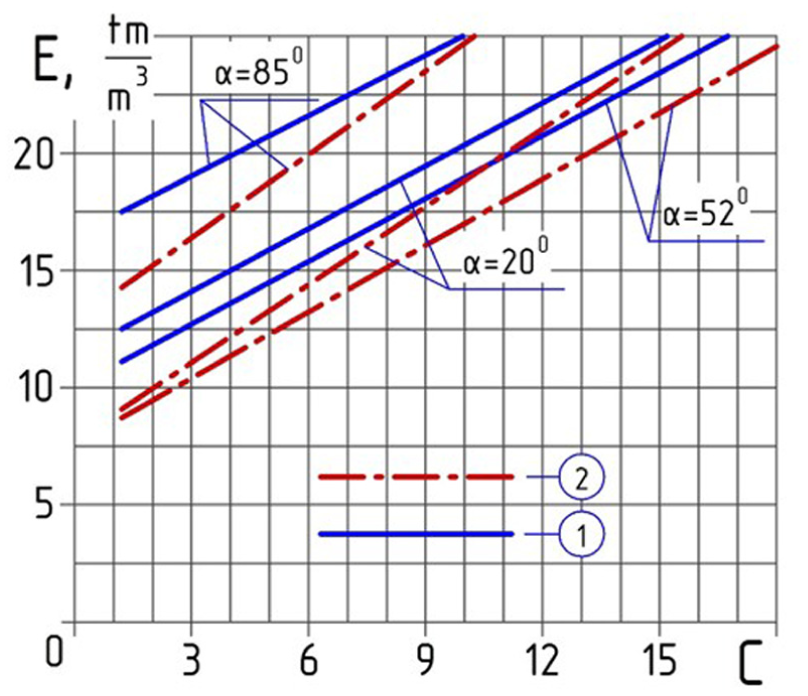
Dependence of energy intensity of the digging process when blades operate along a trajectory on changes in soil density: 1 – traditional blade; 2 – the newly developed flat blade with flexible insert.
Based on the above regression equations, graphs were constructed to show the dependency of excavation energy consumption on soil hardness (C) and cutting angle (α) for the traditional blade (Figure 15(a)), for the newly developed adaptive blade with a flexible insert (Figure 15(b)).
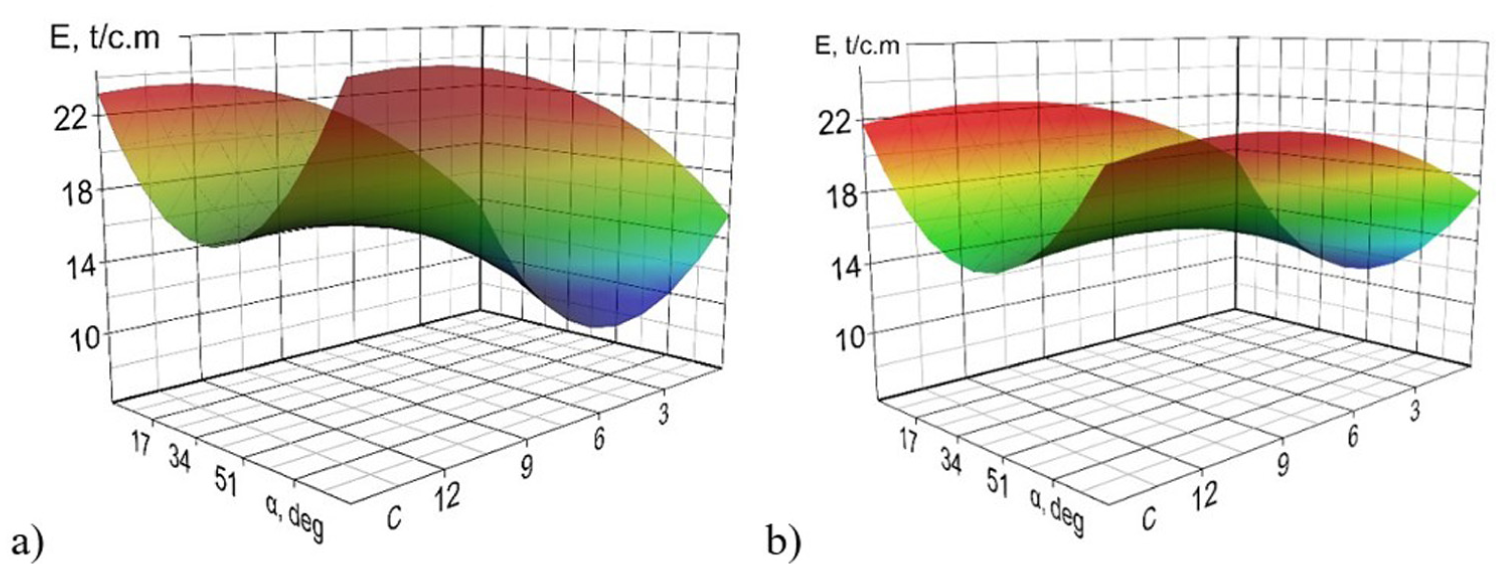
Dependency of excavation energy consumption on soil strength (C) and cutting angle (α) for: (a) the traditional blade and (b) the adaptive blade with the newly developed flexible insert.
For better visualization in determining the application area of the newly developed flat moldboard with a flexible insert in three-dimensional space, a combined response surface was constructed (Figure 16) by overlaying the graph from Figure 15(a) onto the graph from Figure 15(b).

Response surfaces constructed and combined based on the regression equations for: 1 – the traditional bulldozer blade; 2 – the newly developed adaptive blade with a flexible insert.
Analysis of the experimental data and qualitative assessment of soil prism formation made it possible to identify the influence of the cutting angle α and the tipping angle β on the soil excavation process using a flat blade with a flexible insert. A comparison was carried out between a flat blade with a flexible insert and a conventional blade.
Comparison of the experimental excavation data obtained using these blades showed that the energy consumption of the excavation process for the flat blade with a flexible insert is higher than that of the conventional blade at cutting angles a ≥ 60° and tipping angles β < 15° (Figures 14 and 13). In this case, the energy efficiency coefficient КeE at β = 7° and α = 30° varies from 15% to 5% depending on the excavation depth (Figure 15).
The influence of the tipping angle β is illustrated in Figures 12 and 13.
During operation, the energy consumption of the excavation process reaches its minimum at a constant cutting angle of α = 40° (Figure 13) and increases with increasing soil density (Figure 14).
The energy consumption of soil excavation using a flat blade with a flexible insert is lower than that of a conventional blade throughout the entire experimental range, except at cutting angles
The reduction in tractive effort amounts to 15%–25%, with a potential increase in productivity of 10%–15%.
Conclusion
The experimental dependencies determining the influence of the cutting angle (α) and the curvature of blades with a variable front surface and a flexible insert on the excavation energy consumption of bulldozers confirm the validity of the proposed theoretical model.
As a result of the experimental studies, the optimal parameters for the newly developed flat blade with a flexible insert were identified: for constant-depth excavation, the optimal cutting angle is α = 30°; the optimal overturning angle ranges between β = 7°–10°.
Based on the experimental studies of adaptive and traditional blades operating along the selected trajectory, regression equations were obtained, describing the dependency of excavation energy consumption on the cutting angle (α) and soil strength (C).
The soil mass formation process in the newly developed adaptive blade with flexible insert is smoother compared to the traditional blade, due to reduced dispersion of the soil chip, decreased soil loss into lateral ridges.
Productivity loss of bulldozers operating on high-strength soils (Group IV) compared to low-strength soils (Group I) is 55%. This highlights the need for further research and the development of methods to enhance bulldozer efficiency on high-strength soils. One such method is equipping the bulldozer blade with a protruding central cutting edge.
The models presented in this study were obtained using both analytical and experimental approaches and were supplemented with comparative graphical representations and three-dimensional superposition of the resulting surfaces describing the dependence of excavation energy consumption on soil hardness CCC and cutting angle α for conventional and newly developed blades. This approach provides a comprehensive view of how the energy consumption of the excavation process for a given soil depends on variations in its density and resistance to sliding (movement) along a bulldozer blade with variable curvature, while avoiding the limitations of FEM methods typically encountered in large-displacement problems due to severe mesh distortion.
This is because the soil cutting process involves large blade displacements, changes in blade curvature, significant material deformation, and resistance to cutting, which makes classical finite element modeling challenging due to mesh distortion. Based on the derived analytical expressions, it became possible to verify the agreement between calculated cutting forces and experimental results, as well as to analyze the influence of soil physical and mechanical properties and working tool geometry on the calculated cutting forces.
The methodology and sequence of investigations presented overcome the limitations of existing FEM approaches in complex nonlinear problems, such as interaction between a blade with variable geometry and sliding soil, deformation of both the blade and soil, and soil chip fragmentation depending on the local radius of blade curvature. At the same time, the efficiency and accuracy of processing large datasets using FEM methods indicate their strong potential for modeling the behavior of flexible blade surfaces when working with soils of varying density. Future research is planned to apply FEM methods to identify critical cross-sections and strength characteristics governing the operational reliability of the new variable-geometry blade.
The research results can serve as a valuable guideline for bulldozer operators when selecting soil cutting modes, as they demonstrate that excavation energy consumption is minimized at a constant cutting angle of α = 40°.
The use of a flexible frontal surface in blade working tools enables self-optimization of soil layer formation and lifting by matching the transverse blade profile to the shape and trajectory of soil movement.
The low energy consumption of blades with flexible frontal surfaces encourages the development of new blade designs and necessitates further experimental investigations of such configurations.
Footnotes
Acknowledgements
This research was funded by the Science Committee of the Ministry of Science and Higher Education of the Republic of Kazakhstan under grant AP22684640 –“Development of an Articulated Bulldozer Blade Design with Multi-Level Geometric Adjustment”.
Handling Editor: Aarthy Esakkiappan

Funding
The authors disclosed receipt of the following financial support for the research, authorship, and/or publication of this article: This research was funded by the Science Committee of the Ministry of Science and Higher Education of the Republic of Kazakhstan under grant AP22684640 –“Development of an Articulated Bulldozer Blade Design with Multi-Level Geometric Adjustment.”
Declaration of conflicting interests
The authors declared no potential conflicts of interest with respect to the research, authorship, and/or publication of this article.