



Abstract
This article presents a numerical solution for the static analysis of functionally graded porous deep curved beams with various boundary conditions. The main objective is to develop an accurate reference model for structures with high curvature and arbitrary support conditions, where simplified theories—such as higher-order shear deformation models—exhibit limited accuracy. The strong form of the governing equations is derived from two-dimensional elasticity theory for curved beams and solved using the Differential Quadrature Method, which ensures interlaminar continuity of displacements and stresses as well as boundary condition equations. Numerical validation is performed by comparison against results reported in the literature and those obtained using commercial finite element software. A parametric study is performed to investigate the influence of geometric curvature, material gradation, and porosity on the structural response. The results demonstrate the model’s capability to yield accurate solutions applicable to the design of curved structural components made of functionally graded materials.
Keywords
Introduction
The structural analysis of functionally graded materials (FGMs) represents a key challenge in the design of advanced components. These structures are widely employed in sectors such as aerospace, biomedical, and automotive engineering, where high strength, complex geometries, and spatially varying mechanical properties are required. 1 For curved or porous configurations, accurately modeling their structural response demands robust numerical formulations capable of capturing the continuous variation of properties and the actual boundary conditions, beyond the simplified cases traditionally assumed.
Several researchers have developed analytical and numerical models to address the complex behavior of functionally graded structures. Filippi et al. 2 applied the one-dimensional Carrera Unified Formulation (CUF) to the static analysis of FG structures, employing various displacement functions and solving the governing equations using the finite element method. Mantari and Granados 3 proposed a first-order shear deformation theory (FSDT) with only four unknowns for analyzing FG plates, obtaining closed-form solutions using the Navier series. Subsequently, Mantari et al. 4 extended this approach through the Carrera Unified Formulation (CUF) and new non-polynomial displacement fields, employing trigonometric, exponential, and hyperbolic functions to analyze simple and sandwich plates under static loading. Brischetto 5 developed an exact three-dimensional model for the static analysis of simply supported structures made of FGM layers and subjected to harmonic normal loads. In a subsequent extension, Brischetto 6 formulated a general three-dimensional model based on layer-wise elasticity theory, employing a closed-form solution using the exponential matrix method. This model enables the application of normal and shear loads at various positions, providing precise solutions for different geometries, material configurations, and loading conditions. Sankar 7 proposed an exact elasticity solution for beams with an exponentially varying Young’s modulus through the thickness, complemented by an Euler–Bernoulli-type formulation for slender beams. He found that stress concentrations depend on the material distribution, decreasing when the more compliant side is subjected to loading. Zhong and Yu 8 developed a general two-dimensional solution based on the Airy stress function for beams with thickness-wise varying properties, yielding analytical expressions that are useful for analyzing various boundary and loading conditions. Kadoli et al. 9 employed a higher-order shear deformation theory and the finite element method to investigate metal-ceramic FG beams, revealing material gradation to be a significant parameter for static analysis. Thai and Vo 10 formulated several higher-order shear deformation models for bending and free vibration analysis without the need for a shear correction factor. Nguyen et al. 11 developed a first-order theory with an analytically derived shear correction factor, providing analytical solutions for simply supported beams under axial loading. Vo et al. 12 extended this approach by incorporating axial–bending coupling and implementing cubic Hermite elements, evaluating the influence of the power-law exponent and material anisotropy under various boundary conditions. Wang and Liu 13 applied the Airy stress function to curved beams composed of orthotropic FG layers, solving the problem using generalized hypergeometric functions for various boundary conditions. Pydah and Sabale 14 investigated the bending behavior of bidirectional FG circular beams using analytical solutions based on Euler–Bernoulli beam theory. Yarasca et al. 15 analyzed the static behavior of FG beams using a quasi-3D hybrid theory with seven degrees of freedom, solving the equations through finite element analysis with cubic and linear Hermite interpolation. Sayyad and Ghugal 16 analyzed FG curved sandwich beams using a sinusoidal theory to obtain analytical solutions under simply supported conditions. Garg et al. 17 evaluated the behavior of FG sandwich beams under combined hygrothermal and mechanical loading, considering temperature- and moisture-dependent properties through a higher-order zigzag theory (HOZT) finite element model. Belarbi et al. 18 proposed a new refined shear deformation theory that accounts for parabolic shear stress distribution in FG curved sandwich beams, which was solved numerically using a two-node finite element. Excellent reviews on the modeling and analysis of FG structures, including the effects of porosity, were presented by Sayyad and Ghugal, 19 Swaminathan and Sangeetha, 20 and Garg et al. 21 .
Functionally graded porous materials have emerged as an efficient alternative in advanced structural design due to their ability to combine continuous property gradation with density control through the distribution of porosity. This feature allows for the tailoring of mechanical and thermal properties, making them suitable for applications in lightweight, biomedical, and aerospace structures. Chen et al. 22 presented a recent review of this type of material, addressing advances in mechanical analysis techniques, manufacturing methods, and the emerging use of artificial intelligence for modeling and experimental evaluation. In the field of structural analysis, several studies have investigated the impact of porosity on the mechanical behavior of FG structures. Chen et al. 23 investigated the elastic buckling and static bending of porous FG beams using the Timoshenko beam theory and the Ritz method, considering various porosity patterns and boundary conditions. Demirhan and Taskin 24 investigated porous FG plates using a four-variable theory, which accounts for the effect of porosity on bending and free vibration behavior. Masjedi et al. 25 analyzed the nonlinear behavior of porous FG beams subjected to large deflections using an intrinsic formulation and the Chebyshev collocation method. Their study included various porosity distributions (transverse and longitudinal) and demonstrated the effectiveness of the proposed model in capturing large deformations. Similarly, Zghal et al. 26 employed a refined mixed finite element model to investigate the effect of porosity on the static bending of FG beams, considering different porosity distributions, power-law indices, and boundary conditions. Wang et al. 27 developed a higher-order beam model for the dynamic analysis of porous FG sandwich beams under the influence of a moving distributed mass. Their results showed that the mass location has a significant effect on dynamic deflections. Sayyad et al. 28 investigated the static deformation and free vibration of porous FG circular beams using a higher-order hyperbolic theory and Navier-type solutions. This study incorporated both shear deformation and rotary inertia effects, considering uniform and non-uniform porosity distributions.
The differential quadrature method (DQM), introduced by Bellman et al., 29 emerged as an efficient numerical technique for solving nonlinear partial differential equations. DQM has been widely adopted in structural analysis, particularly for composite material structures, where obtaining closed-form solutions is challenging due to through-thickness property variations and geometric complexity. Brischetto and Tornabene 30 applied the Generalized Differential Quadrature (GDQ) method in a comparative study between 2D and 3D models for the static analysis of multilayered and sandwich plates and shells subjected to transverse loads. While the 3D models were solved using exact solutions, the 2D models employed the GDQ method, demonstrating accuracy for structures with complex geometry, including double-curvature shells. In a complementary work, Tornabene and Brischetto 31 extended this approach by developing both closed-form and numerical 3D solutions using the exponential matrix and GDQ methods. The 2D solutions were based on the Unified Formulation and incorporated both classical and refined theories. Monge and Mantari 32 developed a three-dimensional numerical solution for the static analysis of FG shells. They employed the Navier method and the DQM in curvilinear coordinates to accurately capture interlaminar continuity effects and transverse stresses. Subsequently, Padilla et al. 33 extended the semi-analytical formulation and the numerical solution using DQM presented in 32 to the static analysis of laminated arch beams in elevation with deep curvature, employing a two-dimensional DQM solution.
In recent years, several studies have addressed the modeling of advanced composite materials with functionally graded porous structures. Among them, Tounsi et al. 34 and Belabed et al.35,36 have employed higher-order shear deformation theories (HSDT) and quasi-3D theories, together with finite element methods, to analyze the static and dynamic behavior of porous nanocomposite beams reinforced with carbon nanotubes (CNTs) on elastic foundations. For their part, Mohamed et al. 37 investigated the postbuckling behavior and snap-through instability in bidirectional functionally graded (BDFG) porous plates resting on elastic foundations, using a parabolic shear deformation theory and solving the system through quadrature methods.
In parallel, other recent works have focused on the analysis of functionally graded (FG) sandwich beams using higher-order shear deformation theories and quasi-3D theories. Draiche et al. 38 proposed a high-order model for the static analysis of FG sandwich curved beams, accurately capturing shear stress without the need for correction factors. Addou et al. 39 developed a refined hyperbolic theory for the static analysis of FG sandwich beams under different boundary conditions, whereas Mohamed et al.40,41 employed quasi-3D theories to study the static and dynamic behavior of FG sandwich beams with porous core on elastic foundations, considering different porosity patterns and gradations of material properties.
Although formulations based on HSDT or quasi-3D theories, widely reported in the literature, have proven efficient in various applications, their accuracy decreases when applied to beams with deep curvatures, materials with high gradation, or complex boundary conditions. These limitations motivate the development of a two-dimensional elasticity-based numerical formulation for the static analysis of functionally graded porous curved beams, capable of delivering high-accuracy solutions for beams with deep curvatures and arbitrary boundary conditions. Unlike simplified approaches, the proposed model provides highly accurate solutions that can serve both as reference benchmarks for validating other models and as a basis for the structural design of curved components made of functionally graded materials.
To this end, the approach is based on a two-dimensional elasticity formulation derived through the principle of virtual displacements, following the methodology reported in. 33 The governing equations are numerically solved using the two-dimensional Differential Quadrature Method, which allows for the consideration of arbitrary boundary conditions. The results obtained enable the assessment of the influence of key parameters, such as curvature, material gradation, and porosity fraction, on the structural response of functionally graded porous curved beams.
The present article is organized as follows: Section 2 provides a detailed description of the equilibrium equations and their associated boundary conditions; Section 3 formulates the numerical solution using the DQM; Section 4 discusses the numerical results obtained for functionally graded porous curved beams under various boundary conditions; and finally, Section 5 presents the main conclusions of the study.
Two-dimensional curved beam model
Geometry
Consider a functionally graded curved beam with length

Geometry and reference coordinate system of a single-layer functionally graded metal–ceramic curved beam with uniform porosity.
Functionally graded porous material
In this work, single-layer functionally graded porous metal–ceramic beams with continuous variation of material properties along the thickness direction are analyzed (see Figure 1). The FGM varying properties are described by the distribution law
The material properties

where

Distribution of Young’s modulus through the thickness of the beam for various values of the power-law index
Stress-displacement relations
For a general case of a multilayer curved beam with deep curvature, the two-dimensional strain–displacement relations are expressed as follows:

where
For multilayer two-dimensional beams, the stress–strain relations for the functionally graded layer

where
For the plane stress condition, the coefficients

whereas, for a plane strain condition the coefficients

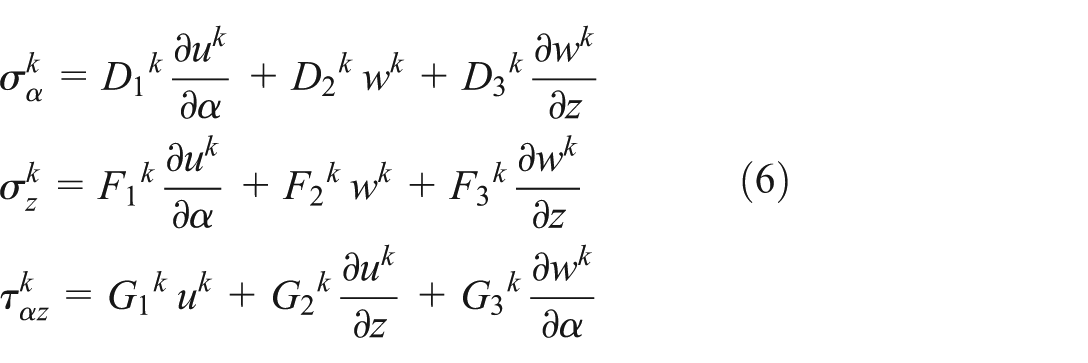
The stress–displacement relationships for the curved beam are obtained by substituting equation (2) into equation (3):
where:

Two-dimensional governing equations
The governing equations for multilayer curved beams are derived from the principle of virtual displacements, as presented in Padilla et al. 33 . The variational form of the governing equations is expressed as follows:

The governing equations in terms of stresses are then defined by collecting the coefficients of the virtual displacements:
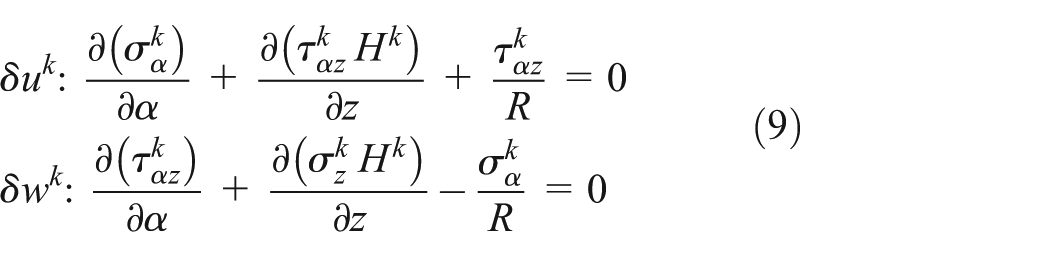
The first equation enforces axial equilibrium, where the variation of the axial normal stress
Finally, the governing equations in terms of displacements are obtained by substituting equation (6) into equation (9):

The coefficients
where:

Boundary conditions
Boundary conditions equations for the beam ends, upper and lower surfaces, and interlaminar continuity conditions for multilayered beams are defined.
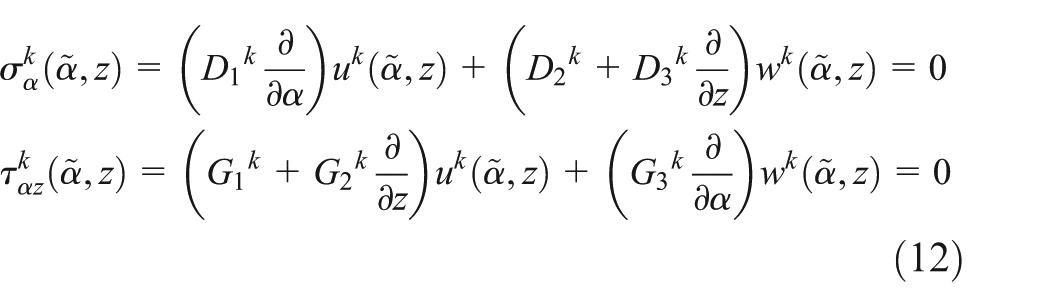
The boundary conditions at the beam ends (
Free (F):
Simply supported (S):

Clamped (C):

The boundary conditions on the lower (


where
In the case of multilayer beams, continuity of displacements and stresses in the

Whereas the interlaminar continuity equations for stresses are defined as:

Substituting equation (6) into equation (18), the interlaminar stress continuity equations in the

Numerical solution using the Differential Quadrature Method
The governing equations (see equation (10)), together with the boundary conditions presented in Section Boundary conditions constitute a system of partial differential equations in which the displacements
DQM in a two-dimensional domain
Let
The function

where
Domain discretization
In the present study, the Chebyshev-Gauss-Lobatto distribution was employed to discretize the problem domain. The coordinates of the grid distribution along the

Similarly, the grid coordinates along the
Weighting coefficients
The selection of the basis functions is a crucial step in the numerical implementation of the DQM. In this work, Lagrange interpolation polynomials are used as the set of basis functions. The use of Lagrange polynomials allows for the computation of the weighting coefficients for any derivative of order

The weighting coefficients related to the discretization of the domain in the
Finally, the linear system of algebraic equations for curved beams with arbitrary boundary conditions is obtained by applying equations (20), (21), and (22) to the governing equations (equation (10)), the boundary conditions at
Numerical results and discussion
In this section, the static analysis of functionally graded porous curved beams with simply supported (S-S), clamped-clamped (C-C), and clamped-free (C-F) boundary conditions is presented. The analysis was conducted for deep curved beams considering various values of the power-law index
The following assumptions were considered for all cases:
The FGM consists of aluminum (Al:
In the DQM solutions, the domain of each layer was discretized along the
The two-dimensional finite element method (2D FEM) was employed to obtain reference results via the commercial software ANSYS. The numerical model was built using PLANE182 elements. The beam thickness was discretized into 250 layers for
The dimensionless results presented use the following normalization formulas:


Convergence and computational efficiency
The convergence of the proposed model was evaluated in curved beams with symmetric (C-C) and asymmetric (C-F) support conditions, considering deep curvature (
The results presented in Table 1 confirm the rapid convergence of the model. For all support conditions and values of
Convergence of the DQM model for functionally graded porous curved beams (

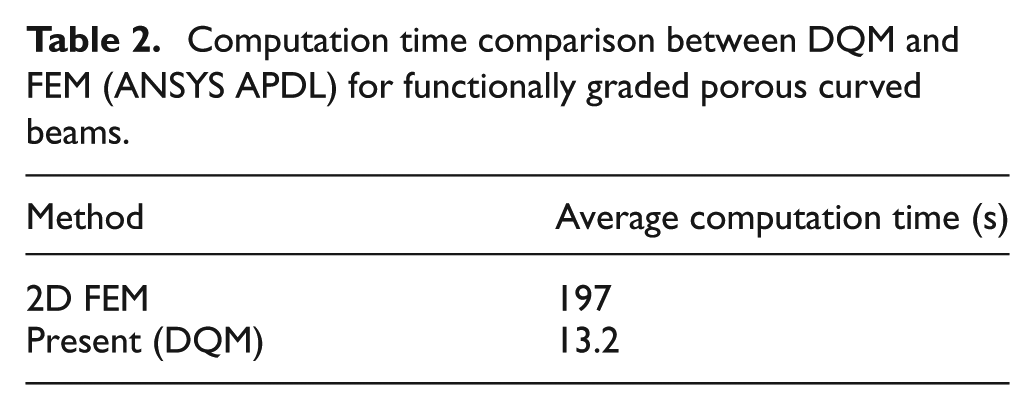
The computational efficiency of the model was evaluated through comparison with a finite element method (FEM) analysis in commercial software. In the case of FEM, representing the functional gradation of the material requires discretizing the thickness into numerous layers, which considerably increases the number of elements and, consequently, the computational cost. In contrast, the DQM directly captures the continuous variation of properties without the need for additional subdivisions. In the tests performed, the MATLAB implementation of the DQM model, using a 35 × 35 grid, achieved the same accuracy as a 2D FEM model in ANSYS APDL with a 250-layer discretization and approximately 1,000,000 elements, but with a computation time about 93% lower. The computation times of both models are presented in Table 2.
Computation time comparison between DQM and FEM (ANSYS APDL) for functionally graded porous curved beams.
The remarkable efficiency of the DQM lies in its direct solution of the original differential equations of the problem at each discretization point, using high-order basis functions. This formulation allows for a continuous representation of the spatial variation of the mechanical properties of functionally graded materials, avoiding the artificial interfaces associated with the layer-wise discretization of conventional FEM methods. Moreover, the use of optimal distributions of discretization points promotes rapid convergence with a reduced number of degrees of freedom.
Nevertheless, the method presents certain limitations that must be considered. The analysis of highly irregular geometries or complex boundary conditions may require further developments, and numerical stability largely depends on an appropriate selection of discretization points. In addition, due to the inherent formulation of the DQM, the resulting stiffness matrix is not positive definite, which necessitates the implementation of specific techniques to ensure the robustness of the computation.
Despite these considerations, the DQM represents a highly efficient alternative to conventional FEM-based methods for the static analysis of functionally graded curved beams, offering a favorable balance between numerical stability and computational cost.
Validation
A static analysis was performed on functionally graded porous curved beams subjected to a uniformly distributed load applied on their upper surface to validate the accuracy of the proposed DQM-based model. The analysis considered various boundary conditions as well as different values of the power-law index
The results obtained using the proposed model were compared with those of the 2D FEM numerical model. Additionally, for S-S beams, the results were also compared with those reported by Sayyad and Ghugal,
16
Belarbi et al.,
18
and Sayyad et al.,
28
which are based on higher-order shear deformation theories (HSDTs). Table 3 presents the displacement and stress results for shallow curved beams with S-S supports, a length-to-radius ratio of
Dimensionless results for

All results are in absolute values.
Tables 4 to 6 present displacement and stress results for deep curved beams (
Dimensionless results for

Dimensionless results for

Dimensionless results for

Figure 3 shows through-the-thickness results, including the deflection
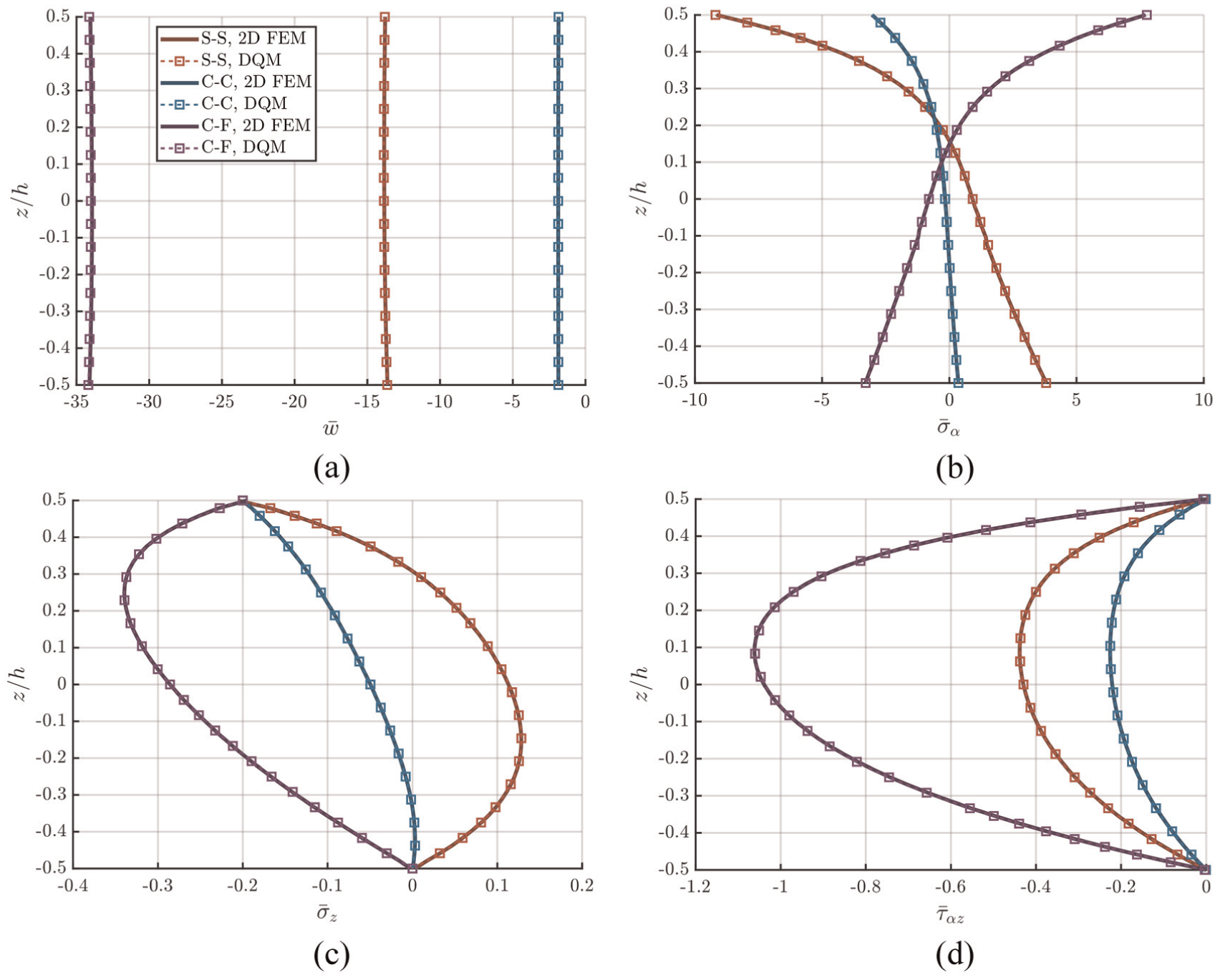
Comparison of dimensionless deflection and stress distributions through the thickness of the beam between the DQM and 2D FEM models (
Analysis of curved beams with S-S, C-C, and C-F support conditions
This section presents the analysis of functionally graded porous curved beams under different boundary conditions: S-S, C-C, and C-F. In all cases, a uniformly distributed load is applied to the upper surface of the beam. The study evaluates the influence of curvature (
Dimensionless results for

Dimensionless results for

Dimensionless results for

In S-S beams, the displacements
In C-C beams, the displacements
In C-F beams, the displacement
The trends described are illustrated in Figures 4 to 6, which show the variation of displacements and stresses as a function of curvature (

Distribution of dimensionless deflection and stresses through the thickness of the beam for various values of
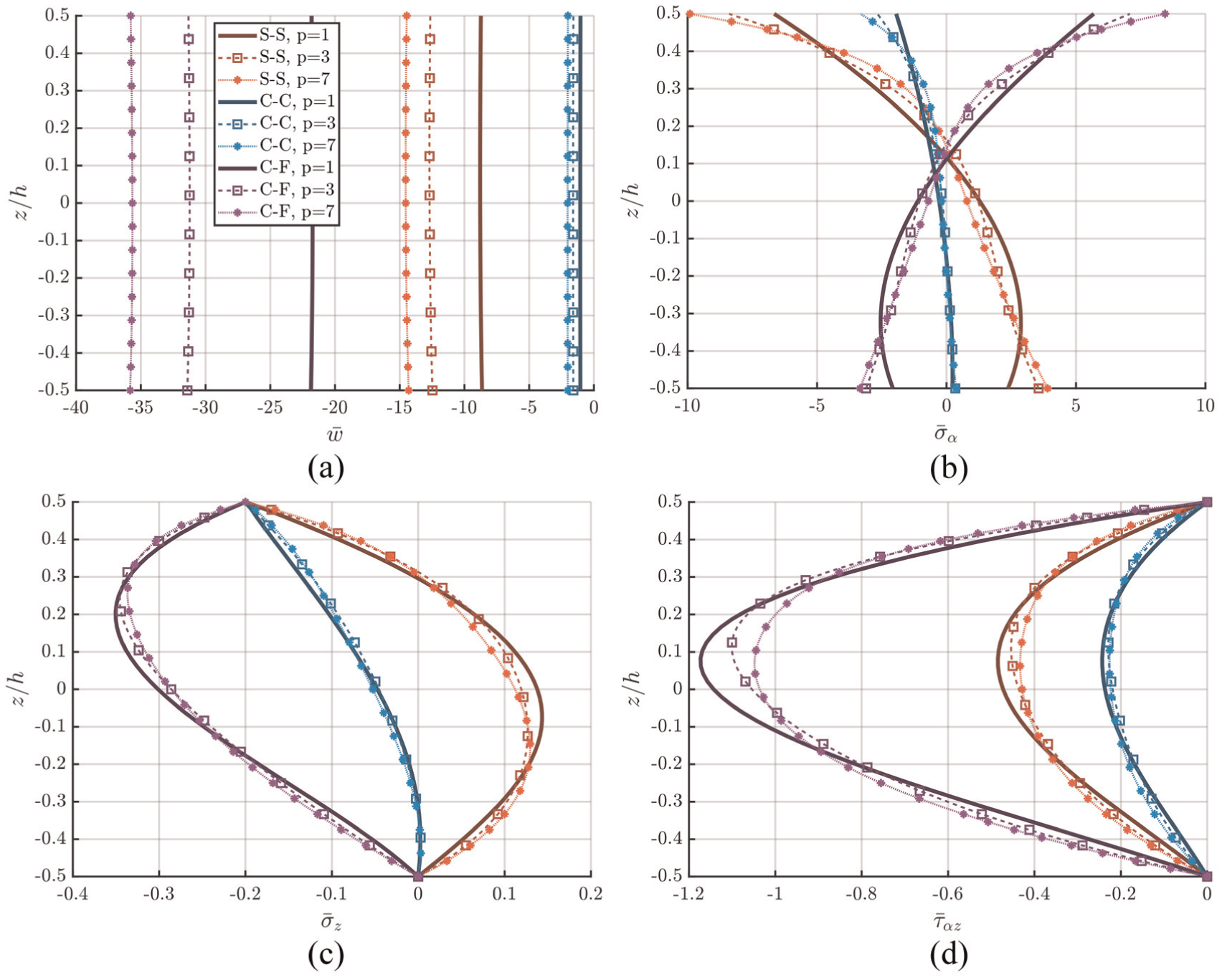
Distribution of dimensionless deflection and stresses through the thickness of the beam for various values of

Distribution of dimensionless deflection and stresses through the thickness of the beam for various values of
Figure 4 presents the through-thickness distributions of displacements and stresses for different curvatures, where the case
Figure 5 shows the through-thickness distributions of displacements and stresses for different values of the power-law index
Figure 6 shows the through-thickness distributions of displacements and stresses for different values of the porosity volume fraction
Conclusions
A two-dimensional numerical solution for the static analysis of functionally graded porous curved beams under various boundary conditions has been presented in this work. The proposed model is based on the general 2D elasticity theory for curved beams. The strong form of the governing equations is solved via the Differential Quadrature Method (DQM), thus ensuring interlaminar continuity and boundary conditions. Validation against results obtained by commercial finite element software, higher-order shear deformation theories (HSDT) reported in the literature, assesses the model’s accuracy. The following conclusions can be drawn:
The developed model provides accurate distributions of displacements and stresses in functionally graded porous curved beams under different boundary conditions and material configurations. It outperforms HSDT-based approaches in terms of accuracy, particularly in cases with high curvature, and shows excellent agreement with FEM solutions.
From a computational standpoint, the DQM approach is more efficient than conventional finite element methods. Whereas FEM models require multilayer discretization to capture the continuous variation of material properties, the proposed approach directly captures the continuous variation of properties without the need for additional subdivisions, achieving comparable accuracy at a lower computational cost.
Geometric curvature, the material gradation (
The solutions serve as valuable benchmarks for validating reduced-order models (e.g., HSDT) and as design tools for advanced functionally graded components. Limitations include the linear elasticity assumption, excluding large deformation and nonlinear effects, and the current omission of multilayered or sandwich configurations, as well as thermal and dynamic phenomena.
Future research should extend this framework to dynamic and thermal analyses, laminated or sandwich structures, and multiphysics loading scenarios.
Footnotes
Appendix A: System of algebraic equations for DQM
Acknowledgements
The authors gratefully acknowledge the financial support provided by CONCYTEC and its funding program PROCIENCIA (E041-2024-03, Proyectos de Investigación Básica 2024-03" con Contrato PE501088864-2024).
Handling Editor: Stefano Guarino

Author contributions
O Padilla: Investigation, Visualization, Software, Writing – original draft.
J Yarasca: Conceptualization, Investigation, Methodology, Writing – review and editing.
J Monge: Conceptualization, Software, Methodology.
J Mantari: Supervision, Writing – review and editing, Funding acquisition.
All authors have read and agreed to the published version of the manuscript.
Funding
The authors disclosed receipt of the following financial support for the research, authorship, and/or publication of this article: This work was supported by the funding program PROCIENCIA (E041-2024-03, Proyectos de Investigación Básica 2024-03" con Contrato PE501088864-2024).
Declaration of conflicting interests
The authors declared no potential conflicts of interest with respect to the research, authorship, and/or publication of this article.
Data availability statement
Data will be made available on request.