




Abstract
Lunar energy storage systems face critical challenges from extreme thermal cycling (−173°C to 127°C) and prolonged darkness periods (354-hour nights). This study systematically evaluates three categories of lunar-compatible technologies: Electrochemical storage (lithium-ion batteries, regenerative fuel cells), Mechanical storage (flywheel arrays, compressed gas energy storage, molten salt reservoirs), Electromagnetic storage (supercapacitors, superconducting magnetic energy storage). However, standalone systems exhibit severe limitations: electrochemical devices show >35% capacity loss below −20°C, The energy storage efficiency of mechanical energy storage methods during the lunar night is relatively low, while electromagnetic solutions suffer from mass-specific energy deficits (<500 Wh/kg). We therefore propose a solar-driven hybrid architecture integrating: Daytime operations (1416 W/m2 irradiance): 47% direct photovoltaic power for base loads; 5.6% of the energy is used for the regenerative fuel cell system; 3.7% of the energy is used for flywheel acceleration; 26.5% of the energy is used for battery charging; 17.3% of the energy is used for lifting heavy objects. Nighttime operations: Predominantly using battery energy storage, gravitational energy storage, and molten salt energy storage systems to provide a combined 89.8% of the electrical energy for the lunar base. The integrated energy storage system has a stable energy supply, can effectively respond to changes in the lunar environment, improve resource utilization efficiency, and prolong the service life of the equipment. It provides a scientific and feasible reference scheme for the lunar energy storage strategy.
Keywords
Introduction
Humanity's interplanetary expansion now prioritizes lunar surface operations as a strategic proving ground, driven by advancements in in-situ resource utilization (ISRU) and modular habitat construction. While Mars colonization remains a long-term vision, the Moon's synergistic orbital characteristics (mean Earth-Moon distance 384,400 km; synchronous rotation period 29.5 Earth days) offer unparalleled advantages for testing extraterrestrial energy infrastructure. 1 However, the lunar environment presents three fundamental energy challenges: Extreme thermal cycling (−173°C to 127°C surface temperature); Prolonged energy droughts (354-hour darkness periods); High-energy particle flux (>100 MeV protons during solar events). These constraints necessitate innovative energy storage solutions beyond terrestrial paradigms. 2
To achieve the ambitious goals of long-term lunar exploration and the construction of lunar bases, establishing a stable and sufficient energy supply system to ensure the continuous operation of equipment has become an indispensable and critical task. Within this energy supply system, the development of a large-scale energy storage system is of particular importance. This is because energy storage systems play a key role in ensuring the stability, continuity, and flexibility of energy supply. They effectively address the uncertainties and fluctuations in energy supply under lunar conditions, ensuring reliable energy support for various equipment under different operating conditions.
In existing research, most of the focus is on one or two energy storage methods. For example: Kunlin Cheng et al. 3 proposed an innovative integrated energy system of a solar-driven closedcycle Brayton cycle and a thermoelectric generator (CBC–TEG). This system, combined with in situ thermal storage, can provide power for the lunar base day and night. During the day, the total power generation efficiency is as high as 35.83%, and the TEG has no rotating parts, resulting in high reliability. However, the power generation efficiency of this system decreases significantly at night on the moon. At the end of the lunar night, its power generation efficiency is only 0.20%. There are also shortcomings such as large fluctuations in the radiator area and the need to reasonably allocate heat storage and power generation during the day to maintain night-time operation. Palos et al. 4 proposed a “Lunar ISRU Energy Storage and Electricity Generation.” This system has advantages such as local availability, low cost, and a wide operating temperature range in energy storage. However, it also has disadvantages such as low thermal conductivity, the need for heat transfer fluids, and the requirement for compaction due to particle size dispersion. Guzik et al. 5 proposed a Regenerative Fuel Cell system. The advantages of this system are that it can separate the mass of energy storage from that of power production, has a significant mass advantage under high energy storage requirements, and can reduce the volume through high-pressure gaseous storage. The disadvantages are that for high-pressure storage, an increase in the mass of pipelines and components needs to be considered, the mass proportion of the balance system is large at low power, and there is a minimum effective power limit.
Thus, it can be seen that a single energy storage method is hardly sufficient to fully adapt to the complex lunar surface environment. Therefore, this paper classifies the energy storage methods on the moon into three categories, namely: chemical energy storage, physical energy storage, and other energy storage methods. 6 Chemical energy storage, as a traditional approach that has been extensively studied and applied on Earth, plays a significant role in numerous fields. Battery technologies such as lead-acid batteries and lithium batteries have established mature production and application systems on Earth. Their related technologies have the potential to be adapted and transferred to the lunar environment, offering feasible solutions for lunar energy storage. Physical energy storage solutions, on the other hand, have garnered attention due to their notable advantages such as long lifespan and high reliability. For example, flywheel energy storage, which has a relatively limited number of moving parts and does not involve complex chemical reactions, can maintain stable operation over extended periods under proper maintenance conditions, providing reliable support for the energy supply of lunar bases. As for other energy storage methods, such as supercapacitors, despite their relatively low energy density, they possess unique advantages such as fast charging rates and a wide operating temperature range. These characteristics make them valuable in specific application scenarios on lunar bases, such as meeting instantaneous high-power demands of equipment or adapting to environments with significant day-night temperature variations.
In-depth research and exploration of energy storage methods suitable for the lunar environment are of paramount importance for advancing the cause of human lunar exploration. Through comprehensive analysis and evaluation of various energy storage methods, more scientific, rational, and efficient reference solutions can be provided for the energy supply of lunar bases.
Chemical energy storage solution
Lithium battery energy storage system
The Lithium battery energy storage system (LBESS) is a system that utilizes the intercalation and deintercalation of lithium ions between the positive and negative electrodes to store and release electrical energy. It mainly consists of lithium battery packs, a battery management system, an energy conversion system, and other auxiliary equipment. LBESS possess a series of significant advantages, including high specific energy, high voltage characteristics, excellent low-temperature performance, low self-discharge rate, and no memory effect. 7 As shown in Figure 1, the working principle of rechargeable lithium-ion batteries reveals that their specific energy is twice that of nickel-metal hydride batteries and four times that of nickel-cadmium batteries, aligning closely with the development needs of space energy storage power sources. Consequently, LBESS are gradually evolving into the third generation of space energy storage power sources, following nickel-cadmium and nickel-metal hydride batteries. Therefore, in application scenarios with stringent requirements for the electrical performance of energy storage power sources—such as low Earth orbit satellites, geostationary orbit satellites, space stations, deep space probes, planetary landers, and lunar rovers—LBESS will undoubtedly become the preferred choice. 8

Schematic diagram of the rechargeable Li-ion battery. 9
However, LBESS applied to lunar exploration missions must operate continuously for up to 14 days during the lunar night phase. Given the uncertainty of load conditions, improper battery maintenance measures may lead to self-discharge or parasitic load effects, potentially causing the battery voltage to drop to 0 V, thereby triggering over-discharge. Over-discharge can negatively impact battery capacity and self-discharge characteristics. In severe cases, irreversible internal short circuits may form within the battery, posing safety risks. Additionally, during the lunar night, the surface temperature can drop as low as −180°C, while the performance of lithium batteries significantly degrades below −20°C, greatly limiting their effectiveness in low-temperature environments. 10 During the lunar day, the surface temperature can rise as high as 127°C. Research by Feng et al. 11 found that under extremely high temperatures, the internal resistance of lithium batteries increases, lithium inventory decreases, and the active materials in the cathode degrade, ultimately leading to capacity loss in the lithium battery energy storage module and even potentially causing combustion or explosion accidents.
In summary, while the use of lithium battery packs for energy storage in lunar bases is feasible to a certain extent, it still faces numerous challenges that need to be addressed. In addition to lithium-ion batteries, Su et al. 12 proposed an aqueous aluminum-ion battery energy storage system based on in-situ construction of lunar regolith simulant. This energy storage system uses ilmenite as the cathode and aluminum as the anode, has high safety, reaches a capacity of 68.1 mAh/g at a current density of 1.0 A/g, and maintains a capacity retention rate of 89.6% after 100 cycles, with stable performance under high current density. However, at present, this energy storage system has not completely solved the problem of long-term stability in the extreme lunar environment, and the engineering technology for practical large-scale application in lunar bases still needs further optimization.
Regenerative fuel cell energy storage system
The regenerative fuel cell energy storage system (RFCESS) is a hybrid energy storage system that integrates fuel cell technology with electrolyze technology. As shown in the schematic diagram of the regenerative fuel cell in Figure 2, it exhibits a specific energy ranging from 400 to 1000 W h/kg, demonstrating significant advantages over traditional battery systems.

Schematic diagram of fuel cell. 13
The main characteristics of regenerative fuel cells are as follows: (1) The system avoids thermal engines and mechanical work processes, thereby breaking free from the constraints of the Carnot cycle and achieving higher energy conversion efficiency. (2) It produces almost no environmental pollution, with no emissions of nitrogen oxides or sulfur oxides, making it clean and pollution-free, aligning with energy-saving and environmental protection requirements and principles. (3) It has a rapid load response and excellent operational quality, capable of transitioning from minimum power to rated power within seconds. (4) It boasts a long service life, with minimal impact from environmental factors, low operational and maintenance costs, and precisely quantifiable parameters. 14
The proton exchange membrane enables the oxidation reaction at the anode and the reduction reaction at the cathode to occur simultaneously while allowing only protons to pass through. Hydrogen flows through the anode channel, reaches the catalytic layer via the gas diffusion layer, and undergoes an oxidation reaction under the action of the catalyst, producing hydrogen ions and electrons. The anode reaction is as follows:

Protons, in the form of hydronium ions, travel from the anode catalytic layer through the exchange membrane to the cathode catalytic layer. Electrons pass through the anode gas diffusion layer, bipolar plates, and external circuit to reach the cathode catalytic layer. At the cathode catalytic layer, the oxidant transmitted from the cathode channel and diffusion layer reacts with protons and electrons in a reduction reaction, generating electricity, water, and heat.
The cathode reaction is as follows:

The overall chemical reaction is as follows:

In the charging (electrolysis) mode, the system can convert electrical energy and water into hydrogen and oxygen for storage. In the discharging (fuel cell) mode, it generates electrical energy through the chemical reaction of hydrogen and oxygen. Regenerative fuel cells can achieve the recycling of matter and energy, possess the ability to simultaneously output electrical and thermal energy, and produce excess water that can be used for astronauts' consumption, making them particularly suitable for lunar base applications. 15 Fundamentally, it is an electrochemical energy storage device with dual functional characteristics of energy conversion and energy storage.
While the RFCESS offers multiple advantages in lunar applications, its drawbacks and limitations are also significant. From the perspective of energy supply, given the high vacuum on the lunar surface, the storage of hydrogen and oxygen gases faces numerous challenges and occupies considerable space. Additionally, due to the unique environmental conditions of the Moon and the limitations of related equipment, its energy conversion efficiency remains relatively low. In terms of material resources, water, as a critical substance for the RFCESS, is extremely scarce in the lunar environment, making extraction and transportation highly challenging. The durability of materials is suboptimal, and system maintenance is highly inconvenient. From a systemic perspective, its structure is inherently complex, requiring additional auxiliary systems in the lunar environment. The coordination requirements among various systems are high, control is difficult, and costs are substantial. Significant financial investments are required during the research and development, transportation, and installation and debugging phases, while the difficulty of equipment maintenance further drives up costs.
Physical energy storage solutions
Physical energy storage, as an energy storage technology, relies on the core principle of utilizing physical changes to achieve the storage and release of energy. Based on an in-depth analysis of the actual conditions on the Moon, physical energy storage methods that remain feasible in the lunar environment include flywheel energy storage, gravitational energy storage, compressed air energy storage, and molten salt energy storage (MSES). Each of these energy storage solutions possesses unique performance characteristics, providing a diverse range of options for energy storage and utilization in lunar bases.
Flywheel energy storage system
The flywheel energy storage system (FESS) is a form of physical energy storage that stores energy as kinetic energy and achieves the storage and release of electrical energy through a motor and power electronic converter. 16 It typically consists of a high-speed flywheel rotor, an electric motor/generator, bearings, Bi-directional Converter, Housing, a control system, and auxiliary equipment. This principle is equally applicable in the lunar environment. Figure 3 shows the internal structure of a flywheel and its components.

The internal structure of a flywheel and its components. 16
The FESS primarily operates in three modes: energy storage mode, standby mode, and energy release mode. When energy storage is required, electrical energy from the grid drives the motor through the flywheel energy storage converter, accelerating the flywheel rotor and converting electrical energy into mechanical energy, which is stored as rotational kinetic energy. When supplying power to a load or the grid, the high-speed rotating flywheel rotor drives the motor into a power generation state, and the converter outputs the required voltage and current, completing the conversion of mechanical energy into electrical energy. In standby mode, the FESS only requires minimal power to maintain the high-speed rotation of the flywheel. 17
The energy stored in a flywheel system is linearly related to the shape of the rotor and quadratically related to the angular velocity.

where

where

After the design of the FESS is completed, the maximum energy it can store depends on the maximum speed the rotor can achieve, which is limited by the tensile strength of the material. This is defined as shown in equation (7).

where

For the general case, this equation becomes:

Where k is a form factor, a function of the rotor used. As can be seen from equation (6), the energy density is proportional to
In flywheel systems, bearings and containment are critical features. Both play an important role in the efficiency of the system. To reduce frictional losses, magnetic bearings and vacuum enclosures must be used.
The FESS exhibits a series of prominent characteristics. In terms of durability, it demonstrates an exceptionally long service life, capable of achieving hundreds of thousands of charge-discharge cycles, with an overall lifespan exceeding 20 years. 18 From a performance parameter perspective, it features rapid response characteristics, high energy conversion efficiency (ranging from 90% to 95%), and significant power density advantages, while also performing well in terms of environmental friendliness. Given its rapid response and high-power output capabilities, flywheel energy storage is widely used in power engineering applications such as uninterruptible power supply systems and power quality optimization scenarios. It can effectively mitigate voltage and frequency instability caused by power supply-demand imbalances or grid failures within a short time scale of seconds. Additionally, in emerging engineering applications such as hybrid electric vehicles, aerospace engineering, and aircraft carrier catapult launch systems, flywheel energy storage also holds significant potential and value.
However, using FESS on the Moon also presents several drawbacks. First, the extreme temperature variations between lunar day and night—high temperatures during the day and low temperatures at night—may cause flywheel materials to expand and contract, potentially damaging their structural integrity and performance. Second, the high vacuum environment of the Moon lacks air for heat dissipation, making it difficult to effectively dissipate the heat generated by the high-speed rotation of the flywheel, which can easily lead to overheating of the system. Finally, the cost of transporting FESS to the Moon is high, and their relatively limited energy density poses certain constraints in the resource-limited lunar environment.
Gravity energy storage system
The gravity energy storage system (GESS) is a form of physical energy storage. In principle, it is primarily based on the concept of gravitational potential energy. The magnitude of gravitational potential energy is related to the mass of the object, its height, and the overall efficiency of the system. During the energy storage phase, external energy (such as electrical energy) drives equipment like motors to lift a heavy object to a certain height, converting electrical energy into gravitational potential energy stored in the object. 19 When energy needs to be released, the heavy object is allowed to descend, driving generators and other equipment through a transmission mechanism, thereby converting the gravitational potential energy back into electrical energy.
As a physical energy storage method, gravity energy storage is inherently safe, offers flexible site selection, and boasts advantages such as zero self-discharge rate, large energy storage capacity, and high discharge depth.
20
In recent years, it has garnered increasing attention both domestically and internationally. Like other energy storage systems, gravity energy storage incurs energy losses, such as friction losses, motor losses, and converter losses. When the energy storage medium completes the energy release and descends, it retains a portion of kinetic energy, which also contributes to the system's losses. Therefore, the overall efficiency

The energy required to lift an energy storage medium of volume

Where
Based on the actual conditions of the lunar surface, this paper categorizes gravity energy storage into the following three types: gravity energy storage based on structural height differences, gravity energy storage based on mountain elevation differences, and gravity energy storage based on underground caverns.
GESS based on structural height differences achieve the storage and release of gravitational potential energy by relying on the height differences of structures with solid heavy objects. When applied in the lunar environment, they exhibit significant advantages. Given the Moon's weaker gravitational field, the materials and energy required for system construction are relatively lower. The energy storage process is simple and reliable, with high energy conversion efficiency and excellent overall system stability. It is less affected by the Moon's unique environmental conditions and can effectively meet the energy supply needs of lunar bases. Current research focuses on structural forms such as energy storage towers, support frames, and load-bearing walls.
GESS based on mountain elevation differences and the lifting mechanism of solid heavy objects can effectively store gravitational potential energy. For the lunar environment, this system offers notable advantages. The Moon's low gravity reduces the difficulty of transporting materials and construction during system setup. Utilizing mountain elevation differences for energy storage is simple and efficient. The energy storage process is stable and less affected by factors such as lunar day-night cycles and temperature fluctuations, making it an effective approach for energy storage in lunar bases. As shown in Figure 4, it is a mountain mine-automotive solid gravity energy storage technology (MC-SGES). The technology effectively uses the height difference between the top and the bottom of the mountain to establish an energy-saving vehicle climbing system. When the heavy-duty vehicle goes downhill, the gravity potential energy is used to store energy, and when the heavy-duty vehicle goes uphill, the stored energy is used to assist it in climbing.

Schematic diagram of MC-SGES. 19
Compared to above-ground GESS, which are susceptible to the Moon's natural surface environment, gravity energy storage based on underground caverns (as shown in Figure 5) presents more significant advantages. Firstly, it can efficiently utilize lunar gravity to achieve energy storage and release through the lifting and lowering of heavy objects. Secondly, underground caverns serve as natural storage spaces, effectively avoiding the adverse effects of harsh environmental conditions on the lunar surface, such as cosmic radiation, micrometeoroid impacts, and extreme temperature fluctuations. Thirdly, this method offers high stability and considerable energy storage capacity, playing a crucial role in specific locations like lunar bases and providing a solid foundation for long-term energy storage and continuous supply.

Lunar cave gravity energy storage system.
However, there are several drawbacks to using GESSs in the lunar environment. Firstly, the Moon's low gravity affects energy storage efficiency, as the weak gravitational force results in significantly less gravitational potential energy stored for objects of the same mass compared to Earth. Secondly, the construction and installation of related facilities face significant challenges. The lunar surface features complex terrain, abundant rocks, and dust, making the transportation, assembly, and underground construction of large equipment extremely complex and costly. Thirdly, the Moon's long day-night cycle and lack of atmospheric protection lead to extreme temperature variations and cosmic radiation, accelerating equipment aging and damage. Conducting maintenance and replacement operations on the Moon is highly inconvenient.
Compressed Gas Energy Storage System (CGESS)
The CGESS is an energy storage technology. Figure 6 illustrates the principle of compressed gas energy storage technology. During the energy storage phase, electricity is used to compress gas and store it in a specific container. In this process, electrical energy is converted into the internal energy and potential energy of the gas. After compression, the gas's pressure increases, and its volume decreases. Since compressing gas requires energy, this operation is performed when there is excess electricity in the grid. During the energy release phase, when electricity is needed, the stored high-pressure gas is released and passed through equipment such as an expander. The high-pressure gas drives a turbine to rotate during expansion, thereby generating electricity through a generator, converting the gas's internal and potential energy back into electrical energy, which is then supplied to electrical devices.
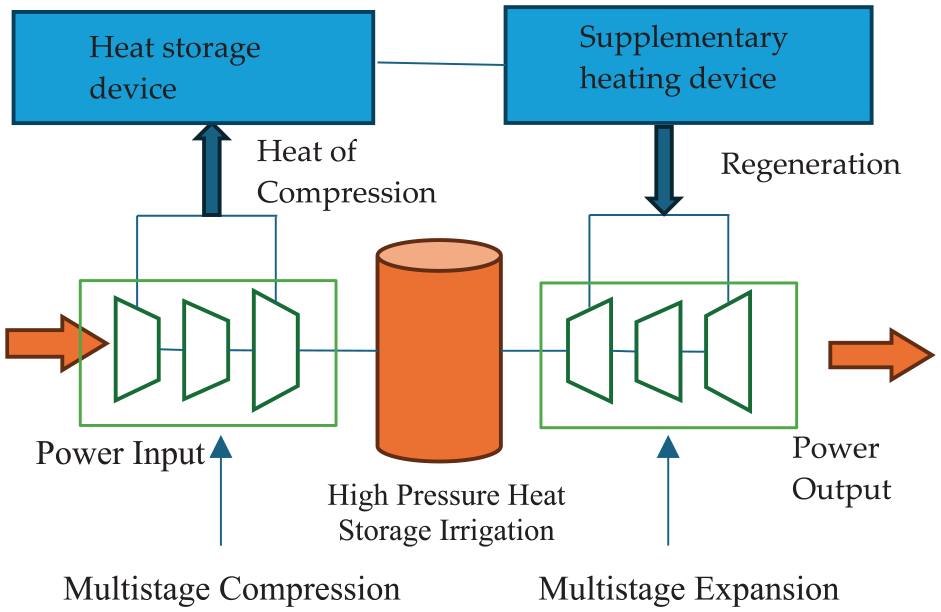
Principle of compressed gas energy storage technology. 21
On the Moon, CGESS offer certain advantages. They are not restricted by geographical conditions and can be flexibly deployed. Additionally, the construction and operation of lunar bases inherently require a certain amount of gas support. Therefore, building a compressed air energy storage system not only meets the needs of the lunar base but also stores a certain amount of energy, achieving two goals at once.
However, there are several drawbacks to using CGESS on the Moon. First, sealing is a critical issue. The vacuum environment of the Moon imposes extremely high requirements on the sealing of the energy storage system. Minor leaks, which might be insignificant on Earth, could be amplified in a vacuum, leading to rapid gas loss and rendering the energy storage ineffective. Second, temperature fluctuations are a concern. The extreme temperature variations between lunar day and night cause significant changes in the pressure and volume of the compressed gas, affecting the system's stability and energy storage efficiency. Third, energy supply is a challenge. The process of compressing gas requires energy, and on the Moon, solar energy is only available periodically. Insufficient energy supply during the lunar night could hinder gas compression. Fourth, equipment maintenance is difficult. In the Moon's unique environment, equipment is prone to damage, and repairs are challenging. If critical equipment fails, the system's operation could be severely hindered.
Molten Salt Energy Storage System (MSESS)
The MSESS, as a thermal energy storage technology, consists of components such as a molten salt solar tower, a cold salt tank, a hot salt tank, a steam turbine, and a steam generator. Its structure can be referenced in Figure 7, which shows a two-tank molten salt heat storage system. This system leverages the property of molten salt (typically a mixture of inorganic salts such as sodium nitrate and potassium nitrate) to store large amounts of thermal energy in a high-temperature molten state, achieving energy storage and release functions. 22 In its liquid state, molten salt exhibits excellent thermal stability and high specific heat capacity, allowing it to absorb and release significant amounts of heat while maintaining relatively small temperature changes. Most MSESS use a dual-tank configuration, where molten salt serves as both the heat transfer and storage medium. The heat exchange process follows the path of solar energy → molten salt → steam, bypassing the heat transfer oil cycle, effectively preventing poor heat exchange phenomena. This system is suitable for high-temperature conditions ranging from 400 to 500 °C and helps improve power plant efficiency and Rankine cycle efficiency.

The two-tank molten salt heat storage system. 22 (a) Direct molten salt energy storage and (b) Indirect molten salt energy storage.
Given the significant temperature differences between lunar day and night, MSESS can store solar heat during the day. With their high thermal storage capacity, these systems can fully utilize the Moon's abundant solar energy resources, providing energy support for equipment during the lunar night.
Compared to other energy storage systems, MSESS are relatively stable and reliable, with a high level of technological maturity. Their fundamental principles remain applicable in the lunar environment, ensuring a continuous energy supply for facilities such as lunar bases. However, the Moon's low gravity may interfere with processes such as molten salt flow and heat exchange, necessitating a reevaluation and adjustment of system operating parameters. Additionally, the transportation and installation of equipment pose significant challenges, and in the event of a molten salt leak, recovery and handling in the lunar environment would be extremely complex.
Other energy storage solutions
In addition to chemical and physical energy storage, there are other energy storage methods, such as supercapacitor energy storage and superconducting magnetic energy storage.
Supercapacitor energy storage system
As a novel energy storage device, the supercapacitor energy storage system (SESS) occupies a unique position in the field of energy storage. Its main components include positive and negative electrodes, an electrolyte solution, a separator, and a current collector. Its working principle relies on charging and discharging operations through the electrolyte, thereby achieving effective energy storage. 23 Figure 8 clearly shows the structural diagrams of electrical double-layer capacitor, pseudo capacitor and hybrid supercapacitor, through which SESS can exhibit unique performance advantages during charging and discharging.
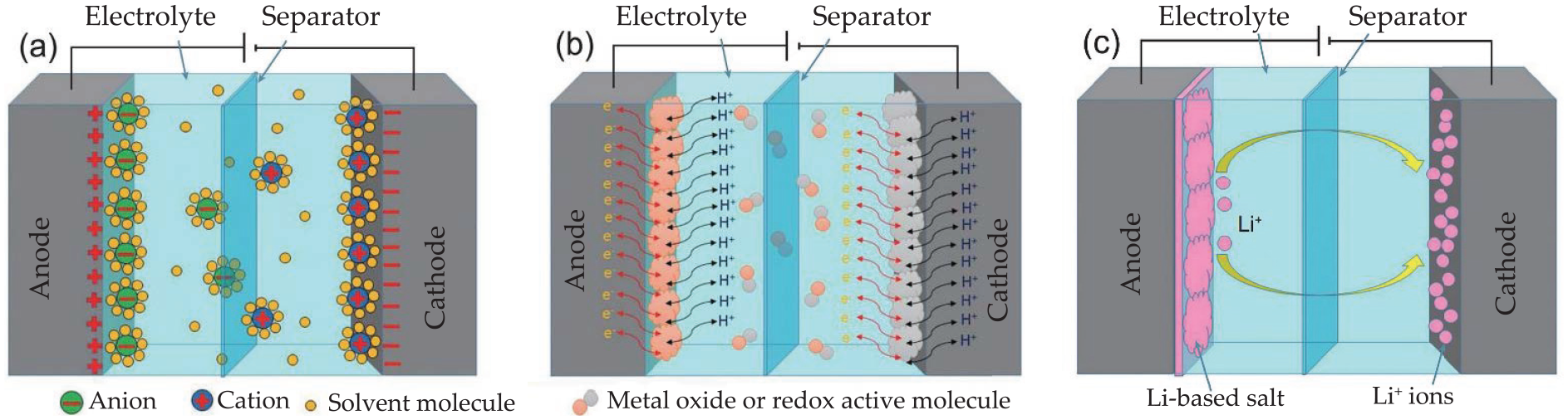
Schematic representation of (a) electrical double-layer capacitor, (b) pseudo capacitor, and (c) hybrid supercapacitor. 24
The development of SESS can be traced back to the 1970s and 1980s, when it emerged as an innovative energy storage technology bridging conventional capacitors and chemical batteries. In subsequent development, supercapacitors have continued to evolve, demonstrating numerous characteristics that surpass traditional energy storage devices. 25 They offer higher capacitance, enabling them to store more charge compared to conventional capacitors, thereby enhancing energy storage capacity to some extent. Their high power density makes them excel in meeting instantaneous high-power demands, allowing them to rapidly release or absorb large amounts of electrical energy, effectively satisfying the energy needs of equipment during high-power operations such as startup and acceleration. 26
In the context of lunar base applications, supercapacitor energy storage offers a series of significant advantages. First, its high-power density and rapid response characteristics make it an ideal choice for meeting the instantaneous high-power demands of equipment. During the operation of lunar rovers, for example, during acceleration or braking, a large amount of electrical energy is required, and supercapacitors can quickly provide the necessary energy to ensure the normal operation of the equipment. Second, the long cycle life of supercapacitors is particularly meaningful in the lunar environment. Due to the challenges associated with maintaining and replacing equipment on lunar bases, a long cycle life reduces the frequency of equipment replacement and maintenance, decreases reliance on Earth's resources, and enhances the stability and reliability of the lunar base's energy supply system. Third, their wide operating temperature range allows them to adapt well to the significant temperature variations between lunar day and night. The temperature on the lunar surface fluctuates dramatically, from extreme cold to high heat, yet supercapacitors can maintain stable performance in such conditions, ensuring that energy storage and supply are unaffected by temperature. Fourth, the relatively low maintenance cost of supercapacitors is particularly crucial in the resource-limited and maintenance-challenging lunar environment. Additionally, their excellent safety performance and environmental advantages provide strong support for the sustainable development of lunar bases.
However, supercapacitor energy storage is not without its drawbacks. Its relatively low energy density is a major limitation, meaning that under the same volume or weight conditions, supercapacitors store significantly less energy compared to some other energy storage methods (such as lithium batteries). This characteristic may require larger or heavier supercapacitor devices to meet the same energy demands, posing challenges for the miniaturization and lightweight design of equipment. Additionally, their relatively high cost limits their large-scale application to some extent. Voltage limitations also complicate charging circuits, requiring more precise circuit design and control strategies to ensure safe and efficient charging processes. Furthermore, supercapacitors exhibit self-discharge, which may lead to energy loss during long-term missions. This necessitates careful consideration of this factor in system design and operation management, along with corresponding measures to reduce energy loss and improve energy utilization efficiency.
Superconducting Magnetic Energy Storage (SMES)
As a form widely studied by various countries in the field of superconducting energy storage, the superconducting magnetic energy storage system plays a crucial role in modern energy storage technologies. 27 It mainly consists of five key components: superconducting coils, a cryogenic system, a power system, a protection system, and a monitoring system. These components work in coordination to jointly achieve efficient energy storage and release functions. Its structural principal block diagram (as shown in Figure 9) clearly demonstrates the connection relationships and working processes among the components, providing an intuitive perspective for in-depth understanding of the operating mechanism of the superconducting magnetic energy storage system.

General components of superconducting magnetic energy storage. 28
The core principle of the superconducting magnetic energy storage system lies in the use of superconducting coils carefully wound from multiple sets of superconducting tapes. These superconducting coils are ingeniously configured into a ring-shaped core component through a combination of series and parallel connections. When an electric current passes through the superconducting coils, due to the unique zero-resistance property of superconducting materials, electrical energy can be efficiently stored in the form of magnetic field energy. When electrical energy is needed, the magnetic field energy can be rapidly converted back into electrical energy and released. The energy loss in the entire process is extremely small, almost negligible.27,29 According to relevant research, the current decay time in a low-temperature closed superconducting coil can be as long as 100,000 years. This characteristic enables superconducting magnetic energy storage to achieve nearly loss-free energy storage in theory, greatly improving the energy utilization efficiency.
Superconducting energy storage has many remarkable advantages, making it highly favored in the field of energy storage. First, its fast response is remarkable. It can instantaneously absorb or release high-power electrical energy in an extremely short time. In the power system of a lunar base, this rapid response ability can effectively cope with situations such as power grid fluctuations and sudden high-power demands of equipment, playing a crucial role in maintaining the stable operation of the power system. Second, the high-energy-storage power characteristic of superconducting energy storage enables it to store a large amount of electrical energy in a short time, providing a solid energy guarantee for dealing with emergencies or meeting the operation of high-energy-consuming equipment. Third, its flexible operation feature allows operators to precisely control the energy storage and release processes according to actual needs, achieving fine-grained management of the power system.
With the continuous discovery and application of high-temperature superconducting materials, superconducting energy storage technology has ushered in new development opportunities. High-temperature superconducting materials make it easier to achieve superconducting energy storage at a low cost, which to a certain extent reduces the construction and operation costs of the superconducting energy storage system, laying the foundation for its large-scale application. In addition, the characteristic that superconducting energy storage is completely free from geographical restrictions gives it broad application potential in various complex environments, especially playing an important role in the construction of new energy power systems. Some industry experts even predict that in the 21st century, superconducting technology will have an unprecedentedly huge impact on the power field and is expected to lead a revolutionary change in energy storage and power transmission technologies. 30
However, using superconducting energy storage in a lunar base also faces some challenges. First, superconducting materials can only achieve the superconducting state at extremely low temperatures, which requires creating and maintaining such a low-temperature environment in the lunar base. However, achieving low-temperature conditions in the lunar environment is extremely costly and difficult, requiring many resources and advanced technical means. Second, superconducting materials themselves are expensive, making the construction and maintenance costs of the superconducting energy storage system remain high, which is one of the important factors limiting its wide application in the lunar base. Third, the superconducting energy storage system is technically complex and has extremely high technical requirements for operation and maintenance. Professional technicians and precise monitoring equipment are needed to ensure the stable operation of the system. Under the relatively limited technical support and human resources conditions in the lunar base, this undoubtedly increases the operation risks and maintenance difficulties of the superconducting energy storage system.
Integrated Energy Storage Solution
Lithium-battery energy storage technology has become relatively mature, and some of the technological achievements from Earth can be directly applied. With a relatively high energy density, it can meet the energy storage needs of small-scale and short-term applications, and can supply power to small lunar devices. However, the significant temperature difference between day and night on the Moon can easily cause the battery performance to decline, thus shortening the battery's service life. The impact of micrometeoroids may also damage the battery.
Regenerative fuel cell energy storage has the functions of cyclic energy storage and power generation. If there is an adequate supply of raw materials, it can operate continuously, showing great potential for long-term energy supply on the Moon. However, the key raw material, water, is extremely scarce on the Moon and difficult to obtain. The system is highly complex and prone to failure. Moreover, the lunar environment makes it difficult to guarantee the technical and resource conditions required for maintenance. Flywheel energy storage is characterized by rapid charging and discharging and high efficiency. It can quickly respond to changes in energy demand and can be used to deal with sudden peaks in energy demand at the lunar base. However, it has strict requirements for materials and mechanical structures. The extreme temperature and vacuum environment on the Moon can affect the material properties, thus threatening the stability and safety of the flywheel. Gravity energy storage has a simple and reliable principle and a large-scale energy storage capacity. It can achieve stable energy storage by taking advantage of the Moon's gravity and is suitable for large-scale energy storage scenarios. However, it depends on specific terrain or structures. Given the harsh construction conditions on the Moon, the construction is very difficult, and the low-gravity environment will reduce the energy storage efficiency. Compressed air energy storage has the advantages of a large energy storage capacity and long-term energy storage. It helps to balance the long-term energy supply and demand relationship at the lunar base. However, the vacuum environment on the Moon places extremely high requirements on the system's sealing. Temperature changes can interfere with the state of the air, having an adverse impact on the energy storage effect. Molten-salt energy storage has excellent heat-storage performance. It can make full use of the solar energy resources during the day on the Moon, which is of great value for the storage and utilization of lunar thermal energy. However, it requires a high-temperature environment to maintain the molten state of the salt. Due to the large temperature difference between day and night on the Moon, the molten salt is likely to solidify. Moreover, the molten salt may corrode the equipment. Supercapacitor energy storage has high charging and discharging efficiency and a long cycle life. It can achieve rapid charging and discharging operations and can be applied to scenarios where lunar equipment starts and stops frequently. However, its energy density is low, and the amount of stored electricity is limited. The lunar environment can also affect the performance of the capacitor. Superconducting magnetic energy storage has extremely low losses and a very fast response speed during the energy storage and release processes. It can effectively regulate the lunar power system. However, it requires low-temperature conditions to maintain the superconducting state. Achieving low-temperature conditions on the Moon is costly and difficult. Superconducting materials are expensive, and the system is complex.
In summary, each energy storage method has both advantages and inevitable disadvantages. To achieve more efficient energy storage on the Moon, a strategy is proposed that uses solar energy as the main energy source and combines multiple energy storage methods to build an integrated energy storage system to meet the energy needs of the lunar base, lunar rovers, and other equipment, as shown in Figure 10.

Integrated energy storage solutions using solar energy as the main energy source.
During the lunar day, solar panels are used for power generation. Part of the electrical energy is directly supplied to the lunar base, lunar rovers, and other equipment. The remaining electrical energy is allocated for storage: some of the electrical energy is used for electrolyzing water to produce hydrogen and oxygen, which are stored in the compressed-gas energy storage system. At the same time, a regenerative fuel cell is used to react some of the hydrogen and oxygen to generate electricity, and the generated electrical energy is stored in the lithium-battery for stable long-term power supply. Some of the electrical energy is used to drive the FESS, converting the electrical energy into the mechanical energy of the flywheel for storage to meet the high-power instantaneous demands of the equipment. A solar concentrator is used to heat the molten salt to store thermal energy, preparing for power generation at night. The supercapacitor performs rapid charging and discharging operations when the equipment starts and stops frequently or has high-power pulse demands (such as during the acceleration and braking of the lunar rover). Its energy mainly comes from the immediate supply of solar power generation and part of the recovered braking energy. For superconducting magnetic energy storage, excess electrical energy is used for charging during the day and stored as an emergency backup energy source or for powering equipment with extremely high power-quality requirements, such as scientific research instruments.
During the lunar night, the hydrogen and oxygen in the compressed-gas energy storage system generate electricity through the regenerative fuel cell to provide stable power to the base. The molten-salt energy storage system generates steam through heat exchange to drive a turbine for power generation, supplementing the power demand at night. When the equipment has high-power demands, such as for emergency startup or dealing with emergencies, the flywheel energy storage and supercapacitor can quickly provide energy support. Superconducting magnetic energy storage provides instant high-power output during power grid fluctuations or emergencies to ensure the normal operation of key equipment. The lithium-battery, as a basic energy storage method, continuously provides stable power supply to some low-power equipment (such as communication equipment, environmental monitoring equipment, etc.) at night.
The advantages of the integrated energy storage system are as follows: First, it has high energy supply stability. Through the combination of multiple energy storage methods, it can continuously and stably supply power under different environmental conditions during the lunar day and night, meeting both long-term stable power supply and instantaneous high-power output requirements. Second, it has a strong ability to cope with environmental changes. It fully considers environmental factors such as the large temperature difference between day and night on the Moon and the change of the light cycle. Different energy storage methods play their respective advantages under different environmental conditions, such as molten-salt energy storage for meeting the thermal energy demand at night and solar-related energy storage for daytime energy collection and storage. Third, it has high resource utilization efficiency. It uses the resources that may exist on the Moon (such as water) for energy storage and conversion, such as electrolyzing water to produce hydrogen and oxygen for compressed-gas energy storage and regenerative fuel cells, improving the resource utilization efficiency. Fourth, it can extend the equipment life. Different energy storage methods cooperate with each other, which can reduce the over-use of a single energy storage method. For example, the supercapacitor shares the high-power charging and discharging pressure of the lithium-battery, thus extending the service life of each energy storage device and reducing the maintenance cost.
Digital Model Construction and Simulation of Integrated Power Generation and Energy Storage System
Basic Parameter Setting
Simplify the parameters and set the day-night cycle of the lunar base (336 hours of lunar day and 336 hours of lunar night).
Lunar Base Load Model: To simplify the model, set the load power of the lunar base to be a constant 10kW. The lunar base consumes a total of 6720 kW·h of electrical energy within 0 to 672 hours.
Photovoltaic Power Generation Model: Set the power generation power of the solar power generation system to follow a sine curve within 0 to 336 hours. The power generation of solar energy is 0 at the two nodes of 0 and 336 hours, the peak power generation is 30kW, and the cycle is 672h. The solar power generation system stops working during the lunar night.
Then the output power function of the solar power generation system is as follows:


The solar power generation system generates approximately 6417
Energy storage system model: including battery, regenerative fuel cell, flywheel energy storage, gravity energy storage, and molten salt energy storage systems. Set the charge - discharge efficiency and total charge - discharge energy of each system as follows:
The efficiency of the battery energy storage system is:
The efficiency of the regenerative fuel cell energy storage system is:
The efficiency of the flywheel energy storage system:
The efficiency of the gravity energy storage system is:
The molten salt energy storage system stores energy by absorbing the heat emitted by the sun, with a discharge energy of
Energy distribution: The solar energy directly supplies the load: 3011 kWh. The solar energy is used for charging: 3406 kWh, which is distributed to the battery, regenerative fuel cell, flywheel, and gravity energy storage system. During the lunar night period and when the net load is negative during the lunar day period, the load is supplied by the discharge of the energy storage system.
Time discretization: To simplify the simulation, the time step is set to 1 hour (
Construction and Simulation of Digital Model for Integrated Power Generation and Energy Storage System
Establish a mathematical model to further study the relationship between the energy consumption of the lunar base and various energy storage systems. The model uses the time - stepping method. For each time step t (in hours), the following variables are calculated, with a range of 0 - 672h (a complete day - night cycle):
To simplify the model, the following assumptions are set: The energy consumed by the lunar base is jointly provided by the solar power generation system and multiple energy storage systems. The parameters are set as follows:
Establish an energy balance equation:

Daytime operation mode of the energy storage system
Nighttime period

Simulation Diagram of Power Supply for Integrated Power Generation and Energy Storage System.
Based on the pre-set total energy allocation, the model adopts a proportional allocation strategy: When
Charging and discharging proportions of various energy storage systems.

To more intuitively present the energy management logic and control strategy of the integrated energy storage system, the following reveals the collaborative working mechanism of each energy storage unit through a control block diagram (as shown in Figure 12). Based on the above mathematical model, this block diagram visually expresses the energy distribution strategy, system state switching logic, and equipment interlocking relationship, clearly demonstrating the dynamic interaction process among solar power generation, multi - type energy storage systems, and loads.

Control block diagram of the integrated energy storage system.
Conclusion
Through in-depth analysis and exploration of the energy storage methods on the Moon, the following conclusions can be drawn:
(1) Whether it is chemical energy storage, physical energy storage, or other types of energy storage methods, a single form of energy storage has its unique advantages, and its inherent limitations cannot be completely overcome. In view of this situation, on the one hand, efforts can be made to continuously optimize the storage system, strive to expand its advantageous scope, and reduce the impact of disadvantages, so that it can better adapt to the harsh characteristics of the lunar environment and effectively serve the energy storage needs of the lunar base. On the other hand, when the defects of a single energy storage method cannot be fully compensated, building an integrated energy storage system based on the advantages and disadvantages of each energy storage system is undoubtedly the most ideal choice.
(2) A solar-driven hybrid energy storage architecture is proposed, integrating lithium batteries, regenerative fuel cells, flywheels, gravitational storage, and molten salts. During lunar days, 47% of solar energy meets base loads, while the rest charges storage systems; at night, battery, gravitational, and molten salt storage provide 89.8% of electricity. Digital modeling validates the system’s stability, with 6,417 kW·h solar energy cycled to store 3,406 kW·h and release 3,740.8 kW·h, enhancing resource efficiency and equipment lifespan.
Future research should focus on low-temperature battery materials, miniaturized superconducting storage, in-situ regolith utilization for gravitational storage, and dynamic energy allocation algorithms. This integrated strategy provides a feasible framework for sustainable lunar energy supply, balancing technological innovation with environmental adaptability.
Footnotes
Appendix
Handling Editor: Simona Merola

Author Contributions
Funding
The author(s) disclosed receipt of the following financial support for the research, authorship, and/or publication of this article: The work is funded by the Shenzhen Science and Technology Program (Grant No. JCYJ20220818102409021, JCYJ20220531103614032, SGDX20240115101806011), National Natural Science Foundation of China (Grant No. U2013603, 52275454), Guangdong Basic and Applied Basic Research Foundation (Grant No. 2024B1515120002) and Shenzhen University Proof-of-Concept Project.
Declaration of conflicting interests
The author(s) declared no potential conflicts of interest with respect to the research, authorship, and/or publication of this article.
Data Availability Statement
The authors do not have permission to share data.