



Abstract
The railway car body is made of aluminium extrusion comprising various rib shapes. The ribs are designed to enhance the stiffness of the car structure. Although the ribs are intended to support large panels of the aluminium extrusion, they can degrade the noise reduction effect owing to multiple resonant vibrations at high frequencies. Therefore, a scientific attempt was made to improve the railway frame by using ribless panels. First, a structural analysis of the original aluminium extrusion was conducted using computer simulation. The simulation results revealed that the ribs of the frames transmitted noise owing to their resonance in the high-frequency range. Therefore, a new railway frame model, named the ribless panel, was developed in this study. Vibration simulations indicated that the ribless panel was effective in reducing noise and vibrations in the high-frequency range. Furthermore, the ribless panel was reinforced with acrylic plastic to reduce the resonant vibrations of the plates. After examining the transmission loss in cross-sectional railway frames, a comparative test of the noise reduction performance was conducted in the reverberation chamber. The results indicated that the reinforced ribless panel improved the transmission loss in the overall high-frequency range. Specifically, 6.7 dB of transmitted noise was reduced using the new panel suggested in this research.
Introduction
The body of a railway vehicle plays a crucial role in providing structural support and minimizing external vibrations and noise propagation during operation. The material used for manufacturing railway car bodies is primarily aluminium extrusion, which is favoured over steel due to its lighter weight and high stiffness. 1 These extrusions typically consist of two connected panels with various internal rib configurations, designed to enhance structural rigidity while maintaining lightweight properties. 2 Various studies have been conducted on the internal shapes of railway vehicles because they have a significant effect on the railway noise and vibration.
A representative example of the outcome of research on railway vehicle bodies is the lightweight vehicle. As the weight of a railroad vehicle has a significant effect on its performance, various studies have been conducted on lower-mass trains. 3 The most common approach for reducing the weight of a railway vehicle body is to manufacture them using lightweight materials. For instance, magnesium alloys have been considered for lightweight railway car body construction from structural and manufacturing perspectives.4,5 It was demonstrated that a magnesium-based railway car body could be potentially constructed with just 85% of the weight of the aluminium car body currently in operation. In addition, the concept of a hybrid body shell for a tilting train was proposed and a prototype model was developed. 6 To satisfy the requirements of a lightweight structure and stability on curving tracks, the upper body shell of the prototype model was made of composite honeycomb panels and the lower underframe was made of stainless steel.
Another study was conducted to improve the performance of rail vehicles by optimizing the body shape. 7 For example, the car body roof of a light rail vehicle was redesigned and optimized by introducing a sandwich structure. 2 A mass saving of 63% was achieved for the optimized components, corresponding to a 7.6% reduction when compared with the mass of the complete car body shell. Furthermore, the design of a vehicle body built from extruded aluminium panels was studied using structural optimization. 8 The weight and stiffness of the structure were determined by changing the shape and thickness of the webs and ribs of the aluminium extrusion. In addition, a new dynamic optimization approach was proposed to support the design of railway vehicle bodies subjected to static loads. 9 It was suggested that the optimized components were 21% lighter than the original, which corresponded to a mass saving of 3% when evaluated on the total mass of the metallic structure of a single car body.
Research on the shape of the railway vehicle body in relation to noise and vibration reduction has been widely conducted to enhance the performance of high-speed trains, as these vehicles are exposed to various noise sources, such as aerodynamic noise and rolling noise during operation.10,11 For example, light acrylic plastic has been proposed as a material for railway car bodies to effectively reduce both noise and vibration. 12 Additionally, a multilayer structure incorporating silicone rubber has been introduced in the vehicle’s connecting parts to enhance low-frequency noise insulation.13,14
Recent advancements in railway noise and vibration control have explored innovative techniques such as acoustic metamaterials and energy harvesting systems to enhance overall sound insulation performance. Studies have shown that acoustic metamaterials can be engineered to create resonance-based sound attenuation mechanisms, effectively reducing noise transmission in lightweight railway structures. 15 Additionally, integration with energy harvesting systems has been proposed as a sustainable approach to mitigate vibrations while simultaneously generating electrical energy, offering a dual benefit for railway applications. 16 Such novel approaches have demonstrated significant potential in improving noise insulation efficiency without adding substantial mass, which aligns with the goal of optimizing lightweight aluminium extrusion panels in railway vehicles.17,18 Incorporating these emerging technologies into future designs could further enhance the structural-acoustic performance of railway vehicles.
Recent advancements in noise and vibration control in railway structures have increasingly drawn on the principles of acoustic metamaterials and periodic phononic systems. For instance, Iqbal et al. 19 demonstrated that flexural band gaps in periodic railway track structures can be exploited to achieve effective vibration attenuation through Bragg scattering mechanisms. Similarly, Ravanbod and Ebrahimi-Nejad 20 developed re-entrant cross-like phononic beams with perforated hosts that enabled broadband attenuation by inducing localized resonance and geometric scattering effects. These structural concepts are distinguished by their periodicity and unit-cell-based design, which generate stop-bands for specific vibration ranges.
Although the ribless panel proposed in this study does not directly implement such periodic unit cell configurations, its simplified geometry with reinforced acrylic support acts to reduce modal complexity and high-frequency resonance pathways—achieving a form of distributed damping. This is analogous in effect to the mechanisms observed in honeycomb locally resonant acoustic metamaterials 21 and membrane-type designs optimized using genetic algorithms, 22 which achieve broadband suppression through coupling between resonant elements and structural membranes. These comparisons provide a foundation for further development of railway-specific metamaterial-inspired structural configurations.
Despite various studies on the noise and vibration of a rail vehicle body, the basic shape of the vehicle body consists of two plates and a variety of ribs, which contribute to the noise within the vehicle. Therefore, this study proposes a simplified shape of the rail vehicle body, which involves removing the ribs for greater noise reduction. First, a structural analysis of the original aluminium extrusion was conducted using computer simulation. The simulation results revealed that the ribs of the frames transmitted noise owing to resonances in the high-frequency range. Based on this result, a new railway frame model, named the ribless panel, is proposed. Vibration simulations indicated that the ribless panel was effective in reducing noise and vibrations in the high-frequency range. Furthermore, the ribless panel was reinforced with acrylic plastic to reduce the resonant vibrations of the plates. After examining the transmission loss using cross-sectional railway frames, a comparative evaluation of the noise reduction performance was conducted in the reverberation chamber.
Theory of transmission loss of panels
The body frame of a rail vehicle consists of two aluminium plates and multiple ribs in between the plates for support. The noise transmission loss in the body frame of a rail vehicle is affected by the mass and stiffness of the two plates and ribs.
The effect on noise transmission loss when noise was mathematically applied to a single plate was examined, as shown in Figure 1, which illustrates the fundamental concept of sound transmission through a single panel, where an incident sound wave strikes the panel surface perpendicularly (normal incidence). The noise-reducing properties of aluminium plates, such as those used in rail vehicle body frames, are generally examined based on the transmission coefficient (



Sound perpendicularly incident on a panel.
The above equations show that the smaller the transmission coefficient or greater the transmission loss, the greater is the noise reduction performance. Generally, the noise reduction performance of a material is indicated by its sound transmission loss.
In addition, the sound performance of a uniform wall or plate can be broadly divided into three parts when compared within a frequency range. When incident noise occurs in the same frequency range as the resonant frequency of the panel, the transmission loss is significantly reduced by the resonance of the panel. Generally, this phenomenon occurs in the low-frequency region. In the region above the resonant frequency, the transmission loss of the panel increases with frequency. In this frequency region, it is assumed that the thickness of the plate is sufficiently small considering the wavelength of the incident noise, and that the entire plate performs piston motion. Furthermore, when the incident sound enters obliquely in a certain high-frequency region, the wavelength formed on the surface of the panel can match the wavelength of the bending vibration of the wall at a specific frequency, and a coincidence effect can occur in which the transmission loss is significantly reduced. In general, in a frequency range higher than the eigenfrequency of the wall, the transmission loss can be expressed as follows. 13

In the above expression, m denotes the mass per unit area and f denotes the frequency.
As shown in the above equation, for a single plate, the transmission loss is primarily determined by the mass per unit area of the wall, and the stiffness or attenuation coefficient is unaffected. Moreover, as the frequency and mass increase by two times, the transmission loss increases by 6 dB, which is called the mass law. 24
The theoretical framework introduces the basic concept of sound transmission loss using classical models developed for homogeneous single-layer plates. While these models are useful for establishing a foundational understanding, they do not fully represent the complex, multi-component structure of aluminium extrusions, which include internal ribs and varying cross-sectional geometries. Therefore, in this study, the classical mass law and resonance behaviour are used as reference points, while numerical simulations and structural analysis specific to aluminium extrusion geometries are employed to capture the actual transmission characteristics of the railway car body panels. In this study, the sound transmission loss of a railway body frame was predicted based on a theoretical method, and the effect of vibration in the rib on the sound transmission loss was determined based on the results measured in an actual reverberation chamber.
Analysis of aluminium extrusions of railway frame
In this study, the rib shape of the railway vehicle was examined, and the effect of the rib structure on the noise reduction of the panel was examined by analysing the dynamic characteristics and transmission loss. First, the cross sections of the body structure applied in actual railway vehicles were examined, as shown in Figure 2. The body of a railway vehicle is made of aluminium panels with thickness of 0.004 m and separated by a distance of 0.064 m. Ribs of 0.002 m thickness are attached diagonally between two panels for support. The length of the body plate is typically more than 20 m, whereas the length of the rib is approximately 0.05 m. The body of a railway vehicle is made of aluminium panels with a thickness of 0.004 m and separated by a distance of 0.064 m. Ribs of 0.002 m thickness are attached diagonally between two panels for support. The length of the body plate is typically more than 20 m, whereas the length of the rib is approximately 0.05 m. If we assume that the wavelength of the sound originating from outside the car body is transmitted through the rib, it can be expected that the rib structure greatly increases the transmission of sound owing to resonance at high frequencies, such as 3140 and 6280 Hz. These resonance frequencies were obtained based on the relationship between the structural dimensions of the rib and the characteristic wavelength of the sound field. Using the fundamental resonance condition f = c/λ, where c is the speed of sound in air (≈343 m/s) and λ is the characteristic wavelength associated with the rib length, the estimated resonance frequencies align with the observed values. There is also a constant gap, such as 0.086 or 0.042 m, between the connection points of the rib and panel. Therefore, it can be expected that resonance in the high-frequency region may occur for short wavelengths, even at this position.

Aluminium extrusion model of railway car body frame.
An engineering analysis program, COMSOL, was used to analyse the characteristics of the vibrations generated in actual aluminium. Figure 3 shows the analysis model with 10,683 finite elements, providing sufficient resolution for high-frequency wave analysis. The aluminium model used in this analysis was the same as that used for actual railway vehicles. The length of this model was 1 m, and a 0.002 m-thick rib was connected to the internal space of the extrusion plate with a thickness of 0.004 m. At the time of analysis, the material properties were the same as those of the actual aluminium material, with a density of 2700 kg/

Analysis model for aluminium extrusion.
Numerical simulations were performed to evaluate the structural and acoustic performance of both the ribbed frame and the proposed ribless panel. Finite element analysis was conducted for structural modal analysis, while sound transmission loss simulations were carried out to assess acoustic performance. The models were developed based on actual railway vehicle panel dimensions, with material properties assigned to match aluminium extrusion and acrylic plastic reinforcements. Free-free boundary conditions were applied for vibration analysis, and a normal incidence plane wave was used in acoustic simulations. The numerical results were validated by comparing them with theoretical mass law predictions and known resonance characteristics.
First, numerous eigenmodes were identified through the natural frequency analysis of the aluminium extrusions (Figure 4). To analyse the vibration behaviour of the ribs in this study, simulations were conducted under free boundary conditions. This approach allows for a more accurate observation of the intrinsic vibrational characteristics of the ribs without external constraints, providing insights into their dynamic response within the extrusion structure. As shown in Table 1, there were approximately 14 multiple vibration modes from the first resonance at 196 Hz to that at 1324 Hz. Railway vehicles have multiple modes because of their complex structures inside the flats owing to multiple ribs. The unique vibration mode in a specific frequency region was reviewed for an accurate analysis. First, in the primary mode at 196 Hz, it was confirmed that the bending mode works as a whole in the body panel. Moreover, in the mode at 536 Hz, multiple resonance modes occur in the interval between the rib and the rib on the panel. This trend was confirmed in the region of 1225 Hz. This confirms that the body panel of a railway vehicle has multiple modes that can cause resonance in the high-frequency region with short wavelengths owing to the large number of short ribs.
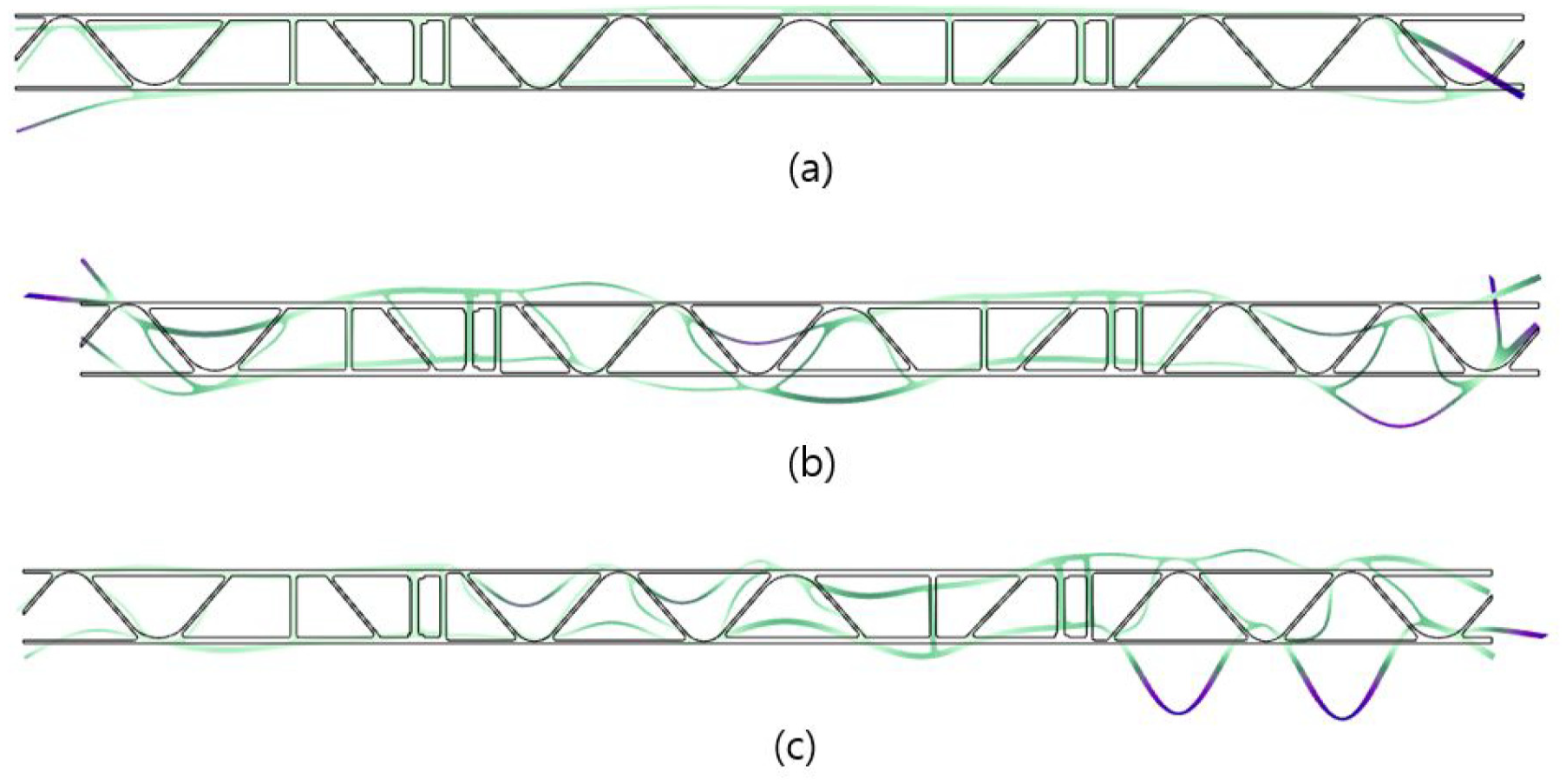
Eigenmode shapes of aluminium extrusion: (a) 196 Hz, (b) 536 Hz, and (c) 1225 Hz.
Natural frequency analysis of aluminium extrusion.

The car body panels of the railway vehicles surround the car body, and the noise and vibrations are transmitted through the panels from the outside. The indoor noise in railway vehicles is caused by rolling noise resulting from contact between the wheels and rails, or external aerodynamic noise that occurs around the car body when the vehicle is driven at a high speed. The computer model shown in Figure 5 was used to examine the transmission loss of noise generated in the body of a railway vehicle when a noise of 1 Pa from the outside is transmitted from a distance of approximately 1 m to the internal space of the car body. The incident sound wave was assumed to be a plane wave in this study. While this assumption may differ from real-world noise environments, it was adopted to prioritize the evaluation of transmission loss performance for the panel. This simplification allows for a clearer analysis of the fundamental acoustic behaviour of the structure under controlled conditions. It is essential to set a denser mesh than that used in the vibration analysis because the wavelength is shorter in the high-frequency region in this case. The models used for this interpretation comprised 42,071 elements, providing sufficient resolution for high-frequency wave analysis.

Model for transfer loss analysis of aluminium extrusion.
The analysis results of the noise transmitted from the extrusion material according to the frequency range are shown in Figure 6. In this analysis, the frequency range of 20–5000 Hz was examined, which is the usable frequency range, and it was analysed at intervals of 1/12 octave bands for a detailed investigation of each frequency region. The transmission loss of the panel is affected by rigidity at low frequencies, gradually decreasing at 160 Hz in the primary bending mode and then gradually increasing in response to the product of the mass and frequency per unit area of the panel. It can be confirmed that the results of the transmission loss analysis of the aluminium panel are generally in the range of 15–55 dB. Furthermore, the transmission loss decreased sharply in a specific frequency range. Specifically, the transmission loss decreased significantly at 1700 and 3750 Hz. According to the mass law, transmission loss decreases in the low-frequency range due to its dependence on material stiffness. In this study, the primary focus is on the transmission loss characteristics influenced by the rib structure, which predominantly affects the high-frequency range. Therefore, the investigation prioritizes the improvement of high-frequency sound insulation, where rib-induced resonance plays a significant role.

Results of transfer loss of aluminium extrusion in the frequency domain.
The sound propagation in the aluminium extrusions was analysed, as shown in Figure 7. To examine the effect on the vibration of the car body when the sound enters, the effect of the vibration generated by the panel was applied to the result. In particular, the analysis was performed by focusing on the 1700 and 3750 Hz regions, where a sharp decrease occurs in the transmission loss in the frequency region. From the results of the analysis, it can be confirmed that the poor performance in terms of the transmission loss in the high-frequency region is closely related to the resonance that appears in the rib of the car body. Many small-length ribs on the panels of the body are attached in a complex manner; therefore, resonance occurs in the relevant parts, and the transmittance performance of the noise is significantly reduced.

Noise map of the transfer loss of the aluminium extrusion at specific frequencies: (a) 1700 Hz and (b) 3750 Hz.
The rib of a railway vehicle supports its frame. However, the rib is short and exhibits multiple resonance modes in the high-frequency region. Therefore, when a sound in the high-frequency region is received, the noise in the relevant frequency region is easily transmitted owing to the resonance of the ribs. Consequently, the noise reduction performance in terms of the sound transmission loss in the high-frequency region decreases. To overcome this, a new scientific approach was developed in this study, which involved removing the ribs and simplifying the railway vehicle body.
Improvement of transmission loss by using ribless panel
In this paper, an approach involving the removal of the ribs from the body of a railway vehicle is proposed to simplify the body. The ribless panel presented in this study is simply connected to two panels in a cylindrical shape, as shown in Figure 8. The width of the panel is 1 m; the two cylinders are equidistant and support the two panels.

Ribless panel model.
An analysis model was implemented (Figure 9) to analyse the effect on the vibration transmission when the body is supported by the suggested ribless panel. Two important factors to consider when designing a body using a ribless panel are the thickness of the panel and thickness of the cylinder supporting the interior. Therefore, a pressure of 1 Pa was applied to the panel, and the effect on the vibration transmission was examined based on the changes in the thicknesses of the panel and cylinder. It was predicted that the thinner the panel and cylinder, the lighter will be the weight of the body; however, the vibration might increase. In particular, the size and shape of this panel were analysed to determine the thicknesses of the panel and cylinder that could reduce the transmission of vibrations when compared with that of the existing aluminium extrusion material.

Vibration analysis model of ribless panel.
The assumptions made in the simulations were carefully considered and clearly defined to ensure the reliability of the results. Material properties were assigned based on actual aluminium extrusion data used in railway applications, and geometrical configurations were modelled to match real-world structural conditions. Sensitivity analyses were conducted using models that considered various panel thicknesses and manufacturability of the proposed design, allowing for a comprehensive evaluation of how these factors influence noise reduction performance. These steps help validate the accuracy of the simulations and their applicability to real-world railway vehicle structures.
First, for the panel thickness of 0.002 m, the vibrations transmitted by changing the thickness of the cylinder to 0.004, 0.005, and 0.01 m were compared as shown in Figure 10. This comparison was analysed in 1/12 octave bands to provide higher frequency resolution, enabling a more precise evaluation of the material’s vibration response across different thickness configurations. From the results of the analysis, it was confirmed that in the case of the existing aluminium extrusions, smaller vibrations than those in the case of panels with a thickness of 0.002 m occurred in the low-frequency region. However, in the high-frequency region, it was observed that the peak of the vibrations of the existing aluminium extrusion occurred more frequently than in the case of the cylindrical panels and ribless panels of different thicknesses. Structural analysis confirmed that the short-wavelength noise of the rib was transmitted through the panel.

Results of vibration analysis of a 0.002 m-thick ribless panel.
In addition, in the case of a panel thickness of 0.004 m, the transmitted vibration was analysed for the cylinder thicknesses of 0.004, 0.005, and 0.01 m, as shown in Figure 11. The results were also evaluated in 1/12 octave bands to ensure consistency in frequency resolution and to capture detailed differences in vibration behaviour across varying support configurations. The results confirmed that the transmitted vibration was significantly reduced when compared with that in the case of the existing aluminium extrusion panel. Furthermore, a cylinder thickness of 0.01 m was confirmed to be the most effective in reducing the vibration transmission among the cases analysed in this study. In particular, when the thickness of the panel was increased to 0.004 m, the vibration of the panel was similar to that of the existing aluminium extrusion panel in the low-frequency region up to 300 Hz. However, at frequencies above 300 Hz, the vibration was significantly reduced when compared with that of the existing aluminium extrusion material.

Results of vibration analysis of a 0.002 m-thick ribless panel.
The mode of vibration of ribless panels with a panel thickness of 0.004 m and cylinder thickness of 0.01 m, selected through comparison with the results of the aluminium extrusion material, is shown in Figure 12. Through this mode analysis, it was possible to clearly examine the shape of the vibration that occurred when the ribless panel was subjected to external excitation. The vibration modes of the ribless panel occurred at short wavelengths and high frequencies due to the support of the internal cylindrical structure. More specifically, at 4000 Hz, the vibration wavelength was noticeably shorter compared to that at 500 Hz, confirming the frequency-dependent modal behaviour of the ribless panel. The ribless design resulted in increased vibration below 300 Hz due to the absence of structural reinforcement from ribs. To mitigate this effect, plastic acrylic reinforcements were introduced, providing additional damping and improving the low-frequency vibration characteristics of the panel. This approach helps to compensate for the reduced stiffness while maintaining the benefits of the ribless configuration.

Vibration modes of ribless panel at specific frequencies: (a) 500 Hz, (b) 1000 Hz, (c) 2000 Hz and (d) 4000 Hz.
In the case of a ribless panel, multiple short-wavelength vibrations occur between the support points when the interior is supported only by a cylinder. Therefore, to improve the vibration reduction performance of this panel, an approach to reinforce it on the inside with aluminium acrylic, a light material, is proposed, as shown in Figure 13. The aluminium acrylic reinforcement was positioned as an internal support structure between the cylindrical panels, providing additional stability to the ribless panel. This configuration helps to reduce vibrations of short wavelengths that typically occur between the support points, enhancing overall structural damping and noise reduction effectiveness.

Reinforced ribless panels with acrylic plastic supports.
The actual body frame is realized by completely surrounding the vehicle. Therefore, to analyse the effect of noise caused by the vibrations generated by vehicles on the interior, the cross-sectional shape of the body proposed in this study was implemented, as shown in Figure 14. These models matched the actual vehicle in size and shape. First, the simplest form of the car body frame was designed using simple supports for the internal and external body frames in the car body, as shown in Figure 14(a). The cross-sectional area of this model was 0.0674

Cross-section of railway car body frame: (a) simple railway model, (b) original aluminium extrusion model, and (c) reinforced ribless model.
A vibration of 1 Pa, applied at the bottom of the car body model, was analysed as shown in Figure 15. The surface vibrations of the simulation models exhibited similar trends in the given frequency range. Furthermore, in the high-frequency region, multiple resonance modes were observed in the case of existing aluminium extrusions and ribless panels.

Vibration analysis of various types of railway frames.
Generally, the interior noise in a railway vehicle is attributed to vibrations generated outside the train and transmitted through the car body. The car body is made of solid metal, which transmits the structural vibrations. Moreover, the air in the interior of the car body is excited by the panel vibration of the railway vehicle. This interior noise generation mechanism was simulated, as shown in Figure 16. Structural-acoustic interactions were considered at the boundary between the interior air and car body frame. The model consisted of 103,325 elements, allowing for detailed simulation of structural-acoustic interactions.The sound field generated through floor excitation was analysed, as shown in Figure 17. This model shows the sound field inside the ribless panel, generated at 1000 Hz. Based on this analysis, the sound pressure distribution inside the car body frame is presented in Figure 17. The results of the spatial average of the noise generated in the internal space, based on the area of the internal space and analysed according to the frequency region, are shown in Figure 18. These results suggest that the noise of the conventional aluminium extrusions is relatively low in the low-frequency region up to 200 Hz. However, in the frequency range above 200 Hz, it was observed that the noise inside the ribless car body was relatively lower than that of the original aluminium extrusion. The main reason for this improvement was that the suggested ribless panel had simple structures that did not generate resonances in the high-frequency range.

Acoustic analysis models of interior cavities in various railway frames.

Average sound pressure level in the interior cavity at 1000 Hz frequency.

Average sound pressure level in the interior cavity in the frequency domain.
Experimental validation of improvement models
In this study, the noise reduction performance through sound transmission loss in the reverberation chamber was compared between the aluminium extrusion and ribless panel models of actual railway vehicles. Transmission loss measurements in the reverberation room were performed by placing the model between two divided chambers, as shown in Figure 19. Specifically, sound was generated by the speaker in the source room and transmitted through the wall and model into the receiving room. The sizes of the transmitting and receiving rooms were 249. and 325

Transmission suite for reverberation test.
To verify the simulation results, a reverberation chamber test was conducted following ISO 10140-2 standards. The test setup included a controlled noise source and microphone array to measure STL across a wide frequency range. Test specimens were fabricated with the same material properties as the numerical models to ensure consistency. Sound pressure levels were measured in both source and receiving rooms to determine the transmission loss.
In the transmission loss test, the aluminium extrusion and ribless panel models, which were the subjects of the test, were installed in the wall of the reverberation room space, as shown in Figure 20, in an open space of 1 m width and length. A concrete wall of 0.3 m thickness was used to minimize the transmission of sound to the wall. The models were attached to the centre of the wall to conduct the experiment. The frequency range of the noise analysis was set from 100 to 5000 Hz, considering the size of the reverberation chamber.

Model for evaluating the noise reduction performance.
The experimental setup in the reverberation chamber was designed to evaluate sound transmission loss under controlled conditions. Measurement techniques included placing microphones at specified positions in both the source and receiving rooms to capture sound pressure levels. Equipment calibration was conducted before testing to ensure accuracy and repeatability. The collected data were analysed using statistical methods to account for variations and ensure reliable results, allowing for a direct comparison between the ribbed and ribless panel designs.
The results of the transmission loss analysis of the aluminium extrusion and ribless panels are shown in Figure 21. In this result, the mass law based on the theory of transmission loss of the panel was also used to compare the noise reduction performance of the panel according to the mass. In this analysis, the transmission loss based on mass law was calculated using a generic rectangular panel with the same thickness as the analysed structures. This reference panel was used to compare the impact of structural modifications, such as aluminium extrusion and ribless panel designs, on transmission loss performance. This approach allowed for a clear evaluation of how geometric and material changes influence sound insulation. In the case of the aluminium extrusion with multiple ribs, high noise reduction performance was confirmed in the low-frequency range of 500 Hz or less; however, in the area above 500 Hz, the noise-reduction performance was low. In particular, considering the law of mass, the noise reduction performance decreased significantly in the high-frequency range. The complex shape of the rib was considered to cause resonance in multiple high-frequency regions in the panel. In contrast, the ribless panels had a high noise reduction performance when compared with that of the existing aluminium extrusions in the range of 500–5000 Hz. In particular, it can be confirmed that the 500–2500 Hz range showed a higher noise reduction performance considering the law of mass. Although the model was only partially reinforced with lightweight plastic acrylic, it had an improved noise reduction performance. In particular, in the 1250 Hz region, the noise reduction performance of 6.7 dB was observed when compared with the noise level in the existing aluminium extrusion model.

Transmission loss analysis for various types of railway car-bodies.
Ribless panels reduce sound transmission by simplifying the structural configuration that typically contributes to high-frequency vibrations. In traditional ribbed designs, the internal ribs create multiple resonance paths that facilitate sound propagation. By eliminating these ribs, the ribless design minimizes structural resonances, leading to a more uniform vibration response and improved transmission loss at higher frequencies. This structural simplification helps enhance the overall sound insulation performance by reducing the pathways through which airborne noise can travel.
In comparison to conventional ribbed structures, the proposed ribless panel demonstrates improved sound insulation performance, particularly in the high-frequency range. This improvement can be attributed to two main mechanisms. First, the removal of internal ribs eliminates structural discontinuities that typically generate localized resonances and amplify high-frequency vibrations. Instead, the ribless geometry produces a simpler, more uniform modal pattern that reduces the radiation efficiency of the panel surface. Second, the acrylic plastic reinforcement introduced between the double aluminium plates provides additional structural damping, which dissipates vibrational energy and suppresses resonance peaks. This damping effect plays a significant role in attenuating high-frequency noise transmission.
Furthermore, the behaviour of the panel varies depending on its stiffness and the excitation frequency. At low frequencies, the panel operates in a stiffness-controlled regime, where the transmission loss is strongly influenced by flexural rigidity. As frequency increases or as the effective stiffness is reduced, the panel transitions into the mass-controlled regime, in which transmission loss increases in accordance with the mass law. The ribless panel, having less local stiffness due to the absence of ribs, facilitates this transition and thus achieves better performance in the mass-controlled region.
Although the ribless panel shows strong performance in the mid-to-high-frequency range, its effectiveness in the low-frequency domain (<300 Hz) is relatively limited. To mitigate this, the acrylic reinforcement contributes not only to high-frequency damping but also provides partial suppression of low-frequency vibration modes through added distributed mass and viscoelastic behaviour. Nevertheless, further refinement—such as localized damping layers or hybrid configurations—may be needed to enhance performance in the low-frequency range.
The study primarily focuses on evaluating the sound insulation performance of both aluminium extrusion and ribless panel designs. While the ribless panel section includes vibration analysis to explain its structural response, the experimental validation was conducted for sound insulation performance, as this is the key parameter for practical application. Moreover, structural vibration testing is most effectively conducted on a full-scale railway vehicle rather than on simplified specimens. Since this study focuses on small-scale panel analysis, conducting such tests was not feasible. However, future work will consider additional experimental vibration analysis to further support the findings.
Conclusion
In this study, a scientific approach was taken to enhance the railway frame structure by introducing ribless panels. To begin with, a structural analysis of the conventional aluminium extrusion frame was conducted using computer simulations, which revealed that internal ribs contributed to noise transmission due to resonance, particularly in the high-frequency range. To overcome this issue, a new railway frame model—referred to as the ribless panel—was developed, and subsequent vibration simulations demonstrated its effectiveness in reducing noise and vibration within the high-frequency domain. Furthermore, to suppress resonant vibrations of the plates, the ribless panel was reinforced with acrylic plastic supports. Based on this design, the transmission loss was evaluated using cross-sectional railway frames, followed by comparative testing in a reverberation chamber. As a result, the reinforced ribless panel showed a notable improvement in high-frequency sound insulation, achieving a reduction of 6.7 dB in transmitted noise. In addition to its acoustic benefits, the proposed design enabled a 10% reduction in vehicle body weight and simplified the overall geometry, thereby enhancing manufacturability. To ensure a realistic assessment of structural performance, a full-scale simulation was carried out to examine the effects of floor vibration, and the same aluminium material used in actual railway vehicles was applied to validate the analysis. Nevertheless, further research is necessary to comprehensively evaluate the long-term mechanical properties of the proposed design before it can be implemented in real-world applications.
Footnotes
Handling Editor: Chenhui Liang

Funding
The author disclosed receipt of the following financial support for the research, authorship, and/or publication of this article: This research was supported by grants from the Railroad Technology Research Program funded by the Ministry of Land, Infrastructure, and Transport of the Korean government and R&D Program of the Korea Railroad Research Institute, Republic of Korea.
Declaration of conflicting interests
The author declared no potential conflicts of interest with respect to the research, authorship, and/or publication of this article.
Data availability statement
Data sharing is not applicable to this article, as no datasets were generated or analysed during the current study.