



Abstract
This study investigates the flow of ternary and hybrid nanofluids over a stretching wedge in a porous medium, incorporating quadratic thermal convection, Newtonian heating, and viscous dissipation. The hybrid nanofluid comprises magnesium and zinc oxides (MgO-ZnO), while the ternary nanofluid includes magnesium, zinc, and graphene oxides (MgO-ZnO-GO), with ethylene glycol as the base fluid. The model accounts for homogeneous-heterogeneous (HOM-HET) reactions and surface-catalyzed processes that enhance reaction rates by increasing molecular collision frequency. A non-similarity transformation is employed to convert the governing equations into a second-order truncated dimensionless form. Unlike similarity solutions, non-similar solutions offer enhanced applicability in fluid flow analysis. The bvp4c numerical method is used to compute velocity and temperature profiles versus varying physical parameters. Results indicate that the concentration of the ternary nanofluid decreases with increasing Falkner–Skan and surface-catalysis parameters. The hybrid nanofluid exhibits enhanced velocity and temperature profiles, while the ternary nanofluid achieves a higher heat transfer rate. Numerical results are validated, confirming the model’s reliability.
Keywords
Introduction
Ternary nanofluids are fluids containing three types of nanoparticles suspended in a base liquid. These nanoparticles, often metals, metal oxides, or carbon nanotubes, alter the fluid’s properties, such as density, viscosity, and thermal conductivity. The third nanoparticle in the mix further changes these characteristics by influencing the size, shape, or surface chemistry of the particles, affecting their interaction with the fluid. The fluid’s rheological properties depend on shear rate, viscosity, and stress. Ternary and hybrid nanofluids are synthesized to optimize the thermal characteristics of conventional heat transfer liquids. These fluids have applications in the automotive industry, refrigeration and air conditioning, industrial processes, and biomedical applications. Kho et al. 1 examined numerically the flow of the hybrid nanofluid over a permeable wedge considering the important effects of thermal radiation and the frictional heating. The interesting outcomes indicate that the rate of heat flux and hybrid nanofluid temperature increase with the thermal radiation parameter. The flow of the hybrid nanofluid over a 3D wedge influenced by nonlinear thermal radiation and a variable magnetic field with momentum and thermal slips is numerically analyzed by Rana et al. 2 The salient results revealed that the velocity field is on the decline for the variable magnetic field and the slip condition. Yusuf et al. 3 discussed the flow of the hybrid nanofluid affected by chemical reactions and gyrotactic microorganisms in a porous medium over a wedge with melting heat impact. The problem is addressed by the Chebyshev spectral collocation method. The leading outcome disclosed that the fluid temperature is enhanced for the melting heat parameter. The ternary-hybrid nanoliquid flow caused by a double-stretched wedge surface with forced convection was described by Xiu et al. 4 The results showed that thermal transmission is quite sluggish in the scenario of the water flow. Next, Animasaun et al. 5 analyzed the unsteady ternary hybrid nanofluid flow considering static and moving wedges impacted by bioconvection and stretching velocity of the wall. The researchers concluded that for the stationary wedge, higher friction is achieved in comparison to the moving wedge. Berrehal et al. 6 computed the irreversibility analysis of the flow of hybrid nanofluid along a moving wedge with distinct shape effects. Yaseen et al. 7 obtained similar solutions of the bioconvective ternary-hybrid nanoliquid flow on three different geometries with modified Fourier law. The outcome revealed that the flow over the wedge exhibits the highest rate of mass transfer and gradient in microorganism density. In parallel with physics-based approaches, researchers have also adopted data-driven methods to analyze and optimize nanofluid behavior. For instance, Hai et al. 8 applied neural networks, gene expression programing, and multi-objective particle swarm optimization to predict and enhance the thermal performance of ternary hybrid nanofluids. Their findings emphasize the potential of computational intelligence techniques for performance prediction and optimization. However, such models often lack the physical insights provided by differential equation-based analyses.
Momentum and thermal boundary-layer theory9–14 is widely used in engineering for heat transfer applications. It applies to fluid flow over solid surfaces, influencing various practical situations, such as friction in automobiles, cooling of metal or plastic sheets, steam and hot water pipes, and extruded wire production. A good number of studies may be found in the literature due to their immense importance.15,16 Analyzing the boundary layer requires making the governing equations non-dimensional, which can be accomplished through either similarity or non-similarity methods. In similar flow phenomena, the dimensionless numbers remain constant along the flow direction. However, in non-similar flows, the fundamental flow properties change along the flow direction. In such cases, it becomes necessary to convert the PDEs into dimensionless PDEs by introducing two new independent dimensionless variables known as non-similarity and pseudo-similarity variables. Identifying a suitable variable that holds prevalent characteristics in a problem is more of an art than a science, and it necessitates a solid mathematical comprehension of the issue at hand. Due to its simplicity, many researchers17–19 focused on studying similarity boundary-layer flows, leading to a substantial number of articles published on this topic. Non-similar boundary-layer flows, which occur naturally and find wide application in our everyday lives, are the focus of the investigation. Sparrow and Yu20,21 noted that these flow patterns can arise as a result of dimensional velocity variations, transverse curvature, or mass transfer onto the sheet. In most physical situations, the similarity approach does not work for boundary layer equations. This is because the equations are nonlinear and difficult to solve mathematically. Numerical and analytical methodologies can be utilized to identify solutions for non-similar flows. Numerical approaches use computers to solve equations, whereas analytical methods seek accurate solutions to problems.
Gorla et al.,
22
Duck et al.,
23
Sahu et al.,
24
Banu and Rees,
25
and Chen
26
include a list of research studies that employed numerical approaches to solve boundary layer equations. By discretizing the infinite domain into a finite set of points, boundary layer equation solutions may be computed using numerical techniques. However, the answers may contain inaccuracies or uncertainty as a result. This problem can be solved using analytical techniques by giving accurate answers to the equations in the infinite domain. Analytical techniques, however, can be challenging to utilize and might not be able to produce precise estimates for all variables. This is due to the dependence on perturbation techniques, which are frequently employed to develop analytical solutions, on small parameters. The perturbation approach may not be valid if these parameters are not small enough. Cimpean et al.
27
investigated non-similar thermal boundary layer flow using both perturbation and analytical approaches. They applied the technique of local similarity, which was first introduced by Massoudi
28
and Sparrow et al.
20
By following this technique, it is presumed that the non-similar terms are considered to be very small and can be ignored by making
Natural convection is driven by temperature-induced density differences, while forced convection relies on external forces like pumps or fans. Mixed convection combines both. Understanding mixed convection is key to studying non-uniform flows. Quadratic convection, prominent in water and molten metals with high thermal conductivity, significantly enhances heat transfer compared to linear convection. Lately, many researchers have focused on the role of thermal convection in numerous scenarios. Upreti et al. 32 studied the free convective flow of kerosene oil-based nanofluid with silver nanoparticles along a cone with frictional and Joule dissipations. They showed that when the Eckert number was raised, the momentum boundary layer diminished. Thriveni and Mahanthesh 33 examined the flow of hybrid nanoliquid under the consequences of quadratic convection and thermal radiation with variable fluid properties and surface response technique. Quadratic convection results in a higher surface drag coefficient. The significance of quadratic thermal radiation and convection accompanied by dust particles in the nanofluid flow over a vertical plate is determined by Mahanthesh et al. 34 The key observation revealed that heat transmission is superior in the case of nanoparticle inclusion into the base fluid, but reduces when dust particles are added to the liquid. Patil and Benawadi 35 deliberated the numerical solution of the Williamson nanofluid flow affected by quadratic convection and multiple diffusions. It is observed that the fluid drag coefficient is higher for the quadratic convection parameter. This is followed by another publication by Patil and Kulkarni 36 in which they discussed the Eyring-Powell nanofluid flow with quadratic nanofluid flow with multiple diffusions. Alsabery et al. 37 numerically computed the thermal convection and entropy optimization of water-based nanofluid flow in an irregular cubical container with a solid cylinder. It is seen that mounting estimations of Rayleigh number diminish the Bejan number. The salient remark of the said exploration is that surface drag force boosts for large values of quadratic convection.
Chemical reactions are classified as heterogeneous or homogeneous based on the phases of the reactants and products. Heterogeneous reactions occur between different phases, like a liquid and a solid, and are influenced by factors like surface area and mass transfer. Homogeneous reactions occur within the same phase, such as between two gases or liquids, and typically proceed faster due to uniform reactant distribution. Both types are crucial in industrial and natural processes, and understanding their mechanisms is key for optimizing reactions. A simplified model for heterogeneous and homogeneous interactions in boundary layer flow was initially scrutinized by Chaudhary and Merkin.38,39 According to Merkin, 40 cubic autocatalysis in the fluid flow signifies the isothermal homogeneous reaction as:

Moreover, a heterogeneous reaction over the catalytic surface is specified via

Here,
The reaction rate for a homogeneous reaction is illustrated as

At the fluid-solid contact, the rate of reaction is defined as:

By employing the above theory in hybrid nanoliquid flow, Haq et al. 41 researched the influences of spongy media and homogeneous/heterogeneous reactions over the three varied geometries (cone, wedge, and plate). The observations proved that both heterogeneous and homogeneous reaction parameters diminish the concentration distribution. Further, in recent studies, scholars have studied homogeneous/heterogeneous reactions over distinct geometries.42–44 In the current model, spongy media, and the surface of the wedge dwell with the same catalyst and no one has adopted this work for ternary nanoliquid flow over a wedge. As a result, the heterogeneous reaction happens on the surface of spongy media, which is classified as a surface-catalyzed reaction. The spongy media reaction rate is formulated by Hill and Root 45 and is given by

where the interfacial area of a porous medium is symbolized by
This article addresses the challenge of handling non-similar terms from similarity transformations, focusing on non-similar boundary-layer flows, which are crucial but less studied compared to similar flows. The research offers a non-similar solution for hybrid and ternary nanofluid flow near a wedge with quadratic convection and surface-catalyzed reactions. It includes effects like Newtonian heating, viscous dissipation, and homogeneous-heterogeneous reactions. Unlike past studies using similar transformations, this work employs a non-similar approach, solving it numerically, and presenting results through graphs and tables. The uniqueness of work in tabular form is presented in Table 1.
The originality of the current hybrid nanofluid flow model.

In the proposed model, we aim to address the following questions:
➢ How does an increasing Falkner-Skan power law parameter influence velocity, temperature, concentration profiles, and boundary layer thickness, particularly under a positive pressure gradient?
➢ How do velocity ratio and porosity parameters influence the velocity distribution?
➢ How does an increasing surface-catalyzed parameter affect the concentration profile?
➢ How do increasing particle volume fraction values affect the heat transfer rate, wall drag coefficient, and surface roughness in ternary nanofluids compared to hybrid nanofluids, and how does nanoparticle inclusion influence thermal conductivity?
➢ How does the quadratic convection parameter influence wall heat transfer rate, surface drag, and vortex formation compared to linear convection, and what role does quadratic buoyancy force play in enhancing heat transfer and turbulence?
Mathematical analysis
The envisaged model is constructed based on the following assumptions:
➢ Steady ternary and hybrid nanofluid flows, based on ethylene glycol, passing over an impermeable wedge within a porous medium are considered.
➢ The stretching velocity of a wedge is characterized as
➢ For ternary and hybrid flows,
➢ The Falkner-Skan power law parameter is described as
➢ The gravitational force
➢ The magnetic Reynolds number and electron-atom collision frequency are so small that the induced magnetic field and Hall current can be neglected.47,48
➢ The non-linear Boussinesq approximation is employed, which says that quadratic density-temperature variation are represented as
➢ Figure 1 is provided to illustrate the flow geometry.
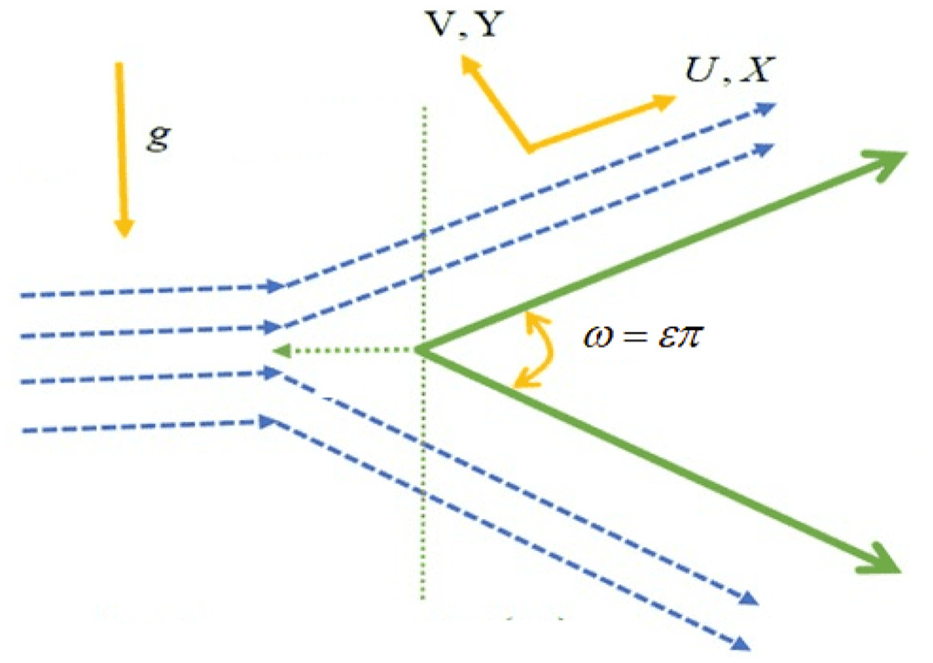
Flow geometry.
The vector form of governing equations is


where,
The following set of governing equations using the Tiwari and Das model with boundary layer approximation is represented as49,50:





With the below-mentioned boundary constraints 49 :

Non-similarity analysis (solution methodology)
The non-similarity transformations 49 are defined below:

By using equation (15) for equations (9)–(14), we derived the subsequent dimensionless system:




with boundary constraints



Further, considering the fact that both species diffuse in the same medium,
38
implies

with modified wall constraints

First level of truncation
Upon the first truncation,
25
the expressions with


with the converted boundary conditions as given below:


Second level of truncation
Following the subsequent underlying relations during the truncation process 21 :

we get the subsequent system of equations:



with transformed boundary constraints


Now by taking the derivative of equations (27)–(30), we get


with the boundary constraints given as follows:

The dimensionless parameters corresponding to the aforementioned set of equations are provided below:

Quantities of physical interest
The surface drag coefficient

with

The dimensionless forms of the above equations are:

Thermal and physical features of ternary-hybrid nanofluid flow
These features are as follows51–53:





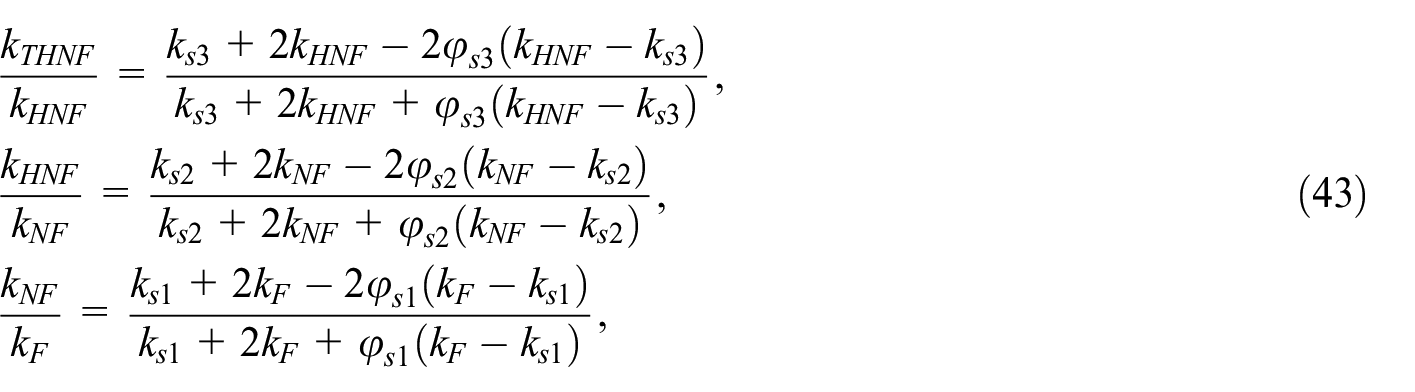
The thermophysical characteristics of the aforementioned traits are shown in Table 2.

Numerical computation
To investigate the findings of the velocity, temperature, and concentration distributions, a numerical solution is built in MATLAB using the bvp4c algorithm. In this approach, a finite difference scheme is used, which is a method of collocation with the order four. Numerical outcomes obtained for the current problem are restricted to a tolerance of






having boundary conditions enumerated below:

To handle the boundary value problem for ODEs, the bvp4c is a MATLAB solver that adopts the collocation technique that uses the finite difference method with adaptive mesh refinement. It implies the fourth-order accurate scheme to ensure reliable convergence. Through a residual control mechanism, stability is guaranteed, ensuring the local error within the specified tolerance. In this study, we have followed the same yardstick. Additionally, consistency between solution accuracy and mesh refinement validates the stability and robustness of the numerical outcomes obtained via the bvp4c solver.
Verification of the assumed model
A comparison of the assumed system with previously published work verifies the high accuracy of the mathematical outcomes achieved, hence validating the numerical technique and conclusions. Table 3 portrays a comparison of the skin friction coefficient
Comparison of

Analysis of results
In the current section, the graphical and numerical results are discussed. Each graph illustrates the comparison between Ethylene-glycol-based ternary and hybrid nanoliquids. The default ranges are assessed in such a way that they match the convergence requirements

Upshot of Falkner-Skan power law parameter

Upshot of velocity ratio parameter

Upshot of thermal convection parameter

Upshot of thermal convection parameter
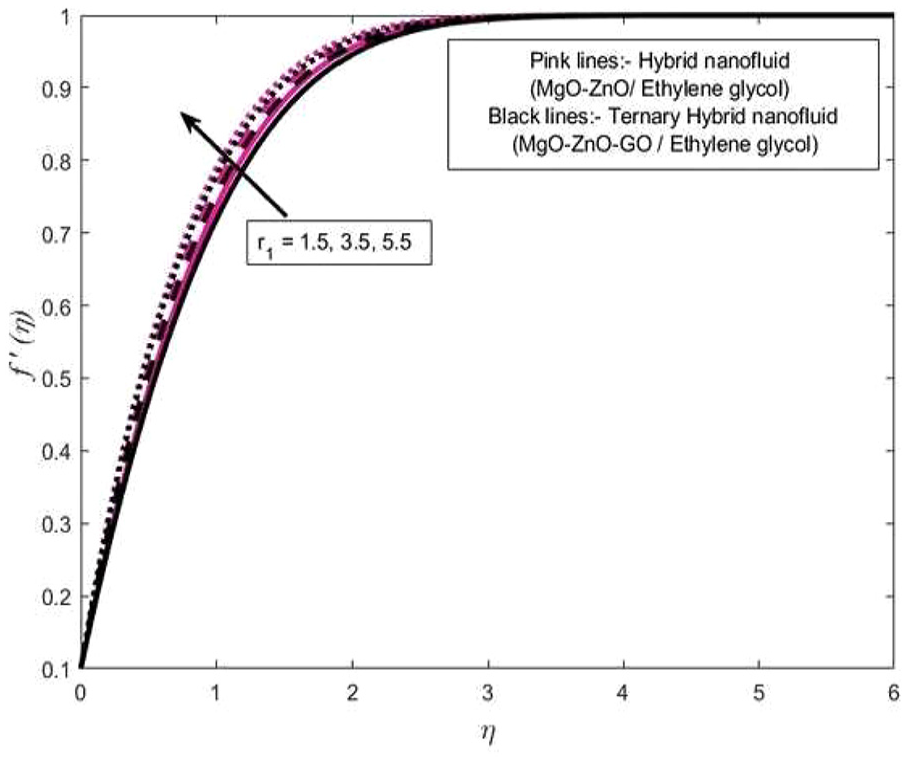
Upshot of porosity parameter

Upshot of Falkner–Skan parameter

Upshot of Eckert parameter
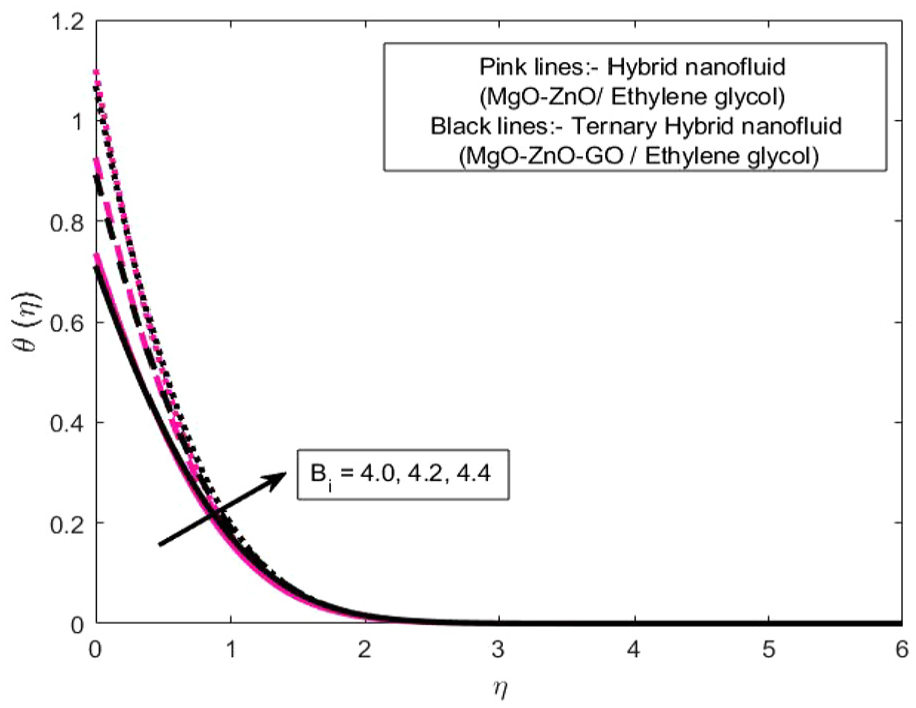
Upshot of Newtonian heating parameter

Upshot of HOM parameter

Upshot of surface catalyzed parameter

Upshot of HET parameter
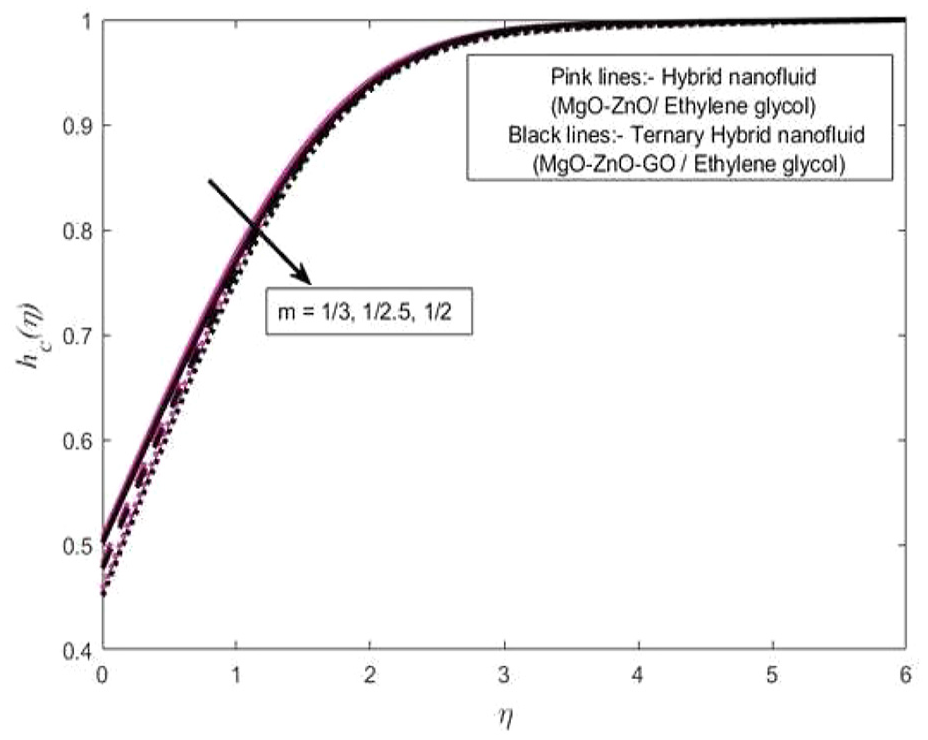
Upshot of Falkner–Skan parameter

Upshot of Schmidt number

Skin friction coefficient against

Nusselt number against
Estimations for surface drag coefficient

Numerical estimates for heat transfer rate

Conclusions
This study has presented a comparative analysis of hybrid and ternary nanofluid flows over a wedge to enhance thermal transport. It has incorporated viscous dissipation, Newtonian heating, and quadratic thermal convection in a permeable medium. Homogeneous reactions have occurred within the fluid, while heterogeneous reactions have been confined to surface interfaces. Velocity and temperature profiles have been computed using the bvp4c method for various parameters. A non-similar solution to the envisioned model is obtained. The findings reveal that increasing values of
Future direction
The anticipated model may be extended as follows:
The thermal radiation amalgamated with Cattaneo-Christov heat flux effects may be considered in the temperature equation.
The convective condition may be replaced with some appropriate boundary condition.
The proposed model may be considered for an applied magnetic field.
Application to the modeled problem
The flow of nanofluids over a wedge closely models high-speed boundary layer behavior over aerodynamic surfaces like nose-cones or wing leading edges. Enhancing heat transfer in such regions is critical for protecting structural components from thermal damage due to high temperatures and shear stresses during atmospheric re-entry or supersonic flight.
Footnotes
Appendix
Handling Editor: Sharmili Pandian

Author contributions
Muhammad Ramzan: Supervision, Conceptualization. Nazia Shahmir: Writing – original draft. Ibtehal Alazman: Methodology. C. Ahamed Saleel: Formal analysis. Jaber M. Asiri: Validation. Abdulkafi Mohammed Saeed: Investigation. Wei Sin Koh: Writing – Review & Editing.
Funding
The author(s) disclosed receipt of the following financial support for the research, authorship, and/or publication of this article: The authors extend their appreciation to the Deanship of Research and Graduate Studies at King Khalid University for funding this work through Large Research Project under grant number RGP2/354/46.
Declaration of conflicting interests
The author(s) declared no potential conflicts of interest with respect to the research, authorship, and/or publication of this article.