



Abstract
Vehicle sound package system plays a critical role in determining vehicle’s noise, vibration, and harshness (NVH) performance. With the advent of new energy vehicles, novel acoustic challenges arise in the absence of the masking effect provided by engine noise. The need for more efficient sound package is an important topic for both automotive Original Equipment Manufacturers (OEMs) and academic researchers. Despite the wealth of research on the sound package, a comprehensive review of the state-of-the-art has been lacking. This review aims to fill this gap by providing a concise and up-to-date overview of the various noise sources and transmission paths, functions, materials, components, and study approaches involved in the vehicle sound package technology. Vehicle sound package is fundamental in controlling the engine noise, road noise, and wind noise inside the vehicle, with functions that include sound absorption, sound insulation, damping, and sealing. To optimize these functions, an assortment of materials have been employed, from conventional options like foam and fiber to more innovative solutions like plastic and rubber, as well as functional materials and multilayer composites. To enhance vehicle sound package performance, both experimental and numerical methods, such as finite element analysis (FEA) and statistical energy analysis (SEA), artificial intelligence (AI)-driven optimization are employed in academic research, while the industrial development process often involves a more intricate and practical approach. This review also makes some recommendations for future research work in this area. It is expected that this review will provide useful information for further development of vehicle sound package technology.
Introduction
Given the growing attentiveness to environmental protection and the popularization of electric vehicles, the requirements of quiet car have gradually increased.1,2 The vehicle sound package is a key system to improve the noise, vibration and harness (NVH) performance, which encompasses a collection of acoustic elements designed to mitigate noise within the vehicle, significantly impacting the distribution of interior acoustic characteristics.3–5 Vehicle noise not only negatively impacts the comfort of passengers and drivers but also poses serious health risks. With the development of the automotive industry, more attention has been put on driving comfort and cabin quietness.6–10 Europe Unit limited the vehicle noise to 82 dB, and then it was further decreased to 68 dB. 11 There are three main methods to control the vehicle’s interior noise, including suppression at the sound source, regulation of the propagation path, and the implementation of safeguarding measures at the receiver. 12 When the vehicle design is completed, the noise control at the sound source is limited. Additionally, it is not practical to control the noise by adding equipment for drivers or passengers. Therefore, the implementation of the sound package emerges as the most viable and effective strategy. In standard passenger cars, the components of a sound package primarily consist of diverse sound absorption elements, sound insulation materials, and various acoustic seals installed in the engine compartment, passenger cabin, and trunk. The comprehensive definition of a sound package also encompasses body damping materials. Strategically placing these sound package parts within the vehicle can effectively reduce the interior noise’s sound pressure, especially airborne noise. Moreover, it enables adjustments to the vehicle’s acoustic characteristics, satisfying passengers’ psychological expectations. 13 The advancement of the sound package plays a critical role in influencing both the noise levels and the acoustic characteristics of the automobile, while also facilitating weight reduction and cost-effectiveness in vehicle production. Therefore, embarking on research to improve the performance of vehicle sound packages is of significant practical and engineering importance.
Developing an ideal sound package presents a significant challenge due to the fact that vehicle noises originate from various sections and span across a broad frequency range. Any overlooked noise, regardless of its point of origin or frequency, can undermine all efforts, a situation aptly described by the “wooden bucket theory.” For vehicles, there are different sound package components to control sound sources. At low speeds, the engine noise is dominant, so there are sound package materials in the engine compartment, typically for the hoodliner and dash panel. 14 At lower to moderate speeds, road-related noises, especially on uneven roads and during cruising or partial throttle conditions, can be the primary source of NVH, while at higher speeds, noise and vibration related to wind are typically encountered. 15 To control these noises, the passenger and luggage compartments are fully lined with sound package materials, which include the floor carpet, headliner, A-B-C pillars, and door panels. 16 To enhance the sound package performance, many researchers from both academia and industry have invested a great deal of effort.
In academic studies, new materials and new optimization methods are the research hotspots.13,17 There has been significant focus on reducing the weight of sound package materials.18–20 The development of electric vehicles has posed new challenges for the sound package, as the alterations in primary excitation sources and significant changes in the vehicle’s body structure necessitate adaptations to the sound package. In industry, every original equipment manufacturer (OEM) needs to develop vehicle sound packages during the design and release of a new vehicle. Based on the profile of the prospective customers, OEMs assess these characteristics and their importance in the design process. 14 As far as we know, there are few systematic reviews about sound packages. One existing literature review, published in 1996, is now significantly outdated given the rapid advancements in automotive technologies and materials. 21 Another review offers only a cursory overview of sound package technologies, with its focus limited to applications within the Indian automotive sector. 18 To fill the research gap, this review aims to give a comprehensive overview of the research and the development status of sound packages and detailed research progress from both academia and industry.
This paper, focusing on vehicle sound package, is organized as follows:
Introducing the noise sources with transfer paths of the vehicle in Section 2;
Reviewing and comparing functions, materials, and components of the vehicle sound package system in Section 3;
Summarizing approaches for the vehicle sound package development in Section 4;
Proposing the future development direction of the vehicle sound package in Section 5.
Vehicle noise sources and transfer paths
To control vehicle noise, it is necessary to identify the main noise sources and transfer paths, so corresponding sound package materials can be applied. The total noise of a vehicle is often split up into engine noise, road noise, and wind noise. 22 The contribution of each component may differ from one vehicle to another and is also strongly dependent on the vehicle’s speed. Studies have shown that the signature tends to be dominated by engine noise at low speeds, with road noise becoming the dominant source at medium speeds and wind noise at high speeds as presented in Figure 1. This phenomenon applies to both vehicles with a conventional internal combustion engine (ICE) and electric vehicles (EV), especially for road noise and wind noise. The difference is that the combustion engine noise can generally mask more other noise sources compared with the electric engine.

Relationship between velocity and noise sources of vehicles.
These various sources of noise within a vehicle are also closely connected to the vehicle’s source-path-receiver system. To create an appropriate acoustics package for a vehicle, it’s crucial to have a thorough understanding of the relationship between the noise sources and transfer paths. The association may exhibit varying degrees of complexity. For instance, a simple relationship is engine noise traveling through the dashboard system and eventually reaching the receiver as noise, while a complex relationship is when aerodynamic noise takes a structural path and then becomes airborne noise. Generally, interior vehicle noise can result from many sources in form of structural-borne or airborne, and primary excitation sources are engine/driveline, tire/pavement, and wind. 23
Engine noise
Currently, the ICE is still the most widely used power source, which includes the intake system, exhaust system, drive-train system, and power plant mounting system. Depending on the mechanical structure and working principle, it is unavoidable to generate vibration and noise during the operation, and the operational velocity primarily determines the emitted noise.
24
The predominant noise of the ICE lies in the frequency range from 900 to 2000 Hz, which is determined by the vibration of various structural elements of the engine which thus determines the characteristics of radiated noise.
25
The relation between frequency (

Compared with petrol engines, diesel engines experience significantly elevated peak pressures and faster pressure rise rates, leading to increased levels of noise and vibration. In contrast, electric engines are much quieter, which is almost totally changing the design of sound packages, and more details will be discussed in the following section. The primary noise source in vehicles is from the engine compartment because the engine produces radiated noise and creates a reverberating sound environment within the compartment. Therefore, the engine is usually wrapped with soundproofing materials along the transmission path. Engine noise transmission path is shown in Figure 2(a).

Road noise
Road noise denotes the noise emitted from a rolling tire as a consequence of the interaction between the tire and the road surface. It was assumed that the main crossover speed was in the range of 50–70 km/h for vehicles. 29 There are both mechanical mechanisms (i.e. structural-borne) and aerodynamic mechanism (i.e. airborne) to generation the noise. 30 For structural-borne, the roughness of the road surface causes the tire tread to deform or come into contact with the road surface, resulting in the excitation of radial vibrations in the tire belt and profile elements. Figure 2(b) illustrates the transfer path of structure-borne road noise, encompassing the front wheel suspension structure and the rear wheel suspension. The noise from the road is transmitted to the vehicle interior through the suspension and vehicle body. It can be noted that structural-borne road noise is a much complex vibro-acoustic problem, so the transfer path analysis (TPA) is widely used in the automotive industry during the sound package development. 31 For airborne, resonances in the cavity inside the tire-wheel assembly contribute to the noise generated by the tires, and then the noise is transmitted to the interior through the air. The transfer path is not complex, but the challenge of airborne road noise lies in the wide frequency range and the nonlinearity of the acoustic material property. 5
Wind noise
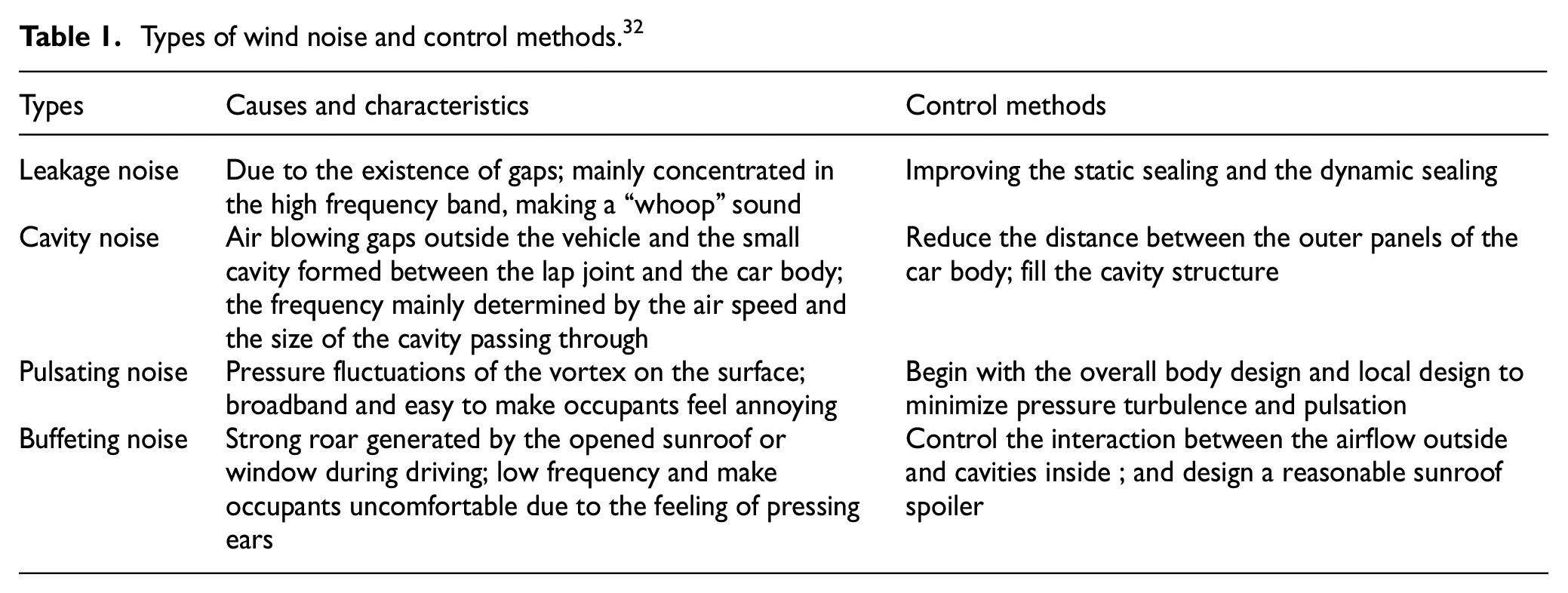
Wind noise is caused by the interaction between the vehicle and the airflow. Wind noise gradually becomes prominent at high speeds (e.g. over 100 km/h), and even could mask the engine noise and the road noise. With the development of other noise control technology, traditional noise sources (e.g. engine, tire) have been greatly suppressed, which prioritizes wind noise among the primary sources of noise. 26 Wind noise can be caused by four categories with different mechanisms as shown in Table 1. About the transfer path as shown in Figure 2(c), leakage noise and buffeting noise go through the vehicle through body openings, while cavity noise and pulsating noise transit through the body and enter the interior. When the openings are small-scale, the wind noise is leakage noise, whereas when the openings are large-scale, the wind noise becomes buffeting noise. In conclusion, all four categories of wind noise transfer into the vehicle by airborne sound transmission.
Types of wind noise and control methods. 32
Vehicle sound package system
Functions of sound package system
Depending on the specific types of noise they are designed to address, sound packages are required to have different functions, including sound absorption, insulation, damping, and sealing as summarized in Table 2. Different sound package components are installed on different parts of the vehicle as shown in Figure 3.


Distribution of different functional sound package materials: (a) sound absorption, insulation, and damping materials 34 and (b) sealing material.
Absorption
Sound absorption is the measure of absorbed energy relative to incident energy, indicating the level of sound absorbed by a material. Sound absorption components are used to reduce the interior noise level by dissipating the sound energy in the material. Sound absorption materials must adhere to two critical principles: (I) Matching the characteristic impedance with the air impedance to minimize reflection of incident sound waves; and (II) ensuring high attenuation properties to absorb the transmitted sound waves effectively. 35 Sound absorption coefficient is the key parameter to assess the absorption effectiveness and capability. Currently, considerable attention is dedicated to the development and fabrication of materials possessing a high sound absorption coefficient in many applications. 36 Sound absorption materials are applied in three different ways on the vehicle as shown in Figure 3(a). The first type is sound absorption structures with fixed shapes, which are used to cover or encapsulate the noise generator, such as the engine hoodliner and dash absorber. The second type is filling material, which is freely placed in different Automotive components, such as sound absorption materials the instrument panel, in the wheelhouses, the headliner, the door trim, and the pillar trims. The third one is the seat, which is a special sound absorption material but very important for interior sound absorption. These sound absorption materials are three kinds of materials: porous material, resonant material, and fiber material, which will be discussed in the next section.
Insulation
Sound insulation means blocking the noise from one side to another side, which is different from sound absorption to control noise on the same side. Therefore, it requires impedance mismatch instead of impedance match, and the insulation lay is usually called the heavy layer due to the much higher impedance than that of air. Sound transmission loss (STL) is the key parameter to evaluate the insulation property. In real applications, both sound absorption and insulation can be used simultaneously to realize a low noise level. One typical sound insulation component is the dash panel, which block engine noise from transmitting to the passenger compartment. 37 Dash panel is one of the most widely studied sound package component. As well, carpets on the floor play an important role in blocking road noise to the passenger compartment. Broadly speaking, the windshield is also an important part with the insulation function. 38 Laminated safety glass, commonly featuring a standard polyvinyl butyral (PVB) interlayer, is widely utilized in automotive windshields and side glazing, delivering superior acoustical performance compared to tempered glass. 39 Typical insulation materials are ethylene-vinyl acetate (EVA).
Damping
Damping materials and structures are in the scope of general sound package, which are usually used to control the type of noise that the vibration of the body panels produces sound and radiates into the car. 40 This type of structural-borne noise is mainly at low frequencies (20–200 Hz), which emerges in the past few years as a crucial subject of research in the car industry. 41 Damping materials are typically non-metallic substances applied to metal panels or plates to dampen their vibration and decrease sound radiation by altering the stiffness, mass, and damping characteristics of the structure. 26
Sealing
Effective sealing forms the basis of automotive noise control. A vehicle contains various openings such as functional, production-related, and unintended apertures, making comprehensive sealing essential for soundproofing. Without well treatments, generated noise in the vehicle will propagate everywhere, even if the outside noise sources are attenuated very well. Besides, the leakage can also cause serious noise, which is one of the primary sources of interior wind noise in vehicles. 42 These openings not only impact the STL, but also diminish the efficacy of the air-conditioning system and allow external dust and pollution to infiltrate the interior environment. It is only through the judicious control of the opening rate and the implementation of robust sealing mechanisms that sound package integration and vehicle noise control can be effectively achieved. Good sound quality is also related to sealing. As shown in Figure 3, different types of sealing parts are applied on the vehicle body.
Materials of sound package system
Sound package materials in automobiles have been a part of the industry since almost the beginning. In recent decades, the automotive industry has witnessed significant advancements in sound package systems, with OEM shifting their focus beyond performance to include considerations such as lightweight materials, health, and environmental issues. The selection of the type of sound package materials that are used in automobiles depends on various criteria appropriate to the application such as 21 :
Raw material cost and availability
Temperature/fire resistance
Moldability
Lightweight
Stretchability and resiliency
Durability and wear characteristics
Recyclability
Various materials have been applied on the vehicle sound package as shown in Figure 4, including foam, fiber, plastic, rubber, functional material, and mulilayer materials.43–45

Typical materials used for sound packages: (a1-2) foam and microstructure for sound absorption, 46 (b1-2) fiber and microstructure for sound absorption, 47 (c) plastic for sound insulation, (d) rubber for sound insulation and damping, (e) metamaterial, 48 (f) MPP, 49 (g) ABH, 50 (h) double laminated glass, and (i) multilayer materials. 26
Foam
Poro-elastic materials with high porosity have found extensive application within the automotive industry because of their low density, high specific surface area, and low manufacturing costs.51,52 Foams (open-pores) are typical porous sound absorption materials as shown in Figure 4(a), which dissipate sound energy by friction among the vibrating frame and by viscous effects due to air vibrating in the pores. Foam is widely applied in interior components, such as seats, tire, inner dash mats, and other acoustic trim parts, which can significantly reduce the vehicle interior noise by absorbing the inside sound waves and reducing the reflected sound waves. Besides, foam is also used as the baffling material to prevent outside sound from passing through the frame cavities and into the interior. Tube-like structures in vehicles, such as A-pillars, B-pillars, C-pillars, side frames, and rockers, make up most body frames. These structures contain holes that serve purposes such as facilitating manufacturing processes or allowing for the installation of other components. However, because sound can travel through these hollow frames or pillars and enter the vehicle’s interior through these openings, it is necessary to block the internal channels of the tubes using foam. This prevents sound transmission and helps maintain a quieter interior environment. 26
Among them, polyurethane (PU) foam is the most widely used porous material in the automotive industry. Foam-based absorptive materials exhibit a notably high sound absorption coefficient, especially within the 2000–4000 Hz range, where the coefficient can reach values as high as 0.7. PU foam, being a porous absorbent material, finds extensive application in automobile components such as the dash panel, carpet, and other areas within the vehicle’s interior. However, its relatively elevated cost positions it as a primary choice for mid-range and luxury vehicles. 26 Its disadvantage is the poor performance in the low-frequency range. Different methods have been tried to improve PU’s performance at low-frequency range. One method is improved by optimizing the synthetic formula. Multi-objective particle swarm optimization has been applied to improve the PU acoustic performances. 53 Previous research has indicated that the acoustic capabilities of PU foams can be altered through the incorporation of functional particles, such as carbon nanotubes, 54 nano-silica, 55 and graphene. 56 With growing public awareness toward environmentally friendly and biodegradable materials, natural materials are garnering significant attention and proving to be more advantageous compared to fillers such as nanoparticles. Bamboo leaves particles were added into PU foams to improve the acoustic properties. 46 The findings demonstrate that the incorporation of appropriate constituents derived from bamboo chips and stems yields a notable enhancement in the sound absorption characteristics of PU foam composites across the entire frequency spectrum. Notably, a considerable improvement in low-frequency sound absorption was observed. Furthermore, these composites offer additional advantages including lightweight composition, cost-effective manufacturing, and easy recyclability, thereby exhibiting positive implications for the ecological environment. To enhance the sound absorption effectiveness at lower frequencies, periodic Biot modeled foams were designed by an advanced and innovative numerical tool, where the average improvement is about 16%. 57 However, the cost of PU is relatively high, so only mid-range and luxury vehicles use PU as sound package material. Besides polymer foams, there are also metallic foams integrated into the vehicle’s structure, possessing superior mechanical properties. As such, solid metal can be replaced by metal foam to achieve simultaneous weight reduction and improvement in NVH performance.58–60 Table 3 systematically reviews the relevant foam researches for sound packages.
A summary of studies on functional materials/structures for sound packages.

Fiber
Fiber materials are the other type of porous sound absorption materials used in automobiles.36,86 Different from the open foam structure, fibrous materials contain diverse channels and cavities as shown in Figure 4(b), which allow the sound waves to penetrate and dissipate. Viscous losses occur when a thin layer of air adjacent to the wall of a pore within the surface of fibers experiences friction. This friction, caused by the viscosity of the air, leads to the dissipation of sound. Additionally, it is notable that sound absorption is impacted by the loss of sound energy due to thermal conduction between the absorber and air. 87 As the frequency increases, the sound absorption coefficients of fiber materials also increase, with the coefficient reaching 0.7 only at very high frequencies. Cotton fiber felt, a commonly utilized fiber material in dash panels, carpets, and various other locations, serves as a prominent example of such materials. Owing to their cost-effectiveness, fiber absorptive materials find extensive application in economy vehicles. 26 Generally, fiber materials are typically employed to mitigate the adverse impact of sound reflection from hard, rigid interior surfaces, aiding in the reduction of reverberant noise levels. 88 In addition, fibers serve a purpose as interior liners, enhancing their utility in sound management. Furthermore, to optimize the sound package’s efficacy, it is imperative to utilize fibers in combination with barriers and inside enclosures. Such a comprehensive approach ensures an overall improvement in sound absorption and control.89,90
Fibers can be separated into synthetic fibers and natural fibers. Synthetic fibers include glass fiber, needle fiber felt, cotton fiber felt, thermoplastic fiber felt, resin fiber, and so on. Natural fibers include kenaf, wood, hemp, coconut, cork, cane, cardboard, and sheep wool.91,92 It is worth noting that carbon fiber is also widely used in the car, but not for sound packages. 93 These conventional synthetic fibers have been widely used in the automotive industry, but they have potential health risks for human beings and significant environmental impact, which limits their applications. Over the past decade, automakers have increasingly utilized natural fiber composite materials in automotive applications due to the growing demand for lighter, safer, and more fuel-efficient vehicles.94–96 Due to the noise-absorbing properties of natural fibers, sustainable and biodegradable nonwovens have been created utilizing materials like banana, bamboo, and jute fibers for automotive interiors. This approach aims to replace traditional materials such as glass, manufactured fibers, and non-recyclable foams, thereby reducing noise levels. 47 The challenge of exterior applications in the automotive industry is natural fibers’ susceptibility to moisture and humidity and the ensuing degradation in mechanical properties. 97 Table 3 systematically compares the relevant fiber researches for sound packages.
Plastic
The above-mentioned foam and fiber are “soft layers,” which are mainly used to absorb sound waves. In contrast, there are also “heavy layers,” 70 commonly including ethylene vinyl acetate (EVA), 98 polypropylene (PP), 99 polyvinyl chloride (PVC), 100 and polyethylene terephthalate (PET) 101 as shown in Figure 4(c). These thermoplastic materials are used as the “heavy layer” to block the noise. 102 In fact, high-performance plastics are significantly influencing the automotive industry through their diverse applications. 70 EVA is the most commonly used plastic as a heavy material and has good sound insulation performance. The weight of the car is an important factor to consider, as it directly impacts its energy consumption. However, the pursuit of high density in materials used may lead to an undesired increase in weight. Therefore, it becomes crucial to explore the utilization of lightweight yet insulated materials in order to achieve a balance between density and weight in automotive design. PP is lighter than other plastics for 15%–20%, which allows substantial fuel savings. It is assumed that a weight reduction in a car body of 100 kg brings about 0.3–0.5 l of fuel savings per 100 km. 67 Table 3 systematically compares the relevant plastic materials for sound packages.
Rubber
Rubber-based materials present a highly cost-effective solution for addressing NVH concerns. Their utilization is attributed to their remarkable viscoelastic properties, which confer unique dynamic behavior.71,103–105 The rubber used can be natural or synthetic as shown in Figure 4(d). Natural rubber, predominantly sourced from Hevea brasiliensis, is obtained by extracting white latex after the bark has been peeled. In contrast, synthetic rubber constitutes a highly elastic synthetic polymer. While natural rubbers exhibit superior damping performance compared to synthetic rubbers, their implementation comes at a higher cost. Currently, the most frequently used damping materials on vehicles are synthetic rubbers. Rubber is often used as insulation material, such as ethylene-propylene diene monomer (EPDM). As well, rubber-based damping materials use rubber as matrix, and mica, carbon black, graphite, etc. are added. 26 The main rubbers used include natural rubber, chlorinated butyl rubber, and nitrile rubber, which all have good waterproofing, oil-resistance, and adhesion properties. Rubber is also the key sealing material, which is used to seal the holes and apertures. Taking a car door as an example, the car door sealing system typically comprises a rubber structure with intricate sectional geometry and a complex channel between the door panel and body frame, which not only affects the noise control but also determines the door closing sound quality.106,107 Table 3 lists these widely used rubbers as sound package materials in the automotive industry.
Functional material
With the development of sound packages and acoustic technologies, more functional materials (or structures) are applied in the automotive industry as shown in Figure 4(e)–(h). For instance, a Japanese company Nissan has developed an acoustic metamaterial that effectively attenuates road noise and enhances in-cabin sound isolation (500–1200 Hz), contributing to a more refined driving experience. Notably, the material achieves comparable acoustic performance to conventional solutions while weighing only one-quarter as much. This reduction in weight supports improved energy efficiency, thereby lowering the environmental impact of driving, and further contributes to occupant comfort through enhanced cabin quietness.
Metamaterial has good sound absorption performance in low frequency range due to a locally resonant phonon crystal formed by a periodic arrangement of elastomers and mass scatters.48,108–110 Different from bulky traditional sound-absorbing materials, acoustic artificial sound-absorbing metamaterials have sub-wavelength dimensions, which can achieve perfect broadband sound absorption while reducing the volume and weight.86,111 These two factors are critical in the automotive industry, so metamaterials have attracted great attention because of their enormous potential. There are different types of metamaterials, including membrane-type acoustic metamaterials,112,113 cavity-type acoustic metamaterials,114,115 and acoustic metasurfaces.116,117 For automotive applications, Liao et al. 78 attached the designed acoustic metamaterial on the tailgate with lightweight and miniaturized features, and found that the low-frequency noise sound pressure levels in the front and rear of the vehicle were reduced by 2.0 and 2.3 dB, respectively. Rieß et al. 118 proposed a vibroacoustic metamaterial suitable for large-scale production and future use in a vehicle door, which shows a wide stop band with a vibration reduction of −25 dB. 3D printing is typical to fabricate the metamaterials, due to the periodic unit.119–121 Luca et al. employs metal 3D printed resonant components installed on the rear wheel arches of a vehicle. This design serves as a potential substitute for conventional dynamic damper solutions, which are commonly fitted on the suspension or vehicle body to address significant noise problems. 79 In industry, Nissan has developed a sound deadening metamaterial, which effectively absorbs sound vibrations of air with a frequency of 500–1200 Hz. 122 However, most of metamaterials are not yet widely applied in industry due to the lack of holistic design and manufacturing concepts for large-scale production. It is still believed that acoustic metamaterials could have more practical applications within the automotive industry in the foreseeable future.
Microperforated panel (MPP) absorbers are perforated plates with holes typically in the submillimeter range and perforation ratios around 1%, which can be a perfect solution to minimize the weight and reduce the size of automotive sound packages.19,123 MPPs were first intensively studied by Maa, 124 and then intensively studied for room acoustical applications. 125 In the automotive industry, MPP was first used in automotive exhaust or ventilation systems.126,127 Mufflers are widely used in exhaust system of cars or trucks to reduce noise. MPP can significantly improve the performance of mufflers. 128 It has been proved that a novel muffler design utilizing microperforated tubes can match the performance of a conventional cylindrical dissipative muffler featuring porous material. 129 MPP can also be introduced to existed sound package materials on the dash panel or door. For example, an innovative approach called the Compact Composite Layer MPP (CMPP) absorber, combining MPP with a porous material, has been suggested to improve acoustic performance while also ensuring enhanced safety features overall. 130 In the future, metal MPP absorbers can be effectively utilized for noise control in various vehicle applications, both in proximity to the source of the noise and at the source itself.49,131
The Acoustic Black Hole (ABH) has garnered increasing interest for its capability to attenuate the incoming sound waves, rendering it highly promising for conventional engineering uses such as vibration damping and sound insulation.50,83 As a novel, lightweight and effective passive solution, ABH on flexural waves are commonly achieved in thick-walled structures, and is mostly used to reduce the mechanical vibration of metal panel. 132 Only few studies consider applications for the automotive industry, especially in the low-frequency domain. In fact, it can also be used to reduce radiated sound of a vehicle structure while simultaneously reducing its mass. Wu et al. 133 designed a new vehicle side window glass using ABH array. The result indicated that ABH can highly improve the transmission loss at the coincidence frequency and meanwhile reduce the weight. A finite element simulation also showed that ABH embedded into automotive body panels tend to predicate and reduce interior wind noise at frequencies above 200 Hz. 84
Windows are essential components of the vehicle, but the wind noise can go through and improve the interior noise level. To overcome this problem, both vacuum insulating glass (VIG)134,135 and double laminated glass39,136 are employed to block the wind noise, especially at high speed. Lux et al. 137 experimentally investigated the airborne sound insulation of vacuum insulating glazing. It was found that VIG shows a better performance than the standard glazings, particularly in coincidence region. However, there is no observable difference between the asymmetric setup and the symmetric setup. The laminated glass is manufactured by pressing two pieces of glass plate and one piece of polyvinyl butyral film together at a high temperature and pressure, which is long served for safety purpose but less known for the advantage in noise attenuation properties.138,139 As a summary, all these functional materials/structures for sound packages are listed in Table 3.
Multilayer materials
Multilayer materials can attain unique properties that monolithic materials cannot match. The extensive range of material and layer combinations available enables excellent adaptability to diverse requirements.140,141 For example, sound insulation materials possess a high surface density, enabling them to reflect sound energy toward the incident direction. In contrast, sound absorption materials are lightweight and highly porous, facilitating the easy access of acoustic waves to the material’s interior. Therefore, achieving the maximum value for both sound absorption and sound insulation abilities in sound package materials is challenging to achieve simultaneously. 53 Therefore, it is necessary to combine them together as shown in Figure 4(i). In real applications, most of the sound package utilized on a vehicle body consists of a blend of absorptive materials and sound insulation structures, including the dash mat, carpet, and more. For dash mat, it is composed of a sound absorption layer and a sound insulation layer. In general, the absorption layer is made of PU foam or cotton felt, and the sound insulation layer usually is EVA, which is a heavy layer and has good sound insulation performance. About carpet, a common carpet sound package structure comprises a carpet lining, a sound insulation layer, and a fabric layer. The carpet lining material, typically foam or felt, is responsible for sound absorption. The fabric primarily serves a decorative purpose, although some fabrics also contribute to sound insulation and absorption to a modest extent. When considering the floor as a sound insulation layer, the floor-liner-sound insulation layer forms a dual sound insulation system. Its sound insulation effectiveness relies on the surface density of the insulation layer and the thickness of the floor sheet. For multilayer materials, the challenge is that selecting a suitable combination for a specific acoustic issue is not always straightforward, which has garnered significant attention. Different methods have been applied to predict and improve the performance of multilayer sound packages including transfer matrix method, 142 finite element analysis, 143 topology optimization, 144 genetic algorithms, 145 or bi-objective pareto approach. 146
Components of sound package system
In a vehicular context, a myriad of noise sources contributes to the overall acoustic environment, with noise management intricately linked to the vehicle’s source-path-receiver framework. Attaining optimal noise control necessitates a profound comprehension of this framework. This model can exhibit both simplicity and complexity, exemplified by contrasting scenarios. A simple configuration entails engine noise traversing the dashboard system to reach the receiver as audible noise. Conversely, a more intricate arrangement unfolds when aerodynamic noise takes a structural path and then becomes airborne noise. Notably, interior vehicle noise emanates from many sources, while primary excitation sources are engine/driveline, tire/pavement, and wind. 23 Correspondingly, there are different sound package components at different locations as shown in Figure 5.

Components of sound package.
Engine compartment
The dominant noise source is from the engine compartment because the engine generates radiated noise during operation and produces a reverberant sound field in the engine compartment. The engine is usually warped with sound package materials. Initially, the engine is packaged by upper and lower guard plate, which can control the vibration and isolate the noise. Besides, there is an engine hoodliner on the top of the engine to further block the noise. 147 The most important component is the outer dash panel, which can protect the driver and passenger from the engine noise with the help of inner dash panel. The dash panel is a plate that separates the engine compartment from the passenger compartment and mainly serves to block engine noise, which first receives the incident wave from the engine compartment. 148 Simultaneously, it acts as a conduit for steering wheel, brake, clutch components, etc. via grommets, underscoring the crucial significance of dash panel design. 37 The level of sound insulation provided by the dash panel significantly influences the extent to which engine noise interferes with the driver and passenger. 149 In fact, the dash panel is the most widely studied component of the sound package system. The conventional dashboard panel comprises a steel stamping structure that requires welding and riveting for assembly.
Passenger compartment
The passenger compartment is the most important part of the sound package system, as it is the main area in contact with the human body, and the interior noise is closely related to passenger comfort. Besides, all noise can penetrate into the passenger compartment, so sound insulation, sound absorption, and sealing materials all need to be applied in the passenger compartment. Different from outer dash felts, inner dash felts have two layers that comprise the upper layers of thermoplastic felt or polyurethane for absorption function and heavy layer for insulation function. 150 As mentioned in the section of sealing, there are functional and manufacturing holes and openings on the dash panel, so those holes on the dash panel all need to be well sealed to avoid obvious noise leakage.
Floor carpet mat is the largest sound package component, which block the road noise and chassis vibration and absorb the inside noise. These sound package components are also interior, so both performance and appearance need to be considered during the design. In fact, the seat is also an important part of the sound package system, which has two major unique characteristics: large area and deep thickness. 151 Open cell polyurethane foam has emerged as the favored material for constructing automotive seat cushions, offering a notable reduction in the weight/performance ratio in contrast to traditional steel spring seat support systems. 152 Due to its extensive surface area and the presence of porous absorptive materials in its internal structure, the seat exhibits excellent sound absorption capabilities. According to the study, the seat contributes to almost half of the overall sound absorption. 153 In term of the frequency, the seat also has advantages. The frequency of absorbed sound is determined by the thickness of the seat foam. Sound waves of corresponding frequencies are absorbed only when the thickness exceeds one-tenth of the wavelengths. The seat, being much thicker than other sound absorption structures, holds an advantage in absorbing low-frequency sounds. 26
Trunk
The trunk is usually connected with the passenger compartment without any block, so the noise generated in the trunk can directly penetrate into the passenger compartment, which has significant effect on the driver and passenger. Besides, the air-gaps present in the trunk cavity behave like Helmholtz resonators, and the resonance frequency will make people feel uncomfortable. As the trunk cavity and the cabin cavity are linked, the presence of air gaps in the trunk impacts the overall acoustic response. 154 Cho and Lee 155 used a deep-learning-based acoustic eigenvalue analysis method to predicate the acoustic natural modes and natural frequencies of a double cavity such as a passenger compartment cavity connected to a trunk cavity. The study revealed that the acoustic natural frequencies and natural modes of the primary cavity (i.e. passenger compartment) can be effectively adjusted through alterations in the auxiliary cavity (i.e. trunk) dimensions. For these vehicles with a parcel shelf, there are still air leakages between the passenger and trunk compartments, which significantly impacts the vehicle’s acoustic model, particularly in low-frequency ranges due to its influence on booming noise. By employing the trim cover or other sound package materials, it is possible to attenuate the coupling effect. 156
As a summary, Table 4 provides a comprehensive summary of the essential components, corresponding materials, and their respective functionalities within the diverse sound package applications. This succinctly demonstrates the intricate relationship between material selection and functional requirements across various locations within the sound package framework.
Key sound package components and corresponding materials and functions.

Approaches for sound package development
Experiment
Experiments are widely recognized as the primary method for developing sound package systems. Various experimental approaches are employed, aligning with specific purposes such as material characterization and acoustic measurement. These diverse approaches facilitate the thorough assessment and refinement of the sound package systems, ensuring optimal performance and effectiveness.
Material characterization
For sound absorption and insulation materials, most of them are porous materials. Porous materials like polymer foams, polyester, and fibers are composed of two components: a solid phase (skeleton) and a fluid phase (such as air). There are various parameters to predict the acoustic performance, and the most comprehensive one is the Biot theory. 157 There are five or nine material parameters to characterize the Biot model as listed in Table 5. The first five parameters are fluid parameters, while the last four parameters are solid parameters. 158 Pan 159 conducted a systematic review of the existing test methods, and gave his recommendations for the need for the development of SAE test methods for Biot parameters. Biot parameters can realize an inverse procedure, which reveals that the geometric design variables can influence different Biot parameters. As a result, a one-parameter optimization method can be developed to maximize the absorption characteristics within the desired frequency range. 160
Material parameters for Biot model.

For damping material, damping loss factor is the key parameter. 161 Dynamic mechanical analysis (DMA), also known as dynamic mechanical testing, involves applying controlled stress or strain at specific frequencies to a sample and analyzing its response to determine phase angle and deformation data. 162 These data enable the calculation of the loss factor and complex modulus. Furthermore, DMA allows for testing polymer-based materials across a wide temperature range, providing the ability to obtain the glass transition temperature (T g ). The T g represents the temperature at which thermosetting polymers transition from a “glassy” state (rigid or hard) to a “rubbery” state (damping or pliable). 163 In the vehicle industry, it is advantageous to align the T g with the working temperature range to fully utilize high damping properties. 35
For sealing material, the compressive strength and deformation characteristics are the key parameters. 164 There are both static and dynamic sealing, so thorough investigation of the material properties of the seal is essential to accurately predict the noise and vibration of vehicles under varying loading conditions. 165 Compression experiments need to be performed with the seal itself using a robotic indenter, which should be repeated many times and the results are averaged in order to minimize the experimental errors. 166 Besides, aging time of the rubber is also an important material property, because factors such as temperature and oxygen play a critical role in the stress relaxation, significantly affecting the long-term performance of the seal.167,168 One common method to guarantee long-term functionality is to conduct accelerated aging tests to estimate its lifetime by assuming. 169
Acoustic measurement
Acoustic performances can also be tested directly, including sound absorption coefficient, reflection coefficient, transmission coefficient, etc. 170 Acoustic testing methodologies typically commence by conducting assessments on smaller-scale samples, gradually progressing toward larger sample sizes, ultimately culminating in the examination of the full-size sample.171,172 Correspondingly, there are different acoustic testing facilities.
Impedance tube is the most widely used acoustic measurement method in the automotive industry. 173 Small samples can be placed on one end of the tube or in the middle, and a sound source is on the other end. Arrayed within the setup are highly sensitive microphone transducers employed to assess the sound pressure levels emanating from the aforementioned samples. Both sound absorption coefficient, reflection coefficient, and insulation coefficient (or STL) can be obtained as shown in Figure 6(a). At the very beginning stage of the sound package development, it is cost-effective to test small samples. However, the test results are not exactly the same as a real case scenario because only perpendicular waves are used in testing. Olivier et al. 174 propose a practical impedance tube technique for enhancing the STL of a double-wall structure, with a focus on the sound package installed within the structure. Within the vehicle, the material is exposed to incident waves coming from various directions. With the development of acoustic metamaterials, an increasing number of square samples are being designed, consequently leading to the utilization of square impedance tubes as shown in Figure 6(b).

Acoustic testing method: (a) traditional impedance tube, (b) square impedance tube, (c) reverberation chamber, and (d) anechoic chamber.
A reverberation room is a place designed to simulate a real acoustic environment by creating a diffuse or random incident sound field. 26 Big or full-size sound package components can be measured in the reverberation chamber. 175 The sound absorption coefficient can be tested in a reverberation chamber. Different from the impedance tube, the direction and phase of each sound wave is dispersed randomly. When a sound wave emanates from its origin and encounters a wall, it is reflected. During this reflection, some of the wave’s energy is absorbed, and the rest is bounced back. The reflected sound wave then traverses the space and impacts another wall, where the reflection and energy dissipation process occurs again. This cycle continues until all the sound energy has been absorbed and no longer persists. The reverberation time is the duration it takes for the sound within the reverberant room to decrease by 60 dB after the sound source has been deactivated. 176 For sound insulation coefficient, there are two kinds of setup namely reverberation chamber-reverberation chamber and reverberation chamber-anechoic chamber as shown in Figure 6(c). In the anechoic chamber, there are no reflected sound waves, so STL for each component of the sample can be determined. In the real application, big anechoic rooms are usually applied to test the vehicle NVH performance as shown in Figure 6(d).
Finite element analysis (FEA)
The FEA is well known for its application in structural and acoustic analysis, so this technology has attained widespread usage in the automotive industry in the modeling and analysis of sound packages. 177 Compared with experiment approach, FEA can significantly reduce the time and cost of the sound package development, and allows for virtual prototyping. Batifol et al. 178 proposed a finite-element study of apiezoelectric/poroelastic sound package concept from a physical perspective, which is impossible for the experiment approach. Nefske and Howell 179 used FEA to guide the development of structurally efficient automobiles and minimize noise and vibration in the passenger compartment. In recent years, some commercial FEA softwares have been developed and widely used. A famous one is COMSOL, which is a multiphysics simulation. Acoustic-structure interaction refers to the merging of principles from two distinct domains: acoustics and structural mechanics. Hu et al. 180 develop a FEA model of double-wall active sound packages in the COMSOL environment based on Batifol’s accomplishments. It has been shown that the numerical and experimental results agreed with each other well. However, FEA is only applicable in the low and mid-frequency range (e.g. usually below 1000 Hz). Therefore, the vibration caused structure-borne noise is usually in this frequency range. As shown in Figure 7(a) and (c), the damping materials on the vehicle floor and composite dash panel were studied through FEA simulation. The noise from the floor is road noise excitation on a rough road, and it is found that 4470 vehicle structure modes were identified at the highest modal frequency of 600 Hz, and 625 interior acoustic modes were analyzed at the highest modal frequency of 1000 Hz. 181 Therefore, FEA can be widely applied on the sound package materials and structures on the chassis. The dash panel is the most widely studied objector, of which upper-frequency limit for the calculation was about 1000 Hz. 148 While for some material studies, the frequency may be 2000 Hz as shown in Figure 7(b).

Statistical energy analysis (SEA)
SEA method is developed to address the challenges of predicting average vibration or noise levels in high frequency bands for complex systems of inter-connected subsystems. At frequencies above the first few resonant frequencies of the subsystems, classical analytic models that involve modal expansions or FEA methods requiring a large number of finite elements become difficult to use.182,183 To overcome this limitation, SEA methods provide a framework for making predictions at single frequencies repeatedly to cover the range of frequencies in each frequency band of interest. These methods take into account the statistical distribution of energy within the system to estimate the average vibration and/or noise levels in various frequency bands. By applying SEA techniques, engineers can analyze and predict the vibration and noise characteristics of complex systems with interconnected subsystems, even at high frequencies where traditional modeling approaches may not be suitable. 184 This allows for a more comprehensive understanding of the system’s behavior and aids in the design and optimization of systems to meet vibration and noise requirements. 185 Besides, SEA method has shown their greatest utility during the concept design phase because they are not reliant on geometric specifics. This becomes especially advantageous when test hardware is not yet accessible, and CAD or FEA models are either unavailable, incomplete, or subject to significant changes that could significantly affect the outcomes. 186 Compared with the FEA dash panel study, a SEA dash panel model has a much wider frequency range up to 8000 Hz. 3 And in the SEA modeling, the dash panel can be divided into several subsystems and energy is stored or exchanged between these subsystems as shown in Figure 8(a), so different thicknesses and configurations can be designed simultaneously. A whole car cabin model can also be established as shown in Figure 8(b), in which an interior trim porous material was investigated. 187 Based on the SEA theory developed, the research can easily examine the impact of design parameters, including the face and core layers’ thickness, the sandwich panel’s loss factor, and the core layer’s shear modulus, on sound transmission as shown in Figure 8(c).

FEA and SEA occupy complementary roles in structural-acoustic modeling, with FEA excelling at deterministic low-frequency predictions through modal analysis and SEA addressing high-frequency regimes (¿1 kHz) via energy flow approximations. However, the mid-frequency gap (200–1000 Hz) challenges both methods: FEA’s deterministic framework becomes computationally intractable due to mesh density requirements and hypersensitivity to geometric uncertainties, while SEA’s statistical assumptions falter with complex, weakly coupled subsystems typical in automotive and aerospace structures. Industry adoption reflects these trade-offs—FEA dominates crashworthiness and low-frequency NVH validation, whereas SEA guides high-frequency insulation design—yet both face validation hurdles, exemplified by experimental techniques like laser vibrometry for FEA and energy input methods for SEA. Emerging hybrid approaches bridge this gap by leveraging FEA-computed transfer functions to automate subsystem partitioning (via entropy-minimizing algorithms).
Industrial method to develop sound package
The development of sound packages is a ubiquitous practice among OEMs, necessitating a comprehensive approach that integrates all components into a unified system. This stands in contrast to academic research, which typically focuses on achieving singular research targets without considering the coupling effects of different elements. The study’s culmination is represented in Figure 9, which delineates the sequential steps involved in sound package development. In academic research, a study may concentrate on a single noise source, compartment, or material to fulfill a specific function. However, for OEMs, the isolated study of individual components and subsequent integration poses an impractical challenge.

An overview of the sound package development steps in industry.
To overcome the challenge, a new developing strategy is proposed as shown in Figure 10. The first step is to consider the sound package development strategy. Vehicles in different levels (e.g. economy vehicles,mid-range and luxury vehicles) have quite different strategies. Luxury vehicles need to compare with the competitive products in the same level, so there will be different requirement output. According to specific requirements, corresponding control method will be applied. For example, the total leakage amount of economy vehicles and luxury vehicles area is different. For luxury vehicles, the amount need to be less than 30

Developing strategy of the sound package in the auto industry.
Challenges and opportunities
Lightweight
The automotive lightweight tendency is unstoppable in today’s vehicle design for fuel economy and government regulations.189,190 The reduction in vehicle weight presents two notable challenges in terms of its impact on vehicle dynamics and acoustics. Firstly, the decrease in weight has the potential to degrade the vehicle’s NVH characteristics. This is because heavier vehicles tend to exhibit lower structural vibration levels when subjected to a given force input. Secondly, the reduction in weight of structural panels can result in increased noise transmission into the passenger compartment. Consequently, the development of an effective sound package for the vehicle becomes a significant challenge, as the conventional approach of increasing weight in sound package components to attenuate interior noise is not a viable option in this case. 19
In fact, the sound package itself also needs a lightweight design, and a comprehensive weight reduction strategy needs to be proposed. 191 The Generalized Light-Weight Concept enables a weight reduction of up to 35% with identical acoustic performance or substantial performance improvement in a reduced space. An analytical method has been devised to assess a vehicle’s acoustic performance when a conventional sound package component is replaced with a lightweight alternative. 192 The SEA simulation and experiment method can also be applied. Zhang et al. 102 presented a control process and mechanism of sound package lightweight development. The results showed an improvement in the sound quality performance of interior automobile with approximately a 55% decrease in weight. The SEA model can only evaluate the high-frequency NVH performance, so FEA needs to be introduced to bring the lightweight vehicle’s low and mid-frequency responses closer to the baseline vehicle’s performance. 193 Some OEMs have applied lightweight sound packages in their vehicles. In 2006, Honda was the first to develop a lightweight sound package for a vehicle, which showed enhancement in road noise quietness and decrease in weight as compared with the previous model. 194 However, most of the studies still focus on simulation and structure optimization, and there are lack of studies on the development of lightweight sound package materials.
Electric vehicle
Electric vehicle tailored sound package will be a new challenge. As shown in Figure 11, the relationship among vehicle speed, noise frequency, and noise sources of vehicles with ICE and EV is compared in details. For ICE and EV, their wind noise and road noise are almost the same, but the powertrain noise is quite different. For conventional vehicles, they are powered by ICE which is the dominant noise source, so noises from other sources can generally be masked by the combustion engine. 195 Therefore, the research focus is on the reduction of combustion engine while less attention was paid to noises from other sources. While a battery electric vehicle (BEV) does not have ICE, let alone automatic transmission, transfer case, fuel tank, air intake, or exhaust systems. As an alternative, locations house the electric drive unit and battery pack. BEVs are quieter compared to vehicles with a combustion engine; however, research on vehicle NVH becomes more crucial as the absence of the combustion engine exposes various noise behaviors of BEVs that were previously overlooked but are now clearly audible and potentially bothersome. 196 In terms of hybrid electric vehicles (HEVs), they combine a gas-engine with an electric motor, which can further be divide into three distinct categories series HEVs, parallel HEVs, and power-split HEVs, so there are very specific noise- and vibration-properties for HEVs. 197 Their sound package design also need to be paid close attention for both academia and the automobile industry.

Relationship among vehicle speed, noise frequency, and noise sources of vehicles with a conventional internal combustion engine (ICE) and electric vehicles (EV). 198
Environmental friendliness
The production process in the automotive industry also need to consider environment problem. The predominant materials utilized in sound packaging solutions primarily consist of polymers; however, a notable gap exists regarding their recycling feasibility and carbon neutrality within the production process. Efforts are thus warranted to advance the sustainability profile of these materials, ensuring both their recyclability and carbon neutrality are adequately addressed in tandem with their functional properties. Water-based damping materials are safe and reliable, so the trend in the automobile industry is increasingly shifting toward the use of environmentally friendly water-based damping materials.26,199 The Life Cycle Analysis (LCA) issues, especially their environment costs, are a focus of numerous studies in this area. 200 As natural fibers are noise-absorbing materials, renewable and biodegradable nonwovens have been developed using natural fibers such as bamboo, banana, and jute fibers for the automotive interiors to reduce noise, which presently include conventional materials like glass and other synthetic fibers and foams that pose challenges for recycling. 47 Numerous studies have been conducted by researchers to enhance the sound-absorbing capabilities of natural fibers and to explore viable alternatives to non-biodegradable synthetic sound barriers.201–203
Artificial Intelligence
Recent advancements indicate that Artificial Intelligence (AI) and Machine Learning (ML) hold transformative potential for the design and optimization of the sound package. Traditional approaches often rely on empirical methods or computationally expensive simulations. 204 However, AI-driven modeling can accelerate and enhance the prediction, design, and performance tuning of acoustic materials. For instance, Shen et al. 205 developed piezoelectric aerogels that not only serve as lightweight sound absorbers but also as intelligent sensors with deep learning-based gesture recognition capabilities, highlighting the dual utility of such materials in both passive and active NVH control strategies. Furthermore, AI-assisted generative models, such as generative adversarial networks (GANs) and variational autoencoders, as discussed by Tezsezen et al., 206 can explore vast design spaces to discover novel acoustic metamaterials with tailored performance. Optimization algorithms like genetic algorithms and particle swarm optimization also offer pathways for fine-tuning material microstructures to target specific frequency ranges or minimize mass while maintaining absorption performance. Additionally, the application of hybrid models—like the integration of artificial neural network (ANN) with genetic algorithms (ANN-GA) has shown superior performance in modeling complex acoustic behaviors. Paknejad et al. 207 demonstrated that such models could accurately predict the sound absorption coefficient of carpets based on structural parameters and wear conditions, far outperforming traditional regression approaches. Therefore, the potential role of machine learning, AI-driven optimization, or hybrid modeling in NVH control could significantly change the development of the sound package.
Conclusion
In this review, we explore the intricacies of the vehicle sound package system, examining the various noise sources and transmission paths, functions, materials, components, and study approaches involved. Based on the critical analysis of the reviewed studies, the following conclusions can be drawn:
The vehicle sound package plays a crucial role in controlling the engine noise, road noise, and wind noise, with functions that include sound absorption, sound insulation, damping, and sealing. To optimize functions of the vehicle sound package, a range of materials have been employed, from foam and fiber to plastic and rubber, as well as functional materials and innovative multilayer composites.
To enhance the performance of sound packages, both experimental and numerical methods are employed in academic research, including material parameters characterization, acoustic measurements, FEA, and SEA simulations. While in the industrial setting, a more complex and practical develop strategy is often employed.
In the context of evolving demands for lighter weight, electrification, and environmental sustainability in automotive design, there arises a significant challenge in engineering vehicle sound packages. Consequently, it is imperative to advance the development of innovative sound package technologies that align with these contemporary requirements. This review offers a concise overview of the latest advances and trends in sound package technology, providing valuable insights for both experienced and new researchers in this rapidly evolving field.
Building on the preceding discussion, several promising directions for future research in this field can be identified, including the following:
This study highlights the growing challenge of maintaining acoustic performance amid vehicle lightweighting, driven by economy and regulatory demands. While strategies like the Generalized Light-Weight Concept and hybrid SEA–FEA simulations show promise, most efforts remain focused on structure and modeling. Future research should prioritize developing lightweight acoustic materials and validating their real-world performance. This work underscores the need for integrated approaches, offering both academic insight and industrial relevance as the automotive sector advances toward quieter, lighter, and more efficient vehicles.
The emerging NVH challenges in electric and hybrid vehicles is due to the absence of traditional ICE masking effects. While BEVs are quieter overall, previously negligible noise sources become prominent and potentially disruptive. HEVs add complexity with architecture-specific acoustic profiles. Future research should focus on EV-specific materials, acoustic modeling, and psychoacoustic impacts. These findings have critical implications for both academia and industry in developing optimized, next-generation NVH solutions for the sound package of electric vehicle.
This study highlights the urgent need for environmentally sustainable sound packaging materials in the automotive industry. While polymers dominate, their recyclability and carbon neutrality remain limited. The shift toward water-based damping materials and biodegradable natural fibers like bamboo and jute marks a promising direction. Future research should focus on optimizing bio-based composites and conducting detailed life cycle assessments.
Emerging approaches—such as AI-assisted generative models, hybrid ANN-GA frameworks, and multifunctional materials—enable rapid, intelligent optimization of acoustic performance. These tools allow for exploration of vast design spaces and precise tuning of material properties. Future research should focus on real-time adaptive systems, standardized datasets, and integration into industrial workflows. The convergence of AI and acoustic engineering holds significant promise for both academia and industry, paving the way for more efficient, intelligent, and sustainable sound package.
Although this study advances the academic understanding of sound package design, it remains largely decoupled from the practical considerations of automotive industry applications. The absence of industry-derived data and validation under real-world conditions limits the immediate translational impact of the findings.
Footnotes
Handling Editor: Sharmili Pandian

Funding
The author(s) disclosed receipt of the following financial support for the research, authorship, and/or publication of this article: The authors gratefully acknowledge the financial support of the National Natural Science Foundation of China (No. 52205197), the Natural Science Foundation of Jiangsu Province (No. BK20220551), Senior Talents Research Start Foundation of Jiangsu University (No. 5501120017).
Declaration of conflicting interests
The author(s) declared no potential conflicts of interest with respect to the research, authorship, and/or publication of this article.