



Abstract
This study investigated the influence of various factors on the safety performance of lithium iron phosphate (LFP) batteries by examining the internal structural changes under squeezing conditions. Squeezing tests were conducted on square LFP batteries, and deformation and failure mechanisms were analyzed using industrial computed tomography (CT) scan technology. The results reveal that the deformation of the battery decreases as the state of charge (SOC) value increases. Furthermore, increasing squeezing pressure leads to increased deformation and raises the risk of an internal short circuit. Additionally, compared to the front squeezing direction, the battery exhibits more significant deformation in the lateral direction. The SOC value has a minor effect on voltage, whereas high squeezing pressure or significant deformation can lead to a substantial voltage drop, potentially followed by a partial or complete recovery to a stable state. Moreover, within a specific range, squeezing exerts minimal influence on the surface temperature of the battery. These research findings provide valuable insights for optimizing the design and safety assessment of LFP batteries.
Introduction
As the global emphasis on advancing novel energy technologies intensifies, lithium iron phosphate (LFP) batteries have gained a significant market share in powering passenger cars, attributed to their superior safety performance, longevity, and cost-effectiveness. The utilization of LFP batteries is poised to play a crucial role in the automotive industry. 1 Despite their safety advantages over other battery types, LFP batteries still pose a safety risk under extreme conditions, such as during squeezing and collisions.
Extensive research has been conducted on the mechanical behavior and failure mechanisms of batteries to understand and mitigate these risks. Greve and Fehrenbach 2 combined experimental approaches with finite-element simulations to investigate the plastic deformation and fracture behaviors of cylindrical lithium-ion batteries under loads capable of inducing short circuits. Dong et al. 3 studied the failure conditions of lithium-ion batteries under various squeezing loads, analyzing both the failure mechanisms and the effects of such loads on battery performance. Wang et al. 4 examined the thermal stability of power lithium-ion batteries during impact and identified several factors influencing their safety. Lan et al. 5 assessed the mechanical response of soft-pack batteries using squeezing tests and developed a homogeneous isotropic battery cell model that closely aligned with the experimental findings. Li et al. 6 employed a fine-grained model to simulate the battery pack under three typical conditions using the finite-element method. Wang et al. 7 developed a detailed mechanical model for cylindrical batteries, providing insights into mechanical deformations and short-circuit initiation time.
However, owing to limitations in experimental setups, most researchers predominantly use finite-element simulation methods to study lithium-ion batteries. As Song 8 highlighted, squeeze testing is crucial for evaluating battery safety because it more accurately simulates real-world scenarios where external forces are applied. Xu et al.9,10 performed tests involving squeezing and bending loads on lithium batteries at various SOCs, noting distinct mechanical responses under identical loads. Lu et al. 11 conducted a safety test involving squeezing on an LFP soft-pack battery module. Huang et al. 12 conducted impact tests on 21,700 cylindrical lithium-ion battery units, finding that batteries with a specific SOC exhibited enhanced resistance to impact. In evaluating factors affecting the lifespan of LFP batteries, Li 13 emphasized the correlation between the calendar life of LFP batteries and energy storage systems with storage time, SOC, and temperature. There has been limited focus in the literature on the failure mechanisms of square lithium batteries under squeezing conditions, especially concerning changes in internal battery structure.
This study addresses the gap by focusing on square LFP batteries and conducting dedicated squeezing tests through experimentally designed setups. Utilizing high-resolution industrial computed tomography (CT) scan technology, we investigate the internal deformation and failure mechanisms of the batteries under squeezing conditions. By analyzing test data, this research aims to elucidate the internal structural changes that occur during squeezing and how various design parameters impact safety performance. Ultimately, this study seeks to provide a scientific basis for optimizing battery design and conducting comprehensive safety evaluations of LFP batteries.
To facilitate understanding, it is essential to define the relevant terms and abbreviations used throughout this study. These are listed in Table 1.
Definitions of terms and abbreviations.

Test of LFP battery
LFP battery and test equipment
In this study, we utilized a 3.2 V square LFP battery cell, shown in Figure 1, with detailed parameters provided in Table 2. Different SOC values were set to induce various deformations using a horizontal power battery squeezing needle test machine, which facilitated evaluating the impact of mechanical stress on battery performance. Additionally, an industrial CT scanner was used to monitor changes in the internal structure of the battery before and after squeezing. The test apparatus, shown in Figure 2, includes a horizontal power battery squeezing needle testing machine, an industrial CT scanner, and a charge–discharge motor. This study adhered to the GB 38031-2020 standard, which specifies safety requirements for power batteries in electric vehicles. 14

Square LFP battery.
Parameters of LFP battery.


Setting up different test groups
We established different test groups by varying the squeezing force, SOC value, and direction based on potential real-world application environments. The specific configurations are detailed in Tables 3 to 5.
Test groups with different SOC values.

Test groups with different squeezing forces.

Test groups with different squeezing directions.

Squeezing test of LFP battery
Charge and discharge preparation of LFP batteries
LFP batteries were preconditioned to control their capacity during the charging process, as detailed in Table 6. For this study, batteries in test groups 1–6 were set to different SOC to meet experimental requirements and facilitate comparisons before and after testing.
Steps in charge and discharge test.

CT scan before squeezing
Prior to the squeezing tests, industrial CT scans were performed to obtain detailed three-dimensional (3D) images of the internal structures of the batteries. The results, summarized in Table 7, confirmed that the integrity of the battery’s outer shell and diaphragm was intact, with no defects such as looseness, holes, cracks, or inclusions observed. While the material density was generally uniform, minor variations in battery thickness due to manufacturing errors were noted.
CT scan before squeezing.

Squeezing test results
The results of the squeezing tests are presented in Table 8. Minimal deformation was observed in batteries 1–3, both before and after squeezing, with only minor wrinkles noted during the initial front squeeze at 25 kN. Additionally, minor detachment of the black outer packaging at the bottom was observed. There were no significant deformations or cracks across all three experiments. Battery 6, when subjected to a side squeezing force of less than 25 kN, showed significant deformation, though no visible signs of rupture or electrolyte leakage were observed. With increasing squeezing force, batteries 4 and 5 exhibited noticeable deformation, resulting in the separation of their upper and lower black packaging layers. Despite these changes, no visible shell ruptures or electrolyte leaks were detected on either battery.
Test diagram of the semi-cylindrical squeezing head.

CT scan after squeezing
The 3D images obtained from the CT scans following squeezing exhibited deformation and wrinkling of the battery cases, as shown in Table 9. Relative to their pre-squeezed states, the battery shells at the stressed sites underwent significant deformation. Notably, battery 6 exhibited more pronounced deformation than the others, while the bottom covers of batteries 4 and 5 exhibited minor cracking. Internal examination revealed a uniform material density distribution for batteries 1–5, whereas battery 6 showed nonuniformity.
3D images of CT scan after squeezing.

Further analysis through cross-sectional views from the CT scans following squeezing, detailed in Table 10, revealed numerous loose holes and other defects. Interestingly, no such defects as looseness, holes, cracks, or inclusions were detected in the batteries. The number of holes in the severely deformed area of battery 6 exceeded those in less deformed areas, and the top cover was bent. The thickness of battery 6 in the highly deformed area significantly increased compared to battery 3. Additionally, in the less deformed parts, the differences between the internal cells and the surface shell were more noticeable.
Cross-sectional view of CT scan after squeezing.

CT scan analysis indicated that the internal deformation of batteries 1–3 was minimal, with marginal variation among them, and the internal cells and pole columns were not significantly damaged. However, the internal structural deformations of batteries 3–6 were considerably different, showing an increasing trend. Specifically, battery 6, which was affected by the side squeezing force, sustained the most severe damage. To enhance safety under mechanical stress, it is recommended that LFP batteries be designed to withstand front-directional squeezing forces while minimizing exposure to side squeezing forces.
Squeezing test analysis and safety assessment of LFP battery
Effect of SOC on the squeezing characteristics
The deformation of the square LFP battery at different SOC values is shown in Figure 3. The results indicate that both the maximum point deformation and the final deformation decrease as the SOC value increases, suggesting that higher SOC values enhance the battery’s stiffness. This behavior is likely due to structural changes in the internal material of the battery during the charging and discharging processes, which influence its response to squeezing. 16 Thus, the SOC value has a significant impact on the battery’s squeezing characteristics.

Force and deformation at different SOC values.
Effect of force on the squeezing characteristics
The deformation of the square LFP battery under varying squeezing forces is shown in Figure 4. The results reveal that as the squeezing force increases, the battery’s deformation also increases, particularly at the maximum point and final deformation, thereby increasing the risk of an internal short circuit. These findings indicate that the squeezing force directly affects the battery’s deformation and internal structural integrity, increasing the likelihood of a short circuit.
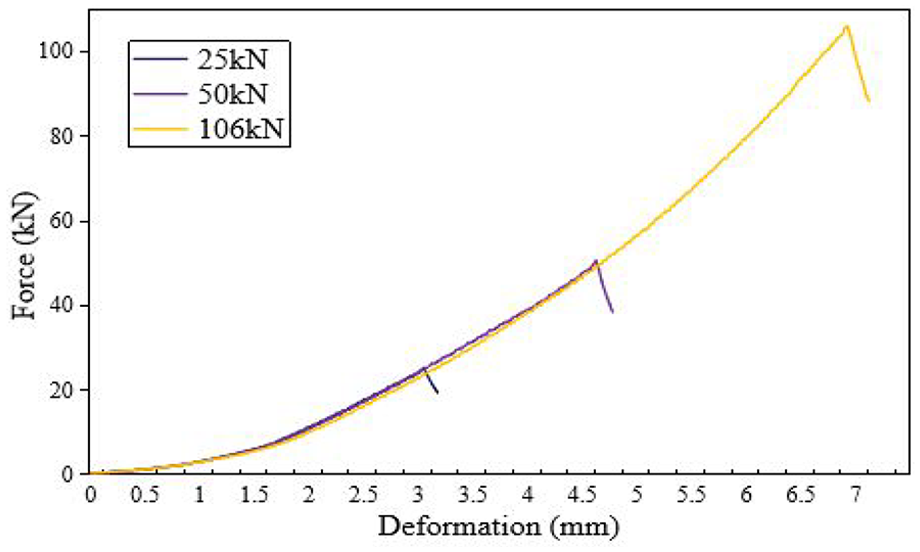
Force and deformation under different squeezing forces.
Effect of directions on the squeezing characteristics
In the event of a vehicular collision, the direction of the applied force on the power battery depends on its installation orientation and the collision angle. The deformation of the square LFP battery under different squeezing directions is shown in Figure 5. The results reveal that squeezing from the front results in less deformation compared to squeezing from the side, which leads to significantly greater deformation, particularly at the maximum deformation point and in final deformation. This difference in deformation patterns can be attributed to the differences in the internal structural damage observed via CT scans, which in turn affect the battery’s performance and safety. Under identical forces, the smaller test area (i.e., the side) experiences higher stress levels.

Force and deformation in different squeezing directions.
Effect of voltage on the squeezing characteristics
The changes in voltage during the squeezing test of the square LFP battery are shown in Figure 6. For the first three battery groups subjected to a 25 kN front squeezing force (i.e., batteries 1, 2, and 3), the deformation is relatively minor, and the voltage fluctuation is not pronounced. However, battery 4 exhibits a voltage decrease of 0.1 V at a deformation of 0.65 mm, which does not occur in the other batteries. This voltage drop may be attributable to experimental errors or variations, leading to disparate observations. Following deformation, the voltage of battery 5 drops sharply to 2.9 V and then rises to 3.2 V after sustaining a certain level of deformation. According to CT scan results, this voltage fluctuation is linked to minor damage to the inner pole column of the battery, which causes the sharp voltage drop. As deformation continues and the squeezing force diminishes, the voltage stabilizes. A similar pattern of voltage stability following significant deformation is observed.
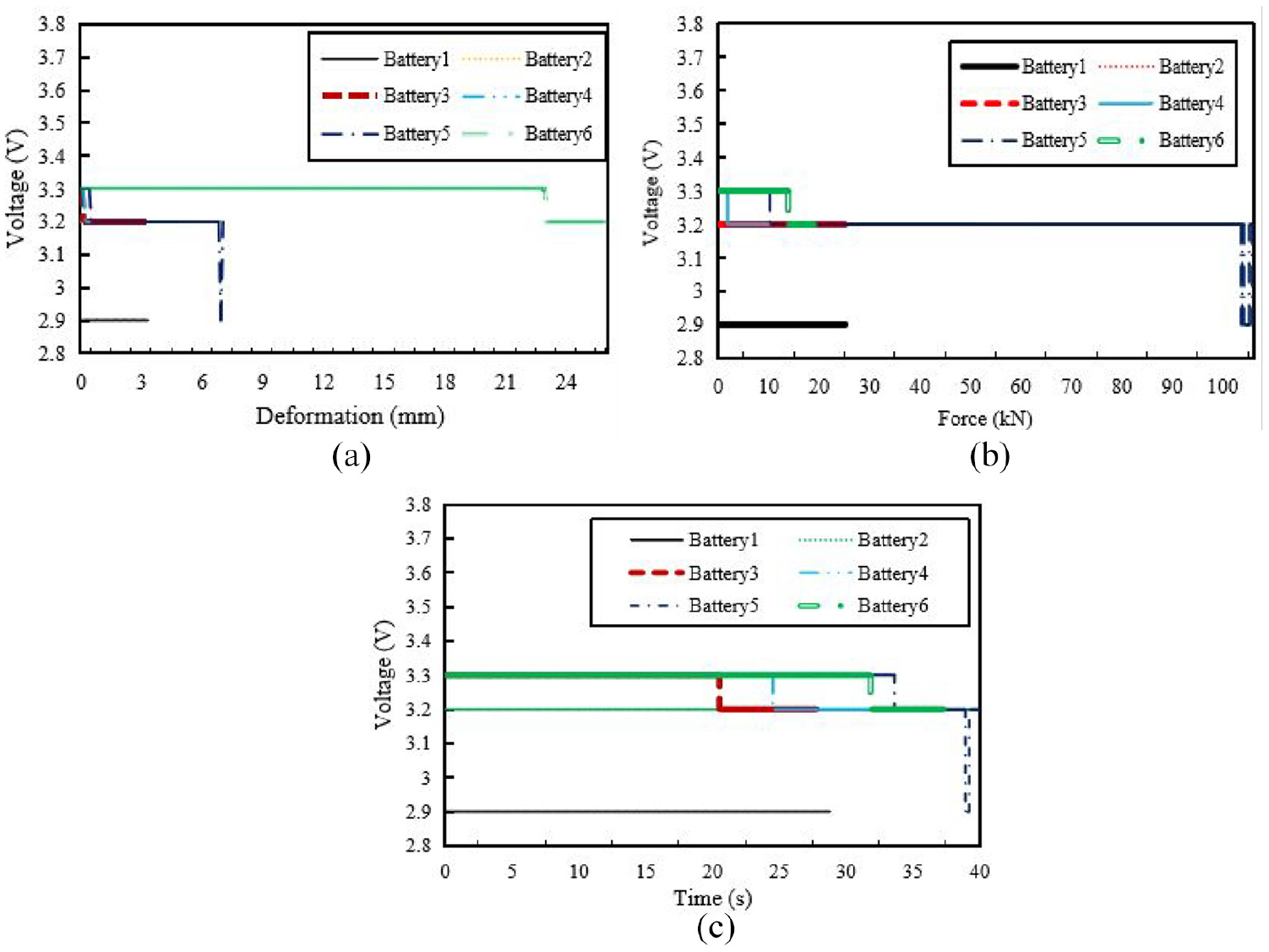
Voltage change during the squeezing test: (a) voltage and deformation under the squeezing test, (b) voltage and force under the squeezing test, and (c) voltage and time before the squeezing test.
At lower squeezing forces, the effect of different SOC values on battery voltage may not be evident. High squeezing forces can cause damage or short circuits within the battery’s internal structure, impacting the voltage output; however, the voltage may partially recover to a stable state after undergoing some deformation. Notably, the voltage of battery 6 drops even under relatively low squeezing forces, suggesting that different squeezing directions can also influence the battery’s voltage output. This may result from the side squeezing direction causing a different stress distribution within the battery’s internal structure.
Effect of temperature on the squeezing characteristics
The temperature variations during the squeezing test of the square LFP battery are shown in Figure 7. Influenced by environmental factors, the surface temperature of the battery exhibits relatively significant fluctuations, though the overall magnitude of these changes is minor, averaging no more than 0.1°C. Therefore, it can be inferred that the squeezing force and deformation have less influence on SOC value, squeezing force and squeezing of the battery in different direction.
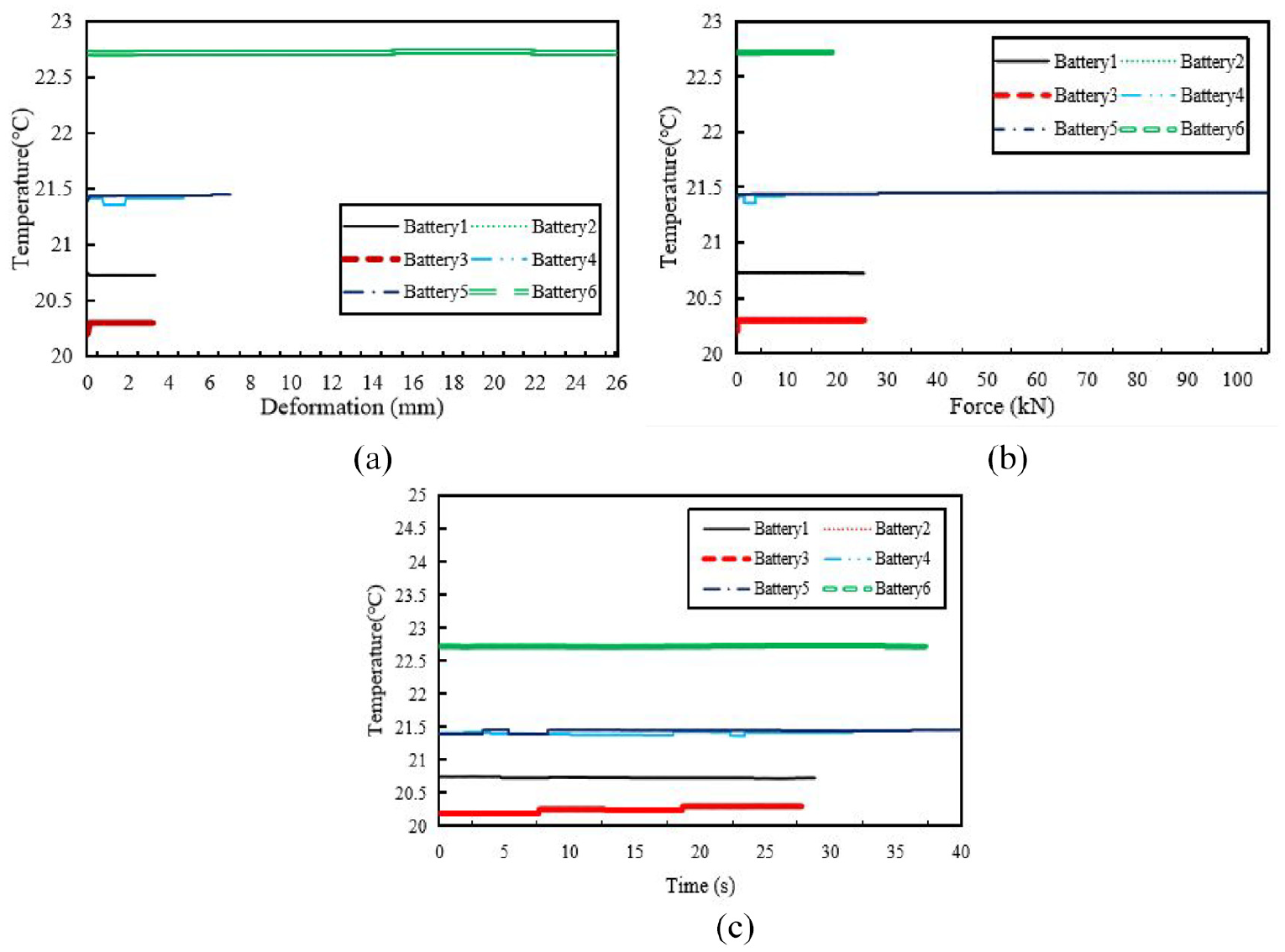
Temperature change during the squeezing test: (a) temperature and deformation under the squeezing test, (b) temperature and force under the squeezing test, and (c) temperature and time before squeezing.
Conclusion and discussion
In this study, we investigated the influence of various factors on the squeezing characteristics of LFP batteries and drew the following conclusions:
(1) As the SOC increases, the battery’s stiffness also increases, resulting in relatively minor deformation. This suggests that the charge state influences the battery’s resistance to squeezing, with higher SOC values enhancing stability. Therefore, controlling and optimizing the SOC can improve the squeezing characteristics, thus enhancing the stability and safety of the battery.
(2) An increase in squeezing force correlates with increased battery deformation and an increased risk of internal short circuits. This observation indicates that excessive squeezing forces can detrimentally affect battery safety and performance. Therefore, the potential impacts of squeezing force must be fully considered in the design and application of LFP batteries.
(3) Squeezing from the side results in more deformation compared to front squeezing, likely because the side force area is smaller, leading to higher pressure on the battery or due to differences in internal stress distribution and the specific internal structure of the battery. To enhance safety in collision scenarios, it is crucial to consider the distribution of the battery within its housing to maximize the contact area and minimize squeezing forces.
(4) The study also examined the effects of different SOC values, squeezing forces, and directions on voltage. The findings indicate that while SOC values have minimal impact on voltage, substantial squeezing forces or deformation can cause a sharp voltage drop, which may subsequently recover or stabilize to some extent. Additionally, squeezing within a certain parameter range has minimal effect on the battery’s surface temperature.
Based on the analysis and summary of these experimental results, we propose the following recommendations:
(1) Design optimization: Incorporate high SOC values in battery design to improve stiffness, reduce forces from side directions, and optimize battery layout.
(2) Safety assessment: Include tests under various SOC values and squeezing pressures in safety assessments to provide a comprehensive evaluation of the battery’s safety performance.
(3) Future research: Further investigate the comprehensive performance and long-term stability of the battery under diverse conditions, particularly under squeezing stresses.
Through detailed analysis and these recommendations, this study provides a scientific basis for optimizing the design of LFP batteries and enhancing their safety, thereby contributing to the advancement of the new-energy automobile industry.
