



Abstract
This study explores the application of Casson fluid in cooling systems for rolling mills and heat exchangers, with an emphasis on reducing leading-edge accretion and optimizing heat transfer efficiency. By building on current optimization practices in metallurgical plants and power generation facilities, our research provides a structured approach to enhancing operational efficiency and reducing costs related to heat management and accretion. Our objective is to advance the understanding and use of non-Newtonian Casson fluids in managing leading-edge accretion, ultimately contributing to the development of more efficient and resilient materials for high-temperature applications. In this work, we analyze the unsteady flow of Casson fluid over an aligned flat plate with a moving slot, incorporating slip boundary conditions. The combined influence of these physical factors offers a comprehensive view of the complex interactions in such systems, which are relevant for industrial processes and advanced material manufacturing. The boundary layer equations are converted to nonlinear ordinary differential equations using the Blasius-Rayleigh-Stokes similarity variable. Solving these equations employs the shooting method in Matlab, where the Runge-Kutta-Fehlberg approach assesses convergence of the numerical solution. We present our findings with visualizations that illustrate the influence of various dynamic parameters on the flow field. This comparative study shows that non-Newtonian fluids improve heat retention, thermal stability, and energy efficiency. They enhance solutal mixing, reduce fouling, lower surface friction, and improve flow control, making them ideal for industrial applications. Non-Newtonian fluids offer better heat transfer, reduce particle deposition, and allow precise control over thermal and solutal properties, making them suitable for cooling systems, lubrication, and nanofluidic applications. Replacing water-based coolants with non-Newtonian Casson-type fluids boosts heat and mass transfer, operational efficiency, and system longevity. Future research should focus on optimizing these fluids under dynamic conditions to further enhance their performance in industry.
Introduction
Global steel production is expected to increase dramatically in the coming years, though the globalization of the steel industry is still ongoing. Each year, new steel-making companies are established with production plants across all continents, a trend mirrored in the aluminum and non-ferrous metals industries. The rolling process, crucial for shaping metal sheets, generates substantial heat through friction and deformation in the roll bite. Effectively managing this heat is vital for maintaining product quality and preventing damage to both the workpiece and equipment. The efficiency of heat regulation directly influences the lifespan and reliability of rolling mills, with improper cooling leading to costly maintenance and operational downtime.
Colas et al. 1 and Guerrero et al. 2 conducted investigations on the hot rolling steel strip mill to examine the rolls’ surface and the wear mechanisms that lead to damage. They explored the heating and cooling cycles, which may cause defects in the rolled strips and potential damage. Their findings revealed that the oxidation of the work roll surface occurs due to diffusional processes, which can advance through cracks in the roll. In some cases, oxide formation can isolate healthy regions of the roll, causing them to break away and accelerating roll wear.
Sun et al. 3 carried out an experimental study on the impact of scale thickness on rolling force and torque during hot rolling of low-carbon steel. They used nitrogen protection to regulate scale thickness and cooled the samples in a cooling box. The effects of the oxide scale on the work roll surface, as well as the prediction of thermal expansion and heat transfer efficiency between the rolls and strips, were also studied by Yukawa et al. 4
In addition to rolling, heat exchangers and turbines in power plants also face challenges related to leading-edge accretion, where unwanted material builds up on heat transfer surfaces. This accretion can significantly reduce the efficiency of heat transfer systems, leading to increased energy consumption and decreased system lifespan. Cooper et al., 5 Müller-Steinhagen, 6 and Sung et al. 7 explored the heat exchanger fouling or accretion can be minimized through effective heat exchanger design, mechanical or chemical mitigation techniques, and by altering the coolant. Their study also highlighted that plate heat exchangers exhibit lower fouling rates than tubular equipment, thanks to the turbulence generated by the plate corrugations.
Regular cleaning and maintenance of the heat exchanger are essential for removing fouling-causing deposits, ensuring its continued efficiency. Surface treatments, such as coatings or nanoparticle layers, can enhance the surface’s resistance to fouling, thus extending the heat exchanger’s lifespan. Modifying fluid flow rate or pattern can help reduce the time the fluid spends in contact with surfaces, minimizing fouling. Additionally, pre-treating the fluid by adding chemicals or filtering impurities helps prevent debris buildup that can cause fouling. Designing the heat exchanger with reduced surface area contact and selecting fouling-resistant materials like stainless steel or titanium can further reduce the risk of fouling. Finally, applying fouling-resistant coatings, such as silicone or fluoropolymer, provides an added layer of protection, ensuring the system operates smoothly over time.
In industries ranging from power generation to chemical processing, advanced nozzle systems are often employed to mitigate these issues by continuously spraying coolant or water to regulate temperature and prevent overheating. However, high operational costs due to coolant consumption and system wear require innovative solutions. Raudensky et al. 8 conducted an experimental study on the cooling of a steel plate using a set of flat nozzles with a non-rectangular spray angle. The study demonstrated that roll cooling should be enhanced by increasing water flow rather than water pressure.
Saha et al. 9 examined the impact of the cooling system on roll performance and explored the thermal aspects of roll cooling on the roll surface at the hot strip mill at Tata Steel. Their model used to predict the roll cooling conditions under different thermal strains and stresses. Liu et al. 10 studied how coiling temperature affects the surface quality and profile shape during the process cooling in hot-rolled steel strips. Their mathematical model, incorporating nonlinear structural results, demonstrated the stable performance of the cooling process, improving the steel product quality.
From this literature survey, the internal and external accretion or fouling of the particle at the surface reduces the heat transfer efficiency of the system. This accretion, by forming layers on the heat exchange surfaces, obstructs the smooth flow of fluid, leading to an increase in thermal resistance. In this case, the accretion formulates the boundary layers of the flow becomes unsteady and it oscillates due to thickness of the scale formation. The external flow model uses the nozzle system and internal flow model uses the coolant over the surfaces to improve the heat transfer efficiency in the system. By optimizing the nozzle configuration and ensuring adequate coolant distribution, both models aim to reduce the formation of fouling by keeping the surfaces cleaner and maintaining a stable flow, which ultimately enhances heat dissipation and system performance. Moreover, the use of advanced materials and coatings on the surfaces can mitigate fouling accumulation, allowing for sustained heat transfer efficiency over longer operational periods.
In 1997, Todd
11
investigated the boundary layers of the unsteady and oscillatory fluid flow. Todd introduced the Blasius-Rayleigh-Stokes similarity variable to characterize the boundary layer thickness under such conditions. Their study focused on the fluid flow over a flat surface with a moving slot. This moving slot controls the flow, causing oscillations that affect the thickness of the boundary layer, thereby influencing the overall heat transfer and flow dynamics. The boundary-layer behavior in these oscillating flows is crucial for understanding how unsteady conditions impact heat exchange and the potential for fouling or accretion. The similarity solutions for leading-edge ablation
The following literature review focuses on leading-edge accretion and ablation, phenomena that significantly impact the thermal and fluid dynamic performance of surfaces exposed to high-speed flows. Accretion refers to the accumulation of material or particles on a surface, while ablation involves the removal or erosion of material from the surface due to intense heat or fluid flow. When a surface experiences accretion, the boundary layer thickens, increasing resistance to heat transfer and potentially leading to flow instabilities. Conversely, under ablation conditions, the material from the surface is removed, causing a reduction in boundary layer thickness and possibly enhancing heat dissipation.
The unstable flow over a semi-infinite flat plate were studied by Fang.12,13 Additionally, it explores flows from a slot on a moving surface, where the slot speed determines whether the flow behaves like a stretching or shrinking sheet. Dzulkifli et al. 14 and Hussanan et al. 15 explored the effects of edge accretion and ablation phenomena. Their study showed that the velocity and temperature fields are significantly impacted by the thinner thermal boundary layer in Blasius flat plate problems compared to Rayleigh-Stokes problems. A theoretical investigation on the heat transfer of magnetic nanofluids leading-edge accretion was carried out by Ilias et al. 16 Their research demonstrates that MHD can effectively enhance the control of heat transfer and fluid flow in nanofluids. The study is significant as it investigates the alignment of magnetic fields with the flow, showing that the accretion process at the leading edge can substantially influence the thermal boundary layer behavior.
Ahmad et al. 17 observed that the inclusion of magnetic particles enhanced heat transfer efficiency, attributed to increased thermal conductivity and the alignment of magnetic dipoles under an external magnetic field. Their results suggest that ferrofluids, which actively respond to magnetic fields, may offer improved thermal management in systems experiencing variable heat flux. Reddy et al. 18 explored Blasius-Rayleigh-Stokes flow through a transient magnetic field, accounting for Joule heating effects. This study is significant for its use of a non-Fourier heat conduction model, incorporating thermal relaxation time to address limitations of the traditional Fourier law.
Basha et al. 19 and Lu et al. 20 studied the effect of Prandtl number on unsteady boundary layer flow over a flat plate, specifically examining leading-edge accretion and ablation. Their numerical analysis sheds light on how variations in Prandtl number influence the heat transfer properties of nanofluids. Ali et al. 21 explored the influence of Stefan blowing, thermal radiation, and Cattaneo Christov heat flux on nanofluid flow with microorganisms, considering conditions of leading-edge ablation and accretion. Using the finite element method, they simulated complex interactions among flow, heat transfer, and species concentration.
Kumar et al. 22 and Mabood and Khan 23 explored laminar Rayleigh-Stokes and Blasius flow with ohmic heating, the process where electric current generates heat in a resistive material. The study concluded that the specified factors significantly influence flow and energy transport characteristics, with implications for improving thermal management in various applications. Blasius-Rayleigh-Stokes variables with slip effect were used to theoretically evaluate the unsteady convective flow of nanofluids by Adebayo et al., 24 Ishaq and Ahmad, 25 and Al Nuwairan and Souayeh. 26
The forced convective boundary layer flow of gyrotactic microorganisms was investigated by Gangadhar et al. 27 To solve transformed boundary value problems, they employed a combination of the collocation and finite difference methods. Their results showed that temperature, velocity, volume fraction of nanoparticles, and microbe density were all significantly impacted by thermal radiation and chemical interactions. These findings, which have been supported by earlier research, have consequences for the creation of biomodified nanomaterials and microflow devices.
Leading-edge accretion can lead to convective and unsteady acceleration, significantly influencing flow dynamics and heat transfer efficiency in various applications. The study by Animasaun et al. 28 explores ternary-hybrid nanofluid flow on horizontal surfaces, revealing how convective and unsteady acceleration impacts thermal behavior, enhancing understanding of heat transfer in engineering applications. Wang et al. 29 explores concentration variations and thermal behavior in water-based nanofluids. It offers valuable insights into accretion phenomena and enhanced heat transfer in nanofluid applications. Vaidya et al. 30 utilizing Blasius-Rayleigh-Stokes variables to examined the impact of heat transport properties on the erratic flow across a moving plate. Their findings indicated that higher dimensionless reference temperatures and moving slot parameters reduced the conductivity of the nanofluid.
From this literature review, the water-based coolants can be prone to accretion or fouling due to the presence of minerals and other impurities in the water. Changing to a coolant that is less prone to fouling, it can help to reduce fouling. Changing to a coolant that is specifically designed to reduce fouling. Recent advancements in fluid dynamics have introduced Casson fluid as a potential coolant for improving heat transfer in such systems. Casson fluid, a type of non-Newtonian fluid, offers several advantages over traditional coolants due to its unique rheological properties, particularly in systems involving high thermal stresses.
Using Blasius-Rayleigh-Stokes variables, Oladapo et al.
31
examined how radiation affected a Casson fluid flow over an inclined surface for solar aircraft applications. This work assessed the heat transfer efficiency of
The reviewed studies present a detailed view of advancements in non-Newtonian nanofluids, from early efforts to improve thermal conductivity using nanoparticles to more sophisticated models incorporating shear-dependent viscosity and heat transfer mechanisms. These insights are particularly valuable for optimizing the use of nanofluids in high-temperature environments and magnetic fields, with applications spanning advanced manufacturing, energy systems, and biomedical technologies. In this manuscript, we analyze the unsteady flow of a non-Newtonian Casson fluid over a horizontal flat plate with a moving slot, influenced by multiple slip conditions and oscillatory boundary layers. Buongiorno’s fluid model is considered due to concentration gradients. These physical phenomena provide critical insights into the fluid’s dynamic behavior. To solve this system, the boundary layer equations are transformed into nonlinear ordinary differential equations using the Blasius-Rayleigh-Stokes similarity variable. By employing the shooting method within Matlab, the Runge-Kutta-Fehlberg technique estimates the convergence of the numerical solution to these equations. To the best of our knowledge, this manuscript is the first to thoroughly examine the combined effects of Casson fluid with unsteady and oscillatory boundary layers combined with slip boundary conditions, Brownian motion, thermophoresis, Prandtl and Lewis numbers, thermal and solutal Grashof numbers for Casson fluid flow over a horizontally stretched sheet with a moving slot. This study delivers a comprehensive analysis of the momentum, temperature, and concentration profiles in the presence of moving slots and slip effects on a horizontal surface.
Mathematical model
Consider the unsteady

Physical model.
The governing equations are characterized by Lu et al. 20




where
The relevant boundary conditions are characterized by


Introducing the Blasius-Rayleigh-Stocks similarity variable and stream functions is of the form

Using (7), the governing equations with boundary conditions (1)–(6) are converted to nonlinear ordinary differential equations of the form:


where
Animasaun et al.
36
discusses the Brownian diffusion parameter as dimensionless, and Song et al.
34
and Cao et al.
35
discuss the energy and concentration equations to account for thermo-migration and haphazard motion. They normalize the concentration difference
The transformed boundary conditions are

where
Result and discussion
Todd
11
investigated the solutions of a new Blasius Rayleigh Stocks boundary layer for
Analysis of results
In this section, we discuss the analysis of the results from the comparative study of Newtonian and non-Newtonian fluids as the physical parameters increase. This study examines how variations in parameters such as the moving slot parameter, Casson fluid parameter, Brownian motion and thermophoresis parameters, Prandtl and Lewis numbers, thermal and solutal Grashof numbers, and slip parameters affect the behavior and performance of both fluid types. By analyzing these trends, we aim to highlight the differences in heat transfer, fluid flow, and solutal mixing, providing valuable insights into the practical applications of each fluid type.
Velocity profile
In Figure 2(a) the velocity of the non-Newtonian Casson fluid exhibits a higher peak compared to that of the Newtonian fluid, indicating greater resistance to flow deformation. An increase in moving slot parameter

Comparison of Newtonian and non-Newtonian fluids in velocity while increasing moving slot and Casson fluid parameters: (a) impact of moving slot parameter
Figure 3(a) shows the impact of

Comparison of Newtonian and non-Newtonian fluids in velocity while increasing Grashof numbers: (a) impact of mass Grashof number
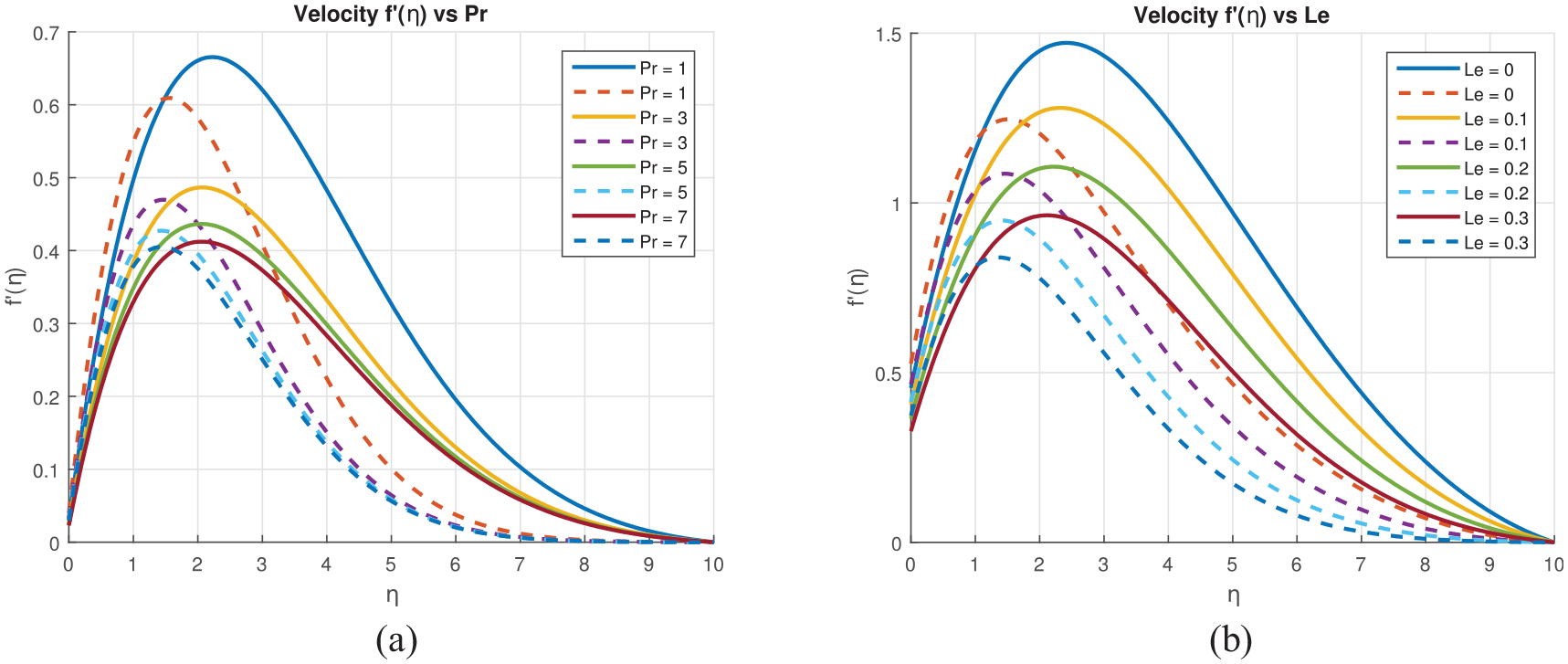
Comparison of Newtonian and non-Newtonian fluids in velocity while increasing Pr and Le numbers: (a) impact of Prandtl number
As

Comparison of Newtonian and non-Newtonian fluids in velocity while increasing diffusion parameters: (a) impact of thermal diffusion parameter
As

Comparison of Newtonian and non-Newtonian fluids in velocity while increasing slip parameters: (a) impact of velocity slip parameter
Temperature profile
From Figure 7(a) the temperature distribution in the Casson fluid is more uniform across the boundary layer, indicating better thermal stability. As fluid velocity increases, there is greater mixing and more heat being transferred through convection. In Figure 7(b) as the Casson fluid parameter

Comparison of Newtonian and non-Newtonian fluids in temperature while increasing moving slot and Casson fluid parameters: (a) impact of moving slot parameter
In Figure 8(a) the increase in velocity due to enhanced buoyancy results in more vigorous convection, leading to greater heat transport. This causes a rise in temperature as the fluid more efficiently transfers heat from the heated surface or surrounding environment. Similarly, in Figure 8(b) as fluid velocity increases due to stronger buoyancy-driven convection.

Comparison of Newtonian and non-Newtonian fluids in temperature while increasing Grashof numbers: (a) impact of mass Grashof number
In Figure 9(a) higher Prandtl number

Comparison of Newtonian and non-Newtonian fluids in temperature while increasing: (a) impact of Prandtl number
An increase in

Comparison of Newtonian and non-Newtonian fluids in temperature while increasing diffusion parameters: (a) impact of thermal diffusion parameter
The momentum slip factor

Comparison of Newtonian and non-Newtonian fluids in temperature while increasing slip parameters: (a) impact of velocity slip parameter
Concentration profile
The decrease in concentration with an increased moving slot parameter

Comparison of Newtonian and non-Newtonian fluids in concentration while increasing moving slot and Casson fluid parameters: (a) impact of moving slot parameter
In Figure 13(a) an increase in the mass Grashof number

Comparison of Newtonian and non-Newtonian fluids in concentration while increasing Grashof numbers: (a) impact of mass Grashof number
In Figure 14(a) with decreased convective velocity and less efficient thermal transfer, mass diffusion of solutes or particles becomes more pronounced. The rise in concentration indicates that the slower-moving fluid causes greater accumulation of solutes or particles, which could result in issues like fouling or deposition. As shown in Figure 14(b) higher

Comparison of Newtonian and non-Newtonian fluids in concentration while increasing: (a) impact of Prandtl number
In Figure 15(a) a stronger thermophoretic effect due to higher

Comparison of Newtonian and non-Newtonian fluids in concentration while increasing diffusion parameters: (a) impact of thermal diffusion parameter
As velocity increases, the convective mass transport of solutes or particles intensifies, leading to a thin concentration boundary layer. As a result the particles are more efficiently carried away due to the higher fluid velocity in Figure 16(a). Finally, Figure 16(b) provided that the higher values of

Comparison of Newtonian and non-Newtonian fluids in concentration while increasing slip parameters: (a) impact of velocity slip parameter
Discussion of results
From Figures 2(a), 7(a), and 12(a) non-Newtonian fluids exhibit thicker boundary layers for velocity and temperature, while their concentration boundary layer remains thinner than that of Newtonian fluids. This behavior is attributed to the enhanced movement of the surface, which facilitates momentum transfer within the fluid. The moving slot has a significant effect on the boundary layers. By optimizing this parameter, cooling efficiency can be improved through the control of boundary layers. Non-Newtonian fluids show a more pronounced response to the moving slot, as evidenced by their thicker velocity and temperature boundary layers. This indicates a better retention of heat and momentum, which is advantageous in systems that require controlled thermal management. An increase in
Non-Newtonian fluids consistently maintain thicker boundary layers for velocity, temperature, and concentration than their Newtonian counterparts in Figures 2(b), 7(b), and 12(b). This behavior reflects the non-Newtonian characteristics of Casson fluids, where higher
From Figures 3(a), 8(a), and 13(a) increasing
Similarly, in Figures 3(b), 8(b), and 13(b) Newtonian fluids show a more pronounced increase in the velocity and temperature boundary layers with increasing
From Figures 4(a), 9(a), and 14(a) it can be seen that Non-Newtonian fluids maintain thicker velocity and temperature boundary layers due to their inherent resistance to deformation, while their concentration boundary layers remain thinner compared to Newtonian fluids. Higher
Increasing
Increasing
In contrast, increasing
From Figures 6(a), 11(a), and 16(a) Non-Newtonian fluids exhibit thicker velocity and temperature boundary layers due to their viscoelastic nature, while Newtonian fluids show minimal thickness. In contrast, Non-Newtonian fluids maintain thinner concentration boundary layers for the same
In Figures 6(b), 11(b), and 16(b) Non-Newtonian fluids exhibit thicker boundary layers across all parameters compared to Newtonian fluids, even though
Conclusion
In this manuscript, we investigated the analysis heat transfer in Casson fluid flow due to aligned flat plate with leading edge accretion and slip boundary conditions. While using the Blasius Rayleigh-Stokes boundary layer, which reveals important distinctions between Newtonian and non-Newtonian Casson fluid behaviors. This analysis demonstrates the influence of leading-edge accretion rates on Casson fluid flow and thermal properties. The findings of the manuscript are listed as follows:
➢ From the comparison, the non-Newtonian Casson fluid flow gives better performance while increasing the leading edge accretion rate.
➢ Increasing the moving slot parameter
➢ Conversely, increasing the Prandtl number
➢ An increase in the thermophoresis diffusion parameter
➢ Increasing the Brownian diffusion parameter
➢ This comparative study demonstrates that non-Newtonian fluids enhance heat retention and thermal stability, making them ideal for applications requiring sustained heat retention and efficient thermal management. These fluids ensure effective solutal mixing, reduce particle accumulation, mitigate fouling, lower surface friction, and improve flow control, all of which contribute to energy-efficient operations.
➢ The practical implications of these findings highlight the advantages of non-Newtonian fluids in industrial applications. They improve heat transfer efficiency, reduce fouling and particle deposition, and allow for precise control over thermal and solutal properties. These qualities make non-Newtonian fluids particularly well-suited for advanced cooling systems, lubrication processes, and nanofluidic applications in biomedicine and material processing.
➢ Finally, replacing water-based Newtonian coolants with non-Newtonian Casson-type fluids offers significant benefits, such as enhanced heat and mass transfer, improved operational efficiency, and increased system longevity. Future research could focus on optimizing these parameters under dynamic operating conditions to further improve the performance of non-Newtonian fluids in industrial applications.
The interplay of these parameters is crucial for determining the efficiency of heat transfer and mass transport in the system. Parameters that enhance fluid velocity and thermal convection generally improve heat transfer, while those that increase viscosity, slip, or random motion tend to reduce the overall efficiency of thermal and mass transport. Understanding these effects is vital for optimizing designs in applications like cooling systems, heat exchangers, and processes involving Casson fluid flow with accretion.
Future directions: Future research could explore the impact of external magnetic flux and thermal radiation could yield valuable insights for optimizing systems in specific applications.
Footnotes
Handling Editor: Chenhui Liang
Author contributions
The authors equally contributed in this manuscript. J Jayaprakash contributed to the methodology, validation, and prepared the original draft. Vediyappan Govindan was responsible for formal analysis, investigation, and supervision. Haewon Byeon secured funding for the project.
Declaration of conflicting interests
The author(s) declared no potential conflicts of interest with respect to the research, authorship, and/or publication of this article.
Funding
The author(s) disclosed receipt of the following financial support for the research, authorship, and/or publication of this article: This research Supported by Basic Science Research Program through the National Research Foundation of Korea (NRF) funded by the Ministry of Education (NRF-RS-2023-00237287, NRF-2021S1A5A8062526) and local government-university cooperation-based regional innovation projects (2021RIS-003).
