



Abstract
The primary objective of this work is to examine the concentration and temperature boundary layers in a Maxwell nanofluid containing nanoparticles, influenced by thermophoresis & Brownian motion. The main findings are to enhance understanding of nanoscale heat with mass transport mechanisms, with potential applications in advanced thermal management systems and nanofluid-based technologies. The contribution of Cattaneo-Christov double diffusion theory captures time-delayed thermal effects. A system of partial differential equations (PDEs) is transformed into ordinary differential equations (ODEs) using similarity transformation (ST). The analysis considers the collective impacts of thermophoresis, Brownian motion, and viscoelasticity. The study elucidates the complex relationship between double diffusion phenomena and nanofluid behavior through analytical and numerical techniques. Dimensionless mathematical problems are numerically solved using MATLAB’s built-in function bvp4c, with the behavior of flow-controlling parameters presented through graphical and tabular data.
Keywords
Introduction
Nonmaterials suspended in a base liquid are called nanofluids, which aim to increase the combined heat and mass transformation process. Its potential applications are in the fields of biology and medicine. Furthermore, the mobility of the necessary nonmaterial’s in the structures is significantly reliant on cancer therapy theories, drug delivery systems, nanotechnologies, fermentation, and medicine fluids traveling via micro fluidic devices in freezers and thermal systems rely only on heat transfer particles given by nonmaterial’s, well-known phenomena. To achieve peak performance, nanofluid dynamics is a vital concept to grasp in any industry that deals with non-particle suspensions in any form. Since, Choi and Eastman 1 invented the term “nanofluid” in 1995, several research have been conducted to investigate the thermos-physical characteristics, synthesis, manufacturing, thermal fluid features, and applications of nanofluid. Nonmaterial science provided an appropriate working material to improve thermal performance. First, three different kinds of nanoparticles were placed in a continuous phase liquid, and their viscosity and thermal conductivity were studied. These particles have a size range of 1–100 nm. Nanofluid contains solid nanoparticles of size 1–100 nm in regular liquid. The thermal conductivity properties of nanomolecules, including silicon, copper, the metal aluminum, and titanium, is extensively utilized. Large heat exchangers in automobiles and industries need more production; consequently, nanofluid is kept together with the necessary nanomolecules. Sheikholeslami 2 investigated the numerical solution of a curved cavity utilizing nanoparticles. Lahmar et al. 3 examined the flow & heat-transmission properties of the compressed nanofluid between two parallel plates. In the existence force, Waqas et al. 4 inspected the magneto cross flow of Oldroyd-B nanoliquid. Rashidi et al. 5 investigated the magnetic field-relevant Copper–water nanoliquids stagnation point boundary layer movement. Slip flow of Maxwell nanofluid with Cattaneo-Christov (CC) heat flux past a vertical surface surrounded by a porous medium was investigated by Al Rashdi et al. 6 Nabwey et al. 7 provides the analysis of micropolar Williamson and Maxwell nanofluids above a perpendicular cylinder with heat and mass transport. Maple 23 software was hired to solve the coupled resulting nonlinear differential equations resulting from appropriate similarity transformations. Saleem and Faheem 8 discussed the synchronized impacts of melting heat transfer Williamson magnetized nanofluid containing microorganisms over a leading edge. A numerical bvp4c approach was used by them.
Many other researchers consider the different models and physical boundary conditions to discussed the flow situation. Mentioned can be made to.9–20 Ayodeji et al. 21 used velocity slip and viscous dissipation to sightsee the flow of nanofluid against a stretched sheet. Platt 22 investigated nanofluids have piqued the interest of researchers due to their potential for enhancing heat transfer and other features in a variety of engineering applications. However, challenges remain in terms of large-scale production, cost-effectiveness, and ensuring long-term stability. Ongoing research aims to address these challenges and explore new applications for nanofluid. Kuznetsov 23 highlighted the key research for the stability of nonmaterial, including motile gyrotactic bacteria. Nayak et al. 24 studied the effect of temperature, solutal, microorganism profiles and momentum on the flow of a biologically inert nanoliquid over a stretched surface. Nima et al. 25 investigated the melting properties of fluids that are not Newtonian in bio-convective swimming organisms passing through non-Darcy porous surfaces with changing fluid flow. Ben Henda et al., 26 Ijaz Khan et al., 27 and Khan et al. 28 relate to more current work on nanoparticles bioconvection patterns and altered flow geometry and technique. On multiple occasions, the steadiness of nanoparticles suspensions has been effectively increased in the presence of gyrostatic bacteria. Imran et al. 29 suggested the properties of melting in non-Newtonian (NF) fluid passing through absorbent materials that are not Darcy with fluid flow that varies in swimming microorganisms that are bioconvective. Jayadevamurthy et al. 30 examined the biological convection stream of a hybrid nanofluid through a moving rotating disk with numerically and MHD has various practical applications. Without the need of mechanical moving parts, MHD generators may directly transfer the kinetic energy of a high-velocity conducting fluid into electrical energy for power generation. MHD propulsion systems have been proposed for spacecraft and submarines. MHD pumps and valves can be used in industries where handling liquid metals is necessary. MHD is also relevant to astrophysics, space science, and the study of natural phenomena involving conducting fluids. Magneto hydrodynamics is a complex and interdisciplinary field that continues to be an active area of research. Comprehending the conductivity of fluids in the presence of magnetic fields holds significant significance for several scientific and technical disciplines. Freidoonimehr et al. 31 examined MHD transient laminar flow of moving nanoparticles across a porous media sheet under free convection. Gangadhar et al. 32 examined MHD outer velocity flow stability across a stretched cylinder in a number of scenarios. Several scholars have looked into stretched flow problems.
For instance, Mukhopadhyay 33 examined the MHD boundary layer (BL) slip flow along a stretched cylinder. Due to its many applications, particularly in engineering, petroleum, mechanical manufacturing, geophysical scientific fields and agriculture. Magneto hydrodynamics has recently become more and more well-known. Typically, one that is orthogonal to a liquid flow, in order to generate the Lorentz force, this strength acts in opposition to the fluid’s flow, influencing its velocity. The generation of information on fluids using nanoparticles and the analysis of magneto-hydrodynamic methods are currently extremely valuable and applicable in a wide range of research sectors, including manufacturing and science. Among the applications are wound therapy, an optical modulator, and a magneto-hydrodynamic power-based transformer. Furthermore, the Lorentz power is discussed in this area’s hypothetical evaluation. Magneto-hydrodynamic forces influence this type of force, which is an extremely valuable concept for regulating cooling processes. Shoaib et al. 34 examined the spinning motion using mathematical modeling of a hybrid nanofluid that is magnetohydrodynamic and radiates heat nonlinearly over a stretched surface. Tian et al. 35 examined the two fins’ two- and three-dimensional shapes and how they affected the heat-sink efficiency of a magneto hydrodynamic hybrid nanofluid that was running either non-slip or slip-slip. Haq et al. 36 studied the process of Eyring Powell nanoliquids’ mixed-convective MHD transport, which results in gyro tactic microorganisms in a stretched cylinder. The effects of thermodynamics and magnetism on nonliquid flow in an annular, porous circular zone created by two particles in motion were examined by Siddiqui and Chamkha. 37 Salem and Fathy 38 investigated how various factors affected the flow of mass & heat transfer via a permeable material that radiates heat toward a stretched sheet, and the flow toward the stagnation point. Najib et al. 39 examined mass transport across a stretching/shrinking cylinder and stagnation point flow. Numerous researchers provide a details studies.40–44
Novelty
This work presents a fresh interpretation of Maxwell nanofluid boundary layer behavior by integrating Brownian motion & thermophoresis into the Cattaneo-Christov (CC) double diffusion model. Unlike traditional Fourier and Fick laws, the Cattaneo-Christov model includes finite speeds for heat & mass propagation, offering a more accurate depiction of thermal and concentration fields in non-Newtonian fluids. This study is the first to use this comprehensive diffusion model to Maxwell nanofluids and illustrates how boundary layer formation is influenced by non-Fickian mass diffusion and non-Fourier heat conduction. The findings provide fresh insights into the interactions between thermal and concentration boundary layers in viscoelastic nanofluids, improving our understanding and suggesting new ways to optimize thermal management systems in engineering applications.
Mathematical modeling
Here propose unsteady 2-D incompressible flowing of Maxwell fluid through a stretching cylinder with radius

Flow diagram.
Governing equation
The governing flow equation for the proposed model are expressed as Khan et al. 44



Boundary condition
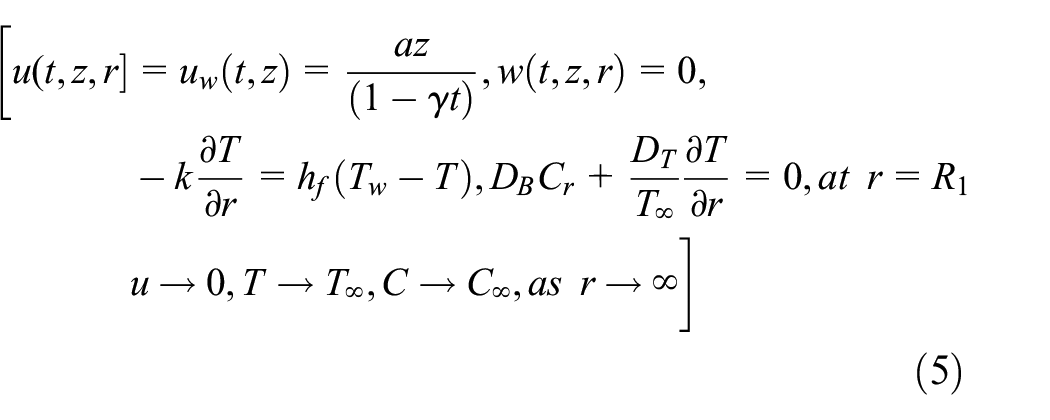
The problem of Maxwell fluid flow is demonstrated under the following boundary constraints.
So,
In the governing equation,
Similarity transformation
The (PDEs) partial differential equations driving the flow characteristics are subjected to a series of notable similarity transformations in this section, resulting in the transformation of the original system into a set of nonlinear dimensionless ordinary differential equations (ODEs). These changes are critical in simplifying the mathematical description of the fluid dynamics being studied. 44

Dimensionless equation
The detail procedure for the transforming (1–4) into the dimensionless form has been communicated in the upcoming discussion.
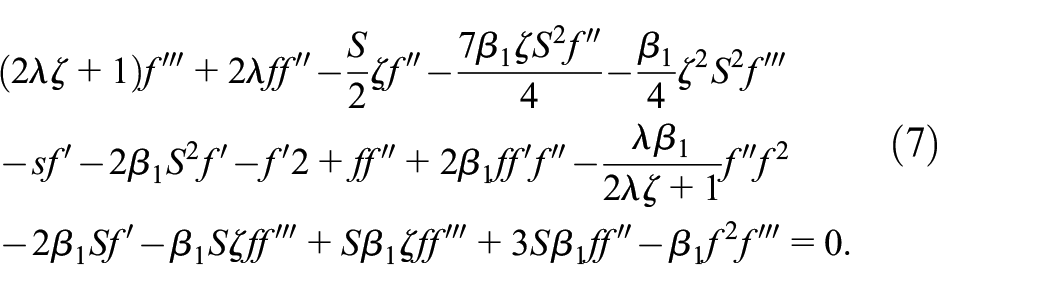
In the above equations

Here,

In the above equations

In the above equations
Numerical scheme
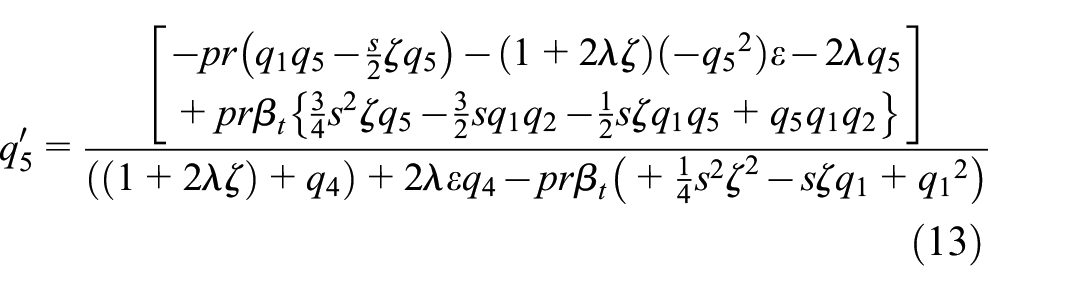
The shooting technique using the bvp4c tool is applied to achieve the numerical results of coupled (ODEs) ordinary differential equations with boundary conditions (BC). The analysis is performed using the software MATLAB and solve numerically and graphically. The higher order of (ODEs) must be reduced in first order for this case. This is accomplished by introducing new variables.
Let



Result and discussion
The importance of flow regulating factors on subjective flow fields is examined in length in this specific area.
Velocity profile
Figure 2 depicted to examine the effects of relaxation parameter

Influences of
Temperature field
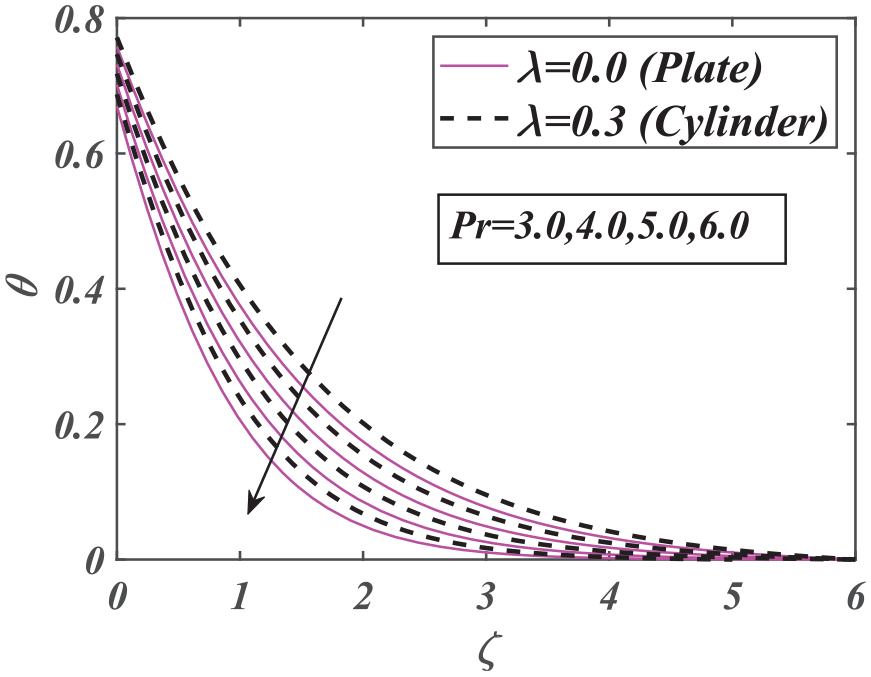
In this slice the behavior of temperature distribution
Influences of

Influences of

Influences of

Influences of

Influences of
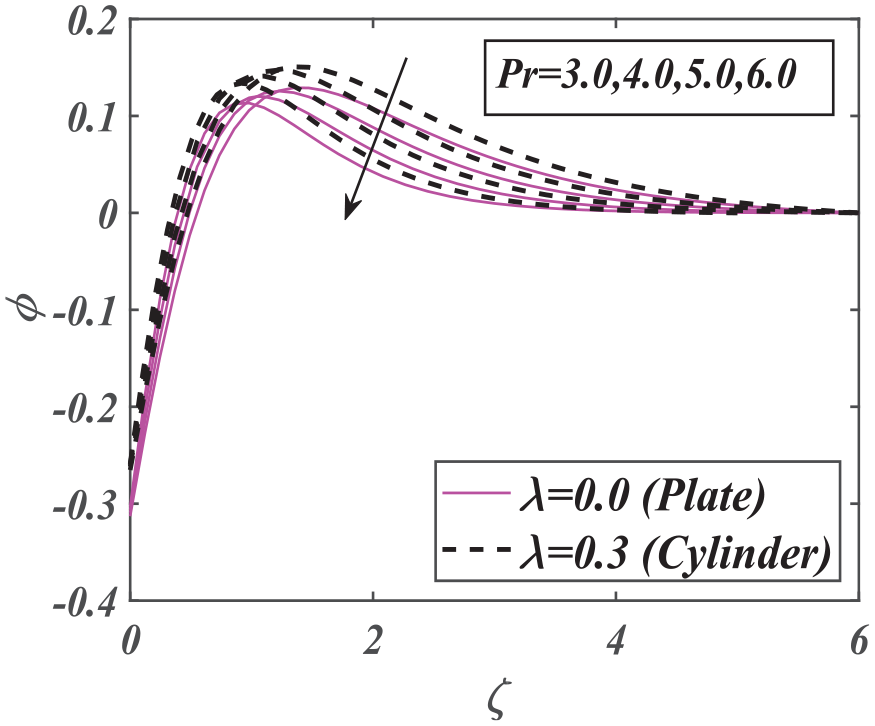
Influences of
The nature of Prandtl number
Concentration field
It is noteworthy that

Influences of

Influences of

Influences of

Influences of
Engineering quantities behavior
This section examines how several parameters, such as the


Remarks and conclusion
A problem of the unstable flow of Maxwell fluid across the stretched cylinder in 2D has finally been discussed. The Cattaneo-Christov hypothesis is utilized in the context of mass and heat transfer systems. The thermal conductivity of the fluid is considered to vary (temperature dependent). This study investigates the bioconvective flow of thyrotrophic nanofluid containing microorganisms in the presence of a bent magnetic field. The following are the main findings of the offered analysis:
It is determined that increases the value of relaxation parameter than the velocity profile reductions.
Increasing the value of Bioconvection Rayleigh number then the velocity is decreases.
It is significant to note that the velocity profile will growth as the mixed convection parameter values increase. The buoyancy ratio parameter value was raised, causing a dip in the velocity profile.
Raising the mixed convection parameter increases the velocity of the profile, whereas raising the buoyancy ratio parameter decreases it. The values of dimensionless parameters are increasing then the velocity will be increases.
Discusses the effects of microorganisms’ difference parameter and microorganism stratification Biot number on microorganism profile.
Footnotes
Handling Editor: Chenhui Liang
Declaration of conflicting interests
The author(s) declared no potential conflicts of interest with respect to the research, authorship, and/or publication of this article.
Funding
The author(s) received no financial support for the research, authorship, and/or publication of this article.
