



Abstract
Due to the increase of sediment carried by the upstream with years, sediment deposition and hardening gradually aggravated, which has severe impact on the waterway passage and agricultural irrigation. Therefore, to develop a highly efficient dredging device is urgently needed. An externally excited oscillating airlift pump is proposed to improve the dredging performance of the existing ring-jet airlift pump, and the influence of excitation methods and working conditions is analyzed. The findings show that under different excitation methods, both water and sand discharge show a reciprocal oscillating pattern as the duty cycle increases, and the overall trend is decreasing. When the duty cycle is 50% and 30% respectively, both water and sand discharge reach their maximums; the corresponding sand discharge in horizontal operation performs better than that in descent operation, and in either operation mode, the externally excited oscillating airlift pump exhibits better discharge performance of solids than the continuous air intake. In the untimed continuous suspended pumping, its sand discharge capacity and disturbance range on the silt layer are greater than the continuous airlift pump. At the duty cycle of 30% and the frequency of 0.4 Hz, its discharge performance and disturbance effect on the bottom silt layer work best.
Introduction
An airlift system primarily include a airlift pump and a lifting pipe. In operation, the compressed gas is delivered from the air compressor through the pipeline to the airlift pump to mix with the liquid, then the solid particles with buoyancy and bubbles acceleration, and finally transported to the designated area by the lifting pipe.1,2 An airlift pump with a simple structure, low maintenance cost, easy installation, and high reliability is one of the effective means of lifting liquids, slurries, or solid particles, which is widely used in the chemical industry for the transportation of abrasive, toxic and explosive materials3,4 and seabed dredging and mining. 5 Moreover, it is frequently used to enhance heat and mass transfer in many bio-process applications. 6 Currently, the low efficiency of airlift pumps is one of the main difficulties affecting dredging performance, 7 airlift pumps are still mainly performed by the traditional continuous air injection method, which leads to a stable negative pressure in the airlift pipe and fails to produce a high peak value of instantaneous negative pressure to improve the airlift pump performance.
Many experimental studies have been conducted to improve the dredging performance of airlift pumps. Hu et al. 8 experimentally studied the effects of the air injection method on the performance of an airlift pump. Similar studies can be found in Tang et al.9,10 For the dredging of Three Gorges Reservoir, Liao et al. 11 and Tang and Liao 12 proposed an integrated electromagnetically airlift device that integrated system into the self-excited oscillating pulsed jet and the latter was employed to crush the deposited hardened layer. Ahmed et al. 13 experimentally found that the efficiency of pulse intake at the frequency of 1 Hz increased by 60% compared with the traditional air intake. Liao and Tang 14 and Tang et al. 15 analyzed the mechanism of the oscillating jet induced by externally excited shear by introducing an electromagnetic oscillating device into the jet nozzle with an external stimulus, and then conducted a spectral analysis of the axial pressure of the externally excited jet to obtain the power spectrum of the pressure signal. The erosion experimental results indicated that this kind of structure featured the advantages of cavitation jets, which triggered intense oscillation and with its frequency easy to regulate, its erosion performance is far superior to that of self-excited jets (nearly twice) and as much as that of ordinary jets, so it can be widely applied for crushing and other engineering applications. Xiong et al. 16 took advantage of the downhole annular fluid column pressure to realize the externally excited oscillating pulsed jet and implemented self-increasing flow experiments and dynamic pressure experiments. The experimental results showed that the structural parameters of the externally excited resonance cavity, the position of the externally excited holes, and the hydraulic characteristic parameters played a vital role in the effect of external excitation, and that the exit pressure of the externally excited jet is two times more than that of the self-excited jet. Based on hydrodynamics, transient flow, and Boundary Layer Theory, Xiong et al. 17 adopted ANSYS CFD to numerically simulate the characteristics and structural parameters of the externally excited oscillating resonance cavity, which provided a new theoretical basis for design optimization of the rock-breaking jet nozzle, and was also of great guiding significance for the introduction of the external excited oscillating resonance cavity to change air intake modes of airlift pumps. Xiong et al. 18 and Tang et al. 19 both changed the intake modes by introducing an electromagnetic oscillating device, which converted from the traditional continuous air intake to the pulsed air intake with a fixed frequency. Both intake modes formed a type of jet that belonged to the pulsed jet and the relevant literature elaborated on the formation of the control system by means of electric circuits.
This study attempts to generate instantaneous negative pressure in the airlift pump, increase the peak negative pressure, expand the pumping performance of the airlift pump and the range of action of the suction port,20–22 to improve the dredging performance of the existing ring-jet airlift pump. Therefore, this paper proposes an external excitation oscillating airlift pump by introducing an electromagnetic excitation control system and analyzes the influence law of the excitation mode and operation conditions.
Experimental system and methods
In Figure 1, the research designs and built a new airlift experimental device that is comprised of four parts: an air compression system, an electromagnetic actuated control system, an air lifting system, and an acquisition and measurement system. Aside from the airlift pump, the electromagnetic actuated system is the most critical part among them, whose circuit diagram is shown in Figure 2. The system consists of a function generator (Pu Yuan (RIGOL) DG1022Z), solid state relay (SSR-25 DA type), solenoid valves (LD8710H normally closed high-pressure solenoid valves) in Figures 3 and 4.

Schematic diagram of the experimental system.
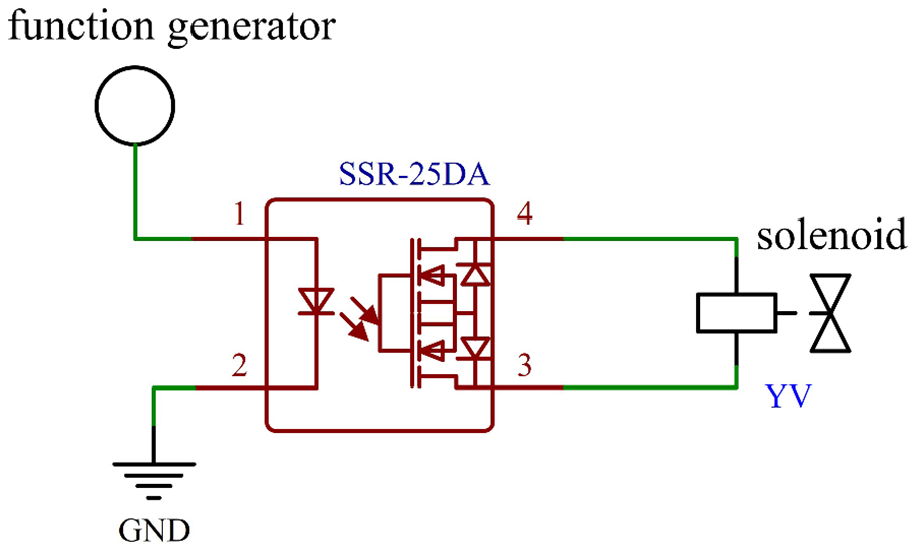
Circuit diagram of the electromagnetic actuated system.

Electromagnetic excitation system: (a) function generator, (b) solid state relays, and (c) solenoid.

Electromagnetic excitation source.
The harmonic oscillation with certain pulsation amplitude is introduced at the suitable position of the airlift pump, and applied to the shear flow of the airlift pump, if the externally excited oscillation wave has a suitable phase relationship with the self-excited oscillation wave or the excitation frequency matches with the self-excited oscillation frequency, an externally excited oscillating pulse jet will be formed.
The solenoid valve is controlled through the whole actuated electric circuit system. In the experiment, rectangular wave is used to control the electric circuit for the purpose of research. Duty cycle (Dc) is the ratio of the jet injection time in one period in a non-constant jet to this period, and the duty cycle is obtained by the following equation:

where T is pulse period, s; tOn is electric circuit opening time/pulse width, s; tOff is circuit closing time/pulse interval, s.
With the introduction of duty cycle, the actual air intake QG0 in the airlift pump should be described by the following equation:

where QG is air intake, m3/s.
As shown in Figure 5, a dredging simulation system of the externally excited oscillating airlift pump is developed to simulate the dredging with the aim of comparing the specific performance indexes such as water and sand discharge at all frequencies and analyzing the dredging performance under different working conditions when exploring the effect of all frequencies on the air-lifting performance under constant duty cycle. To simulate the dredging working conditions as much as possible, the relevant experiments are performed at a high immersion rate (γ = 0.9), where the immersion rate is the relationship between the distance from the suction port at the bottom of the airlift pump to the liquid surface and the distance from the bottom of the airlift pump to the top of the lifting pipe. By means of simulating the movement of the dredging vessel, the experiment first starts the timekeeping and sampling when the airlift pump is lowered to the level of the sand surface; and then halt the downward movement immediately after 30 s while continuing the (single) longitudinal movement and doing timekeeping and sampling. A stopwatch and a waterproof weighing scale are employed to record the working hours of the airlift pump and the required parameters, respectively.

Simulation of dredging working conditions: (a) descent operation and (b) horizontal operation.
When exploring the effect of each frequency on the continuous sand discharge at various duty cycles, the experiment is conducted by untimed pumping at a depth of 80 mm below the sand surface, taking into account the limited capacity of the sampling container. Then the experiment is put to a stop when almost no sand remains in the sampling tube. At five different duty cycles including 30%, 40%, 50%, 60%, 70%, sand discharge is monitored at all frequencies to explore the impact of duty cycle and frequency on the pit morphology surrounding the suction port.
In investigating the effect of frequency and air volume on dredging, the individual opening/closing cycle of the electromagnetism valve is gradually shortened as the frequency exceeds 1.2 Hz and gradually increases. It means that the pulsed airflow inclines to convert into continuous airflow with the increasing of frequency, and the nature of the research will be lost.
Experimental results and analysis
Effect of duty cycle on water discharge performance
Figure 6 illustrates the oscillatory rather than linear relationship between duty cycle and water discharge (QL). When the duty cycle is 50%, water discharge performance is optimal which increases to the peak value of 8.3 kg/s by 12.3% from the valley value. Through the Matlab equation fitting, the function fitting equation of duty cycle and water discharge is obtained as shown in equation (3):


Variations of water discharge with duty cycle.
Through the function fitting, the variations of water discharge with duty cycle can be derived. The above function equation is highly valuable and significant for choosing appropriate excitation parameters of the externally excited oscillating airlift pump when applied in fields like irrigation, drainage, deep-well water extraction, and agricultural production.
Effect of frequency on airlift performance at a constant duty cycle
Descent operation
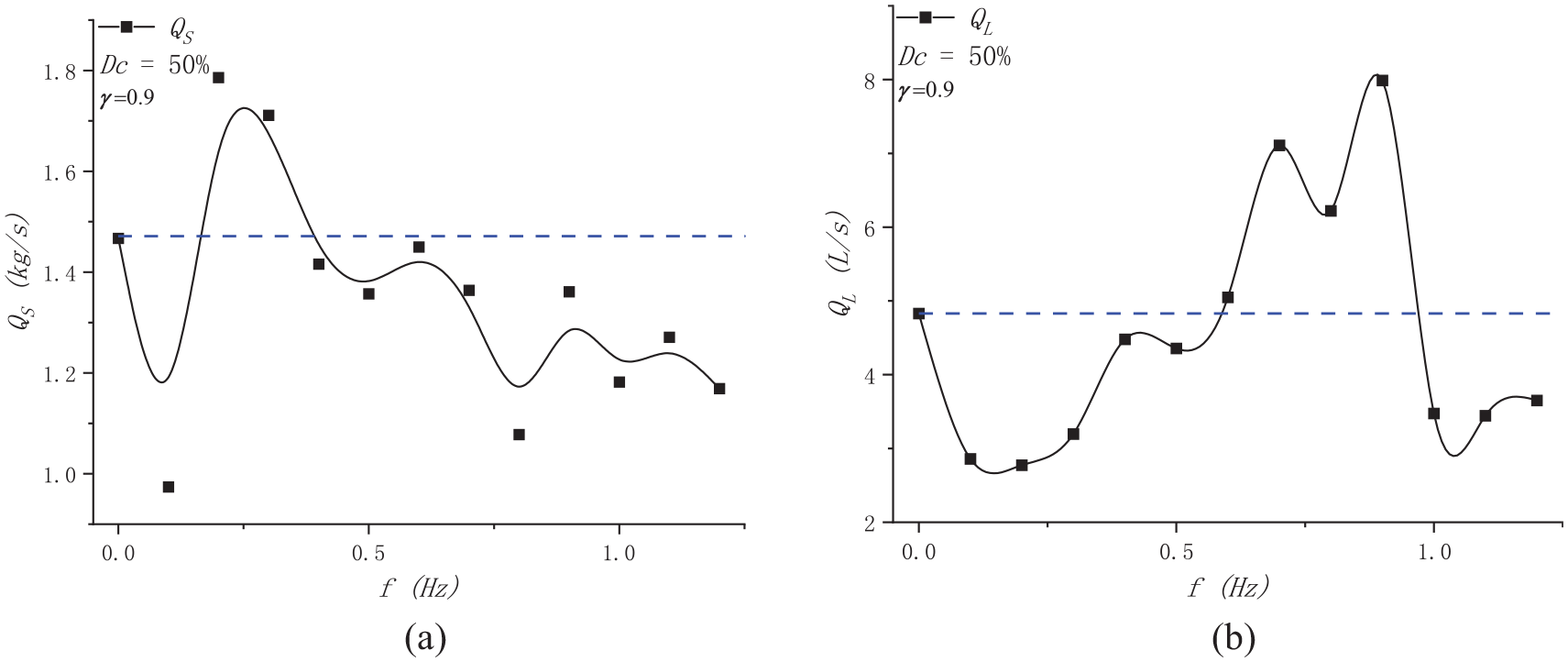
Figure 7(a) and (b) show the variations of water and sand discharge with frequency in descent operation, respectively. As can be seen, sand discharge reaches the peak at the frequency of 0.9 Hz, and when 0 ≤ f ≤ 0.8 Hz, the oscillatory curve becomes more regular. It follows that the sand discharge performance of pulsed airflow is not superior to that of continuous airflow at all frequencies in the unit time of descent working conditions. On the contrary, water discharge hits a record low at the frequency of 0.9 Hz. When 0.1 ≤ f ≤ 0.7 Hz, it shows overall growth with the change of frequency, but it falls rapidly to the valley value from the peak value when the frequency increases from 0.8 to 0.9 Hz. During the descent operation, it is quite obvious that the water discharge of pulsed airflow is almost lower than that of continuous airflow on the whole, and only at the frequencies of 0.7 and 0.8 Hz, the former is slightly higher than that of the latter.

Airlift performance in descent operation: (a) sand discharge and (b) water discharge.
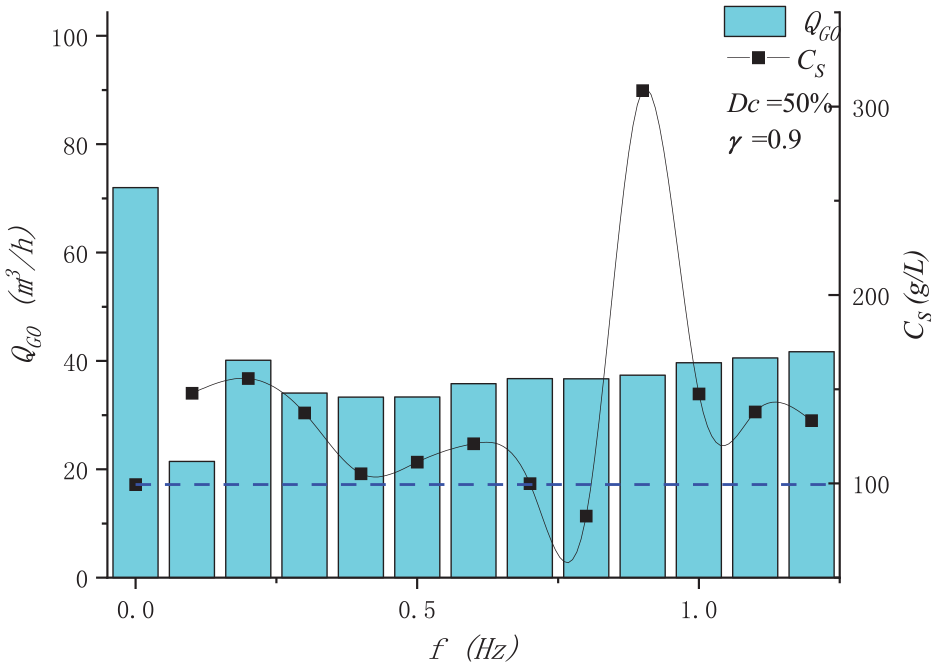
Figure 8 displays the variations of the mass-volume concentration Cs of the slurry with frequency at a constant duty cycle and immersion rate during the descent operation. The bar chart shows the equivalent air volume QG0 at varying frequencies. Compared with the conventional continuous airflow, the pulsed airflow is more likely to make solid particles initiate at the bottom of the suction port and jump upward, meaning that the former requires less air volume than the latter. The high-speed pulsed air jet from Fairthe nozzle breaks the hydrostatic state and interacts with the fluid to form a vortex ring, during which a large amount of mixed fluid is entrained 23 and its kinetic energy loss is lessened consequently because its polarized flow reduces the frictional resistance of the air jet and the surrounding mixed fluid. 24 The high-speed pulse airflow triggers strong energy exchange in the airlift pump and causes its instantaneous impact to spray to the pump. As a result, the chip hold down effect of the liquid on solid particles is quickly “lifted,” which allows a large number of particles to overcome gravity and jump upward. The impact of the pulse airflow is much greater than the drag force of the continuous airflow on solid particles, which further facilitates the lifting of solid particles. Especially at the frequency of 0.9 Hz, its concentration rises to the peak value of 308.49 g/L, which is three times that of the continuous flow.
Variations of discharge concentration with frequency.
During the descent process, sand discharge and concentration both peak at the frequency of 0.9 Hz, while water discharge drops to the valley value. This phenomenon can illustrate that the best dredging performance can be achieved by excitation at the frequency of 0.9 Hz during the descent dredging operation.
Horizontal operation
Figure 9 shows the variations of airlift performance with frequency in horizontal operation, and that sand discharge reaches the peak at f = 0.2 Hz while water discharge falls to the lowest. Considering both descent operation and horizontal operation, the excitation frequencies required to obtain the peak sand discharge are not the same, but under the same excitation, sand discharge in horizontal operation is better than that in descent operation.
Airlift performance in horizontal operation: (a) sand discharge and (b) water discharge.
Figure 10 shows the variations of concentration with frequency in horizontal operation, where the mass/volume concentration rises to the peak of 643.07 g/L at f = 0.2 Hz, and it is 2.12 times that at f = 0 Hz. When compared to Figure 8, the concentration in horizontal operation is found to be higher than that in descent operation with the same operating parameters, except for f = 0.9 Hz. Under both working conditions, the frequency ranges of their peak concentration are not consistent. In descent operation, the peak occurs at f = 0.9 Hz, whereas in horizontal operation, it happens at f = 0.2 Hz. However, by comparing the pulsed airflow with the conventional continuous airflow in both working conditions, the former is more likely to lift sand at the bottom of the suction port and requires less air volume than the latter.
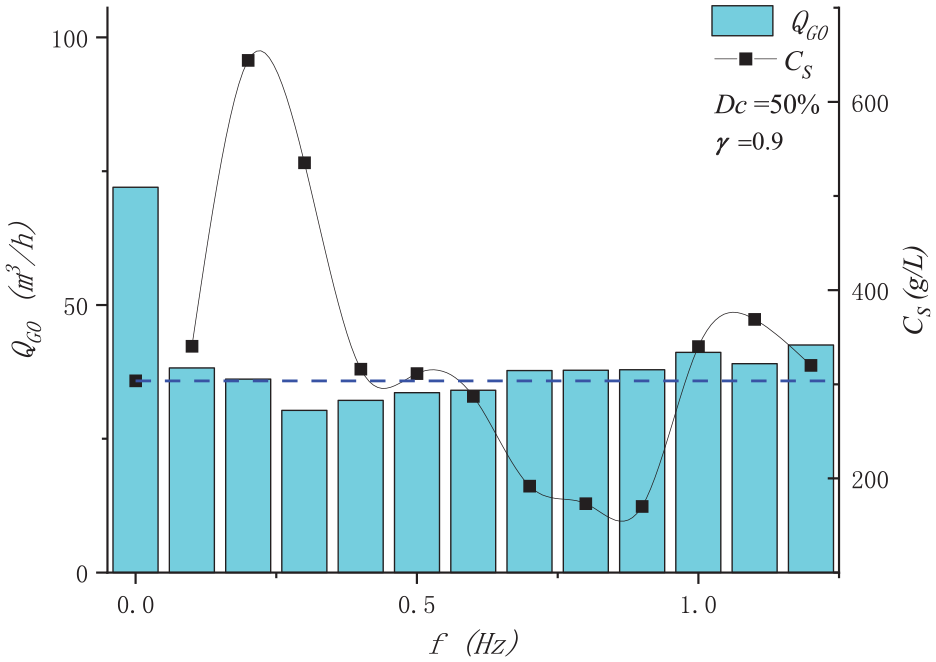
Variations of concentration with frequency.
Effect of duty cycle on sand discharge performance
Based on previous research and analysis, it is found that at 50% duty cycle (under the condition of square wave signal excitation), the operating parameters for the optimal excitation frequency are obtained in both working conditions, which provides some guiding suggestions for selecting operating parameters of the externally excited oscillating airlift pump when applied for dredging projects, but it is impossible to tell how the pulsed airflow affects the bottom flow field. In this regard, this experiment carried out an untimed continuous suspension operation. After opening the inlet valve and running the electromagnetic actuated system, the suction port of the airlift pump is relocated to 80 mm below the sand surface for continuous suspension pumping, and meanwhile, the water supply valve is opened to maintain a constant immersion rate γ = 0.9.
As shown in Figure 11, the experiment explores the effect of frequency on sand discharge of the airlift pump at 30%, 40%, 50%, 60%, and 70% duty cycles. It is obvious that at 50% duty cycle, the continuous pumping performance is basically weaker than that at other duty cycles, and only when the frequency is 0.4 Hz, its sand discharge is greater than that at duty cycles of 60% and 70%. Given the peak sand discharge at the above five duty cycles, the frequency needed is f ≤ 0.4 Hz. At duty cycles of 30% and 40%, the peak sand discharges are attained at f = 0.4 Hz, while at duty cycles of 60% and 70%, the peaks appear at f = 0.2 Hz and f = 0.1 Hz, respectively. By comparing the five peak values, the sand discharge of continuous pumping weighs 76.25 kg at 30% duty cycle. However, at the frequency of 0.4 Hz, it is self-evident that sand discharge decreases with the increase of duty cycle on the whole.

Variations of sand discharge with frequency under five various duty cycles.
In summary, the total sand discharge hits a record low under square wave excitation using untimed suspension pumping, and when the duty cycle is 30% and the frequency is 0.4 Hz, the maximum sand discharge Ms.
As shown in Figure 12, after the completion of the simulated continuous dredging experiments, in order to investigate the influence of the duty cycle on the flow field at the bottom of the suction port, the measurement of the relevant data on the pit shape (pit diameter and pit depth) was carried out, and the pit diameter and pit depth were obtained as shown in Tables 1 and 2.

Measuring diameter and depth of pit: (a) Dc = 30%, f = 1.1 Hz and (b) Dc = 40%, f = 0.8 Hz.
Pit diameter at varying duty cycles.

Bold values represent the maximum value at this duty cycle.
Pit depth at varying duty cycles.

Bold values represent the maximum value at this duty cycle.
Analyzing and comparing the data on the shape of the pits formed in conjunction with Figure 11, the pit diameters and pit depths formed by pumping within 0.1 ≤ f ≤ 0.4 Hz are generally larger than those of the continuous and other pulsating flows, whereas the disturbing effects of the square-wave signal excitation conditions are weaker than other rectangular wave excitations over the entire range of pulsations. Throughout the five waveforms of the excitation data on the airlift system, the continuous airflow is less effective than the pulsed airflow in disturbing the bottom of the suction port only in the pit shape, and only in the case of 60% duty cycle and 0.3 ≤ f ≤ 0.6 Hz, the disturbing effect of the pulsed airflow is weaker than that of the continuous airflow; when the excitation frequency is 0.1 ≤ f ≤ 0.4 Hz, the pit depth and pit diameter formed under the pulsed airflow are larger than the other excitation frequency ranges, based on which it is presumed that running the airlift pump with an excitation frequency of 0.1–0.4 Hz has a stronger mixing effect on the flow field at the bottom of the suction port.
After completing simulated continuous dredging experiments, the relevant data on the pit morphology (pit diameter and depth) are measured to explore the influence of the duty cycle on the bottom flow field of the suction port. The data on the pit diameter and depth are shown in Tables 1 and 2.
From Tables 1 and 2, it can be seen that when the frequency is f ≥ 0.4 Hz, the pit diameter and depth show an overall decreasing trend with the increase of frequency under the five rectangular wave signal excitation, while it is quite the opposite at 0 ≤ f ≤ 0.4 Hz.
According to the experimental phenomenon, under different rectangular wave excitation, the frequencies are not consistent, in order to obtain the maximum pit diameter resulting from airlift pumping. Among them, the maximum pit diameter generated by the square wave signal excitation is only 500 mm, which is much smaller than the pit diameter produced by other rectangular wave excitation. The frequency parameters required for the maximum pit diameter under the five rectangular waveform excitation are either 0.3 or 0.4 Hz. When the duty cycle is 30%, 40%, and 60%, the maximum pit diameter arising from systematic pumping averages 715.00 mm. At the duty cycle of 60% and the frequency of 0.3 Hz, the corresponding maximum pit diameter reaches 730 mm, but the pit depth is only 247 mm. However, at 30% duty cycle and the frequency of 0.4 Hz, the pit depth reaches 274 mm. As can be seen from Tables 1 and 2, under either rectangular wave signal excitation, the frequencies needed to achieve the maximum pit diameter and depth are not identical.
In conclusion, during the continuous untimed operation, the airlift pump performs poorly in agitating the bottom sediment (sand) layer under the square wave signal excitation. In contrast, the airlifting under the other rectangular wave excitation can accomplish the sand lifting after expanding the disturbance range of the pulsed airflow on the sand layer and accelerate grit fluidization. The disturbance performance peaks at 30% duty cycle and f = 0.4 Hz.
Conclusion
In this paper, an electromagnetic control system is introduced to experimentally investigate the dredging performance of the externally excited oscillating airlift pump, and the main conclusions are outlined below:
(1) To investigate the water and sand discharge performance of the externally excited oscillating airlift pump under varied duty cycles, an externally excited oscillating airlift system is designed with the introduction of rectangular wave excitation. It is found that water discharge, sharing an oscillatory relationship with duty cycle, decreases with the increase of duty cycle and peaks at 50% duty cycle; similarly, sand discharge decreases with the increase of the duty cycle and peaks at 30% duty cycle, but it has a reciprocating relationship with duty cycle.
(2) When exploring the effect of frequency on the dredging performance of the externally excited oscillating airlift pump, the pulsed airflow is found to consume less power than the traditional continuous airflow, which is of great significance for energy conservation and emission reduction in the actual dredging project; under both working conditions, the ideal frequencies for the horizontal operation and descent operation are 0.2 and 0.9 Hz, respectively. The efficiency and concentration in horizontal operation are better than those in descent operation.
(3) To further investigate the effect of excitation parameters on the airlift performance, the experiments are conducted by untimed pumping. Sand discharge under pulse excitation is much higher than that under continuous airflow. The morphological analysis of the sand pit reveals that the pulsed airflow has a stronger disturbance effect on the sand layer than the continuous airflow; under the five waveform signal excitation, the rectangular wave excitation exerts the best disturbance effect on the sand layer at the duty cycle of 30% and the frequency of 0.4 Hz.
The above results are valuable for the application of externally excited oscillating airlift pumps in river dredging projects.
Footnotes
Handling Editor: Sharmili Pandian
Declaration of conflicting interests
The author(s) declared no potential conflicts of interest with respect to the research, authorship, and/or publication of this article.
Funding
The author(s) disclosed receipt of the following financial support for the research, authorship, and/or publication of this article: This work is supported by the National Natural Science Foundation of China (grant number 52006061), the Natural Science Foundation of Hunan Province (grant number 2023JJ50088), the key R&D program of Hunan Province (grant number 2024AQ2001), the science and technology innovation Program of Hunan Province (grant number 2022RC1140).
