



Abstract
Hydraulic cartridge valves are extensively used across numerous industries, attributed to their exceptional integration and potent flow capacity. To effectively address the varied load conditions, environmental influences, and durability demands in different contexts, it is crucial for designers to optimize these valves. Currently, a significant number of scholars have undertaken invaluable research on the design optimization of cartridge valves. The objective of this paper is to propose research concepts for the design optimization of hydraulic cartridge valves by analyzing the current literature and thereby boost the performance of hydraulic cartridge valve systems. This paper adopts a mixed review method, elaborating on the literature search methodology for reviews concerning cartridge valve design optimization. The obtained results are subjected to quantitative analysis. Following this, a thorough review of the identified literature is provided, focusing on the methodology and performance concerns of hydraulic cartridge valve design optimization. Finally, the prerequisites and challenges associated with the cartridge valve design optimization approach are discussed in detail, considering aspects such as compact lightweight design, reliability enhancement, and intelligent design optimization.
Keywords
Introduction
Hydraulic cartridge valves find extensive application across various industries owing to their high integration and strong flow capacity. To effectively address diverse load conditions, environmental factors, and longevity requirements in different scenarios, designers must undertake optimization efforts for these valves. Throughout the design optimization phase, both performance and reliability should be considered, and efforts should be made to design systems with superior performance and high reliability. Designers should account for the characteristics of hydraulic components and systems, strive to streamline the design process and minimize redundant testing and manufacturing inefficiencies. Improper design can result in sub-par performance of cartridge valves, manifested in stability issues such as inadequate opening and closing behavior, shocks, and potentially accidents, leading to substantial economic losses and human casualties. Hence, optimizing the design of cartridge valves holds paramount significance.
Firstly, standardized cartridge valves facilitate mass production, and cartridge components from different manufacturers can be interchanged. Secondly, there is a wide range of options for springs, dampers, etc. in cartridge valves. Simply changing the pilot valve or replacing the control cover plate can alter or improve control performance. The above two points provide strong support for design optimization. However, it also increases the blindness of the user in the selection process due to the wide range of choices of cartridge component parameters.
Figure 1 shows the structure of a cartridge valve, which has only one damping orifice in its control cover and can be used as a check valve. The structural parameters that can be optimized include the normal size, the diameter of damping orifice, the spring stiffness, the spring preload, and the area ratio. Its non-structural parameters such as channel shape, valve port shape, chamfer, etc. can also be topologically optimized.

The structure of a cartridge valve.
Numerous scholars have carried out valuable studies on the design optimization of cartridge valves. For instance, Liu et al. conducted a comprehensive study on a hydraulic-feedback proportional throttle cartridge valve, established a detailed and accurate mathematical model, and used root locus method to study the influence of design parameters on dynamic performance. 1 Lisowski et al. optimized the structural parameters of flow control valves to maintain a constant flow rate under pressure changes by establishing mathematical models and Ansys/Fluent simulation models. 2 Li et al. proposed a method to reduce the steady-state axial flow force on the main valve core of a diverged flow cartridge proportional valve. Through a series of computational fluid dynamics (CFD) simulations, the influence of these parameters on the flow force was identified, and the optimal structure was determined based on these simulations. 3
To the best of the author’s knowledge, there is a scarcity of systematic literature reviews on this topic. Therefore, a comprehensive review of these knowledge gaps is essential to gain insight into the current state of research and challenges in hydraulic cartridge valve design optimization.
The objective of this paper is to propose research ideas for the design optimization of hydraulic cartridge valves, thereby enhancing the performance of hydraulic cartridge valve systems. The study encompasses various aspects, including: (1) A thorough discussion of the design optimization methodology for hydraulic cartridge valves, which not only entails an in-depth analysis of the valve structure’s design approach but also encompasses performance concerns. (2) Addressing the challenges and future advancements in the design optimization methodology for cartridge valves from the perspective of compact lightweight design, intelligent optimization, and reliability enhancement.
The paper is organized as follows: Section “Mixed review method” outlines the mixed review method employed in this paper, detailing the literature search methodology for reviews on cartridge valve design optimization. In this section, the obtained results are analyzed quantitatively. Section “Literature review” provides a comprehensive review of the identified literature. Section “In-depth discussion” delves into the requirements and challenges of the cartridge valve design optimization approach. The structure of the paper is illustrated in Figure 2.

Section structure and research structure.
Mixed review method
Many researchers4,5 have employed a mixed review method, integrating both literature analysis and systematic review. The aim of utilizing this mixed review method is to capitalize on the strengths of both qualitative and quantitative methods while mitigating their respective limitations. Literature analysis, a statistical method, is employed to visually represent the structure and characteristics of scientific research. Systematic reviews, on the other hand, aim to provide a comprehensive synthesis of existing research to identify knowledge gaps and anticipate future research directions. Prior to employing the mixed review method, it is crucial to clarify the purpose and conceptual boundaries of this paper. Figure 2 illustrates the complete research methodology adopted in this paper, encompassing the following five sequential steps:
Step 1: Identify the purpose of the paper (Section “Identify the purpose of the paper”).
Step 2: Establish the conceptual boundaries of the paper (Section “Establish the conceptual boundaries of the paper”).
Step 3: Collect data (Section “Data collection”).
Step 4: Conduct literature analysis (Section “Quantitative analysis”).
Step 5: Perform systematic review (Sections “Literature review” and “In-depth discussion”).
Identify the purpose of the paper
Hydraulic cartridge valves are extensively used in hydraulic systems. Ensuring the safety and optimal performance of the system necessitates optimizing its design. This paper aims to analyze the design optimization of cartridge valves, outline performance concerns in optimization, and summarize methods combining theory, simulation, and experimentation for design optimization. Future development directions, such as compact lightweight design, reliability enhancement, and intelligent design optimization – areas currently underexplored – are also discussed. This paper presents innovative insights into the design optimization of cartridge valves.
Establish the conceptual boundaries of the paper
(1) This paper focuses exclusively on cartridge valves intended for hydraulic systems using oil as the medium, excluding applications in hydropower and other systems using water as the medium. The study encompasses both two-way cartridge valves and screw-in cartridge valves.
(2) Design optimization covers several aspects: proposing new structures for cartridge valves, enhancing existing cartridge valve structures, adjusting structural parameters of cartridge valves, designing and selecting hydraulic systems where cartridge valves are the primary components, designing controllers for cartridge valve systems, arranging cartridge valve blocks and configuring hole layouts, etc.
Data collection
Initially, a widely used academic database encompassing various fields is selected, with specific search keywords identified to categorize research areas. Subsequently, the literature undergoes preliminary screening based on keywords, titles, and abstracts. This is followed by secondary screening, which consists of a thorough review of the introduction, conclusions, discussion, Figures, and full-text content to select papers for further investigation.
Literature database
Given its comprehensive coverage across journal publications and knowledge domains, this study opts for the Web of Science as the database for literature search. 6
Data collection criteria
To ensure the acquisition of high-quality and reliable research data, the preliminary data collection adheres to the following criteria:
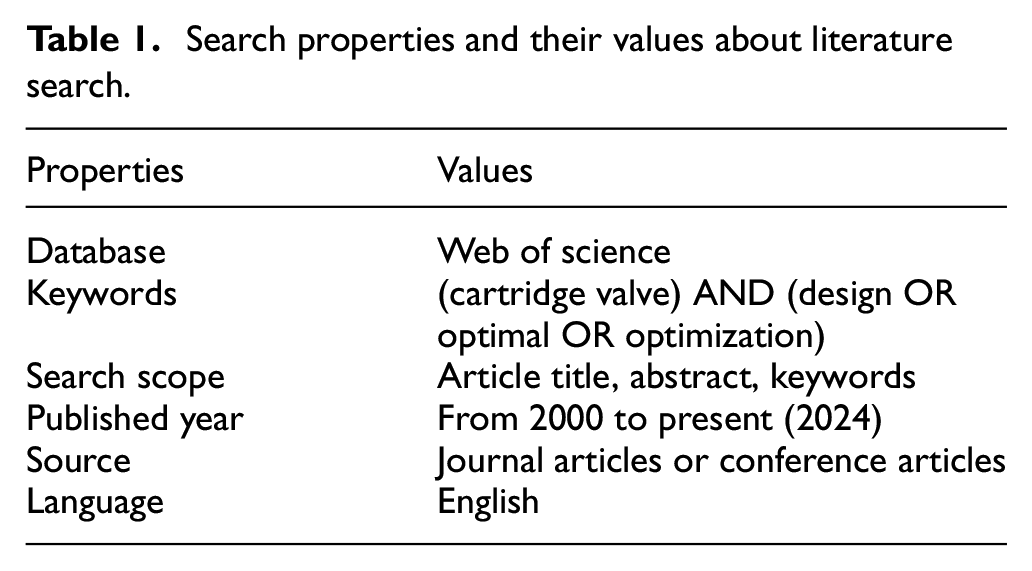
(1) Subject restriction: The primary search keywords are “cartridge valve” and “design or optimal or optimization,” focusing specifically on research aligned with the scope of this paper. The keywords are combined using the logical operator “AND.”
(2) Publication year limit: The analysis includes papers published from 2000 to the present (2024) to encompass the latest advancements in the field.
(3) Language limitation: Only English-language literature is analyzed to facilitate readability and analysis consistency.
(4) Quality restrictions: Only peer-reviewed articles from journals and international conferences are considered to ensure a rigorous and objective review process. Preprints are excluded. Table 1 outlines the search properties and their values.
Search properties and their values about literature search.
Filtering
Based on the search criteria outlined in Table 1, a total of 181 papers related to the design optimization of hydraulic cartridge valves were initially retrieved from the Web of Science core library. Upon detailed examination, it is found that many of these papers only briefly touched upon the topic of “cartridge valves.” Therefore, a thorough review of the titles, keywords, and abstracts of all 181 papers was conducted. Papers unrelated to the specific focus on the design optimization of hydraulic cartridge valves. As a result, 68 papers were retained for further analysis.
Subsequently, the remaining 68 papers were subjected to a comprehensive review, including a detailed review of their introductions, conclusions, discussions, diagrams, and other relevant content. Through this process, 42 papers were selected for inclusion in subsequent bibliometric and systematic reviews. These 42 papers refer to 42 of the 45 references at the end of this paper, except for References 4–6.
Quantitative analysis
This section presents a quantitative analysis of the selected 42 papers. Initially, we perform a statistical analysis of their publication years to discern trends and influential factors within the field of hydraulic cartridge valve design optimization. Following, we explore the sources and affiliations of these papers. Finally, we summarize the key topic areas based on the frequency of keyword occurrences to provide insight into the current research landscape.
Year of publication
The first paper on the design optimization of hydraulic cartridge valves was published in the Chinese Journal of Mechanical Engineering in 2005: In order to overcome the limitations of traditional hydraulic control system design for synthetic rubber presses, as well as the problems of high failure rate, low reliability, high energy consumption, and frequent shutdown of synthetic rubber post-processing production lines, a new hydraulic pressure system combining PC control and two-way cartridge valves was developed, and its reliability was analyzed. 7 Furthermore, it should be noted that there were three relevant papers in 2005, and only one in 2006. Apart from these four papers, there were no other papers in the decade of the 2010s. Relatively, in the past decade, there has been a continuous increase in related papers, and the trend is more obvious, indicating that more and more scholars are paying attention to the optimization design of hydraulic cartridge valves. Due to the lag in the indexing time, there are no relevant papers in 2024. The number of publications for each year is shown in Figure 3.

Year of publication.
Paper sources
As shown in Figure 4, most of the papers were published in the field of engineering. Of these 42 papers, 3 were from Advanced Materials Research, 3 were from Flow Measurement and Instrumentation, and 6 journals have published 2 papers each. Every other journal published only one paper. It can be seen that the journal publications are relatively scattered.
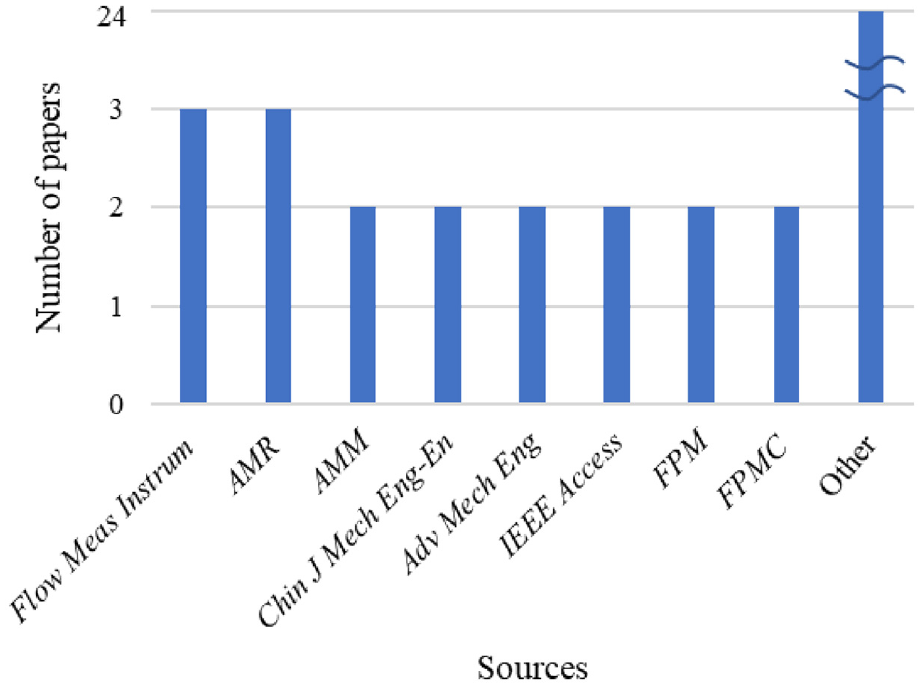
Sources of literature.
Publications distributed by country/region
An analysis was performed on the selected papers based on their author affiliation. As shown in Figure 5, out of the total 42 papers, there are 34 Chinese authors, followed by 4 British authors, followed by 2 American, and 2 Polish authors each. The remaining authors are from other countries and regions, separately (Italy, Lebanon, Germany, and South Korea). Some first authors have two mailing addresses, so the total number of statistical results is greater than 42.

Publications distributed by country/region.
Keywords
Keywords play a crucial role in understanding the research content and trends of relevant papers. The keyword statistical analysis results of these 42 articles show that there are a total of 176 unique keywords, of which 30 appear more than twice, and 15 appear more than three times. Figure 6 shows these 15 keywords, in addition, the keyword CFD appeared 13 times and the keyword carriage valve (group) appeared 11 times. From the perspective of the research object, the analysis of some key words reveals important terms such as carriage valves (group) and poppet. From a methodological perspective, these keywords rank high, including CFD, simulation, numerical simulation, AMESim, etc. From the perspective of performance concerns, analyzing these keywords shows that the top ranked ones include dynamic characteristics, stability, vibration, flow force compensation, etc. Therefore, the following text will conduct qualitative analysis from these specific perspectives.

Occurrence times of keywords.
Literature review
According to the quantitative analysis in Section “Mixed review method,” a literature review is conducted on the methodology and performance concerns of hydraulic cartridge valve design optimization.
Design optimization methods
Design optimization for hydraulic cartridge valves involves multifaceted approaches that include theoretical analysis, simulation, and experimentation.
(1) Theoretical analysis: Theoretical analysis enables optimization of the spool shape and channel design to reduce pressure drop, enhance flow rate, and improve system response speed. Theoretical analysis provides a profound understanding of the valve’s structure, working principles, and performance. It allows designers to discern how various parameters (such as spool diameter, seat shape, and sealing materials) impact valve behavior. Theoretical analysis generally includes one or several steps as follows: (1.1) Dynamic modeling: The main purpose of dynamic modeling is to describe the force and motion of hydraulic cartridge valves by establishing mathematical equations. (1.2) Frequency domain analysis: By analyzing the system’s transfer function in terms of poles and zeros, designers gain insights into the stability and dynamic characteristics of hydraulic cartridge valves. Root locus plot illustrates how the characteristic root move as parameters vary, while by using the Bode plot, the magnitude and phase of the system gain can be observed at different frequencies, thus determining the stability of the system. In hydraulic cartridge valve design, these frequency domain analyses can help optimize control system stability and dynamic response. For example, Yao et al. conducted an investigation into the dynamic behavior of a pilot-operated counterbalance cartridge valve capable of operating at a flow rate of approximately 2000 L/min. They utilized pole-zero plots to elucidate the influence of the control cavity volume, hydraulic resistance on the pilot line, and the counterbalance valve pilot area ratio on system stability, as shown in Figure 7(a). Ultimately, through optimization of these parameters, the dynamic performance of the system under consideration was enhanced. Subsequent experiments verified the effectiveness of the method. 8 (1.3) Material mechanics analysis: Apply material mechanics theory to evaluate valve material strength, wear resistance, and fatigue life. Selecting the most suitable material extends the valve’s longevity and reliability. (1.4) Fluid mechanics analysis: Utilize fluid mechanics theory to examine internal flow characteristics within hydraulic cartridge valves. This includes assessing pressure losses, velocity distributions, and hydraulic shocks.
(2) Simulation: Simulation is mainly divided into the following two categories: (2.1) Simulation of concentrated parameter models: Create a concentrated parameter model of the hydraulic cartridge valve using simulation software (such as AMESim). Parameters such as spool diameter, seat shape, and spring stiffness are varied to evaluate performance across different design scenarios. Simulation predicts valve response speed, flow characteristics, and pressure losses. For instance, Xie et al. proposed a novel bidirectional proportional throttle valve with a two-dimensional cartridge structure. The effects of the inclination angle, width, and initial overlapping height of the oblique slot and rectangular slot on the dynamic response of the valve were explored by AMESim simulation in Figure 7(c), and appropriate structural parameters were selected to design and manufacture the prototype valve. Subsequent experiments confirmed that the method is effective. 9 (2.2) CFD simulation: Use CFD software (such as ANSYS/Fluent) to simulate and analyze internal flow within the hydraulic cartridge valve. Predict pressure distribution, velocity profiles, and hydraulic losses. Optimizing valve structure and channel design enhances fluid transport efficiency and overall system performance. For example, Filo et al. introduced a research focusing on an adjustable check valve. They proposed a novel solution involving modifications to the geometry based on CFD simulation results. The primary research objective was to optimally shape and arrange holes and flow channels within the body, situated between the cartridge valve and the connecting plate. Through CFD analyses as shown in Figure 7(b), they sought to minimize flow resistance. The method was validated by subsequent experiments. 10
(3) Experimental validation: (3.1) Performance testing: Design and conduct practical performance tests on the hydraulic cartridge valve, including flow characteristic testing, pressure response testing, and seal performance testing. These experiments validate the results of theoretical analysis and simulation. (3.2) Durability testing: Evaluate valve durability and stability in real-world operating conditions through long-duration continuous running tests or cyclic load tests. (3.3) Environmental adaptability testing: Conduct experiments under varying temperature, humidity, or pollution conditions to assess valve performance and reliability across different environmental scenarios. The experimental data validates the theoretical analysis and simulation results and guides the final optimized design.
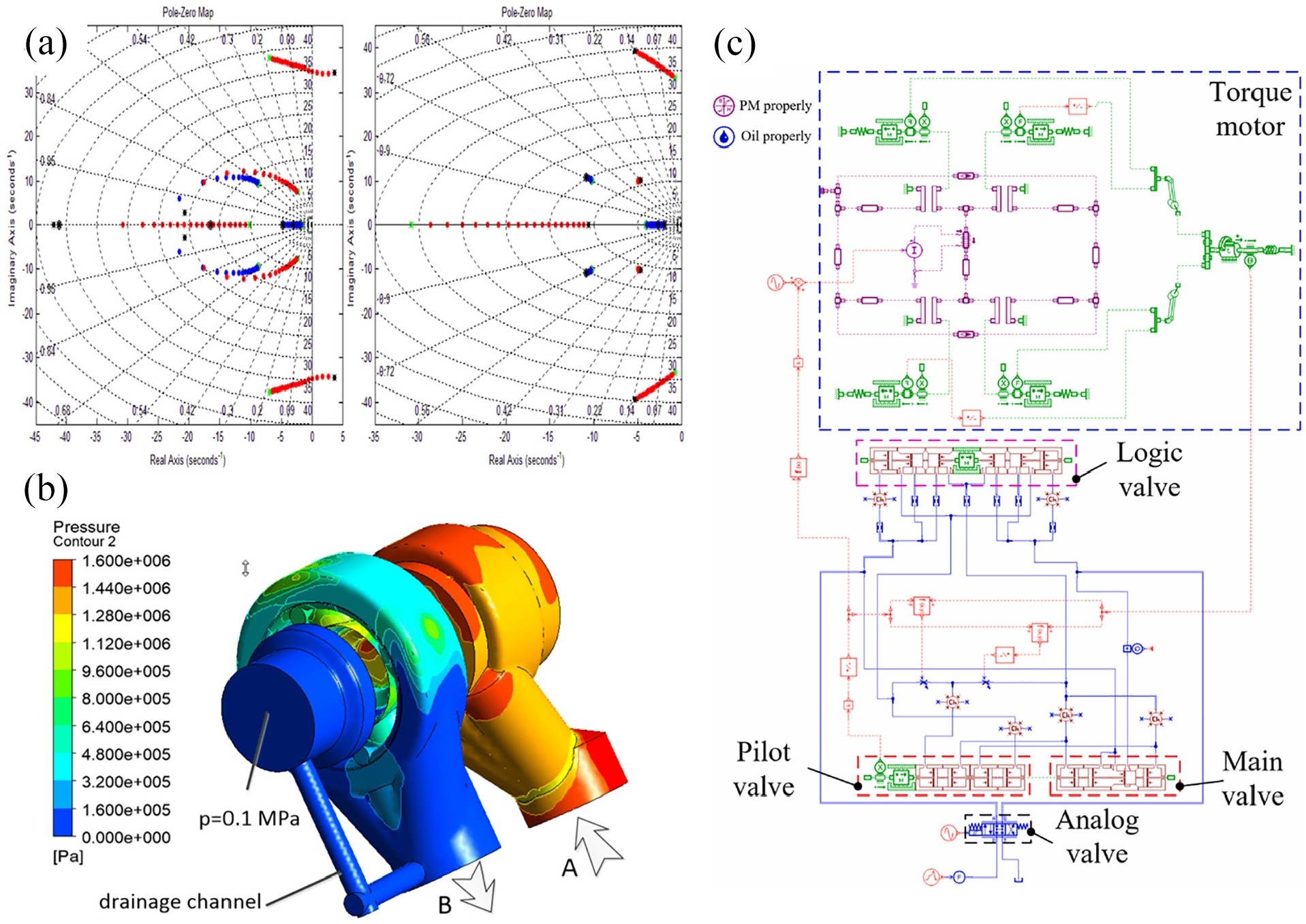
Design optimization based on (a) the pole-zero plot, (b) CFD, and (c) AMESim.
The characteristics, advantages, and disadvantages of different design optimization methods are compared in Table 2.
Characteristic comparison of design optimization methods.

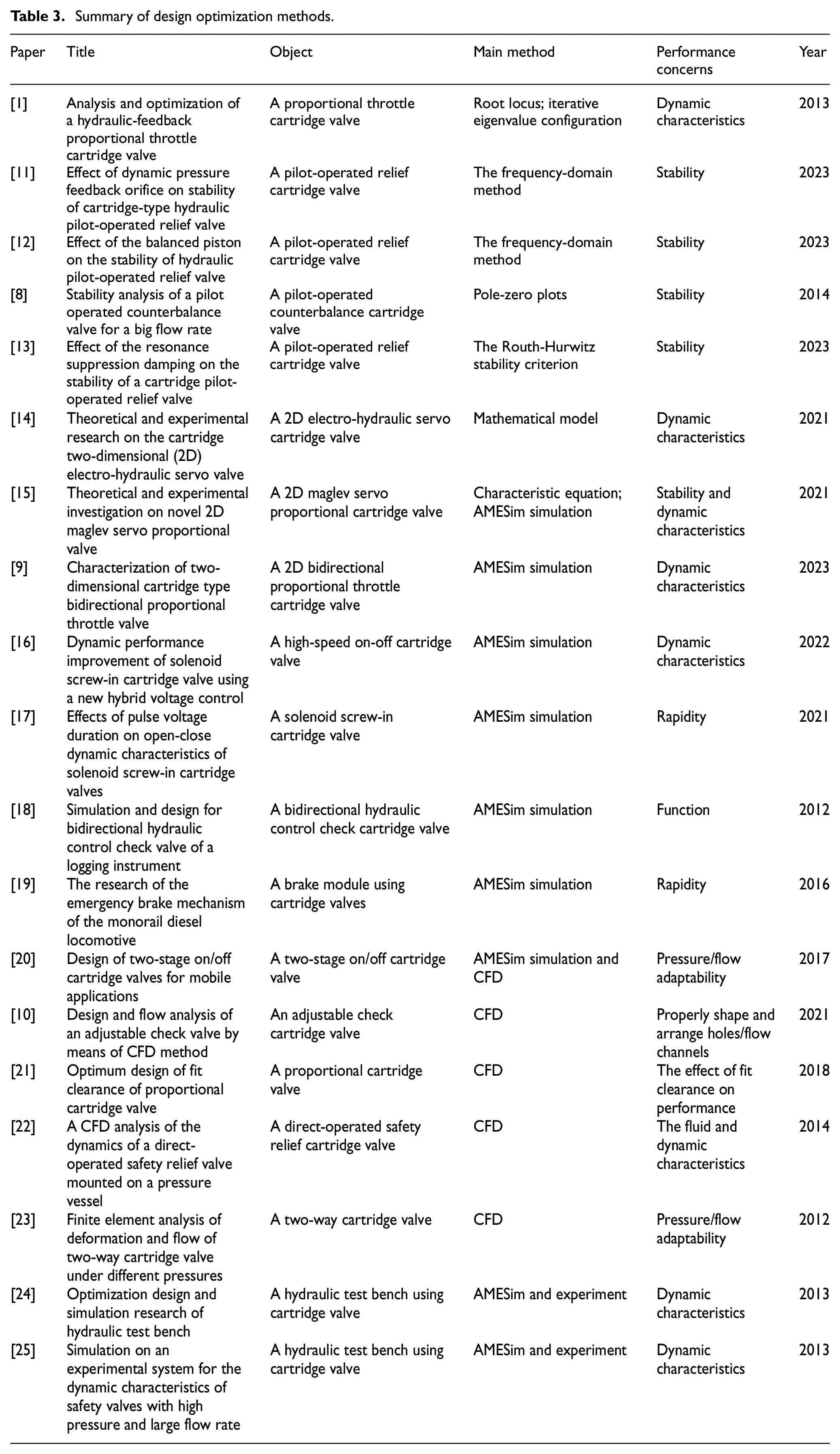
By integrating theoretical analysis, simulation, and experimental studies, we can comprehensively optimize hydraulic cartridge valve designs to achieve optimal performance, efficiency, reliability, and environmental adaptation. Table 3 summarizes the design optimization methods of some papers.
Summary of design optimization methods.
Performance concerns
Optimizing the design of cartridge valves involves enhancing their performance, reliability, and operational efficiency through improvements in structural design, materials, and control strategies. These optimizations are targeted at meeting specific application needs while minimizing energy consumption, leakage, and maintenance costs, thereby enhancing overall system efficiency. Within hydraulic systems that prioritize high performance, efficiency, and durability, cartridge valves serve as pivotal control components. Precise engineering design and innovative technology significantly elevate cartridge valve performance metrics and contribute to improved system reliability and operational efficiency.
The optimization of hydraulic cartridge valve design encompasses several critical facets:
(1) Performance optimization: This involves enhancing stability, rapidity, dynamic characteristics, etc. In the theoretical, simulation, or experimental optimization of hydraulic cartridge valve designs presented in Section “Design optimization methods,” their performance concerns are mainly focused on stability and dynamic properties. In fact, some scholars have conducted detailed research on issues such as vibration and noise, steady-state flow force, etc.
The stability metrics include the phase margin and amplitude margin of the Bode plot, 12 the pole position of the pole-zero plot, 8 the Routh-Hurwitz stability criterion, 13 etc. The dynamic characteristic metrics can be step response speed 9 or overshoot, while the rapidity metrics often focuses more on valve switching time, 17 but the two are similar. The pressure/flow adaptability metrics often focuses on pressure loss, valve body deformation, and stress concentration under different pressures/flows.20,23 Research on noise focuses on reducing the negative effects of cavitation, vibration, etc. by improving the structure of valves (such as adding noise reduction slots, adjusting jet angles, etc.).26,28 The research on flow force aims to reduce the impact of flow force on the valve core by adjusting the valve port structure and parameters. 27
(2) Size and weight optimization: With contemporary engineering machinery increasingly demanding compactness and reduced weight, designers strive to maximize the lightweight and space-efficient attributes of hydraulic cartridge valves while preserving structural robustness.
(3) Energy efficiency and environmental considerations: Energy efficiency during valve operation is pivotal in design considerations. Minimizing energy losses aids in resource conservation and reduces environmental impact. For example, Lisowski et al. used Ansys/Fluent simulations to reduce pressure loss in a cartridge flow control valve. 2
(4) Integration and advanced features: Modern hydraulic cartridge valve designs frequently integrate additional functionalities. Furthermore, features like sensor monitoring, remote control, and automated adjustments are incorporated to address evolving operational requirements.
In addition to the performance concerns mainly focused on stability and dynamic characteristics in Table 3, Table 4 supplements issues such as steady-state flow force, vibration, and noise. Table 4 also involves optimization design methods, so Tables 3 and 4 can complement and contrast each other.
Summary of performance concerns.

While some aspects are mentioned in Section “Literature review,” they are not mentioned in Tables 3 and 4. This is mainly due to insufficient relevant literature, which is also the focus of in-depth discussion in Section “In-depth discussion.”
In-depth discussion
In Section “Literature review,” the literature review underscores several domains where additional research is merited. Specifically, we pinpoint gaps in the following areas:
(1) Compact lightweight design: The objective of compact lightweight design is to reduce the dimensions and weight of hydraulic cartridge valves while maintaining or improving performance. Strategies for achieving this goal include: (1.1) Material selection: Utilizing lightweight, high-strength materials (such as titanium alloys or advanced aluminum alloys) as alternatives to traditional steel. This substitution decreases the overall weight. (1.2) Internal structural optimization: Streamlining the internal design by minimizing unnecessary components, simplifying flow paths, and reducing pressure losses. These improvements enhance hydraulic fluid efficiency. (1.3) Modular design: Implementing modular components that allow for quick replacement or upgrades based on specific application requirements. This approach not only reduces maintenance costs, but also minimizes system downtime. For example, Hassani used additive manufacturing methods to design pressure reducing valves. 39 As of now, there are relatively few articles in this field (only Hassani 39 ).
(2) Reliability enhancement: Enhancing the reliability of hydraulic cartridge valves is critical for their long-term performance. Key methods include: (2.1) Sealing performance: Selecting high-quality sealing materials and precision machining of sealing surfaces to minimize leaks and extend service life. (2.2) Intelligent control and integration: Incorporating sensors, microprocessors, and electromagnetic actuators for smart control. This approach improves fault diagnosis capability. For instance, Chengyu and Jingyi conducted reliability-based optimization design on the hydraulic control system of synthetic rubber press. 7
(3) Intelligent design optimization: Intelligent design optimization is a holistic approach that employs computer simulations, optimization algorithms, and artificial intelligence techniques to attain more efficient, reliable, and eco-friendly product designs. This includes structural parameter optimization, material selection, fluid dynamics analysis, thermal management, and corrosion resistance. Intelligent design optimization methods spur innovation, culminating in both compact lightweight hydraulic cartridge valves and enhanced reliability. These advancements contribute to more efficient, environmentally friendly products in the realm of hydraulic systems. For instance, Xi et al. proposed an optimization method for the hydraulic system. This method can automatically obtain the optimal parameters of the cartridge check valve unit in a multi-pump hydraulic system with subpar performance. Evaluation functions are constructed for three indicators: dynamic performance, steady-state performance, and reliability of the system. 40 Wang et al. used the MOGA-II algorithm and a multi-objective optimization method based on regression analysis to analyze the influence of structural parameters of the two-stage gas pressure regulator’s I-stage structure on output pressure. 41 In the future, the use of surrogate models can be considered to improve iterative optimization efficiency. 42 Among them, flow mapping has been discussed by multiple scholars.43–45 In addition, in the future, a combination of the three can be considered, using intelligent optimization as a means to achieve iterative optimization with the goals of performance optimization, reliability optimization, and lightweight design.
Conclusion
Hydraulic cartridge valves, renowned for their superior integration and robust flow capacity, are widely employed across a broad spectrum of industries. Given the diverse load conditions, environmental factors, and durability requirements in various scenarios, it is crucial for designers to optimize these valves. To date, numerous studies on cartridge valve design optimization have been conducted by numerous scholars. The aim of this paper is to put forth research concepts for the design optimization of hydraulic cartridge valves, thereby augmenting the performance of hydraulic cartridge valve systems. This paper employs a mixed review method, elaborating on the literature search methodology for reviews on cartridge valve design optimization. The obtained results are analyzed quantitatively. The comprehensive research methodology adopted in this paper comprises the following five sequential steps: (1) Identify the purpose of the paper; (2) Establish the conceptual boundaries of the study; (3) Collect data; (4) Conduct literature analysis; (5) Perform systematic review. Subsequently, an exhaustive review of the identified literature is presented, focusing on the methodology and performance considerations for hydraulic cartridge valve design optimization. Consistent with the quantitative analysis in Section “Mixed review method,” a literature review is conducted on the methodology and performance concerns of hydraulic cartridge valve design optimization in Section “Literature review.” Design optimization for hydraulic cartridge valves entails a multifaceted approach that includes theoretical analysis, simulation, and experimentation. By amalgamating theoretical analysis, simulation, and experimental research, we can holistically optimize hydraulic cartridge valve designs, thereby achieving optimal performance, efficiency, reliability, and environmental adaptability. Finally, the requirements and challenges of the cartridge valve design optimization approach are discussed in depth, considering aspects such as compact lightweight design, reliability enhancement, and intelligent design optimization.
Footnotes
Handling Editor: Aarthy Esakkiappan
Declaration of conflicting interests
The author(s) declared no potential conflicts of interest with respect to the research, authorship, and/or publication of this article.
Funding
The author(s) disclosed receipt of the following financial support for the research, authorship, and/or publication of this article: The authors acknowledge the support by the Foundation for Innovative Research Groups of the National Natural Science Foundation of China (grant no. 51821093).
Data availability
The data used to support the findings of this study are included within the article and further data or information can be obtained from the corresponding author upon request.
