



Abstract
A new improved body-centered cubic (BCC) lattice structure is proposed to improve the load capacity by adding a body-centered ball to reduce stress concentrations. The new lattice structure, named as body-centered cubic with balls (BCC-B) lattice structure, is characterized by lightweight, compactness, large load capacity, radiation resistance, and corrosion resistance, which can be widely used for vibration isolation in various areas such as ships, aerospace, nuclear facility, and so on. Theoretical model of BCC-B lattice structure is established. The influences of structure parameters of BCC-B lattice structure are analyzed by both theoretical and numerical methods. Both BCC and BCC-B lattice structure samples are prepared by using Ti-6Al-4V, of which the stiffness, rated load capacity, and yield strength are tested and compared detailly. Compared with the BCC lattice structure, the BCC-B lattice structure shows a 31.58% increase in rated load capacity, a 10.15% decrease in natural frequency, and a 29.53% increase in yield strength. This study might provide some insights for the development of vibration isolators with large load and low stiffness for applications in extreme environmental conditions such as limited space, nuclear radiation, and high temperatures in future.
Keywords
Introduction
Vibration isolation is an important measure to ensure the stable operation of instruments and equipment. Commonly used vibration isolators include air spring vibration isolators,1–4 laminated rubber isolators, 5 steel spring isolators,6,7 wire rope isolators,8,9 and metal rubber vibration isolators,10,11 which have been widely used in the fields of precision instrumentation, vehicles, transportation, and aerospace. Air spring vibration isolators and laminated rubber isolators are made of rubber, that has poor anti-aging,12,13 anti-radiation, 14 and anti-corrosion performance. Steel spring isolators, wire rope isolators, and metal rubber vibration isolators are all-metal isolators, which are characterized by anti-aging, anti-radiation, and anti-corrosion. However, steel spring isolator has a large volume when it realizes a large load, and wire rope isolator is easy to be destroyed when it is subjected to tension. Moreover, metal rubber vibration isolator is made of braided metal wire by stamping. It is difficult to establish an actual theoretical model and simulation model to guide the design and has a vibration isolation effect only in the direction of stamping. In special fields such as aerospace and ships, vibration isolators are difficult to replace due to the large volume and mass of the equipment that need to be isolated and the limited installation space. Therefore, the vibration isolators are required to have the characteristics of large load, low stiffness, strong anti-radiation ability, and strong anti-aging ability. Moreover, the vibration isolators are frequently necessitated to possess a lightweight and compact design.
Lattice structures have attracted extensive attention from scholars because of their lightweight, large specific stiffness, high specific strength, and good energy absorption effect.15–22 In addition, according to the Bragg scattering principle, lattice structures can generate frequency bandgaps, which always occur at high frequencies due to the limitation of the Bragg condition.23,24 To achieve low frequency vibration isolation, lattice structures are usually used to provide high stiffness for static support, while an additional structure is used to achieve the effect of dynamic vibration isolation. For example, a scheme of the lattice structure combined with other vibration isolators in series is proposed to achieve vibration isolation effect. 25 Several structures are introduced to reduce the lower frequency vibration by adding locally resonant microstructures to the lattice structure.25–29 However, the researches on bandgaps are often focused on vibration and noise reduction in specific frequency band.
Moreover, the use of lattice structure as the elastic element of vibration isolator is also a good choice due to its simple structure, single form of deformation, and obvious isotropy. Syam et al. designed several different lattice structures based on BCC lattice structure, and analyzed the load capacity and vibration isolation performance of different lattice structures through finite element simulation and experiment. When using a lattice structure as an elastic element of vibration isolator, a balance usually needs to be struck between stiffness and yield strength. 30 Azmi et al. fabricated BCC lattice structures with different structure parameters by using acrylonitrile butadiene styrene (ABS) materials and analyzed the effects of cell size and beam diameter on vibration isolation performance. 31 Current research predominantly utilizes samples constructed from plastic to validate the theory, but plastics have a limited carrying capacity. Furthermore, the prevalent BCC lattice structure is plagued by stress concentrations, constraining its load capacity.32,33
Toward the need for a large load capacity, an improved BCC lattice structure is proposed. This design aims to provide a large load capacity while also ensuring effective isolation against low frequency vibrations. This paper is organized as follows. Section “Design concept of BCC-B lattice structure for vibration isolation” introduces the design concept of the BCC-B lattice structure. Section “Theoretical modeling and numerical simulation” establishes the theoretical models for predicting the stiffness and maximum load capacity of the BCC-B lattice structure. Additionally, the influences of different materials and structure parameters on the mechanical properties and vibration isolation performance of the BCC-B lattice structure are analyzed. Section “Fabrication and test of BCC and BCC-B lattice structure samples” describes the fabrication and test of the samples of BCC and BCC-B lattice structures. Section “Results and discussion” is mainly about the test results and discussion, and the conclusions are summarized in Section “Conclusion.”
Design concept of BCC-B lattice structure for vibration isolation
For a single-degree-of-freedom vibration isolation system, where m, k, and c are mass, stiffness, and damping ratio respectively, vibration transmissibility (T) can be expressed as

where
As is known, the system is capable of isolating vibrations that exceed
For BCC lattice structures, the stress concentration phenomenon, which always occurs at the nodes, is one of the key factors limiting their load capacity. The simulation of mechanical properties of BCC lattice structure is datiled in supplemental material. In this paper, BCC lattice structure is locally reinforced by adding balls at the nodes to reduce stress concentrations and thus significantly increase the load capacity without overly affecting the stiffness. In this way, the vibration isolation effect of lattice structures with large load capacity is improved. The principle is shown in the Figure 1, in which (a) and (b) are the 3D models of the BCC and BCC-B lattice structures, respectively.

3D models of (a) BCC and (b) BCC-B lattice structures.
Theoretical modeling and numerical simulation
Elastic modulus of BCC-B lattice structure
For the BCC-B lattice structure, only a single beam can is taken for mechanics property analysis, of which the parameters are shown in Figure 2. The incorporation of balls at nodes mitigates the stress concentration effect, which yields a distance, denoted as “a,” between the force and the bending moment. Empirical evidence suggests that this distance is approximately equivalent to

Parameters of simplified single beam.
Then the lever arm for shear force can be expressed as:

where l is the lever arm for shear force (mm), L is the side length of unit cell (mm), d is beam diameter (mm), and b is ball diameter (mm).
In this study, given M1 and M2 represent bending moments, N1 and N2 denote axial forces, F1 and F2 indicate shear forces, with the assumption that these components are consistent across all beams. The bending moments at the cross section are:

where x is the distance of any cross section to F1.
Assuming no rotation of the beam section, the maximum bending moment can be obtained as follows:


From Figure 2, the angle between the beam and the horizontal plane can be calculated as follows:

The single beam is simplified as a cantilever beam, and the axial force effect is neglected because the axial force has little effect on inner stress in the cross section. The simplified beam model is shown in Figure 3.
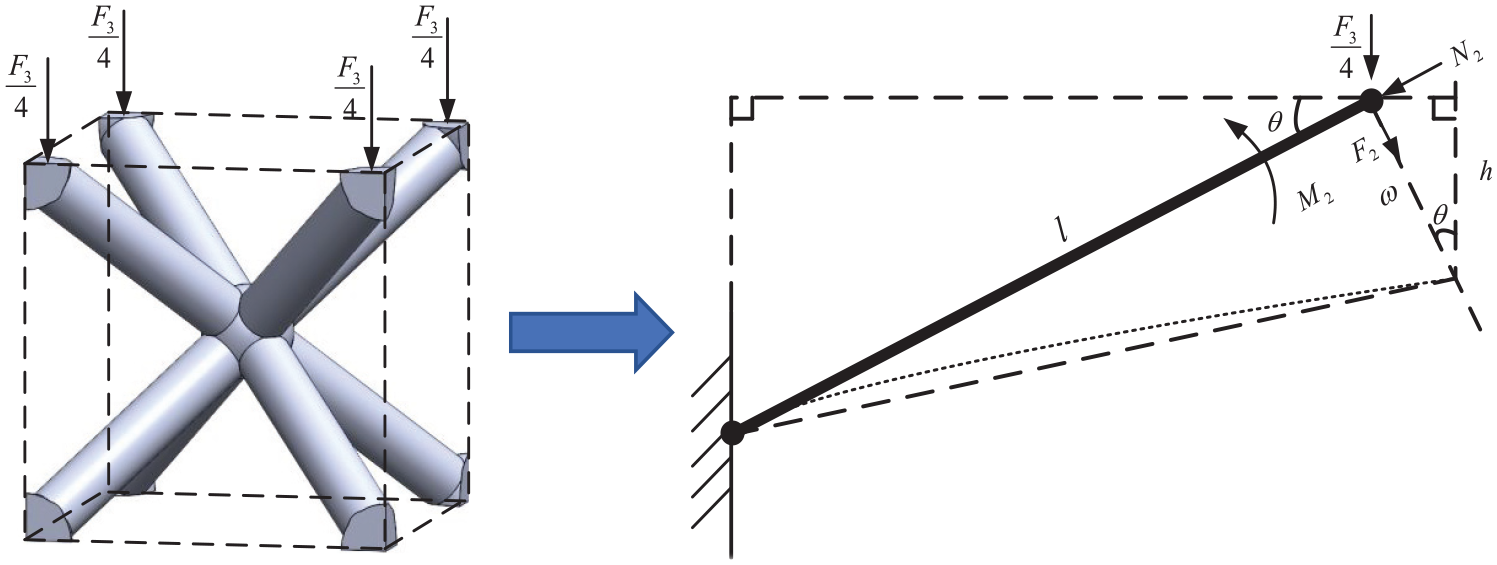
Simplified beam model.
The following relationship can be obtained:


where

where
The shear force (F) can also be expressed as:

According to the Timoshenko beam model, the beam equation can be expressed as:

where M is the bending moment of the beam (kN m),
Substituting equation (3) into equation (10) and using the boundary condition
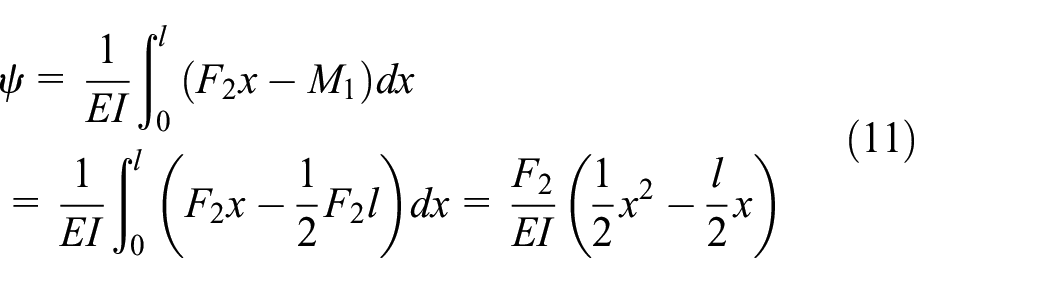
The neutral axial slope of the beam is expressed as:

where F2 is the shear force acting on the beam (N), Q
2
is the shape factor, which is taken as 1/1.1 for beams with circular cross sections, G is the shear modulus (Pa),
Substituting equation (11) into equation (12) yields the first-order differential equation for the beam deflection:

Combined with the boundary conditions

When x = 0, the maximum deflection at the free end of the beam is:

The initial elastic modulus of BCC-B lattice structure can be derived as follows:

Initial yield strength of BCC-B lattice structure
Assuming that all beams undergo the same uniform compression and bending, fully plastic moment concept is used to predict the overall yield strength of BCC-B lattice structure. Considering only bending moment effect, and when the beam undergoes plastic damage, beam bending moment (M) is equal to full plastic bending moment (M0). For the circular hinge, full plastic bending moment (M0) of bilinear materials is expressed as:

where
Substituting

where
From equations (16) and (18),

Stiffness and maximum load capacity of BCC-B lattice structure
Stiffness is defined as:

where K′ is the stiffness of the structure, F is the constant force acting on the structure, and
Figure 4 is the schematic diagram of BCC-B lattice structure. From Figures 3 and 4, the following relationship can be obtained:



Schematic diagram of BCC-B lattice structure.
Substituting equations (20) and (21) into equation (22) gives:

where n1 is the arrayed number of unit cells in the x-direction, n2 is the arrayed number of unit cells in the y-direction, and n1n2 is the number of unit cells in one layer. n3 is the arrayed number of unit cells in the z-direction, that is, the number of layers of unit cells.
Combining equations (7) and (8) gives:

where K′ is the stiffness of BCC-B lattice structure (kN/m), L is the side length of unit cells (mm), and E* is the initial elastic modulus of BCC-B lattice structure (MPa).
The maximum load capacity is:

Influences of different materials and structure parameters on mechanical property and vibration isolation performance of BCC-B lattice structure
Influences of different material parameters
According to equations (16) and (24), elastic modulus E and Poisson’s ratio v of materials are factors that affect the stiffness of BCC-B lattice structure. To analyze the influences of different materials on the stiffness, maximum load capacity, and vibration transmissibility of the BCC-B lattice structure, the structure parameters of BCC-B are taken as: n1n2n3 = 6 × 6 × 6, d = 1.5 mm, b = 2.5 mm, and L = 10 mm.
Figure 5 shows the influences of material elastic modulus E on the stiffness of the BCC-B lattice structure under different Poisson’s ratios. It can be seen that the stiffness of the BCC-B lattice structure increases linearly with the increase in the elastic modulus E of the material, while the Poisson’s ratio has little effect on the stiffness of the BCC-B lattice structure.

Influence of E on stiffness at different Poisson’s ratios.
According to equations (19) and (25), the yield strength influences the maximum load capacity of the BC-B lattice structure for different materials. Figure 6 illustrates the effects of yield strength on the maximum load capacity of the BCC-B lattice structure. As observed from Figure 6, the maximum load capacity of the BCC-B lattice structure increases with the yield strength of the material.
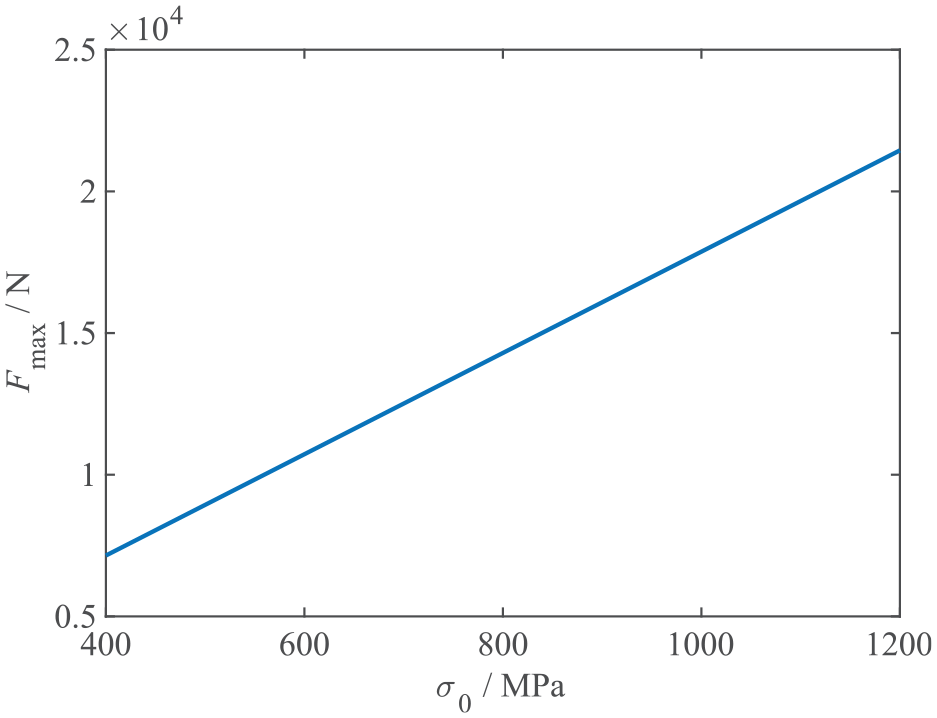
Influences of
When analyzing the vibration isolation performance of a BCC-B lattice structure, it is sufficient to consider the effects of the elastic modulus and yield strength on the vibration transmissibility of the BCC-B lattice structure, as Poisson’s ratio has a minimal impact on its stiffness.
Figure 7 illustrates the variation of vibration transmissibility with the elastic modulus of materials. As the elastic modulus increases, the peak frequency of vibration transmissibility also increases. Therefore, to achieve effective low-frequency vibration isolation, materials with a low elastic modulus should be selected whenever possible. During the analysis, the yield strength

Influences of E on vibration transmissibility.
Figure 8 shows the influences of yield strength

Influences of
In summary, to meet the requirements for large load capacity and low stiffness vibration isolation of large equipment in extreme environment, the material with a relatively low elastic modulus and a relatively high yield strength should be selected as the base material for the BCC-B lattice structure.
Influences of structure parameters
In this section, the effects of structure parameters on stiffness and maximum load capacity of BCC-B lattice structure are analyzed by both theoretical and numerical methods. Figure 9(a) shows the boundary conditions of the BCC-B lattice structure, where the lower surface of the lower cover plate is fixed, and the force is loaded onto the upper surface of the upper cover plate. Figure 9(b) presents the Von-Mises stress nephogram of the BCC-B lattice structure.

(a) Boundary conditions and (b) Von-Mises stress nephogram.
Ti-6Al-4V is selected as the base material of the lattice structure due to its characteristics of anti-radiation, anti-aging, small elastic modulus, and high yield strength. Its main parameters are shown in the Table 1.
Main parameters of Ti-6Al-4V.

Influences of side length of unit cells (L)
To analyze the influences of side length of unit cells (L) on stiffness and maximum load capacity of BCC-B lattice structure, both the simulation and theoretical calculation are conducted with n1n2n3 = 6 × 6 × 6, d = 1.5 mm, b = 2.5 mm, and L = (6:2:20) mm. The results are shown in Figure 10.

Influences of L on mechanical property: (a) influence on stiffness and (b) influence on maximum load capacity.
As illustrated in Figure 10, the simulation results agree well with the theoretical results. When d = 1.5 mm, both the stiffness and maximum load capacity progressively diminish as L increases, which necessitates a balance between the stiffness and load capacity of the BCC-B lattice structure when utilized for vibration isolation. As L extends, particularly nearing 20 mm, the stiffness remains largely constant, while the load capacity markedly decreases. Consequently, to maintain the load capacity, it is imperative that L does not exceed 20 mm. Moreover, when L falls between 6 and 10 mm, both the stiffness and load capacity significantly surpass those within the range of 10–20 mm. Although this allows the BCC-B lattice structure to achieve a larger load capacity, its low frequency vibration isolation performance is constrained. Therefore, to ensure optimal low frequency vibration isolation performance of the BCC-B lattice structure, it is essential to maintain L ≥ 10 mm. Therefore, when utilizing BCC-B lattice structure for vibration isolation, it is observed that if d = 1.5 mm, L falls within a range of 10–20 mm, that is, the value of d/L should be maintained an optimal range of 0.075–0.15.
The influences of side length L of unit cells on the vibration isolation performance of BCC-B lattice structure is analyzed using equation (1), as shown in Figure 11 where Lt denotes the theoretical result and Ls denotes the simulation result. In this analysis, damping ratio

Influences of L on vibration transmissibility.
Figure 11 reveals that the resonance peak of the vibration transmissibility shifts to a lower frequency as L increases. This shift indicates that the system’s initial isolation frequency gradually decreases, enabling the isolation of lower-frequency vibrations. Furthermore, the theoretical and simulation results show good agreement.
Influences of beam diameter (d)
To examine the influences of beam diameter (d) on the stiffness and maximum load capacity of BCC-B lattice structure, both the simulation and theoretical calculation are executed with parameters n1n2n3 = 6 × 6 × 6, L = 10 mm, b = 2.5 mm, and d = (0.9:0.2:1.5) mm. The results are depicted in Figure 12.

Influences of d on mechanical property: (a) influence on stiffness and (b) influence on maximum load capacity.
Figure 12 illustrates that both the stiffness and maximum load capacity gradually increase as d increases. The theoretical values for stiffness and maximum load capacity align closely with the simulation results.
Figure 13 shows the change curve of vibration transmissibility with d. In Figure 13, dt is the theoretical result and ds is the simulation result. It indicates that the frequency corresponding to the resonance peak gradually increases with the increase of d. This phenomenon occurs because although the maximum load capacity increases with d, the increase in load capacity is smaller compared to the increase in stiffness.

Influences of d on vibration transmissibility.
Influences of ball diameter (b)
As depicted in Figure 2, the threshold b0 for the transition of ball diameter from a BCC lattice structure to a BCC-B lattice structure can be calculated:

Therefore, in this section, when d = 1.5 mm, the threshold

Influences of b on mechanical property: (a) influence on stiffness and (b) influence on maximum load capacity.
As shown in Figure 14, stiffness and maximum load capacity exhibit an overall increasing trend with the increase of b, which agrees with theoretical predictions. However, when b = 2.7 mm, the stiffness and maximum load capacity decrease sharply, stiffness and maximum load capacity increase with the further increase of b. The reason for this phenomenon is that with the increase of b, the original deformation mechanism and failure form of BCC-B lattice structure are changed. Therefore, the ball diameter b should not exceed 2.7 mm within the parameters considered.
As the ball diameter increases from 2.1 to 2.7 mm, the resonance peak of the vibration transmissibility gradually shifts to the right, as shown in Figure 15 where bt denotes the theoretical result and bs denotes the simulation result. This shift indicates that the initial isolation frequency increases with the ball diameter b. The primary reason is that the increase in stiffness during this process is greater than the increase in maximum load capacity.

Influences of b on vibration transmissibility.
Influences of number of unit cells in one layer (n1n2)
To study the influences of number of unit cells in one layer (n1n2) on stiffness and maximum load capacity of BCC-B lattice structure, taking the number of unit cells in one layer n1n2 = 6 × 5, 6 × 6, and 6 × 7, respectively, simulation and theoretical calculations are conducted with n3 = 6, L = 10 mm, d = 1.5 mm, and b = 2.5mm. The results are presented in Figure 16.

Influences of n1n2 on mechanical property: (a) influence on stiffness and (b) influence on maximum load capacity.
Figure 16 illustrates the results of both the simulation and theoretical calculations, demonstrating a strong congruence between the two. Figure 16(a) shows that the stiffness increases gradually with the increase of n1n2. Similarly, Figure 16(b) shows that the maximum load capacity of the structure increases gradually with the increase of n1n2.
From equations (22) and (24), the number of unit cells in one layer (n1n2) does not affect the natural frequency, which is consistent with the theoretical curves in Figure 17. In the figure, (n1n2)t denotes the theoretical result and (n1n2)s denotes the simulation result. Simulation results show that n1n2 also basically does not affect the natural frequency. Although there are minor differences between the theoretical and simulation results, these do not affect the overall analysis or the conclusions drawn from the laws.

Influences of n1n2 on vibration transmissibility.
Influences of number of layers of unit cells (n3)
This study investigates the influences of number of layers of unit cell (n3) on the stiffness and maximum load capacity of BCC-B lattice structure. Specifically, considering three different values for n3: 5, 6, and 7, both simulation and theoretical calculations are conducted under the conditions of n1n2 = 6 × 6, L = 10 mm, d = 1.5 mm, and b = 2.5 mm. The results are presented in Figure 18.

Influences of n3 on mechanical property: (a) influence on stiffness and (b) influence on maximum load capacity.
As illustrated in Figure 18, as n3 increases, there is a corresponding decrease in the stiffness. However, the maximum load capacity remains consistent. The simulation outcomes for both stiffness and maximum load capacity align closely with theoretical predictions.
In Figure 19, n3t denotes the theoretical result and n3s denotes the simulation result. Figure 19 shows that although there is a small difference between the theoretical and simulated values of the natural frequency, the overall trend is consistent: the natural frequency gradually decreases with the increase of n3.

Influences of n3 on vibration transmissibility.
Fabrication and test of BCC and BCC-B lattice structure samples
Fabrication of lattice structure samples
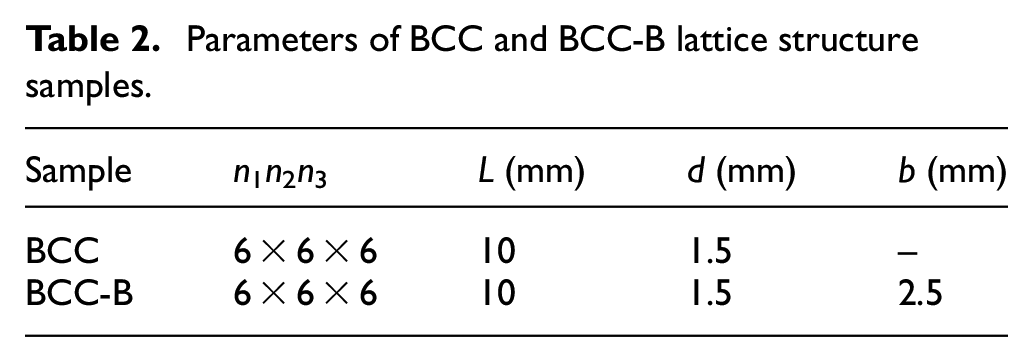
To compare and analyze the performances of BCC lattice structure and BCC-B lattice structure, the two lattice structure samples using Ti-6Al-4V metal powder are fabricated by SLM technology. Parameters of the fabricated BCC and BCC-B lattice structure samples are shown in Table 2. The two fabricated lattice structure samples are shown in Figure 20.
Parameters of BCC and BCC-B lattice structure samples.

The two fabricated lattice structure samples: (a) BCC lattice structure sample and (b) BCC-B lattice structure sample.
In this study, the maximum stress of Ti-6Al-4V material working (
Performance parameters of BCC and BCC-B lattice structure.

Test of lattice structure samples
The performance of the two lattice structure samples is tested by a universal testing machine, the installation and loading style of the lattice structure sample are shown in Figure 21. In the performance testing experiments within the rated load capacity range, a force loading method is adopted for the experiments to accurately load up to the rated force. The rate of change in force loading is set at 10 N/s. The BCC and BCC-B lattice structure samples are loaded to 5700 and 7500 N respectively. Three force-loading tests are carried out on the samples to analyze their stiffness properties, respectively. Furthermore, yield experiments were executed on both BCC and BCC-B lattice structures to substantiate the enhanced mechanical properties of the BCC-B lattice structure in comparison to its BCC counterpart. In the yield experiments of BCC and BCC-B lattice structures, a displacement loading method is adopted for the experiments to better achieve quasi-static loading effects, with the displacement loading rate is set at 0.5 mm/min.

Installation and loading style.
Results and discussion
Results and performance analysis under rated load
Figure 22 shows the three force-displacement curves and their linear fitting curves of BCC and BCC-B lattice structure, respectively, where the force-displacement curves marked as 1, 2, and 3 and their linear fitting curves marked as 1′, 2′, and 3′.

Force-displacement curves and linear fitting curves: (a) BCC lattice structure sample and (b) BCC-B lattice structure sample.
As illustrated in Figure 22, the initial stage’s non-linearity results in minor differences, which can be attributed to potential contributing factors including errors in lattice structure machining and plate machining. Specifically, the processing error of lattice structure is about ±0.1 mm. What’s more, considering that the flatness error of the cover plate is inevitable, the lattice structure and the cover plate cannot be fully contacted in the initial stage, resulting in a smaller and nonlinear stiffness at this stage. In the large deformation stage, the lattice structure and the cover plate are completely in contact, and the force-displacement curve shows a good linear relationship. The fitting results are shown in Table 4, where k1, k2, and k3 are the stiffness values of the three tests respectively. The average stiffness of the three tests is taken as the representative value for the stiffness of BCC and BCC-B lattice structure samples. The stiffness of BCC lattice structure is 1.177 × 10⁷ N/m, and that of the BCC-B lattice structure is 1.250 × 10⁷ N/m.
Stiffness test results of BCC and BCC-B lattice structure samples.

According to the simulation results, Figure 23 presents the maximum equivalent stress varying with loading force for both BCC and BCC-B lattice structures. We can see that, under identical load conditions, the BCC-B lattice structure consistently generates a lower maximum equivalent stress, and the higher the load, the more obvious the difference, indicating that the BCC-B lattice structure possesses larger load capacity compared with BCC lattice structure.

Maximum equivalent stress-force curves.
Compared with BCC lattice structure sample, the stiffness of BCC-B lattice structure sample is slightly increased, but its stiffness is within the acceptable range, while the maximum equivalent stress of BCC-B lattice structure sample decreases obviously with the increase of loading force.
Compared with BCC lattice structure sample, the stiffness of BCC-B lattice structure sample is slightly increased, but its stiffness is within the acceptable range, while the maximum equivalent stress of BCC-B lattice structure sample decreases obviously with the increase of loading force.
Yield experiments results and performance analysis
To more comprehensively compare the yield strengths of BCC and BCC-B lattice structure samples, yield experiments are conducted. The engineering stress-engineering strain curves of BCC and BCC-B lattice structure samples are derived from the yield experiment results, as depicted in Figure 24. Employing the
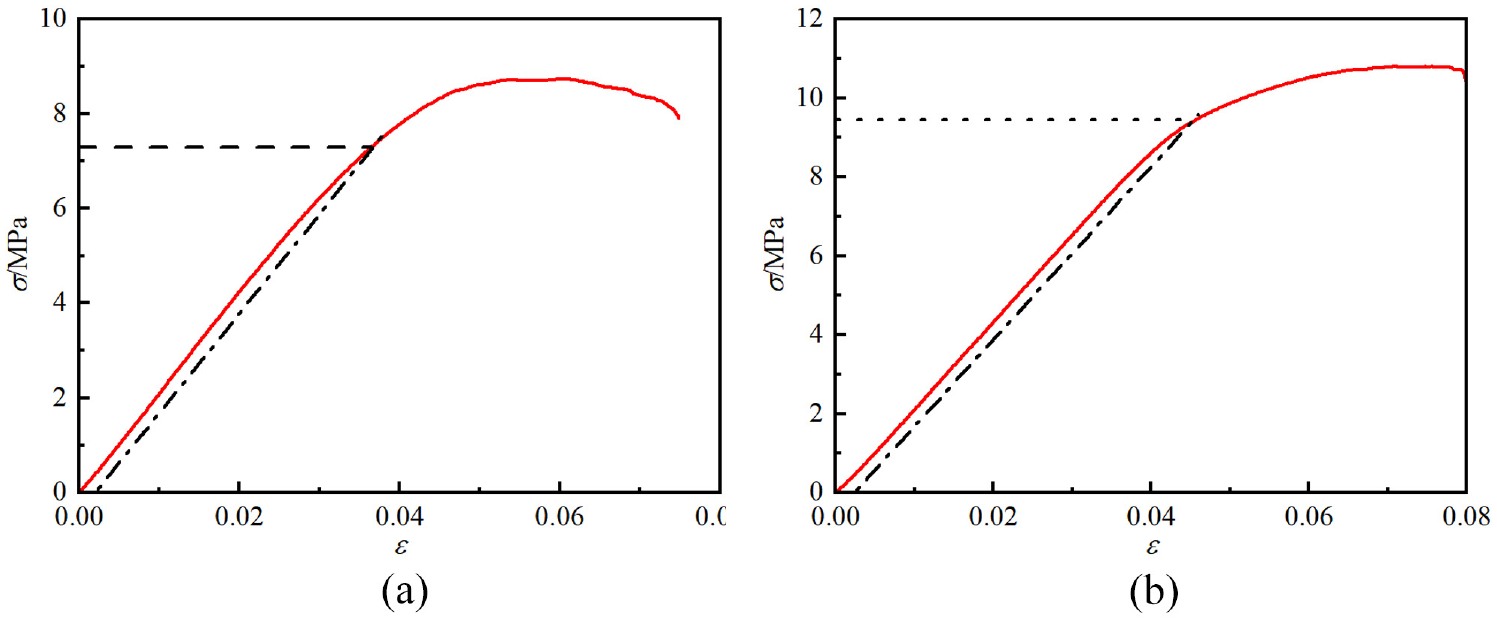
Engineering stress-engineering strain curve: (a) BCC lattice structure sample and (b) BCC-B lattice structure sample.
Performance comparison of BCC and BCC-B lattice structure samples
When utilizing the lattice structure for vibration isolation, it operates in the linear elastic stage to guarantee its reusability. The natural frequency of lattice structure used for vibration isolation can be calculated by equation (27).

The mass corresponding to the rated force is:

According to the experimental results, the natural frequencies of BCC and BCC-B lattice structure samples are calculated to be 22.65 and 20.35 Hz, respectively. Compared with BCC lattice structure sample, the rated load capacity of BCC-B lattice structure sample is increased from 5700 to 7500 N. The increase of rated load capacity of BCC-B lattice structure allows it to support a greater load mass, effectively improves the problem of insufficient load capacity of BCC lattice structure. The stiffness of BCC-B lattice structure is increased by 11.9%, while the load mass is increased by 31.58% when it reaches the rated load capacity. Therefore, under the load mass corresponding to the rated carrying capacity of BCC and BCC-B, the natural frequencies of the BCC and BCC-B lattice structures are 22.65 and 20.35 Hz, respectively. In the system with the rated load mass, the natural frequency of the BCC-B lattice structure decreases by 10.15% due to the increased load.
The yield strength of BCC lattice structure and BCC-B lattice structure is 7.2939 and 9.4478 MPa, respectively. Compared with BCC lattice structure, the mechanical properties of BCC-B lattice structure are improved by 29.53%.
Conclusion
In this paper, a new lattice structure made of Ti-6Al-4V based on BCC lattice structure is proposed to improve the load capacity, of which the stiffness and initial yield strength are predicted by cantilever beam theory and fully plastic moment concept, respectively. The influences of different structure parameters on the stiffness and maximum load capacity of BCC-B lattice structure are analyzed by theoretical and numerical methods. The BCC and BCC-B lattice structure samples are manufactured by SLM technology. Their stiffnesses under the rated load capacity corresponding to 400 MPa are tested. Compared with BCC lattice structure, the rated load capacity of BCC-B lattice structure has been increased by 31.58%, and the natural frequency has been reduced by 10.15%. The yield experiments show that the mechanical properties of BCC-B lattice structure are improved by 29.53% compared with BCC lattice structure.
Subsequently, damping design will be carried out for the structure, and the BCC-B lattice structure and damping structure will be integrated to form a complete vibration isolator. The structure parameters will also be optimized to meet the vibration isolation requirements of large load, low stiffness, and large damping under extreme environmental conditions.
Supplemental Material
sj-doc-1-ade-10.1177_16878132241297489 – Supplemental material for An improved BCC lattice structure for vibration isolation in extreme environment
Supplemental material, sj-doc-1-ade-10.1177_16878132241297489 for An improved BCC lattice structure for vibration isolation in extreme environment by Zhongyi Cheng, Xinbin Zhang, Kai Yan, Yamin Zhao and Junning Cui in Advances in Mechanical Engineering
Footnotes
Handling Editor: Sharmili Pandian
Declaration of conflicting interests
The author(s) declared no potential conflicts of interest with respect to the research, authorship, and/or publication of this article.
Funding
The author(s) disclosed receipt of the following financial support for the research, authorship, and/or publication of this article: This research work is supported by the CGN-HIT Advanced Nuclear and New Energy Research Institute (Grant No. CGN-HIT202215) and the China Postdoctoral Science Foundation (Grant No. 2023M740942).

Supplemental material
Supplemental material for this article is available online.
References
Supplementary Material
Please find the following supplemental material available below.
For Open Access articles published under a Creative Commons License, all supplemental material carries the same license as the article it is associated with.
For non-Open Access articles published, all supplemental material carries a non-exclusive license, and permission requests for re-use of supplemental material or any part of supplemental material shall be sent directly to the copyright owner as specified in the copyright notice associated with the article.
