



Abstract
Nanoparticles have numerous applications and are used frequently in different cooling, heating, treatment of cancer cells and manufacturing processes. The current investigation covers the utilization of tetra hybrid nanofluid (aluminium oxide, iron dioxide, titanium dioxide and copper) for Crossflow model over a vertical disk by considering the shape effects (bricks, cylindrical and platelet) of nanoparticles, electro-magneto-hydrodynamic effect and quadratic thermal radiation. The present study is devoted to present the mathematical formulation of the tetra-hybrid nanofluid flow in a porous channel with stretching/shrinking walls. The present inspection model is derived from given partial differential equations (PDEs) and then transformed into a system of ordinary differential equations (ODEs) by incorporating similarity variables. The transformed ODEs are solved using the bvp4c methodology, which yields numerical results. From the obtained results it is observed that the maximum amount of
Keywords
Introduction
Due to the numerous uses for non-Newtonian fluids in the engineering and industrial sectors, scientists and academicians are becoming more and more interested in this study. Casson developed the fluid flow model that includes non-Newtonian liquid flow in 1995. One essential nanofluid that is used in numerous situations is Casson fluid. Human existence’s use of the Casson fluid flow model has attracted a lot of interest late. Casson fluids include a wide range of materials, such as blood, jelly, chili sauce and honey. In modern research, the Casson fluid flow model is quite important. Yield tension features are present in the Casson fluid. A considerable yielding tension is the point at which a Casson fluid becomes a Newtonian fluid. Even though the strain rate is far less than the shear stress, the Casson fluid change. Eldabe et al. 1 were the first to demonstrate the energy transmission of a consistent magnetohydrodynamic (MHD) non-Newtonian Casson fluid flow between two co-axial tubes. The investigation for this study took several years to develop. Prashu and Nandkeolyar 2 introduced a mathematical model that specifically addresses the significant parameters of Casson fluid in practical scenarios. The model simulates the flow of electrically conducting magnetohydrodynamic fluid over a stretching layer, taking into account the combined influence of radiative heat transfer and Hall current. The objective of this model is to provide valuable insights into the power characteristics of unsteady 3D incompressible fluids. Nadeem et al. 3 conducted a study to examine the impact of an incident particle on the motion of Casson fluid in a two-dimensional flow via a porous and circular extended surface. Interesting results were obtained from modifying the Casson flow form in addition to other fluid flow properties. A number of important and relevant investigations have been carried out recently by a number of scholars, including those of Usman et al., 4 Soomro et al., 5 Mahmood et al., 6 Khan et al., 7 Waqas et al., 8 Pattnaik et al., 9 and Abbas et al. 10
A specific fluid can travel via a narrow or narrow channel with permeable walls, enabling the liquid to enter or exit, in order to mimic the fluid motions observed in living creatures. 11 The suggested model can be used to study how hybrid nanofluids (HNFs) move in different physiological systems, such as the respiratory system, blood circulation, effervescent diaphragms, percolation, blood current, synthetic dialysis, dual fume dissemination, lymphatic system and blood flow. It also has application in the dispensing of drugs. The computational solutions of plasma flow via a stenosed vein were obtained by Omama et al. 12 The authors also looked at how quickly plasma transfers heat through these veins. These are really important scenarios. As the primary biological filters in human bodies, the kidneys and respiratory system are vital for the movement of numerous chemicals and blood-related components. Substances exit the side end of the tunnel bedsteads during this process, and then they reappear at the intravenous end. Wan Azmi et al. 13 looked into the effects of a magnetic field and slip conditions on the passage of nanofluid through a stenotic artery. Given the respiratory system’s critical involvement in the movement of mass, oxygen and other crucial biological constituents, this modelling could prove to be a useful and thorough representation.14,15 In their study, Fangfang et al. 16 employed a novel mass-based model to analyse the movement of blood HNF in the direction of an impermeable stretched slip. The numerical solution for blood flow via a slanted vein with a mild stricture was effectively obtained. They also looked at how a hybrid nanofluid affected the blood flow’s thermal performance. Abdelsalam et al. 17 investigated the impact of electroosmotic pressures on blood flow in sick tissues. Ijaz and Nadeem 18 have observed that pure blood forms the basis of our concept. Sharma et al. 19 conducted a study to examine the impact of tilted magnetic force on the flow of blood via a stenosed vein. Whereas thin blood vessels, which exhibit a greater pressure gradient and are more obviously non-Newtonian, broad blood arteries are different and behave as Newtonian fluids. The heat transfer impact of blood flow in a bell-shaped occluded artery was investigated by Gandhi et al., 20 taking into account factors such as viscous dissipation and Joule heating. Shahzadi and Bilal 21 conducted a comprehensive analysis on a larger artery form, aiming to predict that blood behaviour will adhere to Newtonian rules.
Applications for ternary hybrid nanofluids (THNFs) in blood flow studies have recently been proposed. Karmakar and Das 22 examined the thermal properties of the cilia-driven transition of distributed blood-based THNFs while considering the impact of a slanted magneto field. In their study, Dolui et al. 23 investigated the impact of current and rapidly moving slides on blood flow. They employed the THNFs model, which incorporated a combined magnetic field and thermal-based radiation. Sajid et al. 24 investigated the effects of heat radiation and Cross non-Newtonianism liquid type on blood flow via a stenotic artery using a recently developed tetra hybrid nanoliquid prototype. The drug delivery aspect of a blood-based tri-hybridity fluid flowing via a perforated vessel was investigated by Alnahdi et al. 25 The researchers observed that the heat transference rate increases due to an expansion in the thermal radiative effect. In their study, Rathore and Sandeep 26 developed a computational framework to create a hybrid nanofluid that mimics the flow of blood via a narrowed artery. Riaz et al. 27 examined the comprehension of the cilia signal of electrically guiding Cu-blood THNFs by analysing a consistent coiled frequency in the presence of significant entropy formation. Abidi et al. 28 conducted a comprehensive analysis of the benefits of THNFs, specifically focusing on their impact on blood-base flow. Recent research publications29–35 provide significant insights into the blood flow characteristics of hybrid nanofluids across different geometries.
Raza et al.36,37 investigated the problem of fluid flow in a channel with stretching or shrinking walls. In Raza et al., 36 they considered the problem of nanofluid flow in a semi-porous channel with stretching walls and the problem of casson fluid flow in a channel with shrinking and stationary walls is considered in Raza et al. 37 On the other hand, the present study is dealing with tetra-hybrid nanofluid with stretching and porous walls. Moreover, in order to find the best combination of the physical parameters to enhance the heat transfer rate, we employ Fuzzy optimization called Fuzzy TOPSIS. Therefore, present study is the generalization of the previously published results and never been published before.
Since the non-Newtonian fluid model can faithfully depict the shear thickening and thinning events found in human blood, it is the model of choice. The unique features of the present study are:
➢ This study focuses on the mathematical model that describes the fluid flow containing four different kinds of nanoparticles in a porous channel with stretching/shrinking walls. The model incorporates the interaction between two parallel plates and a Tetra-hybrid nanofluid consisting of gold, silver, aluminium and titanium nanoparticles.
➢ This study also examines the influence of suction and injection walls.
➢ The highly nonlinear system of the derived model is solved numerically by use of the bvp4c method.
➢ The examination of fuzzy TOPSIS is conducted.
➢ The primary objective is to find the best combination of the physical parameter to enhance the heat transfer rate by Fuzzy TOPSIS.
This work presents novel applications in the areas of chemical processes, biological applications, human endoscopy, thermal systems, engineering processes, extrusion systems and heating phenomenon control.38–42
Problem formulation
Let’s consider the following assumptions in order to develop the mathematical model.
The fluid considered is a steady, incompressible Tetra-Hybrid nanofluid (TTHNF) between two parallel plates.
The lower wall is located at
The lower wall is permeable, allowing fluid to be sucked or injected into it.
The lower wall can be stretched at a constant rate
The temperature at the lower wall is
The upper wall is shrinking, impermeable and has a temperature of
A magnetic field is applied at the lower wall in the direction of the
Heat source/sink effects are considered, accounting for possible temperature increases or decreases.
A comprehensive model of single-phase nanofluid is used for the special case of TTHNF.
After the consideration of above assumptions, the governing equations can be written as 36 :



In the above equations, u, v are the components of the velocity vectors, T is the temperature,
Subject to the boundary conditions:


The thermos-physical correlations of TTHNF 43 are given by:

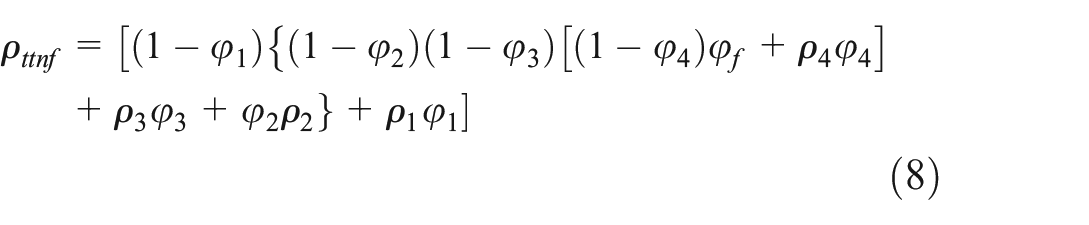

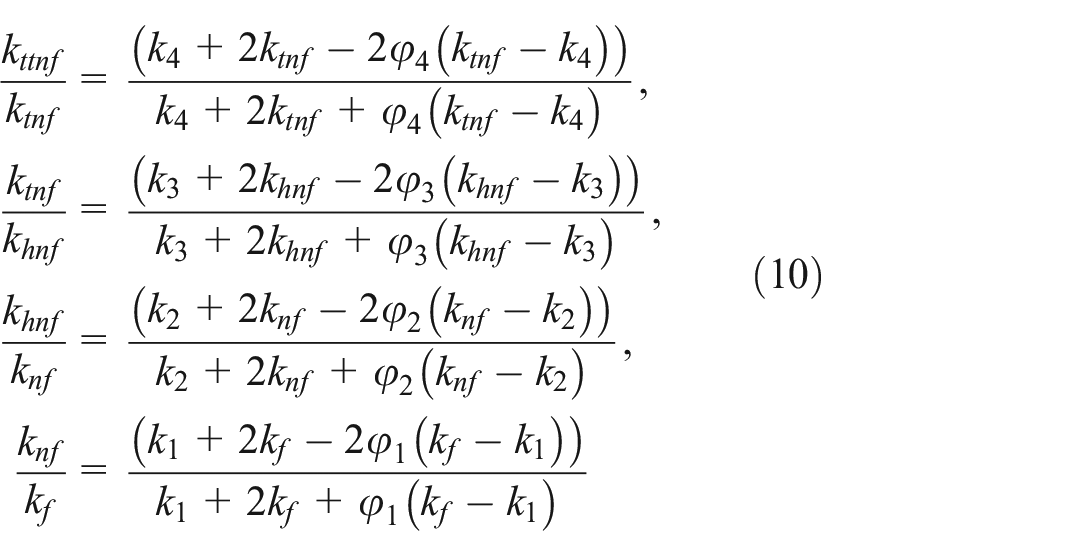

Thermophysical properties of gold, TiO2, Ag, Al2O3 and base fluid can be depicted from Table 1.
Thermophysical properties of TTHNP.

For radiative heat flux, we employ the Rosseland approximation as:

Here,

Similarity Solution:
Now, we introduce following similarity transformation 36 on equations (1)–(6). We get:

Once, we incorporated the equation (12) into the equations (1)–(4), the law of conservation of mass (equation (1)) satisfies and eliminating the pressure terms, the momentum equation and heat equation can be written as:
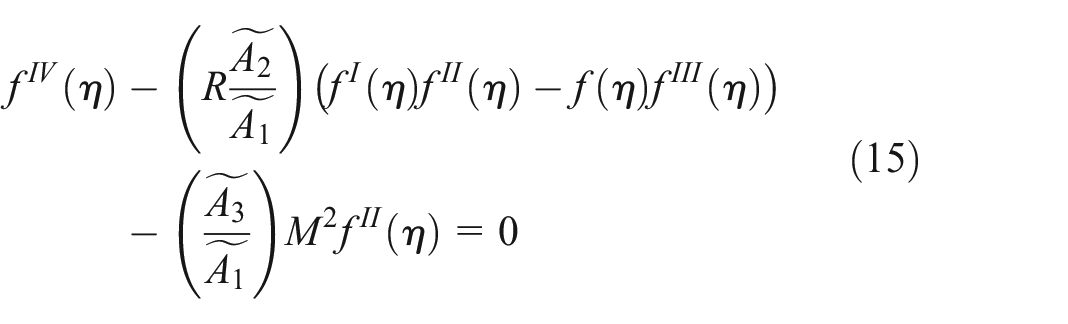

Here, stretching Reynolds number

The boundary conditions become:

where,
Now, we have to solve the similarity equations (15) and (16) subject to the boundary conditions (18) numerically. Since, our governing similarity equations are fourth order nonlinear ODEs therefore we convert them into system of first order ODEs and then solve. For missing initial conditions, we will employ shooting method. For this, we use Matlab built-in routine called bvp4c.
Numerical procedure
We employed bvp4c routine in order to find the numerical solution of equations (15) and (16) subject to the boundary condition 18. The advantage of bvp4c lies in its high accuracy, which is attributed to its use of collocation methods, adaptive meshing, flexible boundary conditions, robustness and automatic error control. For this we reduce the governing equations (15) and (16) into initial value problem by considering:

Then the following system is obtained:

Subject to the initial conditions:

Where
Results and discussions
In this section, we present the graphical and tabulation analysis of the numerical results of the current study (Figure 1). Figure 2 elucidates the effect of Reynolds number

Schematic configuration of the proposed problem.

Effect of stretching Reynolds number on velocity and temperature profile.

Effect of stretching parameter on velocity and temperature profile.
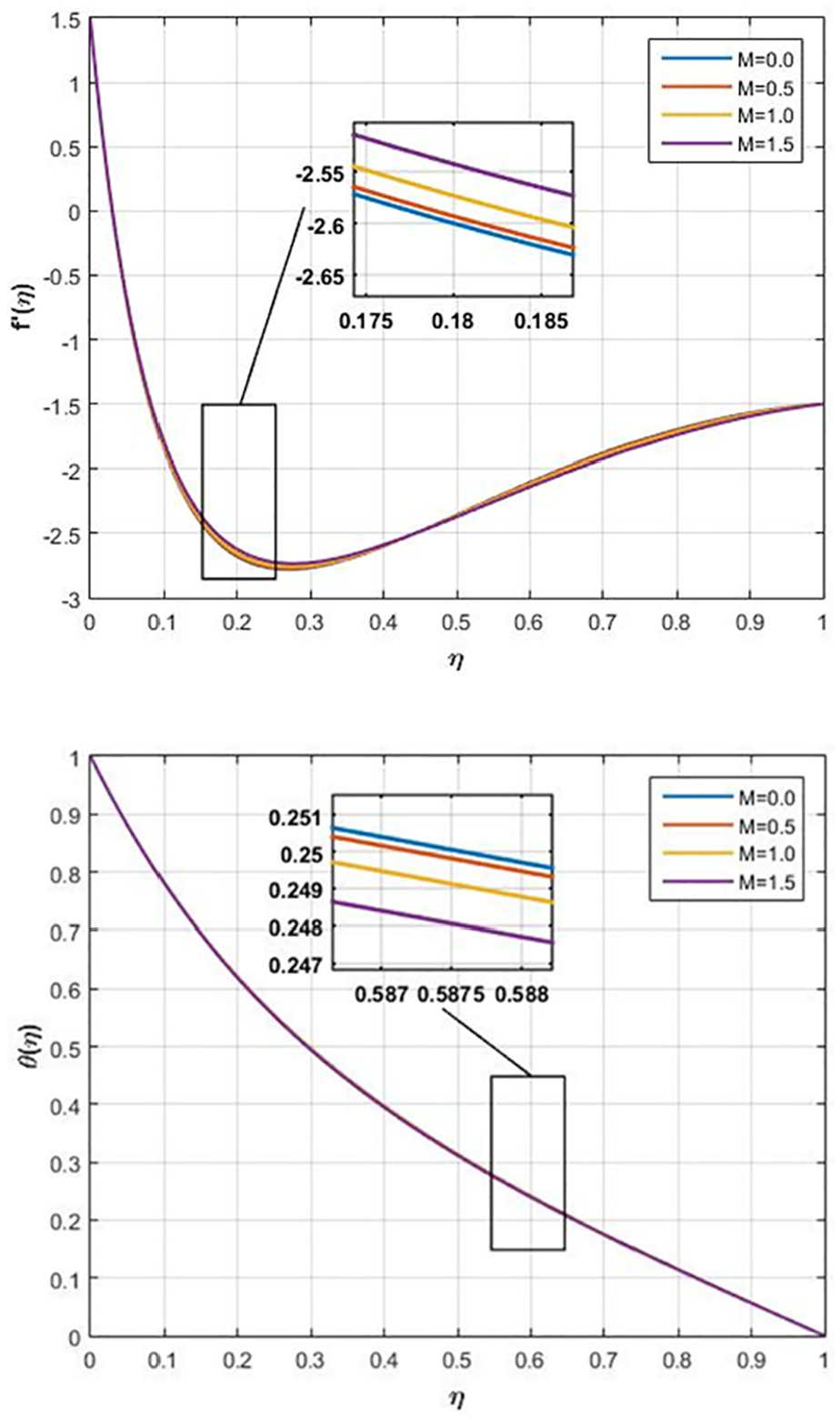
Effect of magnetic parameter on velocity and temperature profile.
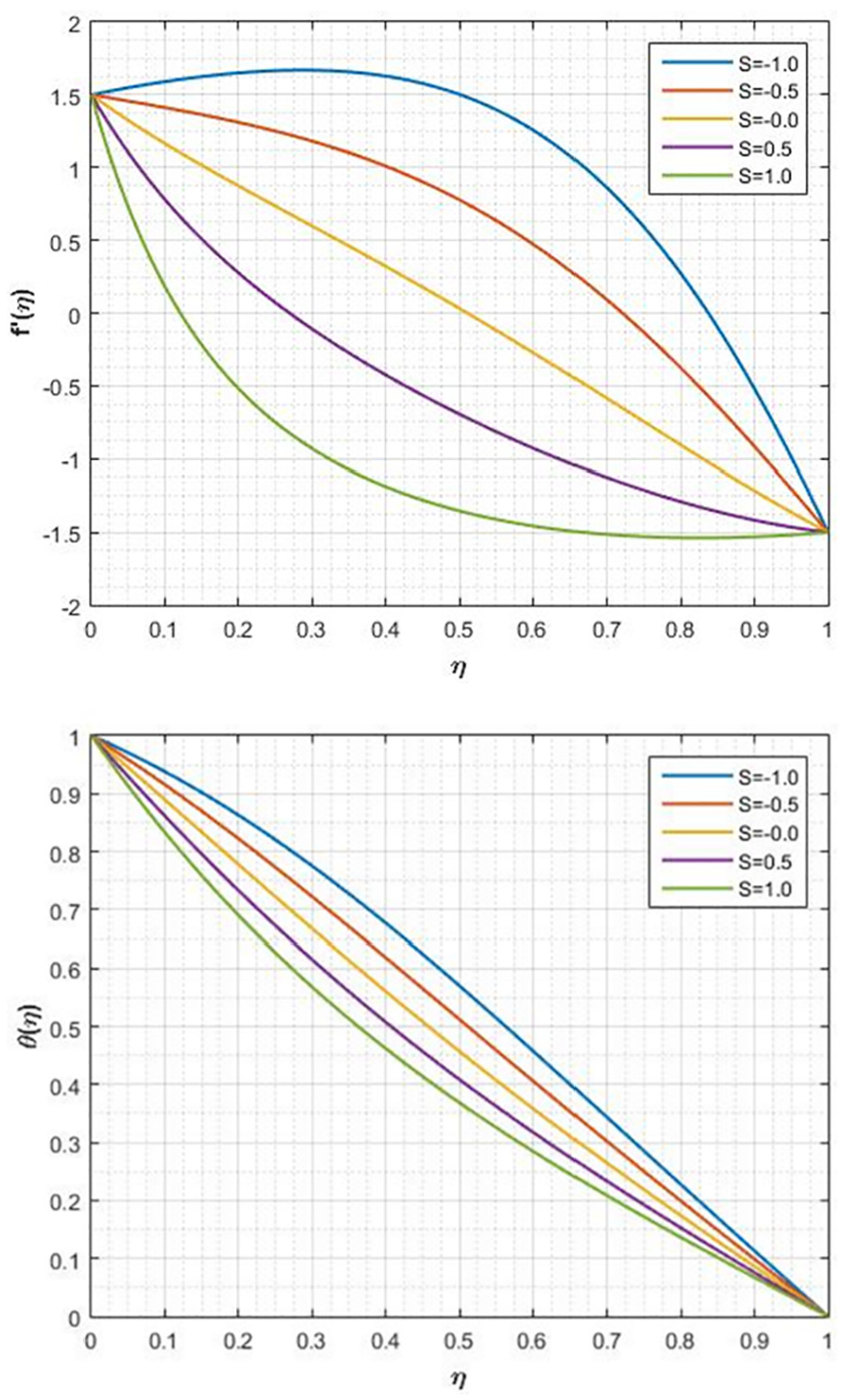
Effect of suction/injection parameter on velocity and temperature profile.

Effect of radiation and heat source/sink parameters on temperature profile.
The combine effect of

(a-f) Combined effects of

(a-f) Combined effects of
Results of fuzzy TOPSIS
In this step we will demonstrate fuzzy TOPSIS (Table 2).
Validations of the results for velocity and temperature profiles with previous published results.

We will follow the following steps:
Step 1
According to the response of experiments Case 1, 2 and 3 from Table 4 and using linguistic variables from Table 3 we make Tables 5 to 7. |−θ(0)| remain same according to Experiment 1, Experiment 2 and Experiment 3.
Weight assigned to linguistic variables for each output response.

Feedback on output responses.

Matrix (in the light of Experiment 1).

Matrix (in the light of Experiment 2).

Matrix (in the light of Experiment 3).

Step 2
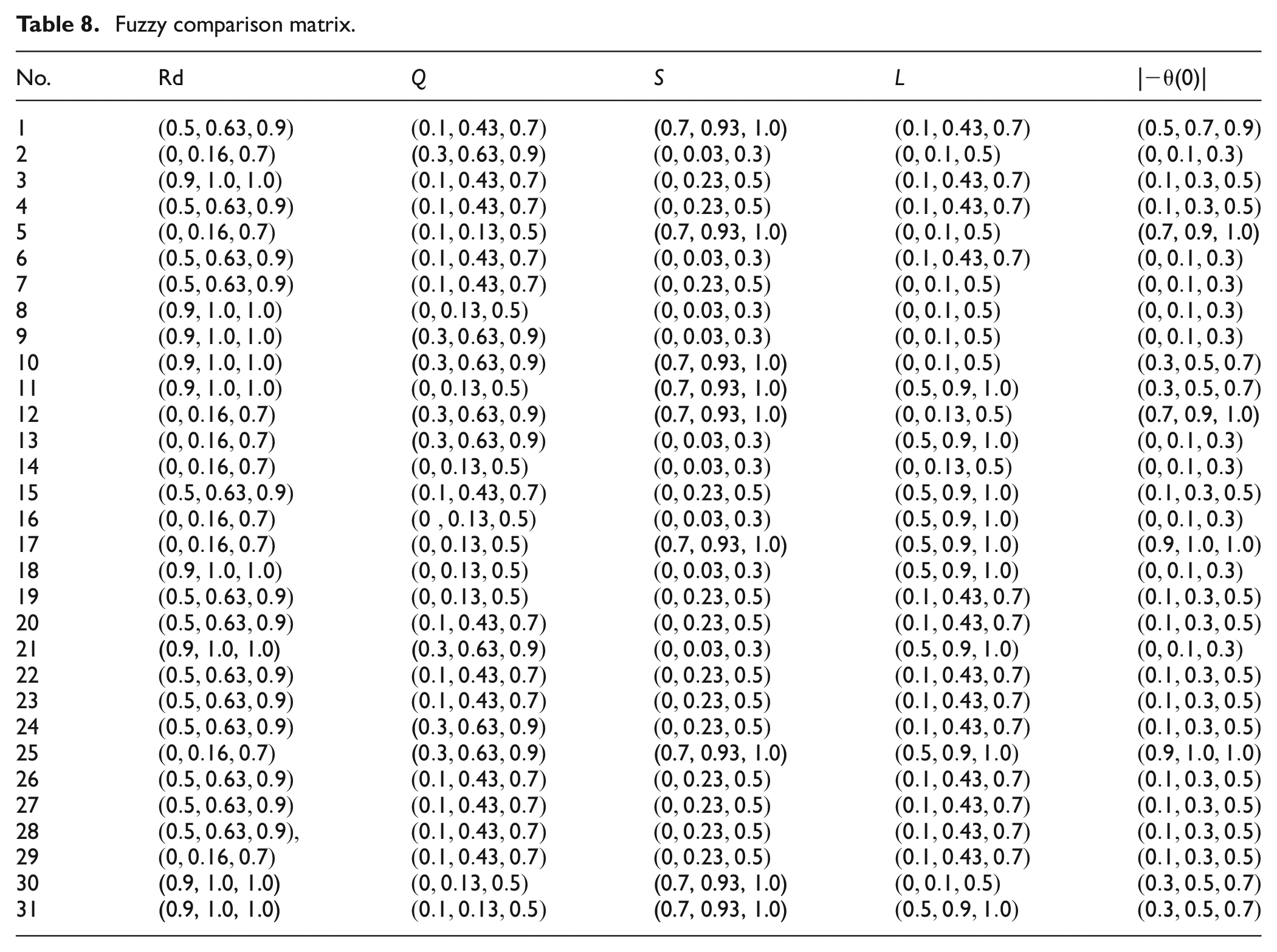
In this step, from Tables 5 to 7 we form Fuzzy comparison matrix as shown in Table 8 with the help of formula as given below.


Fuzzy comparison matrix.
Step 3
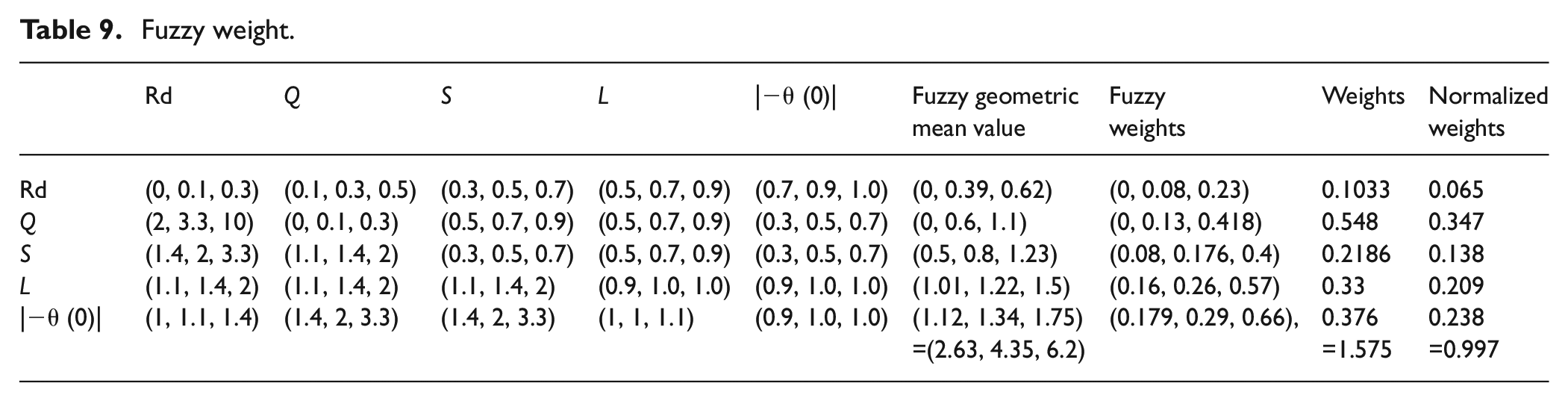
In third step we find the Fuzzy geometric mean, weights, Fuzzy weights and Normalized weights as shown in Table 9 for different parameters.
Fuzzy weight.
We find Fuzzy geometric mean with the help of formula given


Weights =
Step 4
In fourth step, Table 10 Normalized fuzzy decision matrix are form with the help of the following formula by using Table 9 as shown below.


Normalized fuzzy decision matrix.

After analysis of comparison matrix we have come to know that

Step 5
In fifth step we find out the Weighted Normalized Fuzzy Decision Matrix in Table 11.

We know the fuzzy Weight of Rd = (0, 0.08, 0.23) and Q = (0, 0.13, 0.418), S = (0.08, 0.175, 0.4), L = (0.16, 0.26, 0.57), |θ(0)| = (0.179, 0.29, 0.66) which we already find in Table 9.
Weighted normalized decision matrix.

The value of (Fuzzy positive ideal solution)

Step 6
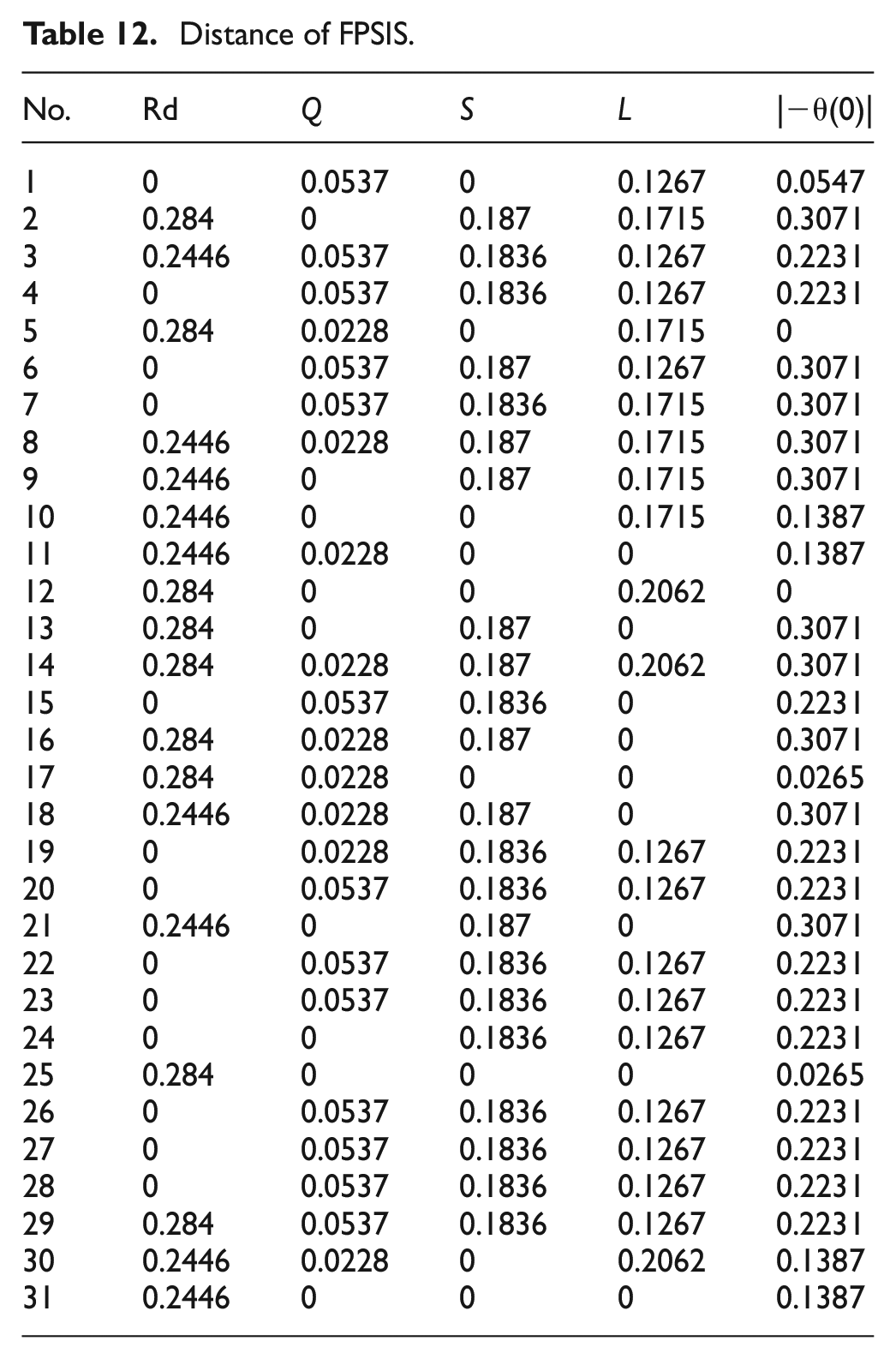
Distance of Fuzzy positive ideal solution (FPIS) and Fuzzy Negative ideal solution (FNIS) for each cell is calculated with the help of formula, as shown in Tables 12 and 13.

Distance of FPSIS.
Distance of FNIS.

Step 7
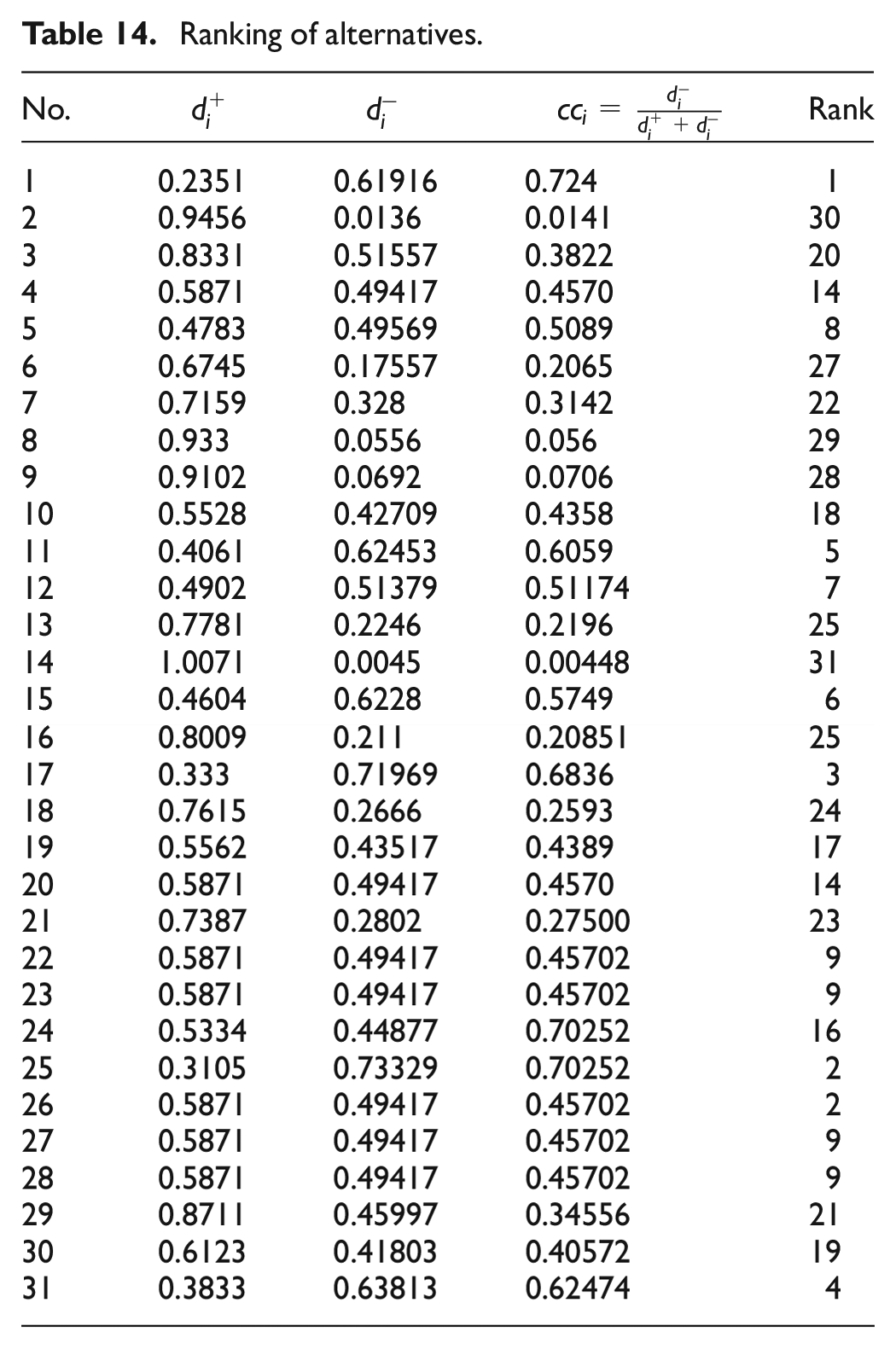
In next step, the distance each alternative of the FPIS and FNIS is calculated with the help of formula. Next the closeness coefficient were determined seen in Table 14.


Ranking of alternatives.
Closeness coefficient C

Finally, when all the findings have been obtained, the ranking of the alternative were completed in order to obtain the best possible collection of choices, given in Table 14. The alternative with the highest C
The ranking of alternatives in the descending order were based on the value of C
Graphical results of fuzzy TOPSIS
In Figure 9 we can see the highest weightage of the parameters Q which is 35%. The lowest weightage of Rd is 6%. |−θ(0)| has fuzzy weight 24%. L has 21% weightage and S has 14% weightage.

Fuzzy weightage of parameters.
In Figure 10 the Ranking of the Alternatives are displaying. The A1 with Rd =

Ranking of alternatives for optimization of HTR.
Conclusions
The goal of this work is to optimize the heat transfer rate of a magnetized tetra-hybrid Tiwari and Dass nanofluid through a channel in stretching walls. The heat transfer rate of magnetized tetra-hybrid nanofluid is taken into account in order to optimize it. Using the bvp4c approach in MATLAB software to solve ODEs and offer precise results and implications for multiple parameters. The results were successfully explained through graphs and tables. After the necessary model formulation was finished and numerical analysis was carried out while taking into account certain physical factors, the following outcomes were obtained.
Velocity of the nanofluid near the lower wall
It came to know that velocity profile shifted upwards from lower wall to the centre of the channel and reverse trend is seen from centre to upper wall of the channel. Additionally, the trend of temperature profile
The velocity
Maximum amount of
Whenever there is injection implies decrease in
Limitation and future recommendations
In the present study, we considered the solid volume fraction of nanoparticles is up to 1%. We considered two-dimensional flow in a channel. In future, this can be generalized for three-dimensional rotating flow for the variation of solid volume fraction. Moreover, in this study we employed fuzzy TOPSIS to find the best combination of the physical parameters to enhance the heat transfer rate. In future, some other optimization techniques can be applied.
Footnotes
Handling Editor: Sharmili Pandian
Author Contributions
All authors contributed equally in the article in conceptualization, investigation, Validation, analysis, writing original draft, review and editing.
Declaration of conflicting interests
The author(s) declared no potential conflicts of interest with respect to the research, authorship, and/or publication of this article.
Funding
The author(s) disclosed receipt of the following financial support for the research, authorship, and/or publication of this article: ‘Project financed by Lucian Blaga University of Sibiu through research grant LBUS-IRG-2023-08’.

Data availability statement
The datasets used and/or analysed during the current study available from the corresponding author (A. A.) on reasonable request.