



Abstract
This study investigated the benefits of adding fly ash as a reinforcement material. The benefits included cost-effectiveness, improved quality, isotropic behavior, and environmental advantages. To improve self-lubrication and wettability behavior, Al6061 alloy composites were fabricated with different amounts of fly ash (0%, 2%, 4%, 6%, and 8% by weight), along with a fixed amount of graphite (3wt.%) and magnesium (2wt.%). Wear tests were conducted using Taguchi’s Design of Experiment (DoE) approach on the composites. The optimized composition with 6% fly ash exhibited the least wear rate under the test conditions of load = 10 N, sliding velocity = 3 m/s, and sliding distance = 2 km. SEM images revealed a uniform distribution of fly ash and graphite reinforcement in the matrix, contributing to enhanced wear resistance. The composites exhibited fewer scratches and plastically deformed surfaces, indicating a decrease in wear rate and increased wear resistance with higher fly ash content. ANOVA were used, and four parameters were identified to be critical, Composition at 34%, Sliding Distance at 27%, load at 23%, and Sliding Velocity at 12% contribution with a statistical confidence of 95%. This research contributes to developing cost-effective and environmentally sustainable materials with improved mechanical properties. It makes them suitable for various industrial applications, such as the automotive industry, where wear resistance is essential.
Introduction
Aluminum metal matrix composites have developed as innovative materials with superior mechanical qualities to typical aluminum alloys, making them more desirable in various technical applications. Among the several fabrication methods available for creating AMCs – such as squeeze casting, gravity die casting, forging, and stir casting – stir casting stands out for its efficiency and cost-effectiveness. This procedure involves mechanically stirring reinforcement materials into a molten aluminum alloy to ensure that reinforcement is evenly dispersed throughout the matrix. The resultant composites have isotropic characteristics, which makes them ideal for applications that require constant performance in all directions. 1 Fly ash, a byproduct of coal-fired power generation has emerged as a suitable reinforcement material for stir-casting AMCs. The use of fly ash improves the mechanical properties of composites while simultaneously increasing environmental sustainability through the reuse of industrial waste. The use of fly ash in AMMCs provides a dual benefit of improving material performance while addressing environmental issues, making these composites an appealing choice for advanced technical applications. 2
Advanced materials known as Aluminum metal matrix composites (AMMCs) have gained popularity due to their superior mechanical properties compared to traditional aluminum alloys. Several production methods, including squeeze casting, gravity die casting, forging, and stir casting, are available to manufacture AMCs. Stir casting is a highly efficient and cost-effective process that is widely used. 3 It involves incorporating reinforcement materials into a molten aluminum alloy using mechanical stirring. This process ensures excellent dispersion of the reinforcement throughout the matrix, leading to improved composite properties. Products made through stir casting exhibit consistent properties in all directions, making them suitable for various applications where consistent performance is essential. Fly ash, a by-product of coal-fired power plants is an excellent reinforcement material for AMCs. By incorporating fly ash into stir casting, we not only enhance the mechanical properties of the composites but also address environmental concerns. Using fly ash as a reinforcement material significantly benefits the environment and the economy. 4 From an environmental standpoint, incorporating fly ash into AMCs reduces land pollution by repurposing waste material in a value-added application. Doing so contributes to a more sustainable approach to waste management. Additionally, utilizing fly ash in AMCs helps reduce the negative environmental impact associated with its disposal. Economically, fly ash is a cost-effective alternative that ensures stable and predictable manufacturing expenses. Unlike traditional reinforcement materials that can be costly and subject to market fluctuations, fly ash is abundantly available as a byproduct of coal power plants. This widespread availability ensures lower costs for composite production, making it a smart choice for manufacturers. In summary, utilizing fly ash in AMCs aligns with conserving natural resources and supports a circular economy model where waste materials are recycled and reused. 5
The impact of magnesium on composite materials was analyzed by Venkat Prasat and Subramanian. 6 They found that magnesium positively affected both reinforced and unreinforced composites, improving interfacial bond strength, wear resistance, and hardness. Venkat Prasat and Subramanian 6 compared stir-cast composite materials’ sliding and wear behavior to basic metal alloys incorporating fly ash content and load. They found that composites were harder, lighter, and stronger than base alloys and that reinforcement reduced wear and friction. Faisal and Prabagaran 7 evaluated metal matrix composite literature and discovered that reinforcement increased tensile strength, compressive strength, wear resistance, and hardness up to a certain threshold, after which it deteriorated due to poor matrix-reinforcement wettability. Sudindra and Kumar 8 studied Alumina and Graphite-reinforced Al6061 composites using liquid metallurgy, specifically stir casting, and found that composites were harder and stronger than the underlying alloy. David Raja Selvam et al. 9 added different fractions of SiC to stir-cast aluminum matrix composites and a fixed weight of fly ash as reinforcement. They found tensile strength was greatest at 10% alumina addition, while wear resistance was enhanced with 6wt.% E-Glass and 10% fly ash. Prajit et al. 10 investigated Al6061 reinforced with glass fiber and fly ash and found that fly ash up to 15% weight mixed well with Al6061 to create composites with greater wettability. At the same time, magnesium increased hardness, and E-Glass and fly ash boosted ultimate tensile and compressive strength. Chawla 11 discovered that reinforcing fiber orientation and diameter affected mechanical characteristics in fiber-matrix composites. Mahanthesh 12 tested tensile strength and hardness with bottom fly ash reinforcement and found that up to 9wt.% fly ash enhanced hardness and tensile strength. Shanmughasundaram et al. 13 found that aluminum base metal reinforced with fly ash increased hardness up to 20% reinforcement by weight before decreasing, while Kadam and Shinde 14 found that ceramic particle reinforcement increased seizure resistance at elevated temperatures, with SiC outperforming alumina. Suresha and Sridhara 15 reported scarce parametric studies on the tribological behavior of aluminum matrix hybrid composites. An increase in speed reduces wear, and an increase in either load or sliding distance or both increases wear. Statistical analysis has revealed interactions among load, sliding speed, and sliding distance in composites with Gr particulates. Due to its high hardness, they discovered less wear loss in the composite material than the base alloy. Welding slag and welding flux-reinforced Al6061 alloy enhanced hardness, according to Rajan et al. 16 Kumar 17 investigated melt-and-semi-solid-state stirred aluminum metal matrix composites and found that particulate temperature, degassing, stirring speed, and pouring temperature affected characteristics. Satishkumar et al. 18 utilized stir casting to create a new composite material, Novel Al6061 (consisting of 10% SiC and 5% 50 μm Flyash). The material was found to have increased hardness when tested with a Vickers tester. A pin-on-disc tribometer study also revealed that the material demonstrated improved wear resistance when subjected to varying loads (ranging from 1 to 2 kg) and velocities (ranging from 100 to 500 rpm). Tiwari et al. 19 stir-cast an aluminum-fly ash particle composite and discovered that magnesium boosted age hardening but lowered ductility and impact strength. Fly ash-reinforced Al6061 was tested for toughness, hardness, tensile strength, and wear resistance by Samvatsar and Dave, 20 who found that fly ash enhanced tensile strength, wear resistance, hardness, and corrosion resistance. Kumar et al. 21 discovered that fly ash reinforcement increased tensile strength up to 15% but then decreased, while graphite reduced hardness but enhanced machining, and fly ash reduced wear by 15%. Venkatachalam et al. 22 also studied fly ash-reinforced Al6061 alloy and found that fly ash enhanced tensile strength, microhardness, and wear resistance in stir-cast composites. Dinaharan et al. 23 found fly ash could reduce land contamination. Zhu and Yan 24 revealed that optimum composites lost less material to wear than basic alloys and that load-dominated wear behavior. The effect of Al6061-Al2O3-SiC composites was studied by Hassan et al., 25 who found that steel molds increased hardness and wear rate, while graphite molds increased ductility and decreased wear rate. Mahapatra and Patnaik 26 created a polyester-reinforced multi-phase hybrid composite with E-glass fiber and ceramics. They found that cement by-pass dust was this composite’s best erosion-resistant filler particle. Finally, Christy et al. 27 compared Al alloy and TiB2-reinforced Al MMCs and found that TiB2 enhanced hardness and tensile strength but decreased ductility compared to Al6061 alloy. Utilizing fly ash as reinforcement in stir casting for AMMCs provides several benefits: cost-effectiveness due to its abundant and zero-cost availability, improved composite quality with isotropic behavior, and environmental advantages by repurposing waste material, contributing to a sustainable approach in manufacturing.28–30
This study analyzes the tribological properties of stir-casted aluminum hybrid composite materials. Al6061 is reinforced with Fly ash, graphite, and magnesium particles to improve its strength and produce a lightweight composite. The present research outcomes are found to suffice the requirements of developing a high-performance hybrid aluminum composite, which can offer higher wear resistance and better performance capabilities. The compositions of matrix and reinforcement are mixed with different % reinforcement, making them superior to the bare Al 6061 alloy. The use of a statistical approach to validate the results and Taguchi’s optimization technique adopted for optimizing the factors of the wear test are unique. Also, the Analysis of Variance (ANOVA) carried out to develop a statistical model to predict the wear rate is a novel methodology for optimization studies aimed at minimizing the effects of wear on the composite developed. The study’s conclusions are intended to provide crucial new information for creating inexpensive, highly effective aluminum composites with various industrial uses.
Experimental detail
Material selection
Al6061 belongs to the 6000 series of aluminum alloys and is widely used due to its heat-treatable nature and versatile properties. It is an extruded composite with medium to high strength capabilities. Figure 1 displays the raw material Al6061 utilized for the current research work, while Table 1 showcases its chemical composition.

(a) Al bar before cutting and (b) Al slab after cutting.
Composition of Al6061 alloy. 31

Reinforcement materials
For any composite material, the resultant properties are based on the filler material. The selection of filler material is the min criterion in any composite material because all the optimum results are associated with the selection and distribution of filler material. The present work selects fly ash (Figure 2(c); Table 2) as filler material. Increasing the bonding between the matrix and filler material is essential for any composite. So, magnesium powder (Figure 2(a)) is added to increase wettability, and graphite (Figure 2(b)) is used as a solid lubricant. The particle size is determined using a particle size analyzer. After two trials, the fly ash particles’ average size was 61.9 and 62.4 μm, respectively. Taking the mean of both readings, the particle size was determined to be 62.15 μm.

(a) Magnesium powder, (b) graphite, and (c) fly ash.
Chemical composition of fly ash [lignite-based power plant, Bikaner, Rajasthan].

Fabrication of AMMCs
In this study, Al6061 alloy composites were reinforced with a fixed amount of 3wt% graphite and varying amounts of fly ash (0%, 2%, 4%, 6%, and 8% by weight) using stir casting. Bars of Al6061 were cut into small pieces and weighed as needed before being melted in a graphite crucible in a casting furnace at 750°C. A pre-measured amount of fly ash and graphite (3wt.% fixed) was added to the slurry, along with a small amount of magnesium (2wt.%) to improve wettability. The mixture was stirred for 5 min to ensure even distribution before being poured into a mold for solidification. This process was repeated with different compositions of additives, resulting in composites with base material and reinforced materials, as shown in Table 3. 32
Compositions of matrix and reinforcement in percentage.

Design of Experiment (DoE)
In this study, Taguchi’s Design of Experiment (DoE) technique was used to systematically investigate the effect of various process parameters on the wear behavior of Al6061 composites reinforced with fly ash and graphite. The Taguchi technique is a powerful statistical tool for optimizing process parameters and improving the quality of manufactured goods with few experimental runs. This method is useful for decreasing the time, resources, and costs associated with significant experimentation while ensuring the dependability and reproducibility of the results. The L25 orthogonal array is chosen for the experiment, with three levels for each of the parameters listed in Table 1. The selection of factors and levels was based on the factors’ criticality. The challenges of implementation and the associated expenses were taken into account. Three levels (Level-1, Level-2, and Level-3) were established to consider potential nonlinearity impact for each parameter. Experiments on wear behavior were carried out utilizing Taguchi’s DoE approach with L25 orthogonal array (OA) to study the influence that process parameters (such as load, sliding velocity, composition, and sliding distance) have on the outcome at five distinct levels as shown in Table 4.
Various control parameters and their levels for L25 Taguchi’s OA Design of Experiment.

Wear test
The dimensions of the wear test specimen (Figure 3(a)) are 10 mm × 10 mm × 30 mm. The surfaces of all the specimens are finished using emery paper of grades 220, 600, 1000, and 1500. Specimens that are worn out after the wear test analysis are selected for a scanning electron microscope to analyze the microstructure and chemical composition of composite material. The cross-section of the sample is kept at 10 mm × 10 mm.
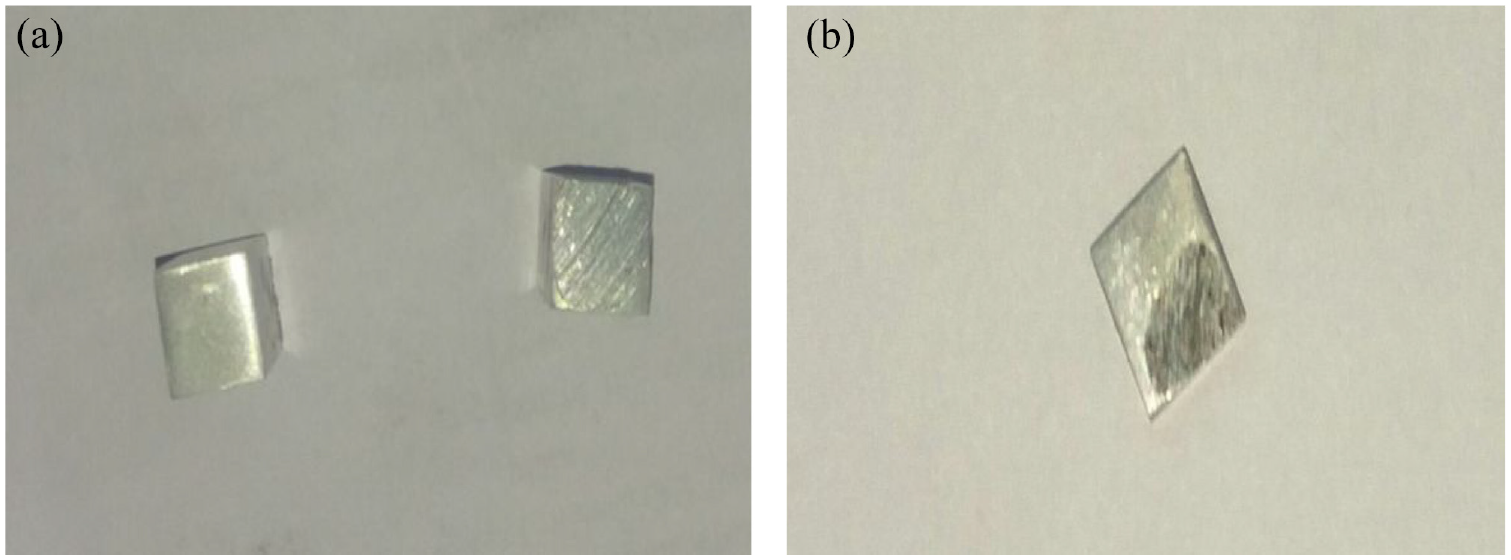
(a) Wear test specimen before test and after test and (b) SEM specimen.
The wear test was conducted in the Tribology Lab at MNIT Jaipur, utilizing the Pin on Disc friction and Wear Test Rig, following the L25 OA (Table 5) at room temperature (Figure 4). Different grades of emery paper were used to polish the test surface to ensure proper contact with the disc. The load was applied to the specimen during sliding and brought into intimate contact with the rotating disc at the track radius. The pinned specimen remained stationary and perpendicular to the disc during the testing while the circular disc was rotated. The wear test was carried out at different operating conditions, and electronic sensors were used to monitor the wear and record it in the system. The “Magview Data Acquisition Software” was used to receive and display the stored data on the computer. 33 Measurement of wear is done in two ways as volume loss as given in equation (1)

Technical specifications of Pin on Disc friction and Wear Test Rig.


Pin on disc apparatus (MNIT, Jaipur).
Microstructural analysis
Samples undergoing wear test analysis are chosen for scanning electron microscope examination to analyze the composite material’s microstructure and chemical composition. The sample’s cross-section is maintained at 10 mm × 10 mm. SEM (Figure 3(b)) micrographs of aluminum alloy and Al6061 filled with fly ash composite are done at MATERIAL RESEARCH CENTRE MNIT, Jaipur. An image of the surface is created by scanning the focused electron beam. The focused electrons from the electron gun interact with the surface of the samples, and various signals are generated. The generated signals are used to observe the information about the topography of the surface.34–36
Results and discussion
Taguchi experimental results for fly ash-filled Al6061 composite
The experiments were randomized using the L25 design of experiments (DOE) to mitigate any bias resulting from uncontrolled noise sources, which could lead to errors. The goal was to determine the optimal values for each parameter to minimize wear and tear. The factors and levels were carefully controlled to ensure that the experiments were orthogonal, ensuring each experiment’s independence. S/N ratios were calculated with the Taguchi method for wear rate using the smaller, better characteristics, and S/N ratios are presented in Table 6.
Wear results according to the Taguchi experimentation method.

The overall average S/N ratio of the wear rate is observed at 9.61 dB. The analysis is done using the software used for the DOE application known as MINITAB-19. The effect of individual factors such as load, sliding velocity, composition, and sliding distance on wear rate can be observed. The parameters with the highest S/N ratio correspond to the minimum wear rate, and the minimum S/N ratio leads to the maximum wear rate. The input process parameter value with the maximum S/N ratio gives the optimum wear rate. Figure 5 shows that load = 10 N, sliding velocity = 3 m/s, composition = 6%, and sliding distance = 2 km provide the optimum condition. The current result concludes that factors A1, B3, C4, and D2 provide the minimum wear rate for the current aluminum-based metal matrix composite. Therefore, it can be concluded that % wt. of flue ash is the most effective and significant parameter, and sliding velocity is the least significant parameter for controlling the wear rate of composite.

Effect of control factors on the wear rate of fly ash/graphite reinforced composite.
The wear test results reveal that the amount of fly ash reinforcement significantly impacts the Al6061 composite’s wear resistance. Among the several compositions evaluated, the composite with 6% fly ash by weight had the lowest wear rate. This ideal composition was achieved under the test parameters of a 10 N load, 3 m/s sliding velocity, and 2 km sliding distance, as determined by the Taguchi Design of Experiment (DoE). The wear rate decreased continuously with an increase in fly ash content up to 6%, after which no meaningful improvement was seen. This implies that 6% fly ash is the best reinforcement for improving wear resistance in the Al6061 composite, as it balances tribological performance and material efficiency.
ANOVA analysis
The table shows the results of the ANOVA on the wear rate of developed MMCs. The ANOVA analysis was conducted at a significant level of 95%. 37 The final column of Table 7 displays the percentage of contribution that each input process parameter had on the response parameter. The composition is ranked 1 with 34%, the sliding distance is ranked 2 with 27%, the load is next level with 23%, and the sliding velocity with 12%. The table indicates that composition had the most significant impact on wear rate, followed by sliding distance. Both load and sliding velocity had a positive effect on the wear rate.
ANOVA of fly ash filled Al6061 composition for wear rate.

The wear test findings show that the proportion of fly ash reinforcement substantially influences the Al6061 composite’s wear resistance. Among the several compositions evaluated, the composite with 6% fly ash by weight had the lowest wear rate. This ideal composition was achieved under the test parameters of a 10 N load, 3 m/s sliding velocity, and 2 km sliding distance, as determined by the Taguchi Design of Experiment (DoE). The wear rate decreased continuously with an increase in fly ash content up to 6%, after which no meaningful improvement was seen. This implies that 6% fly ash is the best reinforcement for improving wear resistance in the Al6061 composite, as it balances mechanical performance and material efficiency. Experimental and analytical findings show that the composition of fly ash and the applied load are the most important elements determining wear resistance, with sliding velocity and sliding distance contributing to a lesser extent.
SEM analysis
SEM images of Al6061 and Al6061 alloy reinforced with fly ash have been displayed under two conditions: without and with wear. Three samples were examined before and after wear, using magnifications of 1000×. Sample A and B represent Al6061 alloy without and with wear, while samples C and D without and with wear finally, E and F without and with wear represent composites with 6% and 8% fly ash by weight, respectively. The images illustrate the effect of fly ash reinforcement, with the wear rate decreasing as the fly ash concentration increases. Additionally, reinforced samples exhibit fewer scratches on their surfaces than alloy samples. This is due to the abrasion resistance of fly ash, which increases with greater hardness. The SEM images also reveal that increased fly ash content leads to fewer plastically deformed surfaces, indicating a decrease in wear rate and an increase in wear resistance. Furthermore, the micrographs show that the presence of cracks, blow holes, wear debris, and grooves is also reduced with greater fly ash content. Finally, the images demonstrate that the distribution of reinforcement in the respective matrix is relatively uniform.
The microstructures of the unreinforced aluminum alloy 6061 (Figure 6(a)), stirred for 15 and 20 min at high rpm, exhibit several clusters, pores, and pinholes. These defects arose from the long stirring periods, introducing a certain amount of air through the melting process. The morphology of the worn surface (Figure 6(b)) shows scratches, clusters, and grooves formed in the sliding direction, with a significantly lower number of pores than the unworn Al6061. This reduction in pores is attributed to high wear losses. In contrast, the microphotographs of the Al6061 alloy with fly ash reinforcement (Figure 6(c) and (e)) show an increased filler content while maintaining a small amount of porosity. The lower porosity of the metal matrix composites (MMCs) can be linked to their higher hardness. 38 The scanning electron microscope (SEM) images reveal a decent bonding between the aluminum matrix and the fly ash particles, resulting in enhanced load transfer from the Al6061 alloy to the filler particles. However, the images of worn samples (Figure 6(d) and (f)) show that the fly ash fillers significantly improved the load-carrying capacity and reduced the wear rate, as evidenced by smaller craters and grooves. The fly ash was homogeneously distributed in the aluminum metal matrix composite, contributing to these improved properties.

SEM (a–f) micrographs of developed composites without and with wear.
Conclusions
This study looked at the impacts of fly ash as a reinforcement material in Al6061 composites, emphasizing increasing wear resistance. The composites were made using the stir casting technique, and their wear behavior was investigated using Taguchi’s Design of Experiment (DoE) method. The results show that including fly ash dramatically improves the wear resistance of Al6061 composites.
The best composition was 6% fly ash by weight, resulting in the lowest wear rate under test conditions of a 10 N load, 3 m/s sliding velocity, and 2 km sliding distance.
This improvement is due to the homogeneous dispersion of fly ash particles within the aluminum matrix, confirmed by SEM examination. Furthermore, the study discovered that load and fly ash content are the most influential characteristics impacting wear resistance, with sliding velocity and sliding distance also playing a role, though to a lesser level.
ANOVA were used, and four parameters were identified to be critical, Composition at 34%, Sliding Distance at 27%, load at 23%, and Sliding Velocity at 12% contribution with a statistical confidence of 95%.
From the experimental report, it can be concluded that the Al6061 is reinforced with Fly ash, graphite, and magnesium and has a better wear resistance than the bare Al 6061 alloy. These findings highlight fly ash’s potential as a low-cost, long-term reinforcing material for improving the wear characteristics of aluminum-based composites.
The SEM of the wear debris has revealed ceramic particulates in silicates, carbides, and oxides that reduce the dry sliding wear of the aluminum composites fabricated in the present work.
This research creates new materials with good wear qualities, making them ideal for various industrial applications, especially in wear-sensitive industries like automotive. Future research could investigate the effects of altering other parameters, such as fly ash particle size and alloy content, to improve the performance of these composites.
Footnotes
Acknowledgements
The authors extend their appreciation to Taif University, Saudi Arabia, for supporting this work through the project number (TU-DSPP-2024-14). They also express their gratitude to MNIT for providing the tools and equipment for casting, wear and SEM analysis of developed composites.
Handling Editor: Aarthy Esakkiappan
Author contributions
Raj Kumar, Kedar Narayan Bairwa, Harinadh Vemanaboina, BoyaVishnu Vardhana Naidu, Kamel A Shoush: Conceptualization, Methodology, Software, Visualization, Investigation, Writing- Original draft preparation. Sherif SM Ghoneim, Mukesh Pushkarna: Data curation, Validation, Supervision, Resources, Writing – Review & Editing. Milkias Berhanu Tuka: Project administration, Supervision, Resources, Writing – Review & Editing.
Declaration of conflicting interests
The author(s) declared no potential conflicts of interest with respect to the research, authorship, and/or publication of this article.
Funding
The author(s) disclosed receipt of the following financial support for the research, authorship, and/or publication of this article: This research was funded by Taif University, Taif, Saudi Arabia (TU-DSPP-2024-14).
Availability of data and materials
The datasets used and/or analysed during the current study available from the corresponding author on reasonable request.
