Square-hexagonal kink chains, also known as hexagonal kink chains or simply kink chains, are structural configurations used in engineering for various purposes, including material science, nano-technology and mechanics. The square hexagonal kink chain likely describes a chain-like structure where the individual units have square and hexagon-like shapes and are arranged with symmetry. Additionally, there are likely points in the chain where the linear arrangement deviates or kinks, possibly due to some structural irregularity. A nonterminal hexagon is regarded as a kink if it contains two neighbouring vertices of degree , while a nonterminal square is considered a kink if and only if it has a vertex of degree . The kinks from these two types of arrangements are called kinks of type and , respectively. Our objective is to discover three possible arrangements of kinks of type further, depending on the process of how different polygons are attached at different places, holding the condition to make a kink at each step. In this work, we have calculated forgotten, geometric-arithmetic, sum-connectivity and atom bond-connectivity indices for the kink chains. A comparison between these topological descriptor is given by computing their numerical values for each kink chain.
A graph is a collection of vertices and edges, denoted as an ordered pair . The number of vertices and edges in a graph is called its order and size, respectively. The number of edges incident to a vertex is its degree, represented as or . A graph is said to be planar if it can be drawn on a flat surface (like a piece of paper) in such a way that no two edges intersect, except possibly at their endpoints. The inner dual of a planar graph is obtained by replacing the faces of the original graph with vertices and connecting two vertices if their corresponding faces share an edge. For basic definitions related to graph theory.1
A geometric figure obtained by connecting regular squares and/or hexagons is known as a Square-hexagonal system. If the inner dual of a Square-hexagonal system is a path graph, it is specifically termed a Square-hexagonal chain. By inner dual (ID) of a Square-hexagonal system, we mean a graph whose vertices represent the polygons of the considered Square-hexagonal system. There is an edge between two vertices of the inner dual if and only if the corresponding polygons share a side. The term ‘Square-hexagonal chain’ refers to a finite graph obtained by concatenating cells (each being either a square or a hexagon) in such a way that any two adjacent cells have exactly one edge in common. Additionally, each cell is adjacent to exactly two other cells, except for the first and last cells (end cells), which are adjacent to exactly one other cell each. It should be noted that different Square-hexagonal chains may be obtained depending on the polygon type and the way the polygons are concatenated. If all the polygons are squares, then it is defined as a polyomino chain.3 The graphs of linear and zig-zag polyomino chains are shown in Figure 1.
Polyomino chains: (a) linear polyomino chain and (b) zig-zag polyomino chain.
If all the polygons are hexagons, then it is known as hexagonal chain. Figure 2 displays linear and zig-zag hexagonal chains.
Hexagonal chains: (a) linear hexagonal chain and (b) zig-zag hexagonal chain.
Additionally, if hexagonal chain has alternate concatenations of squares and hexagons, then it is known as a phenylene chain, as shown in Figure 3.
Square-hexagonal and phenylene chains: (a) linear square-hexagonal chain Ln and (b) phenylene chain Hn.
Square-hexagonal kinks
To obtain the main results, we need to introduce some fundamental terminology related to square-hexagonal kink chains. A polygon in a square-hexagonal chain is termed a terminal polygon if it is adjacent to one additional polygon, and a nonterminal polygon if it is adjacent to two additional polygons. If the centre of a nonterminal polygon is not collinear with the centres of the two adjacent polygons, the polygon is referred to as a kink. There are two types of Square-Hexagonal Kinks: and .3 In type , a hexagon occurs as a kink, while in type , a square occurs as a kink. A nonterminal hexagon is a kink if and only if it contains two consecutive vertices of degree two. Conversely, a nonterminal square is a kink if and only if it has a vertex of degree two. If a square-hexagonal chain has no kinks, it is said to be linear. If every nonterminal polygon has a kink, the chain is said to be zig-zag. The following forms of kinks in square-hexagonal chains will be considered.
Kinks of type : A square-hexagonal kink chain is of type if the non-terminal hexagon has exactly two vertices of degree two (see Figure 4).
Kinks of type : A square-hexagonal kink chain is of type if non-terminal square with a vertex of degree two is adjacent to two squares (see Figure 5(a)).
Kinks of type : A square-hexagonal kink chain is of type if non-terminal square with a vertex of degree two is adjacent to a square and a hexagon (see Figure 5(b)).
Kinks of type : A square-hexagonal kink chain is of type if non-terminal square with a vertex of degree two is adjacent to two hexagons (see Figure 5(c)).
Square-hexagonal kinks of type .
Square-hexagonal kinks of type : (a) T2,1, (b) T2,2 and (c) T2,3.
A segment is a square-hexagonal chain’s longest maximal linear chain that includes kinks and/or terminal polygons at its ends. The length of a segment is defined as number of polygons including in it. Let be the set of all edges of segment .
Topological descriptors
Topological descriptors/Molecular descriptors are quantitative measures that capture the structural characteristics and connectivity patterns of chemical or biological entities, such as molecules or proteins, without considering the spatial arrangement of atoms. These descriptors play a crucial role in computational chemistry, cheminformatics and bioinformatics for the analysis and prediction of various properties and activities. The numerical values assigned to a molecule based on its molecular graph topology are also referred to as topological indices. It provides information about the branching, connectivity and cycles within the molecular structure.
The first and second Zagreb indices6 are one of the oldest and most studied topological indices. These topological indices were applied to branching problem in 1975 and exhibit a potential applicability for deriving multilinear regression models. The first and second Zagreb indices are defined as
Atom-bond connectivity index is another degree based topological index introduced by Estrada et al.7 which is denoted as.
The ABC index provides a good model for the stability of linear and branched alkanes as well as the strain energy of cycloalkanes.7,8
Recently the well-known connectivity topological index is geometric-arithmatic which was introduced by Vukičević et al.9 For a graph , the index is denoted and defined as
It has been demonstrated, on the example of octane isomers, that index is well-correlated with a variety of physico-chemical properties.
In Furtula and Gutman,4 some fundamental characteristics of forgotten topological index are defined and demonstrated how it can greatly improve the first Zagreb index’s physico-chemical applicability. The forgotten topological index is given as
The so-called ‘sum-connectivity index’ is a recent invention by Zhou and Trinajstic5 and it’s defined as
The geometric-arthemetic index of benzenoid systems and phenylenes was calculated by Xiao et al.2 Also a simple relation was established between the geometric-arithmetic of a phenylene and the corresponding hexagonal squeeze. Yang et al.3 computed the exact expression for sum-connectivity index of polyomino chains. Imran and Akhter15 calculated the general sum-connectivity index for polyomino, square, hexagonal and triangular cactus chains. Furthermore, in relation to the general sum-connectivity index, the extremal chains in the square, hexagonal and polyomino cactus chains are determined. Sigarreta et al.17 studied the degree-based topological indices in a random polyomino chain. The key purpose of this manuscript was to obtain the asymptotic distribution, expected value and variance for the degree-based topological indices in a random polyomino chain by using a martingale approach. Consequently, computed the degree-based topological indices in a polyomino chain, hence some known results from the existing literature about polyomino chains are obtained as corollaries.16 Ke et al. compared the excepted values of atom-bond connectivity and geometric-arthemetic indices in random spiro chains and established simple explicit formulae for the expected values of atom-bond connectivity and geometric-arthemetic indices in random polyphenyl chains which are graphs of a class of unbranched polycyclic aromatic hydrocarbons and presented the average values of atom-bond connectivity and geometric-arthemetic indices with respect to the set of all polyphenyl chains with n hexagons. Based on these formulae, a comparisons between the expected values of atom-bond connectivity and geometric-arthemetic indices in random polyphenyl chains was also made. For more results on topological indices see Refs.10–14
In the study, Hayat19 presented a computational method that depends on a computational method to calculate all the distance related indices of chemical graphs (including those related to eccentricity and valency distance). After that, a thorough statistical analysis is conducted using the top five distance descriptors, and the data suggests non-linear regression models as the most suitable option. Applications of the approach are shown in the relationship between linear polyacenes’ heat capacity and entropy. In, Hayat et al.20 investigated the usefulness of a particular class of graphical indices constructed based on eigenvalues, commonly known as valency-spectral graphical indices, for the structure-property modelling of thermodynamic characteristics of polycyclic aromatic hydrocarbons (PAHs). In Hayat et al.21 the class of benzenoid hydrocarbons (BHs)are considered and it is observed that how temperature indices can predict the thermodynamic properties of benzenoid hydrocarbons. Our research is motivated from Ref.18 in which Alraqad et al. represented the square hexagonal kinks and chains. The motivation to study the square hexagonal kink family stems from their significant impact on the properties of various materials and their potential applications, also by their ability to influence and enhance material properties across a range of engineering and technological applications. These kinks are crucial for optimizing mechanical, electronic and energy storage properties in advanced materials, such as nanomaterials and 2D materials, thereby driving innovation in nanotechnology, electronics and energy storage systems.
In this paper, we have introduced three type of kink chains. An exact expression for the atom bond connectivity index, sum connectivity index, geometric arithmetic index and forgotten index of these kink chains have been obtained. Furthermore, a graphical and numerical comparison between their computed values is given at the end. The comparison may be helpful to characterize the kink chains with maximum and minimum values among the considered topological indices.
The detailed analysis of these structural and topological features provides essential insights into how these kink chains can influence material properties, which is a critical first step in translating theoretical results into practical engineering solutions. The study lays the groundwork for future research that can directly apply these findings to specific engineering challenges, such as material design and optimization in advanced technologies.
Graphic structures of , and
Observe that there are three possible kink chains of obtained depending on the way how different square and/or hexagons are attached at different places to form kink chains. Let be the number of kinks in a chain. In these chains, a square containing the vertex of degree becomes kink at each step. Holding the condition to form kink, two squares are attached with terminal hexagon to form kink, while a hexagon is attached with terminal square to form kink. We refer these possible arrangements as kink chains of type and indicate as , and . These are defined as
Kink chain :
A kink chain of type having no two adjacent vertices of degree in hexagon except at terminal polygons. It is represented in Figure 6.
Kink chain .
These chains are descendent when at each step a square is added below the preceding square, whereas ascendant when at each step a square is attached above the preceding square.
Kink chain :
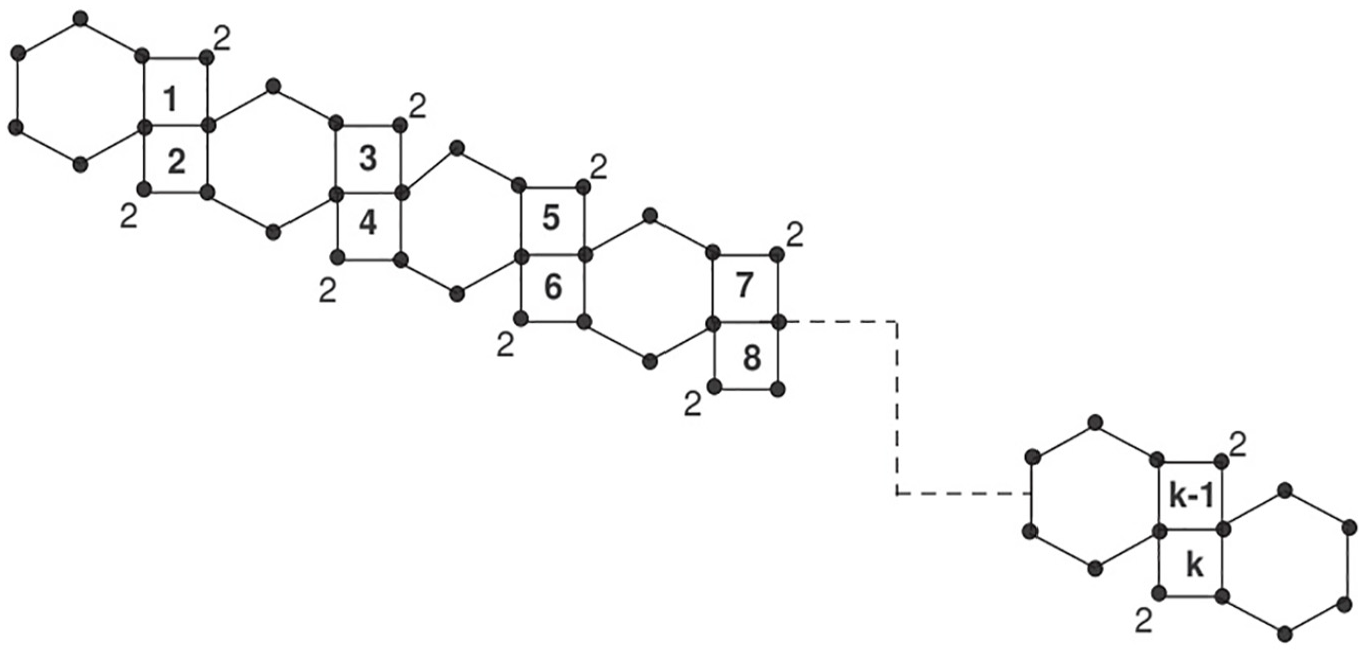
A kink chain having only two adjacent vertices of degree in hexagon except at terminal polygons. It is shown in Figure 7.
Kink chain :
Kink chain .
A Kink chain having three adjacent vertices of degree in hexagon except at terminal polygons. It is shown in Figure 8.
Kink chain .
In other words, there is no -degree edge, only one -degree edge and two adjacent -degree edges are in kink chains , and respectively. It holds for all hexagons except at terminal polygons.
As, in each kink chain, every non-terminal square is kink so each kink chain is a zig-zag chain.
Odd and even number of kinks formed
Let represents the number of squares which are kink in a chain. It is to be noted that in each kink chain when two squares are attached, as a result even numbered kink chains are formed. On the other hand, when a hexagon is attached at terminal, odd numbered kink chains are obtained. Thus to sum up, when terminal(closing) polygon is a square then odd numbered kink chains and when terminal polygon is a hexagon, even numbered kink chains are obtained. It holds for , and . For the sake of generality, we divide our all results into two cases as;
Case-I: When ;
Case-II: When ; .
Order and size of and
Now we define order and size of , and . Let and be the order and size of kink chains respectively. It is to be noted that order of each kink chain remains same in both cases and is given as . The size varies for and . For ; , the size of each kink chain is given as . while for , the size of each kink chain is given as .
Vertex and corresponding edge partitions of and
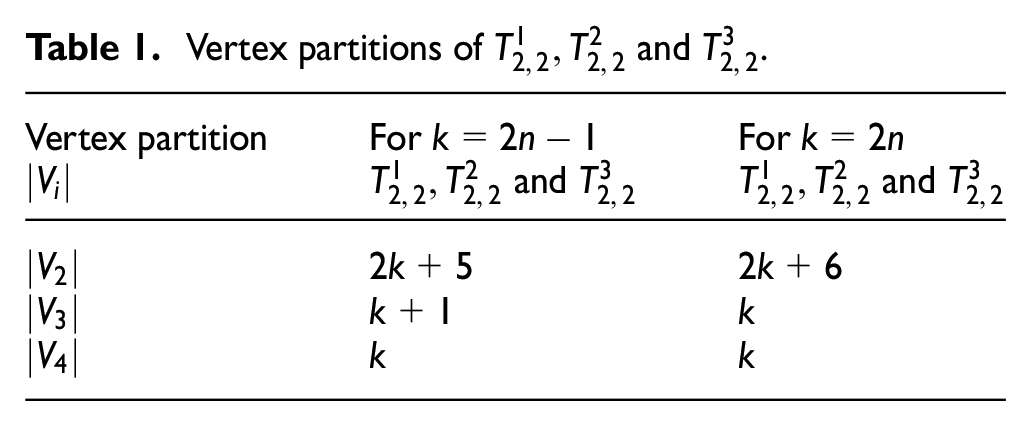
Let be the subclass of vertex set of and . There are only vertices of degree , and in each kink chain. Table 1 represents the cardinalities of vertices for and ; . It is interesting to note that cardinality of vertices remains same in both cases.
Vertex partitions of and .
Vertex partition
For
For
and
and
Let be the subclass of edge sets of and for corresponding edge partitions then |Ěij| denotes the edge partitions for each kink chain. Edge partitions also depends on the number of kinks in each kink chain. Observe that there are only , , , and -type of edges in each kink chain and . So, we have the cardinalities of type , , , and respectively. Table 2 represents the cardinalities of these edges of each kink chain accordingly.
Edge partitions of and .
Edge partition
For
For
)
Let denotes the kink chain for kinks of type and p varies from to .
Theorem 5.1.Let , then the forgotten topological index of kink chain is given as;
Proof. Let . Using the edge partition given in Table 2 and the definition of forgotten topological index, we get
Let . Using the edge partition given in Table 2 and the definition of forgotten topological index, we get
Theorem 5.2.Let , then the geometric arthemetic topological index of kink chain is given as;
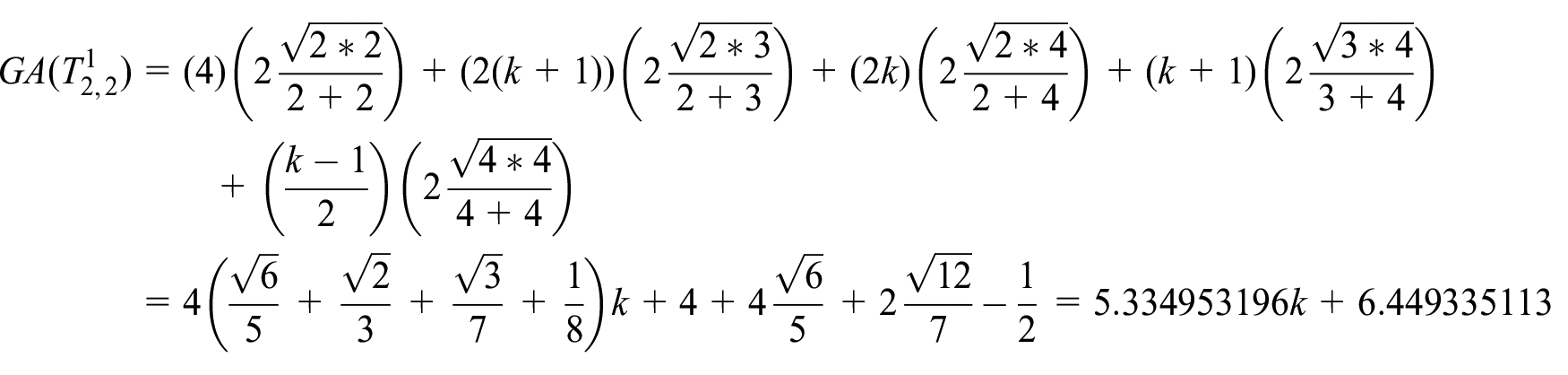
Proof. Let . Using the edge partition given in Table 2 and the definition of geometric arithmetic topological index, we get
Let . Using the edge partition given in Table 2 and the definition of geometric arithmetic topological index, we get
Theorem 5.3.Let , then the sum connectivity topological index of kink chain is given as
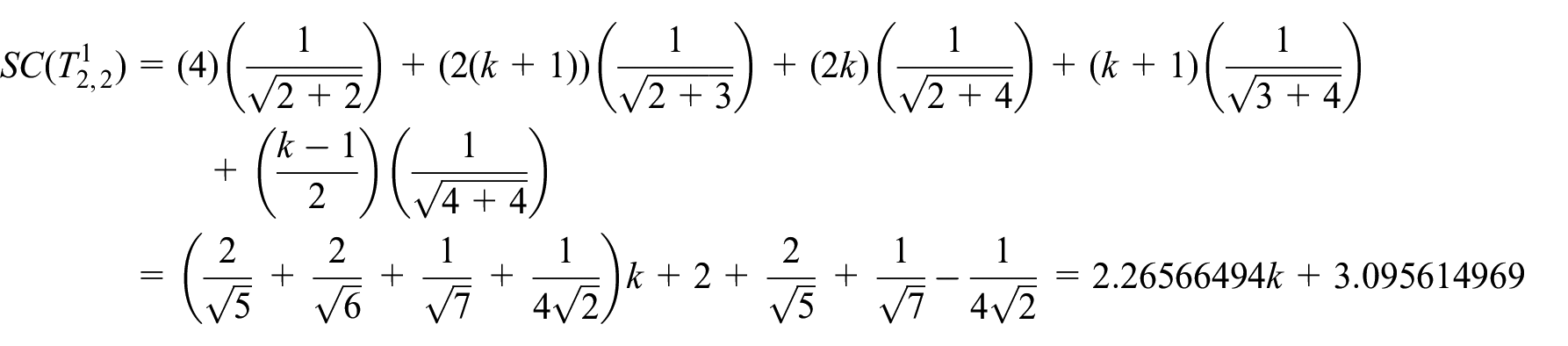
Proof. Let . Using the edge partition given in Table 2 and the definition of sum connectivity topological index, we get
Let . Using the edge partition given in Table 2 and the definition of sum connectivity topological index, we get
Theorem 5.4.Let , then the atom bond connectivity topological index of kink chain is given as;
Proof. Let . Using the edge partition given in Table 2 and the definition of atom bond connectivity topological index, we get
Let . Using the edge partition given in Table 2 and the definition of atom bond connectivity topological index, we get
A comparison of topological descriptors of , and
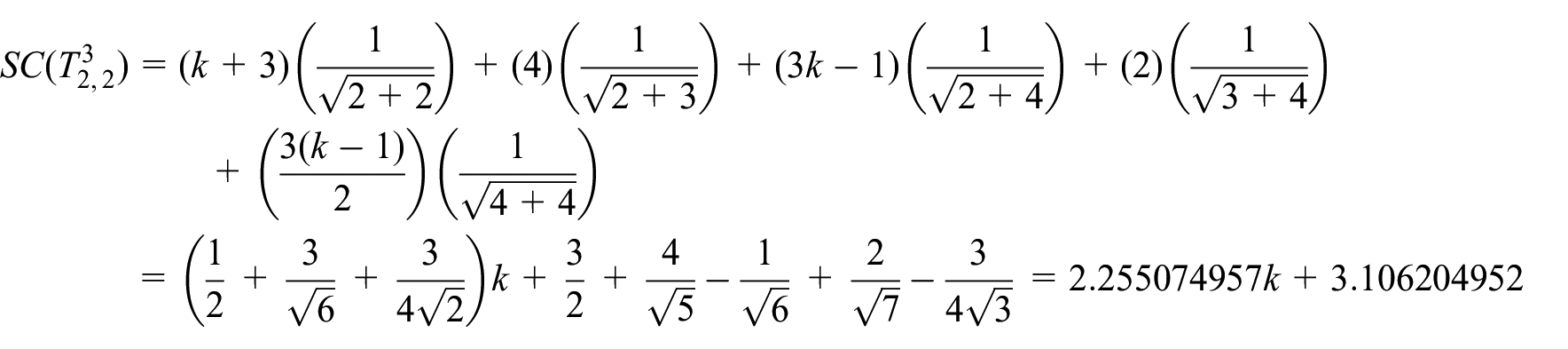
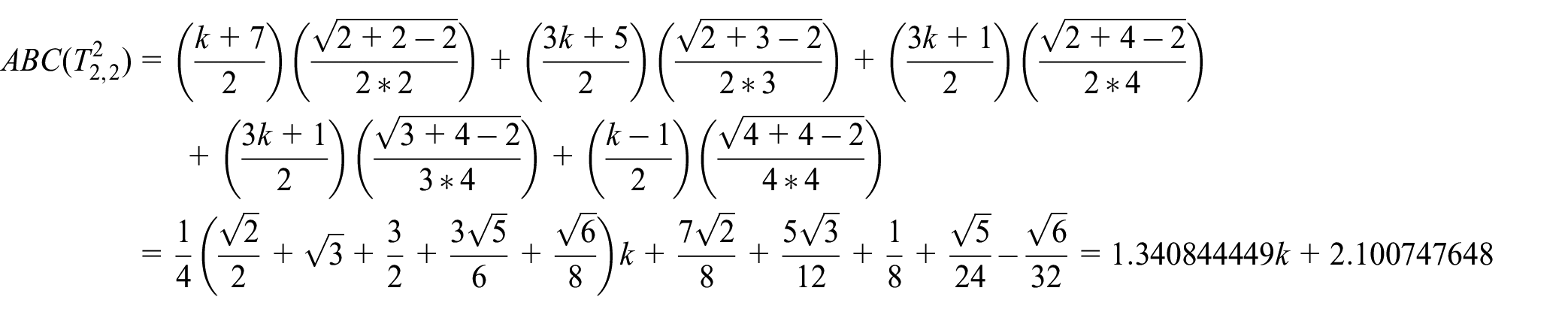
In this section, we give a comparison of forgotten, geometric-arthemetic, sum-connectivity and atom-bond connectivity descriptors for kink chains , and .
Tables 3 and 5 show the numerical values of forgotten, geometric-arithmetic, sum-connectivity and atom bond connectivity descriptors of , and for . Tables 4 and 6 show the numerical values of forgotten, geometric-arithmetic, sum-connectivity and atom bond connectivity descriptors of , and for . We can see that the forgotten topological descriptor of , and attains the maximum numerical value for both the cases, and , in comparison to the other topological descriptors. While the ABC descriptor of , and has minimum numerical value in both the cases.
Numerical values of forgotten and geometric-arthemetic topoloical descriptors of , and for .
Number of kinks
Forgotten index
Geometric-arthemetic index
1
174
174
174
11.78428831
11.78428831
11.78428831
3
388
348
406
22.4541947
22.52133308
22.44114256
5
602
602
638
33.12410109
33.25837785
33.09799681
7
816
816
870
43.79400749
43.99542263
43.75485106
9
1030
1030
1102
54.46391388
54.7324674
54.41170531
11
1244
1244
1334
65.13382027
65.46951217
65.06855956
13
1458
1458
1566
75.80372666
76.20655694
75.72541381
15
1672
1672
1798
86.47363305
86.94360171
86.38226806
17
1886
1886
2030
97.14353945
97.68064648
97.03912231
19
2100
2100
2262
107.8134458
108.4176913
107.6959766
Numerical values of forgotten and geometric-arthemetic topoloical descriptors of , and for .
Number of kinks
Forgotten index
Geometric-arthemetic index
2
262
262
262
16.66990639
16.66990639
16.66990639
4
476
476
494
27.33981278
27.40695116
27.32676064
6
690
690
726
38.00971918
38.14399594
37.98361489
8
904
904
958
48.67962557
48.88104071
48.64046914
10
1118
1118
1190
59.34953196
59.61808548
59.29732339
12
1332
1332
1424
70.01943835
70.35513025
69.95417764
14
1546
1546
1654
80.68934474
81.09217502
80.61103189
16
1760
1760
1886
91.35925114
91.8292198
91.26788614
18
1974
1974
2118
102.0291575
102.5662646
101.9247404
20
2188
2188
2350
112.6990639
113.3033093
112.5815946
Numerical values of sum-connectivity and atom bond connectivity topoloical descriptors of , and for .
Number of kinks
Sum-connectivity index
Atom bond connectivity index
1
5.361279909
5.361279909
5.361279909
3.441592079
3.441592079
3.441592097
3
9.892609789
9.915112377
9.871429823
6.122063723
6.123280995
6.107978205
5
14.42393967
14.46894484
14.38157974
8.802535367
8.804969893
8.774364313
7
18.95526955
19.02277731
18.89172965
11.48300701
11.48665879
11.44075042
9
23.48659943
23.57660978
23.40187957
14.16347866
14.16834769
14.10713653
11
28.01792931
28.13044225
27.91202948
16.8439503
16.85003659
16.77352264
13
32.54925919
32.68427472
32.42217939
19.52442194
19.53172548
19.43990875
15
37.08058907
37.23810718
36.93232931
22.20489359
22.21341438
22.10629485
17
41.61191895
41.79193965
41.44247922
24.88536523
24.89510328
24.77268096
19
46.14324883
46.34577212
45.95262914
27.56583687
27.57679218
27.43906707
Numerical values of sum-connectivity and atom bond connectivity topoloical descriptors of , and for .
Number of kinks
Sum-connectivity index
Atom bond connectivity index
2
8.3132988
7.531329881
7.53132988
4.801791988
4.801791987
4.801791987
4
13.6265976
12.08516235
12.04147979
7.482263632
7.483480885
7.468178095
6
18.9398964
16.63899482
16.55162971
10.16273528
10.16516978
10.1345642
8
24.2531952
21.19282728
21.06177962
12.84320692
12.84685868
12.80095031
10
29.566494
25.74665975
25.57192954
15.52367856
15.52854758
15.46733642
12
34.8797928
30.30049222
30.08207945
18.20415021
18.21023648
18.13372253
14
40.1930916
34.85432469
34.59222936
20.88462185
20.89192537
20.80010864
16
45.5063904
39.40815716
39.10237928
23.5650935
23.57361427
23.46649474
18
50.8196892
43.96198963
43.61252919
26.24556514
26.25530317
26.13288085
20
56.132988
48.51582209
48.12267911
28.92603678
28.93699207
28.79926696
Conclusion
In this article, we represent graphical structures of kink chains of type , named as , and . We computed their order, size and corresponding vertex and edge partitions in two cases, for and , (odd and even numbered kink chains respectively). We determined the explicit expression of forgotten index, sum connectivity index, atom bond connectivity index and geometric arithmetic index of these kink chains. Following that, we calculated the numerical values of attained topological descriptors for both the cases and observe that the numerical value of forgotten topological descriptor of , and in both cases attains maximum value than other topological descriptors. And numerical value of atom-bond connectivity descriptor of , and in both cases attains minimum value than others.
Footnotes
Handling Editor: Chenhui Liang
Declaration of conflicting interests
The author(s) declared no potential conflicts of interest with respect to the research, authorship, and/or publication of this article.
Funding
The author(s) disclosed receipt of the following financial support for the research, authorship, and/or publication of this article: This work is supported by the Natural Science Research Foundation of Colleges and Universities of Anhui Province (KJ2024AH051719, 2024AH050616) and Deanship of Scientific Research, Vice Presidency for Graduate Studies and Scientific Research, King Faisal University, Saudi Arabia [KFU241395].
Data availability statement
All data that support the findings of this study are included within the article (and any supplementary files).
ORCID iD
Salma Kanwal
References
1.
Garcia-DomenechRGalvezJde Julian-Ortiz, et al. Some new trends in chemical graph theory. Chem Rev2008; 108: 1127–1169.
2.
XiaoLChenSGuoZ, et al. The geometric-arithmetic index of benzenoid systems and phenylenes. Int J Contemp Math Sci2010; 5: 2225–2230.
3.
YangJXiaFChenS.On sum-connectivity index of polyomino chains. Appl Math Sci2011; 5: 267–271.
4.
FurtulaBGutmanI.A forgotten topological index. J Math Chem2015; 53: 1184–1190.
5.
ZhouBTrinajsticN.On a novel connectivity index. J Math Chem2009; 46: 1252–1270.
6.
GutmanITrinajsticN.Graph theory and molecular orbitals, total π-electron energy of alternant hydrocarbons. Chem Phys Lett1972; 17: 535–538.
7.
EstradaETorresLRodriguezL, et al. An atom-bond connectivity index: modelling the enthalpy of formation of alkanes. Indian J Chem1998; 37A: 849–855.
8.
EstradaE.Generalization of topological indices. Chem Phys Lett2001; 336: 248–252.
9.
VukičevićBFurtulaB.Topological index based on the ratios of geometrical and arithmetical means of end-vertex degrees of edges. J Math Chem2009; 46: 1369–1376.
10.
GaoWHusinMNFarahaniMR, et al. On the edges version of atom-bond connectivity index of nanotubes. J Comput Theor Nanosci2016; 13: 6733–6740.
11.
GaoWJamilMKNazeerW, et al. Degree-based multiplicative atom-bond connectivity index of nanostructures. IAENG Int J Appl Math2017; 47(4): 1–10.
12.
GaoWYanLShiL.Generalized Zagreb index of polyomino chains and nanotubes. Optoelectron Adv Mater Rapid Commun2017; 11: 119–124.
13.
KhaksariAGhorbaniM.On the forgotten topological index. Iran J Math Chem2017; 8: 327–338.
14.
ElumalaiSMansourTRostamiMA.On the bounds of the forgotten topological index. Turk J Math2047; 41: 1687–1702.
15.
ImranMAkhterS.Extremal cactus chains and polyomino chains with respect to general sum-connectivity index. Far East J Math Sci2018; 103: 1493–1509.
16.
KeXWeiSHuangJ.The atom-bond connectivity and geometric-arithmetic indices in random polyphenyl chains. Polycyclic Arom Compds2021; 41: 1873–1882.
17.
SigarretaSCSigarretaSMCruz-SuarezH.On degree-based topological indices of random polyomino chains. Math Biosci Eng2022; 19: 8760–8773.
18.
AlraqadTASaberHAliA, et al. On-bond incident degree indices of square-hexagonal chains. J Math2022: 1864828.
19.
HayatS.Distance-based graphical indices for predicting thermodynamic properties of benzenoid hydrocarbons with applications. Comput Mater Sci2023; 230: 112492.
20.
HayatSMahadiHAlanaziSJ, et al. Predictive potential of eigenvalues-based graphical indices for determining thermodynamic properties of polycyclic aromatic hydrocarbons with applications to polyacenes. Comput Mater Sci2024; 238: 112944.
21.
HayatSKhanAAliK, et al. Structure-property modeling for thermodynamic properties of benzenoid hydrocarbons by temperature-based topological indices. Ain Shams Eng J2024; 15: 102586.