



Abstract
In recent years, there has been a rising demand for minimizing any power loss in industrial applications due to the direct relation to economic as well as climate considerations. This work investigates the parameters that affect the frictional power loss in journal bearings as they are widely used in such applications. The frictional power loss is calculated considering misalignment conditions in the vertical and horizontal planes with the use of a modified bearing shape. Wide ranges of misalignment and bearing shape parameters are considered in the numerical investigation to study the combined effects of misalignment and bearing shape. It has been found that the misalignment significantly increases the frictional power loss at high operating speed levels. The use of a modified bush shape can play an important role in reducing the frictional power loss as well as, it added further advantages in elevating the lubricant film thickness and reducing the pressure levels. Results show that using a modified bearing shape despite the presence of severe misalignment levels reduces the maximum pressure from 20.30 to 17.94 MPa, increasing the minimum film thickness from 2.66 to 8.21
Introduction
Journal bearings are typically used in a wide range of critical positions in industrial applications such as internal combustion engines, turbines, and compressors. 1 The increase in power demand requires using equipment working at high speed levels which causes an increase in the frictional power loss in journal bearings. Recently, there has been a worldwide effort to minimize CO2 emissions, which requires minimizing frictional power loss. Researchers have investigated this concept over the last few years as the negative consequences of climate change have started to be more clear on a global scale. Studies were presented in Allmaier et al.2–4 to identify the power losses due to friction in journal-bearing systems using different operating conditions and supported loads. A comparison between a numerical solution and an experimental work for the calculation of frictional power loss in journal bearing was presented by Allmaier et al. 1 where excellent agreement was found. They found that the frictional power loss in the considered system of journal bearing was about 600 W when the operating speed was 2000 rpm compared to 1600 W when the speed was 4500 W which illustrates how the recent demand for using high operating speeds can increase the power losses. Another interesting study about the frictional power loss in journal bearing was performed by Knauder et al. 5 In their study, journal bearings in heavy-duty diesel engines are investigated for different operating conditions. They found that the frictional power loss depended on the operating speed in addition to the high operation load. Furthermore, they concluded that using ultra-low lubricant viscosity reduced the frictional losses by 8% but it showed a possibility of metal-to-metal contact at full load condition. A numerical investigation of a journal bearing of a hermetic reciprocating compressor was shown by Posch et al. 6 to examine the levels of friction power loss of the journal bearings considering different lubricant viscosities. A hydrodynamic lubrication model was developed by Razavykia et al. 7 to determine the characteristics of connecting rod big-end bearings, which also included the evaluation of the frictional power loss.
Maintaining optimal operating conditions for the journal-bearing system faces significant challenges. One of the most important and unavoidable problems in this concept is journal misalignment. Misalignment may result in large deformation, installation and manufacturing errors, and many other causes. It results in a sharp reduction in the lubricant thickness and also increases the pressure levels. Such changes clearly reduce the system’s performance. One of the early studies on the misalignment effect on energy loss in journal bearing was conducted by Safar, 8 where it was found that for the same supported load, a misaligned journal bearing consumed more power due to friction in comparison with the aligned journal bearing. The axial movement of misaligned journal bearing on the frictional power loss was investigated by Li et al. 9
An experimental study was performed by Bouyer and Fillon 10 to assess the journal bearing performance under misalignment, where they found about an 80% reduction in the film thickness level due to misalignment. A test bench was used by Sun et al. 11 to evaluate the performance of journal bearing under misalignment resulting from shaft bending, where they found that misalignment changes the pressure and lubricant thickness values as well as their distribution shapes. A relation among friction, misalignment, and wear levels was presented by Nikolakopoulos and Papadopoulos 12 based on a numerical solution method. The researchers have investigated the possible reduction of the negative effects of misalignment on system performance. One of the attempts was performed by Fillon and Bouyer 13 where pre-designed defects were used on the bearing geometry to increase the film thickness levels under misalignment conditions. A hyperboloidal bearing shape was by Strzelecki 14 for the purpose of increasing bearing load despite the misalignment presence. A variable bearing profile was used by Ren et al. 15 in order to improve the bearing performance.
Recently, the problem of frictional power loss in journal bearing has been investigated using different aspects. Tauviqirrahman et al. 16 explained how the relatively high-power loss in journal bearing affects the reliability of this type of bearings. They employed an artificial roughness in bearing in order to enhance performance behavior using computational fluid dynamics analysis. Liu et al. 17 used a multiobjective optimization method of journal bearing design. Double parabolic profiles and groove textures were considered in this method using Taguchi and grey relational analysis methods. Their results showed that the optimal combination of six design factors gave maximum load carrying capacity and minimum friction loss. Yang and Palazzolo 18 showed that the power losses in tilting pad journal bearing increase with machine size and speed. They suggested a novel power loss reduction technique based on a thermo-Elasto-Hydrodynamic simulation model. The results showed a power loss reduction up to 27%. Mandal et al. 19 investigated the frictional torque in journal bearings using Taguchi method where both experimental and analytical approaches were carried out to identify the optimal performance of the bearing. The frictional torque in journal bearing was also investigated by Biswas et al. 20 using response surface methodology. The results of the considered optimization strategy indicated a direct relation between peak pressure and frictional torque at a given pressure angle. The defined the presser ingle as the direction of the journal’s elevation relative to the bearing on the oil film.
It is clear that the frictional power loss has negative consequences on the economic and CO2 emissions considerations. Therefore, this work presents a detailed numerical evaluation for the effect of modifying the bearing geometry on the levels of frictional power loss in journal bearings. The numerical solution takes into consideration the presence of deviations (misalignment) in the journal axis with respect to the bearing longitudinal axis. Wide ranges of misalignment and geometry parameters are considered in this study.
Governing equations
The model used in the current work for the solution of the misalignment problem is illustrated in Figure 1. The governing equations for the solution of the ideal case will be represented at first and then the misalignment effect will be explained later.

Schematic drawing of the current model (enlarged scale). Green: aligned case, solid red: misaligned shaft (front), and dashed red: misaligned shaft (rear side).
The Reynolds and the film thickness equations are given by,21,22


where,
c: clearance.
In the steady state case,
The solution to the problem is performed using the Reynolds boundary method that uses the following conditions, 23
The position of the cavitation angle (
The load components, total load, and the attitude angle which are required in determining the convergence of the solution are given by 22




In the ideal aligned case the eccentricity ratio (i.e. the eccentricity distance,




where,
A detailed explanation of the misalignment model can be found in a previous work. 21
Misalignment results in a reduced clearance at the bearing edges as explained previously. Therefore, modifying the edges of the bush helps in increasing this gap. Figure 2 illustrates this modification in terms of two parameters which are
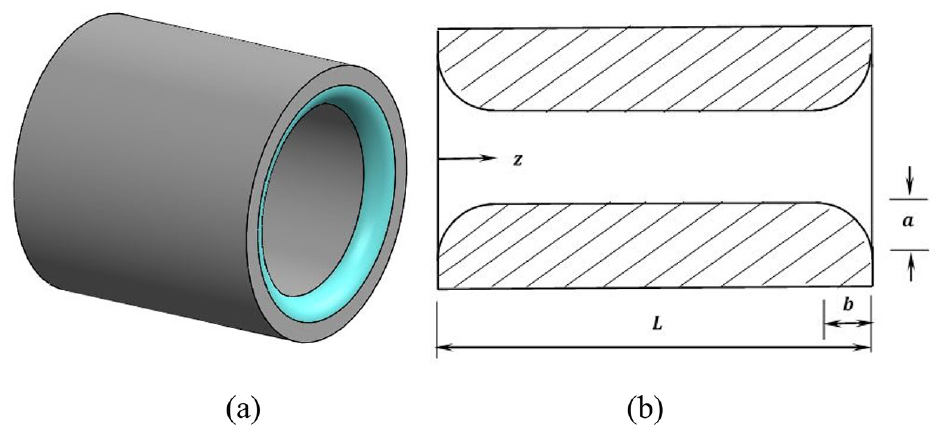
Modifying the bearing edges: (a) whole bush and (b) section illustrates the modification parameters.
The gap due to modification,



The coupling of equations (2), (7–10), and (11–13) results in the total gap between the shaft and the bush surfaces, considering the misalignment and the effect of edge modifications.
Frictional power loss
The frictional power loss (

The bearing forces (
Numerical solution
The finite difference method is used in discretizing the related equations. Then, the Gausses- Seidel method is adopted in solving the resulting equations where an overrelaxation scheme is considered to accelerate the convergence of the solution. More details about the discretizing steps can be found in the author’s previous work. 21 The convergence of the solution is based on pressure and load criteria. The pressure convergence criterion is given by,

After obtaining the pressure convergence, the bearing forces are calculated using numerical integration for the pressure distribution to determine the total load. If the resulting load is within a tolerance of

Solution steps.
Validation of the current model
The numerical solution is started with the mesh independency test to ensure the use of an adequate number of nodes in the solution space. After a series of tests, it has been found that using 65,341 nodes is sufficient enough to minimize any error in this direction. The results of the current model are compared with the corresponding results in Sun and Changlin
26
for system parameters of
Validation of the current model (

Results
The numerical solution is started with the mesh independence test to ensure the use of an adequate number of nodes in the solution space. The case of highest level of misalignment is examined in this test using wide range of nodes (N × M) in the circumferential (N nodes) and longitudinal (M nodes) directions. The maximum pressure, minimum film thickness, and frictional power loss are determined for each N × M case. After a series of tests, it has been found that using 65,341 nodes (

Variation of frictional power loss with the operating speed for the aligned case.
Figure 5 illustrates the misalignment effect on the frictional power loss when the operating speed is 5000 rpm. Figure 1(b) illustrated previously that the maximum deviations in the two planes are given by

Effect of misalignment on the frictional power loss (at 5000 rpm).
The misalignment effect on the frictional power loss is essentially related to its consequences on the maximum pressure (
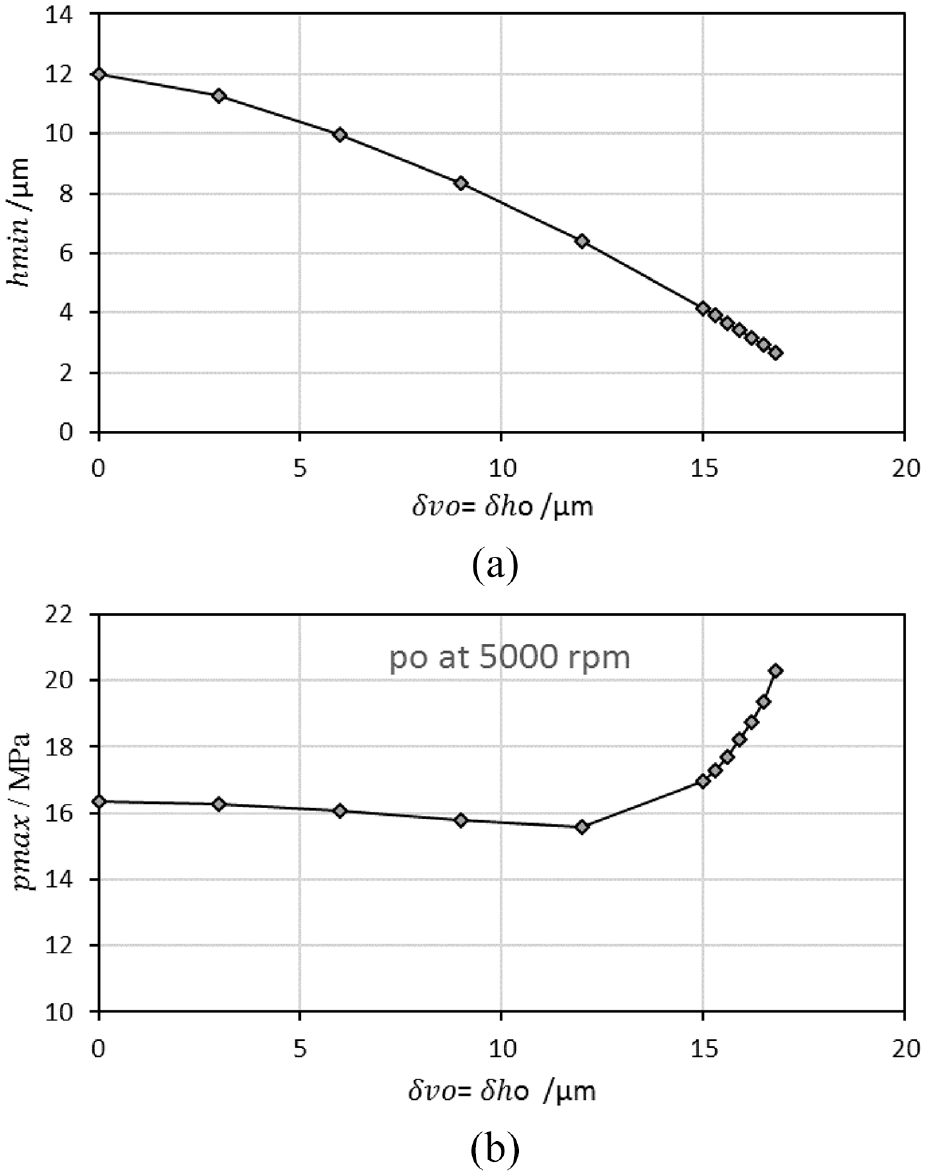
Misalignment effect on (a)
The misalignment effect on

Effect of changing bearing shape on
More details about the effects of changing the bearing shape on the pressure and film thickness distributions are shown in Figure 8. This figure compares the results of three cases, which are the ideal aligned case, the misaligned case, and the misaligned case with the change of bearing shape. It can be seen how the misalignment changes both distributions and causes pressure spikes close to the bearing edges. On the other hand, changing the bearing shape reduces the misalignment influence by elevating lubricant thickness levels and reduces the values of the pressure spikes as the red color (max. pressure and min. film) no longer appears in both distributions.

Pressure (left) and film thickness (right distributions for aligned (upper), misaligned (middle), and new bearing design (lower)).
Conclusions
This work presents a novel solution for the problem of misalignment in journal bearing in terms of using a modified bearing shape considering sever misalignment levels. The frictional power loss, minimum film thickness, and maximum pressure levels are all improved as a result of adopting such bearing shape. A numerical solution to evaluate the effectiveness of minimizing the frictional power loss in journal bearing associated with the shaft misalignment. The solution is performed using the finite difference method. The current solution is validated against the available solution in the literature, where excellent agreement is obtained. At first, the frictional power losses are evaluated for an ideal aligned case and then the misalignment effect on the power loss is determined for a wide range of misalignment parameters. It has been found that misalignment increases the frictional power loss by 10.12% at a misalignment parameter of 16.8
Footnotes
Appendix
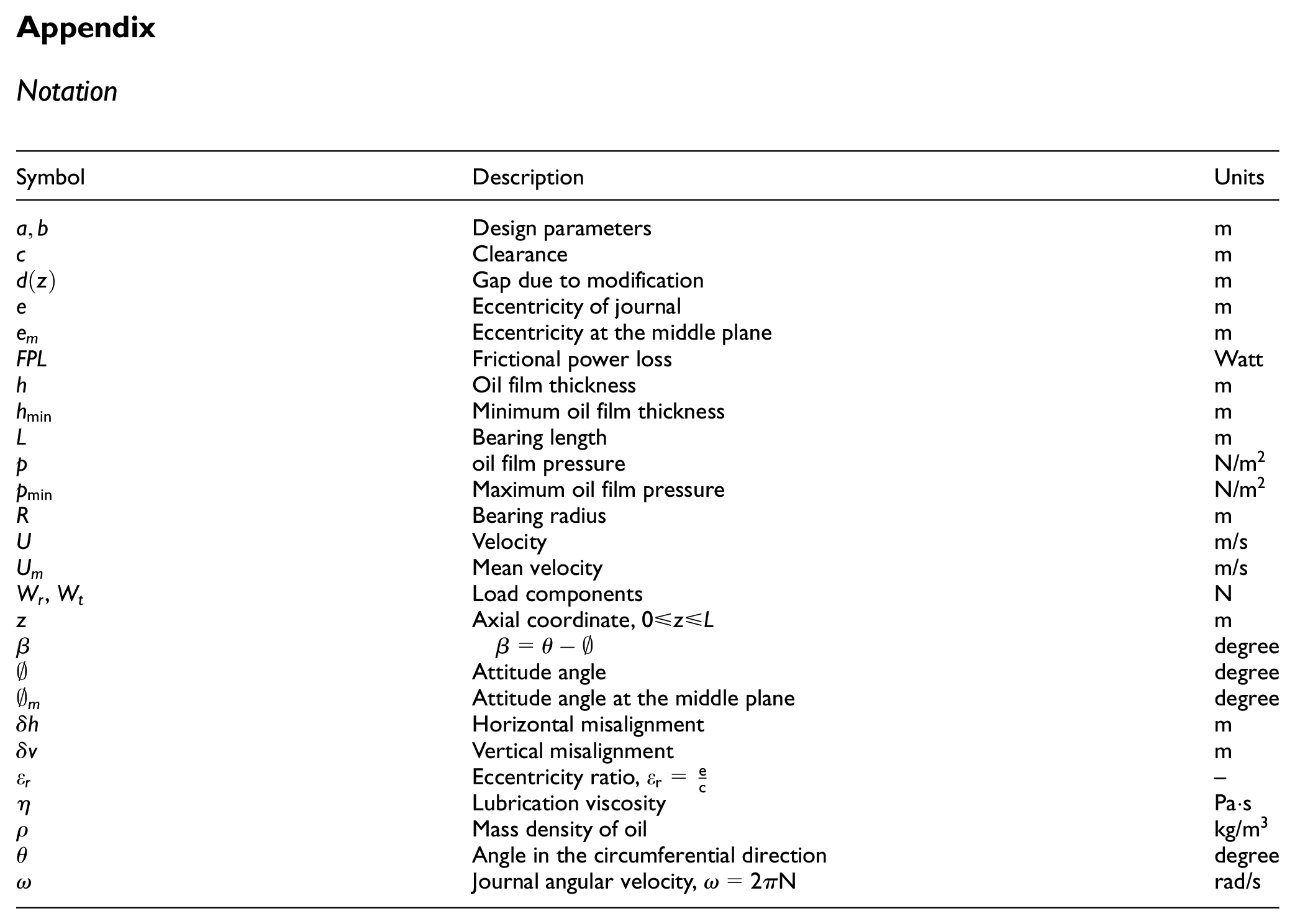
Notation
| Symbol | Description | Units |
|---|---|---|
| Design parameters | m | |
| Clearance | m | |
| Gap due to modification | m | |
| Eccentricity of journal | m | |
| Eccentricity at the middle plane | m | |
| FPL | Frictional power loss | Watt |
| Oil film thickness | m | |
| Minimum oil film thickness | m | |
| Bearing length | m | |
| oil film pressure | N/ | |
| Maximum oil film pressure | N/ | |
| Bearing radius | m | |
| Velocity | m/s | |
| Mean velocity | m/s | |
| , | Load components | N |
| Axial coordinate, | m | |
| degree | ||
| Attitude angle | degree | |
| Attitude angle at the middle plane | degree | |
| Horizontal misalignment | m | |
| Vertical misalignment | m | |
| Eccentricity ratio, | – | |
| Lubrication viscosity | Pa·s | |
| Mass density of oil | kg/ | |
| Angle in the circumferential direction | degree | |
| ω | Journal angular velocity, | rad/s |
Handling Editor: Sharmili Pandian
Declaration of conflicting interests
The author(s) declared no potential conflicts of interest with respect to the research, authorship, and/or publication of this article.
Funding
The author(s) received no financial support for the research, authorship, and/or publication of this article.

Data availability statement
The study did not report any data.