



Abstract
With the rapid expansion of the market for hybrid vehicles, the development of dedicated hybrid powertrain engines has become an important research direction. This study focuses on the techniques to improve the fuel economy of dedicated hybrid powertrain operating conditions of 2000 rpm, 110 Nm. Turbocharging can enhance the performance and fuel economy of gasoline engines while reducing emissions. However, intake boosting increases the pressure and temperature of the mixture in the cylinder at the compression end timing, leading to a higher risk of knock, which is not conducive to the safety and fuel consumption reduction of gasoline engines. Low-temperature combustion with mixture dilution can effectively reduce the occurrence of knock and NOx emissions. In this study, the effects of EGR and VVT strategies as different dilution methods on the combustion of turbocharged gasoline engines were investigated. The experimental results indicate that both EGR and VVT can achieve mixture dilution in the cylinder, reducing the combustion temperature and thus lowering NOx emissions. Furthermore, advancing the ignition timing results in CA50 trending towards the optimal fuel consumption point, shortening the combustion duration CA10–90, and reducing ISFC. Compared to VVT, EGR can better suppress knock, leading to an earlier ignition phase CA50, a shorter combustion duration, and ultimately less fuel consumption. The research findings provide technical support for the optimization of dedicated hybrid powertrain operating conditions.
Introduction
Hybrid powertrains have gained significant attention in the automotive industry due to their potential to improve fuel efficiency and reduce emissions. In this context, the development of specialized gasoline engines for hybrid applications has become a key area of research and development. These engines are designed to operate in conjunction with electric propulsion systems, utilizing a combination of internal combustion and electric power to achieve optimal performance. The development of hybrid powertrain-specific gasoline engines requires a thorough understanding of the performance characteristics under various operating conditions. This includes the investigation of factors such as valve timing, exhaust gas recirculation (EGR) strategies, prechamber jet ignition technology and combustion phasing, which can significantly impact the overall efficiency and emissions of the engine.1–4 In fact, the hybridization of powertrains may further enhance the benefits of EGR in fuel consumption by reducing the dependence of internal combustion engine (ICE) operation on the driver’s power demand. This allows the ICE to operate at medium loads, where the EGR benefit is more significant than at low loads in a gasoline-electric hybrid powertrain. Simulation results revealed that EGR improves fuel economy by 4.6% in the hybrid powertrain during a WLTP driving cycle, 2% more than in the conventional case. 5
The research and optimization of Exhaust Gas Recirculation (EGR) technology can better balance the performance and environmental impact of the engine. 6 The EGR turns to be reduce the combustion flame temperature in the combustion chamber of the engine. 7 Variable Valve Timing (VVT) technology can optimize the intake and exhaust flow, and the airflow in the combustion chamber, improving engine output power and fuel efficiency. With the increasing application of turbocharged gasoline engines, the optimization of VVT technology has become increasingly important. At the same time, the optimization of VVT technology also faces some challenges, especial for its complex structure. Therefore, research and optimization of VVT technology can better improve the performance and fuel efficiency of the engine.
EGR as low combustion strategy can reduce nitrogen oxide (NOx) emissions due to the low combustion temperature. Yu et al. 14 found that to increase the EGR rate the NOx emissions keeps decreasing, however, the Indicated Mean Effective Pressure (IMEP) increases at low EGR rate and then decreases at high EGR rate. It indicated when the EGR rate is high, combustion may deteriorate. The Brake Specific Fuel Consumption (BSFC), CO and HC also have the same trend with IMEP. The EGR technology can obtain earlier ignition timing by knock suppressing. Lou et al. 8 investigated the influences of EGR rate on spark timing advancing. The findings indicated that elevating the EGR rate expands the range of spark timing and decelerates combustion, leading to prolonged ignition delay, extended combustion duration, and reduced heat release rate. Initially, the peak in-cylinder pressure (PCP) and indicated thermal efficiency (ITE) rise due to higher boost pressure accompanying the increased EGR rate. However, with further increments in EGR rate, PCP and ITE decline due to the deviation in combustion phasing. The higher EGR rate induces lower in-cylinder temperatures, resulting in a significant reduction in nitrogen oxide (NOx) emissions, but an increase in total hydrocarbon (THC) and carbon monoxide (CO) emissions, with THC emissions potentially escalating exponentially at elevated EGR rates. The increase of THC emissions is one major problem by using high EGR rate. Advanced gasoline engines are poised to shape the medium-term future of the passenger vehicle market, operating in both conventional and hybrid powertrains. Among various strategies to enhance fuel economy in gasoline engines, downsizing with turbocharging stands out as a widely adopted approach. Galindo et al. 9 assessed the impact of EGR on the transient response of a turbocharged gasoline engine, focusing on three air management strategies to expedite response times during tip-in maneuvers at 1500 rpm (6–12 bar BMEP). These strategies involve reducing EGR dilution by synchronously closing the EGR valve with throttle opening, utilizing a pressurized air tank (PAT), and integrating an electric supercharger at the compressor outlet in series. Experimental findings indicate a 2-second delay in torque response time with EGR compared to without EGR. 1D modeling simulations highlight that the PAT connected to the intake manifold offers the swiftest response, while the electric supercharger presents a favorable balance between fuel efficiency and torque response. Dong et al. 10 found that the external EGR achieved better fuel economy than the inner EGR by suppressing the knocking with reduced fuel consumption. Gong et al. 11 compared the effects of excess air ratio and EGR on the gasoline engine performance of combustion and emissions. The combustion phase and duration delayed slowly with simulated EGR. In addition, the CO emission with lean combustion, and HC emission at stoichiometric combustion changed a little with the addition of EGR. Bozza et al. 12 used simulation method to study the effects of various EGR amounts are investigated in terms of fuel consumption at full load operations. The new concept engine for prechamber jet ignition has showed perfect performance to improve the engine thermal efficiency. Zhou et al. 13 found that the high EGR rate led to low indicated specific fuel consumption at low load. Yu et al. 14 studied the effects of EGR on gasoline engine with ethanol direct injection. Results showed that CO, HC, and BSFC first decreases and then increases, however, the COV, CA 0–10, and CA 10–90 all increased. Zhao et al. 15 succeed increased the compression ratio of SI engine by using EGR strategies. For Miller cycle turbocharged SI engine, Shen et al. 16 achieved low fuel consumption by EGR addition. Thus, a proper EGR rate induces better fuel consumption with low NOx emissions.
The optimized VVT system can also achieve lower fuel consumption and NOX emissions in turbocharged gasoline engines. The VVT system are utilized to introduce internal exhaust gas recirculation, yielding benefits in fuel efficiency and emissions control. In addition, the VVT system can suppress the SI engine knock by residual gases in the cylinder. 17 The Miller cycle for the engine with VVT system, known for its excellent knock suppression performance which also can obtain low-temperature combustion in the cylinder. Wei et al. 18 found that the Miller cycle with intake boost pressure and split injection demonstrates significant potential in achieving improved knock resistance and increased engine power. Wang et al. 19 used a multi-objective genetic algorithm to optimize the EGR and VVT parameters of a turbocharged gasoline engine. They found that under the optimal parameters, the engine’s fuel economy and emission performance were significantly improved. De Bellis 20 studied the effects of VVT system on the knock of the SI engine by simulation. Dong et al. 10 studied the effects of EGR and VVT on combustion and emissions of turbocharged gasoline engines. It found that the combination of EGR and VVT can significantly improve the engine’s combustion characteristics and emission performance. Especially under high load conditions, the combination of EGR and VVT can reduce NOx emissions.
In this paper, the study focuses on the performance of a hybrid powertrain-specific gasoline engine. The study investigates the influence of external EGR, intake valve closing timing (IVC), and exhaust valve closing timing (EVC) on indicated specific fuel consumption (ISFC) under specific operating conditions. The findings provide valuable insights into the optimization of gasoline engines for hybrid powertrains, contributing to the advancement of sustainable and efficient automotive technologies.
Engine parameters and experimental equipment
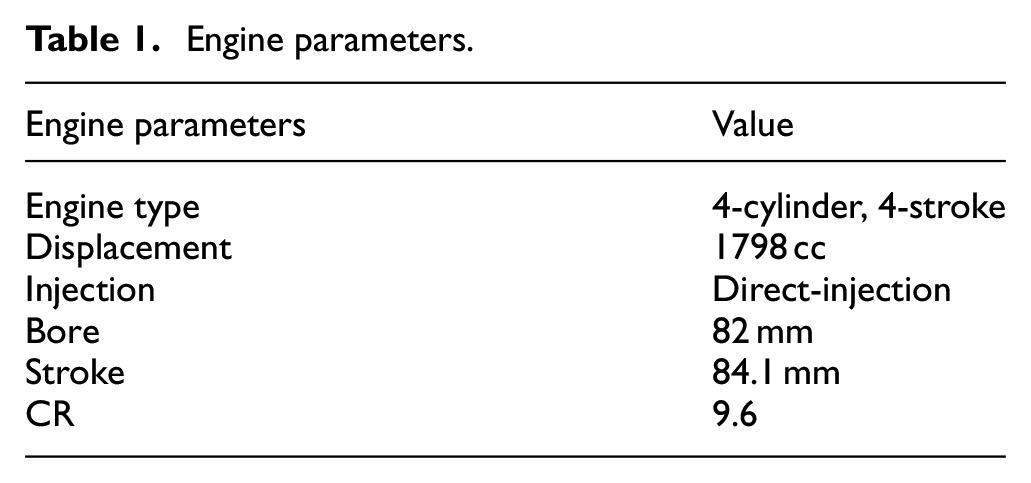
The engine used in this study is a 4-cylinder turbocharged direct injection gasoline engine. The engine has a displacement of 1798 cc and a compression ratio of 9.6. The engine bore is 82.1 mm, and the stroke is 84.1 mm as shown in Table 1. The experimental test bench is shown in Figure 1. The test bench uses an eddy current dynamometer (CW260) with a maximum speed of 7500 r/min, which meets the full load requirements of the target engine. A type of NI-CRIO-EC1408 is used to control the engine load and combustion conditions, such as spark ignition. A combustion analyzer (KIBOX2893 AK121) is used to obtain combustion parameters. In addition, a Kistler 6052C with high sensitivity was used to test the pressure in the combustion chamber, and the measuring frequency is 160 kHz. The combustion analysis is based on the KIBOX2893 AK121 by using apparent heat release. The microphone near the engine is used to listen the combustion noise to judge the knocking sound of combustion in the cylinder along with the ignition timing advancing. In addition, the Pmax variation is also used to analysis the knock occurrence. The combustion analysis for the main combustion parameters CA10, CA50, and CA10–90 are based on offline data processing. The air-fuel ratio can be controlled and tested using an exhaust gas analyzer (HORIBA-MEXA7100DEGR) and an air-fuel ratio measuring instrument (ETAS-ES630). The experiment used stoichiometric combustion. The layout of the experimental engine is shown in Figure 1. It is a turbocharged gasoline engine equipped with low-pressure EGR and variable valve timing. The EGR loop includes an EGR valve, EGR pipe, and EGR cooler, which supports the introduction of combustion gas into the engine intake side. It is a low-pressure EGR, where the exhaust gas after the turbocharger is introduced into the cylinder, and for the high temperature of the exhaust gas, the EGR cooler is used to cool the exhaust gas before it enters the cylinder, otherwise, the intake pipe may be damaged, and high temperature intake is not conducive to suppressing engine knock. The EGR valve is used to regulate the mass flow rate of exhaust gas entering the cylinder. The EGR rate is expressed and calculated using the EGR method for the parameters of the exhaust gas used. The EGR rate calculation formula is shown in equation (1), in which is the CO2 (intake) represents the mass of CO2 in the intake air after mixing fresh air with EGR exhaust gas, the CO2 (intake) represents mass of CO2 in the exhaust gas.

Engine parameters.

Schematic diagram of experimental equipment.
The temperature of the gas is a key factor affecting the speed of laminar combustion. The higher the mass fraction of residual gas, the higher the temperature of the end gas under IVC, leading to higher average combustion temperature in the cylinder. The mass fraction of residual gas can be adjusted by overlapping the intake and exhaust valve timing. Therefore, adjusting the valve timing will result in changes in exhaust pressure, leading to pumping losses in the engine. Introducing combustion gas and cooled combustion gas into the cylinder through an external EGR loop can reduce the maximum combustion temperature, thus lowering combustion parameters.
In this study, the external EGR of the engine was set at 0%, 5%, 10%, and 15%. The internal EGR, which has the characteristics of exhaust gas recirculation caused by valve overlap, can be obtained through valve overlap. At the same time, the duration of valve overlap can be changed by various intake and exhaust valve timings. The VVT timing is changed by the open ECU in the experiment. In this way, the overlap value was selected as 70CA (the maximum overlap of the engine), 60CA, and 50CA to study the effects of overlap and different overlap strategies on combustion, emissions, and engine performance. Since valve overlap can be obtained by changing IVC or EVC, these two different strategies may have different effects on combustion. The coefficient of variation (COV) of the indicated mean effective pressure (IMEP) represents the cycle-to-cycle variations of combustion in the cylinder. Under the experimental conditions, this value was maintained at 3% to avoid damaging the engine in the experimental test. The common operation point of the hybrid powertrain system is 2000 rpm, 110 Nm which is optimized by EGR and VVT strategies.
Results and discussions
Influence of intake valve closing timing (IVC) on combustion characteristics of gasoline engine
In the engine bench experiment, with the EGR rate maintained at 0% and the exhaust valve closing timing set at EVC of 5°CA ATDC, the intake valve closing timing (IVC) was adjusted from −20°CA ABDC to 30°CA ABDC, that is, advancing the intake valve closing timing, with a maximum delay of 50°CA. Under the condition of constant exhaust valve closing timing, a delayed intake valve closing timing will reduce the intake and exhaust valve overlap angle, directly affecting the residual gas fraction in the cylinder, thus influencing the temperature and combustion characteristics of the mixture in the cylinder.
As shown in Figure 2, the graph of the combustion phase CA50 with the variation of intake valve closing timing (IVC) illustrates that the combustion phase is significantly affected by the intake valve closing timing (IVC). With the delayed intake valve closing, the combustion phase generally shows a pattern of first delay and then advance. The experimental results all used the ignition timing at the knock limit, with the earliest combustion phase at 16.5°CA ATDC, indicating that by improving the tendency of knock, the combustion phase can be significantly increased to the optimal MBT point (8°CA ATDC). For the same set of valves, a delayed intake valve closing implies delayed intake valve opening, and under the condition of constant exhaust valve closing timing, the intake and exhaust valve overlap angle decreases, meaning the crankshaft angle range during which the intake and exhaust valves are simultaneously open decreases. Generally, a larger valve overlap angle will result in a larger amount of residual gas in the cylinder. The amount of residual gas in the cylinder, also known as internal EGR, is not only related to the valve overlap angle but also to the intake and exhaust pressures. Proper residual gas retention helps to improve knocking. The residual gas in the cylinder is high-temperature gas, which leads to an increase in the initial temperature in the cylinder, thereby affecting the temperature of the unburned mixture, and consequently influencing the combustion phase CA50. However, the residual gas in the cylinder contains a large amount of CO2, and CO2 is an inert gas with a high heat capacity, which can slow down the combustion rate and reduce the combustion temperature. However, an excessive amount of CO2 can lead to deteriorated combustion and a decrease in peak cylinder pressure. The combined effect of the two factors affects the combustion process in the cylinder, thereby influencing the combustion temperature and the knock limit. Therefore, obtaining the optimal valve overlap angle to achieve suitable internal EGR is crucial.

Changes in combustion phase CA50 under different VIC conditions.
In order to comprehensively analyze the impact of intake valve closing timing (IVC) on the combustion process, the variation of the engine combustion duration (CA10–90) with IVC advanced from −20°CA ABDC to 30°CA ABDC is shown in Figure 3. A shorter combustion duration indicates a faster combustion speed and higher thermal efficiency. It can be observed from the graph that the combustion duration varies with the change in IVC, but the fluctuation is not significant, with a maximum difference of approximately 1°CA. This suggests that the combustion control parameters can be moderately regulated by adjusting the IVC.

Combustion duration CA10–90 under different VIC conditions.
The change in IVC causes variations in intake and exhaust pressures, thereby affecting the Friction Mean Effective Pressure (FMEP). A smaller FMEP indicates lower engine friction losses and higher efficiency. Figure 4 illustrates the variation of FMEP under different IVC conditions, showing that as IVC is delayed, FMEP increases, with a larger delay resulting in a greater increase. This is due to the simultaneous intake and exhaust events occurring during the valve overlap period after the intake valve opens, causing pressure differences and subsequently influencing FMEP. Notably, a smaller FMEP is observed when IVC is delayed, and when IVC is set at −20°CA ABDC.

FMEP under different IVC conditions.
The influence of IVC on Indicated Specific Fuel Consumption (ISFC) is depicted in Figure 5. A smaller ISFC indicates lower fuel consumption. With delayed IVC, ISFC initially increases and then decreases, reaching a minimum value when IVC is set at −20°CA ABDC. Therefore, IVC affects the valve overlap angle, leading to changes in residual gas in the cylinder, which in turn affects combustion speed and fuel consumption.
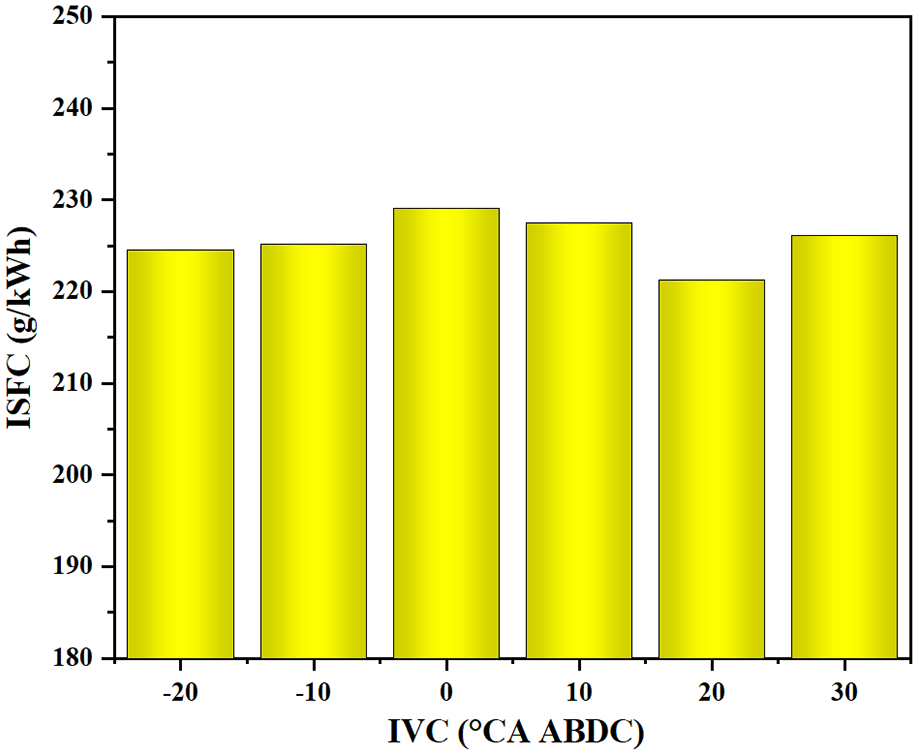
ISFC under different IVC conditions.
In conclusion, the intake valve closing timing (IVC) significantly impacts the combustion process, and by adjusting IVC, combustion control parameters can be moderately regulated, influencing the valve overlap angle and residual gas in the cylinder.
The impact of external EGR on the combustion characteristics of gasoline engines
For gasoline engines, knock-limited combustion is a major factor that affects engine efficiency. Therefore, improving the knock limit of gasoline engines and advancing the ignition timing as much as possible are effective means of enhancing engine efficiency. Knock-limited combustion in gasoline engines is directly related to combustion temperature. One limited way to improve the knock limit is by reducing the combustion temperature. Utilizing low-temperature combustion strategies such as lean combustion and dilution combustion is an effective technical approach to achieving low-temperature combustion. Low-temperature EGR can dilute the gasoline/air mixture with CO2, and the high specific heat capacity of CO2 can lower the combustion temperature, effectively widening the knock limit, advancing the ignition timing, and improving combustion.
As shown in Figure 6, the influence of EGR rate on the combustion phase CA50 (IVC = 0°CA ABDC, EVC = 5°CA ATDC) is depicted. As illustrated in Figure 6, as the EGR rate increases from 0% to 15%, the combustion phase CA50 first advances and then delays. The combustion phase at an EGR rate of 0% is CA50 = 19.2°CA ATDC, while at an EGR rate of 10%, the combustion phase advances to CA50 = 12.7°CA ATDC. The main reason is that with the increase of EGR rate, more CO2 mixed in the air/fuel mixture of the cylinder, which induced low combustion temperature. Moreover, the combustion knock was suppressed under decreased combustion temperature in the combustion chamber. Thus, the ignition timing can future advanced. However, at the high EGR rate of 15%, too much CO2 led to too low combustion temperature which caused the combustion phase delays to CA50 = 12.9°CA ATDC. This is because although EGR can lower the combustion temperature, it can also lead to slower combustion, resulting in combustion phase delay under high EGR rate conditions.
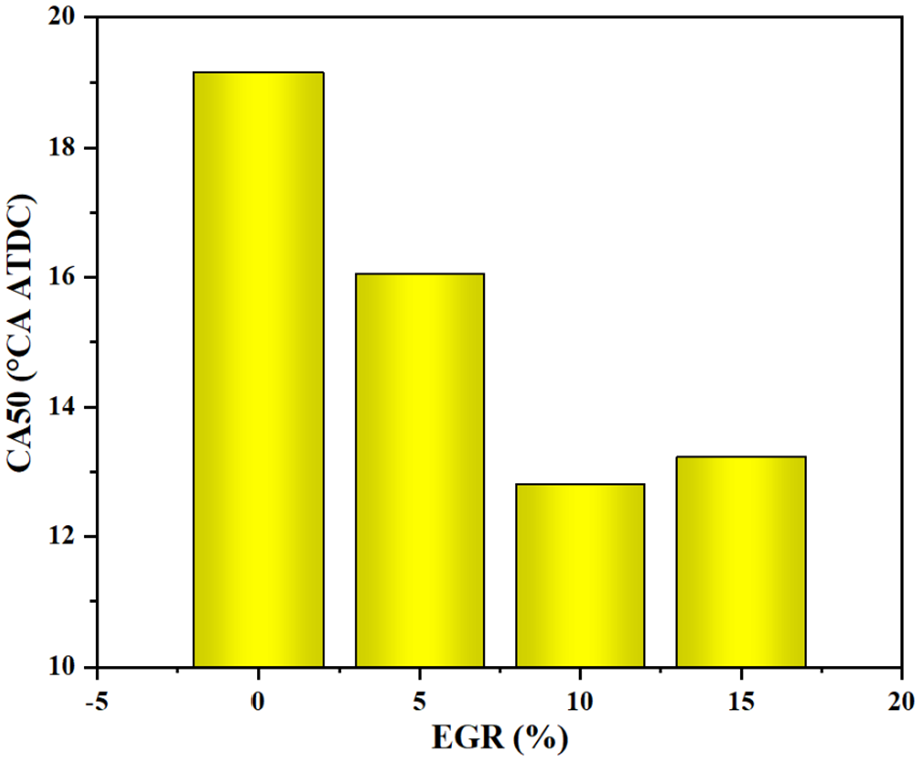
Effect of EGR rate on combustion phase CA50 (IVC = 0°CA ABDC).
To further evaluate the impact of EGR rate on the combustion characteristics of gasoline engines, the variation of combustion duration and ISFC with EGR rate is shown in Figures 7 and 8. From Figure 7, it can be observed that as the EGR rate increases from 0% to 15%, the combustion duration CA10–90 increases from 13.5°CA to 15.8°CA. This is because with the increase in EGR rate, the proportion of exhaust gas in the gasoline/air/exhaust gas mixture increases, and the exhaust gas contains a large amount of CO2, which dilutes the mixture, lowers the combustion temperature, extends the knock limit, and helps advance the combustion phase as shown in Figure 6. However, the addition of EGR reduces the combustion temperature, leading to a slower combustion speed, resulting in an increase in the combustion duration CA10–90. The FMEP also shows an increasing trend with the increase in EGR rate as shown in Figure 8, except for the case of 10% EGR rate. As the calculation of break mean effective pressure (BMEP) is achieved by IMEP removing FMEP and PMEP. The high EGR rate has a weak effect on the BMEP production of the engine.
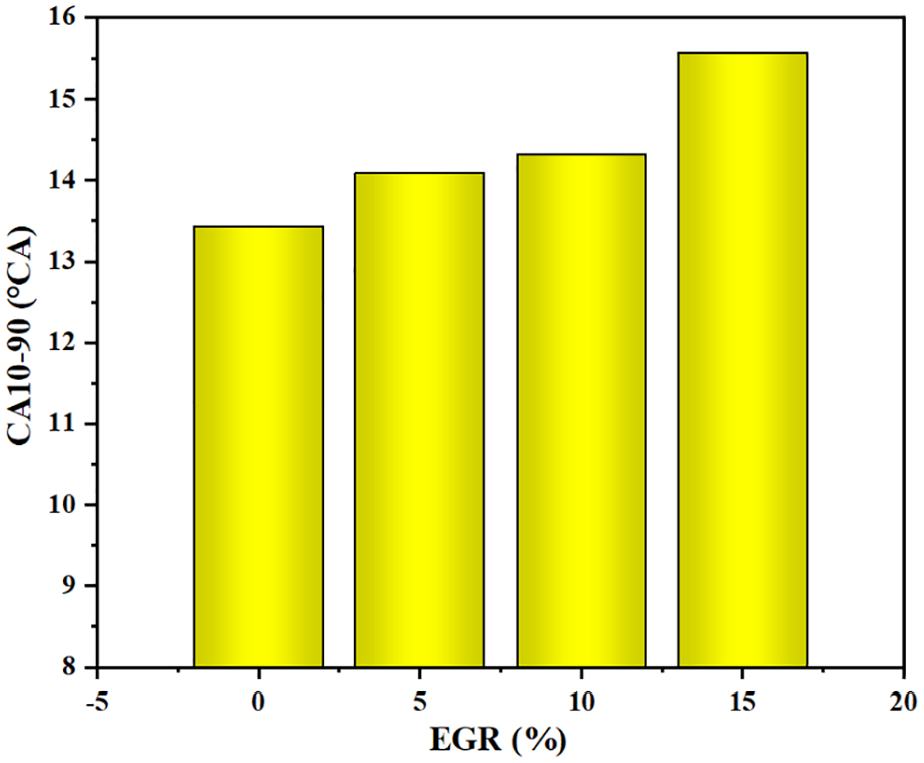
Effect of EGR rate on combustion duration CA10–90 (IVC = 0°CA ABDC).

Effect of EGR rate on FMEP (IVC = 0°CA ABDC).
Looking at the indicated specific fuel consumption (ISFC) in Figure 9, it can be seen that ISFC continuously decreases with the increase in EGR rate, reaching the minimum at 15%. After the implementation of the EGR strategy, the combustion characteristic parameter CA50 advances, while the combustion duration increases, ultimately leading to a continuous improvement in indicated specific fuel consumption (ISFC). This indicates that the external EGR strategy has a significant impact on the combustion of gasoline engines, and the addition of EGR strategy can improve fuel consumption.
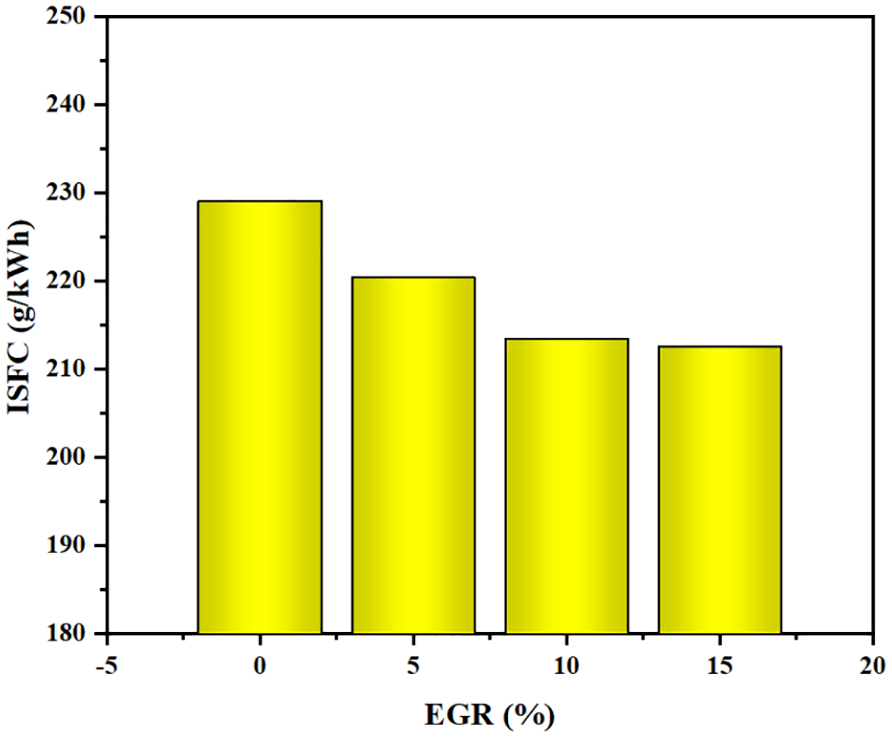
Effect of EGR rate on ISFC (IVC = 0°CA ABDC).
The comprehensive impact of intake valve closing timing (IVC) and external EGR on fuel consumption in gasoline engines
From the above analysis, it can be seen that the variation in residual gas in the cylinder caused by the intake valve closing timing has a relatively small impact on the combustion of gasoline engines, while the external EGR strategy has a greater impact on low-temperature combustion caused by the dilution of the mixture. Therefore, it is of great significance to comprehensively consider and optimize both strategies to improve fuel consumption. Figure 10 shows the variation of indicated specific fuel consumption (ISFC) under different EVC and IVC conditions when the external EGR strategy is not used. It is evident that with the exhaust valve closing timing (EVC) at 5°CA ATDC, the corresponding ISFC remains at a relatively low level as the intake valve closing timing (IVC) changes. The minimum ISFC of 221.3 g/kWh is obtained when IVC is 20°CA ATDC. It can be concluded that the coordinated variation of IVC and EVC has a significant impact on ISFC, highlighting the importance of comprehensively optimizing IVC and EVC.

Impact of IVC and EVC on ISFC (EGR = 0%).
In order to further clarify the impact of the variation in intake valve closing timing (IVC) and exhaust valve closing timing (EVC) on indicated specific fuel consumption (ISFC) when using external EGR strategy, engine bench tests were conducted to investigate the changes in ISFC under comprehensive variations of IVC and EVC with an external EGR rate of 15%, as shown in Figure 11. The results indicate a significant decrease in ISFC under the 15% EGR rate compared to the case without EGR, with the maximum fuel consumption also lower than the minimum ISFC under the condition without external EGR. This suggests that the external EGR has a greater impact on ISFC in gasoline engines compared to the variation in IVC and EVC. It is also observed from the figure that ISFC is relatively low when EVC is at −5°CA ATDC and −15°CA ATDC, and the lowest ISFC of 210.9 g/kWh is obtained when IVC is at 0°CA ABDC. This analysis indicates that a comprehensive optimization approach to coordinate external EGR, IVC, and EVC can achieve the optimal ISFC, significantly improving the fuel economy of gasoline engines.

The impact of IVC and EVC on ISFC (EGR = 15%).
Conclusions
The impact of different technical strategies on the performance of gasoline engine hybrid powertrain specific operating points was studied using experimental testing methods. The main conclusions of the study are as follows:
(1) The SI gasoline engine can achieve better fuel economy by using EGR and optimized intake/exhaust valve timing which is due to the suppressed knock and advanced spark timing. The lowest ISFC of 210.9 g/kWh is obtained when the intake valve closing timing (IVC) is at 0°CA ABDC.
(2) The external EGR strategy can reduce combustion temperature, suppress knock combustion, advance the combustion phase compared to IVC and EVC, and further reduce indicated specific fuel consumption, thereby improving engine efficiency for the hybrid powertrain engine load of 2000 rpm, 110 Nm.
(3) In considering of added price of the hybrid powertrain system, a EGR system can achieve lower fuel consumption than VVT system. Thus, an optimized VVT valve timing and EGR system is good choice for hybrid powertrain system.
Footnotes
Handling Editor: Sharmili Pandian
Declaration of conflicting interests
The author(s) declared no potential conflicts of interest with respect to the research, authorship, and/or publication of this article.
Funding
The author(s) received no financial support for the research, authorship, and/or publication of this article.
