



Abstract
This study aimed to reduce the vibration of an aluminum plate using a single lead zirconate titanate (PZT) electrical circuit. First, the natural frequencies and modes of the aluminum plate were analyzed using an analytical method to determine the dynamic characteristics of the plate. The frequency domain was used to derive the vibration characteristics of the acoustically excited aluminum plate. It was noted that the resonance region where the vibration of the panel increased rapidly was at 390 Hz, which was then set as the reduction target. Thereafter, the vibration reduction performances of the circuit that connects only the resistance element to the PZT panel and the resonant circuit that uses an inductor were compared. Through actual acoustic excitation, the vibration reduction of the aluminum panel using the PZT panel based on resistance and resonance circuits was validated. The results demonstrated that the vibration in the resonant frequency region of 384 Hz was reduced by 20% through the implementation of a resonant circuit, comprising an inductor and a resistor, added to a single PZT, whose weight was 0.08% of the weight of the aluminum panel. Therefore, this study confirmed that the vibration of aluminum plates can be effectively reduced using a low-weight PZT patch.
Keywords
Introduction
When an external force is applied to piezoelectric materials, the materials undergo structural deformation and generate electricity. Piezoelectric materials with unique properties are widely used in various engineering fields. Using the characteristics of electricity generated by external excitation applied to piezoelectric materials, they are commonly used as a basic material for sensors, such as vibration and noise measurements. 1 In addition, the properties of piezoelectric materials can be used to monitor the state of the structures. Ongoing research endeavors involve the implementation of lead zirconate titanate (PZT) sensors embedded within structures to monitor the impedance of hydrating cementitious materials or to identify damage caused from external impacts.2,3 The PZT panel has an embedded form to measure vibration and monitor the structural state using electricity generated during vibration. Hence, it does not require a separate external power source, as the piezoelectric sensor can generate electricity when an external force is applied.4,5
To enhance the use of piezoelectric materials, research on energy harvesting technology has been conducted. The basic concept of energy harvesting is to convert the vibrational energy generated by piezoelectric materials into usable electrical energy.6,7 The major advantage of energy harvesting using piezoelectric materials is that they can be manufactured in lightweight and thin form and have a wide range of voltages and power densities. 8 Recently, a study was conducted to extract energy from noise generated by high-speed trains using a Helmholtz resonator. 9 In this study, it was confirmed that a voltage of 0.7 V can be obtained by a piezoelectric material based on noise generated in the vicinity of a low-frequency region of 174 Hz. It was confirmed that the low-vibration energy acting on the piezoelectric material could be effectively amplified using a resonance device and used to obtain electrical energy.
Compared to the active application of piezoelectric materials in sensors, actuators, and for energy harvesting, studies on direct reduction of vibration of structures are insufficient. In the case of a large structure such as a railroad car, a study was conducted to improve ride comfort using an active vibration reduction system with a piezo-stack actuator. 10 This study confirmed that the bending vibrations generated in the railway vehicle were reduced and riding comfort was improved. A study was also conducted to reduce the vibrations generated by a tram using a piezo-stack actuator. 11 However, because a separate device such as a piezo-stack actuator must be configured to reduce the vibration of the structure, there is a limit to increasing the weight and complicating the system.
Recently, enhancing vibration isolation in the low frequency has attracted wide attention in various areas. Generally, conventional vibration isolation techniques such as vibration absorption materials are not effective for reducing noise at the low frequency range. In this regard, a variety of studies were conducted for achieving effective results. For instance, a rigid–flexible coupling quasi-zero-stiffness vibration isolator was suggested with high-static-low-dynamic stiffness characteristics. 12 The results shown that the suggested vibration isolator design can effectively isolate vibrations in low frequency. Additionally, a systematic analysis methodology to reduce the low-frequency vibration of steering wheel was proposed using classical transfer path analysis. 13 In this study, the mounting structure of the exhaust system is modified based on modal analysis results using finite element method to reduce the vibration of steering wheel. Moreover, a dual-functional meta material was also provided for integrated low-frequency vibration isolation and energy harvesting. 14 In this research, a periodic array of nonlinear electrical energy harvesters, realized by implanting a rolling-ball with coils into a spherical magnetic cavity, is explored to isolate mechanical wave and simultaneously harvest electrical energy.
Various approaches to vibration suppression in plate-like structures were conducted using piezo materials. 15 In early studies, an active damper system employing piezoelectric material was designed as a distributed actuator to reduce vibrations of cantilever beams. 16 Subsequently, the analytical model of piezoelectric patches attached to beam-like structures was developed and experimentally verified. 17 Furthermore, piezoelectric actuation was used to overcome the challenge that the passive isolation technique is generally unfeasible and inefficient in suppressing low-frequency vibrations. For example, the overall effectiveness of active and passive treatment of vibration and sound attenuation for low-frequency disturbances was investigated. 18 Piezoelectric materials are applied in various engineering fields owing to the practical benefit of low-frequency vibration suppression. One of the most common application areas is the aerospace industry; aerospace structures are flexible and lightweight and the components are exposed to severe vibrations during operation. 19
Thus, this research was done to reduce the vibration of an aluminum plate using a single PZT and a simple circuit. When sound is incident on an aluminum plate or vibrations are transmitted, noise is generated as the plate vibrates. At this point, to reduce noise generated from the aluminum flat plate, it is necessary to reduce its vibration. Therefore, this study was conducted to reduce the vibration and noise of an aluminum plate, which is widely used in various structures, such as railway vehicles, automobiles, and ships, using piezoelectric shunts. First, the natural frequencies and modes were analyzed by an analytical method to investigate the dynamic characteristics of the aluminum plate. In addition, an investigation was conducted on the vibration characteristics of each frequency domain generated from the acoustically excited aluminum plate. This study explored a method for reducing the vibration an aluminum plate generates using a single PZT piezoelectric element. Analysis was done on the method of using only a resistive element and developing a resonant circuit using a resistive element and an inductor. In addition, a vibration reduction method for a single PZT panel for aluminum panel vibration was reviewed using a test device that simulates actual acoustic excitation. This study confirmed that the vibration generated during resonance of the aluminum panel can be effectively reduced using the PZT panel. Above all, the study confirmed that the vibration of aluminum panels used in various engineering fields can be suppressed by a small and lightweight patch made of piezoelectric material.
Theories related to piezoelectric shunts
The mechanical-electrical coupling effect of piezoelectric materials is caused by electrical dipoles in their molecular structure. Normally, substances are neutral because the negatively and positively charged nuclei are in electrical equilibrium. However, when the positions of the centers of the negative and positive charges do not coincide, or when a material with a negative charge and a material with a positive charge are separated by a certain distance and have polarity, this is known as an electric dipole. When an external force is applied to certain molecules, the positions of the molecules constituting the crystal change can be converted into a polar form, as shown in Figure 1. This is called the piezoelectric effect, and materials with this property are called piezoelectric materials. When a molecule is polar due to the piezoelectric effect, an electric field is created due to a change in the moment of the electric dipole. By using the property that deformation occurs when force is applied to the material, it can be used to reduce vibrations generated in the flat plate.

Characteristics of piezoelectric materials.
Among various piezoelectric materials, piezoelectric ceramic PZT is composed of lead, zirconium, and titanium. Piezoelectric ceramic has the advantage of retaining its shape, and can be manufactured in various shapes. To activate the piezoelectric effect in piezoelectric materials, they must be heated to the Curie temperature. When the piezoelectric material is heated and sufficient voltage is applied in the vertical direction, the ions inside the structure move along the tensioning axis. As the ceramic cools, the ions retain the position of the pulling axis and move accordingly in the electrical direction of the piezoelectric material, as shown in Figure 2. PZT is widely used in many fields because of its strong piezoelectric effect and high mechanical-electrical coupling. In this study, a piezoceramic PZT was investigated.

Schematic diagram of piezoelectric material.
The electrical properties of the piezoelectric material performed in this study can be expressed as follows20,21

D stands for electric displacement,

Where, S is strain, T is stress, and s is elastic compliance. Piezoelectric materials have electrical and mechanical properties at the same time. This piezoelectric effect can be organized based on the piezoelectric constants. Thus, the basic formula for a piezoelectric material can be expressed as follows:


In the above formula, d stands for the piezoelectric constant. When a piezoelectric material is tensioned in the thickness direction, the isotropic material generally exhibits symmetry in the direction perpendicular to the thickness. Thus, the constitutive equation for a piezoelectric material can be arranged using symmetry. In particular, in the case of isotropy for a piezoelectric material, the strain and piezoelectric constant have the same values in each axis direction. The relationship between the strain and the electrical charge in a piezoelectric material can be expressed by the behavior of the material as shown below:
Here, the x-axis is represented by 1, the y-axis by 2, and the z-axis by 3, where 4 represents the x-axis shear direction, 5 represents the y-axis shear direction, and 6 represents the z-axis shear reflection.


Using the above equation, the electrical and mechanical properties of the piezoelectric material model can be analyzed. In this study, vibration was reduced by attaching piezoelectric materials to the structure of a vibrating aluminum plate. When the structure vibrates, the vibration is transmitted to the piezoelectric material, and deformation occurs. When the electrical energy generated in the piezoelectric material is consumed, the kinetic energy generated by vibration in the structure can be reduced. In general, the method to consume electrical energy is to convert the electrical energy flowing into the circuit into thermal energy with the help of a resistance circuit. At this point, the piezoelectric material serves as a capacitor that is electrically charged by mechanical deformation. Therefore, when the resistance circuit is connected to the piezoelectric material, the capacitor and the resistance circuit are connected in series. The charge in the capacitor naturally flows into the resistance circuit and dissipates as thermal energy.
When a resistor and an inductor are connected to a piezoelectric material serving as a capacitor, theoretically an R-L-C circuit is formed consisting of a resistor (R), an inductor (L), and a capacitor (C). The vibration of the piezoelectric material takes the form of an alternating current, in which the charge in the capacitor periodically changes direction when it vibrates vertically with respect to the central axis. It is expressed as the impedance of the total resistance in an AC circuit. 22 The impedance (Z) is defined as the ratio between the amplitude of the AC voltage and the amplitude of the AC flowing in the actual circuit and is expressed as follows:

In the above equation,
As shown in the above equation, when the inductive and capacitive reactance in the R-L-C circuit have the same value, the impedance of the entire circuit is minimized, and the amount of current in the circuit increases, resulting in higher energy consumption.
The frequency at which the current flowing through the circuit is the highest is called the resonant frequency (

In other words, when a piezoelectric material is attached to a vibrating structure and the resonant frequency of the structure matches the resonant frequency of the circuit, the vibration can theoretically be reduced most effectively. Thus, by attaching a PZT panel to an aluminum panel, the effect of resistance and resonant circuits on reducing vibration was investigated.
The capacitance of electronic materials acts as the spring of the structure, the inductance of the branch circuit acts as the compressor of the structure, and the resistance acts as the attenuator of the structure. Therefore, abatement methods based on resonant branch circuits work as mechanical absorbers. The electro-mechanical equation of state for the piezoelectric branch circuit in the structure is as follows. 23

In the aforementioned equation, D = q/A represents the electrical displacement, S = x/l represents the strain of the piezoelectric material, E = V/l represents the electric field, and
Using the aforementioned relationship and the relationship between the current and charge, the above equation can be used to express the dependent variable for charge and force.


where the capacitance of the piezoelectric material is
The equation of motion related to the plate with a piezoelectric branch circuit attached is expressed in terms of the mass, damping, and stiffness of the structure, as well as external forces and forces generated from the piezoelectric material.


Using the equation mentioned earlier, the equation of motion for the plate and the equation of state for the branch circuit can be obtained.


In the aforementioned equation, the stiffness term is expressed as the sum of the stiffness of the structure and the stiffness of the piezoelectric material.
In this research, the vibration reduction effect of the piezoelectric patch was analyzed by numerical analysis. Specifically, the vibration reduction was validated in terms of acceleration but not displacement. Besides, the piezoelectric analysis model used for the numerical analysis can be converted into a finite element analysis model. 24 In this case, the vibration results of finite element equation for a structure fabricated from a piezoelectric material was indicated with the dynamic damping of the piezoelectric structure.
Analysis of transmission loss and dynamic characteristics of aluminum panels
To reduce the vibration of a structure using piezoelectric materials, it is essential to investigate the following factors in advance: First, it is important to derive the dynamic characteristics of a structure accurately. It was necessary to select the target reduction frequency by checking the resonance frequency generated by the natural frequency of the structure. In addition, the piezoelectric material must be attached to the most effective position by determining the mode shape of the resonance frequency and the vibration energy distribution of the structure. Because the piezoelectric material converts mechanical energy into electrical energy, it can effectively reduce the vibration energy by placing it in a position where the vibration displacement is high. To understand the dynamic characteristics of the aluminum panel, the dynamic characteristics of the extruded aluminum material were analyzed using COMSOL, a numerical analysis program.
As shown in Figure 3, the aluminum panel implemented in this study had a square shape with a width and length of 1 m and a thickness of 0.005 m. The density of aluminum was 2730 kg/m3, the Young’s modulus was 69e9 Pa, and the Poisson’s ratio was 0.33. The number of meshes implemented for finite element analysis was 22,448. Analysis confirmed that aluminum plates had following modes as shwon in Figure 4. The first bending mode occurred at 44.5 Hz, and there were different vibration modes depending on the shape of the square panel. In particular, the second mode of vibration occurred at 90.7 Hz, and it was in the form of a diagonal division of the vibration of the plate. The third mode occurred at 133.8 Hz, and it was confirmed that banding occurred at four positions on the plate.

Aluminum panel analysis model.

Eigenmodes of aluminum panel. (a) first mode: 44.5 Hz. (b) second mode: 90.7 Hz. (c) third mode: 133.8 Hz.
The magnitude of the voltage generated from a single PZT at the center was analyzed when sound was applied from outside the aluminum panel. This was to confirm the magnitude of the vibration acting on the aluminum panel when acoustic excitation occurs and to determine the frequency at which the maximum vibration occurs. We also confirmed whether the piezoelectric effect can be effectively displayed through the magnitude of the voltage generated from a single PZT panel. First, an analysis model was implemented, in which a single PZT was attached to an aluminum panel, as shown in Figure 5. In this analysis, the attached PZT is 0.03 m in width, 0.05 m in length, and 0.001 m in height. Moreover, the density was 7500 kg/m3, which is approximately 0.01125 kg. In addition, the weight of the aluminum panel was 13.7 kg, which was approximately 0.08% of the weight of the whole aluminum panel. When a sound pressure of 1 Pa was applied to the bottom of the panel, the magnitude of the vibration generated at the position of the PZT panel and the voltage generated inside the PZT in the frequency range of 100–1000 Hz were analyzed.

A single PTZ analysis model attached to an aluminum panel.
The magnitudes of the vibration and voltage generated in the PZT area were analyzed in an aluminum panel with a single PZT attached, as shown in Figure 6. As can be seen from the analysis results, it was confirmed that a high voltage was generated in the PZT at a location where a high vibration generally occurred. The frequency at which the highest vibration occurred was approximately 390 Hz and the acceleration was approximately 3.6 m/s2. In this case, a voltage of 0.31 V was applied to the PZT at 390 Hz. At this point, it can be confirmed that high vibration occurs at the center of the panel where the PZT is attached, as shown in Figure 7.

Magnitude of vibration and generated voltage of the aluminum panel by frequency domain.

Vibration mode of the panel under negative pressure excitation.
Subsequently, a circuit was constructed on the PZT, and the degree of energy dissipation was analyzed as a function of vibration. When vibration occurs and the PZT is deformed, it acts as a capacitor. By simply connecting a resistor circuit to the PZT, a capacitor-resistor circuit was formed that dissipates electrical energy as thermal energy. This is known as a resistive circuit. However, because this method may have the disadvantage of reducing the size of the current due to resistance, it is possible to maximize the consumption of electrical energy by constructing an additional resistance-inductor-capacitor circuit equipped with an inductor. This is known as a resonant circuit. Accordingly, as shown in Figure 8, resistance and resonance circuits were configured on the PZT attached to the aluminum panel, and the effects were examined.

Piezoelectric branch circuits. (a) R-C circuit. (b) R-L-C circuit.
It was initially confirmed that high vibrations occurred at 160, 390, 500, 720, and 820 Hz when the PZT was not applied to the aluminum panel. The location where the highest vibration occurred was equivalent to 0.0065 m/s2. A resistance circuit was then attached to a single PZT panel, and the magnitude of the vibration generated at the center was measured, as shown in Figure 9. After vibration reduction of the aluminum plate was simulated, the validation was conducted by using real practical specimen. In this test, the aluminum plate was placed in a small acoustic chamber made with acrylic plastic with a thickness of 2 cm. The plate was simply supported on the tip of the inner wall of the chamber. Naturally, a deformation may be introduced by its gravity effect but the amount of it was not measured because acceleration was only considered for comparison of PZT effect. A sound speaker (Briz) generated sound waves for excitation of the plate. At this time, a single PZT was attached to the center and a 1000 Ω resistance circuit was connected in series. When only the resistance circuit was connected, it was analytically confirmed that there was no significant difference. This is due to the voltage generated in the PZT circuit is as small as 0.31 V, so the magnitude of the current flowing through the resistor is small, and thus, almost no energy is lost. The analysis was performed by attaching a resistor and an inductor to a single PZT. At this point, the inductance of the inductor was 2.13 mH. The analysis results confirm that the vibration was reduced in almost all resonance regions of the aluminum panel without PZT. In particular, in the region of 390 Hz, where the highest vibration occurred, it can be confirmed that the vibration was reduced by about 17% from the existing vibration of 0.0065–0.0054 m/s2. For a single PZT, considering that the weight is 0.08% that of an aluminum plate, a 17% vibration reduction in the resonance region can be considered highly effective. Moreover, the analysis results confirmed that the vibration was reduced in almost all resonant frequency ranges. Generally, PZT shunt by using R-L-C circuit was only effective when parameters of the circuit were appropriately optimized. The optimum frequency turning ratio is affected by the coupling coefficient of the piezoelectric path which can be obtained according to the connection conditions of a circuit. 23 Hence, inductance of the circuit can be determined using the optimal frequency ratio.

Vibration results of the aluminum panel according to the PZT circuit configuration.
Aluminum panel vibration reduction test
In this section, a verification experiment for the vibration reduction of an actual aluminum panel with a single PZT was performed. In particular, to actually simulate the excitation of the flat plate caused by noise from the outside, a simple laboratory was fabricated as shown in Figure 10 and the experiment was conducted. An aluminum plate was installed inside the simple reverberation chamber and vibrations were generated by sound excitation with a speaker. In addition, the degree of actual vibration reduction was confirmed by attaching a single PZT sensor. The interior of the laboratory has a 1 m cube, and a Britz amplifier speaker (BR-1800T3) was installed in the center of the ceiling as shown in Figure 10. The aluminum panel had a weight of 13.7 kg, a height of 0.005 m, and a width of 1 m.
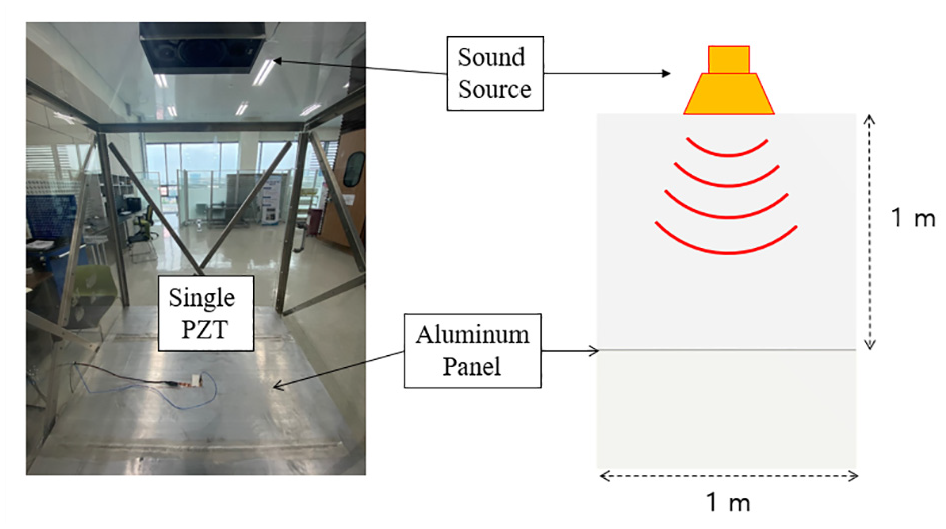
Diagram of the experimental device.
A printed circuit board triaxial accelerometer was installed close to the location where the piezoelectric material was attached to measure the vibration generated by the aluminum panel. The SIEMENS SCADAS Mobile was connected to the piezoelectric patch to measure the signals. The piezoelectric patch was used as an actuator to excite the flat plate and as a device to reduce vibration through a piezoelectric shunt. The two roles were not applied simultaneously but were applied separately through voltage control. The piezoelectric material was attached to the aluminum panel, as illustrated in Figure 11. The PZT panel was 0.05 m wide, 0.03 m long, 0.001 m high, and weighed 0.011 kg. For the piezoelectric material, Digital Echo PZT DE-H was used as the PZT series. This PZT had a relative piezoelectric constant of 4504 and electro-mechanical coupling coefficients of 0.34 for K31 and 0.72 for K33. The piezoelectric strain constant was
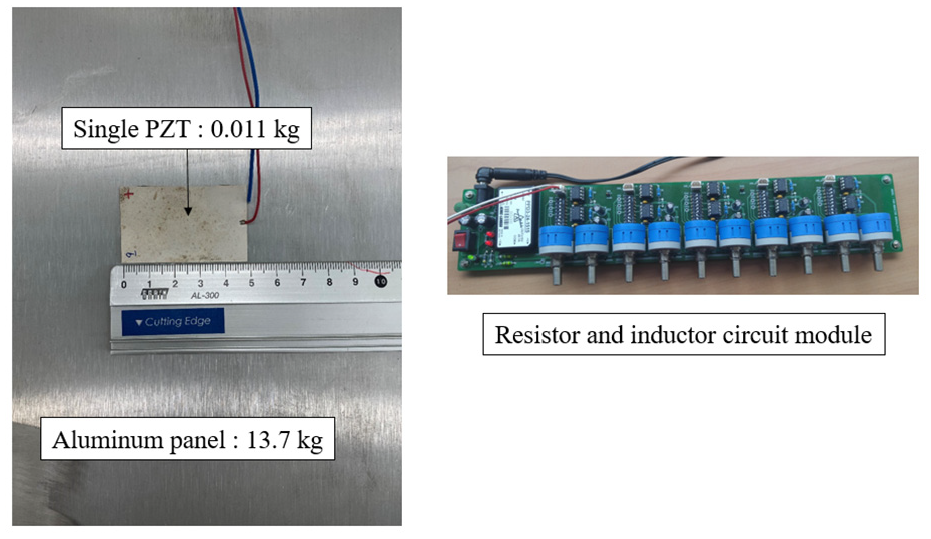
PZT panel and circuit module.
Electrical resonance arises from the capacitance of the piezoelectric material and the inductance of the shunt circuit, and sufficient inductance is essential to reduce low-frequency vibrations. However, typical devices have very low inductance, making it very difficult to tune frequencies below 1 kHz. In addition, the internal resistance of the device is high, so the vibration reduction effect of the piezoelectric shunt is insignificant. To overcome these limitations, a separate inductor module was manufactured as shown in Figure 11. The variable inductor can adjust the desired inductance using an operational amplifier (op-amp) and a variable resistor, and it is possible to produce a stable inductance with a high value. The inductor is a circuit that can create artificial inductance using two op-amps, four resistors, and one capacitor.
Using the above analytical method, it was confirmed that the highest vibration occurs in the 390 Hz region. However, for the implemented model, the boundary conditions could change depending on the installed environment, thus it was necessary to check the resonant frequency. Therefore, the vibrations generated in the frequency domain were measured using a piezoelectric material as the exciter. A PZT panel was used as an exciter to apply vibrations without using an exciter. In this manner, the SIEMENS SCADA Mobile was connected to a piezoelectric patch for excitation; it sent a signal to excite the plate and measure the vibration. A voltage of 5 V was applied to the PZT panel to excite vibrations from 100 to 1000 Hz. As shown in Figure 12, high excitations occur in various frequency domains; a vibration of 0.12 m/s2 occurs at 384 Hz, where resonance occurs. Therefore, the 384 Hz region was selected as the target frequency for vibration reduction in this study.

Aluminum panel vibration result.
The vibration reduction effect of the PZT panel was examined via excitation at 384 Hz using an acoustic speaker. The acoustic speaker was placed 1 m from the center of the plate, and the PZT was used as a vibration shunt. First, the vibration was measured after excitation with an acoustic speaker, with the circuit of the PZT panel short-circuited. For thorough investigation about comparison effect of PZT shunt circuits, the vibration reduction effect of the panel was examined via excitation at the specific resonant frequency of 384 Hz using an acoustic speaker. In this test, only the specific frequency narrow region around 384 Hz was excited and accelerations below and above 382 and 386 Hz recorded as zero. It was found that a vibration of 0.644 m/s2 occurred at 384 Hz, as illustrated in Figure 13. In addition, it was confirmed that the vibration value was reduced to 0.606 m/s2 when only the resistance circuit was connected to the PZT panel. Compared to when the circuit was shorted to the PZT plate, this value decreased by approximately 5.9%. Thereafter, only the resistance circuit was connected to the piezoelectric circuit to examine the effect of vibration reduction on the panel. When only a resistor is connected, the electricity generated by the piezoelectric panel flows through the resistance circuit and dissipates as thermal energy, reducing the vibration. However, for the electricity generated by the mechanical deformation of the piezoelectric material to dissipate as thermal energy through the branch circuit, a large amount of current must flow smoothly because of the low impedance. However, in the case of a resistive circuit, the current can flow smoothly when the resistance is low because the impedance is low. Consequently, the current energy consumed is inevitably low, which leads to low energy consumption. Further, examining the resistance circuit confirmed that the vibration reduction was insignificant.

Vibration reduction results as determined by the PZT circuit of the aluminum panel at the specific frequency of 384 Hz.
When a resonance circuit was constructed by connecting a resistor and an inductor to the PZT panel, a vibration of 0.484 m/s2 occurred in the same frequency range. This confirmed a reduction of 24.8% compared to shortening the circuit to the PZT panel. To increase the vibration reduction effect of the aluminum panel using the PZT, a branch circuit was designed as a resonant circuit with additional inductance. The impedance of the designed branch circuit with inductance decreases rapidly at a specific resonant frequency because the piezoelectric patch serves as a coffee cadence. This makes it possible to maximize the magnitude of the current flowing through the resistance circuit, thereby increasing the energy consumption of the current. When the resonant frequency of the aluminum panel and that of the circuit are matched, they can be designed to effectively reduce the magnitude of the vibration by maximizing the energy consumed in the circuit. This study confirmed that vibration in the resonant frequency domain can be effectively reduced by the configuration of the resonant circuit. The weight of the attached PZT panel was 0.011 kg, and the weight of the aluminum panel was 13.7 kg. Although there was almost no significant increase in weight (0.08%), there was a 24.8% reduction in vibration in the resonance region. Figure 14 illustrates the comparison results before and after the piezoelectric shunt in the frequency domain. The results show that when a resonance shunt circuit was connected to the PZT patch, the panel vibration was reduced to a certain extent. The size of the PZT panel was 0.03 m in width and 0.05 m in length. The vibration was reduced through the appropriate use of the shunt circuit located at the center of a 1 m2 aluminum panel. Considering that the weight of the piezoelectric patch is only 0.08% of that of aluminum, vibrations can be effectively reduced when the resonant shunt is attached at an appropriate location.
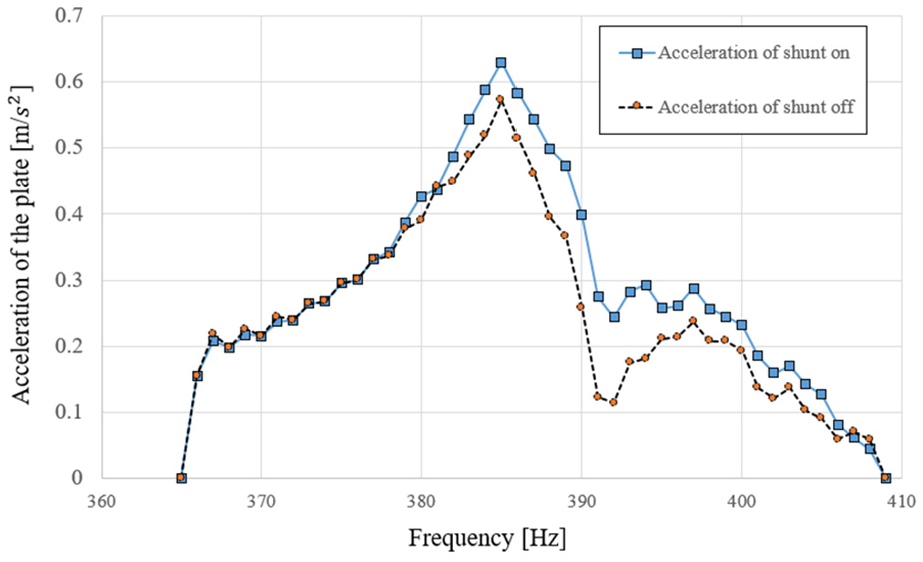
Comparison of vibration reduction of aluminum panel by PZT shunt on and off.
Conclusion
In this study, the vibration reduction effect of a piezoelectric panel on an aluminum plate was analyzed. First, based on theoretical reviews, a method for reducing vibration using electricity generated by piezoelectric materials was investigated. The dynamic characteristics, such as the natural frequency and natural mode of the aluminum panel, were analyzed using an analytical model. The magnitude of voltage generation according to the frequency domain was reviewed through simulation analysis of the aluminum panel. The effect of vibration reduction was verified by applying the simulation results to an actual aluminum panel. An acoustic excitation method was used to simulate the vibration occurring in an aluminum plate without using an exciter. The low-frequency region, where noise is difficult to reduce, was selected as the reduction target. To determine the vibration of the aluminum plate in the actual test body, a voltage was first supplied to the piezoelectric material to generate a physical excitation. In this way, a frequency range for vibration reduction was established. To construct a branch circuit that effectively reduces the vibrations in the selected frequency range, a resistance circuit using only a resistor and a resonant circuit with an inductor added were compared and analyzed. Because of the circuit resistance, the current flowing through the circuit often has a high impedance, minimizing the current flow. In this study, the vibration reduction effect of the resistance circuit was negligible. However, in the case of a resonant circuit, the capacitance of the piezoelectric material and the inductance of the inductor lowered the impedance of the entire circuit owing to the resonance phenomenon at a specific frequency. In this study, validation was conducted to reduce the vibration of aluminum panels using PZT patches. In the study, the magnitude of vibration occurring in a 1 m square aluminum panel was reduced using a small PZT patch measuring 0.03 m in width and 0.05 m in height. It was confirmed that the resonance circuit reduces vibration more effectively; a vibration reduction of 24.8% was achieved, while the weight of the aluminum plate increased by 0.08%. The results of this study demonstrate that vibrations can be effectively reduced using a small-weight piezoelectric patch connected to a resonance circuit to the PZT patch.
Footnotes
Handling Editor: Aarthy Esakkiappan
Declaration of conflicting interests
The author declared no potential conflicts of interest with respect to the research, authorship, and/or publication of this article.
Funding
The author disclosed receipt of the following financial support for the research, authorship, and/or publication of this article: Funding (Korea Railroad Research Institute)
This research was supported by a grant from R&D Program of the Korea Railroad Research Institute, Republic of Korea and by the Korea Agency for Infrastructure Technology Advancement (KAIA) grant funded by the Ministry of Land, Infrastructure and Transport (Grant RS-2022-0014-3396).
