



Abstract
In complex systems, failure dependencies play a crucial role in determining their overall performance. This paper explores the multi-objective optimization of series-parallel systems with mixed failure dependencies. By optimizing system cost and availability, the study aims to identify the most efficient redundancy and repair strategies. Two optimization algorithms, the non-dominated sorting genetic algorithm II (NSGA-II) and a novel multi-objective algorithm named the multi-objective hoopoe heuristic (MOHH), are utilized alongside constraint handling techniques to produce Pareto fronts. These fronts illustrate the trade-offs between cost and availability. Additionally, a fuzzy decision method is utilized to determine the best compromise solutions from each optimization technique. Comparing the results, NSGA-II consistently outperforms MOHH in providing better compromise solutions across five independent runs. However, MOHH demonstrates a better standard deviation in its performance.
Keywords
Introduction
Failures are an unavoidable aspect of industrial systems, where the interdependence of subsystems can significantly impact overall system performance and availability.1–5 In various industrial sectors, from manufacturing to transportation, energy production to healthcare, the failure of even a single component can lead to cascading effects, causing widespread disruption and costly downtime.6,7 Understanding the intricate relationships and dependencies among subsystems within these complex systems is paramount for mitigating risks and ensuring robust operational resilience.8,9
Failure dependency of subsystems in systems refers to the phenomenon wherein the failure of one subsystem can propagate and trigger failures in interconnected subsystems, ultimately compromising the functionality of the entire system. This concept underscores the importance of not only identifying and addressing individual component failures but also comprehensively assessing the potential ripple effects across the system as a whole. In industrial contexts, failure dependency manifests in multifaceted ways. For instance, in manufacturing processes, the breakdown of a critical machine may halt production lines, affecting downstream operations and supply chains. Similarly, in transportation systems, a malfunction in signaling equipment can lead to delays, impacting schedules and passenger services. Moreover, in critical infrastructure such as power grids or healthcare facilities, failures in essential subsystems can have far-reaching consequences, jeopardizing public safety and service delivery.
Addressing failure dependency requires a holistic approach that considers the complex interactions and dependencies among subsystems. Advanced analytical techniques, such as fault tree analysis, reliability and availability modeling, and system simulation, play a crucial role in assessing the vulnerability of interconnected systems and identifying potential failure scenarios. By systematically evaluating the interdependencies and vulnerabilities, stakeholders can implement targeted mitigation strategies, redundancy measures, repairs, and contingency plans to enhance system resilience and minimize the impact of failures.
In Das et al., 10 failures in multi-layer complex networks (MLCNs), focusing on a specific type resembling computer networks, were explored. Through simulations on a three-layer MLCN, the impact of edge and node failures was investigated. In Xiang et al., 11 a reliability analysis framework for failure-dependent manufacturing systems was presented, integrating copula functions, fuzzy inference, and Bayesian networks. It characterized failure correlations, deriving subsystem and system reliability. In Yu et al., 12 the impact of failure dependencies in multi-component systems was addressed, emphasizing the role of redundancy in system reliability. The authors highlighted two aspects of system reliability reduction due to component failures: the loss of reliability contribution and system reconfiguration, including the redistribution of loading. The authors of Hu et al. 13 conducted an analysis of steady-state availability within a repairable series-parallel system featuring redundant dependencies. This analysis considers various component types and repairmen, taking into account the dynamic nature of component failure rates influenced by the presence of other failed components. By introducing a modified failure dependence function to quantify redundant dependency, the paper utilized Markov theory and matrix analysis to compute the steady-state probability vectors of subsystems and overall system availability. In Mohamed and Zulkernine, 14 an approach for assessing the reliability of fault-tolerant component-based software systems, taking into account component failure dependencies, was investigated. A machine learning-based approach 15 for enhancing failure dependency resilience in edge computing services was used in Aral and Brandic. 16 In Hu et al., 17 the authors explored the design of a repairable series-parallel system with failure dependencies, emphasizing their impact on subsystem state transitions and system availability. They introduced a dependence function to quantify failure rates and utilized a Markov model to determine subsystem state distributions. An optimal allocation problem was proposed, aiming to minimize system cost while ensuring availability constraints, and genetic algorithms were employed for this purpose. An adaptive cuckoo optimization algorithm was developed in Mellal and Zio 18 to effectively deal with this complex problem. In Mellal et al. 19 and Mellal and Zio, 20 the flower pollination algorithm, plant propagation algorithm, particle swarm optimization, and cuckoo optimization algorithm were implemented to consider the system cost and availability using the weighted sum method. Linear, weak, and strong dependencies were considered, but a similar type of dependencies was assumed for the subsystems in the system. Later, in Mellal et al., 21 the model was improved by considering mixed failure dependencies. However, the objective was solely to minimize the system cost under a system availability constraint. Differential evolution, manta ray foraging optimization, and shuffled frog leaping algorithm with constraint handling were implemented to minimize the system cost under three scenarios of system availability. A comprehensive literature review on dependent failures in systems was conducted in Zeng et al. 22
The present work addresses both objectives: minimizing system cost and maximizing the system availability of the series-parallel system with mixed failure dependencies through Pareto fronts. The non-dominated sorting genetic algorithm II and the single-objective hoopoe heuristic, transformed into a multi-objective hoopoe heuristic, are implemented to solve the problem. Penalty functions are used to handle the nonlinear system availability constraint. The best compromise solutions are identified and compared using the fuzzy decision method. The remainder of the paper is organized as follows: “Multi-objective optimization of series-parallel system with mixed subsystems failure dependencies” section describes the multi-objective optimization of the series-parallel system with mixed failure dependencies. “Non-dominated sorting genetic algorithm II (NSGA-II)” and “Multi-objective hoopoe heuristic (MOHH)” sections present the principles of the implemented non-dominated sorting genetic algorithm II and the multi-objective hoopoe heuristic. “Best compromise solution based on fuzzy method” section illustrates the method for identifying the best compromise solutions. The results and discussion are provided in “Results and discussion” section. Finaly, the conclusions are presented in the last section.
Multi-objective optimization of series-parallel system with mixed subsystems failure dependencies
Based on the single-objective mixed subsystem failure dependencies model presented in Mellal et al., 21 the multi-objective problem can written as follows:


where Cs and As denote the system cost and system availability, respectively, depending on the redundancy vector n of ni levels and on the repair teams vector r of ri levels. The cost of a component at subsystem I is denoted by


The failure rate of a component within subsystem i is denoted by λi, while its repair rate is represented by μi. The data of the system are represented in Table 1.
Data of the system.

The problem is subject to,


Non-dominated sorting genetic algorithm II (NSGA-II)
The Non-Dominated Sorting Genetic Algorithm II (NSGA-II) 23 has gained significant recognition as a leading approach for addressing multi-objective optimization problems. It represents a notable advancement over its precursor, NSGA, by incorporating innovative strategies to explore and exploit solution spaces while maintaining diversity among generated solutions. NSGA-II has demonstrated superior performance compared to other techniques, such as the Pareto envelope based selection algorithm II (PESA-II) and the multi-objective particle swarm optimization (MOPSO).24,25 Algorithm 1 illustrates the pseudo-code of the implemented NSGA-II.

Multi-objective hoopoe heuristic (MOHH)
The single-objective hoopoe heuristic (HH) was initially introduced in El-Dosuky et al. 26 and later modified in Mellal and Williams. 27 It is has proven to be effective in solving various engineering problems. Inspired by the behavior of the hoopoe bird, a distinctive species found across Europe, Asia, and Africa, the heuristic mimics the foraging behavior of the bird in open woodlands, savannas, and grasslands, where it hunts for insects and small invertebrates. The single-objective HH is extended to address the presented multi-objective problem, as depicted in Algorithm 2.

Best compromise solution based on fuzzy method
The NSGA-II and MOHH are run over different runs and the best compromise solution of each run is identified through the following fuzzy method24,28–31:

with,

The parameters
Results and discussion
The problem-solving algorithms NSGA-II and MOHH were implemented using MATLAB 2023a and executed on a PC with the following specifications: 12th generation Intel Core i7 processor running at 2.30 GHz, paired with 16 GB of RAM. Each algorithm utilized a population size and maximum number of generations set to 100 and run over five independent runs. The parameters were determined through trial-and-error experimentation and guided by prior experience. The best results are highlighted in bold type.
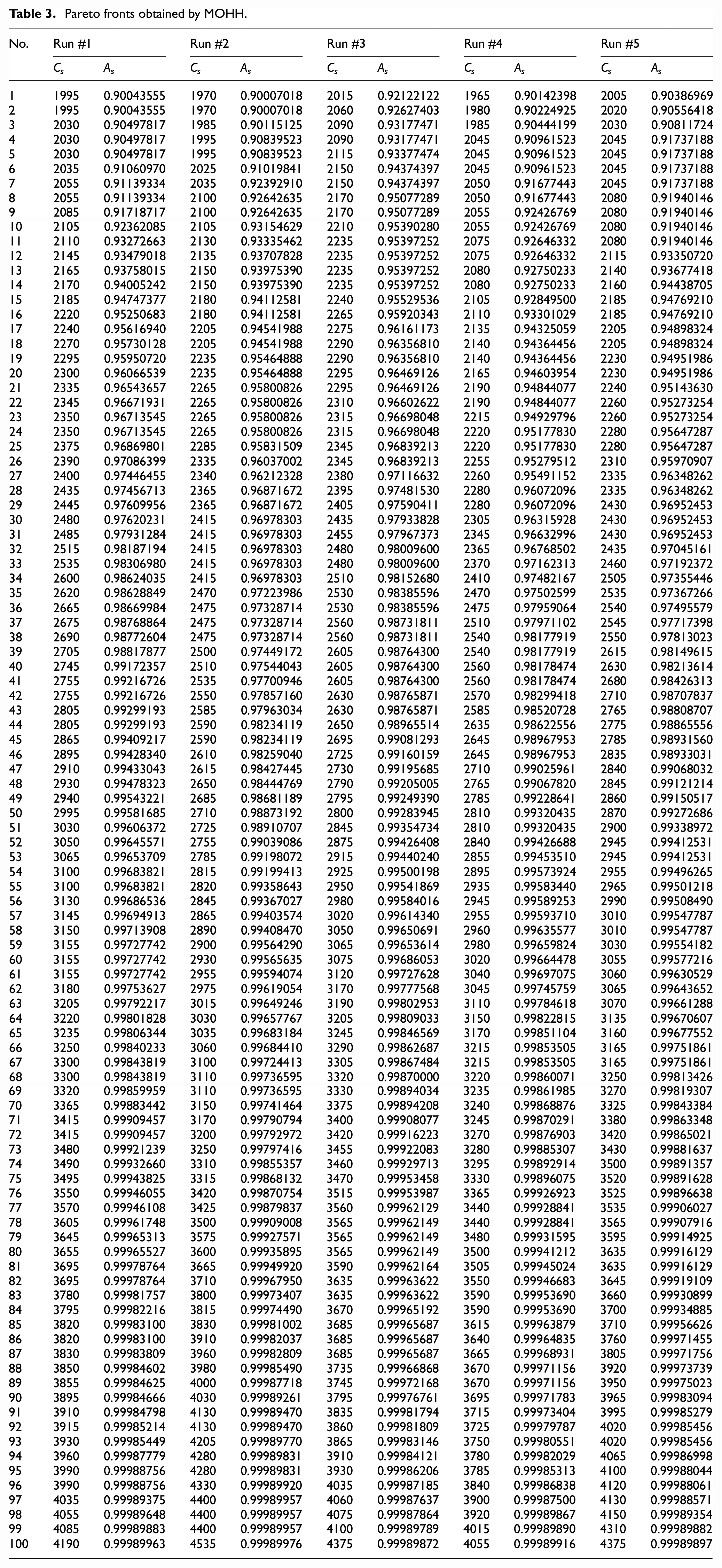
Tables 2 and 3 report the five Pareto fronts obtained by NSGA-II and MOHH, respectively. The normalized membership values of these Pareto fronts are reported in Tables 4 and 5, respectively. From Table 4, it can be observed that the best normalized membership values of the five runs of NSGA-II are 0.0114232903444178, 0.0119524684646373, 0.0122520665697145, 0.0115233016383350, and 0.0122428003975620, whereas, as reported in Table 5, those of the MOHH are 0.0117459168952589, 0.0114796420578444, 0.0114968441366447, 0.0117703770641603, and 0.0114684699765886. Therefore, as compared in Table 6 and shown in Figure 1, the best normalized membership value of NSGA-II was obtained in run #3 and is equal to 0.0122520665697145 with a standard deviation (SD) of 0.000349605318, whereas that of MOHH was obtained in run #4 and is equal to 0.0117703770641603 with an SD of 0.000135975797. NSGA-II provided better normalized membership value than the MOHH, but the SD of latter is smaller. The best compromise solution provided by NSGA-II is [Cs = 3675, As = 0.99976] with a redundancy vector of (5, 5, 5, 5, 7, 4, 3, 4, 7, 6) and (4, 4, 3, 3, 5, 2, 3, 3, 4, 3) of repair teams vector. The best compromise solution provided by MOHH is [2645, 0.98967] with a redundancy vector of (4, 4, 3, 4, 5, 3, 3, 3, 5, 3) and (2, 3, 2, 2, 4, 1, 1, 2, 3, 2) of repair teams vector. Figure 2 shows the box diagram of the normalized membership values of NSGA-II and the MOHH. It can be seen that the MOHH has a lower median value than the NSGA-II but a narrower spread of data points.
Pareto fronts obtained by NSGA-II.

Pareto fronts obtained by MOHH.
Normalized memberships of NSGA-II.

Bold type represents the best value.
Normalized memberships of MOHH.

Bold type represents the best value.
Comparison of normalized memberships.

Bold type represents the best value.

Best normalized membership values.

Box diagram of the normalized membership values.
Conclusions
The aim of this paper was to address the multi-objective optimization of the series-parallel system with mixed failure dependencies. The system cost and system availability were optimized to find the optimal redundancy and repair teams. The non-dominated sorting genetic algorithm II (NSGA-II) and the multi-objective hoopoe heuristic (MOHH) were implemented to generate the Pareto fronts. A fuzzy decision method was used to identify the best compromise solution of each optimization technique. Comparison of the results revealed that NSGA-II consistently provided a better best compromise solution over five independent runs compared to the MOHH. However, the latter exhibited a better standard deviation. The decision between MOHH and NSGA-II depends on computational resources and the preference for consistency. Future works will consider heterogeneity in redundancy.
Footnotes
Handling Editor: Sharmili Pandian
Declaration of conflicting interests
The author declared no potential conflicts of interest with respect to the research, authorship, and/or publication of this article.
Funding
The author received no financial support for the research, authorship, and/or publication of this article.

Data availability
No data was used for the research described in the article.