



Abstract
Aiming at the problem that the life cycle energy consumption index of hoisting machinery is difficult to be objectively quantified, a crane energy consumption evaluation calculation method based on the working cycle of the service period is proposed, the typical service working mode of the crane is analyzed, and the working cycle process of the mechanism is clarified. On this basis, the stress cycle characteristics of the crane structure during the service period are determined based on the coupling relationship between the mechanism and the structure, which lays the foundation for accurately evaluating the life index of the crane. According to the relationship between the load rate and effective power of each mechanism during the service period of the crane, the calculation method for the evaluation and calculation of the structure energy consumption during the service period of the crane is studied. Finally, the crane is designed based on the concept of absolute service safety, and an optimal design model of the main girder structure of the crane with the goal of the lowest energy consumption in service is established. Using the research method of this paper to study a certain type of bridge crane, the energy consumption of the hoisting machinery during its service period is not only related to the accumulation of the operating characteristics of the mechanism but also related to the characteristic parameters such as the structure self-weight. The comprehensive evaluation of energy consumption provides an effective quantitative method and a reliable green design theory for crane design.
Introduction
As the waste of energy and resources has become the main problem hindering social progress, the rapidly deteriorating ecology and living environment have seriously hindered the sustainable development of human civilization, and energy conservation and emission reduction have quickly become the theme of today’s era. As an important industrial product, hoisting machinery has been widely used in the production of the national economy and the manufacturing process of various equipment. The energy-saving design and green evaluation research based on the service period of hoisting machinery has a great impact on saving resources and energy and reducing the energy consumption in the production process is of great significance. At present, the energy-saving design and green evaluation of mechanical equipment have become the research hotspots in today’s academic circles and engineering fields. Many researchers at home and abroad have been able to carry out related research into various aspects such as lightweight and green evaluation, and have obtained a large number of research results, which will have a beneficial impact on the research on reducing the energy consumption of mechanical equipment.
In the aspect of the green design of mechanical products: Liu et al. 1 aimed at the next stage of research and development of green manufacturing, and discussed that green product design should consider the processes of production, operation and maintenance, supply chain, recycling and remanufacturing, etc. It provides theoretical support for the development and application of green manufacturing technology; Kang et al. 2 proposed a product green module division design method based on the design structure matrix to solve the problem of ineffective recycling of resources caused by product obsolescence or elimination; Liu et al. 3 established a parametric design model of the valve system by using the response surface method, and optimized the model by using the optimization design theory; Fu et al. 4 proposed a green design model FSMP that supports the generation of the scheme, quantified it using the life cycle evaluation method to design the environmental impact of space nodes, and verified that the model has a certain guiding effect on green design; AL-Oqla and Hayajnehb 5 introduced a hierarchical preference model for the impact of trace components in composites on the environment, realizing a more rational use of natural resources; Agrebi et al. 6 conducted research on the energy saving of permanent magnet synchronous generators in wind power generation, and used genetic algorithms to optimize the green design model; Ammar and Seddiek 7 aimed at improving the energy efficiency produced by marine machinery, and determined a design scheme that could save 10% energy through the optimization analysis of three different design indexes; Gundran et al. 8 proposed an optimal design method considering battery cooling, economic cost, and environmental cost at the same time given the impact of electric vehicle battery cooling systems on the environment; Milani et al. 9 improved the efficiency of the hydromechanical transmission by improving the fluid dynamic behavior of the lubrication system, and verified the feasibility of the design method through experiments; Banerjee and Punekar 10 took agricultural machinery equipment as the research object, based on the concept of the life cycle, a sustainable design method (MSDS) was used to evaluate the performance of equipment; Liu and Zheng 11 aimed at the relationship between the functional modules of CNC machine tools and the influence of the finite order of each module on the green index during a redesign and proposed to use fuzzy analytic hierarchy process (FAHP) and gray relational analysis (GRA) combined with the priority order identification method to analyze and discuss the research objects; Wu et al. 12 used fuzzy analytic hierarchy process and gray relational degree method to solve the multi-objective decision-making problem of mechanical structure design for green manufacturing; Ma et al. 13 combined artificial neural network and particle swarm optimization algorithm to analyze and optimize the fuel consumption and emissions of micro-ignition dual-fuel engines, and achieved Co-designed for fuel consumption and emissions. Although the above research has made a useful attempt at the feasibility of the green design of the life cycle of mechanical equipment, it is still a big problem to have the green evaluation index of the life cycle of mechanical equipment and the optimal overall design method. Therefore, it is necessary to further explore the integration mechanism of green evaluation indicators and optimal design of mechanical equipment based on life cycle service status information to realize the life cycle green design of mechanical products.
In the aspect of the green evaluation of mechanical products: Li 14 constructed the green degree evaluation system for the equipment manufacturing industry, and applied the intelligent optimization algorithm to the green degree evaluation of the equipment manufacturing industry. Ayağ 15 adopted a variety of fuzzy evaluation methods to study the green evaluation of mechanical equipment. Rödger et al. 16 adopted the life cycle assessment method to merge the two life cycles of the product and the production system, which provided a new idea for the green evaluation of the system. Tian et al. 17 put forward the crane energy efficiency evaluation index scheme by using the hierarchical relation model, which provides a new strategy for the quantitative processing of the crane life cycle energy consumption index. Saad et al. 18 aimed at the problem of energy consumption in the welding process, evaluated and obtained an aluminum plate welding method with the least environmental impact by using sensitivity analysis and life cycle design theory. Dér et al. 19 adopted life cycle-oriented decision-making and evaluation methods to study the use of automotive lightweight materials and the impact of new manufacturing technology on the environment. Vitta 20 took electric vehicle batteries as an object, and conducted an objective evaluation of carbon emissions from mineral resources mining to battery manufacturing; Yu et al. 21 proposed a comprehensive energy consumption evaluation method for engines, generators, and hydraulic pumps for new hydraulic hybrid excavators. Cota et al. 22 proposed a green machine scheduling algorithm based on neighborhood concept for the green evaluation of mechanical equipment. Singh et al. 23 constructed a green index evaluation method based on simulation analysis for the green index in the mechanical manufacturing process, and Del Pero 24 adopted a new evaluation method to establish a model of the relationship between vehicle lightweight index and life cycle energy consumption, and effectively evaluated the effect of lightweight on energy consumption. Sorrentino et al. 25 quantitatively evaluated the energy-saving potential of railway vehicles under the influence of multi-dimensional indicators based on the optimization method of dynamic programming. Li et al. 26 proposed an evaluation method based on extension analysis and D-S theory for the uncertainty and incompatibility of the relationship between indicators in the evaluation of product processing technology planning and evaluation under the background of green manufacturing; Aicha et al. 27 carried out research on the energy consumption of equipment in the disassembly process, analyzed and evaluated the energy consumption of the disassembly process based on working time and quality index, and made clear the coupling relationship between different indicators. Meng et al. 28 put forward an enhanced CO method based on the adaptive surrogate model is proposed in this study. Meng et al. 29 proposed an adaptive Kriging-model-assisted RBMDO strategy is proposed. Meng et al. 30 put forward an adaptive Kriging-model-assisted RBDO method considering hybrid uncertainty is proposed based the decoupling WCA for improving the accuracy of RBDO results. Yang et al. 31 proposed a superior surrogate-model-based reliability evaluation method combination is illustrated in this study, which is instructive for adaptive surrogate-model-based reliability analysis in the reliability evaluation problem of automobile components. Yang et al. 32 proposed an adaptively choose the best update sample. Meng et al. 33 proposed a hybrid RBDO method based on a Portfolio allocation strategy. Yang et al. 34 introduces the ASVM-MCS framework, which addresses these challenges by considering different types of input variables and various failure modes. Scholars at home and abroad have done a lot of research and analysis on the green evaluation of mechanical equipment. And achieved fruitful results, which provide a useful reference for the green evaluation of mechanical equipment. However, the working conditions of different mechanical products are complex and changeable during the service period, and there is a great correlation between the operating state and discrete factors such as equipment parameters and operation mode. Therefore, in order to accurately quantify the green index of mechanical equipment under the operation characteristics of the life cycle, it is necessary to deeply explore the mapping relationship between the operating characteristic parameters and the green evaluation index of mechanical equipment under specific service conditions.
This paper takes the general bridge crane as the research object, and based on the characteristics of the crane service load cycle, the remaining life prediction and service energy consumption evaluation of the crane structure and mechanism are carried out respectively, and the time dimension of the service period of the crane is clarified and the energy consumption of the crane in service is accurately quantified. Finally, based on the above research results, the intelligent optimal design theory is used to carry out the green optimal design of the whole crane, providing an energy-saving design theory for the whole process of service for the crane. The research results of this paper not only provide an objective method of evaluating energy consumption for cranes but also provide a new design concept based on the whole process of service for cranes.
Analysis of working cycle characteristics of crane in service
Crane working cycle
As shown in Figure 1, the crane model studied in this paper is known to have a span of 22.5 m and a maximum lifting weight of 32 t. Other design parameters of the crane will be given in the following chapters of this paper. Because this is a study that we did in the early stages, the data is all from our own trials.The crane needs to carry out cargo hoisting constantly in the course of service. because the hoisting mechanism, the trolley operating mechanism, and the trolley operating mechanism need to work together in the hoisting process, it is of great significance to determine the working cycle mode of each mechanism in the crane life cycle. It is of great significance to accurately obtain the structural load during the service period of the crane and predict the structural life. As shown in Figure 1, the spatial coordinates of the bridge crane, the typical working cycle of the crane includes two stages: cargo lifting and unloading, as shown in Figure 2, the path of the crane (hook) in a working cycle, and the specific hoisting cycle is shown in Table 1.

Crane spatial coordinates.

Hoisting path of crane (hook).
hoisting cycle mode of crane (one cycle).

According to the hoisting cycle mode of the crane in Table 1 and Figure 1, in a working cycle, the crane hoisting mechanism goes through four processes: no-load lifting, no-load lowering, sling lifting, and sling lowering. Both the trolley traveling mechanism and the trolley traveling mechanism need to go through two operations: no-load operation and hoisting operation.
Crane service mechanism and load cycle mode
According to the hoisting path shown in Figure 2, the crane will carry out a large number of above-mentioned work cycles during the service period, and because the hoisting mechanism and operating mechanism (including the whole machine and trolley) work frequently, it will lead to frequent changes in the load characteristics of the whole crane. Defining the load cycle mode of the crane life cycle is the premise of accurately calculating the structural stress change and predicting the energy consumption index during the service period. Because the cycle path of the crane during the service period has certain rules to follow, the existing work cycle data can be analyzed and the corresponding indicators can be predicted.
The working cycle of the hoisting mechanism: In the process of one working cycle of the crane, the hoisting mechanism needs to go through two lifting and two lowering operations respectively, because the hoisting process is only to lift the goods to a safe height, under the condition of no special demand and special working conditions, the hoisting height statistics are consistent with the uniform distribution in the interval [0, 2]. The hoisting height in the working cycle of the hoisting mechanism is randomly sampled by Monte Carlo random sampling method. The coordinate cycle curve of the hoist after 200 hoisting cycles is shown in Figure 3.
Working cycle of the operating mechanism: Under the joint action of the cart operating mechanism and the trolley operating mechanism, the crane will circulate in the X-Y plane shown in Figure 1, according to the randomness of the large and trolley traveling in the limited space, determine the cycle mode during the hoisting process of the crane operating mechanism during the re-service period as shown in Figure 4.
Hoisting load cycle: The hoisting load of the crane in each hoisting process during the service period needs to be determined according to the actual weight of the cargo, and the load spectrum is a key indicator to characterize the actual load state of the crane, as shown in Table 2. Lifting load spectrum of the studied crane during 1800 duty cycles (30 days).

Coordinate cycle of lifting height of the hook.

Coordinate cycle of the operating mechanism.
Crane load spectrum.

According to the data in the table, the distribution law of crane service load can be known, and the relationship between crane mechanism operation and structural stress can be studied based on the hoisting load during service and mechanism operation data.
Mechanism-structure coupling relationship of crane
The crane is an organic whole composed of mechanism and structure, and the operation of the mechanism will have an important impact on the bearing capacity of the structure. The study of the coupling relationship between the mechanism and the structure is of great significance for accurately calculating the energy consumption of the mechanism during the service period and defining the fatigue life of the structure.
The essence of the coupling between the crane structure and the mechanism is the influence of the load fluctuations and changes generated by the movement process of the mechanism on the structure, this paper uses the motion data of the crane running mechanism in the service process, and uses the mapping relationship between the position coordinates of the mechanism movement and the load of the crane wheels (cart wheels and trolley wheels) to evaluate the load rate of the motor, so as to realize the service energy consumption evaluation of the crane. The above is the coupling between the crane structure and the mechanism mentioned in this article.
Structural mechanic model
The crane structure includes two parts: the main girder and the end girder. When verifying the bearing capacity of the crane structure, it needs to be calculated according to the statically indeterminate steel frame structure shown in Figure 5. In the process of service, the crane needs to bear the load in both vertical and horizontal directions, and the vertical load is caused by the dead weight of the structure and the weight of the cargo, while the horizontal load is caused by the inertia force of the crane during acceleration and deceleration.

Structural model of crane: (a) spatial bridge model of crane, (b) mechanical model of main beam structure and (c) mechanical model of end beam structure.
In engineering calculation, the spatial mechanical model of a crane with statically indeterminate characteristics is often simplified to the statically indeterminate girder structure model shown in Figure 5(b) and (c). The crane structure is a central symmetrical structure, and the center of symmetry is the center of the steel frame structure, so half of the structure will be analyzed, and finally the calculation results will be superimposed.The research on the bearing index of the main girder and the end girder structure in the service stage is of great significance to the accurate calculation of the crane structure and the accurate evaluation of the bearing capacity during the service period. In the figure:


Mechanism-structure coupling relationship
During the working process of the crane, the goods are driven by the mechanism to carry out spatial movement, and the weight and position of the lifting goods change with the working conditions, according to the load spectrum, the lifting mode of the mechanism and the circulation mode of the operating mechanism during the period of service of the crane, the influence of the operation mode of the service mechanism on the structure can be determined. According to the theory and practical experience, it is known that the tension zone of the mid-span section of the main girder is easy to produce fatigue damage, as shown in Figure 6 is the common failure mode and section characteristics of the crane at this section. The welding of the auxiliary web and the large diaphragm belongs to the concave angle structure, and the joint has a large stress concentration and belongs to the welding material, so the cross-section belongs to the fatigue danger point. The fatigue danger point located in this section is the weld joint between the auxiliary web and the lower end of the large diaphragm. Based on the mechanism cycle mode, the stress cycle characteristics of the main girder structure at this calculation point are accurately obtained. Defining the coupling relationship between the operation mode of the mechanism and the stress characteristics of the structure is of great significance for the accurate evaluation of the residual life of the crane structure.

Dangerous points and common damage modes of mid-span section of main girder.
The stress index for evaluating the bearing capacity of the crane structure is directly affected by the load, and the stress index fluctuates with the change of the actual load and position, as shown in Table 3, the formula for calculating the internal force of the mid-span section of the main girder under the actual load. Because the horizontal internal force calculation model is the same as the vertical internal force calculation model, the table only lists the internal forces (shear force and bending moment) of the mid-span section of the main girder under the action of vertical loads
Calculation of dangerous section moment of mid-span section of main girder.
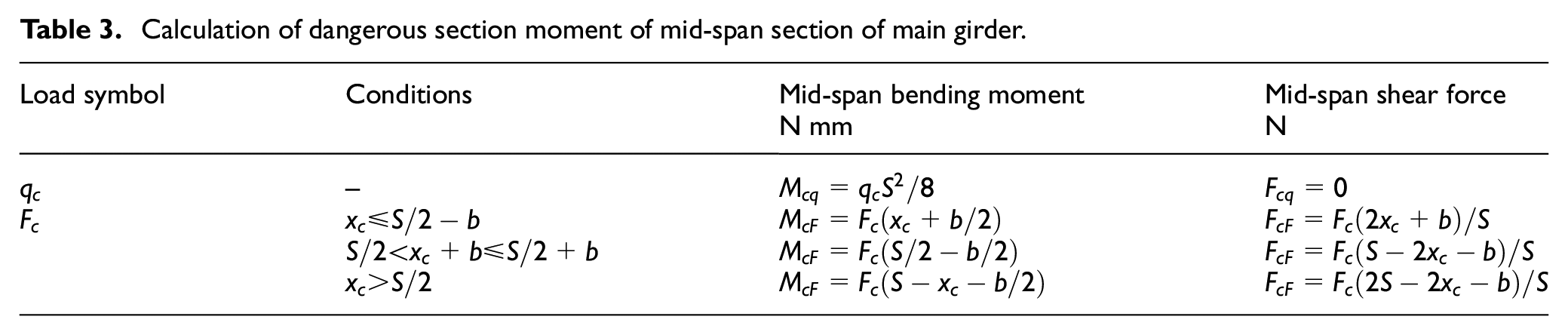
The internal force change of the mid-span section of the main girder is determined according to the hoisting path shown in Figure 2 and the cycling mode of the crane mechanism and load, and then the stress spectrum of the calculation point can be determined according to the section parameters. As shown in Table 4, the structural parameters of the crane are studied in this paper. According to the parameters in the table, the stress change of the calculation point of the middle section of the main girder in the working cycle of the crane can be obtained based on the internal force calculation of Table 3.
Design parameters of crane.

According to the coordinate cycle of the cart, trolley and hoisting mechanism and the change of hoisting weight, based on the coupling relationship between mechanism and structure in the above article, the stress change of the mid-span section of the crane girder is calculated, and the stress change curve of the fatigue calculation point of the mid-span section is shown in Figure 7. In the process of 1200 hoisting cycles, the maximum and minimum stress values of the midspan section of the main girder structure are 108.11 and 29.58 MPa, respectively. The calculation method of stress index in the figure should calculate the structural stress under various loads according to the content of material mechanics, and synthesize the stress as shown in formula (3). The frequent change in stress index will lead to the fatigue of the structure, and the higher the frequency and amplitude of stress change, the lower the fatigue strength of the structure, resulting in a decrease in its life. Therefore, the change in crane mechanism movement index will lead to a change in structure bearing capacity and even structure life. It is of great significance to accurately analyze the mechanical movement of crane during its service life to accurately evaluate the crane structure index.

Where:

Calculation of the point stress cycle in the midspan section of the main girder.
Evaluation of mechanism energy consumption for service process
From the working cycle process of the crane, it can be seen that all the work of the bridge crane during the service period is completed by the cooperation of the lifting mechanism and the trolley operation mechanism, and the mechanism is driven by the motor, and the motor needs to consume electric energy in the process of driving operation. Accurate evaluation and calculation of the relationship between the movement mode of the mechanism and the energy consumption of the crane is of great significance to the energy-saving research of the whole crane. Therefore, this paper studies the coupling relationship between the crane service work cycle and mechanism energy consumption, and explores the quantitative method of the crane service energy consumption index. The theoretical calculation formula of energy consumption calculation comes from the relationship between motor load rate and motor efficiency in electric drive technology, and the relationship between motor load rate and actual torque of motor is converted based on the above relationship, and the calculation of energy consumption evaluation in this paper is realized through the above conversion.
Evaluation of energy consumption of hoisting mechanism
The hoisting mechanism of the bridge crane is shown in Figure 8, which needs to carry out load lifting and lowering operations in the working process. According to the basic principle of energy conservation, cargo hoisting is realized by converting electric energy into gravity potential energy, and the electric energy consumed during cargo hoisting can be calculated by the formula (4).

Where:

Where:

Where:


Hoisting mechanism of crane.

From the above, it can be seen that the motor efficiency
Parameters of hoisting mechanism of crane.

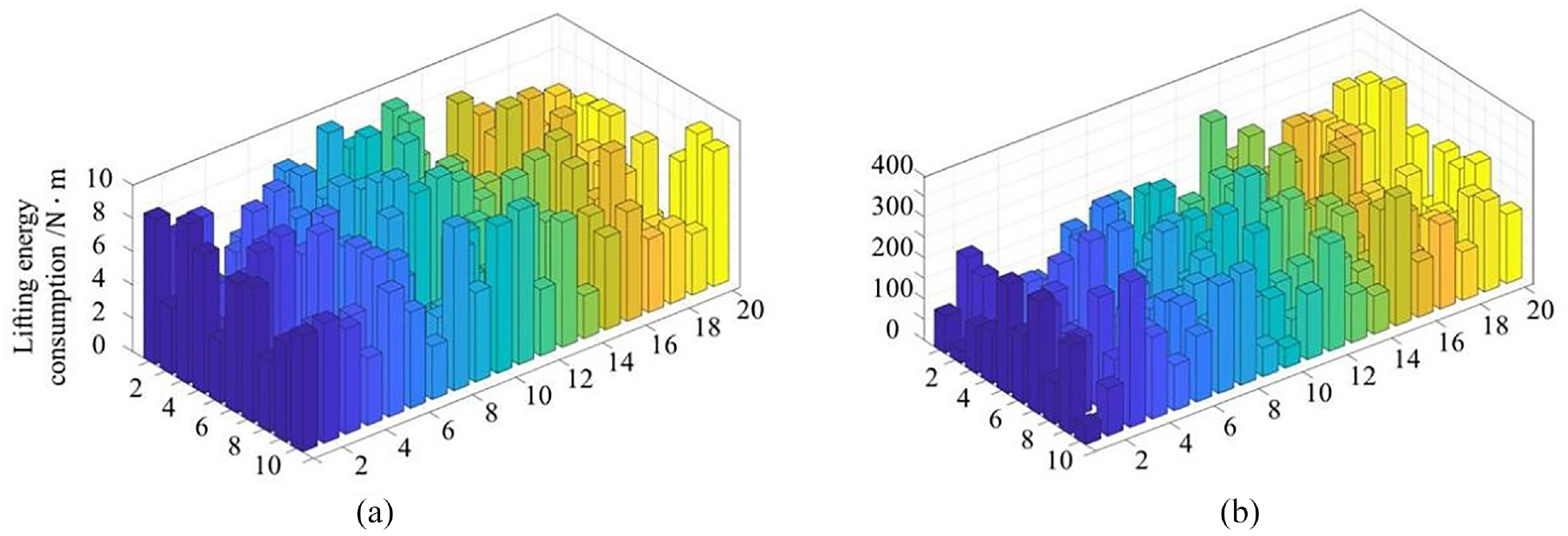
Energy consumption of lifting process: (a) no load and (b) hoisting load.
According to the energy consumption change bar chart of Figure 9 and the energy consumption data in the analysis chart, during the 200 hoisting of the crane, the total energy consumption of the lifting mechanism is
Energy consumption evaluation of trolley operating mechanism
The trolley operating mechanism of the bridge crane drives the trolley to run on the main girder track, and the driving unit of the trolley operating mechanism is the motor, which drives the trolley wheel to rotate and overcome the resistance to do work. Because the crane does not allow skidding between the wheel and the track in the design, the relative motion resistance between the wheel and the track is static friction. During the operation of the trolley, the electric energy is converted into kinetic energy and the work is done by overcoming the friction resistance, while the kinetic energy of the crane is often converted into thermal energy dissipation by friction braking. Therefore, the available formula (9) for the operation of the crane trolley indicates that the rated power of the trolley operating mechanism is known to be 10 kW, and the full load efficiency of the motor is 0.91. According to the above-known parameters, the energy consumption of the trolley operation in the 200th working cycle can be calculated as shown in Figure 10.

Where:

Energy consumption during the operation of the trolley: (a) no load and (b) hoisting load.
According to the above calculation, the total energy consumption of a motor in the trolley operating mechanism during 200 hoisting is
Evaluation of energy consumption of cart operation mechanism
The driving mechanism of the crane is used to drive the whole crane, and the driving mode of the cart is the same as that of the trolley, but because the weight of the crane is large, the wheel pressure acting on the driving wheel of the crane is larger, and the driving motor power of the cart is also very large, and because the position of the trolley wheel pressure on the main girder is determined by the specific working conditions, the actual wheel pressure of the cart wheels on both sides of the crane is different. There is a certain difference in the energy consumption of the cart operating mechanism, and the formula (10) is used to calculate the service energy consumption of the cart operating mechanism.

Where,


By calculating the energy consumption of the cart operating mechanism in the process of 200 hoisting, the energy consumption distribution map shown in Figure 11 can be obtained. The calculation results show that after 200 times hoisting, the total energy consumption of the crane operating mechanism under no-load operation and with-load operation is

Energy consumption during the operation of a cart: (a) no-load operation and (b) hoisting operation.
Comprehensive evaluation of energy consumption of bridge crane in service
Through the above analysis, it can be seen that the electric energy consumed by the crane during the service period is closely related to the movement mode of the mechanism, and the parameters such as structural dead weight, motor type, and transmission system efficiency will have an important impact on the crane services energy consumption. How to greatly reduce the energy consumption of crane services under the premise of safe operation is the key to crane design in the future. Therefore, determining an objective quantitative evaluation method of energy consumption for the whole cycle of crane service is an urgent problem to be solved.
Comprehensive evaluation of service energy consumption
The service energy consumption of the crane is closely related to the energy consumption per unit of time and the service cycle of the crane, and the above two indexes can be obtained indirectly through the working cycle of the crane during its service period. As shown in formula (13), the annual average energy consumption during the service period of the crane is calculated in this paper. Based on this method, the energy consumption index of the whole service cycle of the crane can be evaluated objectively in the case of limited sample capacity.

Where:
The evaluation of crane energy consumption during the service period is based on the absolute service safety of crane. The accumulation of crane maintenance on the life cycle of the crane is very small, and the impact on the energy consumption of the crane is almost negligible, so the research work in this paper does not consider the maintenance process of the crane. Therefore, the above energy consumption evaluation calculation should meet the safety service conditions of crane. Since the structure is the load-bearing body of the crane, it is necessary to ensure that the safety indexes such as static strength and fatigue strength of the crane structure have enough design margin during the service period. In this paper, according to the stress change of a crane structure in its life cycle, the service cycle of crane structure is predicted by using the theoretical method based on fracture mechanics, and the optimal design model of crane structure is established based on structure service life and energy consumption. The crane structure design parameters are solved with the goal of the lowest energy consumption during the crane service period, which provides a minimum energy consumption design scheme for the crane design for the service cycle.
Residual life prediction of crane structure
The crane structure needs to go through the processes of material cutting and processing, welding and transportation before use, which may lead to defects inside or on the surface of the structure. Therefore, in view of the fact that the residual life prediction of the crane structure starts with the initial defect of the material, based on the initial crack assumption of the structure, the fatigue crack propagation theory in linear elastic fracture mechanics is adopted. The fatigue residual life of crane structure under complex load is predicted, and the time dimension of crane structure service period is evaluated in advance. It is a general process for evaluating the life of crane structure. In this paper, the above theory will be used to evaluate the residual life of crane structure. The calculation process is as follows:
(1) Assume that the initial defect is
(2) Calculate the critical crack length: according to the theory of linear elastic fracture mechanics, if we want to estimate the fatigue crack propagation life of the structure, we must first determine the critical crack size of the member under the given load, and the critical crack size can be calculated by the formula (14).

Where,
(3) Determine the stress characteristics in the process of load cycle: Determine the maximum stress


Where:
(4) The crack propagation calculation is carried out by using Miner theory: the crack propagation life of crane structure is determined by adopting formula (17).

According to the known crane design parameters, the residual life of the fatigue danger points in the mid-span section of the crane girder structure is evaluated by the above flow. It is known that the average annual working days of the crane is 360. From Table 2, it can be seen that the number of working cycles per day is 60, then the service life of the crane is
Green design of crane structure with the lowest energy consumption during service
From the above research, it can be seen that the structural safety of the crane is the key to characterizing the service safety of the crane. More advanced methods are adopted to design and study the crane structure, and the influence of various service indexes on the structural safety of the crane is considered. It plays an important role in reducing the incidence of crane accidents. The traditional crane is designed based on the work level provided by the user, and the work level is selected according to the crane service load cycle mode and characteristics, but there is a mismatch between the work level and the structural service characteristics in the crane design. In order to ensure the absolute service safety of the crane, engineers and technicians have adopted a large design redundancy for the crane structure, resulting in the phenomenon of excessive energy consumption during the service period. In order to solve the above problems, the crane structure optimization design model shown in formula (18) is established by an intelligent optimization algorithm, which takes the absolute safety of the crane structure during the service cycle as the constraint and the service energy consumption as the constraint for iterative optimization. The design process is shown in Figure 12.

Where: the physical meanings of
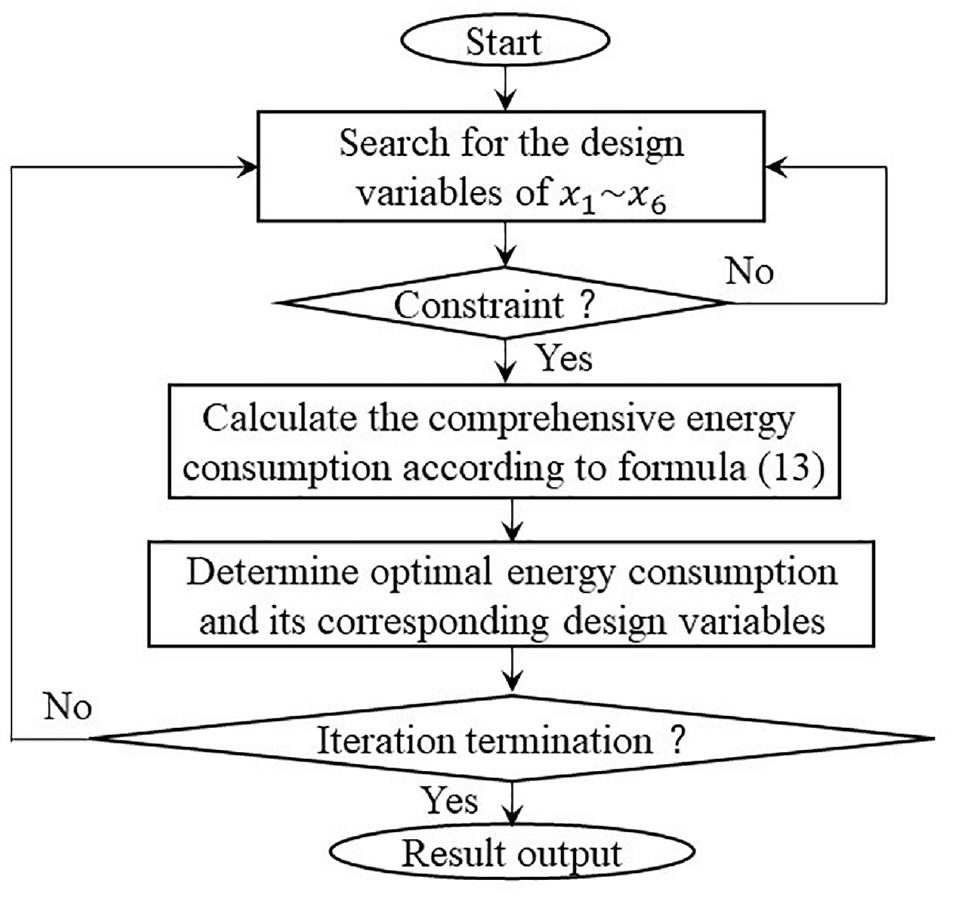
Green optimal design flow of crane structure.
The above optimization results are shown in Table 6, as shown in Figure 13, which shows the iterative curve of the objective function of crane structure optimization design based on the optimal service energy consumption. The objective function calculation results represent the average annual energy consumption of the crane in the service cycle. After 100 iterations, the optimal energy consumption is
Design parameters before and after optimization.

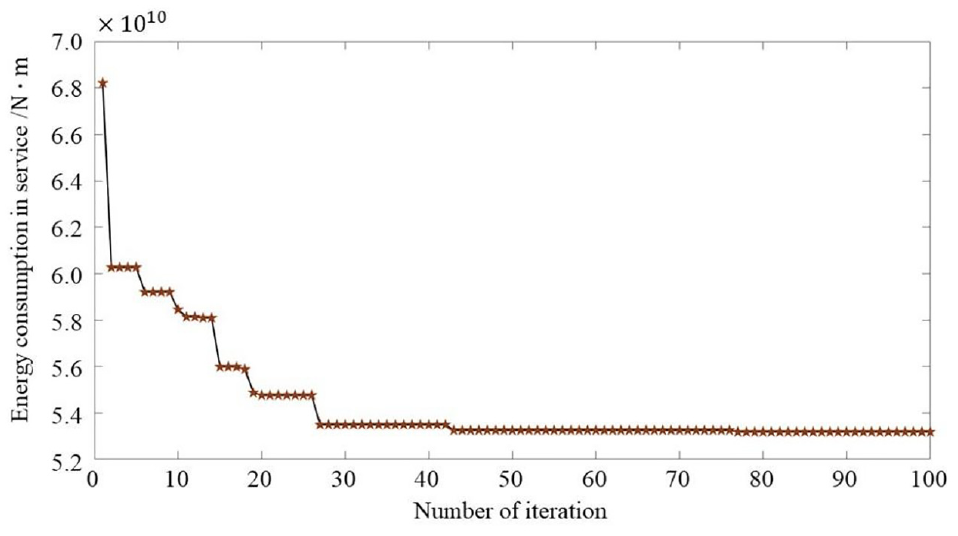
Iterative curve of the objective function.
Conclusion
In order to solve the problem of objective quantification of the energy consumption index of the crane in service, and carry out the green design of the crane based on the service period according to the energy consumption index under the limited working cycle, the above research is carried out and the following conclusions are obtained:
The working cycle mode of the crane in service is simulated based on the load spectrum, the parameters of the crane in service operation are obtained, and the structural mechanical model of the crane is established. According to the load change mode in the model, the mapping relationship between the trolley operation and the bearing characteristics of the main beam and end beam structure is studied, and the coupling mode of the crane structure and mechanism is studied.
The stress cycle characteristics of the structure are calculated and determined through the operation index of the mechanism. The motion mode of the mechanism is defined. It provides a basis for the accurate and objective calculation of the energy consumption of the mechanism and the stress cycle characteristics of the structure in service.
The energy consumption index of crane service process is calculated through the principle of energy conservation in the process of mechanism operation, which provides an objective quantitative method for crane service energy consumption evaluation. From the calculation results, it can be seen that the crane operation has the greatest contribution to the service energy consumption and consumes the most energy, while the cargo lifting process has the least contribution to the service energy consumption.
Based on the crack propagation theory of fracture mechanics, the service time dimension of crane is evaluated objectively, the structural optimization design model with crane service life as constraint is established. The energy consumption during the service period of the crane is controlled by the objective function of energy consumption in service, and the optimal design theory is used to study the optimal design of the model. The results show that the optimization model established in this paper has the ability to reduce the energy consumption of crane service. This paper provides a green design method for crane service cycle.
Footnotes
Handling Editor: Sharmili Pandian
Declaration of conflicting interests
The author(s) declared no potential conflicts of interest with respect to the research, authorship, and/or publication of this article.
Funding
The author(s) received no financial support for the research, authorship, and/or publication of this article.
