



Abstract
As urbanization continues to accelerate, dump trucks assume an increasingly important role in the transportation and construction of infrastructure. The carriage represents a critical structural assembly of dump trucks. One of the primary failure modes of the carriage is weld fatigue failure, which frequently gives rise to the problem of weld fatigue cracking during transportation. To increase the fatigue life of welds and enhance the degree of structural lightweight of a heavy dump truck carriage, a method for anti-fatigue lightweight design based on machine learning and multi-objective optimization is proposed. A high-fidelity finite element model of the carriage is established for static simulation analysis of the typical conditions. Based on the virtual reliability simulation test of the dump truck and the equivalent structural stress method, the fatigue life of the critical welds in the carriage is calculated. The important part thicknesses are selected as design variables through the comprehensive contribution analysis method. The maximum displacement and maximum stress under the dangerous condition are considered as constraints. The mass of the carriage and the minimum fatigue life of the critical welds are considered as optimization objectives. The GA-XGBoost machine learning approximation models (GA-XGBoost-MLAM) and NSGA-II algorithm are employed for multi-objective optimization design of the carriage. The entropy weighted TOPSIS method is utilized for multi-objective decision-making of Pareto solutions. The design after optimization and decision-making shows that, while satisfying the requirements of static structural performance, the minimum fatigue life mileage of the critical welds of the carriage is increased by 157,570 km, representing an increase of 36.58%. Additionally, the mass of the carriage is reduced by 295.69 kg, representing a decrease of 9.47%. Therefore, the proposed design method achieves a good effect in the anti-fatigue lightweight of dump truck carriage.
Keywords
Introduction
With the gradual expansion of Chinese dump truck brands into the international high-end market, the fuel economy of heavy dump trucks becomes a focal point for manufacturers. Structural lightweight stands out as an effective approach to enhance the fuel economy of vehicles. Constituting a significant structural assembly in dump trucks, the dump truck carriage represents 30%–50% of the total vehicle mass. 1 High-strength steel materials provide superior structural performance under equivalent mass conditions. To align with the trend of energy conservation and emissions reduction, high-strength steel materials are extensively employed in the production of dump truck carriages. Due to the high cost of high-strength steel materials, it is necessary to pursue lightweight design during the early stages of carriage product development. Rational lightweight design can not only save overall vehicle material costs but also reduce fuel consumption, thereby enhancing the economic efficiency and environmental significance of dump trucks. 2
In recent years, numerous scholars have conducted a series of studies on the structural lightweight of dump truck carriages. Wang et al. 3 optimized the static and dynamic conditions of the carriage using finite element analysis and approximation models (AM) technology, achieving energy conservation and emission reduction without altering the original spatial structure of the carriage. Jiang et al. 4 performed lightweight optimization of the carriages using the Kriging approximation model and an optimization algorithm. The optimized carriage achieved a 3.7% weight reduction, along with slight improvements in the first-order natural frequency and structural strength compared to the original carriage. Zhang et al. 5 established a comprehensive optimization model for the carriage based on stiffness and strength performance under full load bending and lifting conditions.
Currently, research on the structural lightweight of dump truck carriages mainly focuses on optimizing the static and dynamic structural performance of the carriage. However, there is limited research on lightweight design specifically addressing anti-fatigue aspects for carriage structures. In fact, dump truck carriages are large welded structures characterized by structural complexity, diverse designs, and challenges in connection sealing. During the process of fully loaded transportation, the carriage not only bears the load of heavy cargo but also experiences random dynamic loads caused by uneven road surfaces. Under the coupled effects of various dynamic alternating loads, certain welded structures of the carriage are prone to fatigue damage, leading to the issue of fatigue cracking in welds. This significantly reduces the service life and structural performance of the carriage.6,7 At present, fatigue cracking in the welds of dump truck carriages has become a crucial issue that many manufacturers cannot ignore. Therefore, performing fatigue life calculations for specific conditions on critical welds of dump truck carriages is beneficial for evaluating the reliability of the carriage and further conducting anti-fatigue lightweight design.
The optimization of dimensional parameters based on AM techniques is widely applied in the field of structural lightweight for dump trucks.3–5 However, due to the numerous parts comprising the dump truck carriage and the complexity of their interconnections, traditional AM techniques struggle to accurately predict responses in structural performance, such as highly nonlinear displacements, stresses, and fatigue life of welds. Consequently, this limitation significantly reduces the precision of optimization results, posing substantial challenges to achieving anti-fatigue lightweight of the carriage. With the rapid development of artificial intelligence, data-driven techniques represented by machine learning (ML) can precisely fit complex nonlinear mappings between variables from limited experimental data and predict new data information.8,9 Presently, ML techniques are extensively applied in structural optimization designs across various fields. You employed a multi-layer perceptron (MLP) for the shape optimization of the permanent magnet synchronous motor in electric vehicles, confirming that MLP technology outperforms the Kriging approximation model in predictive performance. 10 Cheng et al. developed an optimization framework based on machine learning approximation models (MLAM) to assist in the structural design of wind turbine generators. 11 Li et al. utilized multiple ML algorithms to rapidly predict the seismic performance of hybrid composite beams and obtained design solutions through an optimization algorithm. 12 Keshtegar and Alfouneh applied support vector regression (SVR) to reliability-based topology optimization (RBTO) of continuous structures, effectively enhancing the accuracy and stability of the RBTO model. 13 Zhu et al. addressed the reliability design issue of turbine blade discs by utilizing a novel ML strategy RSM-SVR, which combines response surface methodology (RSM) and SVR. This approach achieved preferable predictive performance for fatigue assessment of turbine blade discs. 14 Given the limitations of traditional AM techniques in terms of prediction accuracy and generalization capability, establishing AM for structural performance responses based on ML techniques holds promising applications in the field of mechanical structural optimization.
In the process of optimizing the structure of automobiles, it is often necessary to comprehensively consider various factors, such as total mass, structural strength, stiffness, safety, and fatigue life, among others. This easily gives rise to complex multi-objective optimization problems. In recent years, in the field of engineering applications, multi-objective optimization algorithms (MOOA) have become the primary method for addressing complex multi-objective optimization problems. 15 Xiong et al. conducted research on the crush resistance and lightweight of passenger car bodies, employing the multi-objective particle swarm optimization (MOPSO) algorithm to obtain Pareto solutions, resulting in a weight reduction of 7.92 kg while meeting the basic requirements for crush resistance. 16 Zhang et al. calculated the fatigue life of the original heavy tractor frame by establishing the finite element model and a multi-body dynamics rigid-flexible coupling model. The frame was subjected to anti-fatigue lightweight design using the non-dominated sorting genetic algorithm-II (NSGA-II). 17 Dai et al. constructed an optimization framework for the structural design of car seats based on AM and MOOA, considering various factors such as material cost, mass, safety performance, and comfort. 18 However, there is currently limited research on multi-objective optimization design for dump truck carriages. The application of MOOA in the structural optimization design of dump truck carriages holds certain research value.
To establish highly accurate AM, enhance fatigue reliability, achieve structural lightweight, and diversify structural lightweight design approaches for dump truck carriages, this paper proposes an anti-fatigue lightweight design method based on ML and multi-objective optimization. Firstly, considering the structural stress performance under three typical static conditions and fatigue-prone locations, multiple critical welds are selected for fatigue analysis. Secondly, based on the virtual reliability simulation test of the dump truck and the equivalent structural stress method, the fatigue life of the critical welds is computed. Subsequently, utilizing the comprehensive contribution analysis method, the important part thicknesses are chosen as design variables. The high-precision GA-XGBoost-MLAM for response variables are established. Finally, employing the NSGA-II algorithm and the entropy weighted TOPSIS method, the optimal anti-fatigue lightweight design solution for the carriage is determined.
The remaining sections of this paper are structured as follows. In Section “Machine learning approximation models and multi-objective optimization”, basic theories of MLAM and MOOA are introduced, and the basic process for multi-objective optimization design of dump truck carriages is elucidated. In Section “Static simulation analysis and selection of critical welds”, a high-fidelity finite element model of the carriage is established, and static simulation analysis is conducted, along with the selection of critical welds. In Section “Virtual reliability simulation test and fatigue life calculation of critical welds”, a virtual reliability simulation test of the dump truck is conducted, incorporating a multi-body dynamics model. The fatigue life of the critical welds in the carriage is calculated. In Section “Anti-fatigue light weight design of dump truck carriage”, MLAM and multi-objective optimization are integrated for the anti-fatigue lightweight design of the carriage. Finally, in Section “Conclusions”, an overview of the main conclusions of this paper is provided.
Machine learning approximation models and multi-objective optimization
GA-XGBoost machine learning approximation models
Extreme gradient boosting (XGBoost) is an advanced ML algorithm that demonstrates exceptional performance in complex classification and regression problems, characterized by its fast computation, strong generalization, and flexible lightweight nature. 19 XGBoost belongs to an ensemble ML algorithm model, improved from the gradient boosting decision tree algorithm. By incorporating regularization terms into the objective function, the issue of overfitting in predictive models is mitigated. When XGBoost integrates K decision trees, its objective function can be expressed as follows:

where O represents the value of the objective function. n represents the number of samples.

where

After t iterations of computation, the objective function transforms into the following equation:

where
Utilizing the second-order Taylor expansion to approximate the objective function, the constant term is removed, and the quadratic term is retained, expressing the objective function as follows:

where

Substituting the regularization term function defined in equation (2) into the objective function, the objective function can be expressed as:

where I represents the set of leaf nodes. It is evident that the objective function of XGBoost is composed of the loss function and a regularization term to suppress model complexity. During the iterative training process, XGBoost can freely optimize leaf splits, rapidly reducing the residuals of weak learners, and identifying suitable split nodes to form the final strong learning model.20,21
Genetic algorithm (GA) is a stochastic method for global search optimization. 22 Due to the numerous hyperparameters in the XGBoost algorithm model, manually tuning multiple hyperparameters requires a significant amount of time and effort. Enhancing the upper performance limit of the model is challenging. Therefore, the GA-XGBoost ML algorithm models, employing the GA to optimize the hyperparameters of XGBoost, are adopted to establish the high-precision AM for the response variables of dump truck carriages. The program for the GA-XGBoost machine learning approximation models (GA-XGBoost-MLAM) for the response variables of dump truck carriages, written in Python 3, is provided below.
GA-XGBoost-MLAM.

Multi-objective optimization design process
In this paper, a multi-objective optimization design method based on the GA-XGBoost-MLAM and the NSGA-II algorithm is employed to achieve the anti-fatigue lightweight design for dump truck carriages. Firstly, the response variables of the carriage are determined through static simulation analysis and fatigue life calculations of critical welds. The important part thicknesses are selected as design variables using the comprehensive contribution analysis method. Secondly, the modified extended lattice sequence (MELS) experimental design method is utilized to generate sample points for finite element simulation experiments. These points are used to calculate the response variable values for the carriage in batches, forming the dataset for the GA-XGBoost-MLAM. Subsequently, the Pareto non-dominated solution set is obtained by jointly solving the high-precision GA-XGBoost-MLAM for response variables and the NSGA-II algorithm in the objective space. Finally, the entropy weighted TOPSIS method is applied for multi-objective decision-making on the Pareto non-dominated solutions to determine the optimal anti-fatigue lightweight design solution for the carriage. The corresponding multi-objective optimization design process is shown in Figure 1.

Multi-objective optimization design process.
Static simulation analysis and selection of critical welds
Finite element model of dump truck carriage
To ensure the authenticity and accuracy of the lightweight design method for the carriage structure, this paper conducts research on a heavy-duty dump truck carriage currently being developed by a certain company. The carriage body is primarily welded from numerous thin-walled sheet metal parts, which can be categorized into front plate assembly, side plate assembly, bottom plate assembly, and rear plate assembly based on spatial distribution. The side plate and bottom plate on both sides of the carriage are made of high-strength steel plate NM400, while the remaining parts are made of high-strength steel plate LG700XL. The basic parameters of the two materials are shown in Table 1.
Basic parameters of high strength steel material.

The three-dimensional model of the carriage is imported into HyperMesh for finite element pre-processing. Considering factors such as the geometric dimensions of the carriage, mesh quality, solution accuracy, and computational cost, the thin-walled components of the carriage are divided into two-dimensional shell elements with an average mesh size of 10 mm. Some bolt connections are simulated using RBE2 rigid elements. The model contains a total of 1,014,500 elements. Among them, there are 3054 triangular shell elements, accounting for 0.3% of the total. Ultimately, a full-scale and high-fidelity finite element model of the dump truck carriage is established, meeting the requirements for high mesh quality, as shown in Figure 2.
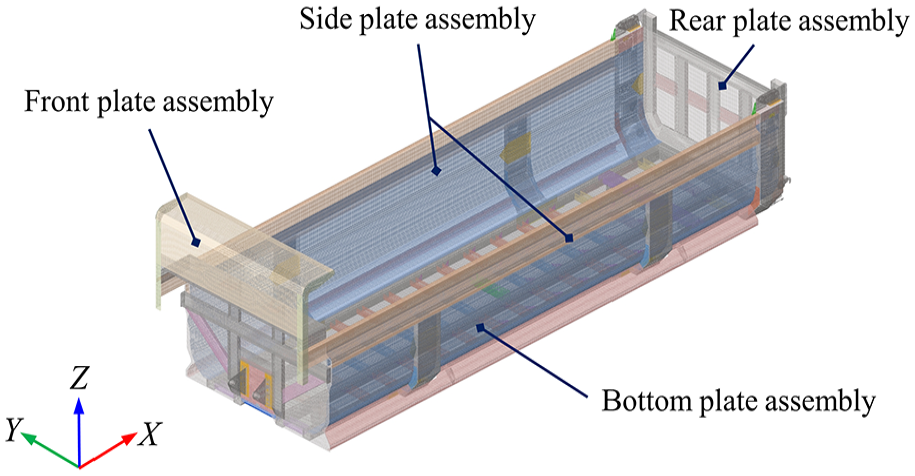
Finite element model of dump truck carriage.
Static simulation analysis
The dump truck primarily transports earth and gravel. During the static analysis of the carriage, the main sources of loads are the self-weight of the carriage and the soil pressure from the earth and gravel on the front, side, bottom, and rear plates of the carriage when fully loaded. The static force analysis and calculations for the loaded condition are conducted using the Rankine active earth pressure theory. 23 The force analysis model for the cross section of the carriage is shown in Figure 3.
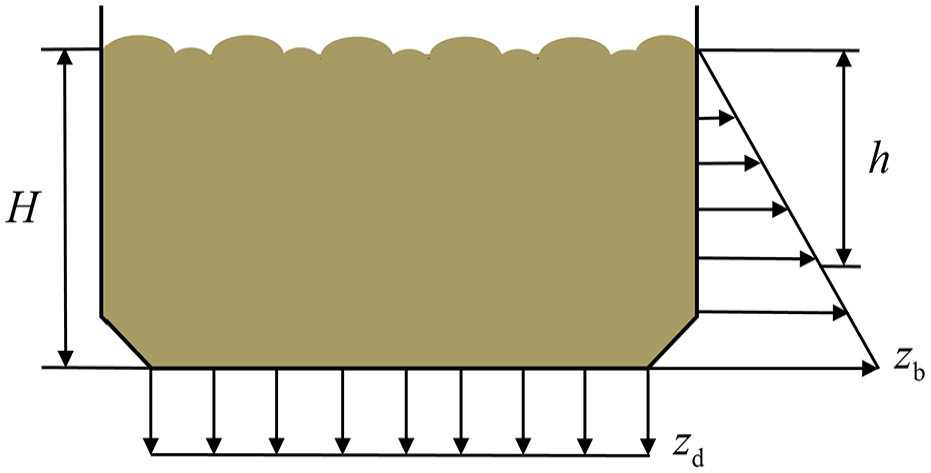
Force analysis model for cross section of carriage.
According to the Rankine active earth pressure formula, the soil pressure acting on the side plates of the carriage can be expressed as:

where F represents the pressure on the carriage side plate.

where
Full load bending condition reflects the force state of the carriage under static full load or uniform slow driving. The soil pressure intensity is calculated under static full load applied within the carriage, with an overall gravitational acceleration of 1g imposed. The rotational degrees of freedom in the Y direction of the support on the oil cylinder and the tipping axis bracket are released, while other degrees of freedom are constrained. The translational degrees of freedom in the Z direction of the main longitudinal beam are also constrained, as shown in Figure 4(a).
Full load turning condition reflects the impact of soil on the left side plate under the action of centrifugal force. Based on the full load bending condition, the soil pressure intensity on the left side plate of the carriage is increased by 0.5 times. The constraint settings are the same as in the full load bending condition, as shown in Figure 4(a).
Full load lifting at 0° condition reflects the force state of the carriage at the initial lifting moment. The load application is the same as in the full load bending condition. The rotational degrees of freedom in the Y direction of the support on the oil cylinder and the tipping axis bracket are released, while other degrees of freedom are constrained. All degrees of freedom of the main longitudinal beam are released, as shown in Figure 4(b).

Constraint setting for three typical working conditions of carriage: (a) full load bending and full load turning conditions and (b) full load lifting at 0° condition.
The three typical conditions are transformed into static conditions for finite element simulation analysis. Displacement and stress contours corresponding to each condition are obtained, as shown in Figure 5.
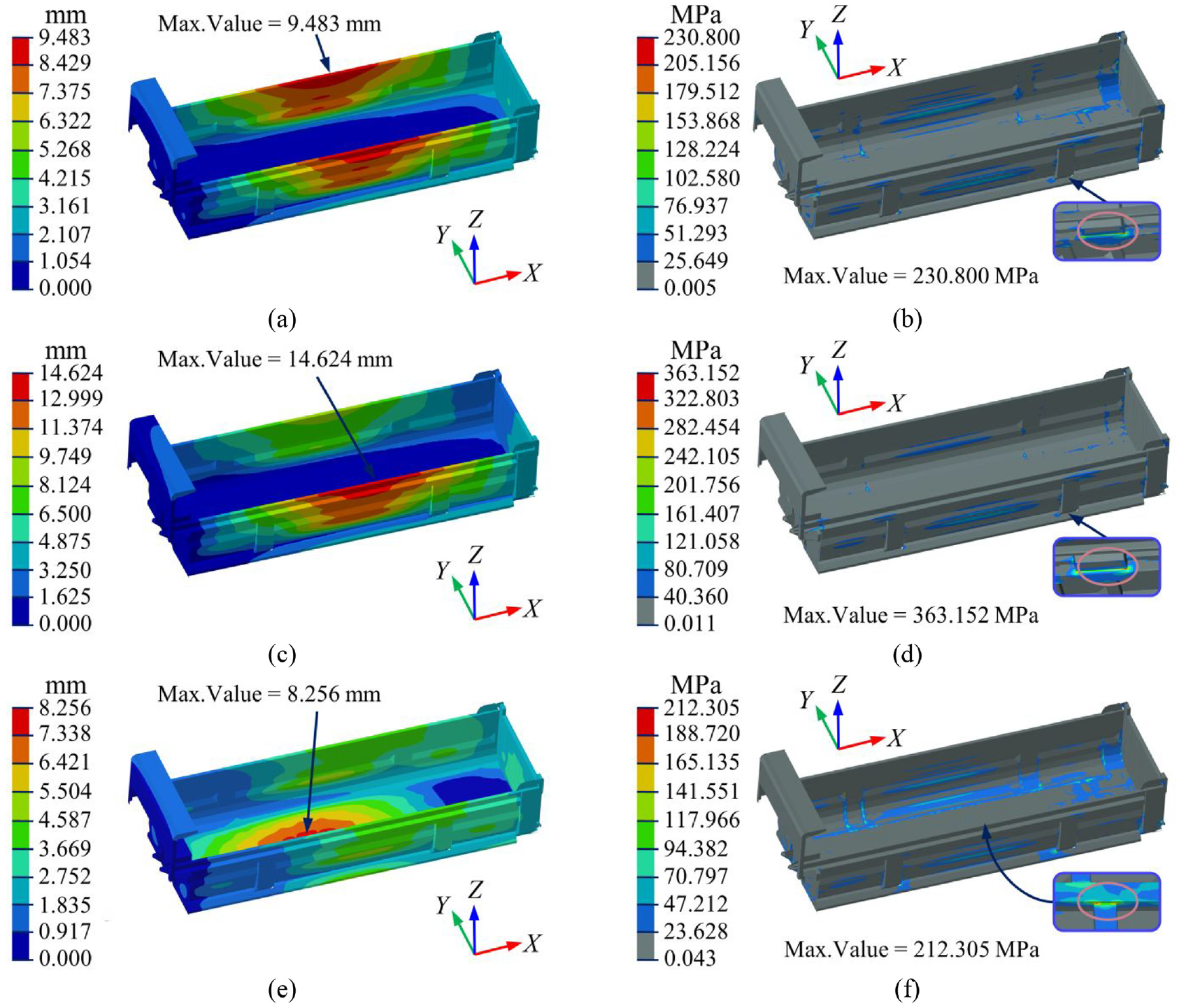
Displacement contours and stress contours for three typical conditions of carriage: (a) displacement contour of full load bending condition, (b) stress contour of full load bending condition, (c) displacement contour of full load turning condition, (d) stress contour of full load turning condition, (e) displacement contour of full load lifting at 0° condition, and (f) Stress contour of full load lifting at 0° condition.
The static structural validation criteria for the heavy dump truck carriage are as follows: the bulging range of the side plate of the carriage should not exceed 15 mm, and the stress values under various conditions should fall within the allowable stress range of the materials. With a safety factor of 1.2, the allowable stress for the materials LG700XL and NM400 of parts are 608 and 1030 MPa, respectively. The simulation contour results show that under full load bending, full load turning, and full load lifting at 0° conditions, the maximum displacement and maximum stress of the car-riage are within the validation criteria. Specifically, under the full load turning condition, the maximum displacement of the carriage is 14.624 mm, occurring at the middle of the upper frame on the guide rail (as shown in Figure 5(c)). The value is close to the maximum allowable bulging value of 15 mm for the side plate of the carriage. The maximum stress is 363.152 MPa, appearing at the lower part of the neutral column (as shown in Figure 5(d)). Overall, the full load turning condition is identified as the dangerous condition for the carriage. In subsequent experimental design and parameter optimization, it is important to consider the impact of the structural performance responses under the full load turning condition on the anti-fatigue lightweight design of the carriage.
Selection of critical welds
When conducting fatigue life simulation of welds in the dump truck carriage, it is necessary to select critical welds for fatigue analysis in order to improve computational efficiency, given the numerous welds on the carriage. During the transportation of materials by the dump truck, the main longitudinal beams and the tipping axis bracket of the bottom assembly undergo repeated tensile and compressive contact with the subframe due to uneven road surface excitation, generating random dynamic loads. This leads to the occurrence of fatigue damage in certain welds of the bottom assembly under the influence of various dynamic alternating loads, resulting in fatigue cracks. Therefore, taking into account the location of maximum stress under full load turning condition and the areas prone to fatigue damage during actual transportation, 20 critical welds are selected for fatigue analysis in the bottom assembly of the carriage, as shown in Figure 6.

Selection of critical welds in the carriage.
Virtual reliability simulation test and fatigue life calculation of critical welds
Virtual reliability simulation test of dump truck
Establishment of multi-body dynamics model
The multi-body dynamics simulation approach is widely applied in reliability research and the design of commercial vehicles, providing advantages such as cost savings and improved development efficiency. 24 Dump trucks belong to complex multi-body dynamic systems with multiple degrees of freedom. To acquire accurate random dynamic load data for the dump truck carriage, a multi-body dynamics model of the dump truck, including subsystem modules such as the carriage, subframe, chassis, cab, front and rear suspension, steering, powertrain, and tires, is established in Adams/Car. The model is based on the actual spatial topology and part communication relationships, as shown in Figure 7. The driving form of the multi-body dynamics model is 6 × 4. The connections between components in the model are composed of various types of joints, including 27 fixed joints, 14 revolute joints, 8 cylindrical joints, 3 spherical joints, 3 Hooke joints, 1 translational joint, and 1 convel joint.

Multi-body dynamics model of dump truck.
Construction of three-dimensional stochastic road surface model
The three-dimensional stochastic road surface is a crucial factor influencing the accuracy of the virtual reliability simulation test for the dump truck. According to the Chinese national standard GB/T 7031-2005, the road surface is divided into eight levels based on the roughness power spectral density. Since dump trucks often operate on urban roads and highways, a B-level road surface with a spatial frequency of 0.008 m−1 < n < 4.830 m−1 is constructed in MATLAB. The road surface serves as the random excitation for the virtual reliability simulation test. The distribution of the B-level three-dimensional stochastic road surface roughness over a 20 m × 20 m area is shown in Figure 8.

Three-dimensional stochastic road surface roughness.
Virtual reliability simulation test of dump truck
The virtual reliability simulation test of the dump truck is conducted in Adams/Car. The B-level three-dimensional stochastic road surface is employed as the virtual test road. The multi-body dynamics model of the dump truck is utilized as the virtual test vehicle to simulate the dynamic fatigue conditions of the dump truck when traveling on urban roads and general highways under full load. The virtual test vehicle is set to travel at a speed of 60 km/h. The simulation lasts for 60 s and consists of 1200 steps. The virtual reliability simulation test of the dump truck is shown in Figure 9.

Virtual reliability simulation test of dump truck.
Through simulation and solution, the dynamic load-time histories are extracted from the result dataset for four connection positions (Y, Z directions) between the tipping axis bracket and the subframe, as well as two contact points (Z direction) between the main longitudinal beam and the subframe. In total, 10 sets of dynamic load data are obtained. The load data in the Y and Z directions for the first and second connection positions between the tipping axis bracket and the subframe are denoted as

Load data in the Y and Z directions for two different connection positions of the tilting axle bracket plate and subframe: (a) load
Fatigue life calculation of critical welds
Equivalent structural stress method
The fatigue life calculation for large welded structures primarily relies on stress analysis combined with the S-N curve of typical welded structures. Representative stress analysis methods include the nominal stress method and the structural stress method. 25 In recent years, the equivalent structural stress method proposed by Dong has been extensively validated as a rapid, accurate, and grid-insensitive approach for calculating structural stress. 26 The method, based on fracture mechanics theory, calculates the fatigue life of welded structures by correlating a large amount of fatigue S-N data with equivalent structural stress. Therefore, employing the equivalent structural stress method to calculate the fatigue life of welds in the dump truck carriage can enhance the accuracy of simulation results.
The equivalent structural stress method focuses on the hot spot stress at the weld toe of the welded joint. It divides the local stress along the thickness direction of the weld toe section under external forces into structural stress and nonlinear self-equilibrium stress. The nonlinear self-equilibrium stress is caused by the geometric notch at the weld toe and exists in a state of self-equilibrium. Due to the local stress distribution (as shown in Figure 11(a)), satisfying equilibrium conditions, according to the structural mechanics theory, the distribution of structural stress (as shown in Figure 11(b)) balances the external forces acting on the weld toe section. The structural stress can be theoretically expressed as the sum of membrane stress



where
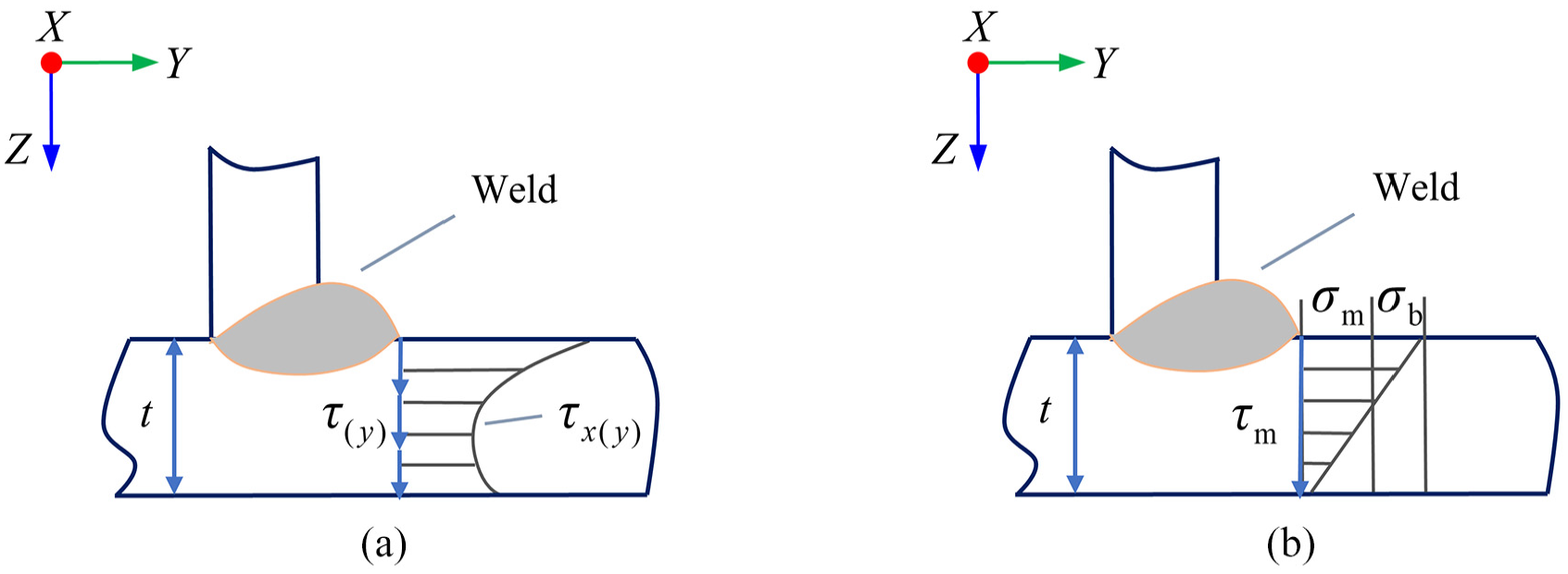
Stress distribution at weld toe: (a) local stress distribution and (b) structural stress distribution.
The equivalent structural stress is derived from the definition of structural stress combined with the principles of fracture mechanics. The master S-N curve equation, based on the equivalent structural stress, is determined using extensive fatigue test data for various welded joints and loading conditions. 27 It is expressed as follows:

where
Fatigue life calculation of critical welds
To obtain accurate structural stress data at the weld toe positions and improve computational efficiency, the main body of the carriage is meshed using shell elements, while critical welds are simulated using solid tetrahedral elements, as shown in Figure 12.

Finite element model for welded structure of carriage.
In Fe-Safe, the Verity module is utilized to define weld lines for 20 critical welds on the carriage based on information such as element type, structural plate thickness, starting element, starting node, node set, element set, and designated successively as
Fatigue life of critical welds in the carriage.
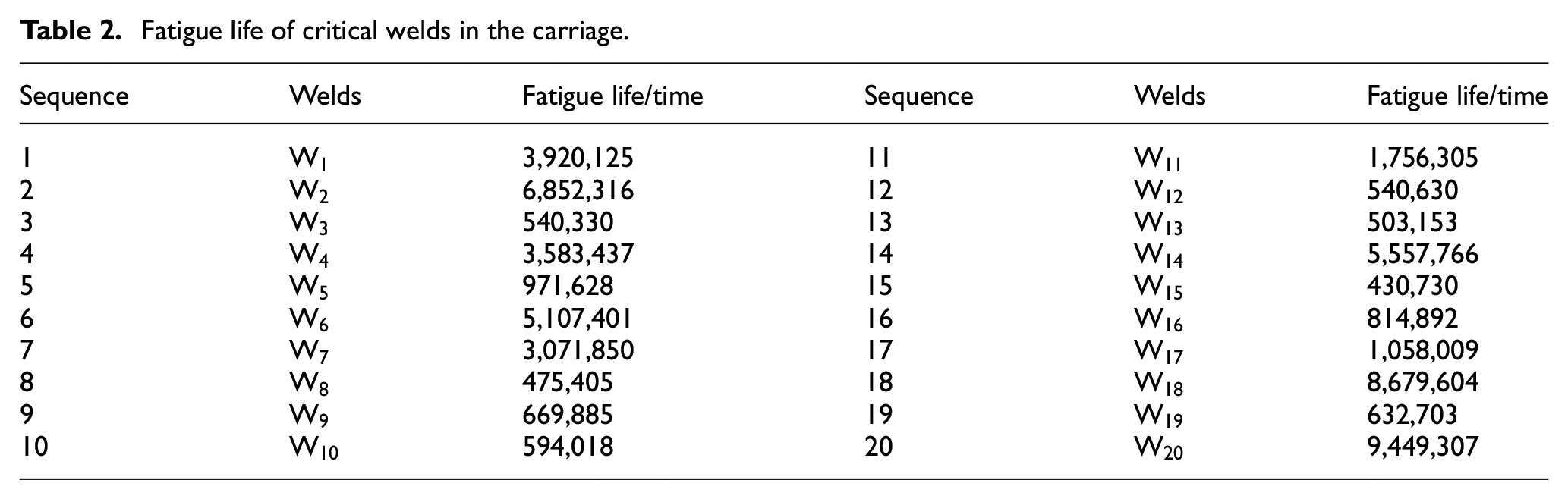
According to Table 2, it is evident that the critical weld
Anti-fatigue lightweight design of dump truck carriage
Selection of design variables for anti-fatigue lightweight
During the anti-fatigue lightweight design of the dump truck carriage, the static simulation analysis under full load turning condition and the fatigue life of the critical welds under the virtual reliability simulation test are considered. The response variables in the size parameter optimization model are designated as follows: the mass of the carriage M, the maximum displacement D, the maximum equivalent stress under full load turning condition B, and the minimum fatigue life of the critical welds L. To preserve the interconnected relationships in the spatial topology of the carriage without disrupting its structure, the part thicknesses are chosen as the design variables in the size parameter optimization model. Due to the numerous parts in the carriage, it is necessary to identify the design variables that have a significant impact on each response variable. Therefore, the comprehensive contribution analysis method is employed for the selection of important design variables.
The response variables of the carriage can be approximated by the main and interaction effect values of design variables through a regression model. 28 Therefore, the comprehensive contribution of design variables to response variables can be calculated by the following formula:


where E represents the contribution of a design variable to a single response variable.
Twenty parts are initially selected from the carriage assembly as screening objects. After setting the upper and lower limits of part thicknesses based on manufacturing process dimensions, a finite element simulation experiment design is conducted with 20 factors at two levels using the partial factorial method. Subsequently, the comprehensive contribution of the initial 20 design variables to the response variables M, D, B, and L is calculated using the results from 40 simulation experiments, as shown in Figure 13.

Comprehensive contribution of initial design variables to response variables.
According to the comprehensive contribution analysis, the 10 part thicknesses that have a significant combined impact on various response variables are selected as design variables for the anti-fatigue lightweight design of the carriage, with being designated as

Design variables for anti-fatigue lightweight design of carriage.
Establishment of GA-XGBoost machine learning approximation models
Considering the time cost of finite element simulation experiments and the sample requirements of the XGBoost model, the MELS experimental design method is employed to randomly sample 10 design variables for anti-fatigue lightweight design of the dump truck carriage within the defined interval. 29 A total of 73 finite element simulation experiment samples are generated. Through batch solving of response variables using relevant simulation software, the sample dataset for the GA-XGBoost-MLAM is obtained, as shown in Table 3 (due to space limitations, some data are omitted).
Sample dataset of GA-XGBoost-MLAM.

The sample dataset obtained from the MELS experimental design is utilized as the learning sample for the GA-XGBoost-MLAM. The dataset is randomly split into 65 training samples (training set) and 8 testing samples (testing set). The hyperparameters of the XGBoost model, including the maximum tree depth, number of trees, and learning rate, are chosen as the optimization objectives for the GA. Following optimization and learning, the hyperparameters of the GA-XGBoost-MLAM for the response variables M, D, B, and L are shown in Table 4. The prediction errors of the response variables of GA-XGBoost-MLAM in the test set is shown in Figure 15.
Hyperparameters of GA-XGBoost-MLAM.

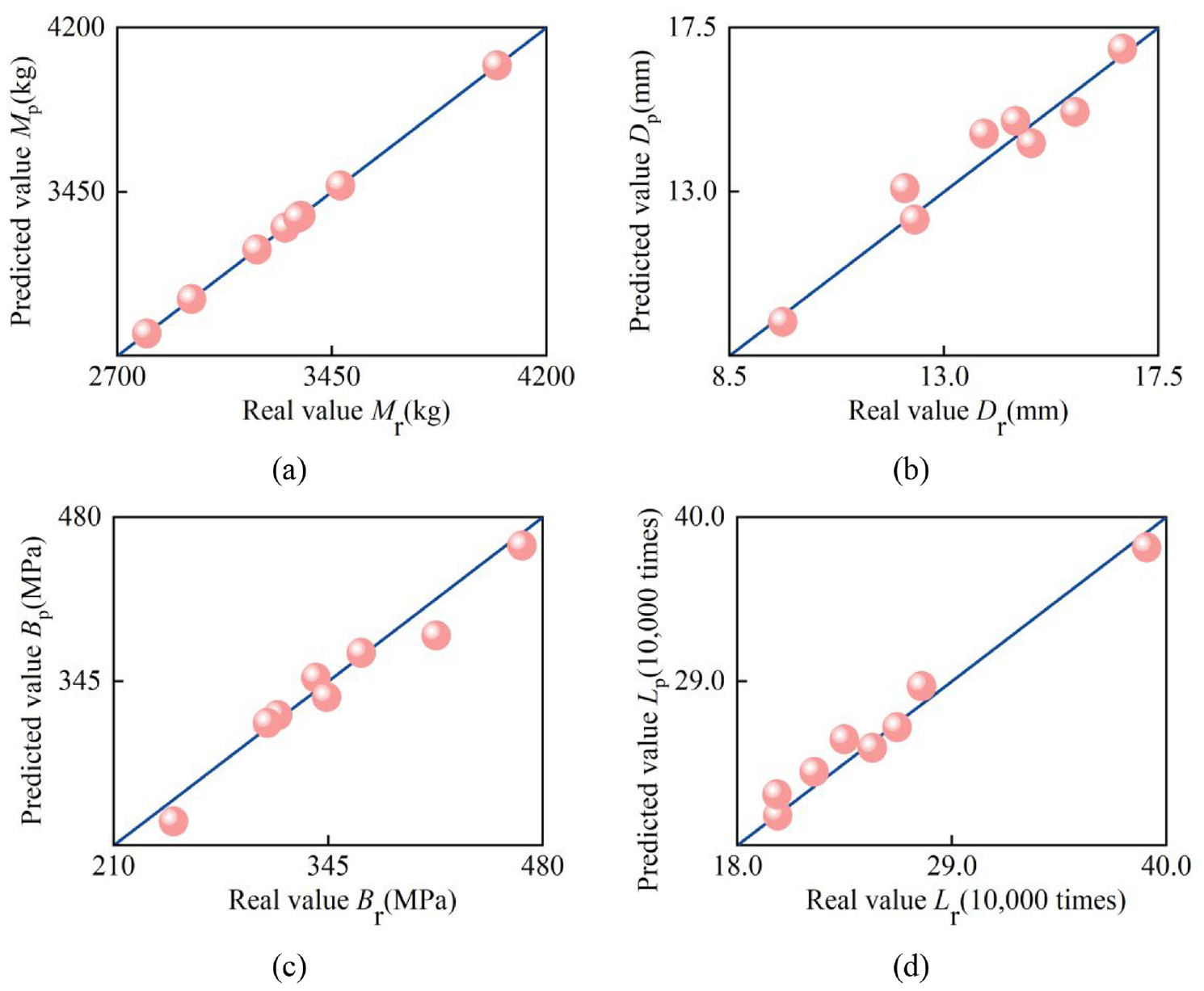
Prediction errors of GA-XGBoost-MLAM: (a) mass of carriage M, (b) maximum displacement of full load turning condition D, (c) maximum stress of full load turning condition B, and (d) minimum fatigue life of critical welds L.
According to the determination coefficient


where
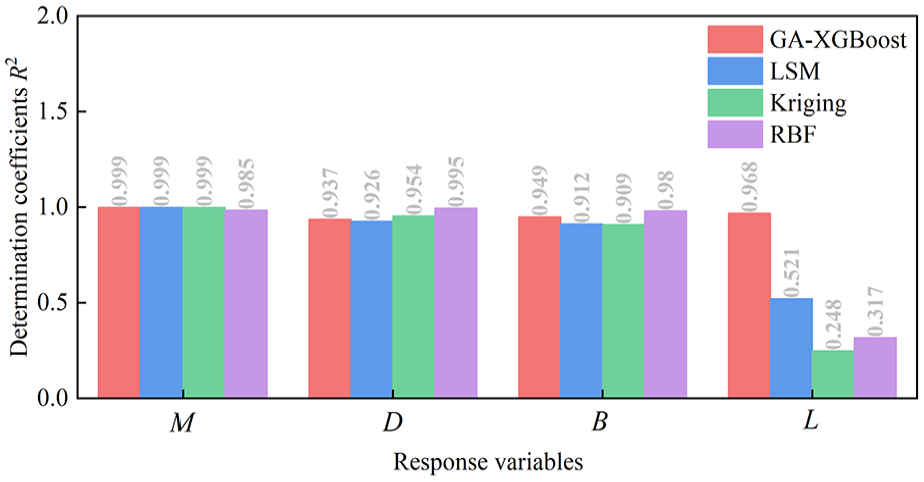
Determination coefficients of approximation models.
Root mean square errors of approximation models.

Based on the calculation results, it is evident that the determination coefficients
In summary, traditional AM techniques face challenges in accurately predicting multiple structural performance responses when there are many design variables and limited sample data. This significantly reduces the accuracy of dimension parameter optimization results. However, whether dealing with highly linear responses (such as mass) or highly nonlinear responses (such as displacement, stress, and fatigue life), the GA-XGBoost-MLAM can accurately fit the mapping relationship between multiple design variables and individual responses. The MLAM provide highly reliable data for subsequent size parameter optimization, further demonstrating the potential application of ML techniques in the field of mechanical structural optimization.
Multi-objective optimization of dump truck carriage
Multi-objective optimization model and Pareto non-dominated solutions
To ensure that the carriage can be reduced in weight while meeting basic engineering and technical requirements, it is essential to comprehensively consider the influence of various structural performance responses for anti-fatigue lightweight design. Therefore, based on the material properties of the carriage and the relevant design standards, in the size parameter optimization model, the maximum displacement D under full load turning condition is set not to exceed 15 mm, and the maximum equivalent stress B under full load turning condition is set not to exceed the allowable stress value of its material LG700XL, which is 608 MPa. To achieve a good anti-fatigue lightweight effect, the mass of the carriage M and the 10 times reciprocal of the minimum fatigue life L of the critical welds are set as the minimization objectives. The multi-objective optimization model for the dump truck carriage is as follows:
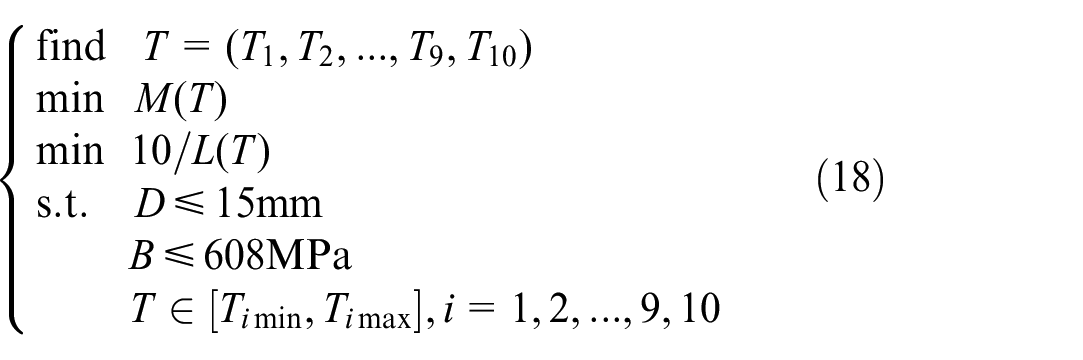
Based on Python 3, the multi-objective optimization model for the dump truck carriage is established using the GA-XGBoost-MLAM and the NSGA-II algorithm. The parameters for the NSGA-II algorithm are set as follows: the population size is 300, the offspring size is 50, the crossover probability is 0.8, the mutation probability is 0.2, the crossover distribution index is 15, the mutation distribution index is 15, and the number of iterations is 600. After solving the optimization problem, 300 Pareto non-dominated solutions are obtained in the objective space.
Entropy weighted TOPSIS method for multi-objective decision-making
To reduce the subjectivity in the selection of Pareto non-dominated solutions, a comprehensive evaluation of the non-dominated solutions using data information is conducted. The entropy weighted technique for order preference by similarity to ideal solution (TOPSIS) method is employed for multi-objective decision-making on Pareto non-dominated solutions. 33 The formula for calculating the entropy weighted values of optimization objectives is as follows:


where
To achieve good anti-fatigue lightweight of the dump truck carriage, the initial values of the objectives M and 10/L are taken as the reference solution. From the obtained Pareto non-dominated solutions, 237 solutions are filtered relative to the reference solution, which serve as preferred non-dominated solutions according to the dominance relationships. The entropy weighted values for the optimization objectives M and 10/L are calculated as 0.4999 and 0.5001, respectively, using the entropy weighted TOPSIS method. The entropy weighted TOPSIS values

Entropy weight TOPSIS values of preferred non-dominated solutions.

Multi-objective decision-making of Pareto preferred non-dominated solutions.
Simulation verification and analysis of optimization results
The optimal design variable values for the 10 part thicknesses corresponding to the optimal solution of the multi-objective decision-making for the dump truck carriage are illustrated in Figure 19. After rounding to the manufacturable precision of the carriage, these values are submitted to the relevant simulation software for solving and calculating various response variables of the carriage. The simulation verification results are shown in Table 6.

Optimal design variable values for part thicknesses.
Simulation verification results of multi-objective optimization.

According to Table 6, the relative errors of the simulation values for response variables M, D, B, and L compared to the Pareto values obtained through multi-objective optimization are all within 5%. Specifically, the errors for the mass M and the maximum displacement D under full load turning condition are within 1% of the Pareto values. Although the relative error of the simulation value for the minimum fatigue life of the critical weld L compared to the Pareto value is relatively large, the overall simulation verification results indicate that the established GA-XGBoost-MLAM possess high predictive accuracy.
In addition, after rounding and matching the 10 optimal design variable values obtained through multi-objective optimization for the part thicknesses, the objective response M is decreased by 295.69 kg, resulting in a 9.47% reduction in the carriage mass compared to the pre-optimization state. The objective response L is increased by 157,570 cycles, which is equivalent to an increase of 157,570 km in travel distance, resulting in a 36.58% increase in the minimum fatigue life of the critical welds in the carriage compared to the pre-optimization state. Although the maximum displacement D under full load turning condition slightly increases, it remains within the safe allowable range. The maximum stress B experiences a slight decrease. Through simulation verification, the optimized carriage maintains ideal stiffness and strength when subjected to full load bending and full load lifting at 0° conditions, as shown in Figure 20. Overall, the optimal design of the part thicknesses, following the optimization and decision-making, not only meets the static structural performance requirements of the carriage but also achieves a positive effect in anti-fatigue lightweight.

Displacement and stress contours for the full load bending condition and full load lifting at 0° condition of optimized carriage: (a) displacement contour of full load bending condition, (b) stress contour of full load bending condition, (c) displacement contour of full load lifting at 0° condition, and (d) stress contour of full load lifting at 0° condition.
Conclusions
To enhance the fatigue reliability of the welds and reduce the weight of the dump truck carriage, an anti-fatigue lightweight design method based on ML and multi-objective optimization is proposed and validated in this study. The conclusions are as follows:
A high-quality finite element model of the heavy dump truck carriage is established. Static simulation analyses are conducted under three typical conditions, and 20 critical welds are selected for fatigue analysis.
The virtual reliability simulation test is performed by establishing a multi-body dynamics model of the dump truck. Load-time histories for the excitation channels are extracted, and the fatigue life of the critical welds is calculated using the equivalent structural stress method.
The anti-fatigue lightweight design variables of the carriage are selected using the comprehensive contribution analysis method. The multi-objective optimization model of the carriage is established based on the high-precision GA-XGBoost-MLAM and the NSGA-II algorithm.
The entropy weighted TOPSIS method is employed for multi-objective decision-making on Pareto non-dominated solutions to determine the optimal design variable values of the 10 part thicknesses. Compared to the original carriage design, the design results after optimization and decision-making indicate that the minimum fatigue life of the critical welds is increased by 157,570 cycles, equivalent to an additional 157,570 km of travel, representing a 36.58% increase while meeting the static structural performance requirements of the carriage. Additionally, the mass of the carriage is reduced by 295.69 kg, representing a 9.47% decrease and achieving a good outcome for anti-fatigue lightweight design.
The benefits and advantages of this study are primarily manifested in several aspects. Firstly, the fatigue life of the critical welds in the dump truck carriage is calculated by integrating the virtual reliability simulation test and the equivalent structural stress method, thereby enhancing the assessment methods for the reliability of dump truck carriages. Secondly, the high-precision GA-XGBoost-MLAM are established, providing reliable predictive data for multi-objective optimization and validating the practicality of ML techniques in the field of mechanical structure optimization. Finally, the multi-objective optimization is employed to carry out anti-fatigue lightweight design for the carriage, providing an innovative solution for the structural lightweight of dump truck carriages.
However, the aforementioned research still has certain limitations. In this paper, the anti-fatigue lightweight design method for the dump truck carriage is determined based on existing theories and finite element simulation results. While the proposed anti-fatigue lightweight design method can provide technical guidance for the product development of dump truck carriages, the conclusions of the simulation analysis and the actual effects after optimization require further validation through testing experiments on the modified carriage. Therefore, in future research, this method can be combined with actual testing experiments to achieve a more robust anti-fatigue lightweight effect.
Footnotes
Acknowledgements
Thanks to Wei Huang’s guidance and the help of the research team members. Without their guidance and help, the study could not be completed.
Handling Editor: Jianguang Fang
Declaration of conflicting interests
The author(s) declared no potential conflicts of interest with respect to the research, authorship, and/or publication of this article.
Funding
The author(s) disclosed receipt of the following financial support for the research, authorship, and/or publication of this article: This research is supported by Guangxi Science and Technology Major Special Project (No. AA22068055, AA22068061, and AA22068060). We would like to express appreciations for the afore-mentioned fund supports.
