



Abstract
The rise of electric vehicles (EVs) is undoubtedly revolutionizing the automotive industry, and its impact on the car repair and service business is profound. While exciting opportunities emerge, the shift also presents significant challenges, potentially leading to the disappearance of certain jobs and parts. In this research, we explore the impact of electric cars on the future car repair and service landscape. By 2030, EVs will constitute 60% of global car sales, underscoring the significant shift towards electric mobility. This transition is expected to reduce maintenance costs by up to 40% compared to conventional vehicles due to the simpler design and fewer moving parts in EVs. Certain body parts, including radiators and exhaust systems specific to gasoline cars, will also become redundant as EVs become more prevalent in the market. However, amidst these disappearing parts, there are emerging opportunities in the automotive industry. The rise of EVs will necessitate new areas of expertise, such as battery diagnostics, charging infrastructure installation, and software updates, creating new job opportunities for trained technicians. Furthermore, there will be a growing focus on software and electronics as they play a bigger role in car functionality. This shift emphasizes the importance of upskilling existing technicians in these areas to capitalize on new avenues within the automotive sector, aligning with the evolving landscape of electric mobility.
Keywords
Introduction
The current state of electric cars globally is experiencing rapid growth in adoption, particularly in developed countries. In the first half of 2021, global sales of electric vehicles (EVs) increased by 160% compared to the previous year, with EVs accounting for 26% of car sales. China is leading in EV adoption, followed by the United States and Europe. 1 Looking toward the future, market forecasts project that the global EV fleet will continue to grow significantly. By 2030, the global EV fleet is projected to reach 95–105 million vehicles; by 2050, it could reach 585–823 million vehicles. In different scenarios, EVs could constitute one-third to one-half of the overall light-duty vehicle (LDV) fleet by 2050. This growth in EVs is expected to reduce oil consumption and emissions, contributing to global decarbonization efforts. 2 The market is projected to reach a revenue of US$457.60 billion in 2023, with an annual growth rate of 17.02%. 3 In Q2 2022, EV sales accounted for 5.6% of the total auto market, indicating an increasing market share. 4 Clean energy, improved performance, and government incentives drive electric vehicle adoption. 5 However, there are still challenges to overcome, including issues with installation, short range, and battery handling. 6 Efforts to address these challenges include increasing the availability of charging infrastructure and improving battery capacity and maintenance. The electric vehicle market is poised for further growth and success, with key factors such as battery quality, price competitiveness, charging infrastructure, government policies, and brand reputation playing crucial roles in driving consumer adoption.
The electric vehicle market is witnessing remarkable growth, with a significant projected global market share in the near future. In terms of the current state, sales figures from 2022 reveal substantial progress: over 10 million electric cars were sold, reflecting a notable 35% increase from 2021, as the International Energy Agency (IEA) reported. This surge signifies a remarkable uptick in the EV sector’s prominence, constituting a 14% share of total global car sales in 2022, a substantial rise from the 4% recorded in 2020. Notably, China emerges as the frontrunner in this market, boasting the largest electric car fleet globally, closely trailed by Europe and the United States, indicating a widespread adoption and acceptance of electric vehicles across diverse regions (Figure 1).7,8

Looking ahead, projections for the future share of electric vehicles in the automotive market paint a transformative picture. EVs are anticipated to represent 60% of global car sales by 2030. Similarly, Bloomberg New Energy Finance envisions a complete transition, predicting that all new car sales will be electric by 2040. These predictions hinge on several key factors, including ongoing technological advancements such as the development of solid-state batteries offering enhanced range, the anticipated 80% decrease in battery costs by 2030, and the rising governmental support manifested in investments in charging infrastructure. As these elements converge, the trajectory points toward a paradigm shift in the automotive industry, where electric vehicles emerge as the dominant choice, reshaping the landscape of transportation on a global scale. 9
The prospects for electric cars are promising. The development of electric vehicles (EVs) has surged in several nations to solve the energy crisis and environmental problems. 10 However, current EV battery technology has limitations, such as heavier vehicles, shorter range, and higher cost. 11 Nevertheless, next-generation technologies under laboratory development, such as lithium-air, metal-air, and solid-state technologies, could radically change this situation. 12 Intensive battery research and development are also underway, which should make EVs more attractive to a wider population. 13 Additionally, predictions suggest South Korea could be fully electrified by 2035. 14 The industry faces challenges in deploying charging stations globally, but with suitable infrastructure and research, over 50% emission voidability could be achieved within a few years; continued government support and technological advancements are expected to drive the transformation from conventional to electric vehicles over time.
Electric cars have lower emissions and operating costs than gasoline-powered cars, but their performance and cost can vary depending on factors such as battery degradation and electricity sources. Studies have shown that EVs generally have lower carbon emissions than gasoline vehicles throughout their lifecycle, especially in developed regions with cleaner electricity sources. 15 However, the performance of EVs can worsen over time due to battery degradation, leading to increased energy consumption and reduced driving range. 16 In terms of cost, the per kilometer cost of ownership for a used EV is lower than that of a used petrol-powered car. 17 Additionally, EVs have the potential to significantly reduce global warming emissions, especially when charged with low-carbon renewable electricity. 18 At the same time, EVs offer environmental benefits and cost advantages in certain scenarios their performance and cost can be influenced by factors such as battery degradation and electricity sources.
Electric cars (EVs) have the potential to mitigate climate change by reducing carbon emissions and air pollution. They produce no tailpipe emissions, helping to reduce local air pollution. 19 Additionally, EVs can contribute to reducing carbon emissions by eliminating the greenhouse gases associated with the combustion of fossil fuels in traditional vehicles. 20 However, there are challenges to the widespread adoption of EVs. These include the high cost of infrastructure, limited range or range anxiety, and the performance of batteries. 21 To overcome these challenges, potential solutions include enhancing the charging infrastructure, increasing the number of charging stations, using battery swapping techniques, and improving battery technology. 22 Governments can incentivize consumers to purchase EVs through tax credits or subsidies and invest in building a robust charging infrastructure 23 ; while EVs offer benefits for climate change mitigation, addressing these challenges is crucial for their widespread adoption and maximum impact.
Electric vehicles represent a significant advancement in automotive technology, boasting higher efficiency in converting electrical energy to power at the wheels compared to conventional internal combustion engine (ICE) vehicles. This inherent efficiency, coupled with lower electricity costs and reduced maintenance requirements due to fewer moving parts, positions EVs as more cost-effective options for transportation.24–28 Conversely, vehicles powered by hydrogen fuel cells face challenges that contribute to higher operational costs, including limited refueling infrastructure and the substantial energy demand for hydrogen production, often derived from fossil fuels. Consequently, the efficiency and cost-effectiveness of EVs outshine those of traditional vehicles and hydrogen-powered alternatives. While biofuels and hydrogen offer promise in reducing emissions, additional factors such as cost and land use must be considered.29–33 Despite these challenges, ongoing research and sustainable practices hold the potential to harness biofuels as tools for environmental sustainability, energy security, air pollution reduction, and decreased dependence on fossil fuels. This underscores the importance of continuous exploration and implementation of alternative fuel sources to address pressing environmental and energy concerns.
The electrification of the automotive industry will significantly impact the future of automotive repair and maintenance. With the increasing number of EVs, there is a growing concern for electric work safety in workshops due to the higher battery voltages and potential electric shock risks. 34 Research suggests that EVs have lower maintenance and repair requirements than conventional vehicles (CVs). 35 However, the transition to EVs may also have implications for workers in the vehicle services sector, requiring careful attention to ensure a just transition and support for workers and communities. 36 Additionally, the widespread adoption of EVs may have indirect, systemwide impacts on carbon emissions, highlighting the need to consider vehicle’s global and whole lifecycle emissions. 37 The electrification of the automotive industry will require adjustments in repair and maintenance practices, consideration of worker impacts, and a comprehensive approach to address environmental concerns. While research has been conducted on the maintenance and repair (MandR) cost variations for battery electric vehicles (BEVs), the impacts of autonomous vehicle (AV) deployment on the MandR sector are still being explored. Factors influencing MandR requirements for AVs include hardware components, software enabling autonomy, increased wear and tear of replaceable parts, and adequate cleaning services. The automotive industry is undergoing rapid technological and manufacturing transformation, with electrification and the emergence of new technologies introducing uncertainty about the future of automotive jobs. 38
Battery thermal management systems (BTMS) are crucial for maintaining optimal operating temperatures in lithium-ion batteries, especially in electric vehicles. Various approaches have been proposed to enhance BTMS efficiency, such as hybrid systems combining active and passive cooling methods, 39 the use of phase change materials (PCMs) for thermal control, 40 and innovative cooling technologies like pulsating heat pipes. 41 These systems aim to prevent overheating, which can lead to reduced battery performance and accelerated aging. 42 Researchers have improved cooling performance by optimizing airflow velocity, PCM thickness, and cooling duct structures while minimizing power consumption. 43 Developing high-performance BTMS is essential for ensuring battery efficiency, longevity, and safety in electric vehicles.
Methodology
This research analyzes the impact of electric vehicles (EVs) on the future of car repair shops by examining both the “disappearing parts/jobs” and “emerging opportunities.” It focuses on how the absence of combustion engine components, fluids, and specific body parts in EVs will affect workers and manufacturers while highlighting new areas like battery diagnostics, charging infrastructure, and software expertise that will create new job opportunities. Determining the exact number of car repair and service shops and the mechanics they employ worldwide is complex. For instance:
Data fragmentation: Unlike other industries with centralized data collection, the car repair sector lacks a unified global record. National statistical agencies typically offer broad business counts within relevant sectors but rarely distinguish specialized service shops like car repair. This fragmentation leaves researchers piecing together estimates from diverse sources, hindering the accuracy and comparability of data across countries.
Definitional discord: Compounding the data challenge is the lack of a universally agreed-upon definition for “car repair shop.” What constitutes a shop can vary significantly: independent garages to dealership service bays, authorized repair centers, and informal roadside stands. This inconsistency makes it difficult to compare data across regions and ensure all relevant establishments are captured.
Informal workforce: Further blurring the picture is the prevalence of informal mechanics. Many operate independently, unregistered, and uncounted by official statistics. This hidden segment, particularly prevalent in developing economies, contributes significantly to the overall car repair workforce but remains invisible in official data, further complicating efforts to obtain an accurate global count.
Unearthing the exact number of car repair shops and mechanics worldwide remains a formidable challenge. Data fragmentation, definitional inconsistencies, and an informal workforce create substantial hurdles. While estimates and industry reports offer insights, a comprehensive and unified global count remains elusive.
The shift from ICE EVs will profoundly impact workforce dynamics within the automotive repair industry. This study examines several key aspects of this transition, such as skill set evolution, which is the skill set required for mechanics and technicians to evolve significantly. Traditional skills related to ICE maintenance, such as engine tuning and exhaust system repair, will decline in demand. In contrast, electronics, software, and electrical system skills will become more critical. This study evaluates the readiness of the current workforce to adapt to these changes and identifies gaps in existing training programs. Job Displacement and Creation: While some jobs will disappear, new opportunities will emerge. The study quantifies potential job losses in traditional repair roles and estimates job creation in new areas such as EV battery maintenance, charging infrastructure installation, and software troubleshooting. The study provides a balanced view of the overall impact on employment by analyzing industry trends and employment data.
The transition to EVs will have broader economic implications for the automotive repair industry. Cost of Training and Retraining: The study assesses the financial implications for repair shops investing in new training programs and equipment. This includes the cost of certifications, new diagnostic tools, and safety equipment for handling high-voltage systems. The economic impact on small and independent repair shops versus larger service centers is also considered. Business Model Adaptations: Repair shops may need to adapt their business models to stay competitive. The study explores strategies such as diversifying services to include EV-specific repairs, partnering with EV manufacturers for authorized service centers, and offering mobile repair services. The potential for new revenue streams from software updates and remote diagnostics is also analyzed.
Understanding consumer behavior and market trends is crucial for repair shops adapting to the rise of EVs. Consumer Awareness and Demand: The study investigates consumer awareness of EV maintenance needs and their preferences for service providers. Surveys and interviews with EV owners provide insights into factors influencing their choice of repair shops, such as expertise, convenience, and cost. Market Penetration and Growth Projections: By analyzing market penetration rates of EVs and growth projections, the study estimates future demand for EV repair services. This includes regional variations and the impact of government incentives and subsidies on EV adoption rates.
Disappearing parts
Significant parts are missing in electric vehicles compared to their gasoline counterparts. EVs have fundamentally different components than gasoline-powered cars. Here is a list of major parts absent in EVs:
Engine and drivetrain:
Internal combustion engine: This is the heart of a gasoline car, converting fuel into power. EVs have electric motors instead, powered by electricity from batteries.
Transmission: Most EVs do not need a complex multi-gear transmission due to the torque characteristics of electric motors. Some high-performance models might have single-speed reduction gear.
Drivetrain components: These include the clutch, flywheel, driveshaft, axles, and differentials, all connected to the engine and transmission. A simpler drivetrain connects the electric motor directly to the wheels or axles in EVs.
Fuel system:
Fuel tank: EVs do not need a tank to store gasoline.
Fuel pump: Delivers gasoline to the engine, which is not needed in EVs.
Fuel injectors: Spray gasoline into the engine cylinders, which are absent in EVs.
Fuel filter: Cleans gasoline before injection, which is unnecessary in EVs.
Exhaust system: Carries burned fuel gases out of the engine, which is not present in EVs.
Other systems:
Radiator and cooling system: Traditional gasoline engines generate heat, requiring a complex cooling system with radiator, coolant, hoses, and water pump. Electric motors produce less heat; EVs often use air cooling or a simpler liquid cooling system.
Starter motor: Cranks the gasoline engine to start; not needed for electric motors.
Alternator: Charges the battery in gasoline cars, replaced by regenerative braking and onboard chargers in EVs.
Additional components absent in most EVs:
Spark plugs: Ignite the gasoline air mixture in gasoline engines.
Oxygen sensors: Monitor exhaust gas composition for efficient combustion, which is not applicable in EVs.
Catalytic converter: Reduces harmful emissions in gasoline cars, which are unnecessary in EVs.
Car maintenance and services
The heart of an EV is its battery pack, which requires specialized maintenance and diagnostics. Technicians must be skilled in using advanced diagnostic tools to assess battery health, capacity, and efficiency. Regular checks for battery cooling systems, voltage balancing, and software updates for battery management systems (BMS) are crucial. Also, handling battery degradation and replacement requires safety protocols due to the high voltage. EVs rely heavily on software, including features such as autopilot systems, regenerative braking, and energy management. Maintenance now includes regular software and firmware updates to improve performance, security, and user experience. This shift necessitates repair shops to be able to interface with the car’s onboard systems and update software as provided by the manufacturer.
With EVs, the charging system becomes a vital part of regular maintenance. This includes checking the integrity and functionality of the on-board charger, DC–DC converters, and external charging equipment. Regular inspection of charging ports and connectors for wear and corrosion is essential, ensuring compatibility and safety standards are maintained for home and public charging infrastructures. Although EVs use regenerative braking, which reduces wear on traditional friction brakes, the brake system still requires periodic checks. Regenerative braking puts less strain on brake pads and rotors, but technicians must ensure that the traditional braking components remain in good condition. The need for brake fluid changes and brake system inspections, though less frequent, remains a part of regular maintenance schedules.
Safety checks specific to the high-voltage systems in EVs are critical. These include inspecting high-voltage cable connectors and ensuring the insulation and integrity of these systems. Regular training on handling high-voltage components is necessary for technician safety. This also involves using appropriate personal protective equipment (PPE) and adhering to strict safety protocols. EVs use sophisticated thermal management systems to keep batteries, motors, and power electronics within optimal temperature ranges. Maintenance includes checking coolant levels, ensuring the proper operation of thermal sensors, and servicing cooling circuits. This helps prevent overheating and extends the lifespan of critical components.
Modern EVs have telemetry systems that collect and transmit data about vehicle performance and component health. Repair shops can leverage this data for predictive maintenance, identifying potential issues before they become serious problems. This proactive approach can enhance reliability and customer satisfaction by minimizing unexpected breakdowns. As the EV market grows, the need for specialized training and certification for technicians becomes evident. Certification programs ensure technicians have the knowledge and skills to safely and effectively service EVs. This includes understanding EVs’ unique electrical and mechanical systems and staying up-to-date with the latest technological advancements.
EVs require less frequent and expensive maintenance than gasoline cars due to their simpler design and lack of wear-prone components. However, battery health and other EV-specific aspects introduce new maintenance considerations. The absence of certain parts in electric vehicles (EVs) translates to different maintenance needs compared to gasoline cars. Here’s a list of car services typically not required for EVs:
Engine-related services:
Oil changes: EVs lack an internal combustion engine and do not require oil changes.
Spark plug replacements: EVs don’t use spark plugs for ignition, eliminating this service.
Tuneups: Traditional tuneups involving adjustments to the fuel-air mixture and ignition timing are unnecessary in EVs due to their simpler electric drivetrain.
Timing belt/chain replacements: These components are specific to gasoline engines and are absent in EVs.
Fuel system services:
Fuel filter replacements: EVs do not have a fuel filter as they do not use gasoline.
Fuel injector cleaning: Fuel injectors are absent in EVs, eliminating this service.
Exhaust system repairs: EVs lack an exhaust system, removing this maintenance concern.
Other service reductions:
Transmission services: Most EVs lack complex transmissions, reducing the need for regular maintenance compared to traditional automatic or manual transmissions.
The cooling system flushes: While some EVs still use liquid cooling, simpler systems, compared to gasoline cars, require less frequent flushing.
Starter motor replacements: EVs don’t have starter motors, eliminating this potential repair cost.
However, it’s important to note that EVs still require specific maintenance:
Battery health checks and potential replacements: EV batteries degrade over time and might need eventual replacement, a significant cost not present in gasoline cars.
Electric motor checks and repairs: While generally reliable, electric motors might require maintenance or repairs during the car’s lifespan.
Brake system service: Even with regenerative braking, EVs still use traditional friction brakes, requiring regular inspection and potential replacements.
Software updates: EVs rely heavily on software for various functions, and regular updates might be necessary.
Table 1 summarizes the parts missing in gasoline vehicles compared to electric vehicles (including extra electric vehicle components).
Parts missing in gasoline vehicles compared to electric vehicles.

Results and discussion
The transition to EVs presents a complex landscape with varied economic impacts for different stakeholders in the automotive industry. While challenges exist, the shift offers significant innovation, growth, and long-term sustainability opportunities.
Traditional automakers face significant costs related to retooling factories and retraining employees to produce EVs instead of ICE vehicles. These investments in new technology and production processes are substantial, and companies must manage the transition without disrupting current operations while maintaining profitability. However, early adoption and innovation in EV technology can position traditional automakers as leaders in the evolving market, potentially capturing significant market share. Conversely, new entrants in the EV market, such as Tesla and Rivian, have the advantage of building their business models and production facilities around EVs from the start, resulting in more efficient production processes and potentially lower costs. While facing intense competition and the need to scale production rapidly to meet demand, these companies can capitalize on the increasing consumer shift toward sustainable transportation options, potentially experiencing rapid growth and high returns on investment.
The EV transition’s economic impact is mixed for parts and component suppliers. Suppliers of components for ICE vehicles, such as engine parts and exhaust systems, will see a decline in demand, leading to potential job losses and revenue decreases. These suppliers need to diversify their product lines to include components for EVs, such as batteries, electric motors, and power electronics. Those who successfully pivot to producing EV components can secure new contracts and maintain their relevance in the automotive supply chain.
Repair and maintenance shops also face significant changes. Traditional repair shops may experience reduced business due to the lower maintenance requirements of EVs, as services such as oil changes, exhaust repairs, and engine tune-ups decline. These shops must invest in new tools, training, and certifications to service EVs. However, those that adapt can offer specialized services such as battery diagnostics, software updates, and charging infrastructure maintenance, potentially capturing a niche market. For charging infrastructure providers, the growing number of EVs increases the demand for charging stations, representing a significant economic opportunity. Providers must ensure charging stations’ availability, reliability, and convenience to meet consumer expectations. Companies involved in installing and maintaining charging infrastructure can benefit from government incentives and growing consumer demand, leading to substantial business growth.
The current automotive workforce will also be impacted. Workers specializing in ICE vehicle production and maintenance face potential job displacement and need retraining and upskilling to transition to roles in the EV sector. Training programs and educational initiatives can help workers move into new roles, such as EV assembly, battery production, and high-voltage system maintenance, ensuring continued employment and career growth.
For consumers, the economic impact of the EV transition includes higher upfront costs than ICE vehicles, which can be a barrier. However, EVs offer long-term savings due to cheaper electricity than gasoline, reduced maintenance expenses, and potential government incentives. Additionally, as the market matures and battery technology improves, the resale value of EVs is expected to stabilize and possibly increase.
Governments and policymakers also face economic impacts from the transition to EVs. Investments in charging infrastructure and grid upgrades are necessary to support the growing number of EVs. Policies encouraging EV adoption, such as tax rebates and subsidies, have short-term fiscal impacts but can drive long-term environmental and economic benefits. Additionally, governments need to address the reduction in fuel tax revenue through new taxation models, potentially including road usage fees for EVs.
In the evolving landscape of electric vehicle servicing, repair shops encounter several technical challenges and common issues during software updates. Ensuring compatibility across diverse EV models and software versions poses a significant hurdle due to the rapid pace of software development and the array of manufacturers in the market. Cybersecurity and data privacy concerns amplify these challenges, necessitating robust protocols to safeguard against potential cyber threats and vulnerabilities. Additionally, the technical complexity of software updates demands specialized training and expertise among technicians to effectively diagnose and address software-related issues, highlighting the importance of ongoing education and certification programs. To mitigate connectivity issues and ensure smooth updates, repair shops invest in high-speed internet infrastructure and secure data storage solutions. Moreover, advancements in diagnostic equipment and software tools tailored to EV maintenance enhance technicians’ capabilities in diagnosing software-related issues and performing updates accurately. Through these concerted efforts, repair shops position themselves to meet the evolving needs of EV servicing while maintaining high standards of reliability and customer satisfaction in the dynamic automotive industry.
Growing interest in exploring new materials that can enhance their performance, efficiency, and sustainability. One potential area of exploration is the use of advanced composites and lightweight materials in EV construction. These materials, such as carbon fiber reinforced polymers (CFRPs), aluminum alloys, and high-strength steels, offer significant weight reduction benefits compared to traditional materials like steel. While these materials contribute to improved energy efficiency and driving range in EVs, they may also pose unique challenges for body shop operations.
Repairing vehicles constructed with advanced composites and lightweight materials requires specialized techniques and tools due to their different properties and behaviors compared to conventional materials. CFRPs, for example, are known for their high strength-to-weight ratio but can be challenging to repair if damaged. Repairing CFRP components often involves specialized procedures such as vacuum infusion techniques or autoclave curing processes to ensure structural integrity and maintain material properties. Similarly, repairing aluminum and high-strength steel components may require specific welding techniques and equipment to prevent heat distortion and ensure proper metallurgical bonding.
While the shift toward EVs is inevitable, its impact on different types of mechanical shops will vary. Breakdown of potential effects:
Engine and Transmission specialists will be significantly affected: These shops focus on repairing and rebuilding internal combustion engines, transmissions, and related components. Their core business will decline significantly with fewer gasoline cars on the road. They might need to adapt by specializing in hybrid or electric vehicle repairs, offering diagnostic services for EVs, or diversifying into other areas like general car maintenance not specific to EVs. Transmission Repair Shops: As most EVs lack complex transmissions, dedicated transmission repair shops might face declining demand. Similar to engine specialists, they may need to adapt or diversify.
General Auto Repair Shops will be Moderately Affected: These shops handle various repairs and maintenance tasks on all types of vehicles. While EVs have fewer moving parts, they will still require maintenance on brakes, suspension, electrical systems, and tires. These shops might need to invest in training and equipment to diagnose and service EVs effectively. Muffler and Exhaust Shops: With no exhaust system in EVs, muffler and exhaust shops will lose a significant part of their business. They might need to expand their services to include general repairs, offer EV-specific services like battery diagnostics, or find other revenue streams.
Body Shops will be least affected: Collision repairs and paint jobs are not specific to vehicle type, so body shops are likely to be less impacted by the EV transition. They might need to be aware of specific materials and construction techniques of EVs for proper repairs. Tire Shops and Auto Parts Stores: These businesses cater to all types of vehicles and should see minimal impact from the EV transition. They might need to stock specific tires and parts for EVs as their market share grows.
The transition to EVs presents challenges for some mechanical shops but also creates new opportunities for others. Adaptability, focusing on new skill sets, and embracing specialized services will be key for shops to thrive in this evolving landscape.
This list focuses on major components and might not include every detail or variation across different EV models and technologies. As electric car technology evolves, new components and systems might emerge, further differentiating them from gasoline-powered vehicles. List of major components present in EVs but absent in gasoline cars:
Powertrain and Drivetrain:
Electric motor(s): converts electrical energy from the battery into mechanical power for driving.
Battery pack: stores the electrical energy powering the motor and other systems.
Battery management system (BMS): monitors and regulates battery health and performance.
Power inverter: converts DC power from the battery to AC power for the motor.
DC–DC converter: converts high-voltage DC power from the battery to low-voltage DC power for accessories.
Onboard charger (OBC): converts AC power from the charging station to DC power to charge the battery.
Singlespeed reduction gear (optional): Used in some high-performance EVs for additional control.
Other key components:
Regenerative braking system: Captures kinetic energy during braking and converts it back to electricity to recharge the battery.
High-voltage cables: Connect battery and power electronics components.
Thermal management system: Maintains optimal operating temperatures for battery and motor.
Charging port: Allows connection to external charging stations or home chargers.
Additional parts (may vary depending on specific EV model):
Heat pump: Provides heating and air conditioning more efficiently than traditional gasoline car systems.
Battery preconditioning system: Preheats or cools the battery for optimal charging and performance.
Vehicle to grid (V2G) technology: Allows EVs to feed electricity back into the power grid.
Advanced driver assistance systems (ADAS) and autonomous driving features: Often more prevalent in EVs due to software-driven integration.
This list focuses on major components and might not include every single detail or variation across different EV models and technologies. As electric car technology continues to evolve, new components and systems might emerge, further differentiating them from gasoline-powered vehicles.
New opportunities:
EV charging station installers: As EV adoption increases, the demand for installing charging stations in homes, businesses, and public spaces will rise, creating new opportunities for specialized businesses.
EV battery repair and recycling: As batteries are crucial EV components, businesses specializing in their repair, refurbishment, and recycling could emerge.
EV software diagnostics and repair: With complex software controlling many EV functions, specialized technicians for diagnosis and repair might be needed.
EV-specific service needs: New areas of expertise will be needed, such as battery diagnostics, charging infrastructure installation, and software updates, which will create new job opportunities for trained technicians.
Independent repair shops: While dealerships might initially hold the advantage, independent shops can adapt and specialize in EV repair, offering competitive services and fostering entrepreneurship.
Focus on software and electronics: As software plays a bigger role in car functionality, upskilling existing technicians in these areas can open new avenues within the industry.
Shifting skillsets: Technicians will need to develop expertise in diagnosing and repairing electric powertrains, battery systems, and software, requiring extensive training and potentially leading to job displacement for those unable to adapt. While electric cars offer advantages like lower emissions and reduced maintenance needs compared to gasoline cars, they still have specific areas requiring attention and potential repair. Here are some main problems facing electric cars in terms of maintenance and repair:
Battery:
Degradation: Over time, batteries lose capacity, reducing range and requiring eventual replacement. Replacement can be expensive, though warranties usually cover a portion of the cost.
Thermal management: Extreme temperatures can negatively impact battery health and performance. EVs need proper thermal management systems to maintain optimal temperature range.
Charging issues: Faulty charging ports, cables, or onboard chargers can hinder charging, requiring diagnostics and potential repairs.
Electric motor and drivetrain:
Software glitches: As EVs rely heavily on software, glitches can affect motor performance, require software updates, or even hardware repairs.
Cooling system issues: While simpler than gasoline cars, cooling systems in EVs can still malfunction, impacting motor health and performance.
Drive unit problems: Although rare, issues with the electric motor, inverter, or drivetrain components might require specialized repairs.
Other areas:
Tire wear: Due to heavier weight and increased torque, EVs can experience faster tire wear. Regular alignment, rotation, and inflation checks are crucial.
Suspension components: Like any car, suspension parts wear over time and might require replacement based on usage and road conditions.
Body and paint issues: Although not directly related to electric drivetrain, collision repairs and general bodywork are still relevant for EVs.
Additional factors:
Availability of specialized technicians: As EVs are relatively new, finding technicians with specific EV repair knowledge and experience might be challenging in some areas.
Cost of repairs: While overall maintenance costs tend to be lower than gasoline cars, specific repairs, especially battery replacements, can be expensive.
Diagnostic complexity: Troubleshooting software and electrical issues in EVs might require specialized equipment and expertise compared to traditional gasoline cars.
Automation and Artificial Intelligence (AI): Advancements in diagnostics and repair could see some tasks automated, further impacting traditional mechanic roles. It is important to note that research and development in battery technology, charging infrastructure, and EV repair practices are constantly evolving. These advancements are likely to address some of the current challenges and improve the overall maintenance and repair landscape for electric vehicles in the future (see Table 2).
Jobs impacted by the EV era: gasoline versus electric car differences.

Additional notes:
This table focuses on direct impacts; indirect impacts across various industries are vast and complex.
The future impact depends on factors like technological advancements, policy changes, and consumer adoption.
Upskilling and reskilling initiatives are crucial to support workforce transition during this transformation.
Integrating informal mechanics into the formal sector, particularly in the context of EV servicing, requires tailored strategies and programs that address their unique circumstances and needs. One potential approach is to provide comprehensive training programs that equip informal mechanics with the necessary skills and knowledge to work on EVs, including battery diagnostics, electrical systems, and software updates. These programs could be subsidized or offered at low cost to make them accessible to informal mechanics. Additionally, initiatives aimed at formalizing informal businesses, such as providing incentives for registration and compliance with industry standards, could help integrate these workers into the formal sector. Collaborations between government agencies, industry stakeholders, and vocational training institutions could facilitate the implementation of such programs and ensure their effectiveness. Furthermore, creating support networks and forums where informal mechanics can access resources, share knowledge, and receive mentorship from experienced professionals can help build their confidence and credibility in the formal sector. Overall, a holistic approach that combines training, incentives, and support mechanisms is essential for successfully integrating informal mechanics into the formal sector for EV servicing.
Conclusion
The rise of electric vehicles (EVs) presents a seismic shift for the car repair and service industry. While the disappearance of traditional gasoline components creates significant challenges, the research reveals a future brimming with emerging opportunities. As combustion engines, exhaust systems, and specific fluids fade away, manufacturers and workers in those sectors will need to adapt. However, the growing demand for expertise in battery diagnostics, charging infrastructure, and software opens exciting new avenues for trained technicians. This research underscores the crucial need for upskilling existing workforces to embrace the evolving landscape of electric mobility. By proactively investing in training and innovation, car repair shops can navigate the coming transformation and thrive in the era of electrified transportation.
Table 2 illustrates the transformative impact of the Electric Vehicle era on automotive jobs, delineating differences between gasoline and electric car components along with their corresponding current and future job scenarios. The transition from gasoline car components to electric car counterparts signifies a substantial shift in employment dynamics within the automotive industry. While traditional gasoline car components like engines, drivetrains, and fuel systems face job losses necessitating upskilling or transition, the advent of electric car components presents new job opportunities across various domains. Engine mechanics and emission control system manufacturers may experience job losses, offset by the emergence of electric motor designers, battery manufacturers, EV drivetrain technicians, and power electronics engineers. Similarly, the traditional fuel system supported by oil and gas workers and gas station attendants undergoes significant job losses, counterbalanced by the rise of charging station designers, smart charging network operators, and battery recycling specialists, indicating a paradigm shift in employment patterns.
Furthermore, the evolution of car parts and technologies extends beyond direct impacts, emphasizing the need for upskilling and reskilling initiatives to facilitate workforce transition during this transformative period. The adoption of EVs not only necessitates a reevaluation of existing skill sets but also fosters the creation of new job roles in emerging fields such as autonomous vehicle technology development, data analytics, and cybersecurity for EVs. While the future impact hinges on technological advancements, policy shifts, and consumer adoption rates, proactive measures in workforce development are imperative to navigate the intricate landscape of automotive job transformation, underscoring the importance of continuous learning and adaptability in the transition toward electric mobility.
The EV era brings both challenges and opportunities. By understanding the changing landscape and embracing adaptation, individuals and businesses can navigate this transition successfully and contribute to a more sustainable future.
Footnotes
Appendix
Notations
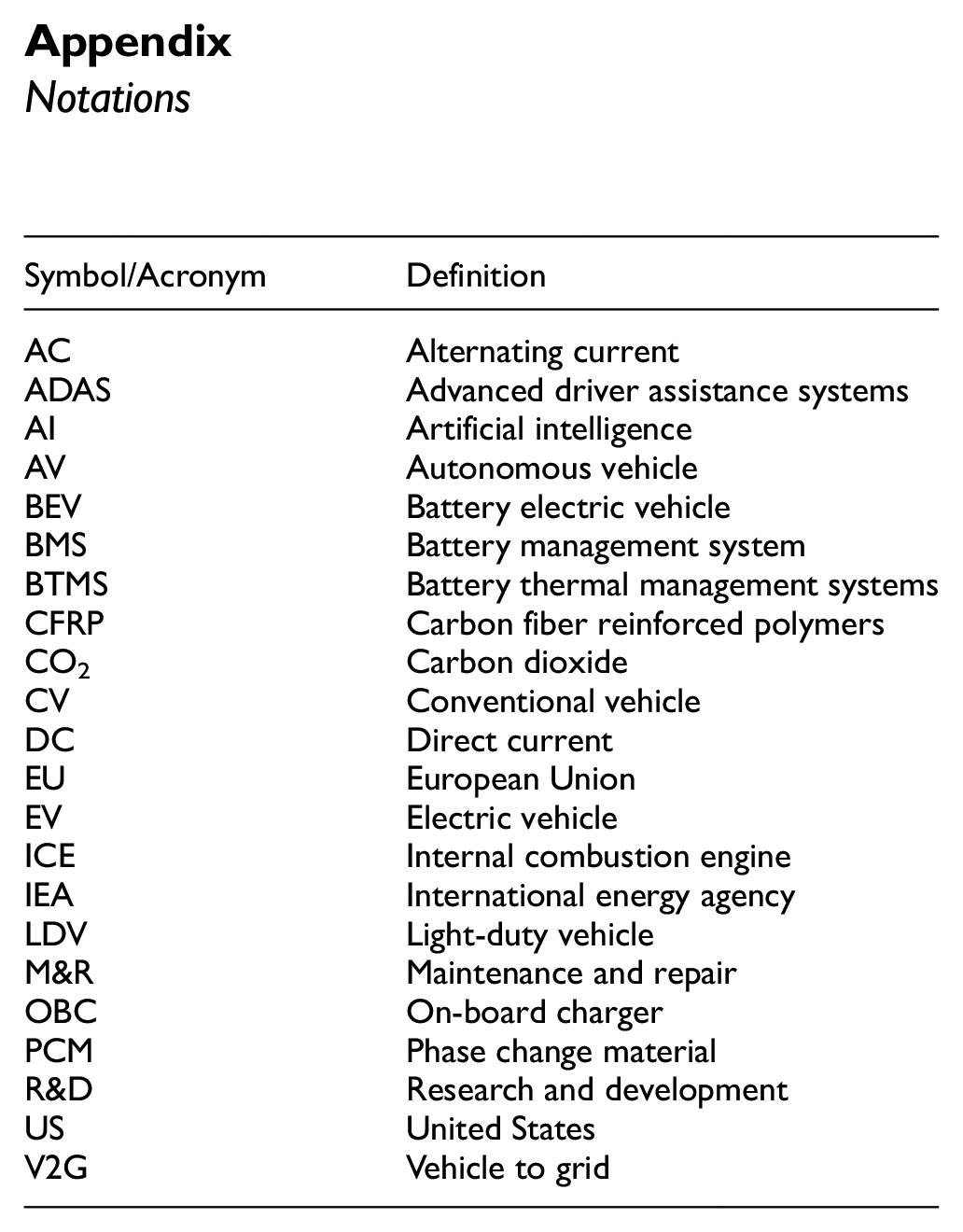
| Symbol/Acronym | Definition |
|---|---|
| AC | Alternating current |
| ADAS | Advanced driver assistance systems |
| AI | Artificial intelligence |
| AV | Autonomous vehicle |
| BEV | Battery electric vehicle |
| BMS | Battery management system |
| BTMS | Battery thermal management systems |
| CFRP | Carbon fiber reinforced polymers |
| CO2 | Carbon dioxide |
| CV | Conventional vehicle |
| DC | Direct current |
| EU | European Union |
| EV | Electric vehicle |
| ICE | Internal combustion engine |
| IEA | International energy agency |
| LDV | Light-duty vehicle |
| M&R | Maintenance and repair |
| OBC | On-board charger |
| PCM | Phase change material |
| R&D | Research and development |
| US | United States |
| V2G | Vehicle to grid |
Handling Editor: Aarthy Esakkiappan
Declaration of conflicting interests
The author declared no potential conflicts of interest with respect to the research, authorship, and/or publication of this article.
Funding
The author received no financial support for the research, authorship, and/or publication of this article.
