



Abstract
Cement-sand reinforced soft clay (C-SRSC) is a complex multiphase geomaterial. Its strength is determined by the physical properties of the internal multiphase substances and the coupling mechanical response between various phases of substances. By considering the effect of the particle size and content of sand particles on the unconfined compressive strength (UCS) and failure mechanism of C-SRSC, the C-SRSC is divided into two phases of the cement soil matrix and sand particles to construct a micro cell model of C-SRSC. Based on the strain gradient theory, the theoretical model of the UCS of C-SRSC based on the physical mechanism at the microscale is derived. Forty five groups of UCS tests were conducted to analyze the effect of sand particle size and content on the UCS of C-SRSC, and to calculate the theoretical model parameters. The results show that the UCS of C-SRSC increases with increasing curing age, cement content, and sand particle content, and decreases with the increasing sand particle size. The theoretical model of the UCS of C-SRSC based on physical mechanism initially verified the consistency of the experimental and theoretical results.
Keywords
Introduction
Cement soil is a kind of multiphase composite geotechnical material made of soil, cement, and water in a certain proportion, which has a wide range of raw materials, low price and can significantly improve engineering performance the host soil. In practical engineering applications, cement mixing pile, which is formed by injecting a certain amount of cement paste into the soft clay with a mixing procedure carried out by the simple cement mixing pile machine, is the most commonly used technology to improve the foundation bearing capacity of soft clay. It has the advantages of simple technology, short construction period, and good economic benefits.1,2 However, the strength of cement mixing piles is affected by the treating depth, especially the properties of host soil. Engineering practice and experimental research found that for the pure soft clay, the 90 days unconfined compressive strength (UCS) of the cement mixing pile with 15% cement is less than 0.3 MPa. However, for the soft clay with a certain amount of sand particles, the UCS of the cement mixing pile under the same conditions is larger than 0.8 MPa. This indicates that cement solidified soft clay can be improved effectively by incorporating a certain amount of sand particles. 3 The coastal soft clay area in South China, especially in the Pearl River Delta, has experienced three sedimentary cycles, and forms a geological interbedded layer of soft clay and fine sand. As a commonly used aggregate, sand particles can be incorporated into cement soil to enhance the compressive strength of cement solidified soft soil.4–6 It is reported that cement-sand reinforced soft clay (C-SRSC) technology has been widely used in the field of geotechnical engineering. 7 The reliable design of the C-SRSC engineering projects requires an in-depth understanding of the strength of the C-SRSC. In particular, a good theoretical model of the C-SRSC is of great significance. Previous studies indicated that the microstructure of the C-SRSC have an essential influence on its macro strength.7,8 However, theoretical models for the prediction of the UCS of the C-SRSC are rarely reported. In this regard, the development of establishing a micro-mechanism-based theoretical framework of the C-SRSC is expected to ensure the security and stability of the C-SRSC engineering projects.
However, for the cement soil mixed with a certain content of sand particles, there are a large amount of discontinuous interfaces between different substance phases. The interaction between cement soil with low strength and sand particles with high strength is generated through the interface, forming a spatial skeleton network structure of cement soil matrix and sand particles, which promotes the strength development of cement soil. 7 The interface surface area between the sand particles and cement soil is determined by the content, size, and shape of the sand particles. Therefore, the sand particle size has an important influence on the microstructure of the cement soil, resulting in complicated cross-scale coupling mechanical responses, which is associated with the interface characteristics and sand particle size at the microscale. The failure of the C-SRSC begins with the elastic-plastic deformation of the contacting surface between sand particles and cement soil. After the contact interface yields, interface cementation separation is induced, and sand particle rotates, forming a directional arrangement and microcracks distributed on the surface of sand particles. This leads to the formation of plastic strain localization and shear band in sand-mixed cement soil, and finally macroscopic sliding failure occurs. 9 Therefore, the failure of the C-SRSC is a complex and trans-scale deformation process. It is a challenge to deduce a theoretical model based on physical mechanism at the microscale, which can scientifically simulate and predict the trans-scale deformation process of the C-SRSC. 10
At present, the UCS theoretical models of C-SRSC can be divided into two categories. One is to predict the stress-strain response of C-SRSC by introducing an embedded function that can describe the cementitious effect of cement based on the classical elastoplastic constitutive model.11–13 The other is to divide C-SRSC into two phases of cement soil matrix and damage phase based on the binary medium theory, which introduce mathematical parameters describing the matrix phase and damage phase to derive a strength theoretical model that can consider the microstructural evolution of C-SRSC. 14
Although the aforementioned studies on the strengthening effect of sand particles have adopted several methods to deduce theoretical models for predicting the strength of the C-SRSC, the parameters of these models do not have clear physical meanings because of the lack of objective experimental verification and rigorous physical mechanisms. Moreover, these preliminary theoretical models do not interpret the physical mechanisms of multiscale coupling interaction between sand particles and cement soil, and thus cannot scientifically simulate and predict the trans-scale mechanical response of the C-SRSC in terms of physical nature and physical mechanisms. 7 In addition, due to the completely different mechanical properties of sand particles and cement soil, even if the macroscopic stress field is homogeneous. The deformation at the microscale is extremely heterogeneous, that is, the macro-strength of C-SRSC is closely related to its microstructures and exhibits a strong multiscale coupling mechanical behavior. The inhomogeneity of deformation of the cement soil matrix induced by the incorporation of sand particle at the microscale is manifested by the phenomenon of strain gradient. The development of the strain gradient theory originated from the study of the strength properties of metal materials at different scales. Based on the gradient phenomenon describing the discontinuity of spatial physical quantities, Fleck and Hutchinson 15 adopted the strain gradient theory to describe the multiscale mechanical responses of metals, and introduced an intrinsic length scale to account for the influence of microstructures on macro-strength. Based on the study of Fleck and Hutchinson, 15 Feng and Fang 16 promoted the strain gradient theory in the field of granular materials.
Although various strain gradient theories well explain the scaling effects of yielding and strengthening mechanisms for single-phase metals 17 as well as granular materials, 16 C-SRSC is fundamentally different from metal and granular materials due to its special physical phase properties, and how to establish a mechanism-based theoretical model for predicting the strength of C-SRSC based on the strain gradient theory needs to be studied more in-depth.
In this paper, based on the second type of C-SRSC strength theoretical model, the material phase of C-SRSC is divided to construct micro cell elements that reflect the basic characteristic information of sand particles and cement soil, and then consider the deformation coordination conditions between sand particles and cement soil, and combine with the strain gradient theory, which is capable of effectively describing the interface discontinuity of mechanical response, 15 to derive a theoretical model of C-SRSC strength based on physical mechanisms. A series of C-SRSC micro cell model samples was prepared for UCS tests to determine the model parameters and assess the feasibility and validity of the model. It is expected to shed light on the research of C-SRSC strength theory based on physical mechanisms at the microscale.
Theory of strain gradient in cement-sand reinforced soft clay (C-SRSC) based on microphysical mechanism
Phase division of cement-sand reinforced soft clay (C-SRSC)
C-SRSC is a special multiphase geo material. In addition to the typical characteristics of cement soil, the C-SRSC also has significant sand particle strengthening characteristics. Its strength is determined by the physical properties of the internal multiphase substances and the microscopic coupling mechanical response between different phases of substances.
18
Therefore, the mechanical properties of C-SRSC cannot be simply described by borrowing the classical soil mechanics theory, which is based only on the principles of continuum mechanics. To deduce a theoretical model of C-SRSC strength that can reflect the strengthening mechanism of sand particles, according to the mechanical response induced by the interaction between cement soil and sand particles, the cement soil with significant cohesive-adsorption effect and the sand particles with remarkable frictional-slip effect in C-SRSC is divided into matrix phase and reinforced phase, respectively. Moreover, it is assumed that sand particles are approximately uniformly randomly distributed in the matrix and surrounded by this matrix and each sand particle forms a C-SRSC micro cell element by volume ratio, as illustrated in Figure 1. Herein, the C-SRSC consists of a collection of many micro cell elements. Therefore, C-SRSC can be simplified as a two phase (matrix phase and reinforced phase) composite with a cytosolic structure. Based on the division of matrix phase and reinforced phase and the ideal distribution of sand particles, a C-SRSC micro cell model was established to clarify the physical and mechanical mechanism of the sand particle strengthening effect. For the C-SRSC micro cell model, the characteristic information of the reinforced phase sand particles is expressed in terms of sand particle content and sand particle size, where the sand particle content

The cell element of the C-SRSC.
Assuming that the sand particles are rigid spheres, each sand particle constitutes a cubic C-SRSC micro cell, and the volume ratio

Where:
For spherical sand particles,

Where:
From the equation (2), the side length

For the C-SRSC micro cell model, the sand particles must be fully wrapped by the cement soil matrix. It can be seen from equation (3) that for the spherical sand particles, the particle size
Establishment of strain gradient theory of cement-sand reinforced soft clay (C-SRSC) based on microscopic physical mechanism
Based on the physical phase division of C-SRSC, its mechanical response can be divided into three scale levels, as shown in Figure 2. The research purposes of different scale structure levels of C-SRSC are different. In the case of the C-SRSC micro cell element, under uniform axial stress, the cement soil matrix produces continuous axial strain, while the sand particles do not produce strain due to their high relative stiffness, but produce rigid rotation and translation. The difference in deformation behavior between the cement soil matrix and the sand particle causes the strain concentration of the matrix adjacent to the sand particles. When the axial strain concentration is increased to a certain extent, the microscopic performance is that the plastic shape distortion occurs inside the C-SRSC micro cell element, resulting in a non-negligible strain gradient. Microscopically, the rotation and translation of the sand particles induces coordinated microcracks in the adjacent cement soil matrix due to the destruction of cementation bonds to meet the microscopic deformation geometric compatibility requirements between the cement soil matrix and the sand particle,20,21 as illustrated in Figure 3. The formation and evolution of microcracks in the cement soil matrix is an important assumption in the derivation of proposed theoretical model. Therefore, the proposed theoretical model is applicable to the two phase materials with the matrix having a certain amount of brittle deformation characteristics. In the micro cell element of C-SRSC, the development of matrix microcracks induced by the interaction between matrix particles, which reflects the cohesion effect, and describes the mechanical behavior of C-SRSC at the microscale. The plastic shape distortion induced by the interaction between the matrix and sand particles describes the mechanical behavior of C-SRSC at the mesoscale. The axial stress-axial strain relationship of C-SRSC describes the mechanical responses of C-SRSC at the macroscale. The micro cell model of the C-SRSC establishes the coupled relationship between the microscale and mesoscale mechanical responses of C-SRSC through the strain gradient theory and realizes the correlation between the microscale physical details of C-SRSC and the macroscale continuum mechanics through the energy balance principle. In this regard, the micro cell model of the C-SRSC is a multiscale framework connecting multiple coupling scales, which can describe the diversity and coupling of physical mechanisms and mechanical responses of C-SRSC at different scales.

Multiscale research framework based on the micro cell element model: (a) macroscale, (b) mesoscale, and (c) microscale.

The coordinated microcracks: (a) schematic diagram and (b) SEM image (medium sand, α = 6%).
In the C-SRSC micro cell element model, the strain gradient theory is adopted to describe the plastic shape distortion of the matrix caused by the incompatible deformation of the sand particles and the cement soil matrix,
19
and the relationship between strain energy and microcrack density is established by the energy balance principle. In this regard, the shear deformation energy

Where: for C-SRSC,
Due to the initiation and development of microcracks, strain energy is released from C-SRSC. Based on the fracture mechanics of brittle solids, 16 the relationship between the surface area of microcracks and the strain energy U can be established, that is

Where:
However, C-SRSC differs significantly from brittle solids due to its complex particle and multiphase properties. The deformation process of C-SRSC includes the microscopic deformation and motion details related to energy release and dissipation, such as cohesion, collision, and friction of soil particles. Therefore, the strain energy in C-SRSC cannot be completely released as brittle solids during the initiation and development of microcracks.
22
Therefore, a strain energy release coefficient

Where:

where:
According to the physical and mechanical mechanism of microcrack initiation and development, the microcrack density

Combining equations (7) and (8), one may find

Where
It is worth noting that the concept of microcrack in the present work is different from that in damage mechanics, where the strength of the material decreases with increasing microcrack density, whereas in the C-SRSC micro cell model, coordinated microcrack describes the integrated rupture of the cementitious bonds among the particles of the cement matrix. This bond rupture is due to the drastic plastic shape distortion of the matrix adjacent to the sand particle. Therefore, equation (9) shows that the yield stress of C-SRSC increases with an increase of coordinated microcrack density.
The flow shear stress on the shear flow zone of the C-SRSC samples under three-dimensional stress state conditions

where
For the UCS test, the axial flow stress of C-SRSC is expressed as

Among them,

The statistical microcrack density

Where:
Since the pure cement soil matrix does not contain any sand particles, that is, for the pure cement soil matrix, the coordinated microcrack density is zero (

Substituting equation (14) into (equation 11), the flow stress of C-SRSC (containing sand particles) can be obtained as

The number density of sand particles
For C-SRSC in engineering practice, the sand particle size is distributed. To quantitatively consider the influence of the sand particle size distribution on the coordinated microcrack density, a number density function
According to the definition of the function of graduation curve of the sand particles
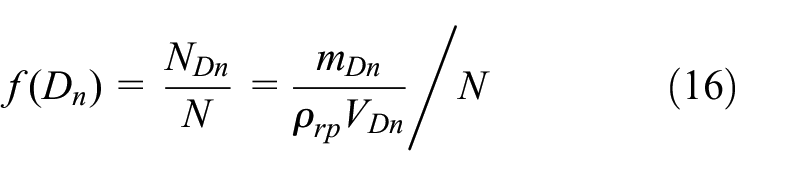
where

where:
Combining equations (16) and (17), f(Dn) can be expressed as

For a unit volume C-SRSC,

Coordinated microcrack density of C-SRSC
Li et al.
21
systematically analyzed the distribution law and evolution mechanism of microcracks in cement soil by CT scanning and 3D reconstruction techniques, and also discussed the influence of microcrack generation and expansion on the mechanical response of cement soil. However, they did not give the quantitative computational formula of microcrack density, which hinders the theoretical application of these findings. To this end, this paper uses an idea similar to the Eshelby’s Equivalent Inclusion Principle (EIM) to determine the coordinated microcrack density of C-SRSC

Where:
Assuming that the extension width

Where:
The length of the coordinated microcrack ring around the sand particle is

Considering the physical meaning of
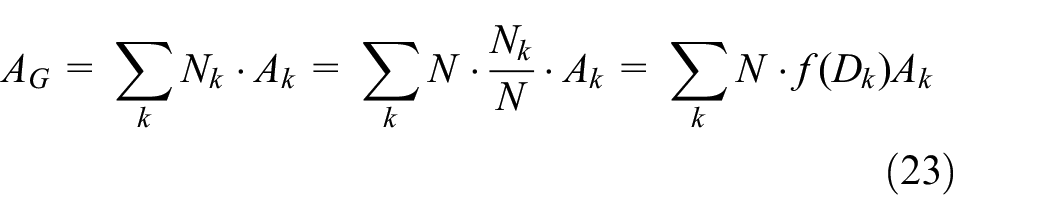
Where:
Combining equations (20)–(23), one may find

Where:
The equivalent strain gradient of micro cell element of C-SRSC
The strain gradient theory can effectively describe the spatial discontinuity of material physical quantities. 19 Therefore, for the C-SRSC micro cell element model, the strain gradient theory can be used to describe the microscopic distortion of the C-SRSC micro cell element caused by the difference of the deformation properties of the sand particles and their adjacent cement soil matrix. The strain gradient under complex stress state can be expressed by the second-order gradient of the displacement field of the C-SRSC micro cell element.16,23 However, for the case where the size of the C-SRSC micro cell element is small enough, the strain gradient of the C-SRSC micro cell element can be approximately by the first-order difference of its strain for simplicity, that is

Where

Among them,


Equations (26)–(28) show that the equivalent strain gradient of C-SRSC is related to the particle size, gradation and volume ratio of sand particles and axial strain of the C-SRSC samples.
For the case where the particle size distribution of sand particles is small enough, it can be assumed for simplicity that

Where
Combining equations (26)–(29), it can be obtained


Combining equations (24) and (32), one may find


Among them,

The intrinsic length scale parameter of C-SRSC
Substituting equation (33) into (equation 15), the flow stress of the C-SRSC can be expressed as

Among them,


where le is the intrinsic length scale of the C-SRSC. In the case of unconfined compressive strength test,
According to equations (32), (36), and (37), the UCS of C-SRSC can be predicted by the C-SRSC micro cell element model once the axial stress-axial strain relationship of the cement soil matrix and the particle size, gradation, and volume ratio of the sand particles are determined.
The micro cell element model of C-SRSC reveals that the UCS of C-SRSC is related to the intrinsic length scale, strain gradient, cement soil matrix properties. The corresponding quantitative relationship can be determined by the UCS test results of C-SRSC. In this study, 45 groups of UCS tests of 180 C-SRSC samples were designed to quantitatively analyze the influence of sand particle size and content on the UCS of C-SRSC. The strain gradient and intrinsic length scale model parameters of the C-SRSC micro cell model were quantitatively calculated, and the established C-SRSC micro cell element model based on physical mechanism at the microscale was preliminarily verified. In the case of engineering application, the proposed theoretical model has two important model parameters, namely, the intrinsic length scale and strain gradient, which can be determined by the size and content of sand particles, and thus can be conveniently adopted by civil engineers to predict the strength of the C-SRSC and conduct relevant geotechnical engineering designs.
UCS test of cement-sand reinforced soft clay (C-SRSC)
Test material
The soft clay used in the test was collected from Chang’an Town, Dongguan City, Guangdong Province. The sand particles were pure quartz sand, and three particle size groups of 0.1–0.2 mm, 0.4–0.5 mm, and 0.7–0.8 mm were sieved. The cement was ordinary Portland cement, the physical and mechanical parameters of soft clay and sand particles, and the chemical composition of the cement are shown in Tables 1 and 2, respectively.
Basic physical property of experiment materials.

Chemical composition of cement.

Test scheme
To investigate the influence of the sand particle size and content on the UCS of C-SRSC, C-SRSC samples with different sand particle combinations and curing age were prepared for a series of UCS tests. Among them, studies have shown that the cement content of 15%–20% can economically and effectively solidify coastal soft clay.8,23 For this reason, the cement content in this study is set at 20%, and the water-cement ratio of the cement slurry is set at 1:1. 180 C-SRSC samples were prepared and 45 groups of tests were conducted. The test scheme is illustrated in Table 3, and the tests were conducted according to the Standard for Geotechnical Testing Method. 24
Scheme of UCS tests.

Sample preparation
Before the test, the soft clay was dried, crushed, and passed through a 0.075 mm sieve to form dry soft clay particles. The corresponding mass of water, dry soft clay particles, sand particles, and cement according to the proportion depicted in the test scheme was weighed and mixed evenly to form the homogeneous paste. This paste was poured into a plastic cylindrical mold with a diameter of 39.1 mm and a height 80.0 mm by the vibratory method. After this sample was prepared, it was placed in the curing box for 3 d (days), and then demolded. The demolded sample was stored in the curing box for design curing age (7 d, 28 d, 90 d), and UCS test was conducted on this sample at design curing age. The loading rate of the test was 0.8 mm/min according to the relevant specification of GB/T 50123—2019. 24 The results of the UCS test were the average values of the test results of the three parallel samples. It’s noted that in practical engineering applications, the prepared cement paste added a certain amount of sand particles is injected in the soft clay, which is then mixed by the cement mixing pile machine, to form cement mixing piles in the soft clay stratum.
Test results
The results of the UCS test of the samples are shown in Figure 4.

The relationship between sand particle content and the UCS of the C-SRSC with 20% cement content: (a) 7 d curing age, (b) 28 d curing age, and (c) 90 d curing age.
Test results analysis
From Figure 4, it can be seen that the UCS of C-SRSC increases with increasing curing age; in addition, under different age, the UCS of C-SRSC showed the same pattern with the change of sand particle content and sand particle size. When the sand particle size keeps unchanged, the UCS of C-SRSC increases as the sand particle content increases; and when the sand content keeps unchanged, the UCS of C-SRSC increases as the sand particle size decreases. The phenomenon that the UCS of C-SRSC changes with the change of sand particle size indicates that the strength of C-SRSC presents a significant scale effect. The microscopic physical mechanism of the enhancing effect of sand particles on the UCS of C-SRSC can be explained as follows: sand particles make the adjacent cement soil produce heterogeneous and discontinuous deformation. Moreover, coordination effect and stress concentration occurs, resulting in more energy storing in the cement soil than that under uniform and continuous deformation and leading to an increase in deformation resistance of the C-SRSC, which showcases a stronger UCS of the C-SRSC at the macroscale.
In order to quantitatively evaluate the influence of sand particle content on the 90 d UCS of the C-CRSC, a strength increase ratio (SIR) is introduced, as shown in equation (39). The results of the SIR of the C-CRSC are depicted in Figure 5. It’s apparent from Figure 5 that adding a certain amount of sand particles in the cemented soft clay can significantly enhance the UCS of the C-CRSC at 90 days curing age and a maximum SIR of 65.5% is found at the C-CRSC with 12% sand particle content and 0.1–0.2 mm sand particle size. This indicates that cement and sand solidified soft clay technology has good economic benefit and can be expected to be applied in large areas in practical engineering applications.

where SIR is the strength increase ratio of the C-CRSC;

The SIR of the C-CRSC at 90 d curing age with different sand particle content.
Comparison of theoretical prediction and experimental results
Parameter determination of theoretical model for strain gradient of C-SRSC
It can be seen from equation (36) that the UCS of C-SRSC can be predicted in terms of the strain gradient
The average strain gradient calculation results of C-SRSC
The average strain gradient

The relationship between sand particle content and strain gradient of the C-SRSC: (a) D = 0.1–0.2 mm, (b) D = 0.4–0.5 mm, and (c) D = 0.7–0.8 mm.
It can be seen from Figure 6 that the average strain gradient of the C-SRSC samples increases with increasing sand particle content, and has a good linear relationship with the sand particle content. It’s noted that the strain gradient is a comprehensive reflection of the internal heterogeneity of the materials. 19 The presence of sand particles causes deformation of the adjacent cement soil matrix and induces the formation of strain gradients.17,25,26 As the sand particle content increases, the number of C-SRSC micro cell elements constituting the samples increases, the shape distortion distribution and internal heterogeneity of the cement soil matrix in the samples becomes more intense, and the strain gradient increases accordingly. Therefore, the strain gradient increases with the increase of sand particle content. Moreover, In the case of UCS test, the volume of the sample approximately remains unchanged. When the sand particle size and content keeps unchanged, the volume and numbers of the micro cell elements remains unchanged with changing curing age, namely, the internal heterogeneity and basic calculated microstructure remains unchanged. Therefore, the curing age does not have an influence on the strain gradient of the C-SRSC.
The intrinsic length scale of C-SRSC
The intrinsic length scale of the C-SRSC sample is determined by equation (38), and the specific calculation results are illustrated in Figure 7.

The relationship between sand particle content and the UCS of the C-SRSC with 20% cement content: (a) 7 d curing age, (b) 28 d curing age, and (c) 90 d curing age.
From Figure 7, it’s observed that the intrinsic length scale of C-SRSC increases with increasing sand content and decreasing curing age of the samples, and is approximately parabolic with the sand content. The intrinsic length scale is related to the inhomogeneous characteristic deformation field of the internal microstructure of the material.27–29 With the increase of sand particle content, the distribution of inhomogeneous discontinuous plastic shape distortion in C-SRSC is more intensive. With the decrease in the curing age of C-SRSC samples, the development range of plastic shape distortion in C-SRSC is larger. Both of them increase the size of the inhomogeneous deformation field inside the C-SRSC, increasing its intrinsic length scale. It’s obvious that the intrinsic length scale of the C-SRSC blended with 0.1–0.2 mm sand particles is lower than that of the C-SRSC blended with 0.4–0.5 mm and 0.7–0.8 mm sand particles, when the sand particle content and curing age remains unchanged. However, when the sand particle size is in the range from 0.4–0.5 mm to 07–0.8 mm, sand particle size has little influence on the intrinsic length scale of the C-SRSC.
Comparison of test results and theoretical results of UCS of C-SRSC
According to the model parameters listed in equations (32), (37), and (38) and Figures 6 and 7, the UCS of C-SRSC can be predicted by the C-SRSC micro cell model based on the microscopic physical mechanism (equation (36)). According to equation (36), the UCS of the C-SRSC is related to the strain gradient and intrinsic length scale as well as the axial stress-axial strain relation of the cement soil matrix. According to equations (32) and (37), the strain gradient and intrinsic length scale can be quantitatively determined, as depicted in Figures 6 and 7. In the present work, the C-SRSC samples have similar pattern of axial stress-axial strain curves and the parameter of “
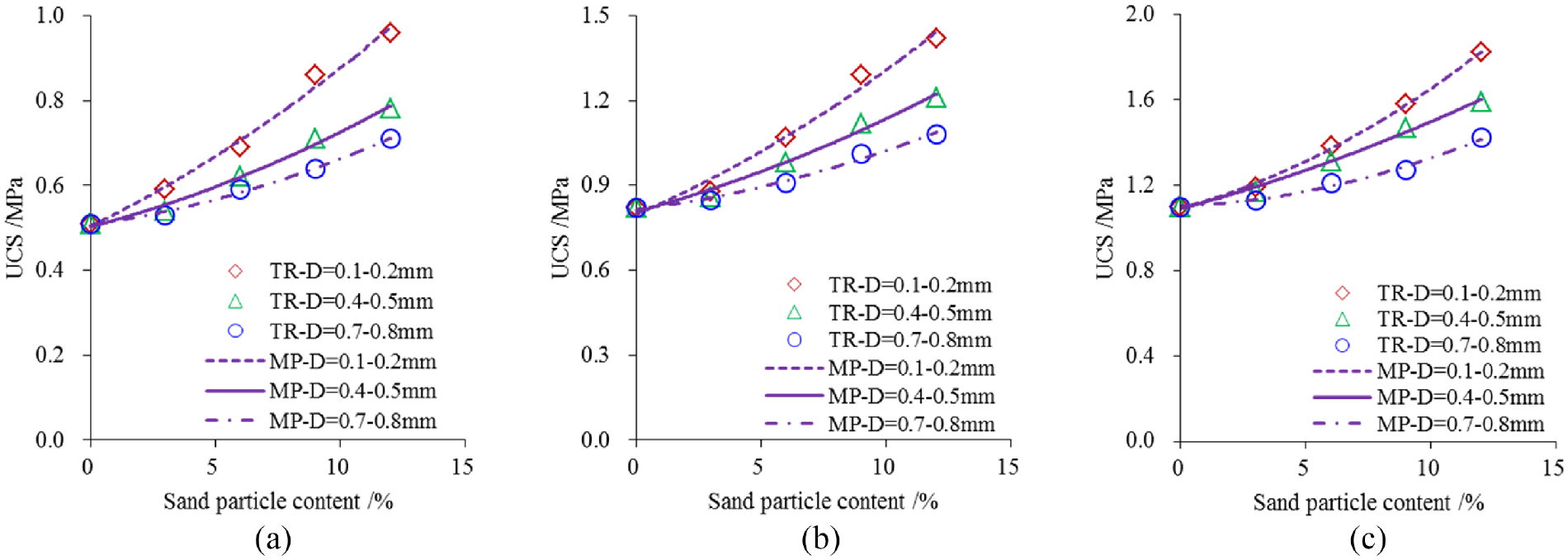
Comparison of UCS of the C-SRSC calculated by the model with the test results: (a) 7 d curing age, (b) 28 d curing age, and (c) 90 d curing age.
It can be seen from Figure 8 that the relative error between the predicted results of UCS of C-SRSC and the experimental results is small, and the maximum relative error (
Conclusions
(1) The UCS of C-SRSC increases with increasing sand particle content and the decrease of sand particle size. The theoretical model of the UCS of C-SRSC according to the microscopic physical mechanism realizes the quantitative correlation between the microstructure characteristics and macroscopic mechanical response of C-SRSC, and can effectively simulate and predict the UCS of C-SRSC.
(2) The theoretical model for predicting the UCS of the C-SRSC based on the physical mechanism at the microscale is embedded two parameters of the strain gradient and intrinsic length scale. The strain gradient increases with increasing sand particle content and decreasing sand particle size, and has a linear relationship with sand particle size. The intrinsic length scale increases with increasing sand particle content and is approximately parabolic with sand particle content.
(3) The physical mechanism of the enhancing effect of sand particles on the UCS of the C-SRSC can be explained by the significant incompatible deformation between the cement soil matrix and sand particles in the C-SRSC, which leads to coordinated microcracks in the cement matrix adjacent to sand particles at the microscale and induces non-negligible strain gradients within the micro cell element of C-SRSC at the mesoscale. Coordinated microcrack and strain gradients increase the energy stored in the C-SRSC, which leads to an increase in deformation resistance and UCS of the C-SRSC at the macroscale.
Footnotes
Handling Editor: Sharmili Pandian
Declaration of conflicting interests
The author(s) declared no potential conflicts of interest with respect to the research, authorship, and/or publication of this article.
Funding
The author(s) disclosed receipt of the following financial support for the research, authorship, and/or publication of this article: The authors are grateful to Guangdong Province Urban Rail Transit Engineering Construction New Technology Enterprise Key Laboratory Funding (grant number 2017B030302009), Guangzhou Academician Expert Workstation Funding (2021 Innovation Center, No. 030), and the National Natural Science Foundation of China (grant number 52078142) for their financial support.

Data Availability Statement
Some or all data, models, or code that support the findings of this paper are available from the corresponding author upon reasonable request.