



Abstract
The energy harvester based on the piezoelectric effect can convert the vibration energy in the environment into electricity to power the network nodes. In order to broaden the effective frequency bandwidth of the piezoelectric energy harvester and reduce the resonant frequency of the system, a liquid slosh-type piezoelectric energy harvester is proposed in this paper. Based on the theory of the piezoelectric effect, the mechanical model and electromechanical coupling model of the piezoelectric energy harvester were established, and the dynamic characteristics of the liquid slosh piezoelectric energy harvester were analyzed. Based on theoretical model and experimental test, the liquid slosh piezoelectric energy harvester is studied. By making a prototype and building a vibration experiment platform, the energy capture characteristics of the piezoelectric energy harvester were tested experimentally. The experimental results show that when the external excitation frequency is close to the first resonant frequency, the maximum output power of the liquid sloshing piezoelectric energy harvester is 0.068 mW, and the optimal matched impedance is 440 kΩ. When the external excitation frequency is close to the second resonant frequency, the maximum output power of the liquid sloshing piezoelectric energy harvester is 0.178 mW, and the optimal matching load resistance is 600 kΩ. Compared with the traditional cantilever beam piezoelectric energy harvester, the liquid slosh piezoelectric energy harvester has a lower resonant frequency and achieves two resonant peaks in the range of 1–20 Hz, which greatly widens the effective frequency bandwidth and improves the energy capture efficiency of the piezoelectric energy harvester.
Introduction
With the rapid development of MEMS technology, wireless sensor nodes have been widely used in the fields of military equipment, artificial intelligence, biomedicine, environmental detection, and intelligent transportation,1–3 and will play an even more important role in the future. To solve the problem of wireless power supply for low-power electronic devices, vibration energy harvesting (VEH) technology has emerged. The use of piezoelectric materials can convert the ubiquitous vibration energy in the environment into electrical energy and store it, which can then be supplied to wireless sensor nodes for power, saving energy and meeting long-term service requirements.4–6 However, conventional cantilever beam piezoelectric energy harvesters have a narrow frequency band and poor environmental adaptability, and can only collect vibration energy efficiently in a resonant state. Reducing the resonant frequency of the system and increasing the output voltage and power of the piezoelectric energy capture device are key factors in improving the energy capture efficiency of the piezoelectric energy capture device. Therefore, the design of high-performance piezoelectric energy harvesters is imperative to promote the further development of vibration energy harvesting technology.
To collect low-frequency vibration energy more efficiently, low-frequency piezoelectric energy harvester technology has attracted a lot of attention from scholars at home and abroad. The resonant frequency of the system can be reduced by changing the mass or shape of the cantilever beam in the piezoelectric energy harvester structure, changing the additional mass or pre-pressure in the tuned piezoelectric energy harvester, etc, to achieve energy harvesting of low-frequency vibrations. Gu and Livermore 7 have designed a touch-type low-frequency piezoelectric energy harvester. The structure consists of a high-frequency generating beam and a low-frequency driving beam. It has been shown that the touch-type low-frequency piezoelectric energy harvester has a higher resonant frequency and a 10-fold increase in power density than a conventional cantilevered piezoelectric energy harvester. Zhang and Cai 8 designed a multi-stage impact piezoelectric energy harvester composed of two piezoelectric cantilever beams due to additional mass. The influences of design variables such as additional mass, cantilever beam thickness, vibration frequency and load resistance on the output power and voltage of the system are investigated. The results show that the output power of the multi-stage impact piezoelectric energy harvester is about three times that of the single impact piezoelectric energy harvester. Ju and Ji 9 designed a cantilevered beam piezoelectric energy harvester based on an indirect shock frequency rise. The structure shocks the outer surface of the cantilever beam piezoelectric energy harvester in a low-frequency vibration environment and the outer surface drives the piezoelectric beam to vibrate, thereby collecting external vibration energy. The output power of the system has been increased by optimizing the dimensions of the cantilever beam piezoelectric structure and the position of the mass block. When the external vibration frequency is 18 Hz and the excitation acceleration is 3g, the maximum average power of the piezoelectric energy harvester reaches 0.963 mW. To solve the problem that the piezoelectric energy harvester is difficult to meet the requirements of wide band, three-dimensional, and efficient acquisition, Ma et al. 10 designed a piezoelectric energy harvester structure with a Z-shaped beam instead of an additional mass. By introducing a Z-beam instead of an additional mass, the piezoelectric energy harvester allows more modes to be concentrated in the low-frequency range, broadening the collection frequency.
To improve the adaptability of piezoelectric energy harvester structures in multi-frequency vibration environments and to increase their energy capture efficiency, tuned piezoelectric energy harvesters with a wide range of resonant frequencies and multimodal piezoelectric energy harvesters have received a lot of attention from researchers at home and abroad. Leland and Wright11,12 designed a tuned piezoelectric energy harvester. The tuned piezoelectric harvester outputs 0.3–0.4 mW in the range of 200–250 Hz when the concentrated mass is 7.1 g; When the concentrated mass of the system is increased to 12.2 g, the output power of the tuned piezoelectric harvester is 0.36–0.65 mW in the vibration excitation range of 165–190 Hz. Shi et al. 13 designed a variable-mass piezoelectric energy harvester. The structure consists of a piezoelectric cantilever beam, an energy capture circuit, a micro stepper motor, and a T-shaped mass block. The structure has a tuning function that increases the corresponding frequency bandwidth by 31% when the piezoelectric harvester is tuned in the range of 4.8–6.3 Hz. Yu and Zhang 14 proposed a multi-cantilever beam L-type wideband piezoelectric energy harvester structure, established the finite element model of L-type piezoelectric vibrator and carried out simulation analysis. The results show that the resonant frequency of the system can reach 12.5 Hz and the frequency bandwidth can be broadened effectively. Li et al. 15 proposed a cantilever beam piezoelectric energy collector with a curved L-shaped detection mass. With this new detection quality, lower fundamental frequency and higher power density are achieved. Wang et al. 16 provides a piezoelectric generator made from an array of multiple circular diaphragm piezoelectric collectors, which can significantly expand the frequency range of energy harvesting by selecting the right end mass in combination with the piezoelectric elements in the array. Meng et al. 17 studied the acquisition performance of a piezoelectric circular plate energy collector taking into account the contact area of the additional mass. The results show that a reasonable choice of the additional mass, the outer diameter of the piezoelectric plate and the load impedance can both reduce the natural frequency of the piezoelectric circular plate and improve its acquisition performance.
Through the study of low-frequency and wide-frequency piezoelectric energy harvester technology at home and abroad,18–20 this paper proposes a liquid wobble-type piezoelectric energy harvester. The device improves the energy capture efficiency of the piezoelectric energy harvester by introducing a liquid wobble vessel, which reduces the resonant frequency of the structure and widens the frequency bandwidth. The piezoelectric energy harvester has been researched through theoretical analysis and experimental tests, and the relationship between load resistance, excitation amplitude, and excitation frequency on the piezoelectric energy harvester has been derived.
First-order intrinsic frequencies and vibration modes of liquids in rectangular vessels
The liquid shaking piezoelectric energy harvester generates electrical energy by artificially exciting the rectangular vessel and then deforming the piezoelectric cantilever beam, when the external excitation frequency is equal to the first-order resonance frequency of the liquid in the container, the system resonates, at the same time the system vibrates violently and the piezoelectric harvester produces a large output voltage and output power. The first-order slosh mode of the liquid is an important parameter for the structural design and vibration control of the vessel, so it is necessary to calculate the theoretical solution of the first-order natural frequency and vibration mode through the theoretical formula. The schematic diagram of a rectangular container is shown in Figure 1.

Simplified diagram of the rectangular container.
Assuming that the depth and width of the stationary water surface in the sink of a two-dimensional rectangular container section are h and 2b respectively, the theoretical value of the two-dimensional sloshing angular frequency of the liquid is 21 :

The first-order sloshing vibration mode of a rectangular vessel can be expressed as:

The first-order sloshing frequency of the liquid in the rectangular container is expressed as:

Where
Construction of experimental platform
Design of a liquid sloshing piezoelectric energy harvester
Figure 2 shows a structural model of the liquid wobble piezoelectric energy harvester proposed in this paper. The liquid slosh-type piezoelectric harvester consists of an aluminum cantilever beam, a piezoelectric fiber patch, a load resistor, water, a rectangular vessel, and a cylindrical vessel. The principle of operation is that the excitation table gives excitation to the rectangular vessel, the water in the rectangular vessel causes the piezoelectric cantilever beam to deform and thus drives the piezoelectric fibers to deform, which then generates a voltage.

Schematic diagram of liquid sloshing piezoelectric energy harvester.
In order to experimentally verify the energy capture characteristics of a liquid sloshing piezoelectric energy harvester, a three-dimensional model of the liquid sloshing piezoelectric energy harvester was created. The rectangular container is made of acrylic glass plate adhesive, and the size of the rectangular container is 200 × 100 × 100 mm3. The size of the aluminum alloy cantilever beam is 250 × 30 × 1 mm3. The piezoelectric material is chosen as piezoelectric ceramic fiber patch type M-5628-P1, which is a kind of piezoelectric fiber composite. The free end of the cantilever beam is connected to a cylindrical container, the purpose of which is to increase the force area when the water is shaken. The physical structure of the piezoelectric energy harvester when the liquid is swaying, is shown in Figure 3.

Structure diagram of liquid sloshing piezoelectric energy harvester.
The production process of sloshing a piezoelectric energy harvester is mainly divided into the following five aspects: making an aluminum alloy cantilever beam, making a rectangular container, pasting a piezoelectric fiber sheet, leading electrode, making an experimental fixture, and fixing bracket.
Building the vibration experiment platform
The whole experimental setup includes an NI data collector, HVP-1070B power amplifier, JZK-10 excitation stage, UTP3303 constant current source, EA-YD-160 accelerometer, and DG1032 signal generator. A schematic diagram of the connections between the instruments of the vibration test platform of the liquid sloshing piezoelectric energy harvester is shown in Figure 4.
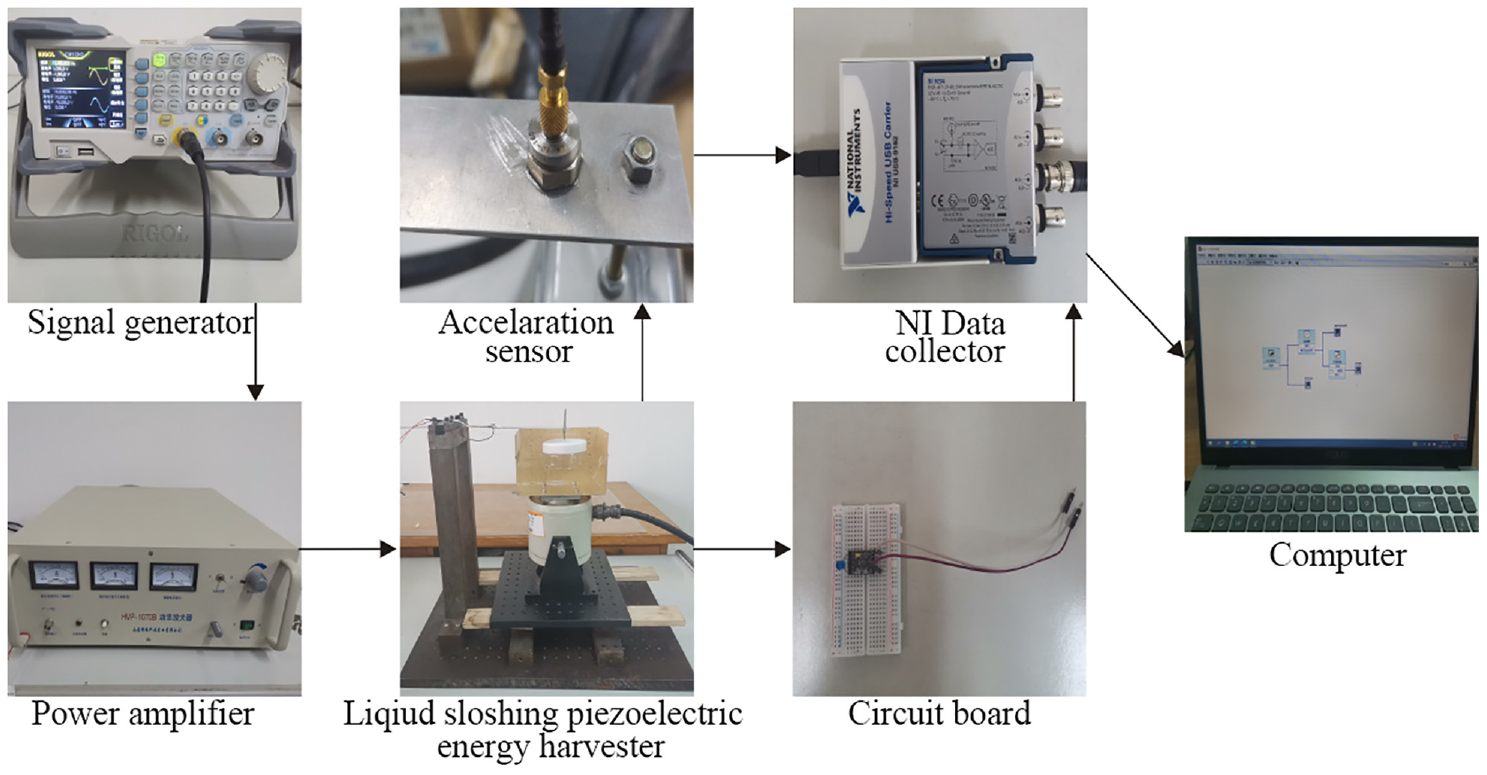
The connection diagram of the experimental platform.
After connecting the various parts of the experimental equipment according to the schematic, the vibration experimental platform of the liquid sloshing piezoelectric energy harvester is shown in Figure 5. The working principle of the test platform is as follows: DG1032 signal generator can send out sine wave signal under certain conditions, and then input the sine wave signal under certain conditions to the power amplifier, and HVP-1070B power amplifier will convert the sine wave signal of the signal level into the driver signal. The power amplifier transmits the driver signal to the vibration table to control the vibration frequency and amplitude of the vibration table to ensure that the experimental requirements are met. By adjusting the output frequency of the DG1032 signal generator, the external excitation frequency of the piezoelectric energy harvesting device is changed. At this time, the vibration frequency of the vibration platform is equal to the excitation frequency of the piezoelectric energy harvesting device. An accelerometer mounted on a rectangular container is used to test the acceleration to ensure that the accuracy of the acceleration is obtained. HVP-1070B power amplifier can amplify the signal to change the acceleration of the vibration platform. The NI data collector is connected to the positive and negative poles of the accelerometer and the piezoelectric energy harvester. The NI data collector can measure the output voltage and acceleration of the system synchronously. After the installation and connection of the equipment, the signal generator was used to carry out the sweep frequency experiment and the fixed frequency experiment respectively, and the range of access load resistance was changed. The energy capture characteristics of the liquid slosh-type piezoelectric energy harvester were obtained through data collation.

Vibration test platform for liquid sloshing piezoelectric energy harvester.
Experimental test
Frequency characteristics
The connected liquid sloshing piezoelectric energy harvester prototype is fixed on the vibration platform, and the excitation acceleration (0.5g) and vibration frequency (1–20 Hz) are set. The sinusoidal vibration signal set is transferred to the power amplifier through the signal generator, and then the vibration platform will generate periodic vibration, so that the piezoelectric energy harvester fixed on the base will vibrate, then a stable voltage and power output is obtained. The working frequency and output voltage of the liquid sloshing piezoelectric energy harvester are determined by the sweep frequency experiment. Experimental conditions: acceleration of 0.5g, excitation frequency of 1–20 Hz sweep frequency. The frequency characteristic data is collected by LabVIEW software, and then the working frequency of the system is determined. The variation curve of the output voltage of the whole system along with the excitation vibration frequency is shown in Figure 6.

The curve of output voltage as a function of vibration frequency.
It can be seen from the sweep response curve in Figure 6 above that the liquid slosh piezoelectric energy harvester has two resonant frequencies in the range of 0–20 Hz, respectively 8.31 and 13.2 Hz. The liquid natural frequency calculated above is 8.6 Hz, and the experimental results are close to the theoretical results, which proves the validity of the experimental results. When the output voltage of the liquid slosh piezoelectric energy harvester reaches its peak, the external vibration frequency is equal to the resonant frequency of the piezoelectric energy harvester itself. When the excitation frequency is close to 8.31 Hz, the natural frequency of the liquid in the rectangular container resonates close to the external excitation frequency, generating a large vibration and obtaining an output voltage of 5.81 V. When the excitation frequency is close to 13.2 Hz, the piezoelectric cantilever beam will resonate, generating a large vibration and obtaining an output voltage of 12.34 V. The variation trend of the output voltage of the piezoelectric energy harvester with the excitation frequency is as follows: at the beginning, it first increases to the peak voltage and then gradually decreases. The peak voltage of the piezoelectric energy harvester is taken as the standard.
The working frequency and output voltage of the traditional piezoelectric energy harvester are determined by the sweep frequency experiment. The comparison of frequency characteristics between the liquid slosh-type piezoelectric energy harvester and the traditional cantilever beam piezoelectric energy harvester is shown in Figure 7. There is a resonant frequency in the low-frequency range of the traditional cantilever beam piezoelectric energy harvesting device. When the excitation frequency is close to 14.16 Hz, the piezoelectric cantilever beam will resonate, produce large vibration, and obtain an 11.65 V output voltage. The comparison of the two structures shows that the liquid slosh type has two resonant frequencies in the low-frequency range of 0–20 Hz, which means that the liquid slosh type piezoelectric energy harvester can broaden the frequency bandwidth and better collect vibration energy to improve energy harvesting efficiency. The first two resonant frequencies of the liquid slosh piezoelectric energy harvester are 8.31 and 13.2 Hz respectively, while the resonant frequency of the traditional cantilever piezoelectric energy harvester is 14.16 Hz. The liquid slosh piezoelectric energy harvester has a lower resonant frequency, which is more conducive to the collection of low-frequency vibration energy. This proves that this structure has high feasibility.

Comparison of frequency characteristics of two piezoelectric energy harvesters.
Then the fixed frequency experiment is carried out, and the liquid slosh piezoelectric energy harvester is tested under the condition of the first-second resonant frequency. The variation curve of its output voltage over time is shown in Figure 8. The system resonates at 8.3 and 13.2 Hz respectively, and the output voltage changes sinusoidal with time.
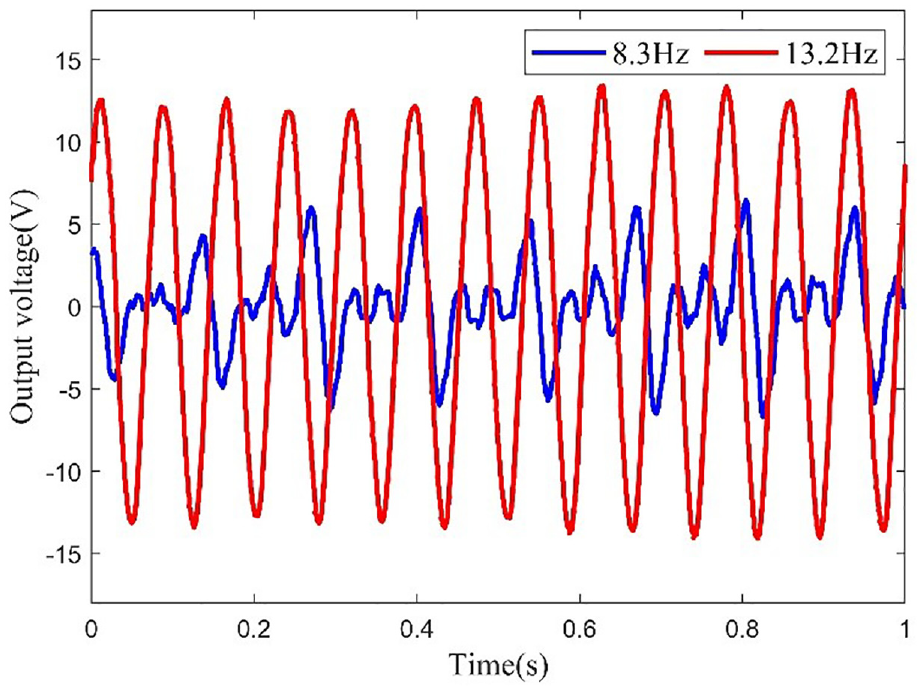
Diagram of voltage variation with time at the resonance of liquid sloshing piezoelectric energy harvester.
Influence of different external excitation accelerations on energy capture efficiency of piezoelectric energy harvester
Then, frequency sweep experiments were carried out with 0.3, 0.4, 0.5, and 0.6g vibration excitation accelerations and the same frequency sweep parameters respectively, and the variation curve of the output voltage of liquid slosh-type piezoelectric energy harvester with frequency was obtained under different vibration excitation accelerations, as shown in Figure 9. The variation curve of the peak voltage of liquid slosh piezoelectric energy harvester with excitation acceleration under a resonant state is shown in Figure 10. The experimental results show that the voltage of the piezoelectric energy harvester varies with vibration frequency under different excitation accelerations. The output voltage of the piezoelectric energy harvester increases with the increase of excitation acceleration.

The variation curve of output voltage with vibration frequency under different excitation acceleration.

The curve of peak voltage variation with excitation acceleration at the resonance of piezoelectric energy harvester.
Impedance characteristic
On the one hand, the impedance characteristic experiment is to determine the best matching resistance of the system, on the other hand, it is to explore the influence of external resistance on the output voltage and power of the liquid slosh piezoelectric energy harvester. The experimental condition is the excitation acceleration of 0.5g, the excitation frequency is the first second-order resonant frequency determined above, and the external load resistance is 10, 51, 68, 100, 220, 300, 440, 470, 600, 680, 780, 940 kΩ, 1, and 2 MΩ, respectively. The optimal load resistance is determined when the output power of the liquid slosh piezoelectric energy harvester is maximum, and the maximum output power is achieved when the piezoelectric energy harvester is supplied. When the external excitation frequency is 8.3 Hz, that is, the first-order resonant frequency, the system resonates. The variation curve of the output voltage and output power of the liquid slosh piezoelectric energy harvester with the load resistance is shown in Figure 11. When the external excitation frequency is 13.2 Hz, that is, the second-order resonant frequency, the system resonates. The variation curve of the output voltage and output power of the liquid slosh piezoelectric energy harvester with the load resistance is shown in Figure 12. It can be seen from the graph that when the external excitation frequency is close to the first-order resonant frequency, the maximum output power of the liquid slosh piezoelectric energy harvester is 0.068 mW and the optimally matched impedance is 440 kΩ. When the external excitation frequency is close to the second-order resonant frequency, the maximum output power of the liquid slosh piezoelectric energy collector is 0.178 mW, and the best-matched impedance is 600 kΩ. The variation trend of the output voltage of the system with the load resistance is as follows: with the increase of the load resistance, the output voltage also increases correspondingly, and the increasing slope first increases and then decreases. When the load resistance is very large, the output voltage is close to the flat state.

Curve of voltage and power of piezoelectric energy harvester with load resistance at the first resonant frequency.
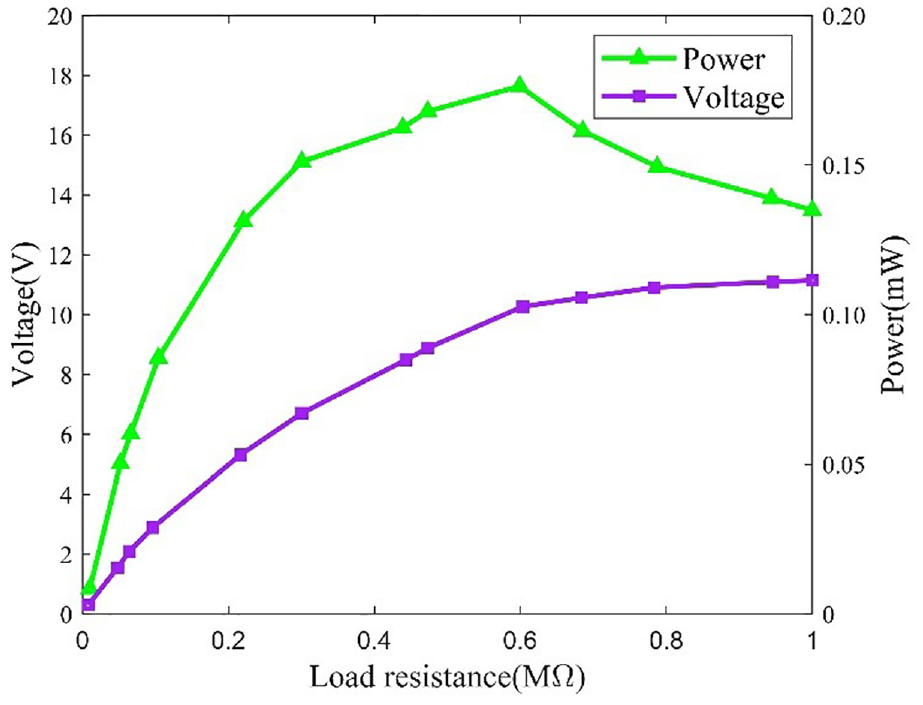
Curve of voltage and power of piezoelectric energy harvester with load resistance at the second resonant frequency.
Five exciting frequencies close to the first-order resonant frequency were selected for another fixed-frequency experiment. Under different exciting frequencies, the output voltage of the liquid slosh piezoelectric energy harvesting device varies with the external load resistance, as shown in Figure 13, the variation curve of the output power of the liquid slosh piezoelectric energy harvester with the load resistance is shown in Figure 14.

Curve of output voltage with load resistance at different frequencies.

Curve of output power with load resistance at different frequencies.
Five exciting frequencies close to the second-order resonant frequency were selected for another fixed-frequency experiment. Under different vibration frequencies of the piezoelectric energy harvester, the variation curve of the output voltage of the liquid slosh piezoelectric energy harvester with the resistance value of the load resistance was shown in Figure 15, the variation curve of the output power of the liquid slosh piezoelectric energy harvester with the resistance value of the external load resistance is shown in Figure 16.

Curve of output voltage with load resistance at different frequencies.

Curve of output power with load resistance at different frequencies.
As can be seen from the above graph, when the vibration frequency in the external environment is close to the resonant frequency of the system, the liquid slosh-type piezoelectric energy harvester resonates, resulting in violent vibration. The piezoelectric energy harvester can output the maximum voltage and power under the excitation frequency at this moment. When the vibration frequency deviates from the resonant frequency of the system, the output voltage and power of the piezoelectric energy harvester will decrease. As the load resistance increases, the output voltage of the system will also become larger and larger, with a low slope at first, then a higher slope, and finally a gentle slope again. For this reason, when the liquid slosh piezoelectric energy harvester is accompanied by increasing access load resistance, the output voltage of the piezoelectric energy harvester will not change, but the output current will become smaller. At this time, the influence of the output current of the system on the output power is much greater than that of the output voltage of the piezoelectric energy harvester, which is also the reason for the trend of the output voltage and power curve of the liquid slosh-type piezoelectric energy harvester. For the piezoelectric energy harvester, impedance matching is a very important step, only by selecting the appropriate optimal load resistance, the output power of the liquid slosh piezoelectric energy harvester can reach the maximum, to effectively improve the energy harvesting efficiency of the piezoelectric energy harvester.
Conclusion
In this paper, a liquid sloshing piezoelectric energy harvester structure is designed, and theoretical analysis is carried out by establishing a physical model, according to the theoretical results, a prototype of piezoelectric energy harvester was made and experimental studies were carried out on the output voltage, output power, and resonant frequency, the factors affecting the energy collection efficiency of the liquid slosh-motion piezoelectric energy harvester are analyzed and obtained, the conclusion is summarized as follows:
(1) Compared with the traditional cantilever beam piezoelectric energy harvester, the liquid slosh-type piezoelectric energy harvester has a lower resonant frequency and achieves two resonant peaks within 1–20 Hz, which greatly broadens the effective frequency bandwidth and improves the energy harvesting efficiency of the piezoelectric energy harvester.
(2) When the external excitation frequency is close to the first-order resonant frequency, the maximum output power of the liquid sloshing piezoelectric energy harvester is 0.068 mW, and the optimal matching impedance is 440 kΩ. When the external excitation frequency is close to the second-order resonant frequency, the maximum output power of the liquid slosh piezoelectric energy harvesting device is 0.178 mW, and the best-matched load resistance is 600 kΩ.
(3) The liquid slosh-type piezoelectric energy harvester is affected by the resonant frequency, load resistance, vibration frequency, and excitation amplitude of the container liquid, so the energy harvesting efficiency is not determined by a single condition. According to different vibration environments, the frequency bandwidth and resonant frequency of the system can be changed by adjusting the height of the liquid in the container and the cantilever beam model, to effectively improve the output voltage and output power of the system.
Footnotes
Handling Editor: Sharmili Pandian
Declaration of conflicting interests
The author(s) declared no potential conflicts of interest with respect to the research, authorship, and/or publication of this article.
Funding
The author(s) disclosed receipt of the following financial support for the research, authorship, and/or publication of this article: The authors would like to acknowledge the support provided by Natural Science Foundation of Shandong Province Number ZR2022QA058 and ZR2022MA069 funded by Department of Science and Technology of Shandong Province, China.
