



Abstract
Efficiency is a concept that evaluates the optimal utilization of resources, including time, energy, finances, or materials, in order to accomplish a particular goal or objective. As widely acknowledged, energy losses occur in systems involving relative motion between interacting machine elements due to friction. In the case of a gearbox, these losses can arise from tooth friction in the gear mechanism, friction in sealing elements, friction in roller bearings, and the influence of the lubricant used in the system, all of which are subject to environmental conditions. This study aims to experimentally determine the efficiency of the gearbox under various operating conditions by considering the gearbox as a comprehensive system encompassing all its components. A measurement system was designed in order to obtain the efficiency of a gearbox. Experiments and measurements were carried out via software support. The measurement system contains two torque transducers, electrical resistive load device, an electrical motor with temperature measurement thermocouple, and two stage helical gearbox. In experiments conducted through computer commands, input revolutions were incrementally increased with 400 rpm intervals within the range of 700–2700 rpm. Moreover, experiments were carried out at different lubricant levels in the gearbox. At the same time lubricant temperature was measured and effects to the gearbox efficiency were investigated. Subsequently, different lubricant with distinct viscosity indices were employed. As a result of this experimental design, regime efficiency values were obtained for each case. Thus, power loss of the gearbox system has been determined. These results were examined using a general full factorial design. Analysis of variance (ANOVA) tables were created and the effects of the parameters on the system and the efficiency results were determined by checking whether the parameters were interacting or not. Finally, regression analysis was performed and the regression function was obtained in order to develop a predictive model to estimate the efficiency of a gearbox.
Introduction
Approximately 23% of global energy consumption occurs due to tribological contacts. 1 Therefore, efficiency plays a significant role in mechanical and industrial applications and in the field of machinery technology, one of the primary goals is to achieve maximum efficiency. In order to attain this objective, it is crucial to make appropriate component selections, ensure the compatibility of component pairs, and establish suitable operating conditions, subsequently operating mechanisms in accordance with these conditions, as this can result in substantial gains.
The gearbox is a component that plays an important role in the transmission of mechanical power. The gearbox has the ability to change speed and torque by transmitting the rotational motion through gears on a shaft. Gearbox efficiency is defined as the ratio between input power and output power. In an ideal situation, the input power should be the same as the output power, that is, the efficiency should be 100%. However, in reality, gearbox efficiency can often be 90% or less due to energy losses and friction.2,3
Understanding and optimizing the efficiency of a gear mechanism has paramount importance in various industrial applications. The efficiency of the gearbox depends on many factors.3,4 The following factors play a significant role in determining the efficiency of a gearbox. Gear type, gear ratio, gearbox size, materials and manufacturing geometry,5,6 lubrication, 7 load conditions,8,9 operating conditions, 10 and operating temperature 11 can be listed as some of those factors.
Every machine element in relative motion within the gearbox has an impact on efficiency. Among these elements, bearings and sealing components play a significant role in affecting the overall efficiency of the gearbox.12,13 In this study, the effects stemming from these components have been integrated into the total efficiency analysis. However, a detailed examination specifically dedicated to these elements has not been conducted yet.
The type of gears used within a gear mechanism, such as bevel gears, helical gears, spur gears, and others, plays a crucial role in efficiency. 14 Gear type influences the contact pattern and friction between gears. Certain gear types, as helical gears, are known to provide lower friction and consequently, better efficiency.
Gear geometry is another important factor affecting the efficiency of the gearbox. Factors such as number of teeth, profile shape,15,16 and module used in the gearbox directly affect the efficiency.17,18 Choosing a proper tooth profile 19 and matching tooth numbers may help increase efficiency. The gear ratio governs the change in speed and torque between the input and output shafts. Higher gear ratios increase torque while reducing speed. Proper adjustment of the gear ratio is essential to achieve efficiency aligned with the specific requirements of an application. Factors such as the number of gears and the number of teeth on those gears, affects torque and friction. Larger gears are capable of transferring greater torque, but they also tend to produce higher levels of friction. Thus, the optimal size and gear configuration are critical in enhancing efficiency. 20 Furthermore, the proper alignment of gears holds significance. Well-designed tooth profiles and well-matched gears can diminish friction and enhance operational efficiency.
The quality of materials used in the gear mechanism and the precision of the manufacturing process are other influential factors affecting efficiency.21,22 More durable and low-friction materials can lead to higher efficiency. High-quality manufacturing processes can improve gear precision and suitability.
Proper lubrication of the gears inside the gearbox reduces friction and enhances efficiency. Accurate lubrication and maintenance of suitable lubricant levels can facilitate the more efficient operation of gears.3,23,24
The efficiency of a gear mechanism can vary under different load conditions. Various loads may lead to fluctuations in efficiency. Overloading or excessive heating can particularly reduce efficiency.9,25
The operating temperature of the gear mechanism can impact the viscosity of the lubricating oil and the material properties of the gears. 26 Lower temperatures can lead to higher lubricant viscosity and a subsequent decrease in efficiency. Thus, appropriate lubricant selection and temperature control are vital for improving efficiency.
Gearbox and gear pair efficiency measurement systems have been investigated in the literature. It has been observed that the FZG gear test rigs are widely used in many studies. Apart from this test rig, specially designed test setups have also been encountered.3,17,25,27–30 In the view of these information, the experimental setup used in this study was designed and constructed.
The efficiency of a gearbox is contingent upon numerous factors and it is possible to enhance efficiency by optimization. There are two distinct approaches to enhance gearbox efficiency: one involves implementing design modifications during the gearbox design process, while the other focuses on improvements in operating conditions on an already manufactured gearbox. The most straightforward method to improve the efficiency of an already existing gearbox lies in determining the optimal lubricant selection and operating conditions. Thus the use of high efficiency gearboxes will provide more effective power transmission and save energy.
The primary objective of this study is to identify the impact of lubricant parameters and operating conditions on the efficiency of manufactured gearboxes. In line with this objective, an experimental setup is designed and experiments were conducted with two different types of lubricants at various lubricant levels, temperatures, and rotational speeds. As a result of this investigation, a statistical model has been formulated and presented as a linear function. The impact of parameters on the efficiency of the gear mechanism has been determined through regression analysis. This statistical approach is sufficiently robust to yield prompt results for different gearboxes when employed in forthcoming investigations. Manufacturers or users utilizing this model can achieve gains in terms of efficiency. This study represents a preliminary step toward the statistical creation of a predictive model.
Experimental study
This study comprises steps of designing the experimental setup, designing control unit, selecting the equipment to be used, determining the experimental parameters, applying the design of experiments (DoE) method, and obtaining and interpreting the results.
In the design of the experimental setup, it is planned to obtain the input and output powers and calculate the overall efficiency of the gear unit based on the ratio of these powers. In order to achieve this goal, an electric motor to generate the input torque and a resistance motor to operate the system under load were required.
As an electric motor, ABB brand, 3-phase asynchronous motor with a power of 1.5 kW and a nominal speed of 2800 rpm, was used.
As a resistance motor, Delta brand servo motor with a power of 1.5 kW and a nominal speed of 2000 rpm, was employed.
In order to facilitate data flow through the equipment to be used, there was a need for data acquisition equipment. In this context, National Instruments (NI) brand analog data input connectors were employed. To enable the reading of analog signals acquired during measurements, a computer interface was designed, and the collected data was recorded.
In order to calculate the input and output powers, a torque transducer was positioned between the gear unit input shaft and the motor shaft. Another torque transducer was positioned between the gear unit output shaft and the resistance motor shaft. Both Burster brand torque transducer at the input has a maximum measurement level of 10 Nm, and the torque transducer at the output has a maximum measurement level of 50 Nm. Both torque transducers were specified to have a maximum rotary speed of 15,000 rpm. In terms of measurement accuracy, with an error of up to 0.2% of the maximum, measurements were obtained.
Additionally, real time rotational measurements of the input and output speeds were obtained using torque transducers.
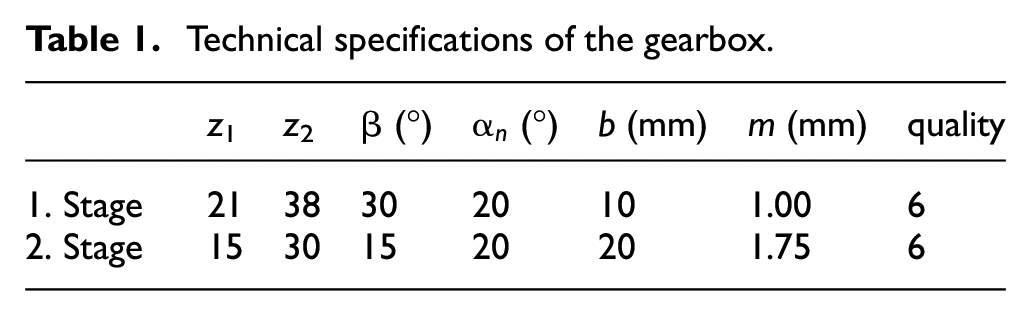
In order to conduct the experiments, two-stage helical gear units with a 3.62 gear ratio were employed. Technical specifications of the gearbox is given in Table 1 where,
Technical specifications of the gearbox.
The temperature of the lubricant inside the gear unit was simultaneously measured utilizing a Baumer brand industrial temperature sensor. This sensor is mounted to the oil drain plug of the gearbox. The range of the sensor is −50°C to 125°C and an accuracy of 0.3°C.
Test setup and parameters
Metal bellow couplings have been employed to connect torque transducer between the output shaft of the electric motor and the input shaft of the gearbox. Similarly, a connection has been established using metal bellows between the output shaft of the gearbox and the resistance motor. Metal bellow couplings have been mounted for the purpose of correcting angular misalignments and for damping potential vibrations.
In order to ensure concentricity in the general assembly of the experimental setup, step tables were used under the torque transducer and gearbox. Likewise, since the gearbox input and output shafts are not coaxial, different step tables were used on the load side given in Figure 1.
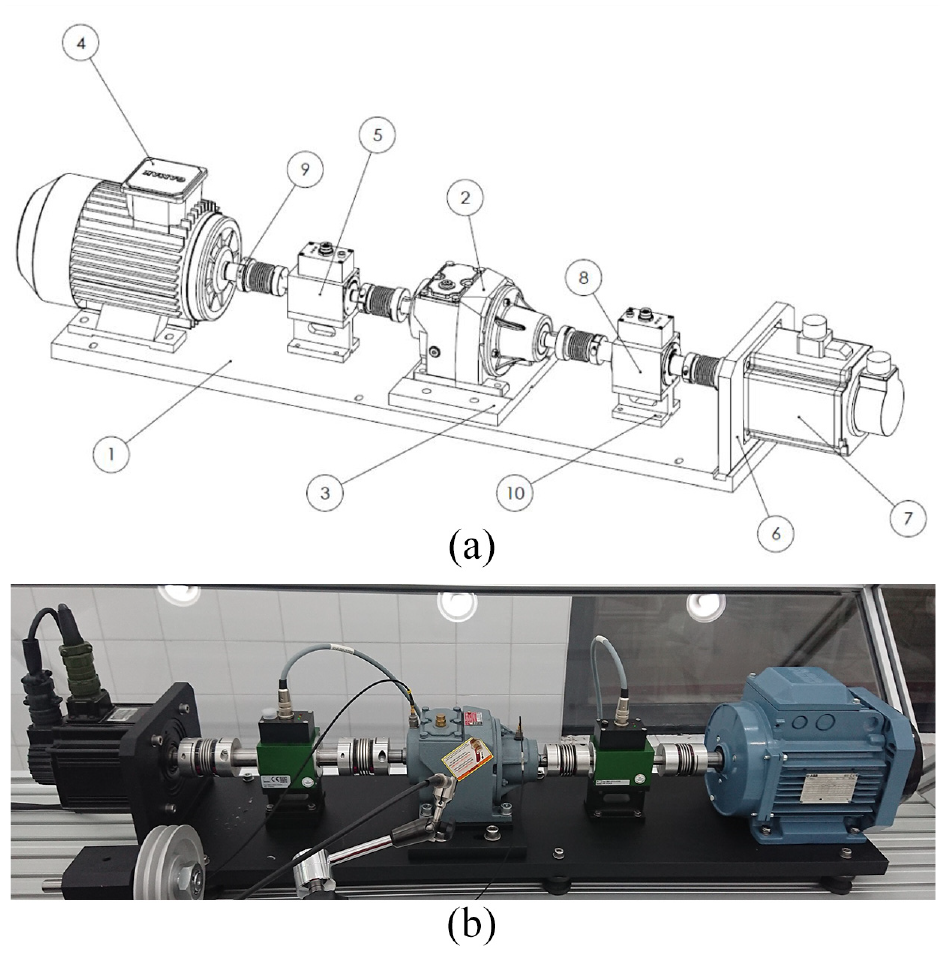
(a) Gearbox efficiency measurement test setup model: (1) bottom table, (2) gear box, (3) adjustment table, (4) electric motor, (5) torque transducer, (6) mounting plate, (7) resistance motor, (8) torque transducer, (9) bellow coupling, (10) adjustment table and (b) gearbox efficiency measurement test setup.
After the installation of the system, experiments were conducted where electric motor was speed controlled and the resistance motor was torque controlled, with a constant load of 7.2 Nm on the resistance motor. In the experiments to be carried out with this experimental setup, the test parameters were selected as lubricant oil, rotational speed, lubricant level, and lubricant temperature. The reason why temperature and oil type are selected as separate parameters is to benefit from the controllable levels of these variables. Simultaneous measurements of torque at the input and output of the gearbox, as well as the angular displacement per unit time, were attainable. Using the collected data, power was calculated employing the formula

where; P is power (W), M is torque (Nm), and the

where;
Schematic view and the assembled state of the experimental setup is shown in Figure 1. The experiments were carried out in a laboratory environment in a glass cage, isolated from external effects.
Test procedure
The gearbox employed in this test setup has been designed by the manufacturer with consideration for a nominal input torque of 10 Nm and a nominal input speed of 2500 rpm, with the recommendation for the use of ISO VG220 lubricant.
The rotational speed was increased from 700 to 2700 rpm in increments of 400 rpm. Measurements were taken at 700, 1100, 1500, 1900, 2300, and 2700 rpm.
In general, the kinematic viscosity of oil decreases as temperature increases. Therefore, experiments are conducted at various oil temperatures. The oil temperature was conditioned to 25°C, 30°C, and 35°C, starting from the ambient temperature, and measurements were taken at these values for all cases, respectively.
Experiments were conducted with varying oil quantities, specifically at 150, 200, 250, 300, and 400 ml levels, with each quantity added separately.
Schematic view of lubricant level, which added to the gearbox gradually, is represented in Figure 2.
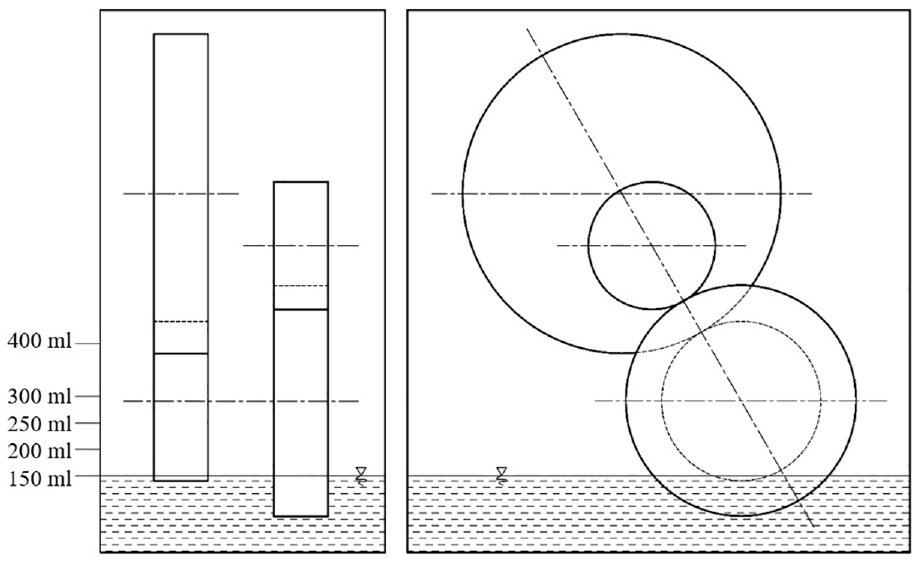
Lubricant level in the gearbox.
In order to assess the impact of viscosity on efficiency, two different types of lubricants were selected for the study: SAE 5W30 engine oil and ISO VG220 industrial oil. When evaluated based on viscosity indices, ISO VG220 exhibits an average kinematic viscosity of approximately 220 cSt at 40°C. 31 In the context of the SAE standard, 5W30 can be considered roughly equivalent to an oil with a viscosity around ISO VG22. 32 The kinematic viscosity of this oil at 40°C can be regarded as 22 cSt. In order to clearly observe the effect of viscosity on efficiency, 5W30 engine oil was utilized alongside ISO VG220, which is commonly employed for lubricating gear mechanisms.
The experiments were conducted by sequentially adding the predetermined type of oil into the gearbox in the specified amounts as mentioned above. The temperature of the oil within the gearbox was adjusted to one of the previously mentioned temperature conditions, and measurements were subsequently taken at the specified rotational speeds. Before taking measurements, a certain period was allowed for the establishment of a steady-state regime both before and after each rotational speed change. Subsequently, data collection commenced. Simultaneous values of torque and angular displacement were obtained at a frequency of 1024 Hz using the torque transducer and saved for further processing.
Considering the experiment variables and values mentioned above, a total of 180 experiments were conducted. To mitigate hysteresis errors in the experiments, they were carried out in as random a sequence as possible. Furthermore, some experiments were repeated, and the repeated results were compared internally to assess the accuracy of the system.
Results and discussions
After data collection, the data processing stage was initiated. For each case, the input power at the gearbox input shaft was calculated based on the torque and angular velocity at the gearbox input. Similarly, using the torque transducer at the gearbox output shaft, the output torque and output velocity were measured, and the output power was calculated. Due to the asynchronous nature of the electric motor, the input speed was not constant. In order to mitigate the impact of instantaneous speed fluctuations on the system, the data was processed in real-time and the frequency of the measurement is 1024 Hz. Moreover, both speed measurements are taken subsequent to the motor output, the influence of fluctuation frequency of motor on the data acquisition frequency is negligible.
Through a written Matlab code at MATLAB 2022b academic version, the collected data was processed iteratively, and the average efficiency values for each case were computed.
The torque values collected at 1024 Hz frequency from the experiments conducted at 25°C and 1500 rpm rotational speed with 300 ml ISO VG220 lubricant, were processed in MATLAB by ignoring the outliers and the obtained torque graphs are presented in Figure 3. Similarly, angular speeds for the drive-side and load-side angular speeds were obtained during a 12 s period of time and input and output power as given in Figure 4 were calculated. Consequently, by dividing output power to input power for every single data obtained in 12 s with 1024 Hz frequency, the efficiency graph was attained and given in Figure 5.

Input (drive-side) and output (load-side) torque of the gearbox at 1500 rpm 25°C with 300 ml ISO VG220 lubricant.
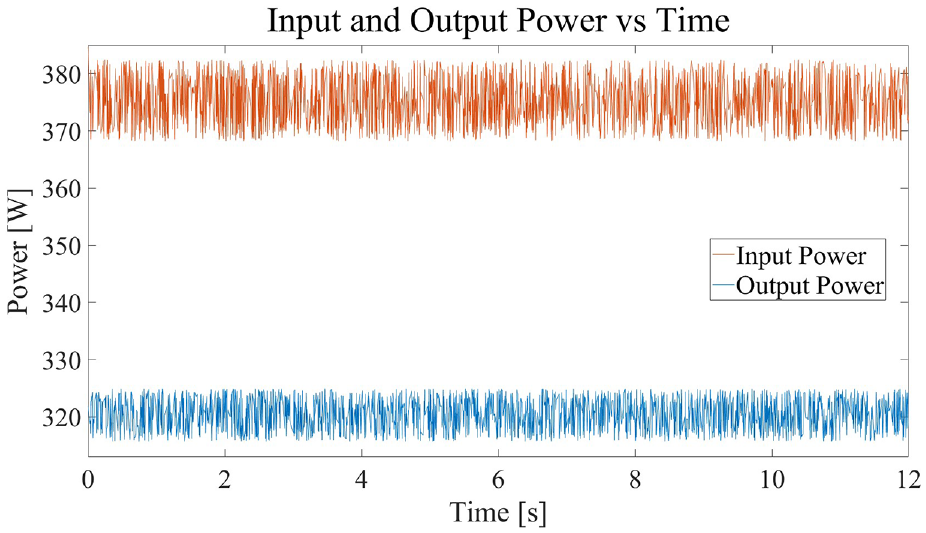
Input (drive-side) and output (load-side) power of the gearbox at 1500 rpm, 25°C with 300 ml ISO VG220 lubricant.

Calculated efficiency of the gearbox at 1500 rpm, 25°C with 300 ml ISO VG220 lubricant.
A single efficiency value was obtained for this case, by averaging the efficiency values in Figure 6. Through identical procedures applied to all variable levels, moment and speed values were sequentially obtained for ISO VG220 and SAE 5W30 lubricants at temperatures of 25°C, 30°C, and 35°C, based on the amounts of lubricant filled into the gearbox. Input and output powers were calculated, and efficiency was determined for each case. The graphs resulting from this process are presented in Figure 6.

Efficiency versus lubricant amount graphs: (a) ISO VG220 at 25°C, (b) ISO VG220 at 30°C, (c) ISO VG220 at 35°C, (d) SAE 5W30 at 25°C, (e) SAE 5W30 at 30°C, and (f) SAE 5W30 at 35°C.
As can be observed, deriving conclusions from all the experimental data presented in Figure 6, expressing the effects of parameters clearly, and demonstrating interactions between parameters are quite challenging.
Therefore, an Analysis of Variance (ANOVA table) was conducted at Minitab 2016 academic version, in order to assess both the robustness of the experiments and the levels of impact of the parameters.
In order to generate the Anova table, the experiments were designed in a Multilevel Factorial Design framework. Repetition experiments were carried out, but were not included in the table due to the attainment of consistent results. Multilevel Factorial Design, General Linear Model, and Analysis of Variance for Efficiency are respectively given in Tables 2 to 4.
Multilevel Factorial Design table.

General Linear Model table.

Analysis of Variance for Efficiency table.

The R-squared (R2) and adjusted R-squared (R2 adj) values are calculated in order to assess the goodness of fit of our statistical model to the data. These metrics are essential in regression analysis as they provide insights into how well the model explains the variability in the dependent variable. In our case, we obtained remarkable R2 value of 99.79% and R2 adj value of 99.05%. These high values indicate that our model accounts for an overwhelming majority of the variability observed in the data, with 99.79% of the variation explained by the independent variables. The R2 adj value, which takes into account the number of independent variables in the model, is particularly important in the context of model selection. Moreover, the p values of less than 0.05 indicates that meaningful parameters were selected in the experimental design and it shows that changes in these parameters will significantly affect the experimental results. In our analysis, it demonstrates that our chosen model is highly effective in capturing the underlying patterns in the data, aligning closely with the observed data points. These results affirm the robustness of the model and its suitability for explaining the relationships between variables in this study.
Given in Figure 7, the normal probability plot revealed a nearly straight line, where the x-axis represented residual values ranging between −0.002 and 0.002, and the y-axis depicted percentiles spanning from 1% to 99%. This linear pattern indicated that the residuals were distributed in a manner close to a normal distribution. Furthermore, the absence of significant outliers in the plot indicates that our dataset adheres well to the characteristics of a normal distribution. This suggests that our statistical model is suitable for the dataset, as it effectively captures the underlying data patterns, validating the reliability of our results and the appropriateness of our chosen statistical approach.
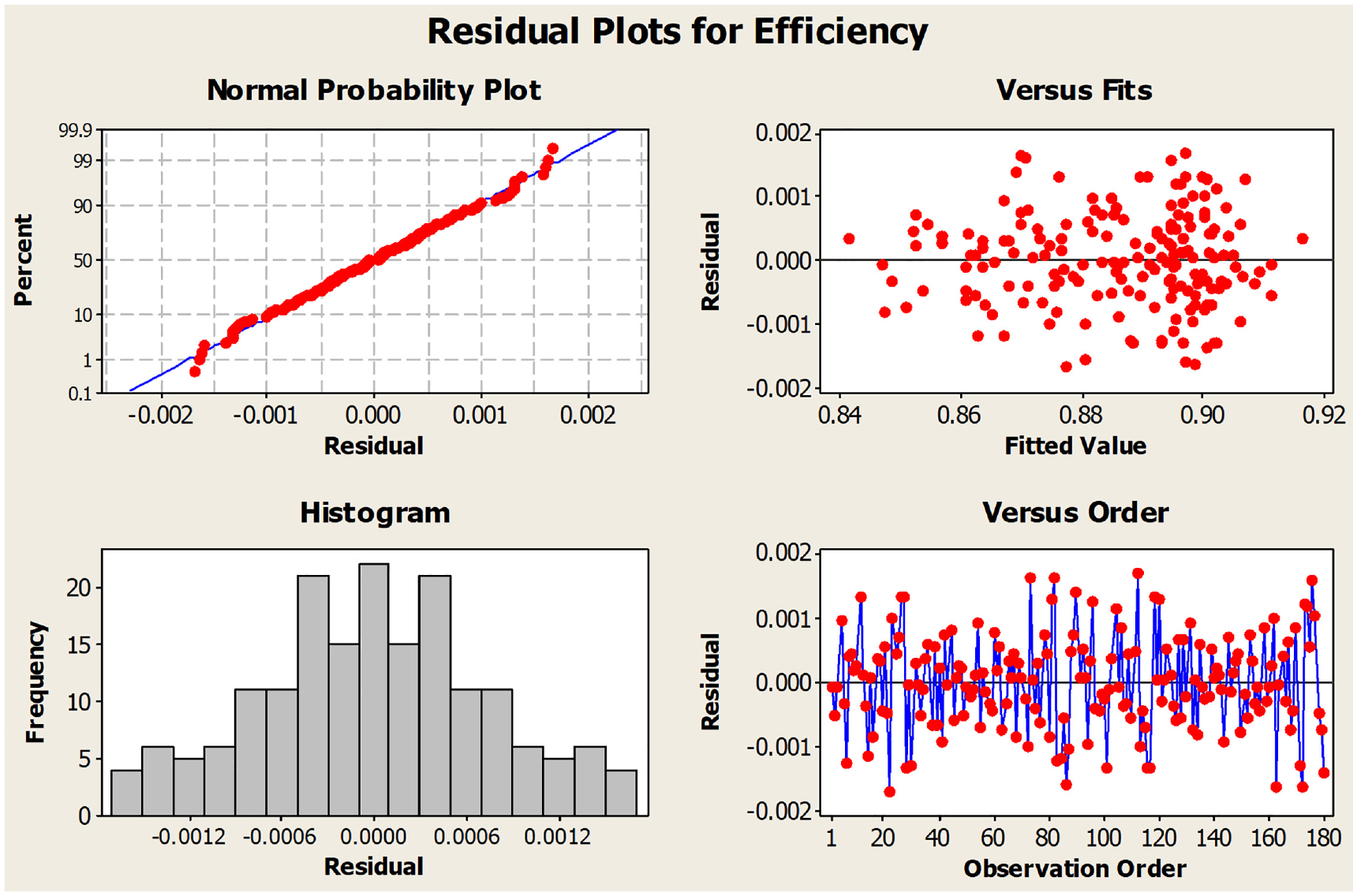
Residual plots for efficiency.
In order to examine the shape and spread of the data, a histogram graph is plotted. It can be seen that the graph is in compliance with the normal distribution curve.
Considering that values’ distribution is random and close to 0 line in the versus fits plot indicate that a meaningful design of experiment has been successfully achieved, the fact that values between −0.002 and 0.002 are seen shows the consistency of the experimental results. Similarly, in the versus order graph, a random distribution occurs around 0 line and this shows that residuals are independent from one another.
In the efficiency interaction plot given in Figure 8, the absence of intersections among the lines signifies a lack of interaction between the respective variables. Conversely, intersecting lines or those progressing in the direction of intersection can be interpreted as exhibiting high and low interactive behaviors, respectively.
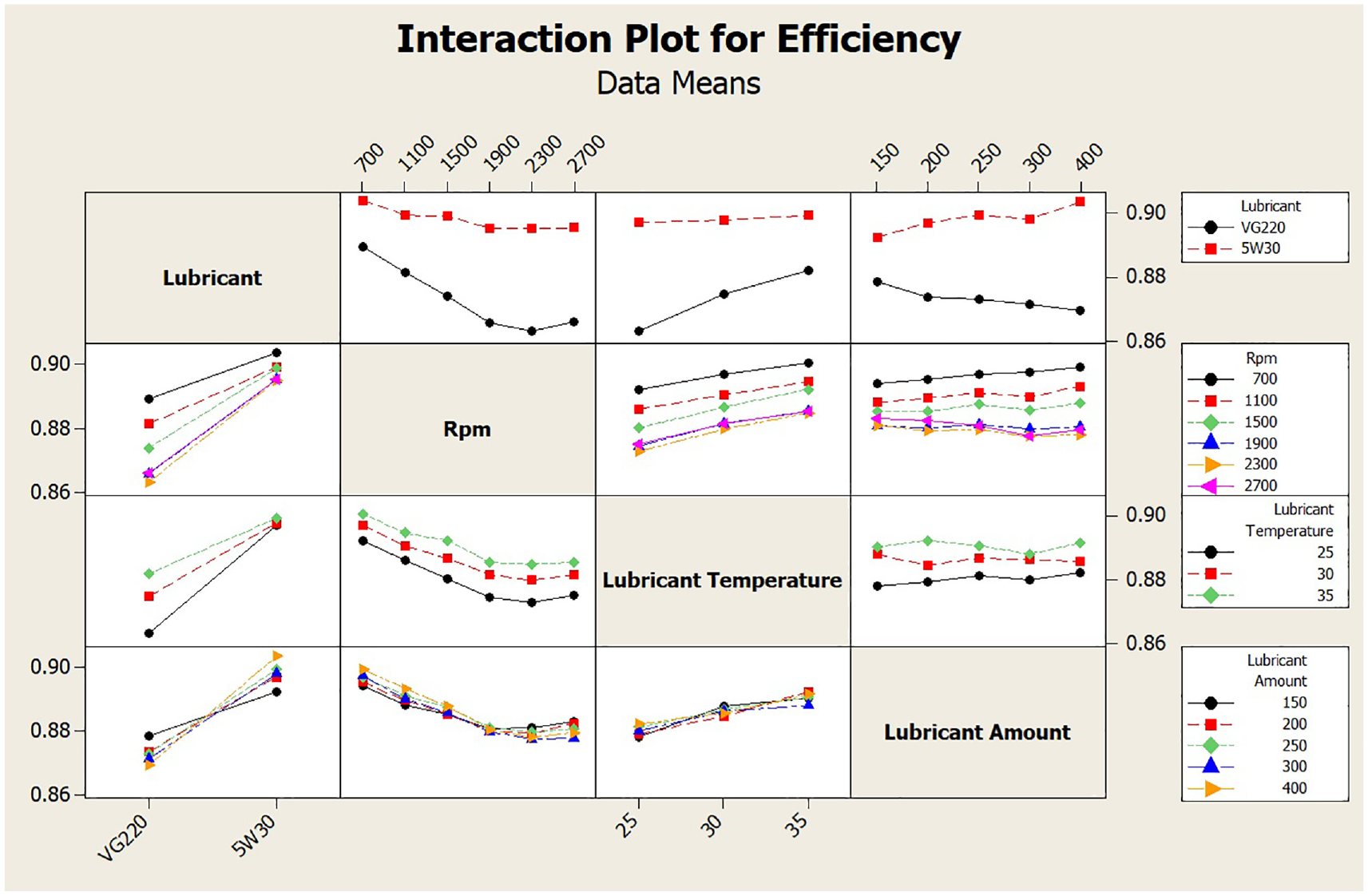
Interaction plot for efficiency.
In a broader context, it is evident that the selected parameters do not exhibit strong interactions with each other. Therefore, the results of experiments involving different levels of the utilized parameters contribute to the enrichment of findings, yielding meaningful results.
It is noteworthy that the interpretation of the results does not give rise to misguiding implications, ensuring the absence of any misleading circumstances.
The motor oil, 5W30, has been observed to remain unaffected by temperature changes and, consequently, enables the attainment of higher efficiencies compared to VG220. Experiments with VG220 reveal that an increase in lubricant amount reduces efficiency, while in the case of 5W30, an increase in lubricant amount enhances efficiency.
Energy losses in the gearbox due to friction was formulized considering all of the gearbox components, 33 moreover the impact of lubrication conditions of sealing components and bearings on the efficiency loss of gearboxes were examined. 3 Accordingly, in this study, the phenomenon of increased efficiency with the rise in oil level is attributed to the improved lubrication of components such as sealing elements and roller bearings located in the upper stage of the gearbox. This is particularly pronounced in oils with low viscosity, as they allow for greater infiltration of oil from the region, potentially necessitating a higher lubricant quantity compared to oils with higher viscosity.
In addition to this information, considering the gear contact perspective, it was pointed out that viscosity and the fully immerged teeth affect the pressure balance in the formation of hydrodynamic film, where the lubricant completely fills the space. 34 This, in turn, forms more uniform pressure distribution and reduces oil leakage due to pressure differentials referred as Squeeze Effect.
Furthermore, in the context of temperature increase in the gear teeth, the evaporation of oil contributes to lubricant loss. The increase in oil quantity is believed to decrease the ability of low-viscosity oils to leave the lubricated area, thus assisting in the improvement of efficiency.
Main effect plots given in Figure 9 explicitly reveal how parameters directly impact efficiency, with the slopes of the lines on the plots indicating the levels of effect. The variation in lubricant type has been observed to exert an effect on efficiency of more than 2%.

Main effects plot for efficiency.
As the rotational speed increases, it has been deduced that efficiency dramatically decreases up to a certain value and then stabilizes thereafter. The impact of a 10
When considering different types of lubricating oils individually, the effect of oil level is observed. However, subjecting both lubricants to variance analysis reveals an inverse relationship, as indicated in the interaction plot. Consequently, it is apparent that, in general, churning effects do not impact system efficiency as much as other parameters.
Through regression analysis with these data and experimental design, two distinct regression equations have been obtained for both lubricants.
Regression equation for ISO VG220 has been calculated as given in equation (3);

where, RS is rotational speed, LT is lubricant temperature, and LA is lubricant amount.
Regression equation for SAE 5W30 is given in equation (4);
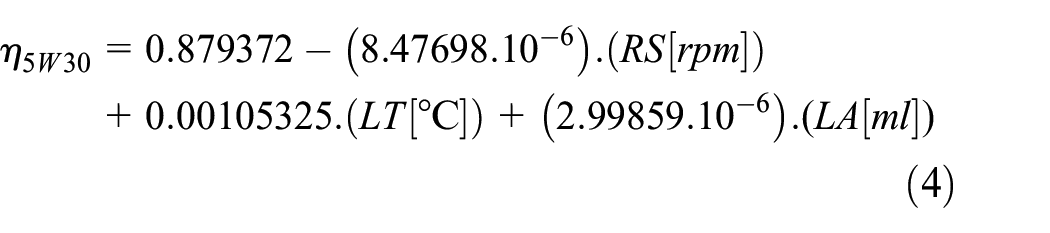
These equations demonstrate the outcomes we can expect by employing specific parameters at different levels for this gearbox. These equations are only valid using this specific gearbox and the above mentioned lubricants and at the specified parameter levels.
Conclusion
The final objective of the general project is to develop a statistical model to determine all possible inputs and faults of the system, optimize performance, predict component errors, and improve the actual design. Oil viscosity and level are some of these variables that affect the efficiency and predictability of the gearbox.
The objective of this study is to determine the impact of oil-related operational parameters on the efficiency of a gearbox. Since this is a preliminary investigation, experiments are conducted with one gearbox and two types of lubricants; in future works, different types of gearbox data will be collected sufficient for an effective statistical model that can be used for estimation and prediction.
Based on the results, insights are gained into which levels of parameters manufacturers of gearboxes should use and within which ranges these parameters should be maintained during the pre-design stage, considering efficiency objectives. For instance, conclusions were drawn regarding the optimum temperature range for efficiency, the necessity of additional cooling and the recommended speed intervals. Despite obtaining a regression function, it is important to note that adjustments within the parameter level range used in the experimental design could potentially yield maximum efficiency for only this gearbox. In other words, these equations are only valid using this specific gearbox and the above mentioned lubricants and at the specified parameter intervals.
In the results section, the behavior exhibited by lubricant level in the main effect suggests that the system is not significantly affected by churning. Therefore, it can be inferred that excessive lubricant usage in high viscosity has neither positive nor negative effects on efficiency for this specific gearbox and thus, the minimum amount of lubricant possible may be sufficient for efficiency objectives. However, when specifically examining experiments conducted with 5W30 oil, an increase in lubricant level is observed to correspond to an increase in efficiency. For further investigations, on the experimental setup other sensors are mounted and different data are measured related to the other parameters, such as noise and vibration. The noise level differences show better lubrication with 5W30 oil, at high levels especially at the upper stage, affecting the other components of the gearbox.
The experiments conducted with VG 220, a lubricant more susceptible to temperature variations, reveal a positive impact of temperature increase on system efficiency. It is established that operating the system at an optimum temperature contributes to achieving maximum efficiency from the gearbox.
It is expected for lubricants with lower viscosity, such as 5W30, to provide higher efficiency, and this study clearly demonstrates its numerical impact.
The results of this study will contribute to the planning of future research. The groundwork is laid for studies related to appropriate lubricant selection based on load, determination of the optimal lubricant quantity from the manufacturer’s perspective, recommendations for operating speed depending on application, and determination of the operating temperature range of the gearbox. Moreover, with measured different variables that will be used in a complex model, these results will be helpful to better interpret the total system response and distinguish every single component frequency.
Footnotes
Acknowledgements
Special thanks to Adeon Company and Umut Murat Gök for their support. Additionally, thanks to Yılmaz Redüktör Company for providing the gearbox samples.
Handling Editor: Chenhui Liang
Declaration of conflicting interests
The author(s) declared no potential conflicts of interest with respect to the research, authorship, and/or publication of this article.
Funding
The author(s) received no financial support for the research, authorship, and/or publication of this article.
