



Abstract
Carreau fluid flow over a linearly curved stretching surface has significant applications in manufacturing industries. This study focuses on the impact of various parameters on the velocity, temperature, pressure skin friction, and heat transfer coefficient of a 2D Carreau flow. Both shear thinning (pseudoplastic) and shear thickening (dilatant) behaviors are considered. The parameters include suction, non-dimensional radius of curvature, Weissenberg number, magnetic parameter, power-law index, Eckert number (viscous dissipation parameter), and Prandtl number. The effects of viscous dissipation, magnetic field, convective boundary conditions, and suction are also taken into account. The study reveals that the flow velocity decreases with increasing magnetic parameter, curvature factor, and suction, but increases with the Weissenberg number and power law index. The heat transfer rate is reduced by the curvature factor, Weissenberg number, suction, power-law index, and Prandtl number, while the magnetic parameter has the opposite effect. The boundary value problem is simplified through appropriate similarity transformation and solved numerically using the shooting method and Matlab’s built-in function bvp4c. The results obtained from these two methods show good agreement. The findings also align well with existing literature in some limiting cases, confirming the validity of the study.
Introduction
Heat transfer flows due to moving boundaries have many important applications in industries. In manufacturing processes the stretching of sheets has significant effects on the quality of finished products. The final products are significantly influenced by stretching and heating/cooling; depending upon the skin friction or frictional drag and the rate of heat transfer. Under various stretching velocities, different real processes take place, viz; extrusion of polymer sheet, manufacturing of plastic films, continuous stretching, hot rolling, metal spinning, rubber sheet, or thin film and many more.
The boundary layer behavior prompted by the motion of a moving surface has taken attraction of researchers because of its applications in the manufacturing process, such as the flow generated in fiber spinning, glass blowing, hot rolling, paper production, and fibers production. Some of the famous applications of stretching process have been given by Fisher 1 and Altan et al. 2 Sakiadis 3 discussed the effects of constant velocity on Newtonian fluid caused by a moving plate. Erickson et al. 4 analyzed the impact of heat mass transfer past a moving plate. Tsou et al. 5 reported the influence of constant velocity over a stretching surface in the boundary layer together with temperature. Crane 6 carried forward the work of Sakiadis and discussed that in polymer industries it is sometimes essential to consider a stretching plastic sheet. The boundary layer analysis due to a stretchable porous plate of the heat and mass transfer is examined by Gupta and Gupta. 7 Recent studies on the curved surface, exponentially stretching curved surface and irregular surfaces emphasizes on the importance of its applications in biological and engineering industries.8–12
Carreau fluids are a type of generalized Newtonian fluids whose model was put forth by Carreau in 1698. Power law models are enable to predict the viscosity for very high and low shear rate. Carreau fluid is ideally used to model the phenomena of non-Newtonian fluids like plasma, blood flow, and visco-elastics. This model was put forth by Carreau in 1698. Power law model are enable to predict the viscosity for very high and low shear rate. The Carreau Model is

In the above equation,

where

Hayat et al. 13 investigated the flow of Carreau fluid caused by linear stretching under the effects of Newtonian heating and chemical reactions. Effects of physical parameters on velocity, concentration, and temperature were considered. Khan et al. 14 implemented shooting scheme to study the behavior of Carreau nanofluids due to paraboloid upper horizontal surface. Carreau fluid over a linearly curved stretching surface is an important model in many engineering and industrial applications. After these initials, a lot of research has been done to compensate the applications of Carreau fluids in industries.15–18
In numerical analysis, the word shooting for shooting method is originated artillery which describes its working in such a way that it places cannon at initial position and by continuously changing the angle it targets until it reaches and satisfies boundary conditions. Initial value problem is obtain by reducing boundary value problem and by applying appropriate similarity transformation, non-linear ordinary differential equations are obtain from PDE’s of differential equations. The equations are then solved by shooting method coupled with iv order Runge-Kutta integration scheme. This scheme is preferable to solve fluid dynamics problems because it takes advantage of speed and adaptivity over other numerical schemes. 19
The objectives of this study is concerned with the analysis of boundary driven flow of Carreau fluid over a curved stretching surface. Carreau fluid of both shear thinning (pseudoplastic) and shear thickening (dilatant) nature have been considered. The effects of viscous dissipation, suction and magnetic field are taken into account. Governing equations are reduced to self-similar equations via appropriate similarity transformation. The reduced system of equations are solved numerically through the implementation of shooting method and Matlab built in function bvp4c. The pertinent parameters in this communication are the suctions, non-dimensional radius of curvature, Weissenberg number, magnetic parameter, power-law index, Eckert number (viscous dissipation parameter), and Prandtl number.
Problem formulation
Carreau fluid flow over a curved surface is investigated with incompressible steady property. The surface is curved with radius

Flow geometry.
The governing equations for the flow are given in vector form as follows see Sajid et al. 20 :
Continuity equation

Momentum equation

Energy equation

where
Mass conservation equation

Momentum equation


Energy equation

boundary conditions for the above defined problems are (see Rosca and Pop 21 ):


To formulate the system dimensionless, we utilized the following similarity variables



Governing equations 7–10 with boundary conditions 11–12 are renewed into non-dimensional form as follows:


and the pressure term from (17) refers to as:

by utilizing equations (16) into (17), one can eliminate the pressure term

boundary conditions are:


Where
Physical quantities
The quantity of physical interest in this problem is the skin friction coefficient

where


using equations (13)–(15) in (35), we obtain;


The Reynolds number is
Numerical scheme
Solutions to boundary value problems related to fluid flow can be determined using appropriate numerical techniques. The shooting method, one of the oldest and most efficient numerical methods, is often used. This method initially transforms the boundary value problem (BVP) into a system of first-order initial value problems (IVP). Then, the missing initial conditions at the starting point are estimated. This transformed IVP is solved using a highly efficient sixth-order Runge-Kutta method. The accuracy of the resulting solution is verified by comparing it with the given values at the end point. If the solution’s accuracy meets the desired level, it is accepted. Otherwise, the estimated values are iteratively refined using the Newton-Raphson method until the boundary conditions are satisfied within a specified tolerance limit at infinity.
Shooting method
The non-linear ODE for heat and momentum equations that is, subject to the boundary conditions are solved numerically using sixth order Runge-Kutta method along with shooting technique.



The boundary conditions are defined as:


Results
Discussion
The current study examines the behavior of Carreau fluid over a stretching sheet. It explores how various physical parameters, such as the radius of curvature, Weissenberg number, magnetic parameter, and suction parameter, influence the velocity, temperature, and pressure of the fluid. This is considered for both shear thinning

Radius of curvature

Radius of curvature

Weissenberg number

Weissenberg number

Magnetic parameter

Magnetic parameter
Suction parameter represents the amount of fluid being removed from the system. It means that suction parameter reduces the amount of fluid from system which results in decrease of velocity profile of fluid. Figures 8 and 9 deliberates the effect of suction parameter by decrease in velocity profile for both

Suction parameter

Suction parameter
Figures 10 and 11 are sketch to know the behavior of radius of curvature
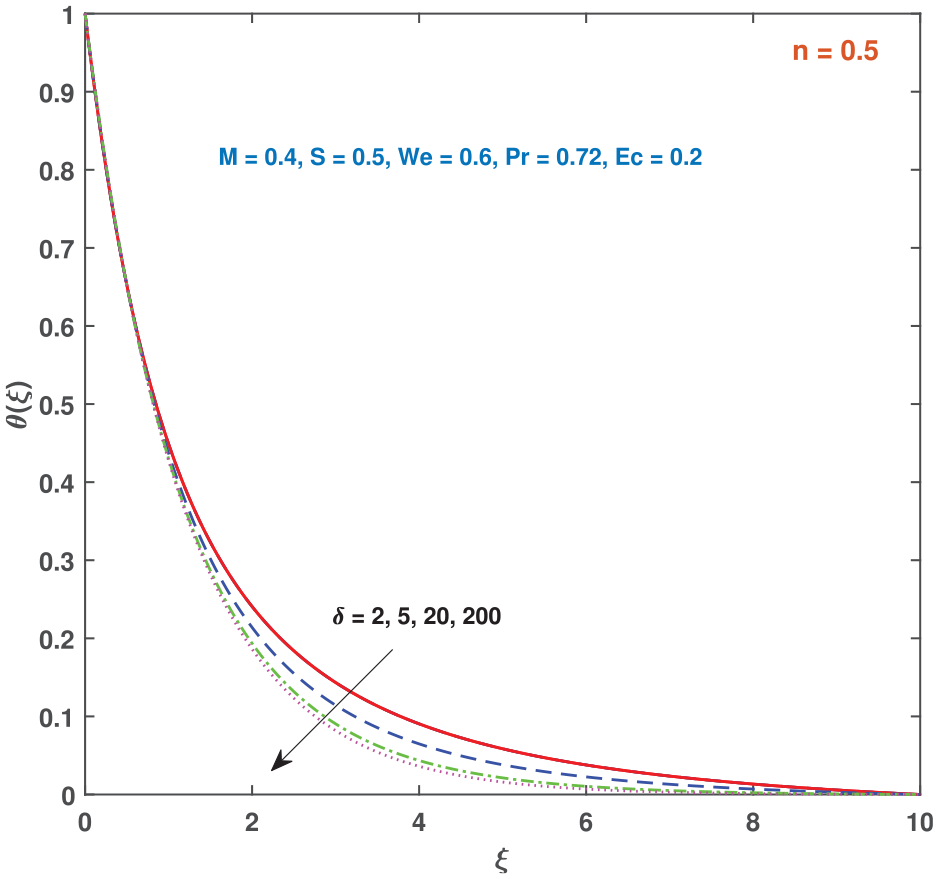
Radius of curvature d impact on temperature profile with n = 0.5.
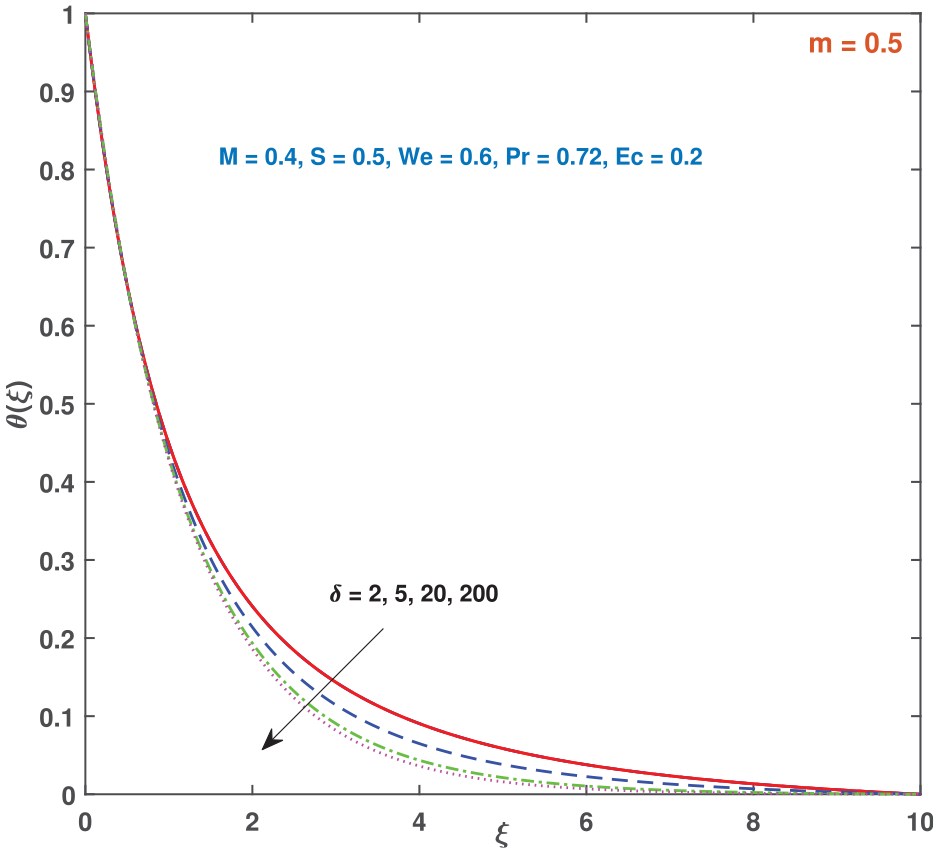
Radius of curvature d impact on temperature profile with m = 0.5.

Weissenberg number We impact on temperature profile with m = 0.5.

Weissenberg number We impact on temperature profile with m = 1.5.

Magnetic parameter M impact on temperature profile with m = 0.5.

Magnetic parameter M impact on temperature profile with m = 1.5.
Suction parameter refers to the amount of fluid being removed from system. When the amount of fluid reduces, the internal energy of the particles also reduces which effects the temperature of system. Figures 16 and 17 portrays the effect of increase in suction parameter on temperature profile which shows decline with increases in suction parameter.
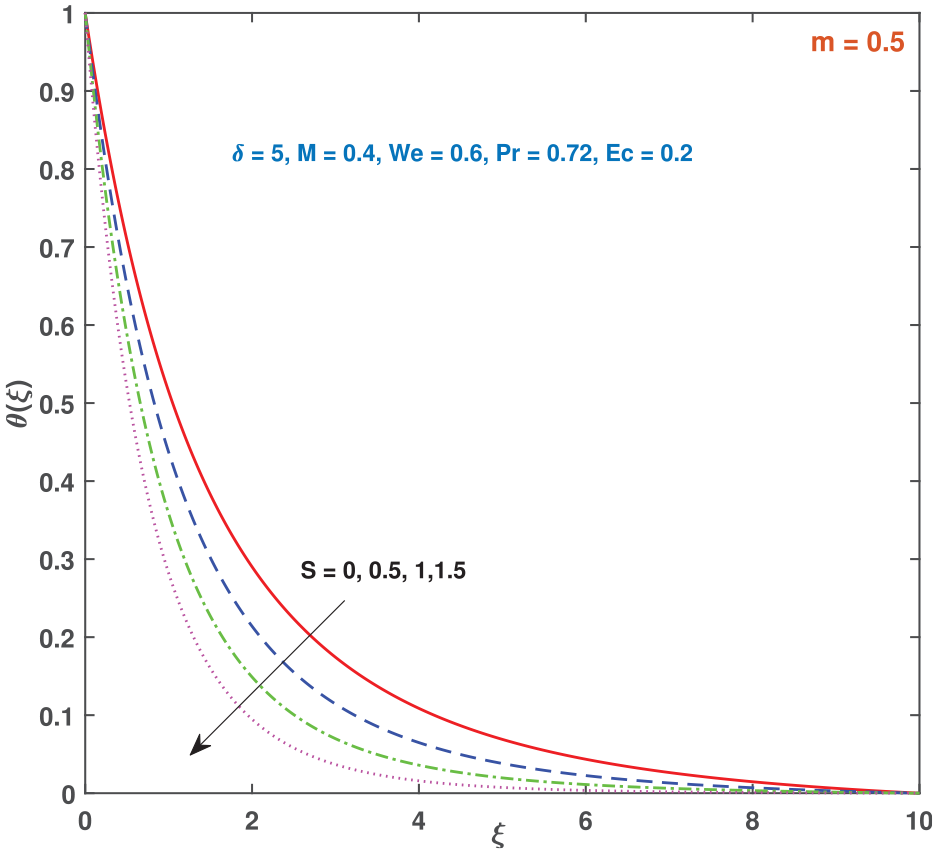
Suction parameter S impact on temperature profile with m = 0.5.

Suction parameter S impact on temperature profile with m = 1.5.
Figures 18 and 19 interpret the influence of Prandtl number on the thermal field. Both cases showed decline in temperature profile.

Prandtl number Pr impact on temperature profile with m = 0.5.

Prandtl number Pr impact on temperature with m = 1.5.
Increases in Eckert number produces heat in fluid due to frictional heating. Eckert number is fraction of kinetic energy to specific heat enthalpy. So when the Eckert number increases, it works against fluid stresses to transform kinetic energy into internal energy. Figures 20 and 21 display the increase in temperature profile in both cases by increasing Eckert number

Eckert number Ec impact on temperature profile with m = 0.5.
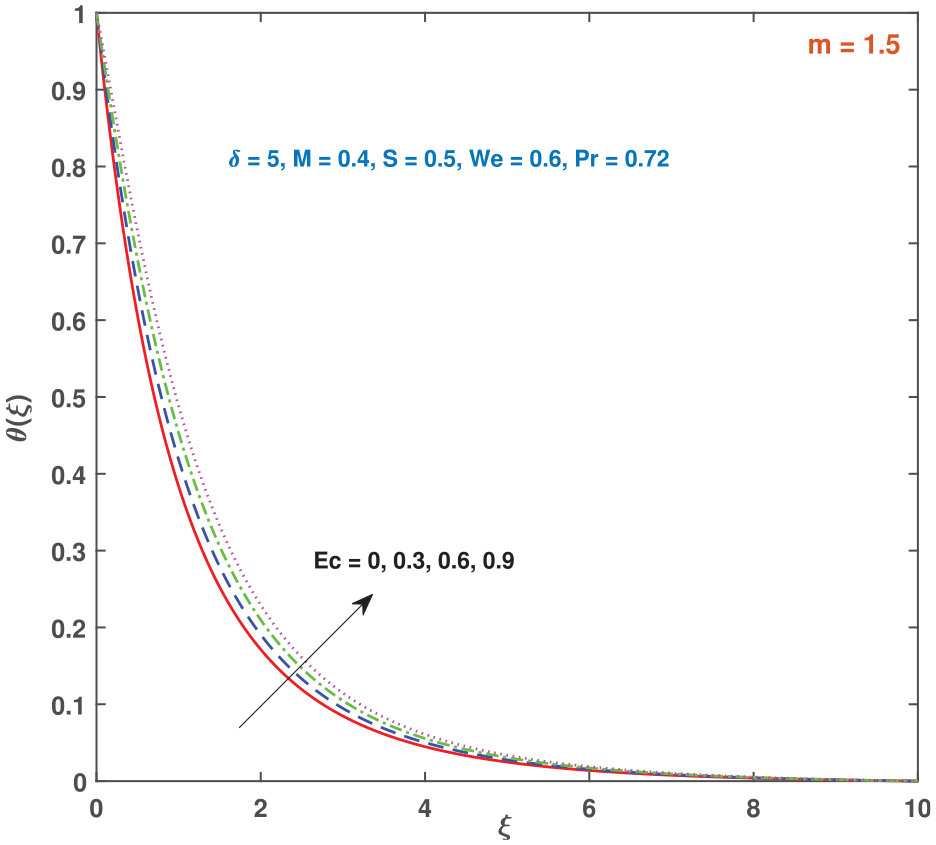
Eckert number Ec impact on temperature profile with m = 1.5.
When the radius of curvature keep increasing the surface become flat hence causes a decrease in pressure of fluid. The effect of increasing radius of curvature and Magnetic parameter on the pressure is plotted in Figures 22 and 23. For large values of

Radius of curvature
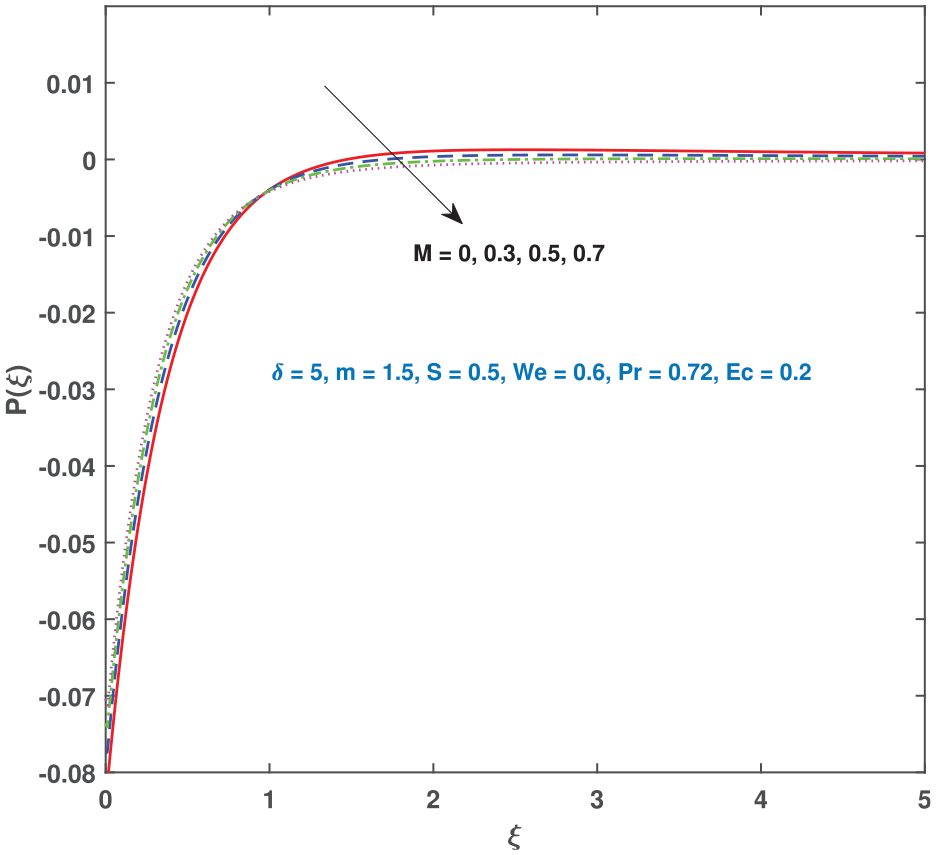
Magnetic parameter

Power-law index
Table 1 is presented to show the validity of the present results with the previous published work. The results for all values of
Comparison of present values of the local friction coefficient

Numerical values of the local friction coefficient

Numerical values of local heat transfer coefficient for different physical parameters.

The above promising results gives future directions for this model to utilize for further industrial approaches by considering the effect of entropy generation. Moreover, for other non-Newtonian fluids this work can be carry forward.
Conclusions
Numerical investigations have been carried out on the flow of the Carreau fluid along with a linear stretchable curved wall. On the basis of our investigation, the key points of the pre-sent analysis are given below.
For shear thinning fluids, increases in Weissenberg number intensify the velocity of fluid while it mitigates the velocity for shear thickening fluids.
An increase in the magnetic parameter, curvature factor and suction parameter results in a decrease in the flow velocity. On the other hand, fluid velocity increases with an increase in the power law index.
For shear thinning fluids, the temperature profile increases while it decreases for shear thickening fluids when the Weissenberg number is large.
The heat transfer rate decreases with an increase in the suction parameter, curvature factor, power-law index and Prandtl number. Conversely, the opposite behavior is observed for the magnetic parameter.
Footnotes
Appendix
Handling Editor: Chenhui Liang
Declaration of conflicting interests
The author(s) declared no potential conflicts of interest with respect to the research, authorship, and/or publication of this article.
Funding
The author(s) received no financial support for the research, authorship, and/or publication of this article.
