



Abstract
To address the problem of modeling the growth rate of coating film thickness when spraying at inclination angle, based on Gaussian sum model, it is proposed to use the elliptic double Gaussian sum model to establish the cumulative model of coating film thickness when spraying at static inclination angle of the spray gun. The differential geometry amplification theorem is used to establish the coating growth rate model with the spraying inclination angle as the variable; after that, the static inclination spraying experiments are carried out, and the coating thickness data of the sampling points are recorded through the spraying experiments, and the Levenberg-Maquart algorithm is used for the least-squares fitting of the model, which results in the static spraying film thickness distribution model. Finally, compared with the elliptic double β model, the fitting accuracy of the elliptic double Gaussian sum model is 6.3% higher than that of the elliptic double β model when spraying at inclination angle by comparing the R-square values, and the elliptic double Gaussian sum model is more capable of obtaining a better fitting accuracy, which further confirms the validity and practicability of the model.
Introduction
In recent years, with the development of global robotics, robotic spraying has gradually become a more mature technology and is widely used in automotive, marine, aerospace, and other fields. The key technologies in robotic spraying include spraying quality and efficiency, where spraying quality is mainly expressed in the thickness, brightness and uniformity of the paint layer on the surface of the sprayed vehicle. 1 An accurate coating model can provide reliable predictions of coating thickness and uniformity to optimize process parameters, coating trajectory, and coating thickness, so the establishment of an effective and practical coating model is essential for the further application of coating robots.
A great deal of work has been done in this area by companies and scholars at home and abroad, Sahir Arıkan and Balkan 2 conducted paint experiments on a flat surface using a spray gun with a circular spray area at different spray distances and different spray speeds in order to simulate paint distribution, and used the β model to simulate different spray thickness distributions. Arikan 3 developed an offline programing system that can be used for the prediction of coating thickness, by using a computer the user can determine the coating strategy, parameters and paths, and compared to the actual coating results, the thickness prediction deviation can be within a very small range by using this method. The film thickness distribution model established by From 4 was derived from the study of the effect of electrostatic spinning cup movement speed on film thickness during planar spraying. The model is no longer applicable when the type of workpiece is changed or when the gun position is changed. The microscopic mechanism of spray film thickness build-up was investigated, 5 and the distribution pattern of film thickness and the causes of film formation were explained at the microscopic level by combining a multi-field coupled flow field theory model with a film thickness distribution model. Zeng et al. 6 and Liu 7 conducted a series of spraying experiments with a spray gun under tilted conditions and established a coating thickness distribution model based on the Gaussian sum model with variable tilt angle. The experiments showed that the Gaussian sum model 8 also has high fitting accuracy in describing the coating growth rate for spraying at different inclination angles. The prediction model can be used to reflect the coating growth rate quickly and accurately by spraying at variable angles and to meet the real-time and practical modeling requirements for offline programing systems. Feng and Sun 9 obtained the coating deposition function through the flow distribution at one point in the spraying flow field, and verified the three-dimensional dynamic simulation of the film thickness on the relevant platform, which is favorable for the establishment of the subsequent offline programing system for robots. Xia et al. 10 used the neural network method and genetic algorithm for the fitting of the spray thickness model, which can quickly establish a coating deposition model that coincides with that in real operations.
In summary, specific results have been achieved at home and abroad in the establishment of coating model analysis and other aspects, but there is still the problem of a simpler spraying model and a single consideration, which also makes the scope of its application often limited. The Gaussian sum model is obtained by superimposing the Gaussian model, and the fitting effect is better.11,12 Gaussian and the model provide multiple coefficients, by adjusting the coefficients, can simulate the coating film thickness distribution under different gun parameters, so the scope of application is wider, but it is based on the conical torch plane as the theoretical basis, the fundamental working conditions of the spraying surface is mostly elliptical plane for more. Therefore, an elliptical double Gaussian sum model is proposed based on tilted spray growth rate modeling. For this reason, we introduced an elliptical double Gaussian model on the basis of the traditional Gaussian distribution model. This model takes into account the influence of the inclined plane on the spraying distribution and can more accurately simulate the thickness distribution of the coating on the inclined surface.
In this study, not only the mathematical model of inclined plane spraying is established, but also special attention is paid to identifying the optimal results and comparing and analyzing the numerical results with the experimental data. To achieve this goal, the key parameters of the model were first identified and algorithmic optimization was used to find the optimal values of these parameters. This process involves careful adjustment of variables such as spray angle, distance and coating thickness to ensure that the model most accurately reflects the actual spraying process. Subsequently, the numerical predictions derived from the elliptic double Gaussian model were critically compared with the experimental data. This comparison not only included a direct comparison of coating thicknesses, but also involved a detailed analysis of the shape and extent of the distribution. A variety of statistical and graphical methods were used to present these comparisons, such as error analysis, regression curves, and distribution plots. These comparisons enable an accurate assessment of the predictive performance of the model and identify any possible biases or inaccuracies. This step is crucial to validate the effectiveness of the model as it is directly related to the reliability and accuracy of the model in real-world applications. The results show that the optimized elliptic double Gaussian model can be very close to the experimental data in most cases, showing superior fitting accuracy and high reliability. In summary, this study not only proposes a new mathematical model to describe the coating thickness distribution of inclined plane spraying, but also demonstrates the high accuracy and practical application value of the model by comparing the detailed numerical and experimental results. These findings provide a solid foundation for further research and industrial application of spraying technology.
Coating thickness distribution model for static tilt spraying
The actual spraying operation often applies shaping gas to both sides of the spray cap, resulting in a spray profile that is usually oval, as shown in Figure 1.
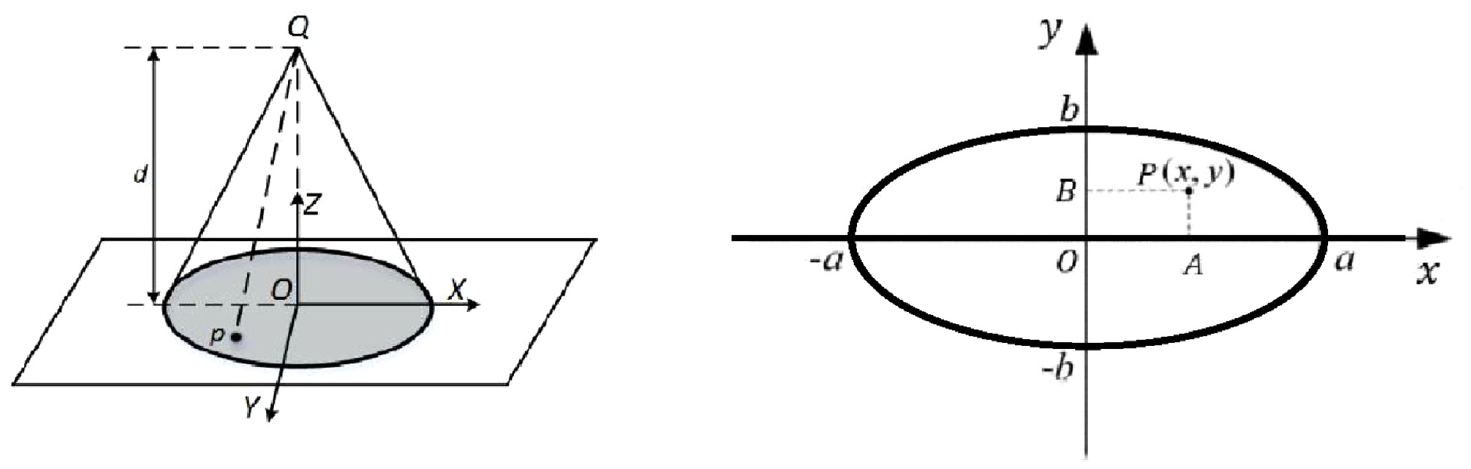
Oval painted surface.
The elliptical double beta distribution model is one of the more widely used models. 13 is one of the more widely used models, and its basic form is as follows:

In the above equation, the parameters a, b depend on the distance of the gun from the surface of the car body, where β1, β2 are the shaping parameters of the elliptical double β model in the x-direction and y-direction, the magnitude of which depends on the magnitude of the shaping air pressure.
Due to the limitations of the elliptic double β distribution model’s mathematical properties, its ability to fit complex data analysis is not ideal, so this paper proposes a new model based on the Gaussian distribution model, namely the elliptic double Gaussian sum distribution model. The Gaussian sum model is also more flexible due to its more selectable parameters, and its basic form is as follows:

In the above equation, ω i , μ i , σ i are the parameters to be identified, r is the distance from the spraying point to the spraying center, N = 1,2,3…, when the order of N is more significant the more excellent the order of N, the higher the accuracy of the fit, but N increases to a certain extent to the model fitting effect change is not apparent, but will make the complexity of the model solution become larger. 14 Therefore, a third order Gaussian sum model is usually used to meet the requirements. The modeling process of the elliptic double Gaussian sum model is described below.
Taking the oval sprayed area above as an example, the film thickness distribution in the sprayed oval area y = 0, x direction is

Similarly, the distribution of the coating film thickness in the direction of the sprayed elliptical area x = 0, y, can be obtained as
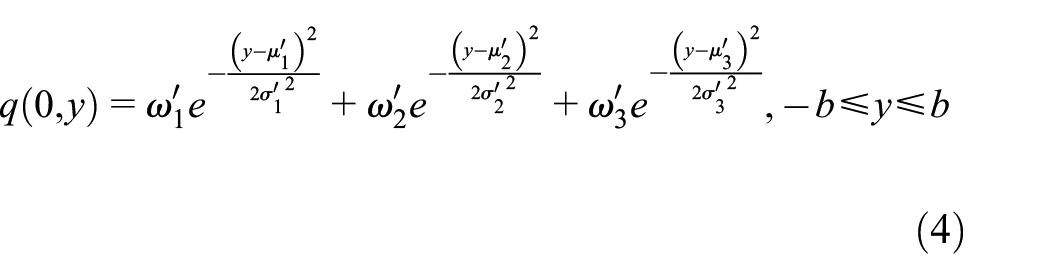
Where a, b are the semi-long axis length and semi-short axis length of the ellipse, respectively; ω1, ω2, ω3, μ1, σ1, σ2, ω1′, ωω2′, ω3′, μ1′, σ1′, σ2′ are parameters to be determined; e is a natural constant.
The main point P (x, y) obeys the Gaussian sum distribution in both x-direction and y-direction, which can be transitioned from the Gaussian sum model calculation in x-direction to the Gaussian sum model calculation in y-direction first. The Gaussian sum model in the x direction is first calculated to obtain the coefficient of the coating film thickness distribution in that direction, λx, which is expressed as follows:

The above equation λ x is the ratio of the coating thickness at x = x p to the coating thickness at x = 0 for the cross-section at yp = 0, indicating the variation of the coating thickness in the x direction, where q (0,0) represents the coating thickness at the center of the ellipse. The Gaussian sum model in the y-direction is then calculated. Since the y-direction and the x-direction have the same distribution, it is assumed that the distribution coefficients of the coating film thickness in these two directions are equal, that is, λx = λy. However, the range of values taken in the y-direction decreases at the position x p , so the range of values taken in the y-direction should be correspondingly The proportional correction, so that when x = x p , there is

Also, as the distribution range of y changes, the expected value μ and standard deviation μ of the Gaussian sum function of the cross section in the direction of y need to be corrected in proportion to the range of values taken to obtain the new corrected expected value μi, xp and standard deviation σi, xp:


At this point the Gaussian sum model in the x = x p , y direction is

The above equation gives the following distribution of elliptic double Gaussian and model functions.

The above equation represents the spray thickness at a point (x, y) in the elliptical spray area, which uses a Gaussian sum distribution function in two directions x, y to represent the different distributions of the coating film thickness in the two directions, so it is called the elliptical double Gaussian sum distribution model, which has more optional parameters, so it is more widely applicable and more accurate.
As it is tilted spraying, the spraying will come with a corresponding angular tilt, so the corresponding position angle processing conversion operation will be carried out, and the growth of the coating film for tilted spraying is shown in Figure 2.

Diagram of inclination spraying.
There is a point
In the case of different spraying heights, the point being sprayed is considered as a small plane that changes its area size depending on the distance, so the small plane corresponding to the point

Since the thickness of the sprayed coating film is inversely proportional to the surface area being sprayed at the same spray volume, there is:

It is assumed that two planes with different inclinations exist in the plane of the same injection tension angle, as shown in Figure 3.

Face normal deflection.
Where the

Where:
When performing the actual film thickness calculation, the point being sprayed is mapped onto a reference film thickness plane at a standard height, its reference film thickness is calculated and then substituted into equation (13) to find the thickness of the sprayed model at different angles and heights.
Coating thickness distribution model fitting method
According to the experimental measurement to obtain the coating thickness data, choose equation (13) as the spraying model, establish the spraying model parameter fitting equation to obtain the distribution of the coating on the processed surface, and use the non-linear least squares fitting optimization algorithm to solve for the values of the coefficients to be determined, the basic steps are shown in Figure 4.

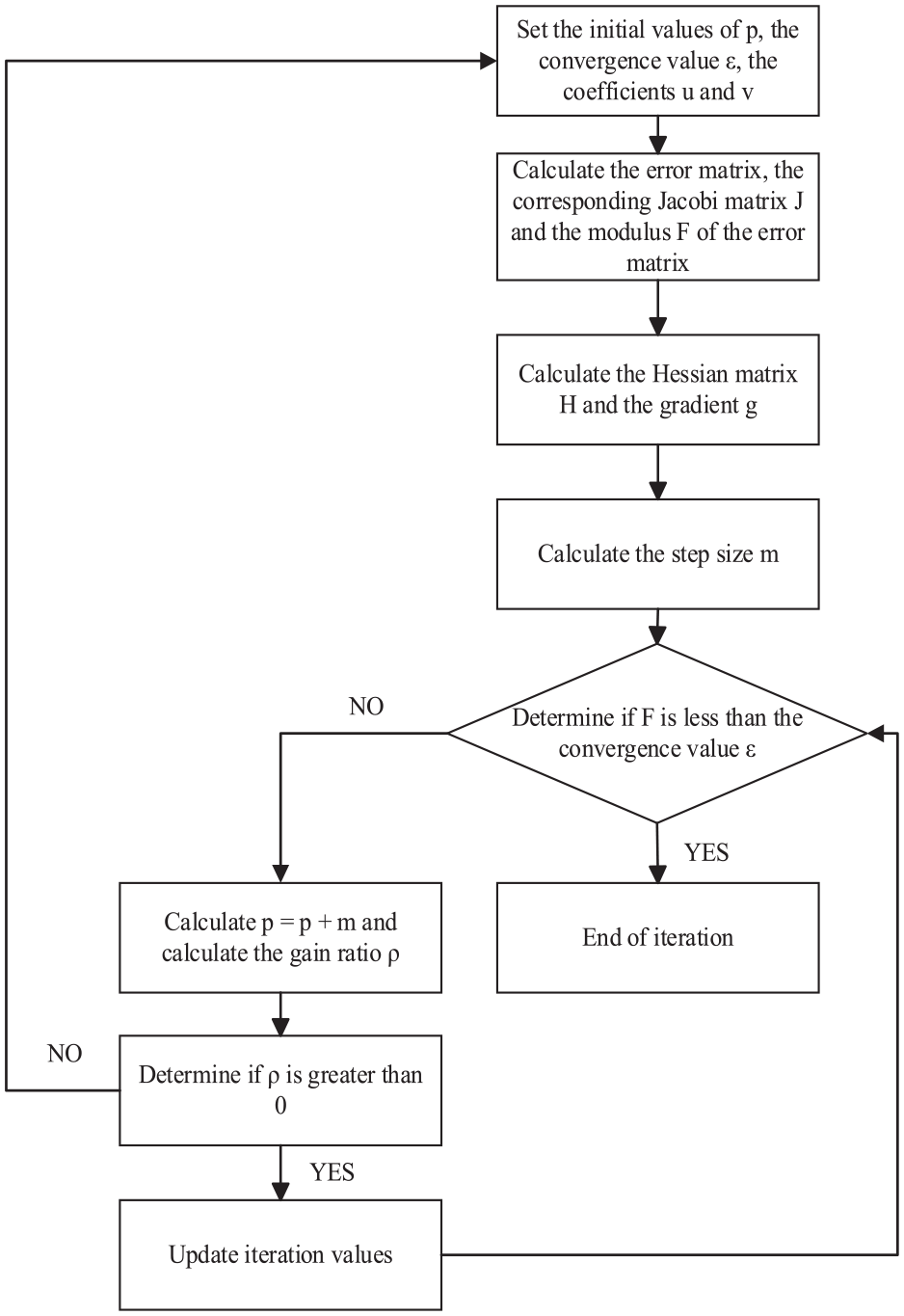
Flow chart of the LM algorithm.
In the above equation, E is the sum of the squares of the differences between the coating film thickness values at the sampling point and the theoretical calculated values.
This study uses the Levenberg-Marquardt optimization algorithm 15 to solve for the spray model parameters, the basic steps of which are as follows:
Substituting the resulting parameters into the elliptical double Gaussian sum model gives a map of the static coating thickness distribution for inclination spraying.
Experimental validation
Experimental verification of static tilt angle spraying was carried out with an experimental platform consisting of an air compressor, an automatic spray gun, a spray gun holder, etc. The coating thickness measurement was carried out using a magnetic thickness gage. The spraying time was set at 1 s, the inclination angle was 0°, 10°, 20°, 30° and H was 200 mm. Through several experiments, the workpiece with the best results was selected for the paint thickness measurement. After the paint has been completely dried, the geometry of the sprayed area and the thickness of the paint film are measured. The resulting elliptical sprayed area is divided, where the long axis direction is the x-axis and the short axis direction is the y-axis, and the thickness of the paint film is measured by taking points evenly on each of the two axes. The film thickness distribution in the direction of

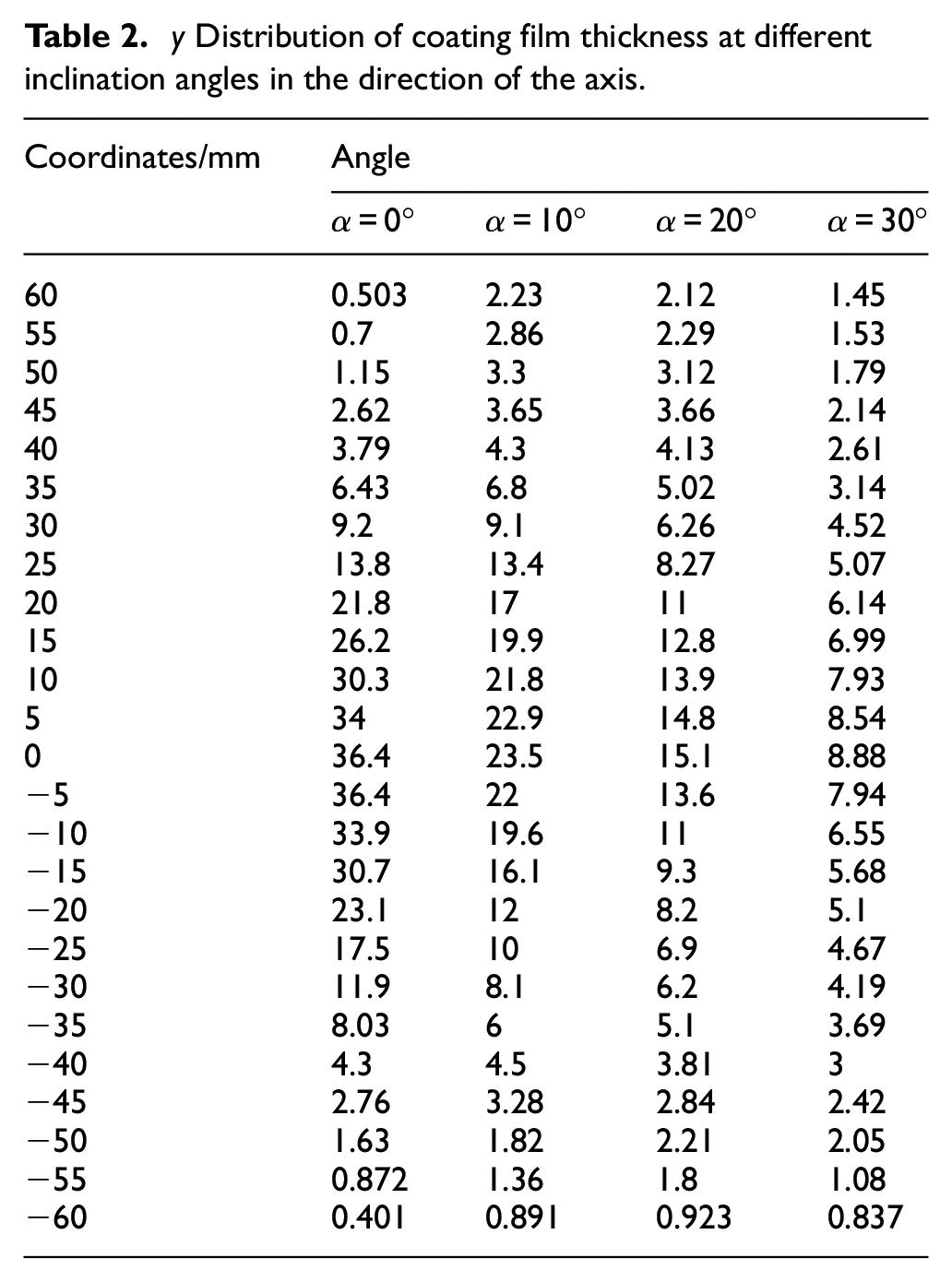
To test the validity of the elliptical double Gaussian sum model, on the basis of the experimental data, this experiment focuses on fitting the elliptical double β distribution model and the elliptical double Gaussian sum model to the inclination spray data for comparison. The fitted calculations for (0° to 30°) were compared sequentially.
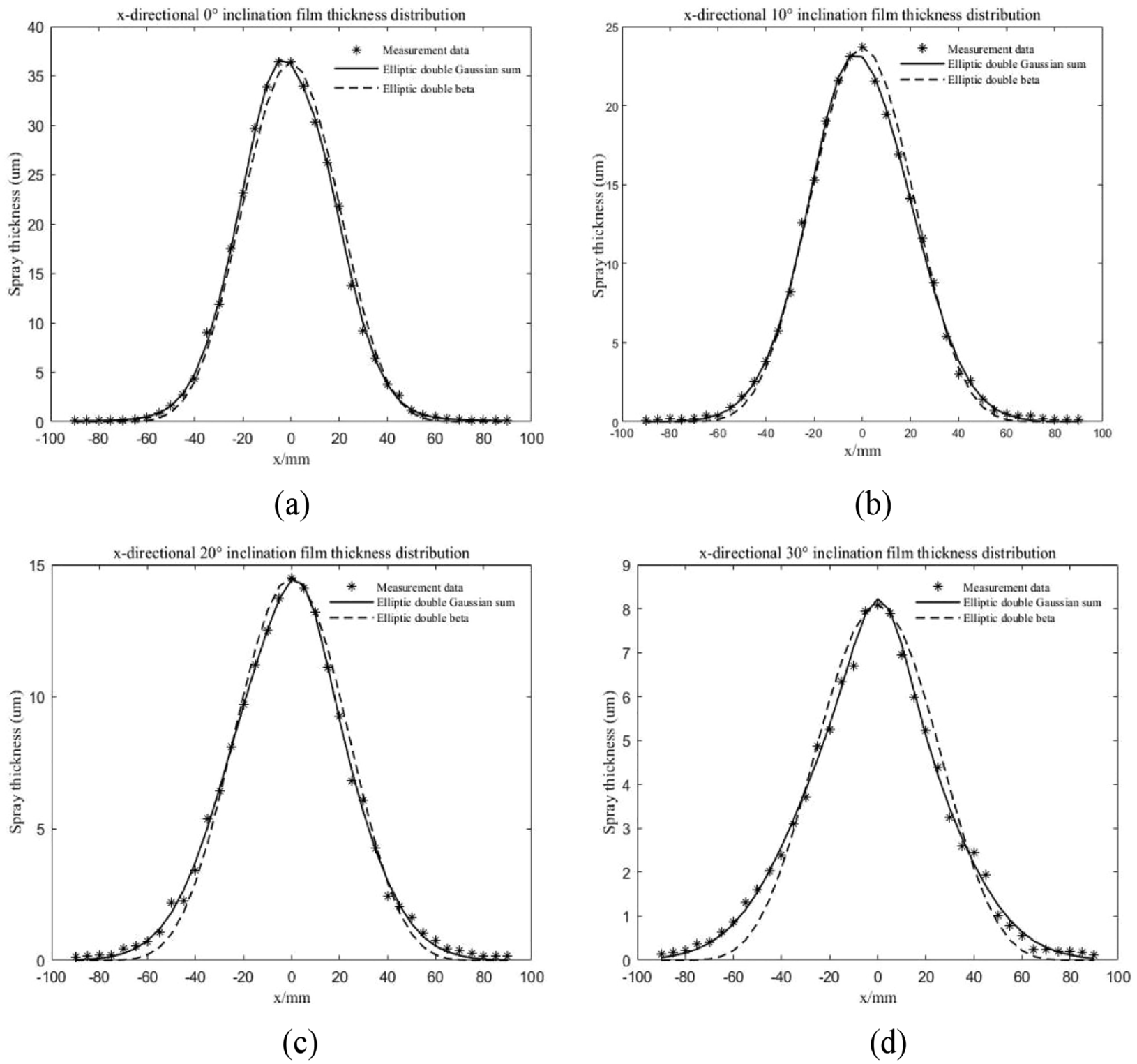
When the inclination angle is 0° (i.e. the gun nozzle is perpendicular to the surface of the workpiece), the distribution of data points on the axes resembles a standard curve, and both the elliptical double Gaussian and elliptical double beta models fit these data points very well, with each data point almost fitting on the fitted curve. The fit of both models is excellent when spraying on a flat surface. When the angle of inclination is 10°, as can be found from the above figure, the two models’ fit curve differences, elliptical double β model fit curve in
The curve fit in the

As can be seen from the above graphs, the film thickness distribution in the
In this study, we used an elliptic double Gaussian model to mathematically fit the coating thickness distribution during the spraying process. By comparing the fitting results of the model with the experimental data, we found that the model can better express the distribution characteristics of the data points. Especially in the x-direction, the fitting curve of the elliptic double Gaussian model is highly consistent with the experimentally measured coating thickness distribution pattern, which shows the ability of the model in describing the coating distribution in the actual spraying process.
It is worth noting that although the model also fits better in the y-direction, it performs slightly less well compared to the x-direction. This difference may stem from the asymmetry of the coating distribution during the spraying process as well as the influence of the spraying angle on the coating formation. Further analysis shows that the fitting accuracy of the model decreases slightly as the spraying angle increases. However, even in this case, the error remains within a relatively small range, which further demonstrates the applicability and accuracy of the elliptic double Gaussian model under different spraying conditions.
In summary, the elliptic double Gaussian model has shown excellent performance in describing the coating thickness distribution during inclined plane spraying. Its high fitting accuracy in the x-direction is particularly worth highlighting as it is important for understanding and predicting the coating formation mechanism as well as optimizing the spraying parameters. Although the fitting accuracy of the model is slightly reduced under specific conditions, overall, its accuracy and practicality are still well validated, providing a valuable reference for future research and application of the coating process.
To measure the goodness of fit of the two models, the R-square of the fit of the two models was calculated for comparison and the results are shown in Tables 3 and 4.


It can be seen from Tables 3 and 4 that the decidable coefficient R-squared decreases as the angle of inclination increases, which shows that it is more difficult to fit as the angle increases. At the same time, the elliptical double Gaussian sum model fits better than the elliptical double β model at all inclination angles, and the elliptical double Gaussian sum model can be fitted well at all operating conditions.
Conclusion
In this paper, for the spraying operation when the gun is not perpendicular to the surface of the workpiece, the inclination spraying is proposed, and according to the differential geometry amplification theorem, the inclination coating thickness distribution model based on the elliptic double Gaussian sum model is established, and the elliptic double β model is chosen to compare with it, and the two models are fitted according to the results of the spraying experiments, and through analysis and comparison it can be concluded that:
(1) When the tilt angle is 0° and the gun is sprayed perpendicular to the surface of the workpiece, the two models are fitted similarly, and both have good fitting accuracy.
(2) At the end of the inclination spraying operation, the surface of the workpiece forms a similar elliptical film area, in which the film thickness distribution in the short axis direction varies considerably with the increase in inclination angle and its central symmetry.
(3) As the inclination angle increases during spraying, the fit accuracy of the elliptical double beta model deviates slightly more, while the elliptical double Gaussian sum model has a higher fit accuracy compared to it. This provides an important theoretical basis for the subsequent planning of dynamic spraying trajectories at the inclination angle.
Footnotes
Handling Editor: Chenhui Liang
Credit authorship contribution statement
Li Chengdong: Acquisition of data, Analysis and/or interpretation of data, Writing – original draft, Writing – review & editing. Sanjay
Sun Weihao: Conception and design of study, Analysis and/or interpretation of data, Writing – original draft, Writing – review & editing.
Jin Jianying: Conceptualization, Supervision, Writing – review & editing.
Liu Shuang:Conceptualization, Supervision, Writing – review & editing.
Tian Xu: Conceptualization, Supervision, Writing – review & editing.
Declaration of conflicting interests
The author(s) declared no potential conflicts of interest with respect to the research, authorship, and/or publication of this article.
Funding
The author(s) disclosed receipt of the following financial support for the research, authorship, and/or publication of this article: This work was financially supported by the National Natural Science Foundation of China (Research on generating mechanism and restraining method of screech under off-wear braking: 51875494) and Jiangsu Jinke Environmental Engineering Technology Co., LTD (Research on intelligent recycling technology of new energy vehicle power battery: 2022062803)

Data availability
Data will be made available on request.