



Abstract
The linear and nonlinear dynamics of a bolted cylindrical shell under a point excitation were experimentally investigated. The tests have been carried out through methods of the hammer test and sweeping frequency test. This paper aims to discover the effect of bolt joints on shell vibration, including the effects of bolt number, tightening torque, and excitation levels. The natural characteristics were analyzed by utilizing natural frequency and mode shapes. The nonlinear dynamic characteristics were analyzed through amplitude-frequency curves. The resonance frequency, resonance amplitude, and damping ratio under different tightening torques and excitation levels were investigated. Results show that: the number of bolts can not only change the value and order of the natural frequencies but also the shapes of the mode; The low tightening torque and larger excitation levels strongly lead to more complex nonlinear dynamics of shell structures.
Introduction
Thin-walled cylindrical shell structures are commonly used in engineering applications, such as aerospace and submarine. The vibration problem of cylindrical shells under different boundary conditions has gradually become a hot research topic. For example, Qin et al.1,2 studied the vibration of elastic-supported cylindrical shells and thin cylindrical-moderately thick annular plates with arbitrary boundaries and elastic coupling conditions. Gradually, the vibration of cylindrical shells with bolted joints, which will bring the nonlinear boundaries, has come into researchers’ view. Li et al. 3 investigated natural frequencies, damping ratios, and forced response of the fiber-reinforced composite cylindrical shells under different partial bolt loosening boundary conditions. More, experiment research is another important method for these vibration problems.
In recent years, there are lots of literature about experiment investigations on shell vibration. Schwingshackl et al. 4 proposed a constant scanning LDV technique to obtain the mode shapes of cylindrical structures. And Yan et al. 5 applied this technique to the modal experiment of a liquid rocket engine nozzle. Farshidianfar et al. 6 used acoustical excitation to excite a long cylindrical shell and obtained the vibration modal. Kumar and Patel 7 observed the nonlinear vibration behaviors of the cylindrical shell through acceleration measurements, digital image correlation, and numerical simulations. Jalali and Parvizi 8 analyzed the effects of liquid on the modal properties of liquid-containing shells through experimental results. Li et al. 9 experimentally investigated the modal characteristics of a cylindrical shell with hard coating under cantilever boundary conditions by considering its nonlinear stiffness and damping influences. Zippo et al. 10 experimentally studied the linear and nonlinear dynamics of the cylindrical shell under axial static and periodic resonant loads. Li et al. 11 utilized experimental results to discuss the effect of elastic boundary on the modal parameters of a thin cylindrical shell. Antunes et al. 12 used experimental modal analysis to obtain the frequency response functions to identify natural frequencies, modal damping ratios, and mode shapes of a variable stiffness composite laminated plate. Zhao et al. 13 measured and calculated the spectra for both vibration and sound in shell structure in continuous immersion undergoing point-force excitation. Li et al. 14 obtained the natural frequency and nonlinear response of a points-supported cylindrical shell. Zippo et al. 15 experimentally studied the effect of temperature on nonlinear vibrations of a polymeric cylindrical shell with a top mass. Lu et al. 16 carried the active stiffness control experiments on a cylindrical shell structure and obtained the natural frequency and mode shapes.
Meanwhile, there are also a lots of literature about experiment investigation on the dynamics of bolted joints. Heller et al. 17 experimentally studied the nonlinear damping capacity of built-up structures of two bolted beams through an equivalent modal parameter identification method. Zhao et al. 18 implemented an experimental test to reveal the natural frequencies of bolted joints increase along with bolt preload. Wang et al. 19 presented a theoretical and experimental analysis of the effect of the number and pre-tightening force of the tightening bolts on the natural frequencies of the bolted disk-drum joint structure. Ouyang et al. 20 conducted an experimental study of the dynamic behaviors of a bolted joint that connects two beams with the varied bolt preload and torsional excitation at two resonant frequencies. Li et al.21,22 numerically and experimentally studied the dynamic responses of a bolted joint rotor system with nonlinear oil film force and those with pedestal looseness.
Through the literature review, it can be found that many experimental aspects have been explored for different cylindrical shell structures or bolted joints, however, there are few studies regarding experimental investigations on the effect of the bolted joint on the nonlinear vibration of the cylindrical shell. The purpose of this paper is to provide a clear view on the vibration of shell structures under mechanical loads and bolt joints. The mode characteristics and nonlinear dynamics of cylindrical shells with bolted joints have been experimentally investigated by the hammer test and sweeping frequency test. First, the results from the experiment were compared with those from analytic calculation to verify their correctness. Then, the mode characteristics of the cylindrical shell under different numbers of bolts were analyzed through natural frequency and mode shapes. The nonlinear dynamics were investigated through amplitude-frequency curves under different tightening torques and excitation levels were investigated, in which the resonance frequency, resonance amplitude, and damping ratio were fully discussed.
Experimental system and test method
The linear and nonlinear dynamics of a cylindrical shell are tested. The cylindrical shell is bounded on the base by Allen head bolts, which are M6 and of stainless steel. The number of bolts can be selected as 4, 8, 16, and 32 based on the requirement of the experiment. The bolts with different numbers can be installed as shown in Figure 1, where the filled dot represents the position of the bolt. Then, the flange is designed as a discontinuous one to reduce the interaction effect of the bolt-tightening sequence. A flat washer is placed between the flange and the base to control the contact area.

Installation distribution of the bolts with different numbers of bolts: (a) 4 bolts, (b) 8 bolts, (c) 16 bolts, and (d) 32 bolts.
To investigate the vibration characteristics of the bolted cylindrical shell, two test schemes will be carried out. First, the hammer test is applied to obtain the natural frequency and mode shapes and the experiment adopts the method of multi-point excitation and single-point vibration measurement. The schematic diagram of these two test methods are plotted in Figures 1 and 2. To be specific, as shown in Figure 2, the force hammer used is PCB 086C01 force hammer, and the data acquisition instrument is LMS 16-channel acoustic-vibration analyzer. The adopted acceleration sensor is BK 4517 micro droplet charge accelerometer, the mass of which is only 1 g to greatly reduce the influence of the sensor mass on the vibration test results and its frequency response range can reach up to 20,000 Hz. Second, the frequency sweeping test was carried out to obtain the amplitude-frequency response of the shell structure. As shown in Figure 3, the shaker used is SINOCERA JZK-10 mode shaker, where the force constant is 10 N/A and the rated output is 100 N. The acceleration sensor is fixed on the cylindrical shell at different measuring points to realize vibration pickup. The acceleration sensor used is CA-YD-125 miniature piezoelectric accelerometer with a mass of 1.5 g, and its frequency response range can reach 2–15,000 Hz. The power amplifier is SINOCERA YE5872A, where the current and voltage can be read in the front panel. The data acquisition card used is NI USB-4431, whose sampling rate can reach 102.4 KS/s, and can fully meet the test requirements. Figure 4 is the field test experiment.

Schematic diagram of the hammer test experiment.

Schematic diagram of the sweeping frequency test experiment.

Field test experiment: (a) the hammer test experiment and (b) the sweeping frequency test experiment.
Besides, it should be noted that the shell structure was fixed by bolts and the pre-tightening effect of bolts is controlled by a torque wrench. The dimension parameter and material parameters of the cylindrical shell structure are listed in Table 1.
Dimension parameter and material parameters of cylindrical shell structure.

Experimental results and analysis
Through the hammer test and sweeping frequency test, the vibration of the shell structure can be obtained. Firstly, the experimental results, the experimental results are compared with the theoretical calculation results.
Then, the influence of bolt quantity on the frequency and mode of the cylindrical shell structure is discussed.
Finally, the effect of tightening torque and excitation level on nonlinear vibration characteristics of bolted cylindrical shell structures was studied.
Comparison of the linear modal between the experiment and analytical results
The natural frequencies and mode shapes of the cylindrical shell with 32 bolts were obtained by the experiment by the hammering method and compared with those from analytical results. The process of a similar analytical method to solve the bolted cylindrical shell has been reported in Refs.,23,24 which would not be repeated for simplicity. The comparison is listed in Table 2. As shown, the errors of the natural frequencies among the experimental and analytical results are less than 5%, and the mode shapes and mode order are also similar, which declares the axial half-wave number is one and the circumferential wave number is six for the first order as an example. Above all, the experiment results for the frequency and mode shape have good agreement with the analytical results, which indirectly demonstrates the validity of the experiment method.
Natural frequency of cylindrical shell structure from experiment and simulation.

Effect of bolt number on the linear modal of cylindrical shell
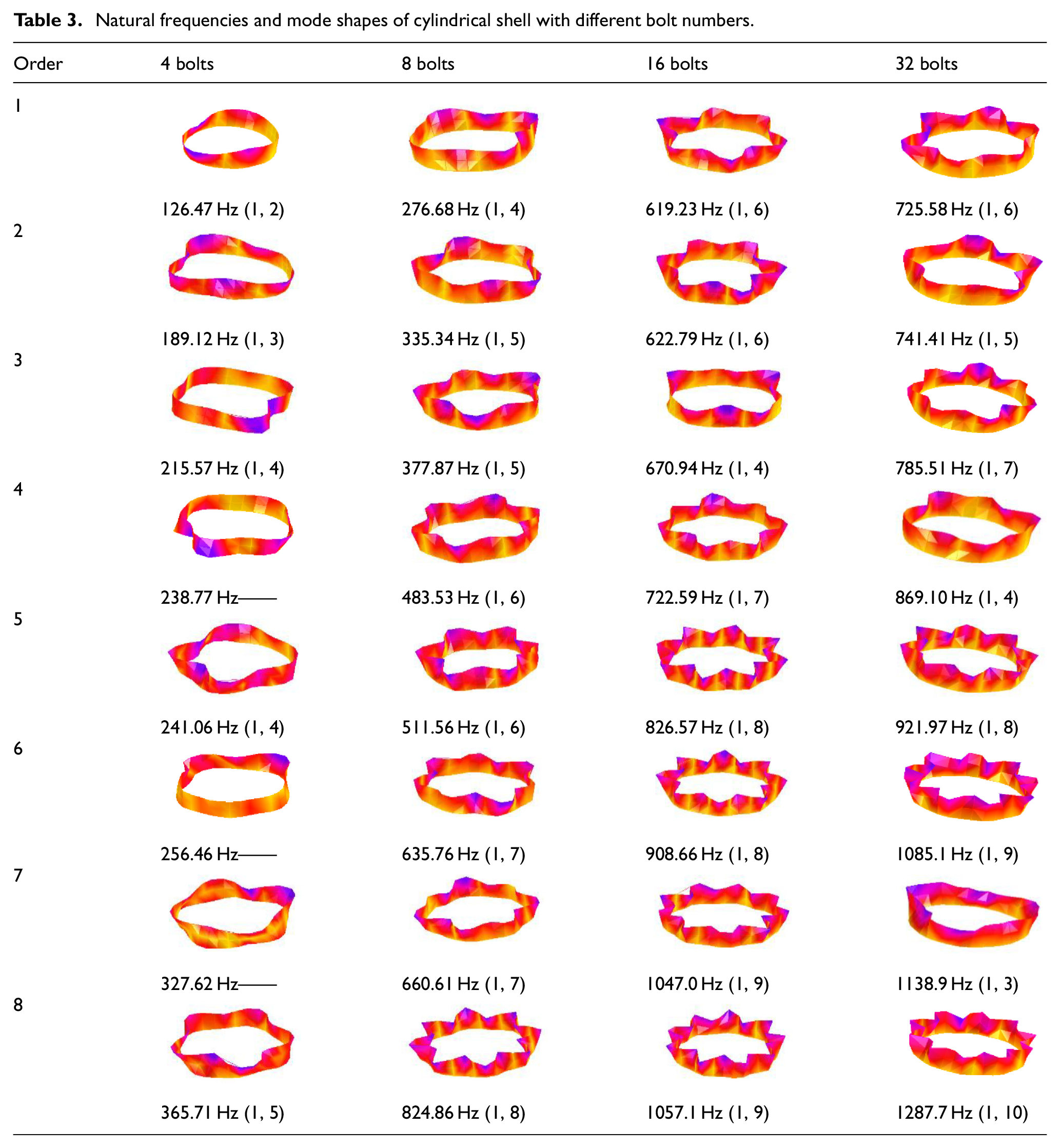
To investigate the effect of bolt number on the linear modal of cylindrical shell, the natural frequency and mode shapes of the cylindrical shell with 4 bolt, 8 bolt, 16 bolt, and 32 bolt, where the preload was kept stable by torque spanner, are discussed. The first eight order frequencies and mode shapes are listed in Table 3. As shown, more bolts cause large frequencies, and the mode shape and its order vary with the change of bolt numbers. Taking the first order mode as an example, the mode is (1, 2) for 4 bolts, (1, 4) for 8 bolts, and (1, 6) for 16 and 32 bolts. Also, the mode shape tends to be stable as the bolt number increases.
Natural frequencies and mode shapes of cylindrical shell with different bolt numbers.
Effect of tightening torque on the vibration of cylindrical shell
Tightening torque is an important factor in connecting stiffness and damping. In this section, the frequency sweeping test was carried out to study the effect of tightening torque on the vibration characteristics of the cylindrical shell. 4, 8, 12, 13, and 20 Nm, which can be controlled by a torque spanner, were applied to the bolts. What should be noted is that the bolt-tightening sequence is kept consistent. Table 4 gives the first eight order resonance frequencies under different tightening torque. It can be noticed that the frequency, increases as the tightening torque gets larger, and the tightening torque has more effect on the lower frequency. The reason is that the larger tightening torque makes the interface contact more closely, which helps the interface to keep the stick state under the external load. That means the larger tightening torque causes the connect stiffness to increase to make the frequency increase.
Resonance frequencies of cylindrical shell with different tightening torques.

To further investigate the effect of tightening torque on the resonant frequency and the nonlinearity of the cylindrical shell, the sweep vibration test for dynamic characteristics was presented beside the first-order frequency. Figure 5(a) gives the amplitude-frequency curves of the cylindrical shell under different tightening torques. As shown, as the tightening torque increases, the soft nonlinearity is changed to linearity, the resonant frequency moves right and the resonant amplitude gets large. The detailed message of resonance frequency (represented by

Vibration characteristics of the cylindrical shell under different tightening torques: (a) amplitude-frequency curves, (b) resonance frequency and amplitude, and (c) damping ratio.
Effect of excitation level on the vibration of cylindrical shell
In this part, during the frequency sweeping test, several excitation levels (represented by FA) from 5 to 60 N were applied to investigate the effect of the external excitation level on the vibration characteristics of the cylindrical shell. Table 5 presents the first eight orders of the cylindrical shell’s natural frequencies under different excitations. It can be found that as the excitation level increases, the frequency decreases, especially for the lower orders. This phenomenon can be expressed as the decreased connect stiffness, which is caused by the large excitation prompting the contact interface state from more stick to slip.
Natural frequencies of cylindrical shell with different excitation levels.

To further investigate the effect of the excitation level on the resonant frequency and the nonlinearity of the cylindrical shell, the sweep vibration test for dynamic characteristics was presented beside the second-order frequency. Figure 6 plots the vibration characteristics of the cylindrical shell under different excitation levels. As plotted in Figure 6(a), as the excitation level increases, the amplitude-frequency curve shows soft nonlinearity. The detailed message of the response, such as resonance frequency, resonance amplitude, damping ratio, and admittance amplitude (represented by AF), is shown in Figure 6(b) and (c). Firstly, when the excitation level increases, the resonance frequency of the cylindrical shell decreases gradually because of the transformation of the interface state of the bolted joint from linear contact to nonlinear contact, which causes the equivalent stiffness to decrease. However, the rate of the frequency variation gradually decreases, especially for the larger excitation. Secondly, as the excitation level increases, the damping ratio shows an increasing trend, which can be explained by the increasing excitation making the friction at the interface of the bolted connection more and more serious, resulting in dry friction damping which increases the system damping. At the same time, it is found that the change in the damping ratio is not linear, which also indicates that the damping characteristics of the system have nonlinear characteristics. Thirdly, as shown, the resonance amplitude increases monotonically as the excitation increases. However, admittance amplitude decreases monotonically with the increase of excitation level, which means the amplitude of vibration stimulated by unit excitation decreases gradually as the damping increases.

Vibration characteristics of the cylindrical shell under different excitation levels: (a) amplitude-frequency curves, (b) resonance frequency and amplitude, and (c) damping ratio and admittance.
Conclusion
The linear and nonlinear dynamic behaviors of a cylindrical shell with bolt joints have been experimentally analyzed. Several conditions of bolt number, tightening torque, and excitation level have been considered. Tests are carried through the hammer and frequency sweeping test. A good agreement was shown between the frequency and mode shapes obtained from the experimental results and those from the theoretical results. The effect of the bolt number on the modal characteristics and the effect of the tightening torque and excitation level on the nonlinear vibration characteristics of the cylindrical shell were obtained. Conclusions are as follows: (i) The bolt number not only changes the value and the order of the frequency but also the shapes, especially under a few bolts, and when the number of bolts is large, the frequency and vibration shape tend to be stable and gradually regularized. (ii) Under the external excitation and bolt joints, the frequency-amplitude curve of the cylindrical shell shows a nonlinear phenomenon. (iii) Tightening torque reduction implies the resonant frequencies and amplitudes move toward lower values and the damping of the system increases. (iv) The larger excitation level results in a decrement of resonant frequencies and an increment of resonant amplitude and damping ratio of the present system.
Footnotes
Handling Editor: Chenhui Liang
Declaration of conflicting interests
The author(s) declared no potential conflicts of interest with respect to the research, authorship, and/or publication of this article.
Funding
The author(s) disclosed receipt of the following financial support for the research, authorship, and/or publication of this article: Supported by the National Natural Science Foundation of China (Grant No. 52205078), Anhui Provincial Natural Science Foundation (Grant No. 2108085QE223), Universities Natural Science Research Project of Anhui Province (Grant No. KJ2021A0156).
