



Abstract
The current investigation explores the effect of activation energy on the MHD radiative Williamson nanofluid flow across a wedge using heat generation and binary chemical reactivity. The flow model consists of partial differential equations (PDEs) by transforming them into ordinary differential equations (ODEs). Numerical computations have been carried out through the bvp4c MATLAB package. The most effective solutions for flow profiles have been displayed through graphs, while the numeric solutions for the drag friction, heat, and mass transport have been displayed via tables. Numerical findings demonstrate that the temperature field is accelerated by the increase in radiation parameter. In addition, it is intriguing to discover that the concentration boundary layer thickness improves as the activation energy increases. A fundamental study further reveals that the local skin friction coefficient is a rising function of thermal and concentration Grashof numbers. Moreover, it is concluded that the enhanced Brownian motion, thermophoresis, and Eckert number decline the heat transfer rate.
Keywords
Introduction
Heat and mass movement of liquids are assured in a variety of thermal technology uses such as crude oil refineries, heat exchangers, geothermal processes, and isolation processes with a defence system. The theory of boundary layers is crucial to many branches of engineering and practical problems. This theory is most useful when trying to calculate the drag caused by skin friction for a body moving in an aircraft, turbine blade, and many more. Elbashbeshy and Dimian 1 inspected computationally the impact of radiated viscous fluid flow past a wedge and exposed that the thermal distribution is an enhancing function of radiation parameter. The non-Newtonian fluid due to a saturated porosity wedge with a vertical sheet was conducted by Hayat et al. 2 Habib et al. 3 developed the mathematical model for the MHD stagnant flow of Prandtl fluid past a stretching/shrinking wedge under the sway of activation energy. The numerous investigations for the transport of various viscous fluids over a stretching wedge are detailed in the literatures.4–7
The pseudoplastic behavior of many substances may be characterized by the Williamson fluid model, which is based on a class of non-Newtonian fluids. Pseudoplastic fluids are the most well-known example of the liquids experienced in the study of non-Newtonian fluids; they are encountered in the production of emulsion sheets like imaging films, polymeric sheets extraction, the transport of blood and plasma, etc. Hamid and Khan 8 explored the two-layered heat transport of Williamson fluid over a wedge. Hussain et al. 9 scrutinized the significance of dissipation and internal heat source for MHD Williamson fluid flow on a permeable wedge. Further, they revealed that the Nusselt number rises as the heat generation escalates. Extensive scientific and theoretical investigations on non-Newtonian fluids made available in the literatures.10–12
Magnetohydrodynamic (MHD) fluid flow on a stretching porous wedge is the subject of several researchers with relevance in a broad of technological fields including oil beds, MHD energy generation, plasmas, nuclear reactor cooling operations, and heat exchangers. Kameswaran et al. 13 investigated the hydromagnetic nano-liquid motion past a stretched sheet under the impact of the chemical reaction. Goqo et al. 14 analyzed the entropy production on MHD nanofluid flow on a porous wedge through the sway of thermally radiated effects. The MHD flow with chemical reactivity on the Cross nanoparticles flow using a wedge was investigated by Haq et al. 15 Hussain et al. 16 analyzed the heat transfer of the MHD flow of non-Newtonian fluid past a wedge geometry in the presence of radiation and convective boundary conditions.
As a form of energy transmission, thermal radiation has several potential applications, most notably in the solar sector. A material medium is unnecessary for this kind of heat transmission. Numerous academics have taken notice of heat radiation impact, most likely as a result of its extensive use in polymer production processes. Ullah et al. 17 discovered the mixed convective movement of radiative nanofluid by utilizing the Keller box scheme in the presence. Swain et al. 18 examined the heat generation effect on the MHD flow of Maxwell fluid on a porous stretched sheet with thermal radiation. Recently, various academics19,20 have described the heat transfer phenomenon with energy generation and thermal radiation effects.
Nanofluids have been demonstrated to enhance heat transmission in a variety of industrial settings, including nuclear reactors, semiconductors, medical diagnostics, and food processing. Buongiorno 21 explored the essential applications and models for studying nanofluids including Brownian motion and thermophoresis effects. The physical characteristics of Williamson nanofluid flow past a Wedge were studied by Hashim et al. 22 Amar et al. 23 discovered the MHD fluid flow with radiation effect and wedge emerged due to a spongy medium. The Analysis of non-Newtonian nanofluid past an expanding surface with activation energy and chemical reaction was performed by Shamshuddin and Mabood. 24 Moreover, some studies on nanofluids with various effects are referred to in the literatures.25–31 The activation energy is the additional energy supplied to initiate an advantageous work done. In chemical engineering, water emulsion, oil reservoir, geothermal, and mechanical engineering, activation energy accompanying binary chemical reactions plays an important role. Many fields, including material design, geothermal storage, atomic reaction cooling, and thermal oil recovery, have shown interest in the development of mass gradient studies with activation energy. The naturally convective fluid flow through a porous area with activation energy was originally studied by Bestman. 32 Azam and Abbas 33 have recently described the effect of Arrhenius activation energy on the radiated flow of a nanofluid past a melted wedge. Ali et al.34,35 have presented the MHD Falkner-Skan motion of non-Newtonian nanofluids past a wedge under radiation and activation energy.
In the present analysis, the MHD Williamson nanofluid flow due to a porous wedge with heat generation, activation energy, and binary chemical reaction is considered. In addition, the effects of thermal radiation and viscous dissipation are taken into account. The partial differential equations (PDEs) that are transmuted have been altered into nonlinear ODEs with the assistance of appropriate transformation. The bvp4c MATLAB package is implemented to fix the system of ODE. Further, the consequences of numerous physical quantities for the flow quantities are discussed and elaborated in detail. It is crucial to note that the proposed investigation has broad applications in many disciplines including engineering such as solar power, biomedicine, power storage, cancer treatment, microelectronics, thermal engineering, and several other areas.
How did the nanoparticles affect the mixed convection flow?
How does the Lorentz force affect the velocity of Williamson fluid?
What is the significant of velocity Williamson nanofluid against numerous variables?
What is the mechanism of Williamson nanofluid temperature through wedge flow parameters?
Mathematical formulation
We assumed the magneto-Williamson nanofluid flow on a wedge through a porous surface under the activation energy effect. Also, the thermal radiative, viscous dissipation, and heat source are taken into consideration. The movement of nanoparticle effects is observed by using Buongiorno’s model. The coordinate system and flow model considered in the current study is presented in Figure 1. The coordinates (


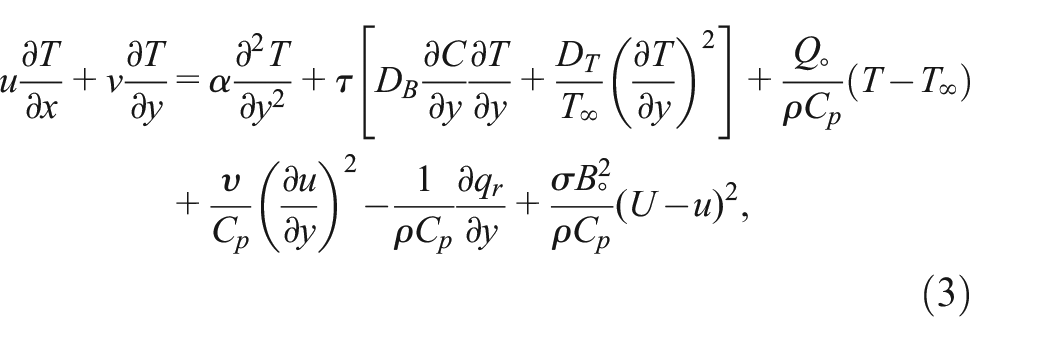

The associated boundary conditions are:


Here,

Geometrical view of flow problem.
To alter governing equations into non-dimensional form we establish the following suitable transformation:

Using equation (6) in equations (2)–(4) with boundary conditions equation (5), we have


The transformed boundary conditions are as:


where
In engineering interest, the physical interpretation of friction factor, Nusselt number, and Sherwood number are stated as:

Numerical solution
The transmuted equations (7)–(9) with the boundary conditions (10) are utilized numerically via a shooting method with the bvp4c MATLAB package. In this method, the higher-order nonlinear ODEs are altered into first-order ODEs by considered variables. The considered variables are


Along with boundary conditions


Results and discussion
The significance of the problem was empirically determined by utilizing numerical findings of the velocity, friction factor, temperature, heat transfer rate, concentration, and mass transfer rate for the pertinent crucial parameters, which were revealed via graphical and tabular representations. The contribution of numerous flow parameters, including the magnetic field

(a–e)
The magnetic field influence on the thermal distribution is exhibited in Figure 3(a). As an increase

(a–e)
The influence of the temperature difference parameter

(a–c)

(a) Contour plot for numerous values of

(a) Streamlinesfor different values of
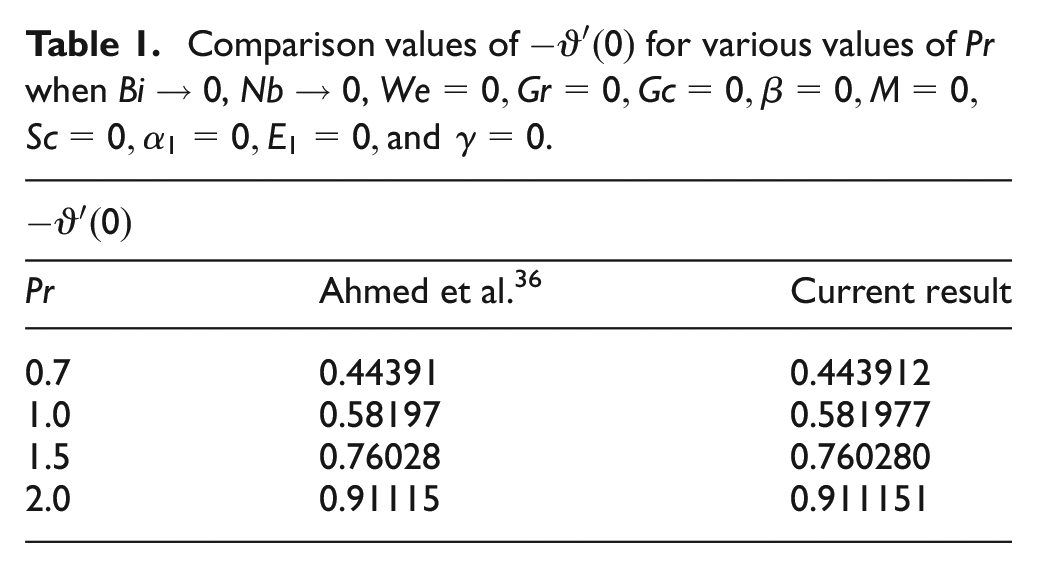
Table 1 shows a limiting case comparison of
Comparison values of
Numerical values of
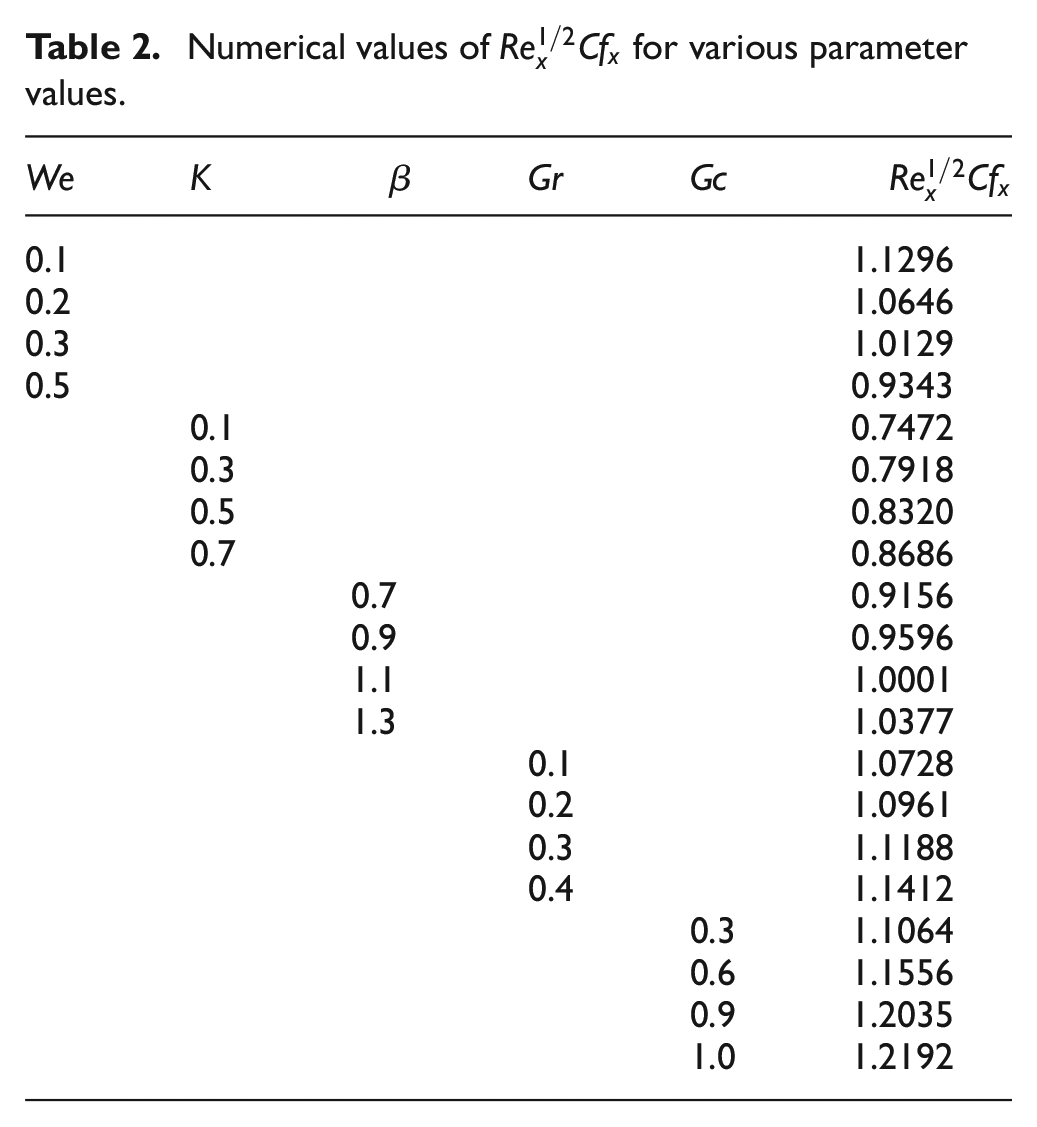
Numerical values of

Numerical values of

Conclusion
In this study we explore the magneto-Williamson nanofluid flow past a wedge in a porous medium under the influence of heat generation, activation energy, and binary chemical reaction is considered. In addition, the effects of thermal radiation and viscous dissipation are taken into account. Numerical execution of the R-K method through the bvp4c MATLAB package has enabled the parametric investigation to be accomplished. It appears that this work’s findings are promising and they may be used to improve heat transfer in large-scale technological operations. The important conclusions of this study are listed as:
The rate of heat and mass transport diminishes with enrichment in thermophoresis and Brownian motion parameters.
The Hartree pressure gradient parameter and Williamson parameter diminish the velocity field.
An increased activation energy upsurges the concentration profile whereas reverse performance is observed in the case of rising amounts of temperature ratio and chemical reaction parameters.
The friction factor is enhanced with an increment in thermal and concentration Grashof numbers.
As the enhanced thermal radiation and Eckert number boost the temperature field.
Footnotes
Appendix
Handling Editor: Chenhui Liang
Declaration of conflicting interests
The author(s) declared no potential conflicts of interest with respect to the research, authorship, and/or publication of this article.
Funding
The author(s) received no financial support for the research, authorship, and/or publication of this article.

Availability of data and materials
All data used in this manuscript have been presented within the article.