



Abstract
Motivated by novel developments in smart non-Newtonian thermal duct systems, a theoretical study has been presented in this article for electro-magneto-hydrodynamic (EMHD) buoyancy-driven flow of a fourth-grade viscoelastic fluid in a vertical duct with quadratic convection. The viscosity of the fourth-grade fluid model is assumed to be temperature-dependent, and the Reynolds exponential model is deployed. Viscous heating and Joule dissipation effects are included. The duct comprises a pair of parallel electrically insulated vertical flat plates located a finite distance apart. Via suitable scaling transformations, a nonlinear boundary value problem is derived for the momentum and heat transport. A homotopy perturbation method (HPM) solution is obtained coded in Mathematica symbolic software. There is a considerable enhancement in wall skin friction with an increment in fourth-grade fluid parameter, Brinkman number, electrical field parameter, thermal buoyancy parameter, and quadratic thermal convection parameter. However, skin friction is strongly reduced with a rise in variable viscosity parameter, Hartmann (magnetic) number, and electromagnetic heat generation to conduction ratio. Nusselt number magnitudes are elevated with increase in variable viscosity parameter, thermal buoyancy parameter, and quadratic thermal convection parameter, whereas they are significantly suppressed with increment in fourth-grade fluid parameter, Brinkman number, and Hartmann magnetic number.
Keywords
Introduction
Magnetohydrodynamics (MHD) has emerged as a major discipline in 21st century engineering sciences, tracing its roots to astrophysics. 1 It involves the interaction between magnetic fields and either viscous or inviscid electrically conducting fluids. In modern energy systems a major application is the heat transfer and flow control in nuclear ducts and other energy systems (solar) where excessive temperatures can arise. MHD ducts flows feature in lithium blankets, 2 turbulence suppression, 3 magnetic sensors, 4 ferromagnetic solar absorber collectors, 5 liquid metal flow couplers, 6 coolant deployment in sodium fast reactors (SFRs), 7 and pressure drop regulation. 8 In mathematical models of MHD duct flows frequently dimensionless parameters arise which include the Hartmann number (ratio of magnetic body force to viscous force), Stuart magnetic interaction number (ratio of magnetic force to inertial force), and magnetic Reynolds number (when induction effects are significant). Electrohydrodynamics (EHD) 9 is a sub-discipline of the more general continuum electromechanics and also known as electro-kinetics. It focuses on the interaction between electrical fields and electrically charged liquids. While in MHD usually transverse magnetic fields are utilized to generate a perpendicular Lorentz electromagnetic body force, in EHD the electrical field is often implemented along the axis of the conduit or duct. Many exciting applications for EHD duct flows (e.g. parallel plate geometries) have emerged in recent decades including atomizers, 10 corona-based duct flows, 11 electrode gas pump channels, 12 electrostatic precipitators, 13 dielectric barriers for electro-fluid injection, 14 EHD heat exchangers, 15 coolants for circuits, 16 thermal enhancement, 17 and bio-inspired microfluidic pumping systems. 18 As with MHD, some popular electrohydrodynamic dimensionless numbers arise in numerical and theoretical studies of EHD duct flows and these include the electrical Hartmann number and electrical Reynolds number. The many studies communicated on either MHD duct or EHD duct flows have demonstrated that generally transverse magnetic field damps flows whereas axial (longitudinal) electrical field accelerates flows. These findings instigated interest in combining both electrical and magnetic fields in the science of electro-magnetohydrodynamics (EMHD) which emerged in the late 1960s. 19 The most comprehensive treatment of the mechanics of EMHD flows was presented by Eringen and Maugin 20 who considered many types of fluids including ferromagnetic, dielectric, electro-viscous, ferroelectric, electro-strictive, electro-magneto-rheological (EMR), and hybrid magnetic ionic liquids. Subsequently many researchers have investigated the combined effects of magnetic and electrical fields (both static and alternating) in viscous duct flows. Jian and Chang 21 developed theoretical solutions for EMHD incompressible viscous flow in a horizontal a slit microchannel duct under a lateral uniform electrical field and a spatially non-uniform vertical magnetic field. They deployed the variation of parameter method (VPM), Gaussian quadrature and Chebyshev spectral collocation techniques, and obtained good correlation with experiments. They found that axial flow deceleration is induced with increasing magnetic field decay factor whereas strong acceleration is generated with larger electrical field strength parameter. Chakraborty and Paul 22 computed the EMHD transport in a microchannel, showing that at relatively weak magnetic field intensities, significant enhancement in volumetric flow rate is produced. They also noted that excessive electrical field can ramp up the Joule heating and induce wall degradation. Umavathi and Bég 23 investigated the thermo-solutal EMHD nanofluid convection in a vertical duct for nuclear cooling applications. They showed that the polarity of the electric circuit strongly modifies the velocity distribution and interaction with magnetic field. For negative electrical field, the flow is directed downwards whereas for positive electrical field it is upwards. For the case of a short circuit (vanishing electrical field), a linear velocity distribution is computed. They also found that skin friction is depleted at the left duct wall with increasing Hartmann number and nanoparticle solid volume fraction but enhanced with those these parameters at the right wall. They also examined the relative performance of copper, titanium oxide, and silver nanoparticles and noted that silver nanoparticles generate the highest Nusselt number, whereas titanium oxide nanoparticles produce the lowest. Nusselt numbers were also shown to be suppressed with electrical field but enhanced with magnetic field.
The above studies ignored non-Newtonian effects. However, many studies have identified that in for example nuclear slurry duct flows and solar direct absorber tubes, the presence of particles suspended may lead to rheological behavior. This has further motivated researchers to explore the use of different non-Newtonian formulations to better characterize the nonlinear shear-stress-strain behavior of such fluids. Soundalgekar and Aranake 24 used the Stokeian polar (couple stress) rheological model to study heat transfer in vertical duct flows. Muzychka and Edge 25 developed an elegant model for power-law liquids based on the Rabinowitsch-Mooney formulation and computed volumetric flow rates in a variety of ducts including circular and elliptic tubes, parallel channels, rectangular ducts, isosceles triangular ducts, circular annular, and polygonal ducts. Other relevant studies include Chaudhuri et al. 26 (on forced convection heat transfer in third-grade viscoelastic fluids in ducts) and Rajagopal and Na 27 (third grade fluids with thermal buoyancy effects in ducts). All these studies confirmed the significant deviation in heat and momentum characteristics due to non-Newtonian behavior. A more sophisticated viscoelastic model of the differential type is the fourth-grade model. This is superior to the second grade and third grade Reiner-Rivlin models. In addition to predicting normal stress differences, the fourth-grade model can also accommodate the shear thinning or thickening characteristics of actual industrial slurries since it does not assume shear viscosity to be a constant). Several investigations have implemented this model in thermal duct flows. Kazemi et al. 28 studied the hydromagnetic flow of a fourth-grade viscoelastic fluid in a duct with forced convection. They showed that there is a decrement in average velocity and the bulk temperature inside the duct with an increase in non-Newtonian parameter. Fatima et al. 29 presented perturbation solutions for two-phase ionic fourth-grade flow in a convergent/divergent duct containing spherically homogeneous metallic particles under an axial electrical field. Nadeem and Ali 30 conducted a second law thermodynamic analysis of fourth-grade viscoelastic flow with heat transfer in a vertical pipe using a homotopy method. Further investigations include Sajid et al. 31 , Salawu et al. 32 (on thermal stability of magnetized fourth-grade fluids), and Khan et al. (on bio-inspired pumping of chemically reacting fourth-grade fluids with species diffusion). These studies generally showed that with increasing viscoelastic material parameter associated with the fourth-grade model, deceleration is induced in the flow.
In nuclear and other energy duct applications, complex thermophysical phenomena arise. These include thermal dispersion, stratification, radiative heat transfer, and convective heating at the boundaries. Another interesting characteristic is quadratic convection (nonlinear convection or non-Boussinesq convection) which is associated with nonlinear density temperature differences in the buoyancy force term in natural convection. This generalizes the conventional Boussinesq approximation and provides more sophistication in thermal modeling of such systems. Temperature gradients can be significantly modified with quadratic effects and therefore considering the nonlinear variation of density with temperature is preferable to the simpler approach of a linear variation of density with temperature. A number of articles have addressed quadratic convection in multi-physical flows. Kunnegowda et al. 33 used homotopy perturbation method to compute the MHD viscoplastic micro-duct transport with an exponential space dependent heat source and quadratic convection effects. Triveni and Mahanthesh 34 simulated the nanofluid flow in an annular duct with quadratic convection and quadratic thermal radiation. Kumar and Sood 35 studied the non-Boussinesq mixed convection stagnation point flow on a contracting surface to a porous medium permeated with a magnetic field. They showed that increasing quadratic convection parameter strongly modifies the transport and both accelerates the boundary layer and encourages thermal diffusion. Okoya et al. 36 computed the natural convection flow from a moving wall with variable thermal conductivity and quadratic non-Boussinesq effects. Al-Kouz et al. 37 evaluated quadratic convection and thermal radiation influences on second order viscoelastic boundary layer flow with a bvp5c finite difference algorithm in MATLAB. They showed that flow is accelerated with stronger quadratic convection and a cooling effect is induced. Further studies include Sabu et al. 38 (on inclined plate MHD nanofluids), Bhatti et al. 39 (on viscolastic Maxwell radiative-convection flow from a stretching wall with thermal relaxation effects), and Mahanthesh et al. 40 (on dusty nanofluid convection from a vertical wall).
In the present work we theoretically study the fourth-grade EMHD natural convection flow in a vertical parallel plate duct with temperature-dependent viscosity and quadratic convection. Previous studies have considered alternative simpler rheological models including the Williamson model, 41 Phan-Thien-Tanner (PPT) model, 42 couple stress model, 43 and second order Reiner-Rivlin model.44,45 Furthermore, we incorporate the effects of viscous dissipation and Joule heating (Ohmic dissipation)46,47 and the Reynolds exponential temperature-dependent viscosity model48–52 all of which can exert marked modifications in nuclear duct electro-magneto-hydrodynamic flows. The novelty of the present work is therefore the collective consideration of fourth-grade viscoelasticity, viscous heating, exponential viscosity, and Joule dissipation, which have not been considered hitherto anywhere in the scientific literature, despite immediate applications in nuclear duct electromagnetic flow control. Fourth-grade fluids are materials with exceptional flow characteristics that fall between regular liquids and solids. These materials exhibit a complicated rheological behavior known as non-Newtonian flow, in which the viscosity (resistance to flow) varies with shear rate, temperature, and pressure. Fourth-grade fluid flow has applications in numerous scientific disciplines, including physics, chemistry, engineering, and material science. Understanding fourth-grade fluid is essential for comprehending the behavior of complex fluids such as emulsions, foams, and suspensions. Scientists can design sophisticated materials with the desired properties for a variety of applications, including drug delivery systems, cosmetics, and paint formulations, by studying the flow properties of these substances. Viscoelastic fourth-grade rheology is also applicable to geology and the study of geological formations. It explains phenomena such as lava flow, mudslides, and glacier movement. By comprehending non-Newtonian dynamics, scientists can predict and manage such natural occurrences more precisely. Fourth-grade fluid flow is crucial in a variety of other industries, including food processing, polymer manufacturing, and hydrocarbon extraction. Understanding the flow behavior of non-Newtonian substances is crucial for optimizing manufacturing processes, regulating product quality, and increasing productivity. In particular the modern thrust in electromagnetic smart polymer-based conducting materials in high-risk industries including nuclear reactor technology has mobilized great interest in electro-magneto-fluid dynamics of viscoelastic fourth-grade liquids. This provides a strong justification for the current study. The normalized nonlinear ordinary differential conservation equations and boundary conditions are solved with a homotopy perturbation technique. Detailed solutions for axial velocity, temperature, skin friction, and Nusselt number are presented graphically and in tables for the effects of key electromagnetic, thermal, and dissipation parameters. Detailed interpretation is included. The simulations as noted earlier are pertinent to providing a deeper understanding of laminar transport phenomena in nuclear and solar ducts deploying advanced functional rheological working liquids.
Mathematical model for EMHD non-Newtonian quadratic dissipative duct flow
The regime under investigation is visualized in Figure 1. An electromagnetic fourth-grade fluid flows under natural convection between the vertical parallel electrically insulated plates which are located a finite distance 2d apart. A Cartesian coordinate system (

Physical model for EMHD fourth-grade fluid flow in a vertical parallel duct.
Under these assumptions, the mass conservation (continuity) equation takes the form:

The momentum equation using Ohm’s law is defined as:

Here the stress tensor is designated by

Here electrical conductivity is designated by
The constitutive equation for fourth-grade Reiner-Rivlin differential viscoelastic fluid is expressed following 53 as:
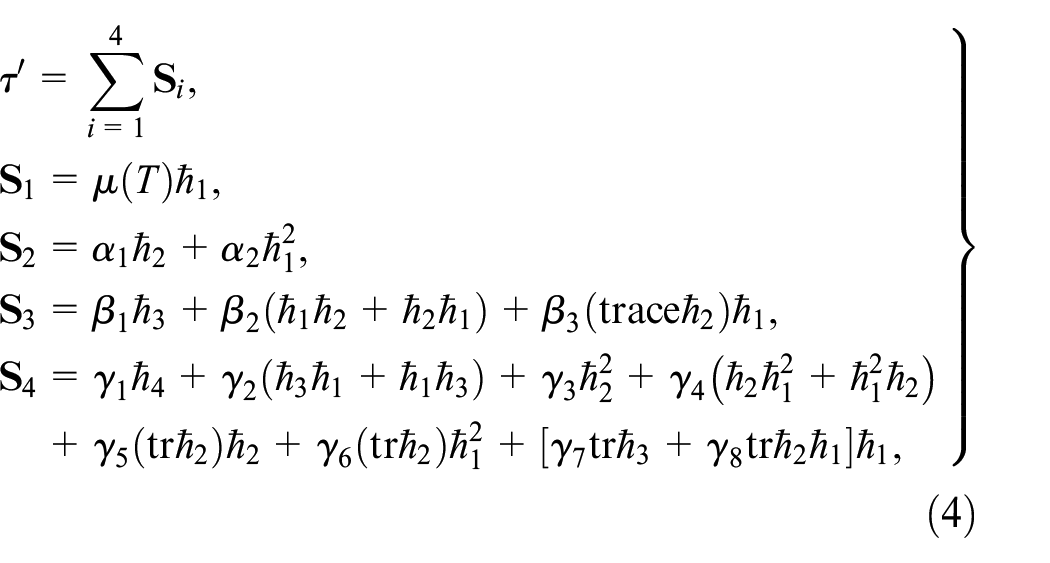
Here

The energy equation considering the effects of Joule heating and viscous dissipation is specified as:

Here thermal conductivity of the fluid is designated by
For the proposed problem, we seek the velocity field and the temperature field in the following form:

The general vector equations may be reduced to the following component form:

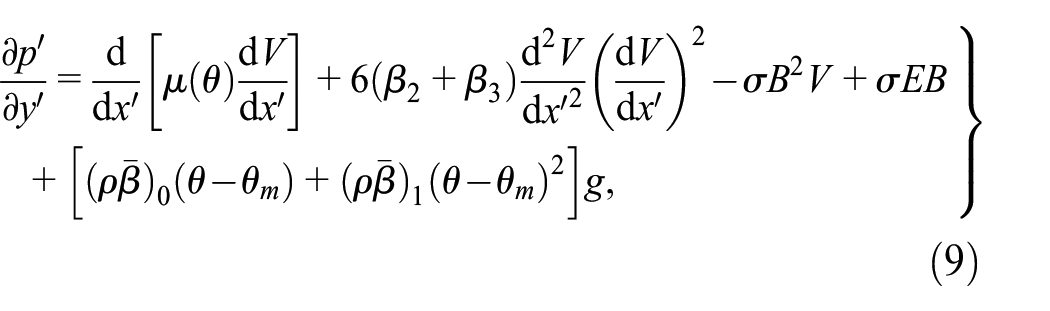

In equation (9), the viscoelastic fluid viscosity depends on temperature and the Reynolds exponential model is used which is defined as:

Here
The modified pressure is stated as follows:

In view of equation (12), equations (8–10) can be reduced to the following form as:

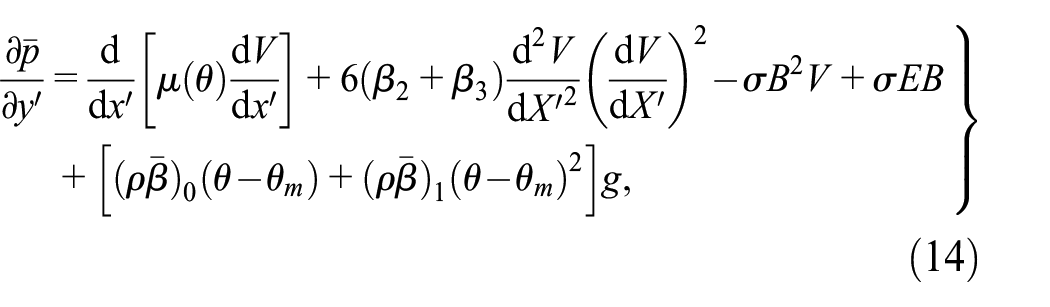

The preceding equation indicates that the pressure gradient

The following are the velocity boundary conditions at the duct walls:

The energy equation including viscous dissipation and Joule heating is defined as:
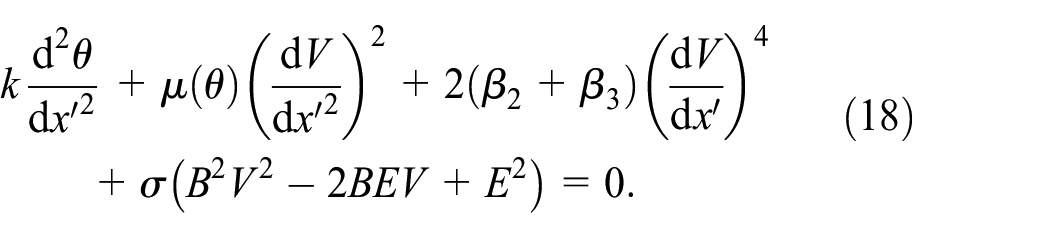
The relevant thermal boundary conditions prescribed at the duct walls are as follows:

The next step is to transform the above equations into dimensionless form using the scaling variables listed below:

Here


The boundary conditions (17) and (19) now assume the dimensionless form:

And
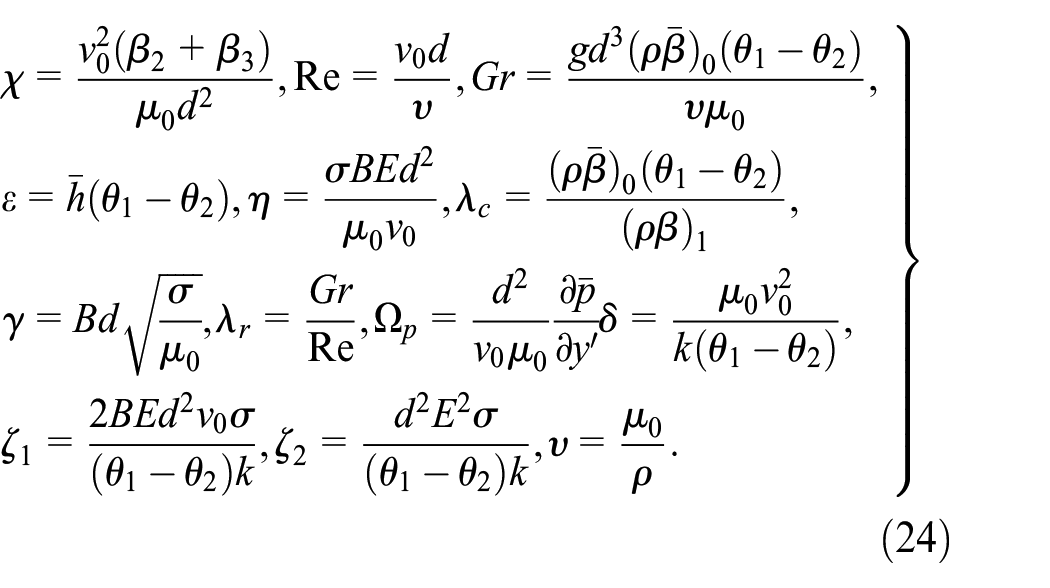
Here
On the left plate

Perturbation solutions using HPM
The transformed ordinary differential equations for momentum and energy, that is, equations (21) and (22) are nonlinear and coupled, rendering exact solutions intractable. As a result, we utilize the homotopy perturbation method (HPM) for determining series solutions. This method was introduced as a special case of the homotopy analysis method (HAM) and is very adaptive and yields excellent accuracy and stability for nonlinear differential equation systems. It has been utilized in a wide spectrum of complex engineering science problems, including structural vibration, 54 peristaltic pumping,55,56 and more recently, electromagnetic duct flows containing porous media. 44 The perturbation formulation for the present problem is as follows:
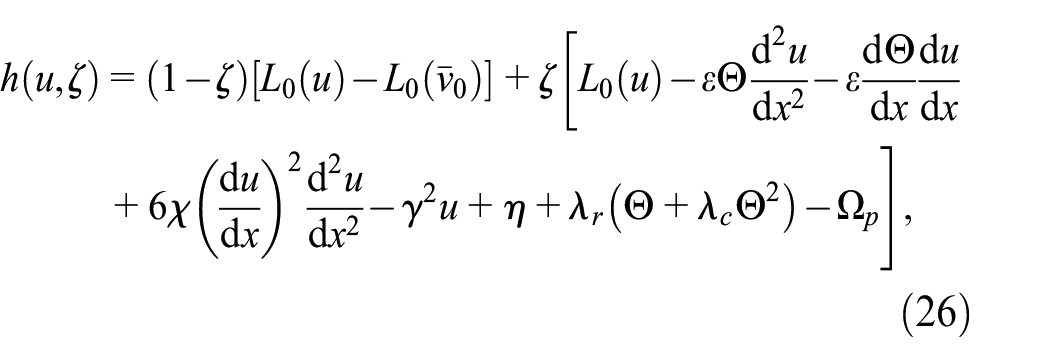

Where

Let us now propose the series expansions for equations (26) and (27), that is,

By inserting equation (29) into equations (26) and (27), we acquire a set of linear differential equations at every level. After the accomplishment of this stage, we will utilize the symbolic software Mathematica to determine the linear differential equation solutions for each order.
Zeroth other system
and solutions
By substituting equation (29) into equations (26) and (27), we get the zeroth order system as follows:


The zeroth order solution is found to be:

First order system
and solutions
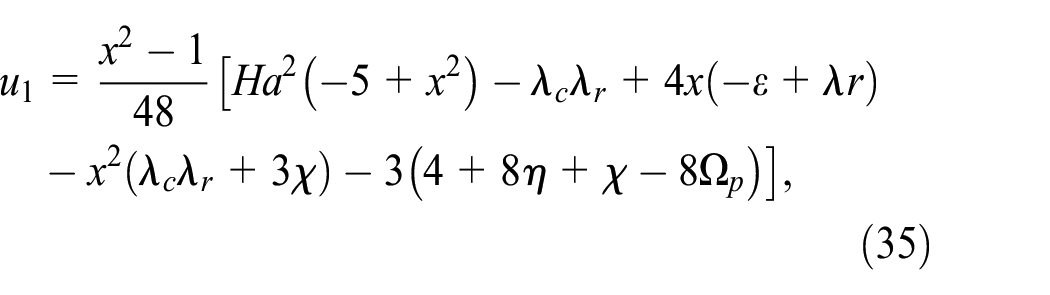
The first order system is obtained in the following form:


The solution of the first order system is obtained as:

Second order system
and solutions
The second order system is obtained as:
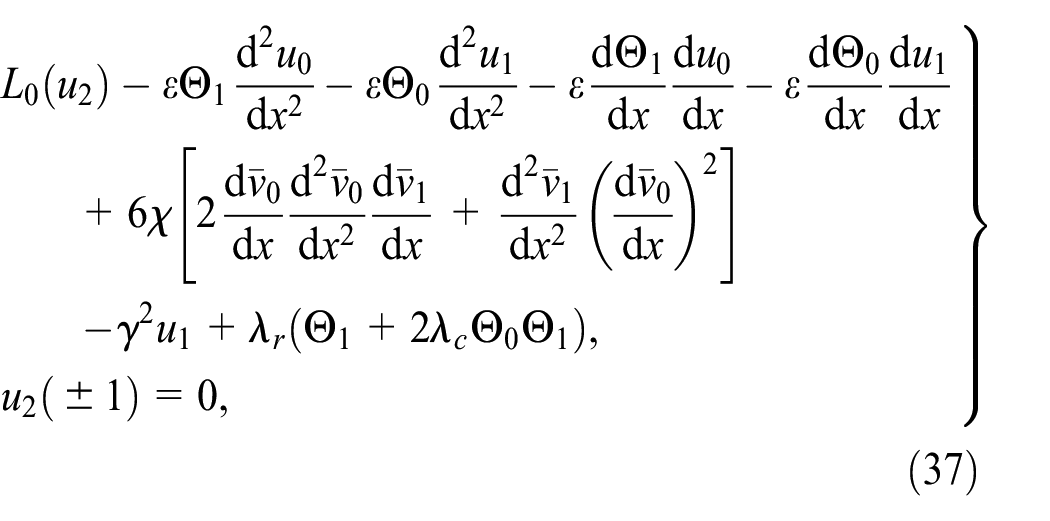
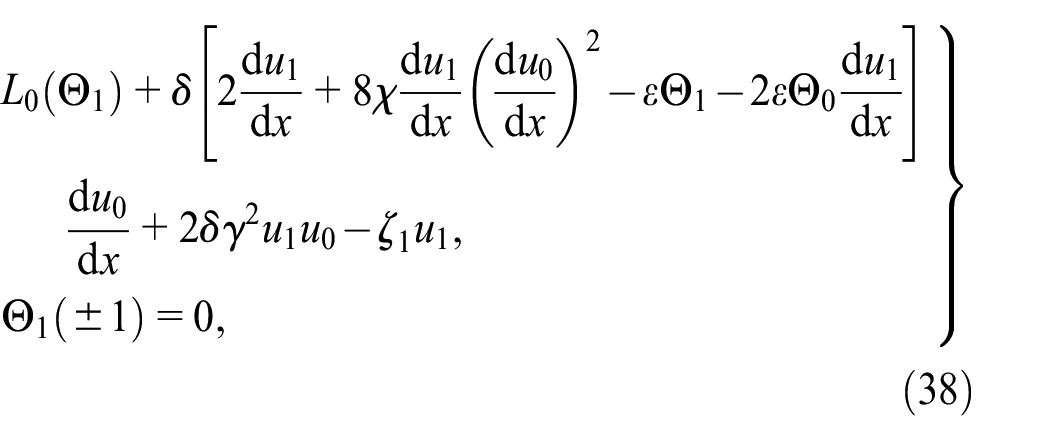
The solution of the second order system is obtained as:

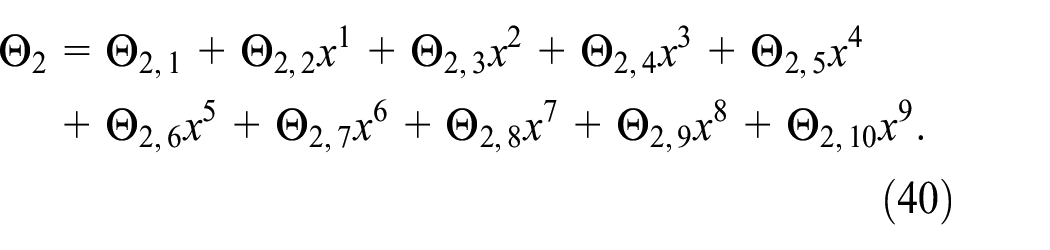
The constants


Results and discussion
In this section, we present detailed graphical and tabular solutions for velocity, temperature, skin friction, and the Nusselt number in the duct, for the influence of all key control parameters. All computations are executed in Mathematica and shown in Table 1 and Figures 2 to 15. As one particular case of our investigation, Table 2 displays the numerical comparison with previously published data. It is noticed that the current findings are precisely consistent with Abbasi et al. 57 .
Comparison of the velocity profile with previously published results by fixing the remaining parameters as


Coefficient of skin friction for multiple values of variable viscosity parameter

Nusselt number for multiple values of variable viscosity parameter

Influence of fourth-grade material parameter

Influence of electric field strength parameter

Influence of variable viscosity parameter

Influence of thermal buoyancy (natural) convection parameter
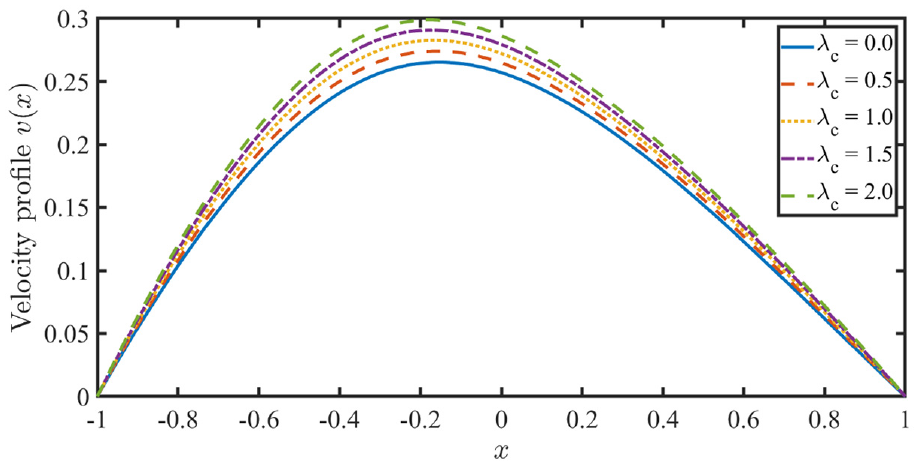
Effect of quadratic thermal convection parameter

Influence of Hartmann (magnetic) number
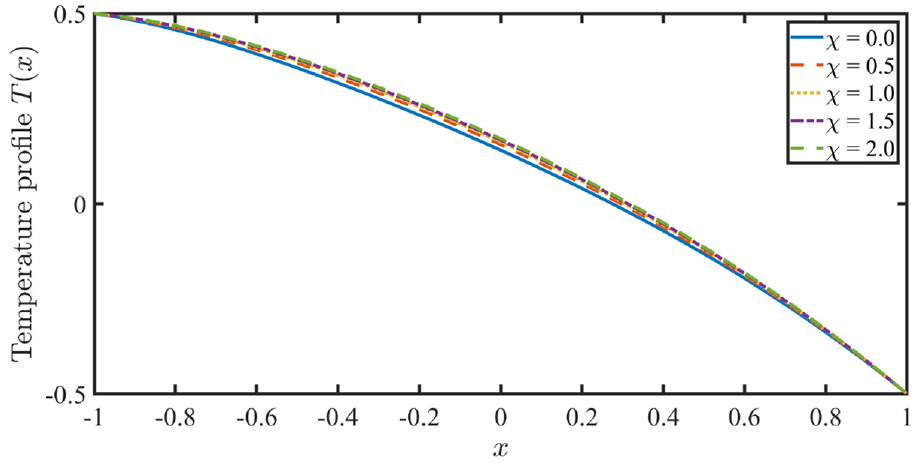
Effect of fourth-grade material fluid parameter

Influence of Brinkman number

Influence of electromagnetic heat generation to conduction ratio
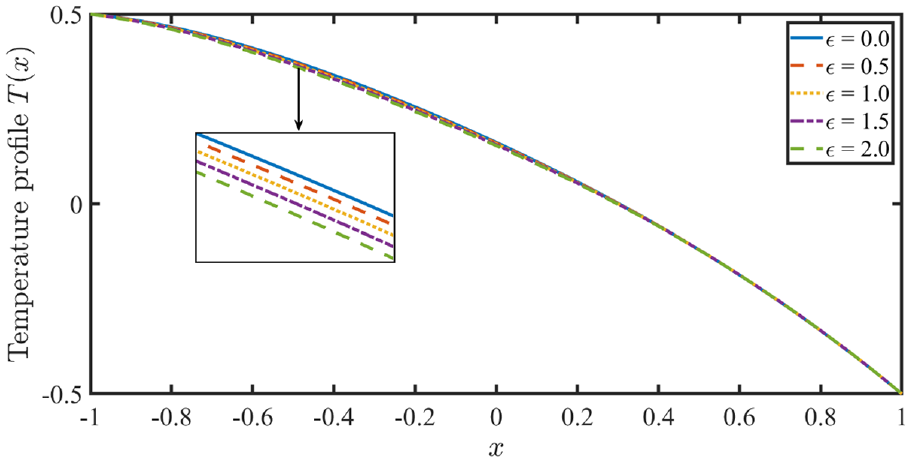
Influence of variable viscosity parameter

Effect of thermal buoyancy parameter

Effect of quadratic thermal convection parameter
HPM results for the effects of key parameters on skin friction and Nusselt number.

Skin friction and Nusselt number
Table 2 shows skin friction coefficient and Nusselt number for all the emerging parameters.
A significant enhancement in skin friction accompanies an elevation in fourth-grade fluid parameter
The results In Table 2 are further visualized in Figures 2 and 3. Figure 2 shows the variation in the skin friction profile. It is noticed here that increment in the variable viscosity parameter
Figure 3 shows that Nusselt number is elevated with variable viscosity parameter but is suppressed with fourth-grade material parameter. A significant decrement in Nusselt number is also associated with greater Brinkman number since temperatures are elevated in the boundary layer and the net effect is to draw heat away from the wall, leading to a cooling there. A thinner thermal boundary layer thickness will result with higher Brinkman numbers associated with stronger viscous dissipation. Hartmann number elevation also induces a strong downturn in Nusselt number since the electromagnetic fluid is heated with higher magnetic field. Increasing the magnetic field in the fluid flow amplifies Lorentz force that dominates over the viscous force. This results in a net transfer of heat away from the wall into the core region of the duct and decreases Nusselt number. A similar though less prominent increment in Nusselt number accompanies an increase in thermal buoyancy and quadratic convection parameters. Again, the initial increase in Nusselt number is computed with a rise in electrical field strength parameter but subsequent increase in this parameter produces the opposite trend which is associated with the presence of Joule dissipation in the flow.
Velocity distribution
Figures 4 to 9 show the impact of all key parameters on velocity profiles. The velocity profile in Figure 4 exhibits a strong depletion with larger values of the fourth-grade fluid parameter. In practical terms, an increase in
Temperature distribution
Figures 10 to 15 depict the evolution of the temperature profiles with key parameters. Figure 10 demonstrates that the temperature is boosted with elevation in fourth-grade fluid
Concluding remarks
A new theoretical study has been presented for fourth-grade viscoelastic EMHD natural convection flow in a vertical parallel plate duct with non-Boussinesq quadratic convection. The effects of viscous dissipation and Joule heating (Ohmic dissipation) and Reynolds exponential temperature-dependent viscosity model have been included, all of which arise in nuclear and solar hybrid duct transport phenomena. The normalized nonlinear ordinary differential boundary value problem has been solved with a homotopy perturbation method (HPM) up to second order approximation which achieves exceptional accuracy and stability in terms of power series solutions. Detailed solutions for axial velocity, temperature, skin friction, and Nusselt number have been depicted graphically and in tables for the effects of key electromagnetic, thermal, and dissipation parameters. The key findings of the current analysis may be summarized as follows:
(i) There is a considerable enhancement in wall skin friction with an increment in fourth-grade fluid parameter
(ii) Nusselt number magnitudes are elevated with increase in variable viscosity parameter
(iii) A variable response in Nusselt number is computed for increment in electric field parameter
(iv) Increasing fourth-grade viscoelastic parameter
(v) A minor increase in temperature is induced with greater viscoelastic parameter
(vi) A marked boost in temperature is generated with increasing Brinkman number
(vii) Increasing electrical strength parameter
(viii) In the left half space of the duct an increase in variable viscosity parameter
(ix) Consistent acceleration, that is, higher velocities are associated with an increment in thermal buoyancy parameter
(x) A weaker but distinct increase in axial velocity is also observed with higher values of quadratic thermal convection parameter
(xi) The greatest elevation in skin friction number is produced with high electrical field strength parameter whereas the largest Nusselt number at the wall corresponds to low Brinkman number.
The current study has probed deeper into emerging smart electromagnetic liquids for nuclear and other energy systems duct transport phenomena. Attention has, however, been confined to steady state flows. Future work may consider time-dependent effects and additionally the use of other non-Newtonian microstructural models such as the polar and micropolar family of formulations. Furthermore, alternating electrical and magnetic fields may also be addressed to reflect further industrial scenarios.
Footnotes
Appendix
Handling Editor: Chenhui Liang
Author’s Note
Hakan F Öztop is also affiliated to Department of Mechanical and Nuclear Engineering, College of Engineering, University of Sharjah, United Arab Emirates.
Declaration of conflicting interests
The author(s) declared no potential conflicts of interest with respect to the research, authorship, and/or publication of this article.
Funding
The author(s) disclosed receipt of the following financial support for the research, authorship, and/or publication of this article: Lijun Zhang and Muhammad Mubashir Bhatti are supported by the National Natural Science Foundation of China No. 12172199.
