




Abstract
This letter presents a time-frequency estimation approach based on memory-dependent derivative to obtain accurate spectrograph interpolation information. The memory correlation derivative is the convolution of a time-varying signal with a dynamic weighting function over a past time period with respect to a common derivative. Considering the described method, discrete data from previous times can be derived to estimate the signal values at the current time and to reduce the effect of noise. Fourier transforms with different scales and delay transforms are used as kernel functions to obtain energy-concentrated time-frequency curves with higher resolution and without frequency leakage. Besides, the memory-dependent derivative with adjustable scale factor is used to overcome time-frequency grid mismatches. Furthermore, differing from the phase accumulation manner of conventional time-frequency estimation, ℓ1-norm suppresses the heavy-tailed effect from outliers, thus the robustness of estimator can be enhanced greatly. By suitably choices of scale factor, the estimator can be tuned to exhibit high resolution in targeted regions of the time-frequency spectrum.
Introduction
Extracting the time-frequency trajectory of a non-linear frequency modulated signal from small samples with noise is a foundational problem in statistical signal processing. One challenging task is that the resolution of time-frequency cell is constrained by the time bandwidth product. 1 This indicates that the linear time-frequency analysis (TFA) cannot achieve an arbitrarily high time-frequency resolution at the same time. The other task is that TFA method designed for Gaussian noise performs poorly in the presence of outliers. The noise with heavy-tailed distribution, like impulsive noise,2,3 will make the correlation function severely deviated from the theoretical value. 4 Therefore, the motivation of this letter is that time-frequency estimator designed for large samples and Gaussian noise perform poorly in the presence of outliers in a small sample.
To improve the performance of TFA methods, many endeavors have been made in the past many years, and plenty of effective methods are proposed. Generally, these methods can be divided into two strategies: time-frequency reassignment and parameterized TFA.5–7 Time-frequency reassignment method, for example, synchrosqueezing transform (SST), belongs to a post-processing technology, and it can improve the readability of time-frequency representation obviously. 8 If the modulated frequency of a signal can be known in advance, the reassignment operator aims to sharpen the time-frequency representation by assigning the average of energy in a domain to the gravity center of these energy contributions. The parameterized TFA method, for example, general parameterized TFA (GPTFA), 9 is inspired by the fact that different analyzed window can achieve the different time-frequency resolution. The parameterized model needs to be estimated from conventional TFA, so it is needed the initialized TFA with a fair energy concentration.10–17
Although these advanced TFA technologies can provide more precise insights into the complex structure of a signal, their inherent limitations cannot be ignored, for example, the accuracy is disturbed by time-frequency cells and outliers.18–22 Minimum ℓ1-norm optimization model has found extensive applications in linear parameter estimations. The phase accumulation used by conventional method is converted to ℓ1-norm to guarantee robust frequency localization in SαS noise.23–28
Considering that impulse noise is instantaneous, the average power within a set time is adopted to reduce the effects of instantaneous impulses partially. Memory-dependent derivative with adaptive kernel function guarantees exact localization for the time-frequency trajectory, so the SαS noise can be suppressed. Furthermore, minimizing ℓ1-norm of frequency residual within sliding window eliminate noise interference, for example, impulsive noise.29–33
This paper is organized as following. In Section 2, the FM signal model is described. Section 3 discusses non-linear prediction model via memory-dependent derivative. In Section 4, time-frequency estimation with memory-dependent derivative is presented. Section 5 presents some processing results based on numerical simulations. The last section concludes this paper.
FM signal model
An analytic signal

where
The conventional linear TFA is established on the assumption of the considered signal being piece-wisely linear frequency modulation in a short time. For example, in the short time

where
In fact, the window function needs to be short enough for strongly modulated frequency signal, otherwise, the instantaneous frequency is still time-varying. However, small samples within a short windows not only leads to a poor time-frequency resolution, but also sensitive to noise at a low signal-to-noise ratio (SNR) level. Specifically, the impulsive noise whose variance or energy is infinite causes large error for the signal within short window. Thus, this letter proposes an accuracy and robust time-frequency estimation method for non-linear FM signal.
Non-linear prediction model via memory-dependent derivative
In this section, the memory-dependent derivative as a predict model of FM signal is derived from the integral of Taylor series at expansion points over an interval. Linear prediction is a mathematical operation where the current value of a linear frequency signal is estimated as a weighted function of previous samples. The most common representation is given by

where v stands for time,
Most prediction method can model linear frequency signal, but fails for FM signal. One of the simplest and effective specifications is to make
In this case, the first-order Taylor series expansion as a linear function approximates

Additionally, the second and higher order are ignored because the derivative amplifies the noise inevitably and the resulting inaccuracy worsens for higher derivatives. 10
Next, as expansion point v slides in the short time interval

Inserting equation (1) and

which indicates that
In fact,

which is an integral form of
Time-frequency estimation with memory-dependent derivative
The kernel function determines the accuracy of the prediction model for FM signal, so a memory-dependent derivative is characterized by its kernel function. A fundamental issue is to design an appropriate kernel function which improve accuracy of time-frequency estimation result.
Given a rectangular window

where

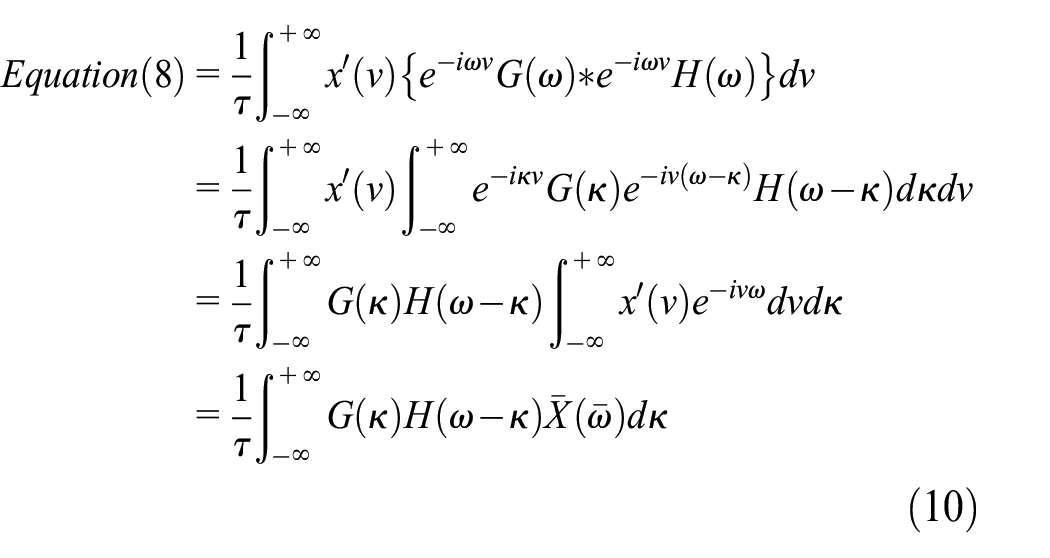
Substituting equation (9) into equation (8), it can be rewritten as
Traditionally, the TFA can discretize the continuous space to a finite number of time-frequency cells presented the time-frequency trajectory. This discretized model is simple and easy to handle analytically, but it inevitably brings the drawback that the restriction of uncertainty principle causes the energy dispersion. Especially, in the case of short window size, the conventional TF representation is not sufficient to generate a more energy concentrated results.
Utilizing the Fourier scale transformation, an kernel function with tunable grids is designed to generate the more energy-concentrated result by introducing the scale coefficient

where

Obviously, the frequency domain grid can be refined for
Inserting equation (12) into equation (10), we can obtain as follows

Then, equation (13) is given by

The energy of result in the time-frequency space divided into many small grid is well-concentrated, and it is not restricted by the Heisenberg uncertainty principle because it is based on an inner product operator with the refined kernel function.
Furthermore, because a peak at the true frequency at

As the window function

The ℓ0 or ℓ2 norm is sensitive to outlier observations. This sensitivity is the principal reason for exploring alternative norms. Procedures for the proposed method that involve the norm have been developed to increase robustness. The ℓ1 norm has been applied in numerous variations of frequency estimation. ℓ1 norm is an attractive alternative to ℓ0 norm or ℓ2 norm because it provides globally optimal solutions in polynomial time and can impart robustness in the presence of outliers and is indicated for models where standard Gaussian assumptions about the noise may not apply.34–38 Therefore, this equation (16) proposes an ℓ1 norm procedure based on the efficient calculation of the optimal solution of the ℓ1 norm best-fit hyperplane problem.
Additionally, a proper scale factor can ensure a good concentration of energy in the time-frequency presentation. Thus, the optimal scale factor

Due to both of

Optimal scaling factor
Considered an FM signal x(t) and a short and sliding rectangular window

From a statistical perspective, ℓ1-norm is robust to impulsive noise. 12 Equation (19) not only effectively mitigates the effect of artifacts caused by the noise, but also produces a time-frequency estimation for the nonlinear FM signal with an excellent concentration.
Numerical simulations
We compare the performance of the memory-dependent derivative algorithm with several classical algorithms, and they are assessed by tests on generalized sinusoidal FM (GSFM) signal. The signal is given as

The sample time is T = 1 S and the sample frequency is fs = 5000 Hz. In the simulation, symmetric

Figure 1 displays the performance of SST,
8
GPTFA
9
and the proposed algorithm at

(a) FM signal at SNR = −5 dB and
Next, Figure 2 illustrates the average relative error with the whole sample time for SST, GPTFA, and the proposed algorithm for 200 Monte-Carlo simulations. As shown in Figure 2(a),
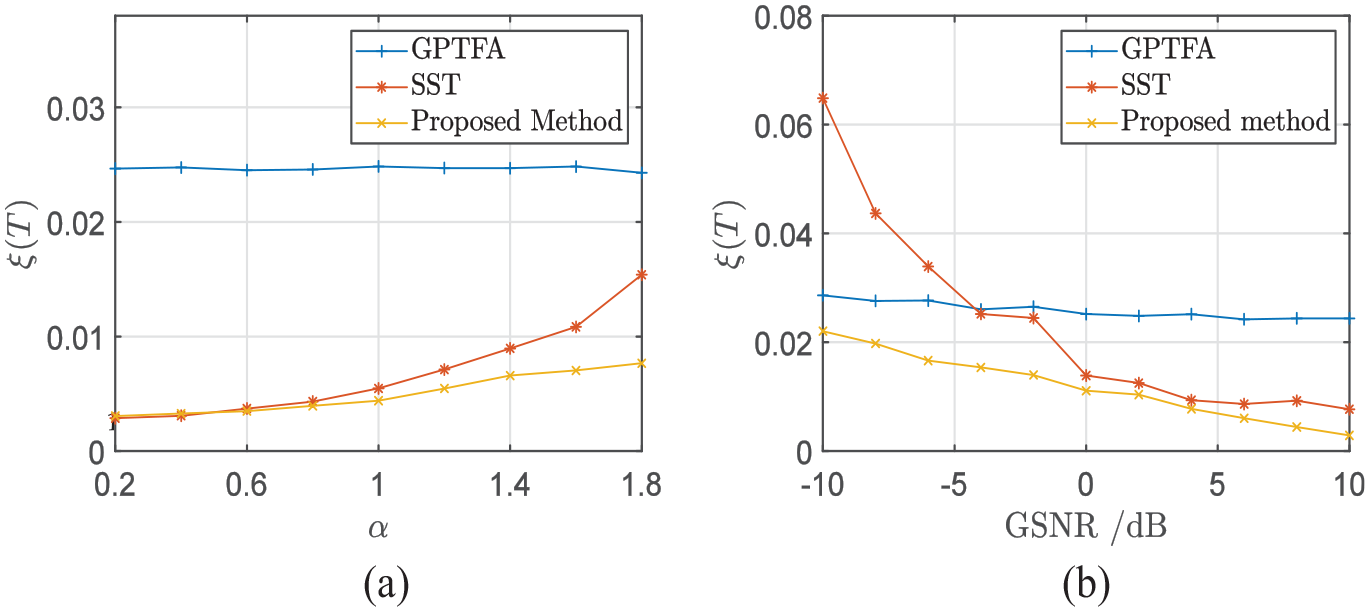
Results for the FM signal at SNR = 5 dB and
Conclusion
This letter presents the time-frequency estimation algorithm based on memory-dependent derivative for the exact and robust instantaneous frequency estimation of nonlinear FM signal. Unlike previous work in time-frequency estimation, the instantaneous frequency is not assumed to lie on a grid, but can assume any value in the frequency domain. Furthermore, the phase accumulation used by conventional method is converted to ℓ1-norm to guarantee robust frequency localization in S
Footnotes
Handling Editor: Chenhui Liang
Author contributions
Conceptualization, WS and PH; methodology, WS; software, MW; validation, JX; formal analysis, JX; investigation, WS; data curation, JX; writing – original draft preparation, PH; writing – review and editing, MW; visualization, WS; project administration, PH; funding acquisition, PH. All authors have read and agreed to the published version of the manuscript.
Declaration of conflicting interests
The author(s) declared no potential conflicts of interest with respect to the research, authorship, and/or publication of this article.
Funding
The author(s) disclosed receipt of the following financial support for the research, authorship, and/or publication of this article: This research was funded by the Natural Science Foundation of Shandong Province grant number ZR2023MD122.
