



Abstract
At present, the construction of high-speed railway in the western region has become one of the key points in China. However, the existing train control systems do not adapt to the environment. So a new type of train control system (TCS-NT) is proposed. However, for TCS-NT, the definition and content of its operating scenarios are not clear, and the construction of operating scenarios is mostly involves subjective analysis. It faces problems such as a lack of a comprehensive operating environment analysis method, a method for selecting scenario elements for varying test requirements, and inexplicable design choices. In this paper, the Operational Design Domain (ODD) and a key element extraction method for simulation scenarios are proposed to analyze the operational environment of the TCS-NT. Using this method, the impact of each scenario element on the sub-functions is sequentially analyzed in the tracking operation scenario of the TCS-NT. According to the influence on each sub-function, a mapping equation is constructed for the three-dimensional plane comprising element, structure, and function, and scenario elements are extracted using the discriminant matrix. In this paper, the method is used to analyze the operation scenario in the train tracking scene, and the feasibility of the method is verified.
Introduction
The development of high-speed railways in vast and sparsely populated areas has emerged as a pivotal focus in China’s high-speed railway advancement. Railways in these regions face the challenges of high altitudes and rugged terrain, leading to a prevalence of bridges over tunnels, lengthy inclines, and heightened susceptibility to ground-related disasters. Despite the extensive application of the existing CTCS-2/CTCS-3 systems, they involve a considerable number of ground and trackside equipment that prove challenging to maintain within the demanding environment of the western regions. Consequently, the need arises for a new train control system, tentatively referred to as TCS-NT. TCS-NT transcends the constraints of the C2/C3 system and departs from the conventional structure centered around ground equipment. It eliminates the need for track equipment along the rail, operates using a moving block system, and utilizes satellite navigation for precise train positioning. 1
Due to these novel operational demands, the validation of TCS-NT’s suitability in unique line environments has become a prominent research area. Numerous railways operating in distinctive surroundings are currently undergoing preliminary validation studies, and the formulation of their operational scenarios is still under development. Consequently, at the initial stage of research, it becomes imperative to thoroughly investigate the delineation of railway operational scenarios, classification of scenario elements, and the construction of scenarios within these exceptional environments. The evolution and application of computing technology have extended testing methodologies for automated vehicle driving systems to encompass the realm of train control systems. 2 In the realm of autonomous driving, the concept of Operational Design Domain (ODD) is articulated in “Automated Driving Systems: a Safety Vision 2.0.” It refers to the specific conditions under which a particular driving automation system or its functionalities are intended to operate. These conditions encompass a range of factors, including but not limited to the environment, geographical attributes, time of day restrictions, and specific road scenarios marked by distinct conditions. 3 Miao 4 suggested employing ODD rooted in normative space to partition the scenarios of autonomous driving systems for shared vehicles. This division separates scenarios into two categories: dynamic traffic scenarios and static traffic scenarios. Meng 5 has introduced the concept of ODD into the realm of train control systems. In this context, the operational scenarios of the Automatic Train Operation (ATO) system are delineated by ODD. The constituent elements of the ATO system’s scenarios have been categorized into several aspects, namely railway infrastructure, relevant system components, information transmission, operational environment, operation constraints, operational area, and operating environment. Geyer et al. 6 defines the notion of a scenario as encompassing the driving environment, the driving task itself, as well as the static and dynamic elements associated with it. Xu et al. 7 thought that a scenario functions as a model that intricately captures the dynamic interplay between individuals, vehicles, roads, and the environment across spatial and temporal dimensions. In this context, scenario elements are classified into distinct layers: traffic facility layer, static facility layer, temporary facility layer, dynamic layer, interaction layer, and environment layer. The German PEGASUS project classifies scenarios into three distinct categories based on the level of abstraction: functional scenario, logical scenario, and specific scenario.8–10
Regarding scenario extraction, two primary approaches are prevalent: accelerated search and data model-driven methodologies. Within the data model-driven approach, there exist three categories: data-driven, model-driven, and data-model-driven methods. Techniques for expediting scene search can be categorized into sampling-based methods and adaptive-based search methods. Within the data-driven method, Zhu et al. 11 employs extensive natural driving data for data cleansing and utilizes Bayesian learning to extract crucial scenario elements. However, this method relies heavily on a substantial volume of data. Within the model-driven method, Menzel et al. 10 introduced an automated approach for generating highway traffic scenarios grounded in ontology. This involved creating a knowledge representation model comprising five distinct levels. Within the method based on data-model determination, Zhu et al. 12 developed a two-vehicle trajectory relationship model and employed the Monte Carlo method to construct a testing scenario for the highway. In the context of the sampling-based method, Bai et al. 13 introduces an element-structure-function element extraction technique. However, when confronted with a substantial quantity of scenario elements, this approach results in excessive model complexity. Zhao et al. 14 presents an Analytic Hierarchy Process (AHP) as a means to extract the pivotal scene elements within autonomous driving systems. The extraction of these elements is conducted based on the weights assigned to each scene element derived from the Analytic Hierarchy Process. Nevertheless, the precision of the Analytic Hierarchy Process is not particularly high. Based on the adaptive search method, Ding et al. 15 proposes an adaptive sampler, and designed a multi-modal key scene generation method using the proposed sampler.
Building on the aforementioned research, it is posited that the operational scenarios of train control systems represent models that intricately depict the complex dynamic relationships between the on-board equipment, ground-equipment, and environment across spatial and temporal dimensions. However, the current description and analysis of operational scenarios in the train control system heavily rely on expert experience, lacking a relatively objective support methodology. Furthermore, there is a dearth of methods to tailor scenario elements to various testing subjects. These issues result in inconsistencies between scenario description and construction design, and also lead to the intricate conversion of test scenarios. Therefore, addressing the constituent elements of scenarios and the comprehensibility of scenario interpretations constitutes the foundational basis of scenario theory.
Aiming at the above problems, this paper proposes a key element extraction method for simulation scenarios of TCS-NT in special environment. The innovations of this paper include:
(1) By employing a decomposition method of TCS-NT, this study analyzes the impact of scenario elements on sub-functions, such as moving block, multi-source positioning, and train integrity checking, within the tracking operation scenario.
(2) Proposed a combined model of AHP and elements-structure-function to quantify the importance of each scenario element.
(3) Established an element extraction model based on the planar node discriminant matrix to achieve the discrimination and selection of key scenario elements. Finally, analyzed the composition of elements in the tracking scenario of TCS-NT for railways in special environments, verifying the effectiveness of the method.
Scenario analysis of railway in special environment
The core aspect of the study concerning the suitability validation of TCS-NT for specialized railway environments entails outlining its operational scenarios and assessing the impact of scenario elements on TCS-NT. Presently, research in the domain of train control systems in such contexts remains scarce, and the analysis of scenario element effects on the system predominantly focuses on a select few elements. Moreover, the rationale behind the selection of scenario elements often lacks explanation. In this section, the ODD is employed to define the operational scenario for the train control system within specific railway environment. Furthermore, the influence of meteorological factors, line conditions, and other scenario elements on TCS-NT is scrutinized.
Construction of ODD framework
To precisely capture and assess the operational environment of TCS-NT within a distinct environment at specific temporal and spatial instances, the study adopts ODD from the realm of autonomous driving. This approach is tailored to the unique attributes of the actual railway line environment, encompassing factors like uncertainty, complexity, and dynamic features. In contrast to prior ODD approaches within the train control domain, this method is more specific in its scope, encompassing the scene elements pertinent to TCS-NT utilization in the western plateau region, where each scene element corresponds to a distinct dimension. The ODD framework of TCS-NT is shown in Figure 1. The ODD is categorized into four dimensions: meteorological environment, static line information, dynamic line information, and scenario participants. The meteorological environment encapsulates the distinctive weather conditions encountered by TCS-NT in the western plateau, encompassing elements like lightning, strong winds, rainfall, snowfall, low temperatures, and so on.

The ODD framework of the TCS-NT.
Static line information and dynamic line information are categorized based on the dynamic attributes of scenario elements. Static line information comprises three primary aspects: line conditions, railway infrastructure, and operational areas. Line conditions are further divided from various perspectives, encompassing factors like maximum slope, minimum curvature radius, bridges, tunnels, geological settings, and other line attributes. Railway infrastructure encompasses electrical facilities, trackside installations, and station amenities. The operational area is formulated to demarcate the spatial domain where the system operates, encompassing both inter-station and intra-station segments. Within the inter-station area, further subdivisions are based on electrical facilities and phase separation, distinguishing between the mainline and sidetrack. Dynamic line information incorporates two key dimensions: information transmission and operational constraints. Information transmission elucidates the relationship and exchange of information between devices during the operation of the new train control system. It primarily comprises three facets: train-to-ground communication, train-to-train communication, and ground communication. Operational constraints define the prerequisites for the system’s normal operation and outline its boundaries, encompassing time restrictions, positional limitations, and distance constraints.
The scenario participant represents the system members that the TCS-NT relies on when it is in normal operation. It includes onboard equipment, central equipment, trackside equipment, and running trains. In the TCS-NT, the sub-functions and structure of the system members have improved accordingly, including adding train tail equipment (EOT) to the on-board equipment to realize the integrity inspection function of the on-board equipment, simplifying the trackside equipment, and adding electronic maps to the ground equipment to reduce the cost of railway construction. Add a moving block function to RBC and optimize the train tracking operation method; these changes make the system have a greater advantage than the traditional C2/C3 system. Furthermore, the new functionalities of TCS-NT are also reflected in the framework design of ODD and subsequent scenario element extraction studies.
Influence of scenarios on TCS-NT
The operational scenarios of the train control system describe the intricate dynamic relationship between the onboard equipment, ground equipment, and environment across spatial and temporal dimensions. It can delineate and simulate the effects and influences of various scene elements on the train control system. These operational scenarios encompass elements such as meteorological conditions, static line information, dynamic line information, and more. This section will analyze the impact of scenario elements on the train control system.
Influence of meteorological factors
The primary meteorological elements in the special environment of the railway encompass lightning, strong winds, rainfall, low visibility, and glaze. These meteorological elements significantly impact the TCS-NT. Among them, lightning on the Sichuan-Tibet Railway is particularly prevalent during the summer and autumn seasons, 16 which mainly affects the power system of high-speed railway, resulting in power failure and abnormal operation of trains. The average annual gale in Tibet is 25 times per station. 17 The gale may cause the failure of the train power system and signal system, and may also cause the train to capsize, which is one of the meteorological disasters that have the greatest impact on the high-speed railway. Heavy rainfall is another significant weather hazard that profoundly affects the regular railway operations. In Tibet, the annual precipitation ranges from 450 to 1127 mm, and it exhibits an uneven distribution pattern. 18 In general, heavy rainfall can easily cause floods to destroy the track. The snowfall can easily lead to snow on the rail area, which will cause short circuit and cause system power supply and signal system failure. Theoretically, the low visibility caused by fog, haze, snowfall and rainfall will not affect the signal system, and high-speed railways can generally achieve blind driving. Glaze is one of the important weather phenomena that lead to freezing disasters. It will lead to the reduction of rail surface friction, the fracture of power lines and communication lines, the collapse of inverted rods, etc., affecting train operation. Fortunately, Guizhou and Sichuan are less likely to be affected by freezing rain disasters. 19 The influence degree of each meteorological element on the TCS-NT is shown in Table 1.
Meteorological influence factors of TCS-NT.

Influence of line environment
The Western Plateau Railway passes through the Sichuan Basin, the Transverse Mountain Range, and other terrains characterized by towering mountains and deep valleys, with steep and rapidly rising terrain featuring continuous long slopes, forming a distinct longitudinal slope topography. In such a unique operational environment of the western plateau, the effects of the railway’s environmental factors on the proper functioning of the TCS-NT are considerable. The characteristics of the line environment in special environmental areas are shown in Table 2.
Overview of railway line environment in special environment.

The line environment mainly describes static line information. In the western plateau railway mainly refers to the altitude, temperature, bridge-tunnel ratio, long ramp, curve radius and other factors.
The highest altitude of the western plateau railway is 4475 m, and the lowest temperature is −30.6°C. When the train runs in such a harsh line environment, compared with the plain area, the influence of altitude change on the basic resistance of the train is about 70%, and the influence of temperature change on the basic resistance is about 17%. 20 The total length of the western plateau railway tunnel is 841 km, accounting for 82.6%, and the tunnel’s altitude above 4000 m accounts for 21%. 21 Ling et al. 22 thinks that when the train runs in the tunnel under high altitude and low temperature conditions, compared with the plain area, the change of altitude will lead to 30% of the basic resistance in the tunnel, and the temperature change will lead to 10% of the basic resistance. The minimum surface radius of the Sichuan-Tibet Railway is about 2800–3500 m. 23 The minimum surface radius is the minimum radius of the circular curve that the train can safely pass through, which will directly affect the running speed of the train. The smaller the minimum surface radius, the lower the speed of the train running, otherwise there will be a rollover risk at any time. The maximum gradient is the maximum design gradient specified on a line or a section of the railway profile design. The tight slope section of the Sichuan-Tibet Railway is more than 300 km long, and the longest slope section even extends 79 km. 24 When the train runs on this kind of long ramp, the power supply problem will occur on the uphill ramp, and the downhill ramp will lead to the lengthening of the tracking interval due to the lengthening of the braking distance, thus affecting the capacity of the section train. Ren 25 believed that the speed limit should not exceed 65 km/h during the downhill period of passenger trains when running on long ramps.
Scenario elements extraction model
The length of the railway often leads to the infinite possibility of the scenario encountered by the train during operation. Applying the TCS-NT to the railway in the special environment, the scenario elements required to verify the sub-functions of different systems are also different. It is generally solved by writing test cases covering scenario elements through expert experience. However, all the test cases are written by expert experience, without explaining the interpretability of the scenario and the rationality of the design. In order to solve these problems, this paper proposes an extraction model of key scenario elements of train control system based on AHP and factor-structure-function analysis model.
Model of AHP
TCS-NT faces the interference of various types of scenario elements. Typical scenario modeling is to model the operating environment in a limited dimension. However, due to the inexhaustibility of the environment and the limited computer simulation, how to extract effective scenario elements is a problem to be solved. The extraction process of scenario elements is the process of analyzing the influence of scenario elements on the TCS-NT.
due to the variety of scenario elements of the TCS-NT, if the preliminary screening is not carried out, it will inevitably lead to the complexity of the extraction of the scenario elements of the element-structure-function model used later. Therefore, the AHP and fuzzy matrix method are used to preliminarily screen the scenario elements.
AHP is a qualitative and quantitative decision analysis method. 26 In this paper, the hierarchical model of scenario elements is established by taking the tracking operation scenario of the TCS-NT in special environment area as an example, and the composition structure of key elements is determined on this basis. As shown in Figure 2, the scenario is mainly composed of meteorological elements, static information, dynamic information, and scenario participants. Each type of element can continue to divide sub-elements downward, and elements that cannot be further divided downward become meta-elements. The extraction of scenario elements can be extracted using the scenario element extraction model in meta-elements.
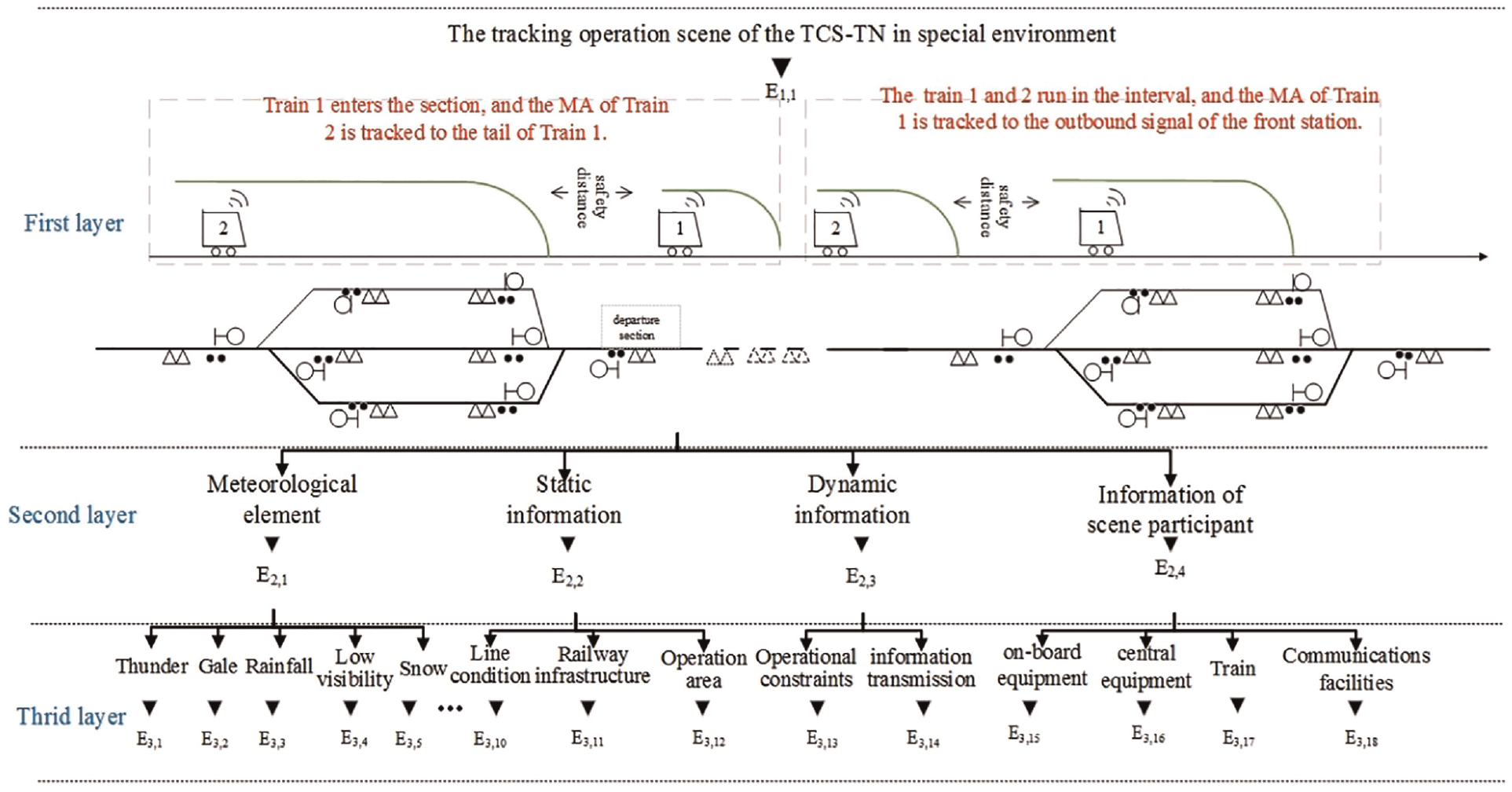
Hierarchical model of elements of tracking operation scenario for TCS-NT.
The subordinate relationship of scenario elements in the hierarchical model is described as:

Where
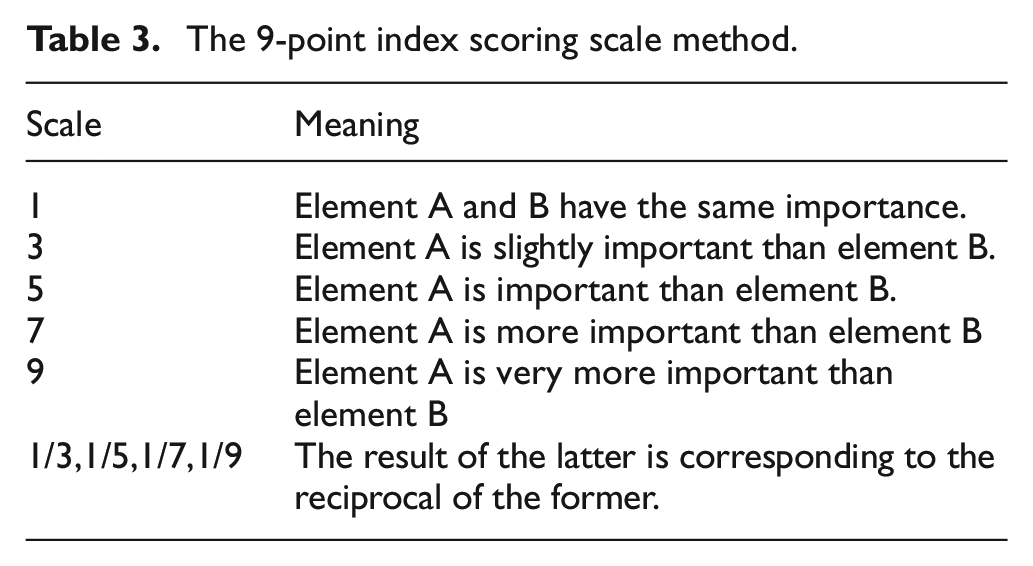
At the same time, in order to describe the degree of influence of scenario elements on the TCS-NT, the judgment matrix

Where
The 9-point index scoring scale method is shown in Table 3.
The 9-point index scoring scale method.
After obtaining the judgment matrix of equation (2), the weight coefficient is calculated by using the judgment matrix, as shown in equation (3):
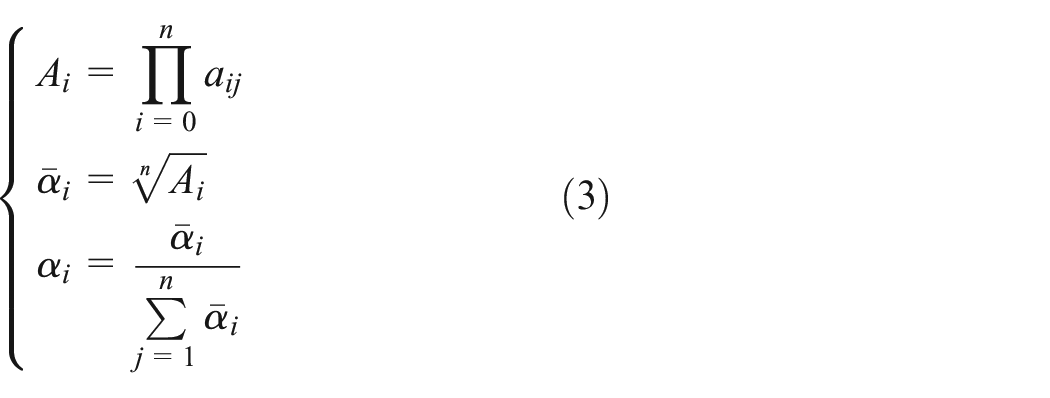
Where the vector composed of
The second-level weight coefficient and the third-level weight coefficient can be obtained by the same method. The weight coefficient can be used to express the relative importance between the elements at the same level. When the weight coefficient is greater than a certain value, it is considered that the scenario elements may have a deep impact on the TCS-NT.
In order to verify the validity of the results, it is necessary to introduce the Consistency Ratio (CR) to test the consistency of the results.
The calculation formula of the

Where

Where
In general, when
Factor-structure-function model
Due to the low screening accuracy of AHP, after using the AHP to preliminarily screen some scenario elements, the element-structure-function model is used to accurately screen the scenario elements.
Firstly, the TCS-NT is divided into two parts: structure and function. The extraction model of environmental impact factors based on system structure and function coupling analysis is proposed, as shown in Figure 3.

The model of element-structure-function.
The element-structure-function model decomposes the structure and function of the TCS-NT, and analyzes the influence of scenario elements on the structure and sub-function respectively. After that, the scenario elements are extracted according to the model results.
Divide structure of TCS-NT
TCS-NT is composed of various structures. This paper uses the method of target tree to deconstruct the system and get the set of system structure.

Where
Divide function of TCS-NT
Similar to the structure division of the TCS-NT, the function of the system is deconstructed by the target tree method to obtain the set of system sub-functions.

Where
Factor-structure-function matrix
Since the influence of a single scenario element on the TCS-NT is mapped to different substructures and sub-functions, the influence of these scenario elements on the basic unit can be analyzed one by one. The model divides the influence degree into high, medium, low and null (corresponding to 1, 2/3, 1/3, and 0 respectively). After quantifying the relationship, the factor-structure and factor-function vectors are formed.
The model can reflect the influence of scenario elements on the corresponding substructure and sub-function respectively. When analyzing the influence of a single scenario element on the system, an element-structure-function plane (E-S-F plane) can be obtained through the above definition method, and the influence relationship between the elements is quantified to form the E-S-F matrix, which is defined as follows:

Where
In this model, the interaction between the elements is defined as 0, so as to better analyze the impact of individual elements on the system. At the same time, due to the influence of different scenario elements on the TCS-NT,
In the model, the influence of a scenario element on the TCS-NT is measured by comparing the size of the E-S-F matrix, and the matrix norm is used to measure it. The commonly used norms are 1-norm, 2-norm, and F-norm. In this paper, F-norm is used to calculate the size of E-S-F matrix, as shown in equation (9).

After obtaining the norm of the E-S-F matrix, the threshold

After completing the extraction of all scenario elements, if the system adds a new structure or sub-function, it only needs to add a new dimension to the extraction model to re-analyze.
Screening flow
The screening of each specific scenario element is based on the scenario element extraction method, as shown in Figure 4.

Scenario elements screening process.
According to Figure 1, the scenario elements are divided into weather, static line information, dynamic line information and scenario participant information.
As the system structure, the scenario participants are extracted by the target tree method in the whole extraction model. Therefore, only the other three types of scenario elements need to be preliminarily screened by using the AHP to obtain a list of scenario elements, and the scenario elements in the list are substituted into the scenario element extraction model to obtain the corresponding E-S-F matrix. The F-norm size of the E-S-F matrix is calculated by formulas (8)–(10). After that, the scenario elements are extracted. When all the elements are extracted, a list of key scenario elements is obtained, and the subsequent scenario construction is carried out based on the elements of the list.
Case study
Results of AHP
In order to simplify the parameters of the scenario extraction model and calculate the weight coefficient required by the subsequent model, the scenario elements are preliminarily screened by the analytic hierarchy process described in section 3.1 Model of AHP, and the results are shown in Table 4.
Preliminary screening results of train tracking operation scenario elements.

It can be seen from Table 1 that the importance of low visibility, glaze and other scenario elements in meteorological elements is less than 0.1, which is considered to have little impact on the TCS-NT, so it can be preliminarily excluded. Similarly, other scenario elements are screened. Finally, the initial 14 elements are screened by AHP to obtain 10 scenario elements, which facilitates the simplification of model parameters for subsequent scenario element extraction.
Results of factor-structure-function model
Due to the excessive structure of the TCS-NT, in order to avoid unnecessary model complexity, this paper uses the target tree method to determine the basic structure of TCS-NT for on-board equipment, central equipment, communication equipment and train power system four sub-structure nodes. Similarly, in the sub-function dimension, there are three dimensions: moving block, multi-source positioning and train integrity inspection. At the same time, because rainfall is a common weather phenomenon in the western plateau railway, 27 this section elaborates the specific quantitative process of scenario elements through the scenario elements of rainfall.
Influence of rainfall on system structure
In the tracking operation scenario, the influence of rainfall on the central equipment is null. The central equipment is often stored in the indoor work of the station, and there is generally no direct contact with the rainfall. The influence of rainfall on the on-board equipment is low. Rainfall can easily lead to a decrease in the adhesion coefficient of the track, resulting in an increase in the braking distance, which has a greater impact on ATP and ATO. The influence of rainfall on communication equipment is small. The communication of the new train control system adopts the method of IP-based bidirectional data transmission between train and ground, and the influence of rainfall on it is small. The influence of rainfall on the power system is moderate, which will lead to the decrease of the adhesion coefficient of the track, thus increasing the braking distance.
Influence of rainfall on system sub-functions
The influence of rainfall on the train multi-source fusion positioning function is medium. The TCS-NT integrates satellite positioning, speed sensor, physical transponder, electronic map and other information to achieve continuous and reliable positioning. However, rainfall will lead to the decrease of the adhesion coefficient of the rail, resulting in wheel slip, making the speed sensor error increase. The influence of rainfall on moving block is null. The realization of moving block depends more on the logic of computer. The influence of rainfall on train integrity inspection is null. The train integrity is judged by comparing the wind pressure at the head and tail of the train and comparing the position and speed of the head and tail. Combined with the above analysis, the rainfall-structure-function plane can be obtained, as shown in Figure 5.

Rainfall-structure-function plane.
Similarly, the element-structure-function planes of the other 10 scenario elements can be obtained, and their F-norms are calculated according to formulas (6)–(8) respectively. The results are shown in Table 5. the F-norm of the element-structure-function matrix corresponding to the scenario elements is calculated respectively. Due to the rigorousness of the train control system, the thresholds selected in this paper are all zero.
Scenario element extraction and evaluation.

Discussion
Based on the extraction results of scenario elements, the primary components of the train tracking operation scenario include factors such as line conditions, operation constraints, and information transmission. These elements hold significant importance for testing the train control system. Simultaneously, it can be deduced that elements like lightning and operation area have limited relevance to the testing of tracking operations. Moreover, the addition of certain meteorological elements to the testing scenario, such as rainfall and gale, can enhance its diversity. This enrichment will effectively contribute to the testing and differentiation of the TCS-NT’s performance in the special environment.
Conclusion
Aiming at how to verify the TCS-NT in a special environment, how to select the test scenario elements and how to design the scenario, this paper proposes a key element extraction method for the test scenario. Firstly, the AHP is used to preliminarily screen the scenario elements. Then, the function and structure of the TCS-NT are decoupled and the influence of the scenario elements on the function and structure is analyzed respectively. The plane mapping equation of scenario elements-system structure-system function is established, and the importance of each element is quantified. Finally, the method is applied to the scenario analysis of train tracking operation in a special environment, and the effectiveness of the method is verified.
Footnotes
Handling Editor: Chenhui Liang
Declaration of conflicting interests
The author(s) declared no potential conflicts of interest with respect to the research, authorship, and/or publication of this article.
Funding
The author(s) disclosed receipt of the following financial support for the research, authorship, and/or publication of this article: This work was Supported by the Fundamental Research Funds for the Central Universities [Science and technology leading talent team project 2022JBXT000], and China State Railway Group Co. Ltd. Science and Technology Research and Development Program Project [L2022X003, N2022G010].
