




Abstract
Titanium dioxide (TiO2) nanomaterial has numerous applications in the fields of cosmetics, medicines, coatings, inks, plastics, food, and textiles. Therefore, the problem of heat and mass transport on Bödewadt flow of TiO2/water nanofluid over a rotating disk subjected to wall suction is studied. The impact of chemical reaction with partial slip and temperature jump conditions are also considered. For the numerical solution to the problem, the similarity variables are added to transform the three-dimensional flow equations into a favorable set of ordinary differential equations. The impacts of shear stresses, rates of heat and mass transport, and cooling efficiency of nanofluid on the flow are investigated by employing a bvp4c routine in Matlab software. Additionally, the plots for two-dimensional streamlines are presented to visualize the impact of slip velocity and rotation. Through asymptotic analysis, it is found that the presence of similarity solutions for nanofluid over the disk can occur only if the disk is driven to a significant amount of suction. The skin friction factor grows by enhancing the nanoparticle volume fraction
Introduction
A great deal of attention has been paid in the past decade to the traditional Von Karman flow and heat transfer, for which the motion is driven by a rotating disk. Its cousin problem constitutes one of the classical problems of fluid mechanics such that the motion is superimposed owing to the fluid rotating with a uniform angular velocity at a larger distance from a stationary disk. However, although this case also possesses theoretical as well as practical importance, for example in understanding the dynamics of tornadoes and hurricanes, and rotor–stator systems in turbines, less research has been conducted to understand its physical insight. Therefore, the current work is devoted to the three-dimensional revolving flow motion and heat-induced by a stationary disk, but unlike the classical case as considered in the past studies, a disk with a uniform stretching in the radial direction is taken into account here for the first time in the literature. Bödewadt boundary layer flow occurs due to a rotating flow over a stationary disk and it represents a full analytical solution of the Navier–Stokes equations since it was first theoretically investigated by Bödewadt. 1 For the example of the conventional rotating disk problem, 2 the fluid forced outwards by the centrifugal force is replaced by a fluid stream in the axial direction. On the other hand, a reverse effect is observed for the revolving flow over a stationary disk, so that the fluid drawn to the axis of rotation is swept upwards, a phenomenon as a result of the radial pressure gradient being balanced by the centrifugal force. In the book by Schlichting 3 it was cited that “The secondary flow which accompanies rotation near a solid wall can be clearly observed in a teacup: after the rotation has been generated by vigorous stirring and again after the flow has been left to itself for a short while, the radial inward flow field near the bottom will be formed. Its existence can be inferred from the fact that tea leaves settle in a little heap near the center at the bottom.” Bödewadt flow and heat transfer over a stretching stationary disk were reported by Turkyilmazoglu. 4 Thermally developed generalized Bödewadt flow containing nanoparticles over a rotating surface with slip condition was studied by Abbas et al. 5 Mahyuddin et al. 6 discussed the Bödewadt flow and heat transfer in nanofluid over a permeable and radially stretching disk. A widespread inspection of this category of flows with its several uses can be found through7–13 and references therein.
Nanofluids are relatively new generation heat transfer fluids that exhibit much higher thermal conductivity in comparison to conventional coolants even at low particle concentrations. Due to this reason, they have importance in a number of industrial sectors including transportation, power generation, micro-manufacturing, thermal therapy for cancer treatment, chemical and metallurgical sectors, as well as heating, cooling, ventilation, and air-conditioning. To be more specific magnetic nanofluids also known as ferrofluids can serve to deliver drugs and radiation to cancer patients without destroying the health tissues which is a significant side effect of conventional cancer treatment. 14 Nanofluids are pretty useful in tackling cooling problems in thermal systems. Their high thermal conductivity can also be utilized in engine oils, automatic transmission fluids, coolants, and lubricants. The concept of NF for the enhancement of thermal conductivity of heat transfer fluids was first proposed by Choi and Eastman. 15 In the study of nanofluids, the models of Tiwari and Das 16 and Buongiorno et al. 17 were frequently applied by many researchers. Khan et al. 18 formulated the problem of heat transfer of nanofluids past a stretching disk using the Tiwari and Das model and the Buongiorno model. They found that nanofluids improve the rate of skin friction and heat transfer. Mustafa 19 investigated the impacts of MHD, partial slip, and temperature jump on the nanofluid flow with the transfer of heat and mass above a rotating disk. Further, he observed the influences of the Brownian motion and thermophoresis on the fluid flow. The peristaltic motion of a couple stress nanomaterials in a tapered channel was investigated by Rafiq and Abbas. 20 In this study, authors adopted lubrication approximation theory to simplify the normalized equations. Alkuhayli 21 analyzed the heat transfer analysis of a hybrid nanofluid flow on a rotating disk considering thermal radiation effects. Some recent studies in this direction were reported in Refs.22–25
In general, it is assumed that the flow velocities stick to the wall of the body. However, in practical applications of science and engineering, it is sometimes impossible to satisfy the no-slip condition exactly on the disk, particularly when the surface of the disk is filled with impurities or the disk itself is rough. On the other hand, if the amplitude of the impurities or the characteristic scale of the protuberances is small as compared with the boundary layer thickness on the disk, the no-slip condition may be approximated by a partial slip condition applied to the envelope of the roughnesses, in accordance with the partial slip condition for rough surfaces proposed by Navier. 26 In micro-scale fluid dynamics, because of the micro-scale dimensions, the fluid flow behavior belongs to the slip flow regime and greatly differs from the traditional flow. 27 For example, in the situation when the fluid is particulate such as emulsions, suspensions, foams, and polymer solutions, 28 the no-slip condition is inadequate. In such cases, the suitable boundary condition is the partial slip. In general, the slip coefficients may be different in different directions. Whenever a uniform roughness on the surface is considered the slip coefficients may be equal. Sparrow et al. 29 considered the flow of a Newtonian fluid due to the rotation of a porous-surfaced disk and for that purpose replaced the conventional no-slip boundary conditions at the disk surface with a set of linear slip-flow conditions. A substantial reduction in torque then occurred as a result of the surface slip. This problem was recently reconsidered by Miklavcic and Wang 30 who pointed out that the same slip flow boundary conditions as those used by Sparrow et al. 29 also could be used for slightly rarefied gases or flow over grooved surfaces. The importance of slip in stretching sheet problems was also investigated by Wang. 31 The presence of velocity slip on the wall may cause temperature rise or temperature jump, which must be taken into account in real-life applications. 32 Turkyilmazoglu 33 recently demonstrated for the stretching sheet problem that an increase in the magnitude of temperature slip greatly affects the temperature profiles, resulting in variations in the rate of heat transfer.
The combination of heat and mass transfer has an essential role in the process of many applications in different fields. It controls temperature and humidity in the agricultural lands. Also, it prevents crops from damage by freezing, helps in evaporation of wet surfaces, etc. It also helps to purify blood in the liver and kidneys. This combination also separates chemicals in the process of distillation. Because of its many applications in different areas, many scientists and mathematicians paid attention to a model of stretchable disks. A numerical analysis of the time-dependent flow of viscous fluid due to a stretchable rotating disk with heat and mass transfer was reported by Ibrahim. 34 Agarwal 35 investigated the heat and mass transfer in electrically conducting micropolar fluid flow between two stretchable disks. Numerical simulation of heat and mass transfer in magnetic nanofluid flow by a rotating disk with variable fluid properties was reported by Sharma et al. 24 Few recent significant research regarding heat and mass transfer demonstrated in Refs.36–44
Due to the numerous uses of titanium dioxide (TiO2) in cosmetics, medicines, coatings, inks, plastics, and textiles. The Bödewadt flow of nanofluid over a rotating disk with heat and mass transport phenomena is examined in this paper. The impacts of wall suction, chemical reaction, velocity slip, and thermal slip are also investigated. This type of study has never been conducted and is unavailable in the literature. The novelty of the problem is illustrated in Table 1. The investigation is made by applying the Tiwari and Das nanofluid model. In section 2, a physical model of the nanofluid is proposed. In section 3, the similarity transformation is applied to convert the governing equations into a set of coupled ordinary differential equations, which are then evaluated numerically with the help of a Matlab solver bvp4c. In section 4, the impacts of physical parameters on the fluid velocities, temperature, concentration, skin friction factor, rate of heat transfer, and rate of mass transfer are discussed theoretically and presented in tabular and graphical forms. The results of the study could help to better understand heat transfer in similar conditions and have applications in fields such as energy engineering and thermal management.
The novelty of the current work.

Problem formulation
Consider the three-dimensional steady, incompressible, and axisymmetric flow above the permeable disk with slip boundary and temperature jump conditions. Titanium dioxide is chosen as the nanomaterial while drinking water is selected as the base fluid. A constant angular velocity is assumed for the rotation of fluid around the vertical axis. The flow system is described using

Flow geometry.
The basic equations that govern the flow are given as 36 :
Mass conservation equation:

Momentum equation:


Energy equation:

Concentration equation:

The boundary conditions (BCs) with the partial slip and temperature jump at the wall are expressed as 33 :
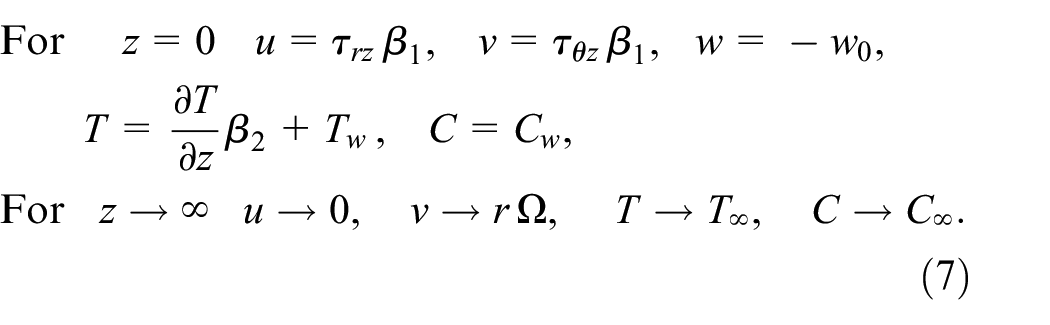
Where

Thermal and physical properties of NPs and base fluid. 21

Note that the centrifugal force is balanced by the radial pressure gradient outside the boundary layer and hence we have
Similarity transformations
Now the Von Karman transformations
2
are introduced with the dimensionless velocities

By utilizing the above transformations, equations (1)–(7) now become


with BCs:
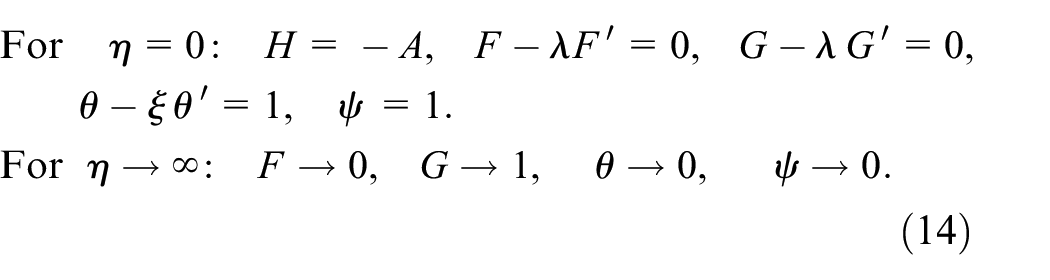
The dimensionless terms arising in equations (9)–(14) are defined in Table 4, while the constant ratios

The dimensionless quantities with notations and definitions.
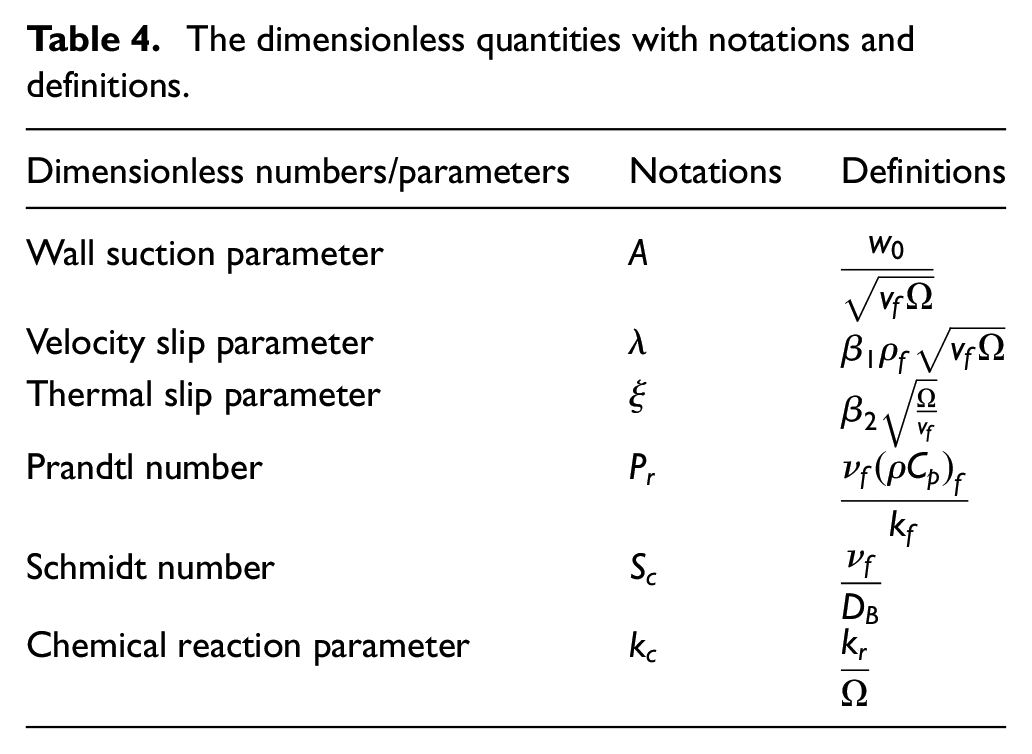
The practical terms of significance for the considered problem are the skin friction factor
Skin friction factor
The skin friction factor for this problem is defined by

where

Using transformations (8) and equation (18), and equation (17) yields

here
Nusselt number
Nusselt number for the present problem is defined as

here

Utilizing transformation (8) with equation (20), equation (19) gives

Sherwood number
Sherwood number for this study is defined below

where

With the use of transformation (8) and equation (23) in equation (22), one finds

Numerical technique
The profiles of velocities, temperature, and concentration of the nanofluid are evaluated by employing the bvp4c routine in Matlab software. This built-in package is very easy to implement and reliable. It comprises a finite difference code that uses the three-stage Lobatto-IIIa formula to produce a continuous solution. The solution derived from this technique is accurate up to the fourth order in the entire domain. For the evaluation of the solution, the thickness of the boundary layer

Meanwhile, the first-order equations are attained as:








with BCs:

The system is given in equations (26)–(35) is inserted in the bvp4c solver to obtain the numerical solution. The computations are made with a tolerance of
Numerical results and discussion
In this section, the influences of the physical parameters are discussed theoretically and illustrated graphically. The nanofluid flow is governed by the momentum, energy, and concentration equations with the velocity slip, thermal slip, and chemical reaction. The calculations are executed numerically by adopting a Matlab routine bvp4c. The code is validated by making a comparison with the published work of Rahman and Andersson.
36
Table 5 demonstrates that the present results of
Comparison of

The numerical values of

Figure 2(a) to (d) represents the impact of

Impact of
Figure 3(a) to (e) displays the distribution of fluid velocities, temperature, and concentration with and without the effects of wall suction. The viscous drag causes the axial velocity of the fluid to decline close to the disk while the axial velocity remains constant at a distance far from the disk. For the conservation principle to be valid, the fluid particles close to the disk are forced to travel in the direction of the rotational axis due to the axially independent radial pressure gradient. As a result, in the Bödewadt flow, the axial flow is directed upward. The components of velocity exhibit oscillatory behavior and when suction is applied, these oscillations are damped and have significantly smaller amplitude. With a moderate wall suction velocity, such oscillatory behavior in the flow fields is suppressed. The asymptotic value of the velocity profiles is reached at a closer distance above the disk as a result of this impact. Therefore, it can be claimed that the wall suction’s damping effect is likely to dominate any absolute or convective type instabilities that are known from published studies. On higher values of the suction parameter, the radial and circumferential velocity components yield an increasing trend while the axial component of velocity reduces significantly with negative values revealing the vertically downward motion of the fluid. Figure 3(a) reveals that using higher

Impact of
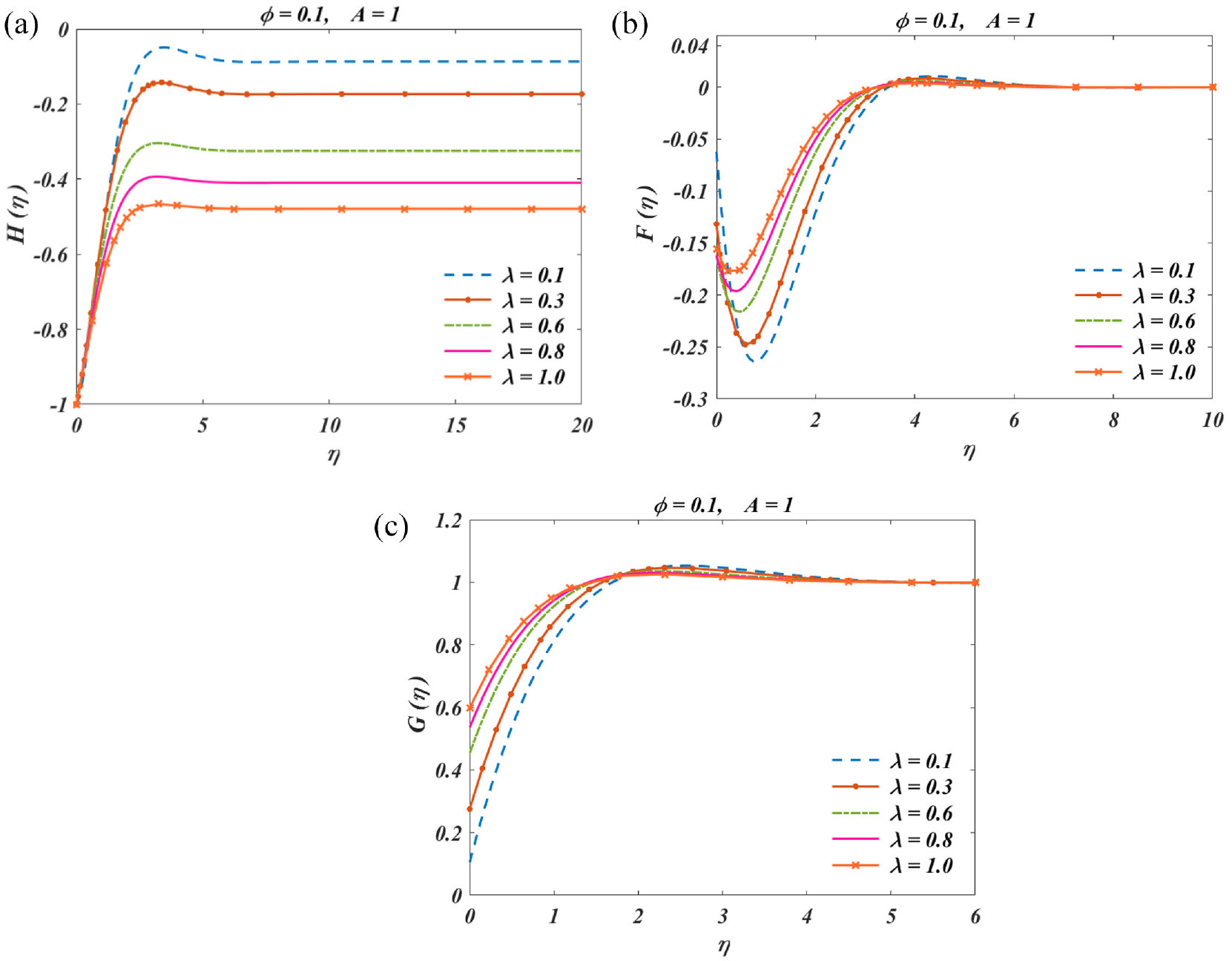
Figure 4(a) to (c) represents the fluctuations of velocity profiles with the impacts of
Impact of
Figure 5(a) portrays a declining trend in thermal boundary layer thickness as well as surface temperature by enhancing the values of the thermal slip parameter. It is because as the thermal slip grows then there is less heat transmission from the disk to the surrounding fluid layers, due to which the fluid temperature is dropped. Figure 5(b) depicts that the profiles of concentration exhibit a decreasing trend to large values of

Impact of (a)
The fluctuations of the volumetric flow rate

Impact of
The two-dimensional streamlines in the xz-plane are depicted in Figure 7(a) and (b) to visualize the effects of no-slip velocity and slip velocity. The streamlines with the no-slip condition are portrayed in Figure 7(a) whereas the streamlines with the impacts of velocity slip are displayed in Figure 7(b). The existence of slip can be seen in the figure which retards the flow of fluid. Figure 8 portrays the two-dimensional streamlines in the xy-plane. In this figure, the rotation effects are evident from the streamlines.

Two-dimensional streamlines in xz-plane for

Two-dimensional streamlines in xy-plane for
Conclusions
The focus of this study is on analyzing the heat and mass transfer phenomena that occur during the revolving Bödewadt flow of a nanofluid generated via a rotating disk. The novelty of the work lies in the investigation of heat and mass transfer in a nanofluid that flows due to a rotating disk, taking into account the effects of chemical reaction, partial slip, and temperature jump conditions. The study uses similarity transformations and the bvp4c method to solve the governing equations and presents graphical illustrations to aid in physical analysis. The motivation for this study arises from the widespread utility of nanofluids and the need for precise thermophysical and chemical properties to meet certain requirements necessary for several applications. The study aims to fill the knowledge gap by investigating the heat and mass transfer phenomena occurring during the flow of a nanofluid generated via a rotating disk, which has not been extensively analyzed in the literature. The validation of results and graphical depictions are essentially provided to test the accuracy of the solution and to facilitate physical analysis. These findings could be useful for understanding heat transfer in similar conditions in fields like energy engineering and thermal management. The key findings of this study are summarized below:
The skin friction factor increases with higher
The skin friction factor, the local Nusselt number, and the local Sherwood number all rise as the suction grows.
The amplitude of oscillatory profiles is inversely related to the axial distance, wall suction, and velocity slip.
The radial and circumferential velocity is directly related to the wall suction while the axial velocity is inversely related to it.
When the values of velocity slip are augmented, then the fluid tangential velocity upsurges, the axial velocity diminishes, and a significant impact is seen on the axial flow.
There is no boundary layer solution for heat transfer problems in pure Bodewadt flow with moderate or zero suction. The flow becomes physically possible when strong suction is applied.
The fluid temperature and the thermal BL thickness are both reduced by a significant rise in
The fluid concentration is reduced by augmenting the Schmidt number and it is also declined by enhancing the chemical reaction parameter.
Footnotes
Appendix
Notation

| Mass diffusivity | Wall suction parameter | ||
| Dimensionless velocity functions | Sh | Sherwood number | |
| Fluid concentration | Greek symbols | ||
| Fluid temperature | Angular velocity | ||
| Heat and mass flux | Constant ratios | ||
| Mass flux coefficient | Density | ||
| Cylindrical polar coordinates | Dimensionless temperature function | ||
| Skin friction coefficient | Dynamic viscosity | ||
| Specific heat capacity | Kinematic viscosity | ||
| Surface and ambient concentration | Radial stress | ||
| Surface and ambient temperature | Tangential stress | ||
| Thermal conductivity | The volume fraction of nanoparticles | ||
| Chemical reaction rate | Thermal diffusivity | ||
| Velocity components | Thermal slip coefficient | ||
| Dimensionless numbers/parameters | Thermal slip parameter | ||
| Chemical reaction parameter | Velocity slip coefficient | ||
| Nu | Nusselt number | Velocity slip parameter | |
| Prandtl number | Subscripts | ||
| Reynolds number | Fluid | ||
| Schmidt number | Nanofluid | ||
Acknowledgements
We are thankful to the reviewers for their encouraging comments and constructive suggestions to improve the quality of the manuscript.
Handling Editor: Chenhui Liang
Declaration of conflicting interests
The author(s) received no financial support for the research, authorship, and/or publication of this article.
Funding
The author(s) received no financial support for the research, authorship, and/or publication of this article.
