



Abstract
The durability and degradation of polymers is very important for product design in terms of material choice. The degradation behavior of two biodegradable thermoplastic materials manufactured by 3D printing, Enviro ABS and PLA, was studied. The action of the sun and seawater was simulated to find out how they affect the properties of these materials over a period of 8 weeks. The yield strength, maximum elongation, ultimate tensile strength, and microscopy were analyzed, as well as dimensions and mass changes. These biodegradable materials were studied to conclude whether there is an environmentally friendly alternative to traditional ABS, being one of the most widely used petroleum-based plastics in industry and in fused deposition modeling (FDM) or fused filament fabrication (FFF). PLA showed a weight loss and increase in ultimate tensile stress on degradation by sunlight and a prolonged decrease in ultimate tensile stress on degradation by seawater due to humidity absorption. In contrast, Enviro ABS does not show a noticeable difference between the beginning and the end of the test, which leads to the conclusion that Enviro ABS is a good alternative to conventional ABS without forgetting the environmental effects that are currently involved in the manufacture, recycling and composting of this type of material.
Introduction
Today, plastics can be found in practically any object or place, from packaging, cosmetics and clothing to fish, bottled water and even in the human body. The United Nations Climate Change Assessment (COP26) emphasizes that plastics are a climate problem. Using a life cycle analysis, it was estimated that in 2015 plastics were linked to the production of 1.7 Gt of CO2 equivalent (GtCO2e), and by 2050 this figure is projected to rise to approximately 6.5 GtCO2e (15% of the global carbon budget). 1
In addition, in 2015 the total production of plastics reached 380 million tonnes and this amount would not be so concerning if these materials did not take hundreds of years to decompose. During this long degradation process, they coexist alongside other species in oceans and forests and greatly hinder their life cycle. If we go even deeper, this waste, exposed over a long period of time to ultraviolet radiation, breaks down into small fragments of less than 5 mm, which are called microplastics, and there are currently more than 51 trillion of these particles floating in the seas and oceans, making it easier for marine animals to consume them and thus for them to reach the food and products consumed by humans.2,3
The vast majority of plastics are made from fossil hydrocarbons and petroleum derivatives, so they are not recyclable materials. Alternatives to this problem need to be sought globally. One of the proposed solutions is to drastically reduce the consumption of plastics or to improve recycling systems, since of the 6 billion tonnes of plastics that have become waste, only 9% have been recycled.4–6
Another alternative is the use of 3D printing and biodegradable materials. 3D printing is a good solution for the reduction of plastics for several reasons: firstly, it is possible to print a design made in a remote part of the world without the expense of plastics or packaging cardboard, since it would not be necessary to transport the physical object, only its design; secondly, this type of technology, in addition to having no geometric limitations, sometimes produces a percentage of material waste of less than 2%; another advantage is the reduction of labor, since by generating objects in a single piece, it eliminates assembly and final finishing components. 7
Biodegradable materials are another alternative currently being implemented in the battle against plastics. These types of plastics are made from plants or biological materials such as corn, potatoes, bananas, cassava, or even avocado, which radically eliminates the use of non-renewable materials and, as organic waste, prevents packaging made from these materials from ending up in landfills. 8
Although the use of biodegradable plastics seems like a great alternative, there are certain disadvantages. These materials have certain requirements to be the ultimate solution to the environmental problem which suggests that today’s society is not ready to support them. One of the main problems with the manufacture of biodegradable plastics is precisely that they are made from foodstuffs. In order to grow these products, land needs to be developed and much of the food destined for consumption needs to be focused on the creation of these plastics. Another major problem arises when it comes to recycling, as these plastics do not degrade naturally. Large composting plants are needed, and these plants eradicate the major drawbacks. 9 Firstly, these plants are not implemented on a large scale in society, so it is very difficult for these materials to be recycled in an adequate way to end their useful life by composting and minimizing their carbon footprint; secondly, temperatures of more than 50°C must be reached for long periods of time, which requires energy and produces emissions into the environment; lastly, the recycling of biodegradable materials becomes an arduous task as it is essential that they are not mixed with other materials.10,11
Furthermore, studies on 3D printing and biodegradable materials have grown significantly in recent years as these technologies have evolved.12,13 Table 1 shows a compilation of some studies by other authors on the degradation mainly of poly lactic acid (PLA), PLA-derived composites or other materials, such as acrylonitrile butadiene styrene (ABS).
Experimental tests by other authors.

In all the results of the different authors it can be concluded that biodegradable materials, such as PLA, degrade under different degradation conditions. These results are expressed in different ways: visually, reduction of molecular weight, or reduction of geometrical and mechanical properties. This means that exposure of a biodegradable material under specific conditions results in a degradation of the material or product that can be analyzed in different ways.
However, the authors reject the possibility of recycling as a way out of this crisis and warn of harmful alternatives to single-use products, such as bio-based or biodegradable plastics, which currently pose a similar chemical threat to conventional plastics. The reuse of plastics should therefore be explored.
Therefore, the aim of this work is to combine the use of FDM technology and biodegradable materials to explore the possibility of minimizing the use of petroleum-based materials and moving closer to environmental sustainability. For this purpose, two materials were used, PLA derived from natural sources, and enviro ABS, a material obtained from petroleum but modified to be biodegradable. These materials have been chosen because PLA and ABS are the most widely used polymers in 3D printing. The alternative ABS enviro is a relatively new material that has not been studied before. Also, two types of degradation were proposed: sunlight exposure simulation and seawater simulation. The response of these materials was analyzed in relation to their tensile mechanical properties.
Materials and methods
Two environmentally friendly materials were studied: naturally derived poly lactic acid (PLA) and sustainable acrylonitrile butadiene styrene (Enviro ABS), a petroleum derivative. This modified ABS has a biological additive attached to it that attracts bacteria which are capable of biodegrading the material when present in large quantities, as is the case in a landfill, until these conditions are present the material will not degrade. 25
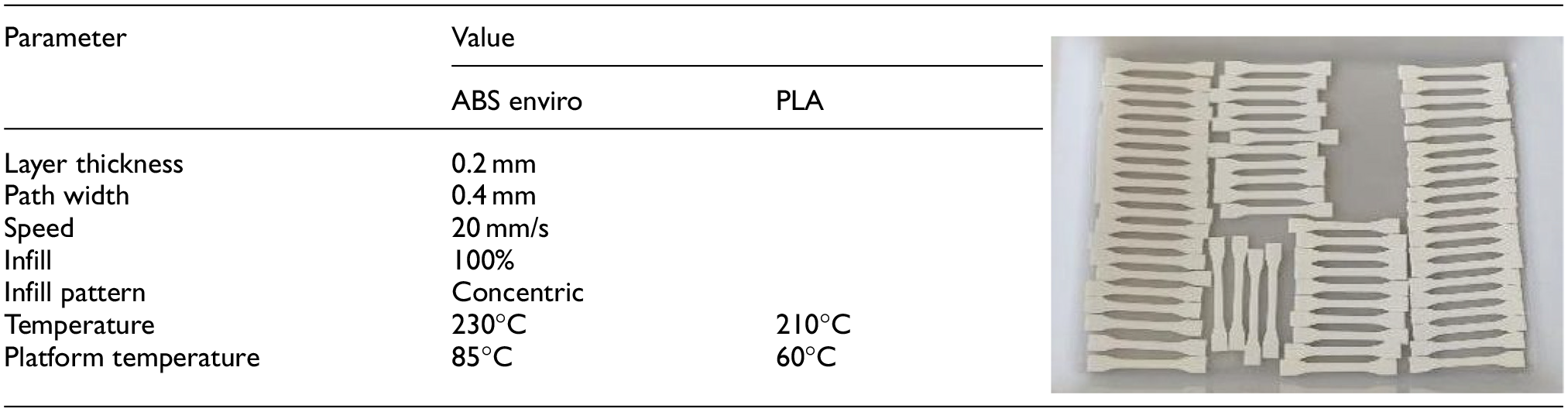
Single tensile specimens were designed according to the recommendations of ISO 527. 26 The specimens were fabricated on a fused deposition modeling test bench. The main manufacturing parameters are listed in Table 2. The print speed was low because no adhesives on the platform were used. These conditions were also chosen on the basis of previous studies.
Manufacturing parameters.

The dimensional evaluation of the monolayer specimens serves as the basis for the evaluation of the mechanical properties of the material. These dimensional deviations were characterized using Optical Measures 3D Techniques, concretely Tesa Visio 300 was used. Also, samples were weighed prior to degradation and before each mechanical test performed.
Two types of degradation were proposed: sunlight and saline water. On the one hand, to simulate degradation by seawater, the salinity of the Mediterranean Sea was estimated. On the one hand, to simulate the degradation by the action of the water of the Mediterranean Sea, we looked for the approximate grams of salt per litre of water that the sea has on average, in this case the selected data was between 36 and 39 g/l of water, so it was decided to dissolve 38 g/l. As the density of this water is higher than that of the samples, the samples had to be anchored to the bottom of a fish tank to prevent them from floating to the surface. On the other hand, a 1000 W Maurer photo halogen lamp was used to simulate the degradation due to exposure to the sun. The samples were positioned with respect to the lamp to simulate the maximum energy emitted by the sun, so that the energy was similar to 1000 J, for which the energy meter PCE-SPM 1 was used.
The specimens were subjected to single tensile tests at a constant speed of 2 mm/s in the universal testing machine Shimadzu® AG-X series before being exposed to degradation and every certain period of time (Table 3), up to a maximum of 8 weeks over time.
Tests carried out during degradation.

Finally, all of the specimens were analyzed before and after the mechanical tests mentioned, to assess by means of stereoscopic optical microscopy (SOM) and support the study of the fracture type that appears in these samples according to their degradation time and type. The equipment used for the application of SOM was Nikon® SMZ800.
Results
Figure 1 shows the evolution of the maximum stress through each of the test. It can be seen that in the case of degradation by seawater, Enviro ABS shows a practically constant trend, while PLA shows a clear downward trend. This is due to the fact that PLA is a much more hydroscopic material than Enviro ABS and is therefore more affected by the presence of humidity.

Maximum tensile strength of the tests.
In the case of degradation by light, in both cases (Enviro ABS and PLA) there is a rise in the maximum stress at the beginning of the tests, this may be due to the decrease in humidity in the specimens thanks to the effect of temperature and light. It is observed that this increase is greater in the case of PLA since, as mentioned above, it is a material much more sensitive to humidity than Enviro ABS.
It is important to mention that in week 5 the bulb melted due to sunlight degradation. This setback can be clearly observed in both PLA and Enviro ABS as it shows a clear decrease in peak stress in week 6 possibly due to moisture absorption in the period of time the specimens were not exposed to temperature and light. When the test was reactivated, an increase in tension was observed again (week 8) as the humidity of the specimens decreased again.
The evolution of the elastic coefficient (ε) was also analyzed during the 8 weeks of the study (Figure 2). In the case of Enviro ABS, both light and seawater degradation, a clear constant trend is shown, in which the final value is not very dissimilar to the initial one. However, in the case of PLA, both degradation by light and water show a trend in which a decline in the values is observed in the first weeks to reach a minimum value and then rise again, even surpassing the initial value. This shows that the material becomes more plastic in the first weeks (decreasing zones) and then becomes brittle again (increasing zones).
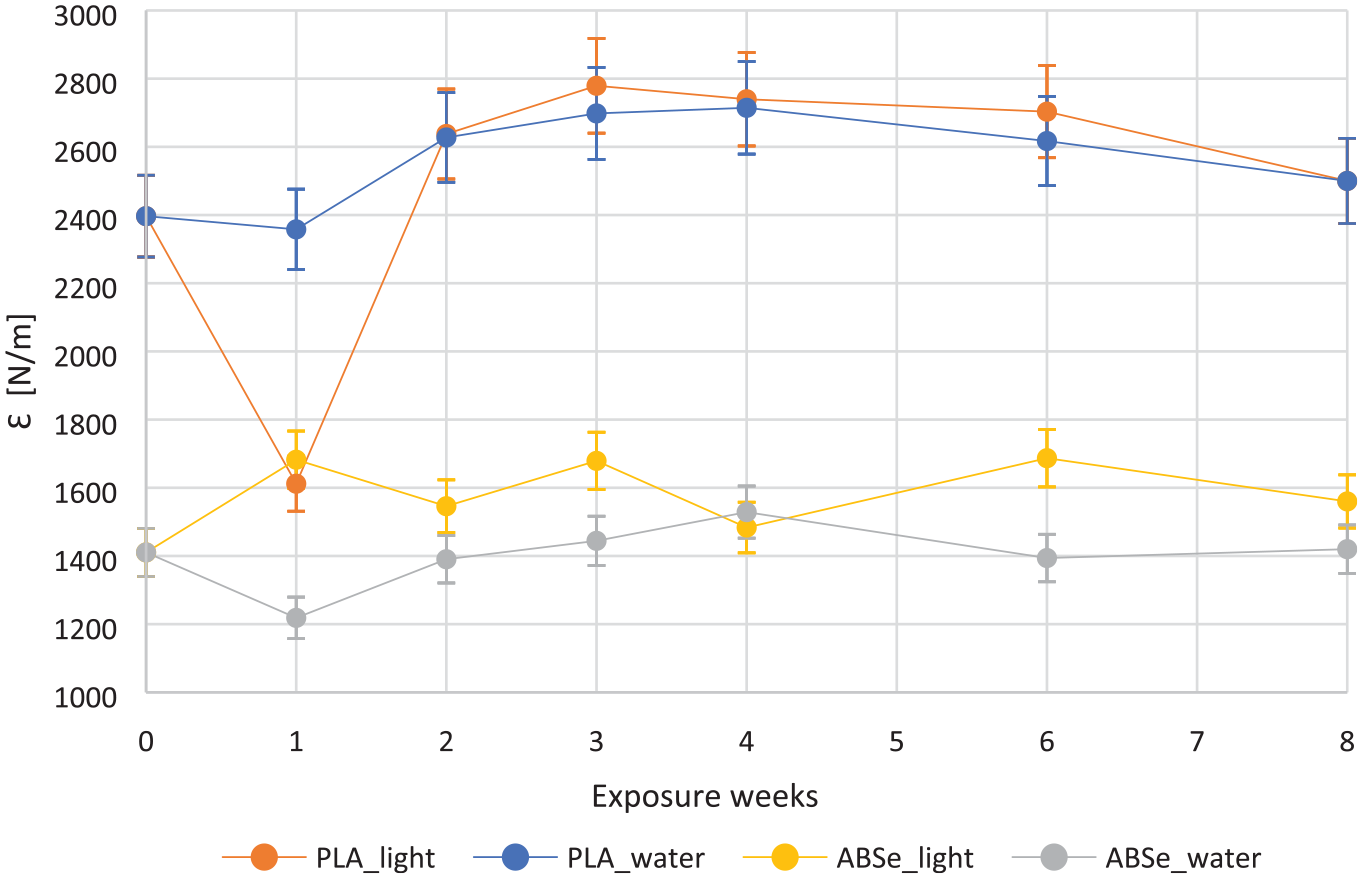
Elastic coefficient of the tests.
In the case of PLA exposed to sunlight, there is a sharp drop in the eighth week. This may be due to a problem in the final week of the project in which the light bulb, which was used for the light degradation test, exploded, burning all the samples.
Another fact to comment on the graph is that Enviro ABS is less rigid than PLA. These data are not entirely real, since the stress graphs of these materials do not have a straight elastic zone to measure its slope and thus find the Young’s Modulus correctly, but they are elastoplastic materials without a yield point, since there is no change from elastic to plastic zone. Because of this, the results obtained for the elastic coefficient and elongation cannot be treated as if they were other types of materials with well-defined elastic and plastic zones.
Figure 3 shows the evolution of the elongation (Δ) in percentage during the test time. In this case, a completely inverse response to the previous case is observed. The two cases of PLA have a practically constant trend and the two cases of Enviro ABS have a first decrease of values in the first weeks to reach a minimum and then increase again. Although, as mentioned above, these data cannot be studied as in the case of other materials, as they have a single elastic-plastic zone. Therefore, the periods of exposure to degradation should be extended in order to have stronger statements. However, we can already state that PLA seems to be more affected by this exposure to degradation than by ABS enviro.

Elongation of the tests.
Also, stress-strain plots are shown for each case at the beginning and at the end of the degradation period (Figure 4). For ABS enviro exposed to salt water degradation, there is no noticeable difference in the elastic zone or after the yield point. Therefore, it can be stated that there is no apparent degradation in the samples. For the case of the Enviro ABS exposed to solar degradation, it can be clearly observed how the specimen at week 0 fractures practically doubling the displacement obtained in the week 8 test. This decrease goes hand in hand with the decrease in the plastic zone or creep zone, causing the material to fracture earlier, finding this fracture almost at the moment of finding the elastic of finding the yield point at week 8.

Stress-strain graphs of (a) ABS and (b) PLA at 0 and 8 weeks of sunlight and seawater exposure.
In the case of PLA degradation by salt water there is a big difference in the trend in the graphs. PLA has an elastic-plastic graph like ABS and there is no straight region. The displacement is a little less in week 8 and the big difference is the decrease of the maximum force from week 0 to week 8. This seems to indicate that PLA exposed to this type of environment strongly influences its final mechanical properties, as seen above. Finally, in the case of PLA exposed to sunlight, no noticeable difference is observed either, it could only be added that in week 8 the displacement before breakage is lower than in the initial week.
The fractures of the specimens were analyzed by microscopy (Figure 5), and it was found that the longitudinal view does not show a noticeable change in the fracture to ensure that it is due to degradation. A brittle fracture always occurs due to the plastic nature of both materials. A clear difference is observed in the ABS before and after exposure to salt water degradation, as the week 8 image shows the deformation zones to be slightly less brittle, showing a small deformation of the layers before breaking, which is in agreement with the tensile plots.

Cross section of the samples: (a) water ABS – 0, (b) water ABS – 8, (c) water PLA – 0, and (d) water PLA – 8, weeks of exposure.
Cross sections of PLA samples exposed to solar degradation are also shown. First of all, these images show a clear difference between the Enviro ABS and the PLA, since on this occasion it is not possible to clearly distinguish between the layers and the directions of the layers. As for the difference between week 0 and week 8, in the latter some areas without material can be observed as if they were pitting caused by deformation. Ram Krishna et al. 14 showed how PLA evolves against degradation by moisture over a 30-day period, and the appearance of pitting, which can also be seen in this image. Finally, for both materials exposed to degradation by sunlight, there is no clear difference between the cross sections of the samples fracture.
Conclusions
In this work, the influence of two degradation conditions (solar and salt water) on two biodegradable materials, PLA and ABS enviro, has been studied. The latter has not been studied before and is a potential substitute polymer for traditional ABS.
Based on the results obtained, the following conclusions can be drawn:
- The mechanical response of Enviro ABS is better than that of PLA for a degradation period of 8 weeks. It shows better results in tensile tests, mainly in the maximum stress study.
- The degradation of Enviro ABS is not noticeable in 8 weeks and it has degraded in practically the same way in the two study media (light and water).
- In the case of PLA, there is a difference in the degradation of the material depending on the study medium. In the case of light there is a small increase in the maximum stress due to the elimination of moisture in the material; but the specimens degraded by water do show a tendency to decrease mechanical properties and a change in its internal structure.
Both materials showed a good mechanical response to degradation to be considered good substitutes for conventional ABS, with Enviro ABS being a better option. Although it is important to mention that, this solution is not definitive, since in addition to eliminating the use of petroleum-based materials, recycling and composting of bioplastics must be encouraged. This mission belongs to both governments (creating laws that benefit these ideas and building composting factories) and society, since if there is no change in the mentality of the use of plastics and disposable materials in general, any biodegradable solution will not be 100% effective.
In short, for this idyllic future to be possible, a general change of mentality is necessary, as well as a correct education about plastics and their correct recycling. It has been shown that degradation into environmentally friendly materials is not so automatic, and that these materials could be implemented in many applications.
Footnotes
Acknowledgements
The authors thank the SC-ICYT of University of Cadiz and the Own Research Plan of the University of Cadiz for financial support.
Handling Editor: Chenhui Liang
Author contributions
Conceptualization, AV, SF-V, and FB; methodology, GF-S; software, SF-V; validation, FB; formal analysis, AV and SF-V; data curation, AV and GF-S; writing – original draft preparation, AV and GF-S; writing – review and editing, SF-V and FB; visualization, GF-S; supervision, FB; project administration, AV; funding acquisition, SF-V. All authors have read and agreed to the published version of the manuscript.
Declaration of conflicting interests
The author(s) declared no potential conflicts of interest with respect to the research, authorship, and/or publication of this article.
Funding
The author(s) received no financial support for the research, authorship, and/or publication of this article.
Availability of data and materials
The data that support the findings of this study are available from the corresponding author upon reasonable request.
