



Abstract
It is increasing concerned that the plateau environment will potentially increase fuel consumption in engines. Despite this, the current state of research on high altitude engines is still inadequate in providing sufficient and detailed information to counteract the decrease in engine efficiency. In addition, one of the novelty of this study was that the investigated altitudes is up to 4500 m, of which the previous studies was limited. Therefore, this study aims to investigate the effect of altitude on in-cylinder spray, combustion, and soot formation processes in diesel engines. A calibrated three-dimensional (3D) computational fluid dynamics (CFD) model of a single-cylinder, four-strokes, direct injection (DI) compression ignition, intake boost research diesel engine is established. The numerical CFD model used in this study has been validated through comparison with experimental data. It effectively investigates the in-cylinder activities and provides insights into the causes behind combustion and soot emission deterioration. The simulation is operated at altitudes of 0, 1500, 3000, 4500 m with corresponding intake pressure. It has been observed that engine performance and soot emissions deteriorate as altitude increases, and a sharp drop occurs when the altitude exceeds 3000 m, which can be attributed to the dramatic decline in combustion efficiency. The extended spray leads to a decrease in air utilization, which ultimately results in a sudden drop in combustion efficiency at altitudes above 3000 m. Overall, this study has identified that the extended penetration of the spray, caused by reduced pressure and air density, leads to poor air utilization, resulting in decreased performance and increased emissions. Hence, it is recommended that optimization of the combustion chamber geometry and injection strategies of diesel engines operating at high altitudes be undertaken to improve air utilization and combustion quality. This will serve as an avenue for further research in the future.
Introduction
In recent years, the escalating effects of global warming, extreme climate changes, and rapidly shifting climate attributable to greenhouse gas emissions have awakened a critical need for concerted efforts toward global decarbonization. 1 Among the major contributors to carbon emissions are diesel engines, which have long been the primary drivers of transportation and power generation. 2 In response, researchers have concentrated efforts on replacing conventional fossil fuels with alternative, cleaner fuels like hydrogen and ammonia as effective strategies for achieving zero-carbon emissions. Notwithstanding this progress, further improvement in diesel engine thermal efficiency under different operating conditions remains crucial to minimize carbon dioxide emissions.3,4
While many diesel engines perform optimally under heavy-duty and relatively high-speed operating conditions, there is still considerable potential for enhancing engine efficiency in various environments. Particularly, diesel engines experience output power degradation and higher fuel consumption rates at high altitude regions, which constitute a substantial fraction of the planet’s landmass. 5 This phenomenon has been extensively documented by numerous researchers, underscoring the necessity of continued endeavors aimed at improving diesel engine performance under challenging circumstances. 6 Therefore, research must focus on innovative methods to increase the fuel efficiency of diesel engines, including advanced combustion strategies, optimized engine designs, and the use of renewable fuels like biodiesel and biofuels.7,8 These measures will enable diesel engines to reduce their carbon footprint while continuing to provide cost-effective and reliable transportation and energy generation services. 9
For example, Szedlmayer and Kweon 6 found that the combustion quality of diesel engine dropped sharply when operating altitude is above 3000 m, and it can be concluded that 3000 m was the threshold of soot emission level. Our previous works could also prove that highland diesel engines had decreased cylinder pressure, lower excess air ratio, longer ignition delay, extended combustion duration, increased pressure rise rate, and reduced combustion efficiency. 10 However, the high-altitude areas can cover about 2.5 million square kilometers around the world, and more than 6 million vehicles are registered in these areas. 7 Vehicles in these areas have less efficiency and more carbon emissions. 8 But today’s diesel engines can only work within a narrow altitude range, not adapt to high altitude conditions. 6 Recent theses have also illustrated that diesel engines at high altitude would produce more soot, which caused a significant challenge to Selective Catalytic Reduction, and might even lead to substandard emissions. 11 What’s more, components may be influenced when diesel engines work at high altitude, 12 for instance, the valve and piston may be corroded, and engines will have high emission gas temperature and turbocharger overspeed. 13
From the previous research it can be inferred that poor ambient pressure and lower air density are primary reasons accounting for engine combustion degradation. Besides the deteriorated combustion at high altitude also increases various emissions especially soot. 13 Based on existing research, it can be concluded that the primary cause of combustion deterioration at high altitudes is the mismatch between fuel and air quantities. This mismatch leads to reduced engine efficiency and increased emissions. Therefore, implementing effective measures to enhance engine combustion performance not only reduces harmful emissions but also contributes to the reduction of carbon dioxide emissions. 14 However, achieving this goal necessitates a comprehensive understanding of the in-cylinder activities of plateau diesel engines. Despite previous investigations into this area, there still exists a limited understanding of the underlying mechanisms and processes governing in-cylinder activities at high altitudes. It is important to note that previous studies have mainly focused on altitudes below 3000 m, with limited research on higher altitudes. This is understandable because engine benches in the plains, when simulating high altitude environments, have lower intake pressures than ambient pressures, resulting in additional pressure differentials on the intake pipeline. To prevent damage to experimental equipment, simulated altitudes are limited. Thus, in most studies conducted on the plain, the altitude was limited to below 3000 m. One of the novelty of this study was that the investigated altitudes is up to 4500 m, allowing to gain insights into diesel engine performance at higher altitudes above 3000 m.
Despite extensive investigations into the performance and emission degradation of diesel engines at high altitudes, limited detailed or sufficient studies have been conducted on in-cylinder activities in plateau diesel engines. This knowledge gap hinders manufacturers from proposing effective measures to compensate for power loss and reduce emissions in high-altitude regions. Typically, in-cylinder spray behaviors, combustion, and emission formation are difficult or expensive to capture using experimental methods. Researchers can only infer or imagine the in-cylinder activities by analyzing pressure traces and other recorded data. However, the three-dimensional (3D) computational fluid dynamics (CFD) method provides an insightful view of in-cylinder flow motion, spray behavior, combustion, and other critical parameters, thereby facilitating a better understanding of the effect of altitude on in-cylinder activities that result in performance and emission deterioration. 15 As such, there is a growing interest among researchers to employ CFD simulations to investigate the intricate in-cylinder activities in high-altitude diesel engines. 16 These simulations provide an efficient means of comprehensively understanding the complex flow physics associated with diesel engine combustion under various operating conditions. 17 Furthermore, CFD simulations enable the optimization of engine design and fuel injection strategies while minimizing the cost and time associated with experimentation.18,19 Consequently, CFD simulations promise to be a vital tool for investigating the in-cylinder activities of high-altitude diesel engines and improving their performance and emission characteristics.20,21
Hence, the principal aim of this study is to investigate the effects of altitude on in-cylinder spray, combustion, and soot formation processes in diesel engines by utilizing a meticulously calibrated three-dimensional (3D) computational fluid dynamics (CFD) model. The outcomes of this analysis are expected to provide a valuable benchmark for optimizing the performance of diesel engines operating in high-altitude environments, with the additional benefit of emissions reduction. Ultimately, these findings contribute to the broader objective of decarbonizing the transportation sector.
Materials and methods
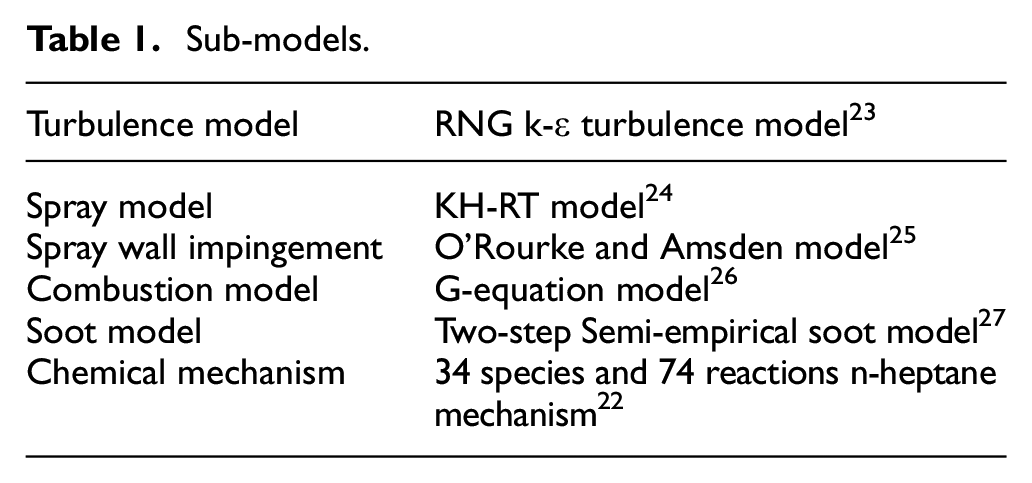
A 3D CFD model of a single-cylinder, four-strokes, direct injection (DI) compression ignition, intake boost research diesel engine is established in this study to investigate the in-cylinder activities of diesel engine at different altitude. The commercial software ANSYS Forte is employed to establish the numerical model. Since this study focuses on the in-cylinder activities, the computational domain only includes the combustion chamber during intake valve close (IVC) and exhaust valve open (EVO), that is, the close cycle. Besides considering the Periodic symmetry of combustion chamber around 10 nozzles, the numerical model utilizes a sector of 36° to represent the in-cylinder activities with less computational cost. The boundary conditions at the edges of the segments are determined as the periodicity boundary. The conditions imposed on these boundaries can be inferred from the assumed n-fold periodicity. The grid size is limited in 0.5–2 mm to achieve a balance between accuracy and computational cost. The 3D geometry and computational mesh of the combustion chamber is shown in Figure 1. Various sub-models are selected to characterize the flow motion, turbulence distribution, spray behavior, and combustion process, etc. In this study, the Reynolds-Averaged Navier-Stokes (RANS) approach was chosen over the more computationally expensive Large-eddy Simulation (LES) approach. To accurately represent turbulent flow characteristics, the RNG k-ε model was adopted. Unlike the standard k-ε model, the RNG version is derived from rigorous mathematical principles, ensuring better accuracy in capturing turbulent transport and mixing. By utilizing the RNG k-ε model, the study aims to effectively model the main effects of turbulence on flow and combustion characteristics while avoiding the computational burden of resolving small-scale structures and fluctuations. As for the chemical mechanism of diesel fuel, a reduced n-heptane mechanism consisting of 34 species and 74 reactions is selected to model the chemical reactions. The diesel fuel is represented with n-heptane while the physical property is represented by tetradecane in spray penetration, atomization, and vaporization, etc. The hybrid Kelvin-Helmholtz/Rayleigh-Taylor (KH-RT) model was employed to describe the spray atomization, droplet breakup, collision and coalescence, and wall impingement. In this study, the O’Rourke collision model initially considered for spray particle collisions exhibited limitations in cylindrical mesh configurations. To address these limitations, the study adopted the Radius-of-Influence (ROI) collision model. In the ROI method, collision partners are sought within a sphere of influence centered at each parcel’s location. All parcels within this sphere have the potential to collide with the centered parcel. As a result, the ROI model eliminates the dependency on both CFD mesh size and collision mesh size, enabling efficient and accurate collision detection. 22 The mixing controlled in-cylinder combustion is tracked by G-equation model. In addition, a two-step soot model including competing formation and oxidation steps is utilized to capture the formation and evolution process of soot emissions. In other word, the two-step soot model will predict the soot formation and oxidation semi-empirically based on the soot precursors like C2H2, which is controlled by adopted diesel fuel chemical mechanism. The NOx formation process in this study is predicted by the adopted chemical kinetic mechanism, in which the Zeldovich mechanism plays a dominant role. These sub-models along with basic governing equations can simulate the in-cylinder activities including flow motion, spray behaviors, and combustion development, etc. The adopted sub-models are listed in Table 1.

The 3D geometry and computational mesh of the combustion chamber.
Sub-models.
Before applying the 3D CFD numerical model to investigate the plateau diesel engine performance, it is essential to validate the predication accuracy. The pressure trace and corresponding heat release rate (HRR) measured from engine bench experiment from Liu et al. 4 is adopted to calibrate the numerical model. Specifically, the research engine is operated at the ambient pressure corresponding to the altitude of 3000 m and 1500 rpm rotate speed. The computer system used in this study consisted of two CPUs with a total of 48 cores, a base frequency of 3.0 GHz, and 512 GB of memory. Each simulation took approximately 8 h to complete. The predicted pressure trace and heat release rate curve of CFD model at the same condition is plotted in Figure 2, where the measured data is plotted in dash line for comparation. It can be seen that the simulated pressure trace agrees well with that of experiment. Despite the slight difference between measured and simulated HRR curve, the result of numerical model successfully capture the features of diesel engine combustion, including ignition delay and combustion phases. Overall the result indicates that the established 3D CFD numerical model is capable to characterize the plateau diesel engine in-cylinder activities.
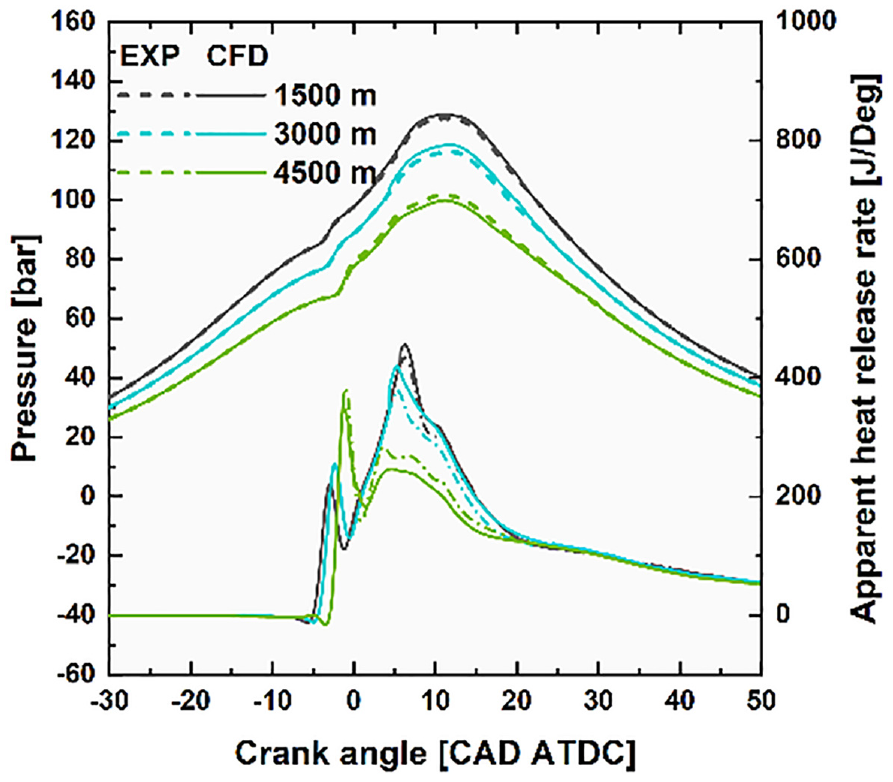
Comparison of simulated cylinder pressures and apparent heat release rates with experimental data at altitude of 3000 m.
As can be conclude from previous researches, the lower ambient pressure is primary reason for engine combustion deterioration at high altitude. Therefore the difference of other factors like temperature and air density at different altitude are not considered in this study. The ideal gas equation is utilized in this paper. Once the initial temperature and pressure of the air are determined, the density and trapped mass can be established. This indicates that the impact of the trapped mass is equivalent to that of the intake pressure. To quantitively investigate the effect of altitude on diesel engine in-cylinder activities, the intake pressure is set to the values corresponding to different altitudes are varied from sea level to 4500 m high. As the primary cause of engine performance degradation at different altitudes was the mismatch between fuel and air quantity, the fuel flow rate was kept constant as full load condition at sea level, rather than adjusting it to an optimal level. The detail engine operating conditions are listed in Table 2.
Engine specifications.

In order to verify the accuracy of the established 3D CFD model in this study, the predicted pressure trace and heat release rate (HRR) were compared with experimental data collected at an altitude of 1500, 3000, 4500 m above sea level. Figure 2 illustrates that the predicted pressure trace shows good agreement with the experimental results, with only minor discrepancies observed at pressure peaks. Furthermore, the start of combustion, combustion phases, and duration of combustion reflected in the HRR curve of the CFD model exhibit strong correlation with the experimental data. Although the HRR traces do not completely overlap, the established CFD model successfully captures the dominant features of the HRR trace of the plateau diesel engine. This indicates that the established 3D CFD model accurately simulates the in-cylinder combustion of this engine under high-altitude conditions.
Results and discussion
This section will firstly investigate the macroscopic engine performance deterioration at high altitude through cylinder pressure, engine combustion efficiency, and thermal efficiency, while the soot evolution curves during close cycle are also presented to assist evaluating the overall effect of altitude. Then the spatial results from 3D CFD simulation will be utilized to analyze the cause of engine combustion degradation from the perspective of in-cylinder activities.
Figure 3 shows the pressure trace and apparent heat release rate at different altitudes to assess the overall effect on energy release. As can be seen the initial pressure at different altitudes have maintained the magnitude during the total close cycle, which is understandable according to classical thermodynamic theory. Besides it can be inferred from Figure 3 that the high altitude tend to delay the start of combustion, that is, the crank angle that heat release rate starts raising in the figure. The peak value of heat release rate increases with higher altitude, because an extended ignition delay corresponds to more fuel reacted in premixed combustion phase and therefore a rougher combustion. Consequently the pressure raise rate at high altitude will be larger, but still cannot compensate the pressure gap at different altitude. During the diffusion combustion, that is, the second peak in heat release curve, the heat release rate shows a decreasing trend when the altitude raises. It indicated that more fuel that is burned during the premixed phase results in a decreased quantity of fuel that to be combusted during the diffusive phase.
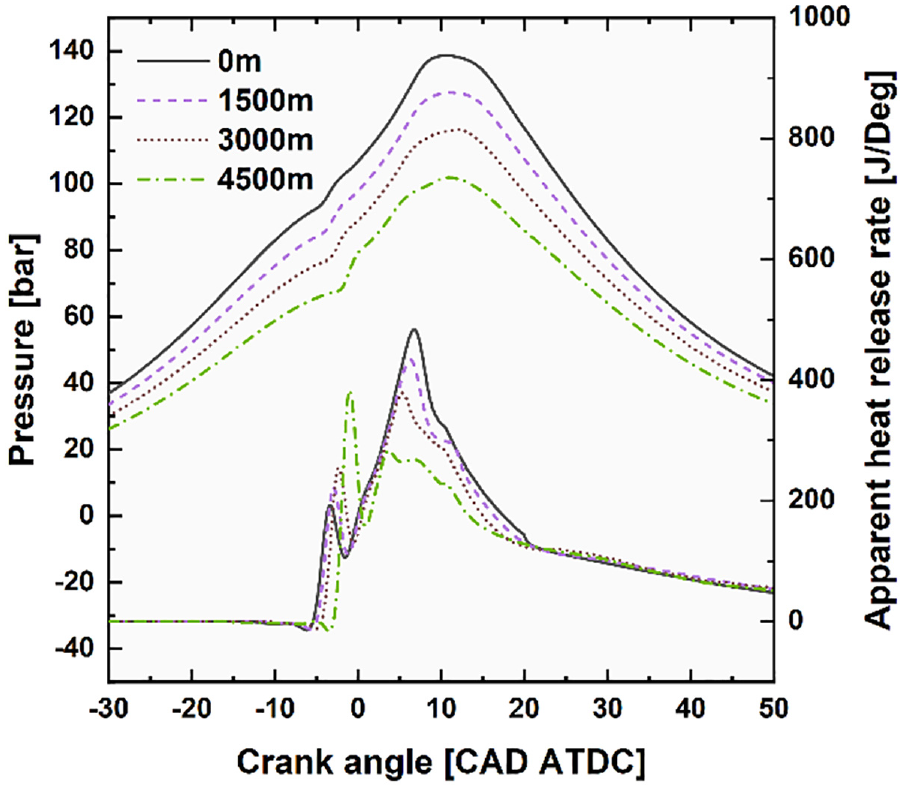
Effect of altitude on cylinder pressure and apparent heat release rate.
Figure 4 depicts the engine combustion efficiency and thermal efficiency at different altitude to macroscopically assess the engine performance deterioration. As shown in Figure 4, the combustion efficiency below 3000 m altitudes is 96.5%–98.1%, while the incomplete combustion occurs at altitude of 4500 m, evidenced by the combustion efficiency of 88.5%. The sudden drop in combustion efficiency at the altitude above 3000 m is also reported by Liu et al. 4 as mentioned previously, which reported the sudden combustion deterioration at the altitude above 3000 m. This phenomenon suggests the possibility that the spray droplet impinging with cylinder wall. As a result of the decrease in ambient pressure at higher altitudes, there is a larger gap between fuel injection pressure and in-cylinder pressure; this increases the spray velocity and also increases the penetration length. In addition, the thermal efficiency below 3000 m altitudes is 42.0%–44.7%, while that at altitude of 4500 m is 39.1%. This difference is the result of different heat release rate discussed above. Specifically, the extended ignition delay and longer duration of combustion (DOC) caused by high altitude are not conducive to the conversion of energy into mechanical work. A larger proportion of premixed combustion at high altitude would cause more negative work before the crank angle of top dead center (TDC). Hence, the thermal efficiency decreases when the altitude raises.

Effect of altitude on engine combustion efficiency and thermal efficiency.
It is also of importance to investigate the in-cylinder pollutant concentration development to holistically investigate the effect of altitude on emissions. Therefore Figure 5 shows the various pollutant mole fraction trace at different altitude during studied cycle. As can be seen from Figure 5(a), the CO is rapidly generated during combustion and then consumed by later oxidization reaction into CO2. The CO concentration raising segment at different altitudes are highly overlapping, indicating a similar CO production rate. Meanwhile the gap between that of reduction segment reflects that altitude elevation tends to inhabit the CO later oxidization. In other words, the high altitude operation condition reduces the excessive air ratio and deteriorate the air utilization, resulting in CO emission degradation. It is also of interest to point out that the remained CO concentration at exhaust valve open increases rapidly when operating above the altitude of 3000 m. The evolution trace of the UHC is similar to that of CO, presenting a continuously consumption tendency during combustion and oxidation. Besides, the UHC concentration at EVO is much lower than that of CO, because its chemical bond energy is smaller and more susceptible to be oxidized. As for the NOx trace, it is dominantly formed during mixing-controlled combustion phase, evidenced by echoing primary heat release in previous analyzation. This is expected because the high temperatures favors the formation of NOx, oxidizing environments, and adequate reaction times, according to thermal NOx theory. Accordingly, it can be inferred from the difference of NOx generation rate at different altitudes that altitude elevation tends to reduce the spatial distribution of diffusion flame and thus NOx generation. In addition, the soot evolution trace shown in Figure 5(d) indicates that high altitude will contribute to soot formation and inhibit the later oxidization, resulting in deteriorated soot emission. In particular, the remained soot concentration climbs abruptly when the altitude above 3000 m. According to the favored conditions of soot formation, the larger spatial extent of fuel-rich areas and increased fuel-air mixing inhomogeneity may be responsible for the decrease in soot emissions.

Effect of altitude on the formation and evolution process of average concentration of (a) CO, (b) UHC, (c) NOx and (d) soot in the chamber.
To determine the reasons for combustion deterioration and soot emission increment, the specific spatial solution of equivalence ratio, temperature, and soot concentration will be depicted and analyzed in below section.
Since the spray behavior plays a essential role in diesel engine combustion, the 3D distribution of equivalence ratio, temperature, and OH radical are illustrated in Figures 6 and 7, respectively, to demonstrate the effect of altitude on spray process and combustion. To better demonstrate the length of spray tip penetration, an yellow arrow along the spray is depicted to represent for liquid penetration length and the white arrow to represent for gas phase penetration length. As can be seen in Figure 6, the temperature distribution during spray process can reflect the difference of spray behavior at different altitudes. Additionally, the spheres that colored by velocity are utilized to represent the spray droplet with different diameters. Thereby the spray tip penetration can be better investigated.

Effect of altitude on the temperature spatial distribution in the vertical plane during main combustion process.

Effect of altitude on the equivalence ratio spatial distribution in the vertical plane during main combustion process.
As can be seen in the Figures 6 and 7, the fuel is injected through the injector situated on the engine head, and into the combustion chamber around by piston upper surface and cylinder. The low temperature region along the spray jet suggests that the spray has undergoes the vaporization, atomization, which are heat-absorbing process and thereby results in this temperature profile. Notably, the spray tip penetration length is observed to increase when operating at higher altitudes, evidenced by the distribution of spray particles illustrated in the figure. Regarding the ignition process, it can be found that the diffusion flame firstly occurs at the side of spray due to better fuel-air mixing process. Besides the elevation of altitudes has prolonged the ignition delay according to the diffusion flame development difference in Figure 6, which is consistent with the pressure trace analysis. For example the ignition below 3000 m altitude have occurred at −2 CAD ATDC while that of 4500 m altitude still not start. This phenomenon of ignition delay is also agreed with previous study, 10 which reported the retarded ignition.
As the fuel spray enters the cylinder, it interacts with the cylinder wall and piston surface, generating two distinct combustion zones located in the bowl and near-squish region, respectively. This phenomenon is inherent and inevitable in diesel engines, and an appropriate piston design can regulate the separation and mixing of the spray, thus enhancing air utilization. Furthermore, based on the temperature distribution and equivalence ratio profiles shown in Figures 6 and 7, it can be inferred that increasing altitude leads to a narrower spray distribution and, consequently, a more confined diffusion combustion region. Specifically, at high altitudes, fuel droplets tend to break up earlier, leading to spray impingement with the piston bowl edge at unexpected crank angles. This can cause more fuel-gas mixture to enter the squish zone of the combustion chamber, rather than the piston bowl, resulting in the formation of a fuel-rich region in the squish zone. Consequently, the air in the piston bowl and center of the cylinder is not fully utilized, leading to lower air utilization efficiency and degraded combustion efficiency. In other words, the spatial extent of the fuel spray is reduced at high altitudes, which restricts air utilization and hinders the efficiency of the combustion process. These factors help to explain the performance deterioration that can occur in engines operating at high altitudes.
For diesel combustion, the formation of soot occurs when the equivalence ratio exceeds a critical value of 2. It is generated through the cracking of nC7H16 (n-heptane) into smaller hydrocarbon species, primarily C2H2 (acetylene). In this study, the focus is mainly on the formation of C2H2 as a precursor for soot based on empirical models. In real processes, nC7H16 undergoes cracking to form C1–C4 hydrocarbons, which then undergo reactions such as C2 + C4 or C3 + C3 to form initial benzene rings. Subsequently, these species undergo dehydrogenation and acetylene addition (HACA) reactions, leading to the growth of multi-ring polycyclic aromatic hydrocarbons (PAHs) in the gas phase. PAHs then combine to form dimers, which serve as the nuclei for further growth through HACA reactions, eventually forming mature soot particles. Due to the complexity and computational burden associated with the detailed PAH and soot kinetics, empirical models based on the C2H2 to soot conversion pathway are commonly used in commercial CFD simulations as a substitute for first-principles models. Therefore, in this study, an empirical model for soot formation, specifically the C2H2 to soot conversion model, is employed to replace the computationally intensive first-principles approach. To further investigate the soot formation spatial and time characteristics at different altitudes, Figure 8 shows the soot volume fraction at vertical plane during primary combustion process at different altitudes. As can be inferred from Figure 8 along with previous analysis of spray behaviors, there is a unignorable low-temperature zone existed in the region between the combustion bowl and the near-squish area, where the air-fuel ratio was low due to the spray penetration. This condition gave rise to the formation of soot due to the abundance of a rich mixture, evidenced by the overlapping spatial distribution of soot concentration. Notably, an increase in altitude leads to a higher concentration of soot due to the degradation of the spray spatial distribution. This finding is supported by the soot evolution trace depicted in Figure 5, which highlights a greater amount of soot formation at higher altitudes. While the oxidation process is a critical factor in the evolution of soot, it is observed that soot is concurrently oxidized by oxygen enrichment, which is faster at lower altitudes. However, the limited spray distribution at high altitudes, such as 4500 m, impedes further oxidization of soot due to reduced air entrainment. It is also notable that a large amount of soot was formed at 22 and 24 CA ATDC at altitude of 4500 m. A possible reason for distribution is the spray-interaction. The soot is carried by the spray-interaction and gathered at the center of spray. Therefore, under high-altitude conditions, the soot remains confined to a region with limited air entrainment and insufficient oxygen for combustion. Moreover, the reduction in the excess air ratio exacerbates the degradation of the soot oxidation capacity. The soot is approximately completely oxidized at sea level and 1500 m, while that of altitude above 3000 m are remained. Especially for altitude of 4500 m, the soot can hardly be oxidized and gather in the squish zone near the cylinder wall. In other words, the inhibited oxidization capacity and larger fuel-rich region at high altitude (3000, 4500 m) are the reasons for rapid increment of soot concentration.

Effect of altitude on the soot concentration spatial distribution in the vertical plane during main combustion process.
To briefly conclude, the injection of diesel engine at high altitude fails to deliver the fuel into expected position, resulting in limited spray spatial distribution and thereby worsen combustion and soot emission. The prolonged penetration and earlier drop breakup due to lower pressure in plateau is the reason for deterioration of spray diffusion, which favors the soot formation and suppresses the later oxidization. As a result, altitude elevation above 3000 m leads to rapidly increased soot concentration.
As discussed in previous part, the air utilization plays a critical role in plateau diesel engine performance degradation. Hence, Figure 9 shows the soot, oxygen, and OH radical concentration in vertical plane at exhaust valve open (EVO) to better understand the effect of altitude on air utilization. Figure 9(a) shows the distribution of soot in the later oxidization stage. It can be seen that after the combustion period shown in Figure 8, as the piston move down, soot accumulates on the surface of the piston. When the altitude is above 3000 m, soot also distributes on the cylinder wall, especially at 4500 m, where a large amount of soot accumulates on the upper side of the cylinder. It can be inferred that higher soot concentration in this area should attributed to the fuel-rich zone at corresponding place when altitude elevated above 3000 m. With respect to oxygen utilization, it is apparent that with an increase in altitude, the concentration of O2 migrates toward the center of the cylinder, gradually diminishing in proximity to the liner. Essentially, the presence of high oxygen concentration in a given area precludes the production of soot. This observation may be attributed to the relatively low concentration of equivalence ratio in these regions, where unreacted excess oxygen persists. OH radicals serve as an indicator for reaction. It is noteworthy that the distribution of OH radicals is similar to that of soot at the EVO moment. Furthermore, an increase in altitude correlates with a higher concentration of OH radicals in proximity to the liner. At 4500 m, the distribution range of OH radicals is at its widest, signifying a greater abundance of soot to be oxidized, which is further corroborated by the findings in Figure 5(d). In general, as the O2 content in the cylinder diminishes with increasing altitude, a larger area is made available for soot formation.
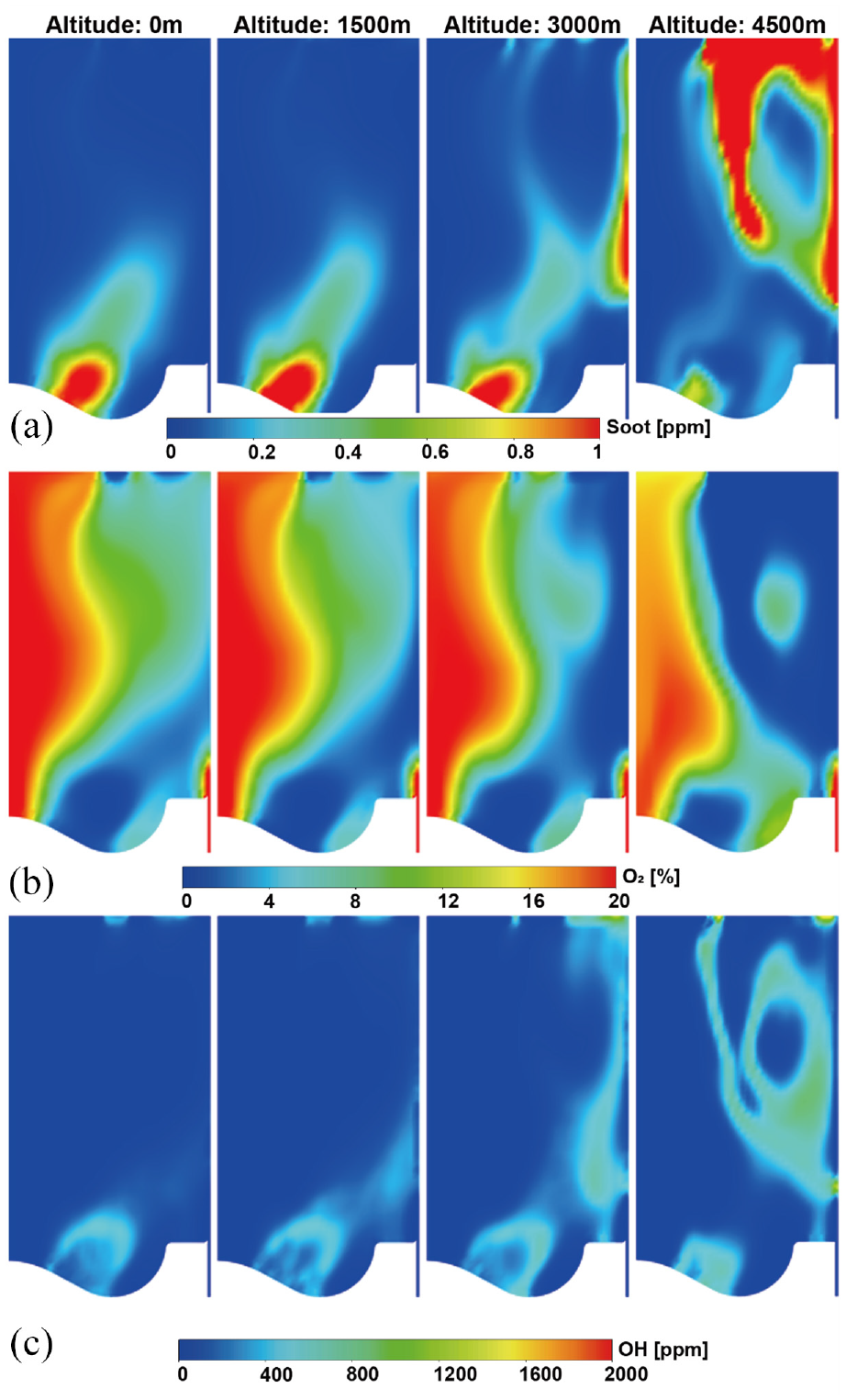
Effect of altitude on the (a) soot, (b) oxygen, (c) OH concentration spatial distribution in the vertical plane during main combustion process.
Summary and conclusions
This study aimed to investigate the impact of altitude on in-cylinder spray, combustion, and soot formation processes in diesel engines. A 3D computational fluid dynamics (CFD) model of a single-cylinder, four-strokes, direct injection (DI) compression ignition, intake boost research diesel engine is established. The main findings are listed following:
The established 3D CFD numerical model for diesel engines at high altitude is capable of accurately capturing in-cylinder combustion deterioration and heat release characteristics, as evidenced by the high level of agreement between predicted pressure and HRR traces and experimental data.
It has been observed that engine performance and soot emissions deteriorate as altitude increases, and a sharp drop occurs when the altitude exceeds 3000 m, which can be attributed to the dramatic decline in combustion efficiency. Through analysis of 3D solutions of temperature and equivalence ratio, it is found that the prolonged spray penetration length and faster spray injection velocity are due to the lower pressure at high altitude. As a result, it is observed that at an altitude of 4500 m, a greater proportion of fuel is delivered to the squish zone. This phenomenon is undesired, as it does not enhance air utilization. In other words, the extended spray leads to a decrease in air utilization, which ultimately results in a sudden drop in combustion efficiency at altitudes above 3000 m.
Furthermore, it is noteworthy that the trend in soot emission exhibits a contrary pattern to that of combustion efficiency, with a dramatic increase observed at an altitude of 4500 m. Analysis of the distribution of soot concentration, OH radical, and oxygen has revealed that soot is rapidly generated during the combustion process, especially in the fuel-rich zone. Subsequently, the majority of soot is consumed by oxidization reactions, ultimately resulting in low soot levels. However, this process is impeded at higher altitudes. For instance, at an altitude of 4500 m, the oxidization process is significantly slower compared to that at sea level. This phenomenon is attributed to the degradation of spray behavior and corresponding equivalence ratio distribution at high altitudes.
Overall, this study has identified that the extended penetration of the spray, caused by reduced pressure and air density, leads to poor air utilization, resulting in decreased performance and increased emissions. Hence, it is recommended that optimization of the combustion chamber geometry and injection strategies of diesel engines operating at high altitudes be undertaken to improve air utilization and combustion quality. This will serve as an avenue for further research in the future.
Footnotes
Appendix
Handling Editor: Chenhui Liang
Declaration of conflicting interests
The author(s) declared no potential conflicts of interest with respect to the research, authorship, and/or publication of this article.
Funding
The author(s) received no financial support for the research, authorship, and/or publication of this article.
