



Abstract
Single wave impeding barrier has been widely evaluated to attenuate vibrations. Nevertheless, research on the utilization of multiple-layer wave impeding barriers is extremely limited since most studies focus on periodic foundations and periodic piles. In this work, the attenuation of ground vibration utilizing a periodic wave-impeding barrier composed of rigid and elastic materials was investigated by applying improved plane wave expansion approach using the notion of phononic crystals, then the simulation of the proposed barrier is presented to demonstrate its relevance to the real case, where it can isolate more than 75% of vibration induced by El Centro earthquake. The effects of the key factors on the attenuation zone of the proposed wave impeding barrier are evaluated by conducting a thorough parametric study. Numerical results demonstrate that the mitigation efficiency at low frequencies increased as Young’s modulus of elastic material increased and as the density of two materials and periodic constant decreased. In addition, the proposed ANN model showed high accuracy to predict those parameters in order to choose them according to the desired attenuation zone. The findings of this study will aid the stakeholders in selecting the optimal geometrical and physical characteristics of the suggested barrier to attenuate vibration.
Keywords
Introduction
Ground vibration produced by the earthquake, traffic load, machine operation, and engineering construction causes structural and acoustic problems to the adjacent structures. To isolate or eliminate such problems, multiple types of countermeasures have been developed recently. Common vibration mitigation measures that have been proposed include the use of open or infill trenches, 1 rows of piles,2,3 and wave impeding barrier (WIB, henceforth). Among the previous works related to WIB, six important studies are to be cited. Hung et al. 4 employed the 2.5D finite/infinite element method to reveal the efficiency of WIB in scattering the train-induced vibrations. Çelebi and Göktepe 5 analyzed the isolation performance of WIB applied to protect the structure, using 2D FEM (Finite element method) in the time domain via Plaxis software package. Gao et al. 6 conducted several field studies to assess the active vibration attenuation of a horizontal wave impedance block for a surface foundation. Gao et al. 7 proposed a Duxseal wave impeding block (DXWIB), made of a new material Duxseal, as an active countermeasure of ground vibration. Coulier et al. 8 demonstrated that the subgrade stiffening block next to the railway track may behave as a WIB. The results of the aforementioned works reveal that the attenuation effectiveness of these barriers depends strongly on the frequency range of vibrations. Thus, it is difficult to achieve the isolation performance for a huge range of frequencies.
Since 2006, several researchers studied the reduction of vibration, using a periodic structure which is a recent solution according to the notion of phononic crystals. 9 Thanks to the structure’s periodicity, the incident wave will be stopped on the bandgap frequency. In other words, incident wave propagation is prohibited if its frequency falls into the range of the attenuation zones of the structure. Among these researches, Shi et al. 10 proved the screening efficiency of a seismic vibration, using a layered periodic foundation as a support to a six-story building. Yan et al. 11 carried out in situ measurements of a scaled 2D periodic foundation supporting a higher structure. Wang et al. 12 have shown that periodic barriers perform better than open trenches for a certain frequency range in mitigating the vibration generated from the shaker. Moreover, certain research has investigated the effectivity of periodic pile barriers in attenuating vibration.13–15 Based on the theory of attenuation zone, Zhao et al. 16 evaluated the isolation performance of Rayleigh waves, using periodic pile barriers with different cross section. Using the same approach Wang et al. 17 evaluated the vibration screening of periodic rock-socketed pile barriers with the existence of groundwater, also some authors conducted a parametric study to reveal the key parameters influencing the existing AZs (attenuation zones) of periodic trench-soil system.18,19
To remedy the limitation of WIB to attenuate vibrations for a range of frequencies, this paper studies the isolation capability of the periodic wave impeding barrier to isolate ground vibration for a huge range of frequencies. In this paper, an ANN model was developed. It can predict the suitable infill materials and geometry of periodic wave barriers in order to isolate the ground vibration. ANN model was used successfully in different fields such as medicine and mechanical and civil engineering; for example, many studies used ANN to predict ground vibration induced by blasting.20,21 Thus, the next parts of this study are organized as follows. First, the attenuation zone of a periodic wave impeding barrier (PWIB) is investigated, applying the improved plane wave expansion method (IPWE), then the proposed method was compared to the available data in the literature. Second, using the Ansys program, a 3D numerical model is elaborated to simulate the AZs for a finite periodic structure. Third, a parametric investigation is conducted to analyze the impact of essential parameters on the AZs. Fourth, an ANN is developed to predict the parameters of the components of the PWIB that can mitigate a range of frequencies that can be generated by a given vibration. Finally, conclusions and recommendations are summarized.
Research significance: As mentioned before extensive studies have used periodic pile or foundation barriers to show the isolation efficiency of ground vibration, while this paper evaluated the performance mitigation of the PWIB which can help the stakeholders to isolate a huge range of frequencies of ground vibration even for the existing construction contrary to the solution studied in the literature. Furthermore, the proposed ANN model allows the stakeholders to choose the physical and geometrical parameters of the PWIB which can be used to control a frequency range corresponding to a given vibration that can be generated by traffic, earthquake, etc.
Theoretical formulation and validation
Governing equations
In this paper, the periodic wave impeding barriers, made up of two materials 1 and 2, are considered with different densities and elastic constants. These barriers are organized alternatively in the z-direction to define a one-dimensional periodic wave impeding barriers as shown in Figure 1, where h1 and h2 denote the thickness of material 1 and 2, respectively. Thus, the periodic lattice is H = h1 + h2. Assuming isotropic, continuous, perfectly linear viscoelastic materials with a small deformation regime and without taking damping and body force into consideration, the equation of motion for a shear wave can be formulated as9,22:

Where

Simplified scheme of periodic wave impeding barrier.
Bloch’s theory
Bloch’s theory states that solutions to the displacement equation in a periodic structure could be represented as a plane wave envelope function’s product. As maintained by the Bloch theorem,

ω denotes the angular frequency. As shown in Figure 2, k represents the wave vector restricted to the first Brillouin zone. Let


The reduced wave vector.
It is crucial to note that R is the lattice vector. By virtue of the Bloch theorem, solely one unit cell instead of the periodic structure is considered in our calculations, and according to equations (1) and (2), the boundary conditions of the typical cell are9,22:

Taking into account the structure’s periodicity and according to the Bloch theory mentioned before, the following equation emerges:

The plane wave expansion method
There is a great number of methods employed to study the dispersion diagram of periodic structures, among which are the finite-element-method (FEM),23–26 plane-wave-expansion-method (PWE),22,27,28 the mass-spring-model (MSM), 29 finite-difference-time-domain-method (FDTD), 30 and transfer-matrix-method (TMT). 31 In this study, the PWE method is used.
Owing to the periodicity along the z-axis, the density ρ(z) and the Lamé constants μ(z) can be expressed as a Fourier series9,22:

Where f(z) is ρ(z) or μ(z), i denotes the imaginary unit number, and G is

For the particular case G = 0, 22

The general case (G ≠ 0) is given by 22 :

Hence, the result is:

Substituting equations (2) and (3) into equation (1), a linear algebraic equation which can be used to form the eigenvalue problem of the structure is attained as follows 22 :

IPWE
Since the used materials have different properties and the PWE method is a Fourier-based method, it can cause difficulties in terms of convergence and time which is required due to the Gibbs phenomenon. Hence lies the use of IPWE. Thus, the sole distinction between them is how the Lamé constants μ(r) and the density ρ(r) are used in the equations, and it is as follows 32 :

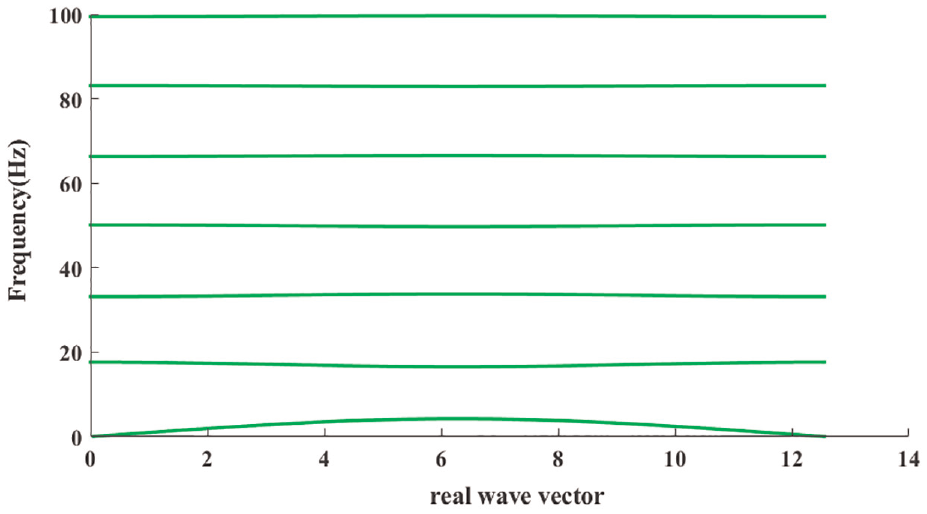
The band gap frequency of PWIB composed of elastic and rigid material, with the properties mentioned in Table 1, is determined using the IPWE method mentioned before, with 2001 plane waves. The parameters are presented in Figure 1 and the dispersion curve is demonstrated in Figure 3. The first three attenuation zones are 4.254–16.5767, 17.6572–33.1535, and 33.7207–49.7302.
Material parameters.

Dispersion curve.
As mentioned by Li et al. 23 the ambient frequency generated by a train moving at a speed of 380 km/h is 36.5–42.5 Hz. As maintained by Huang and Shi 13 the principal frequency of vibration generated by a train is in the range 10–40 Hz. Also Pu and Shi, 19 reported that the main frequency of vibration caused by the train is ranging from 30 to 80 Hz.
As stated by Huang and Shi 13 the frequencies of vibration induced by automobile, bus, and Truck are in the range of 3–30, 7–27, and 10–35 Hz, respectively.
Moreover, the range 0–10 Hz corresponds to the vibration near Nuclear Power Plants. 33 In addition, the ambient vibration of the Mexico earthquake in 1985 is from 0 to 1.5 Hz. 34 Thus, the first three attenuation zones correspond perfectly to the band frequency of vibration induced by traffic and earthquake.
Validation
The proposed method has been verified, as being correctly precise for the calculation of AZs, through comparing it with the method developed by Shi et al. 10 in which Shi and co-workers studied the isolation efficiency of a periodic foundation composed of several rubber blocks and concrete layer. Using the theory of periodicity, they considered such a periodic foundation as an equivalent periodic layer. Therefore, a multi-layered structure made of rubber and concrete materials is considered in which the Poisson ratio, density, and Elastic modulus of the concrete one are 0.2, 2300 kg/m3, and 25 GPa, respectively. The Poisson ratio, the density, and the Elastic modulus of the rubber material are 0.463, 1300 kg/m3, and 0.137 MPa, respectively. The thickness of the concrete layer and that of the rubber layer are 0.2 and 0.2, respectively. It can be shown from Figure 4 the attenuation zones are calculated by using the proposed IPWE method. The results attained by this method match perfectly with the results attained by Shi et al. 10

Dispersion diagram of layered periodic foundation.
Result and discussion
Vibration attenuation verification
The AZs calculated previously are suitable for an infinite periodic structure, while in reality the number of unit cells is finite. Thus, in this section, a 3D numerical model is developed to evaluate the dynamic response of the periodic WIBs system to demonstrate the efficiency of the attenuation zone. The numerical model’s geometrical parameters as shown in Figure 5 are:


Schematic diagram of attenuation vibration using PWIBs.
The impact of the surface wave is simulated by using a periodic surface harmonic load of magnitude of 10 Pa and a frequency of 40 Hz. The material properties of soil were depicted in Table 2.
Soil properties.

The numerical simulation is carried out using Ansys Program. The isolation efficiency of PWIB is evaluated by using the amplitude reduction ratio Ar. This ratio is determined as the maximum spectral amplitudes of displacement obtained for the case of the existence of the PWIB. These amplitudes are divided by the maximum spectral amplitudes of displacement obtained without the proposed solution at a given point after the installation of PWIB.
Figure 6 shows the displacement response of point P in the y direction. It is clear that the vibration is reduced significantly with the existence of PWIB compared to that without PWIB, generating an Ar of 0.299 which demonstrates the validity of the suggested solution.

Displacement response of point P in the y direction.
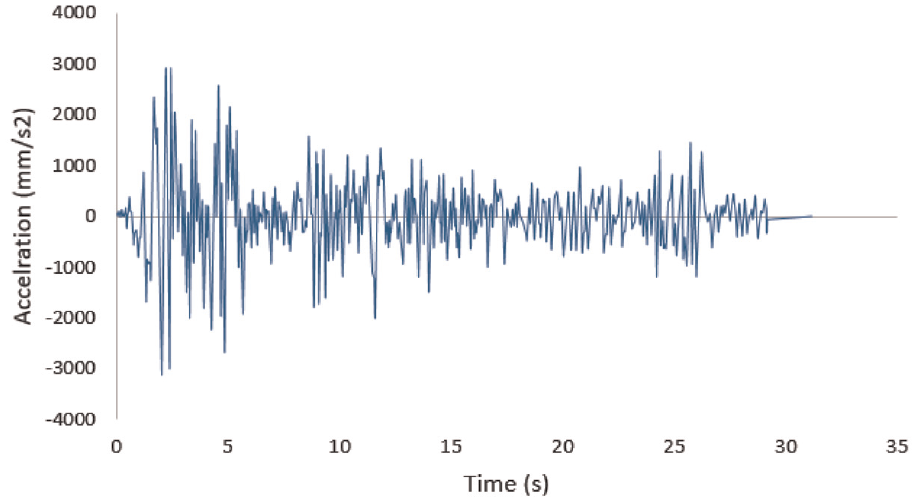
The transient response of PWIB subjected to earthquake-induced vibration is further studied where the time history acceleration of the El Centro earthquake was plotted in Figure 7.
El Centro earthquake’s time-acceleration history.
According to Figure 8, the acceleration response of the point P with considering of PWIB is highly attenuated, compared to that without PWIB. Therefore, the finite element study of the real structure fits perfectly with that based on the periodic theory.

Displacement results in the y direction of point P.
Parametric study
In order to introduce the PWIB into the traffic and seismic isolation, in this part, a parametric study is done to investigate the effect of some important parameters on the band gap frequency. The single variable method is to be adopted, in which one parameter varies solely whilst the other factors remain unchanged as described in Table 1. Briefly speaking, only the result in the first attenuation zone (FAZ) described by the three parameters – Width Attenuation Zone (WAZ), Upper Bound Frequency (UBF), and Lower Bound Frequency (LBF)-is displayed.
Influence of elastic moduli
The elastic moduli influence the first attenuation zone in two ways. First, the impact of Young’s modulus of rigid material on the FAZ of the PWIB has been investigated. To do so, it is varied in the range of 20–40 GPa. It can be seen from Figure 9 that all parameters are in a constant state. Thus, Young’s modulus of rigid material does not affect the attenuation zone. The parameter could be determined depending on economic and safety criteria. Second, the effect of elastic moduli of elastic material on the FAZ of the PWIB has been investigated. To do so, the value is varied in the range of 0.1–6 MPa. It can be shown from Figure 10 that the increase of Young’s moduli of elastic material leads to an increase for the three parameters LBF, UBF, and WAZ. Thereby, Young’s modulus of elastic material can be controlled to have the FAZ wanted. Those results are consistent with the research on the periodic layered slab track published in the literature. 25

Effect of Young’s modulus of rigid material on FAZ.

Influence of Young’s modulus of elastic material on FAZ.
Influence of density
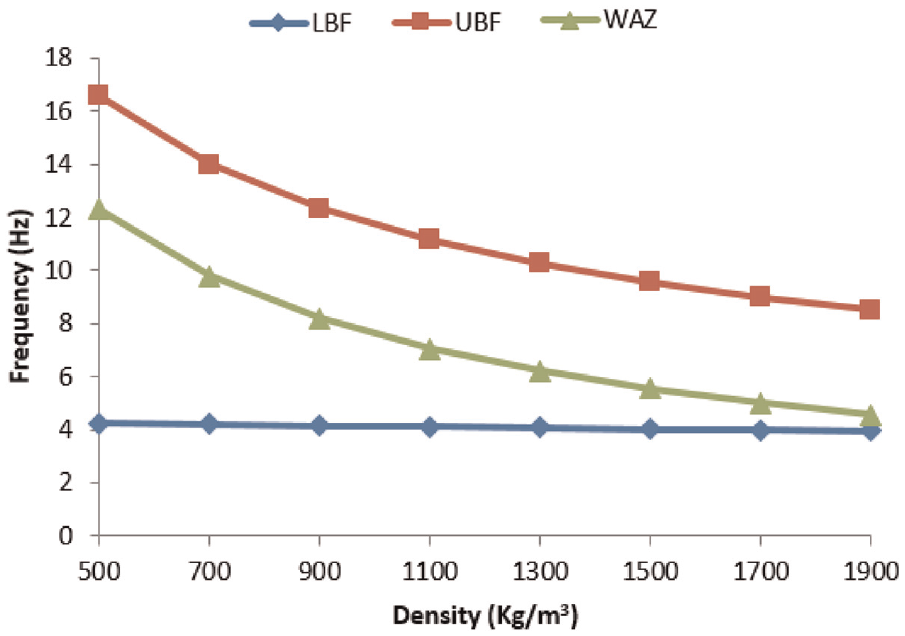
Density influences the first attenuation zone in two ways. The impact of the rigid material density on the FAZ of the PWIB has been analyzed. Therefore, the value is varied in the range of 1500–2900 kg/m3. It can be reported from Figure 11 that the UBF remains unchanged, while WAZ gradually increases and LBF constantly decreases as the rigid material density increases. The choice of the density of rigid material depends on structural security. In addition, the effect of the elastic material density on the FAZ of the PWIB has been analyzed. Therefore, the value is varied in the range 500–1900 kg/m3. It can be seen through Figure 12 that LBF is almost constant, whereas the increase of the elastic material density produces the decrease of both UBF and WAZ.

Impact of rigid material density on FAZ.
Impact of elastic material density on FAZ.
This funding can be explained also in terms of the impedance ratio which is represented as 1 :

The Gb and ρb stand for the Shear moduli and the density of the infilling material, respectively. Gs and ρs are those of the soil. Generally, when the IR value is higher than 1 means, the structure has no isolation effect. However, for low and almost zero values the structure works as an open trench, allowing low wave transmission. Therefore, a high density value generates a high IR value. This is well illustrated by the WAZ value showing that the performance isolation is decreased by increasing the density value of elastic material.
Impact of Poisson’s ratio
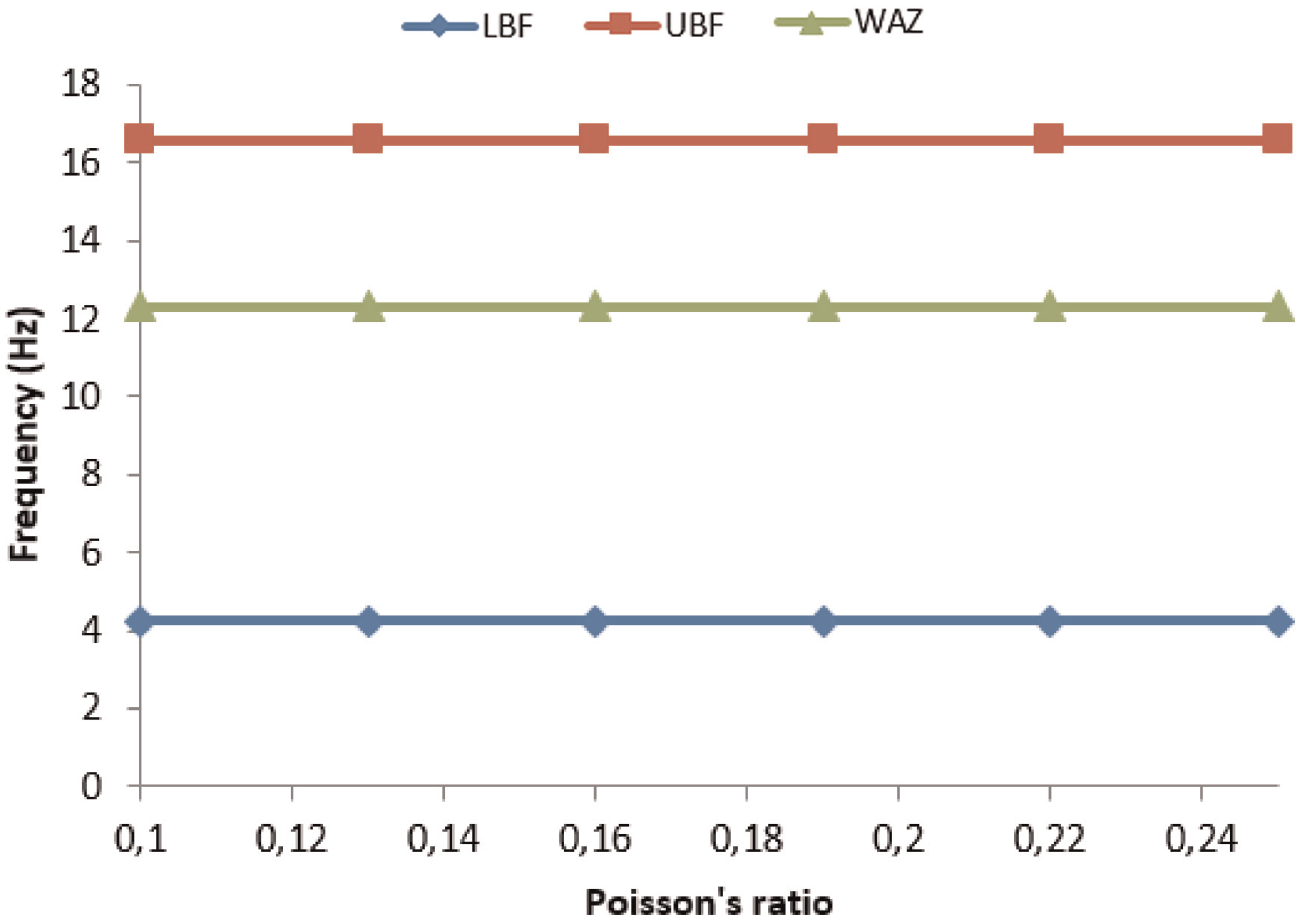
The Poisson’s ratio influences the first attenuation zone in two ways. The effect of Poisson’s ratio of rigid material on the FAZ of the PWIB has also been evaluated. Thus, it is varied in the range of 0.1–0.25. It might be reported from Figure 13 that the LBF remains constant while UBF and WAZ increase slowly as the rigid material Poisson’s ratio increases. Further, the impact of Poisson’s ratio of elastic material on the FAZ of the PWIB has been investigated. Thus, the value is varied in the range of 0.4–0.5. It might be reported from Figure 14 that the three factors LBF, UBF, and WAZ decrease slowly as the elastic material Poisson’s ratio increases. Consequently, it can be concluded that Poisson’s ratio of both elastic material and rigid material has a weak impact on the frequency band gap. This result was also found for the case of periodic pile barriers. 9
Impact of rigid material Poisson’s ratio on FAZ.

Impact of elastic material Poisson’s ratio on FAZ.
Impact of periodic constant
The impact of the periodic constant (H = h1 + h2) on the FAZ of the PWIB has been analyzed. Therefore, the value is varied in the range of 0.2–1 m. It can be observed through Figure 15 that the increase of the periodic constant generates the decrease of LBF, UBF, and WAZ. The same result was found by Hu et al. 25 that evaluated the impact of the lattice constant on the isolation efficiency of periodic slab track composed of concrete and rubber layers.

Influence of periodic constant on FAZ.
Artificial neural network (ANN) model
ANN is a statistical tool that finds its roots in neurobiology, in which they are designed in the form of very simplified mathematical models inspired by the concept of the biological neuron, which is conceived as a network processing input digital information with interconnected processors called artificial nodes allowing to link the variables in a non-linear way. 35 Each neuron is associated with its weight, the weighted summation of the inputs passes through the activation function to give the output as shown in Figure 16.

Structure of an artificial neuron.
The LBF and WAZ are the crucial parameters for determining the dynamic characteristics of periodic structures, and according to the previous part, the most parameters that influence the attenuation zone are the elastic moduli of elastic material, the elastic material density, and the periodic constant.
In this subsection, a backpropagation multilayer perceptron neural network was employed to calculate the intrinsic parameters of the materials making up the proposed solution based on these two parameters. This type of neural network contains one or several hidden layers and an output layer, which consists of reducing the error between what the network predicts and what it actually was.
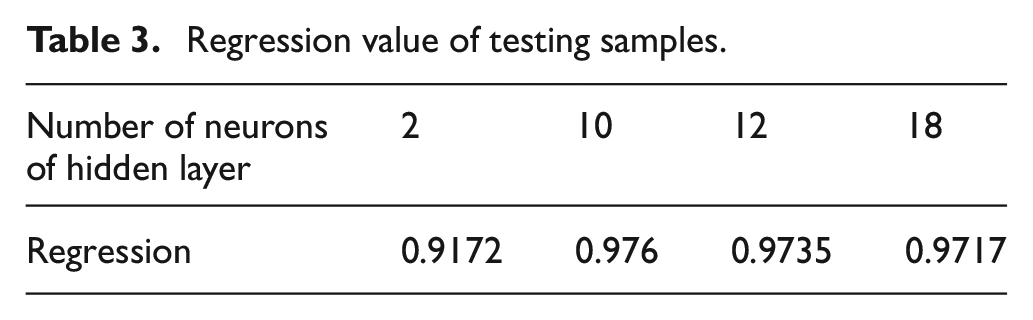
The network developed here has one hidden layer. To choose the number of neurons in the hidden layer, we carried out several tests in which this number varied from 2 to 20. It turned out that beyond 10 neurons the performances are not improved in a significant way in terms of the regression value of testing samples as shown in Table 3. Hence this 10-neuron configuration was retained.
Regression value of testing samples.
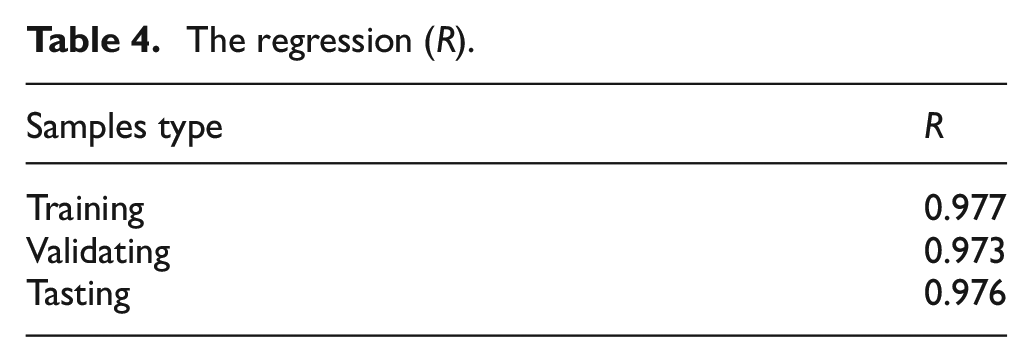
The learning step is calculated using The Levenberg-Marquardt algorithm, it is a gradient descent algorithm known as backpropagation which allows to calculate a local gradient of the error with respect to the weights. The input layer is composed of two neurons, representing LBF and WAZ. The output layer is composed of three output variables which are the elastic moduli of elastic material, the elastic material density, and the periodic constant (as shown in Figure 17). The data set is made up of 890 results from varying the two input parameters. Of this database, 70% are retained for training neural networks and 15% for validated networks. The remaining 15% make up the test set. Table 4 illustrates the regression results for testing, validation, and training samples, notice that the regression value is closest to 1 indicating the perfect correlation between the targets and outputs. Thereby, the effectiveness of the ANN in the estimation of the three variable values is lofty. The developed neural network allows the choice of materials composing the PWIB according to the desired attenuation zone.

The neural network architecture used in this study.
The regression (R).
Conclusions
In this article, the frequency band gap of PWIB composed of elastic and rigid material has been investigated using the IPWE method according to the notion of phononic crystals. The results affirm that the AZs of the proposed solution correspond perfectly to the band frequency of seismic and traffic vibration. Considering the significance of the notion of attenuation zones, the influence of various factors such as elastic moduli, density, Poisson’s ratio, and the periodic lattice have been thoroughly examined. Furthermore, an ANN model is created to predict the parameters of the components of the PWIBs. The principal findings are drowning as follows:
The proposed periodic wave barriers can reduce almost 75% of El Centro earthquake induced vibration, which confirms the isolation efficiency of the PWIB based on the periodic theory.
Periodic constant, density, and elastic modulus of elastic material are the major parameters that govern the FAZ of PWIB in which the increase of periodic constant and elastic material density constant leads to the decrease of LBF, UBF, and WAZ while these three parameters increase as the elastic modulus of elastic material increases.
The Poisson’s ratio has no notable impact on the FAZ of periodic wave impeding barriers.
The ANN model developed in this study shows high accuracy in predicting periodic constant, elastic modulus, and density of elastic material in order to choose them based on the required attenuation zone which corresponds to a frequency range of a given vibration that can be generated by earthquake, railway, etc.
Unlike the vibration attenuation solution proposed by the literature, PWIB proposed in this article can be used for the case of already existing sources of vibrations and especially for existing structures receiving these vibrations. Therefore, the experimental study on 3D PWIB for real cases and data of ground vibration can be suggested for future work. Further, the optimization studies are recommended to have a PWIB with an AZ that can simultaneously attenuate vibration at low and high frequencies, which can be induced by earthquake, traffic vibration, blasting, etc.
Footnotes
Acknowledgements
The authors appreciate the editor’s and reviewers’ insightful comments.
Handling Editor: Chenhui Liang
Declaration of conflicting interests
The author(s) declared no potential conflicts of interest with respect to the research, authorship, and/or publication of this article.
Funding
The author(s) received no financial support for the research, authorship, and/or publication of this article.
