




Abstract
The potential of hybrid nanofluid (HNF) to maximize heat transportation has captured the attention of many researchers, inspiring them to further investigate the performance of the common base fluid. Conventional flow in Cu-Al2O3/H2O hybrid nanofluid (HNF) toward a high permeability horizontal flat plate incorporated in Darcy porous medium has been explored in this research to determine how Cu-Al2O3/H2O hybrid fluid will respond thermodynamically when physical factors like suction/injection and slip boundary conditions are present. In addition, the effects of radiation, dissipations, energy engagement, and inclined magnetized field associated with the fluid flow were studied. The governing system is transformed by similarity transformations to a solvable ordinary differential equation by employing HAM (Homotopy Analysis Method) scheme. The main results show that Cu-Al2O3/H2O has high thermal conductivity compared to Cu/H2O. As a result, hybrid fluids are essential for the development of thermal phenomena.
Introduction
Heat transfer intensification is essential in many industrial, engineering, and medical fields with achievable cost and less energy. The demand for tiny gadgets with remarkable attributes including excellent performance, precise operation, and prolonged lifetime is nowadays being encouraged by breakthroughs in science and technology. Viewed in this way, the attention of many researchers and scientists has gathered in a concerted effort to analyze heat and mass transfer.1–3 Scientists and scholars introduced a novel class of liquid they declared “nanofluids” (NF) as a result of solids’ superior heat transmission characteristics to those of ordinary fluids. 4 Gowda et al. 5 scrutinized the impact of activation heat with chemical reactions on energy transmission of the Marangoni flow of a non-Newtonian nanofluid. KKL (Koo-Kleinstreuer and Li) correlations and a refined model of Fourier heat flux are used in Punith et al. 6 to investigate the idea of computational simulation of nanocomposite flow across a curved stretchable surface. With H2O as a common fluid and Cu as the nanoparticle, Sheikholeslami and Ganji 7 calculated the heat transfer rate and demonstrated the influence of volume fraction and Nusselt number on identical surfaces. 8 looked into the Casson nanofluid flow between parallel discs that are convectively heated. 9 investigated the radiative-reactive magnetized flow of viscoelastic nanofluid, which contains gyrotactic microorganisms due to a vertical stretching surface while being subject to various convective and stratification limitations. 10 According to the research on the mathematical replication of nanofluids flow classifying as root canal, the root canal’s wall shear stress rises as nanofluids concentration and irritating volumetric flow rate increase. In an intelligent computing model, Shoaib et al., 11 examined the Ohmic thermal effect and entropy creation for a microfluidics scheme of Ree-Eyring fluid.
A novel and advanced nanotechnological fluid is known as a hybrid nanofluid (HNF) is developed by distributing two nanostructures into an established heat transfer fluid. Hybrid nanofluid (HNF) is the combination of two different nanoparticles in the same base fluid. HNFs have played an extensive role to enhance the HT rates, scientists and researchers have recently examined ternary hybrid nanofluids (THNFs). THNFs have a higher TC and dynamic viscosity than convectional fluids, HNFs, and NFs. THNF is made up of three different types of NP, water being the basic fluid. These liquids are widely used in solar power and photovoltaic thermal collectors. Recent studies suggest that hybrid nanofluids, particularly those operating at very high temperatures, can successfully replace convectional cooling. Hybrid nanofluids were shown to have excellent thermal consistency and characteristics when compared to simple nanofluids, which makes them ideal for heating purposes such as solar thermal systems, automotive cooling systems, heat sinks, or thermal energy storage. The idea of a hybrid nanofluid was developed by Suresh et al. 12 and Baghbanzadeh et al. 13 and investigated by various studies and numerical outcomes. In contrast to nanofluid and simple fluid, the hybrid nanofluid, in his opinion, increases energy transmission. Many several researchers were inspired to work in the area of hybrid nanofluids by this concept. This concept inspired a wide spectrum of researchers to work in the hybrid nanofluid sector. Mishra and Upreti and Upreti 14 used the Buongiorno model to compare the Ag-MgO/water0and Fe3O4-CoFe2O4/EG-water hybrid0nanofluid flows along curved surfaces with chemical reactions. They examined the Ag–MgO/H2O hybrid nanofluid flow for the enhancement of heat transfer (HT) under the inspiration of viscous dissipation.
Tlili et al. 15 developed a novel framework for hybrid nanofluidic (methanol) three-dimension motion with the effect of MHD on an irregular, thick surface with slip factors. According to the results, the transmission of the heat of the flow of hybrid fluid is much higher than that of the corresponding nanofluid with the unique nanoparticle. The resistive type force caused due to the magnetic force on the fluid is less pronounced in the hybridized fluid that contains the nanofluid. Kumar et al. 16 proposed exploring the effects of activation heating on hybrid nanocomposite flow on a curved stretchy surface. Darcy-Forchheimer SWCNT-MWCNT’s thermal management was examined by Sahu et al. 17 due to a vertically stretched cylinder-induced cross-hybrid nanofluid flow with and without inertia effects. The characteristics of the flow of hybrid nanofluids are studied by Hussain, 18 who reveals that the mixture with the highest energy transfer coefficient, graphene, and molybdenum disulfide (MoS2), utilizes a marginally greater particle pressure than water. The impact of the non-Fourier heat flux models of interior energy production on the tri-hybrid nanofluid flow, in which water takes as a base fluid was studied. 19 Diamond-Co3O4/ethylene glycol hybrid nanofluid flow with nonlinear radiative MHD flow was examined by 20 for entropy effects. Waini et al. 21 reveal that there are two anti-flow solutions when he discusses the motion of hybrid nanostructure of different sizes of complex nanoparticles with the extension impact of mixed convective through a permeable medium. Shaw et al. 22 investigated for each Prandtl number of different impacts of thermal radiations (linear, nonlinear, and quadratic) on MHD flow. Naveen et al. 23 conduct a comparative study on heat transfer analysis in tri-hybrid nanofluid that is transporting various nanocomposite shapes in three dimensions of unstable magnetic fluid flow. Nayak et al. 24 highlighted the importance of non-Newtonian fluids with hybrid nanostructures in terms of thermodynamics. The studied literature specifies that the hybridized fluid with different nanoparticles is an essential replacement for conventional thermal systems. Nadeem et al. 25 investigated the flow of hybrid nanofluid through a curled medium and during this analysis, they predicted that when suction or injection are related, the hybrid nanofluid allocates energy faster than the simple nanofluid.
Due to its applications across many technical fields, boundary film moves through a stretchable medium and has attracted a lot of attention. This kind of flow occurs in many different contexts, such as the boundary film along a conveyer of material handling, liquid film, and condensing mechanism, sheet, and fabric cooling, or drying processes, manufacturing of fiberglass, and many other scientific, and technical sectors. In fluid mechanics, the fluid flow over a stretchy surface is crucial for biomedical sciences and industrial operations. Crane 26 was the first, who discovers a way of getting the same outcomes for the nanofluid stream through an extending sheet or surface. However, compared to the stretching scenario, the flow passing through the stretch film received little attention. The use of the KKL relationship in the computation of nanofluid flow over a stretched sheet, taking magnetic dipole, and chemical reaction into account was emphasized in. 27 Vjravelu et al.. 28 explored the viscous nanocomposite motion over a linearly expanding medium. In the presence of a magnetic dipole, 29 brought up the concept of the important impact of Stefan blowing on nanocomposite motion across a stretchable medium. Ariel et al. 30 used the HPM technique and examined the fluid flow over an elongating surface. Using two simultaneous extended permeable surfaces with slipping velocities, 31 investigated a 3D nonlinear radiative hybrid nanofluid flow. Dutta et al. 32 analyzed the temperature field inflow across an expanding surface with heat flux and the Prandtl effect. To model, the movement of nanofluids over a bent stretchable surface, 33 looked into the use of convective energy transmission along with KKL correlation. Fang et al. 34 explained the slip of MHD ferrofluid flow over a spreading texture and investigated the exact solution with the combined effect of slip conditions and magnetic field. Punith et al. 35 looked explored the impact of thermophoretic particle deposition and magnetic dipole on heat and mass transport in ferromagnetic fluid flow across a stretching sheet. ’According to Andersson et al., 36 who researched the power law model of fluid flow across an expanding sheet under the influence of a magnetic field, the thinner boundary layer in this article is due to the magnetic field impact, which increases wall friction.
The hybrid flow of nanofluids over a permeable porous surface has become the focus of many academics due to its wide range of applications. The fields of nuclear engineering, solar sciences, and material sciences could “all” benefit from the use of flow-through permeable porous surfaces. Darcy’s law is incorrect and frequently applied to comprehend the porous surface flow. Deutsch et al. 37 developed the second-order polynomial in the momentum equation based on the permeability when calculating the impact of inertia to pinpoint the Forchheimer component, see the study. 38 Many hybrid nanofluid regularities utilize Darcy Forchheimer’s theories, and numerous academics have explored a porous medium flow. Here many of them are cited in this manner. Sahu et al. 39 studied the Carreau nanofluid’s hydrothermal stagnation point flow across a moveable tinny needle using non-uniform Navier’s slip condition along with chemical processes in a Darcy-Forchheimer surface. Eid et al. 40 investigated and incorporated homogeneous and heterogeneous catalysis on electromagnetic radiational Prandtl fluid flow with the theory of the Darcy-Forchheimer substance scheme. Sahu et al. 41 examined the thermal implications with SWCNT/MWCNT suspensions and the Darcy-Forchheimer flow behavior as a result of the rotating disk’s shrinkage. In this regard, many researchers have studied the Darcy Forchheimer fluid flow for different industrial and engineering fields for heat transfer applications.42–44
In this work, we demonstrate the results of a complex fluid over an exponentially stretching sheet that contains nanomaterials of Copper and Aluminum Oxide suspended in water. Our inspiration for this study came from the aforementioned viewpoints. The investigation of many elements affecting the hybrid flow, and nanofluid’s heat transport form the basis of the suggested model. Additionally, graphic and statistical sketches of the impact of several parameters on the kinetics of hybrid fluid phases are presented. The current analysis is a novelization of the previously published work. 45
The following research gaps are addressed by this study.
➢ How does the magnetic field cause the (HNF) to flow over the slippery surface?
➢ How can one observe the impact of the porous space in the existence of suction/injection terminologies?
➢ What consequences does natural convection have on (HNF) heat transfer?
➢ How does the thermal radiation, and heat absorption/omission affect the (HT) of (HNF)?
Applications
By combining the velocity slip, temperature convective conditions, and cross-diffusion analysis, it is possible to obtain information about the behavior of HNF flow via a stretched surface. The results of this analysis can lead to better uses in different fields, such as refrigeration, industries, chemical treatment, solar energy systems, heat exchangers, biomedical engineering, energy production, etc.
Novelty
The recent work aims to investigate the effect of hybrid nanoparticles (Cu-Al2O3) in the form of (HNF) to analyze the (HT) rate. The problem is based on differential equations which have been solved through the (HAM) technique.
The structure of the paper is displayed below.
❖ Recent work is extended to describe the impacts of solid volume fraction, suction, and injection, viscous dissipation, and Newtonian heating.
❖ The most current research relies on a hybridized fluid that incorporates Cu (copper) and Al2O3 (aluminum oxide) nanoparticles into the H2O base fluid.
❖ Current findings have incorporated the influence of thermal enlargement, energy source, Darcy- Forchheimer model as well as thermal, and velocity slip of nanofluids.
❖ The magnetic field effect is inclined to the flow of fluid.
❖ Filling the spaces in the literature is the basic aim of this analysis, the modified set of differential equations is attempted with the help of the HAM technique using the advanced package of BVPh.2.
❖ The influence of the physical parameters is compared for the nanofluids and hybrid nanofluids. The obtained results show that hybrid nanofluids are more appropriate for the enhancement of heat transfer.
Materials and methods
The analysis of the heat transmission of a hybrid nanofluid flow through an exponentially extending surface with electrical conductivity and incompressibility has been taken into consideration. The physical configuration of the suggested model is presented in Figure 1. With the following presumptions, the influence of velocity, and thermal slip conditions on the flow is explored.
The flow of fluid is permeated over a stretchable sheet as a result of the stretching velocity
H2O is contained of Cu and Al203 nanostructure, where it has to be supposed that these materials are in the form of thermal equilibrium, among these there are free slippage effects.
The induced magnetic field is despite, that is very weak, instigated by the angle
The polarization effect is disregarded because there is no outside induce electric field.
The energy exchange rate is enlarged by integrating the ideas of optically high radiating effect, absorption of energy, and viscous dissipation.



The physical configuration of the model: (a) Hybrid nanofluids and (b) Geometry.
The Rosseland approximation allows for the following representation of the radiation heat flux

Where in equation (4),

Equations (5) and (6) are employed in equation (3) getting the following form:
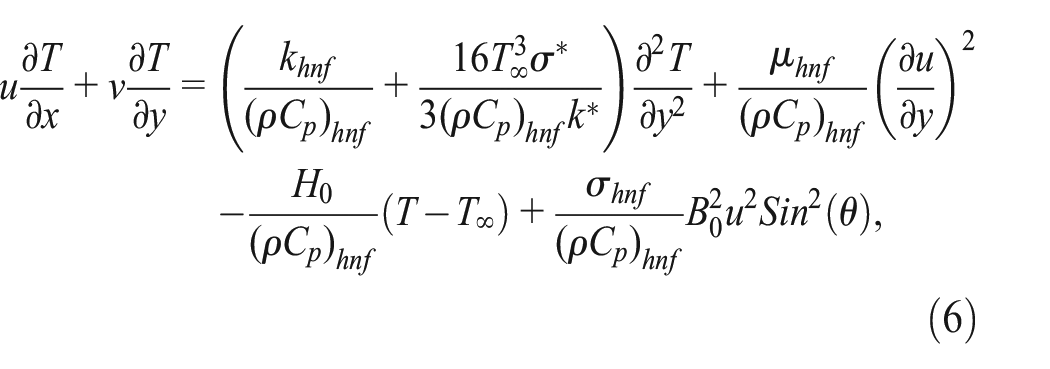
The initial and boundary conditions as given follow:

In Table 1, the experimental values of the supposed materials are presented, whereas various thermos-physical features of the hybrid nanofluid are shown in Table 2. Here
The tentative values of copper, aluminum oxide, and water.

The thermochemical possessions of the hybrid nanofluid.

By implementing the following non-dimensional factors:

Equation identically satisfied, while the equations (1–4) yield the form:
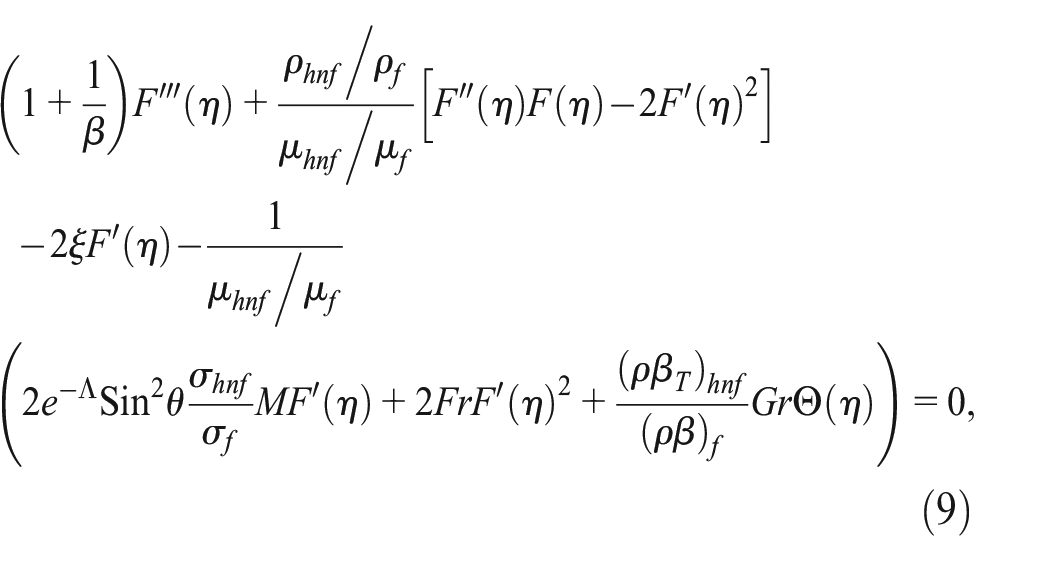

Boundary conditions are:

Here

Expressions of

Where are the wall heat flux, and the wall shear stress are given below:
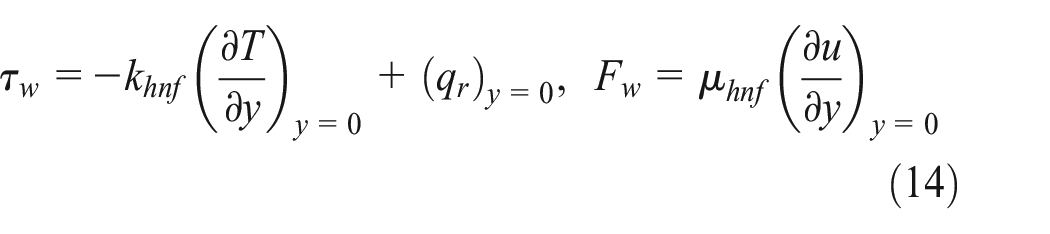
Therefore,

Solution methodology
The homotopy analysis (HAM) method is a semi-numerical serial solution used to solve high non-linear problems.46–48 The trial solution is obtained from the higher-order linear terms with the help of physical conditions. Then the MATHEMATICA software is used to find the standard solution using the initial solution. The HAM scheme is employed to get the analytical outcome of the proposed model. The transformed model (ODEs) is highly non-linear, to obtain the solution through HAM Mathematica 12 software has been used. For the current analysis, the preliminary guess and linear operators are:

The extended form of

Where
Employing Taylor’s expansion


Now


After the above implementations take the following form

Where in the above equations
Optimal control parameters for Convergence
In homotopical outcomes, the


According to Liao 46 :

Where
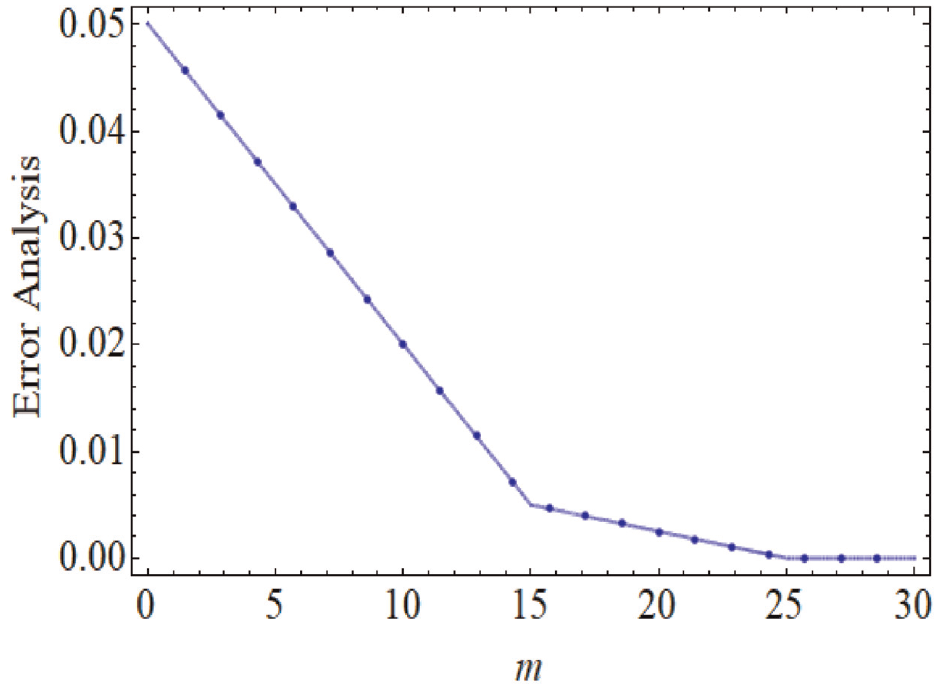
Total residual error of slip factor
Result and discussion
Graphic and tabular representations of the hybrid nanofluid flow and energy transport features were made to better understand the current problem. In this portion, we deliberate the impact of several nan-dimensional physical factors on hybridized fluid flow, heat, and concentration distribution. Individual average-squared residual errors are shown in Table 3 using the optimum convergent control parameters. The average squared residual errors for higher approximations are apparent. Table 4 demonstrates a strong similarity between the bvp4c (MATLAB 2021b) numerical findings and the HAM.
The individual average squared residual errors for the slip factor

Comparative outcomes of M for

Figure 3(a) depicts the relationship between the temperature profile and Eckert number

(a): Influence of
The
Figure 4(a) shows how the thermal radiation parameter

(a): Influence of
Figure 5(a) shows the relationship between the dimensionless magnetic parameters

(a) Influence of

(a) Influence of
Figure 7a represents the bond between the

(a): Influence of
It displays all of these Figures 3 to 7, that
Table 5 shows the variation of
Presentation of

Presentation of
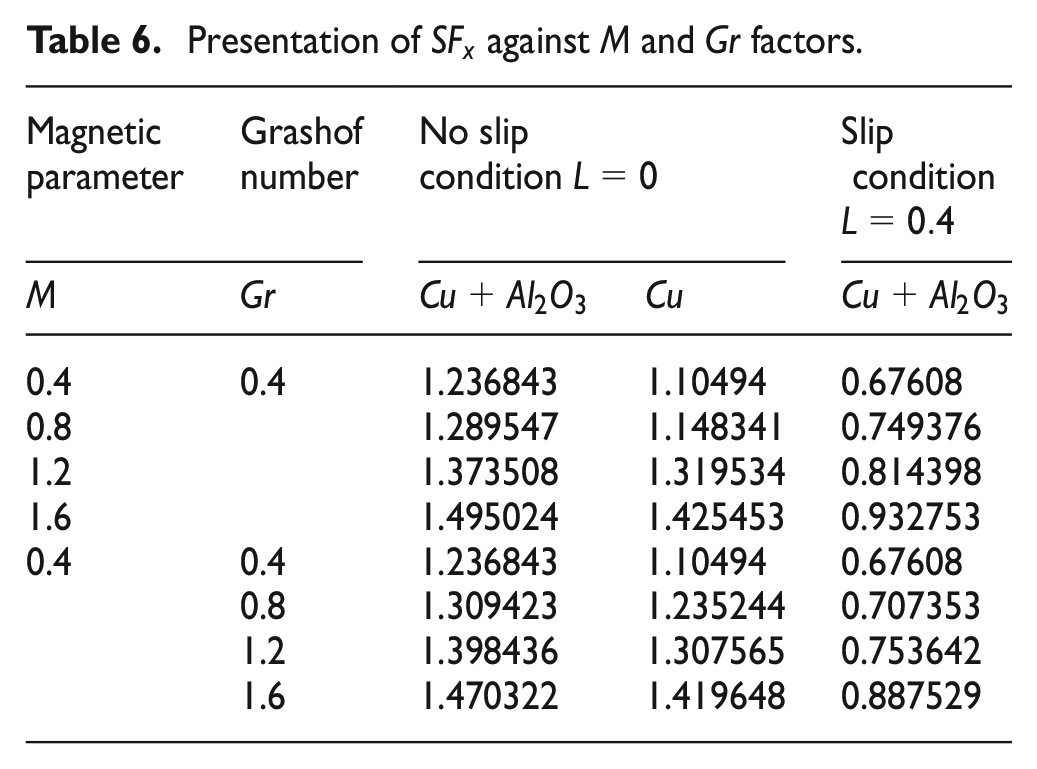
Presentation of

Presentation of

Presentation of

Bold value signifies the maximum range that is 5%.
Skin friction validation in consideration of common parameters.

Conclusion
The current investigation showed the energy conversion using a hybrid Cu and Al2O3 nanoparticle liquid flow over a large surface sheet. Also taken into account are the thermal and velocity slip conditions. By adding Cu and Al2O3 nanoparticles to the water as a base fluid, a hybrid nanofluid is produced. A hybrid substance merges the physical and chemical characteristics of sundry materials and subsequently presents these features in an augmented and standardized manner. The field of HT, surrounding transportation, and the medical sciences, can reap benefits from employing this model. In light of all of the above-mentioned findings, hybrid NF exhibits superior HT characteristics compared to ordinary NFs owing to their elevated concentration of NPs.
The main conclusions are:
Increasing the angle of the magnetic field and effect reduces a hybrid nanofluid’s velocity contour while enhancing its energy profile.
As the injection limitation is improved, the velocity and energy profiles are enhanced, however, the Darcy-Forchhemier effect along with the suction term has the opposite effect.
By increasing the radiation effect, energy source, and dissipation, while decreasing the thermal slip factor, the thermal profile of the hybrid nanofluid rose.
The dispersion of copper and aluminum oxide nanoparticles in the base fluid significantly enhances the velocity and energy transmission rate.
Thermal radiation and heat absorption contributions increase the thermal profile and boost the energy transmission rate.
Footnotes
Appendix
Acknowledgements
NA
Handling Editor: Chenhui Liang
Declaration of conflicting interests
The author(s) declared no potential conflicts of interest with respect to the research, authorship, and/or publication of this article.
Funding
The author(s) received no financial support for the research, authorship, and/or publication of this article.

Data availability statement
NA