



Abstract
This paper aims to inspect the mixed convective peristaltic transport of ternary hybrid nanofluids between two sinusoidally deforming lubricated curved concentric tubes. Titanium, Alumina, and copper nanoparticles are taken for the current problem with blood as a base fluid. The heat equation is also modeled in the presence of heat generation/absorption. The curved shape structure of flow geometry from the external side with a flexible complex nature of the peristaltic endoscope present inside that is similar to the endoscopy of a living organ. The governing expressions of the proposed model are followed under the long wavelength and small Reynolds number hypothesis. The exact solutions for flow fields that is, velocity, temperature, pumping phenomenon, and streamlines are attained by utilizing the separation of variable technique. Furthermore, graphs are used to examine and discuss different parameters outcomes. The outcomes reveal that liquid velocity enhances near the outer wall of the sinusoidal curved tube but it declines with the peristaltic endoscope for enhancing curvature parameter. The fluid temperature is reduced by enhancing the values of curvature parameter.
Keywords
Introduction
The alternative contraction and relaxation of muscles that goes on continuously in the digestive tract and pushes the food downward are known as peristalsis. Due to its exciting engineering and physiological uses, the peristalsis phenomenon has attracted a lot of attention recently. Examples of peristaltic flow in physiological systems include the movement of bile in ducts, the movement of an ovum in fallopian tubes, the transportation of embryos, and the vasomotion of blood vessels. Particular applications for the significance of the peristaltic phenomena can be found in physiological materials and a wide range of industrial processes. Peristalsis is used in the creation of peristaltic pumps, which are used in dialysis machines and artificial heart pumps during heart surgery. In light of these applications, various theoretical and experimental studies have been done to look into different aspects of the peristalsis process. In 1969, Latham 1 made a significant contribution to the study of fluid motion peristalsis. Abd Elmaboud et al. 2 investigated how non-integral peristaltic wave frequencies might cause pressure peaks to shift over time and reach different values. A lot of research has been done on peristaltic transportation, and many researchers have looked at both its theoretical and practical aspects. Tamizharasi et al. 3 have focused on how the peristaltic motion of nanofluid in an asymmetric channel affects the measurement of heat and mass transfers. Farooq and Hussain 4 deliberated the sinusoidal phenomenon of Williamson blood flow with Rosseland’s approximation and used lubrication theory to simplify the normalized equations. The impact of hall current on the electroosmotic radiative flow of modified hybrid nanoliquids in a tapered channel with sinusoidal walls was scrutinized by Guedri et al. 5 examined the electroosmotic peristaltic flow of a modified hybrid nanofluid in the presence of entropy formation. Priam and Nasrin 6 explored the Casson liquid properties with unsteady peristaltic movement and thermal features. Intensification of silver nanoparticles in peristaltic activity of Jeffrey liquid eccentric annuls with thermal jump by taking the hypothesis of lubrication theory was explored by Kotnurkar and Talawar. 7 Abello et al. 8 analyzed the main cellular component of blood arteries that comes into constant touch with hemodynamic pressures in endothelial cells. Devakar et al. 9 investigated that when an endoscope is put into the small intestine, the motion of gastric juice is one of the numerous clinical uses for how an endoscope affects the peristaltic flow, which is crucial for medical diagnosis. Nadeem et al. 10 analyzed the sinusoidal movement of viscous liquid in a vertically placed elliptic duct and attained analytical outcomes for the flow fields. The chemically reactive flow of couple stress nanomaterial in a tapered channel with slip constraints was reported by Rafiq et al. 11 and utilized the lubrication hypothesis to model the flow equations. Some important studies address the behavior of peristaltic fluid flow over various geometries.12–14
Researchers from all over the world are concentrating on the investigation of many aspects of nanofluids because of their numerous applications. A solution is termed a nanofluid when solid particles with a diameter of 1–100 nm are distributed equally in a base fluid (such as water, engine oil, ethylene glycol, etc.). Nanofluids have a wide range of applications including in heating pipes, fuel cells, drilling, lubrication, oil production, thermal storage, nuclear cooling systems, coolant in car engines, solar-heated water, drug delivery methods, and cancer diagnosis and treatment, etc. A novel type of nanofluids known as hybrid nanofluids is created by mixing two nanoparticles with the base fluid. Furthermore, the ternary-hybrid nanofluid is formed when three different types of nanoparticles are combined with base fluid. The preliminary contribution to the thermal aspect of nanofluids through an experimental approach is done by Choi and Eastman. 15 Numerous investigators pronounced the thermal performances of nano-materials for peristaltic transportation. For instance, the peristaltic motion of a hybrid nanofluid including chemical reactive species was examined by Bibi and Xu. 16 The concept of hybrid nanoparticles on the sinusoidal activity of viscous liquid in the existence of entropy generation phenomenon was developed by Zahid et al. 17 The dynamics of ternary hybrid nanofluids through a rectangular closed domain were reported by Elnaqeeb et al. 18 and resolved numerically with shooting technique. The impacts of magnetic force and nonlinear thermal radiation on hybrid bio-nanofluid flow in a peristaltic channel under the lubrication theory was reported by Abo-Elkhair et al. 19 The sinusoidal flow of hybrid nanoliquids with entropy optimization phenomenon was investigated by Guedri et al. 5 Recently, Alghamdi et al. 20 presented a mathematical model to discuss the peristaltic pumping of hybrid nanofluids through an inclined asymmetric channel having sinusoidal walls. Some important studies regarding nanofluid flow over various geometries can be seen through Refs.21–25
Endoscopy is the mechanism that is utilized to examine the internal cavities of the human body and it is also useful for repairing and maintenance of complex machineries. In order to meet the complex scenarios like catheterization in the human body and the restoration of machines having complex internal structures, it is very important to have a flexible endoscope rather than a rigid one. Such a flexible endoscope can easily move through curve tubes and corners while the rigid one can damage the internal cavities of body and also causes discomfort to the patient in some cases. Thus a flexible endoscope has a wide range of applications both in medicine and industry. Further, it is more useful to have a flexible endoscope that has the same shape as the shape of cavity in which it is being inserted, since it makes the process of catheterization even more comfortable. For such practical purposes, a novel endoscope that is called a peristaltic endoscope (an endoscope having deformable sinusoidal walls) is developed and its locomotion is experimentally tested. Such a peristaltic endoscope consists of McKibben-like actuators around the main hollow tube and each of the actuators has its own source of compressed air for expansion and a spring for contraction as well. This novel peristaltic endoscope is useful for the endoscopy of tubes that also have deformable sinusoidal walls. Rachid and Ouazzani26,27 first time used this concept of peristaltic flow in a tube also having a peristaltic endoscope in it. The mathematical analysis of fluid transportation inside a tube due to deforming sinusoidal walls was first time presented by Barton and Raynor. 28 Mekheimer 29 used an endoscope to study the peristaltic flow of couple stress in an annulus. Akram and Akbar 30 examined the concept of endoscopy for peristaltic flow inside a tube and utilized lubrication hypothesis to model the normalized equations. Since our present study deals with the peristaltic flow inside a curved tube, therefore some useful and recent research that interpret the mathematical analysis of peristaltic flow inside curved tubes are referred as Refs.31–33
After inspecting the literature survey successfully, it is noticed that authors has focused the mixed convective flow of nanofluid, hybrid nanofluid, and ternary hybrid nanofluid in the presence of heat generation/absorption effects for the peristaltic phenomenon. However, no attention has been paid toward the mixed convective peristaltic flow of modified ternary hybrid nanofluid between two sinusoidally deforming lubricated curved concentric tubes in the presence of heat generation/absorption effects. The current formulation is productive to understand the flow of fluids in an endoscope of the human body and the transport phenomena that are involved in curved structures etc. This curved nature of the outer sinusoidal tube with a flexible peristaltic endoscope placed inside it covers the topic of practical applications like the endoscopy of human organs having curved shapes and the maintenance of complex machinery that involve complex curve structures. The usage of a flexible peristaltic endoscope inside a curved sinusoidal tube makes the process of catheterization more comfortable. The modified hybrid nanofluid is molded with the interaction of three distinct types of nanoparticles namely titanium, alumina, and copper nanoparticles with blood as a base fluid. The governed equations are simplified with the hypothesis of lubrication theory. The impacts of numerous involved parameters emerging in the solutions are carefully scrutinized and elaborate with the help of graphs.
Problem formulation
Consider the peristaltic transport of ternary hybrid nanofluid namely (


where

Geometry of the problem.
The fundamental equations governing the flow are given by 32 :


where,
The velocity field is given by

Using equation (6), the governing equations for ternary hybrid nanofluid in the curvilinear coordinates are 25 :


where


Introducing the transformation equations to link the two frames of reference.

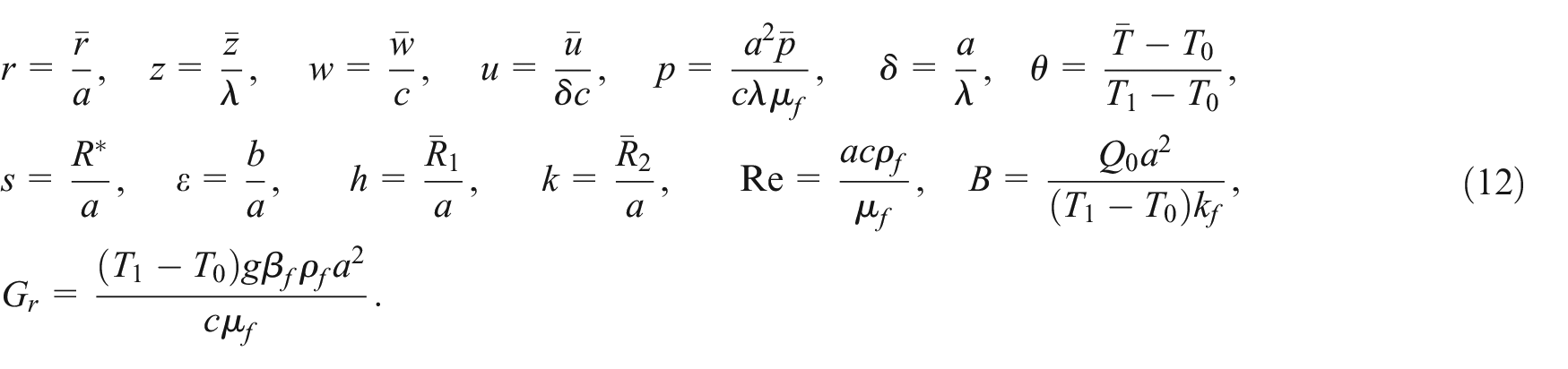
The valuable dimensionless variables for this problem are given as:
where
Invoking equations (11) and (12) in equations (7)–(10), and after applying long wavelength and low Reynolds number approximation, we get


The appropriate boundary conditions for the current problem are:

Method of solution
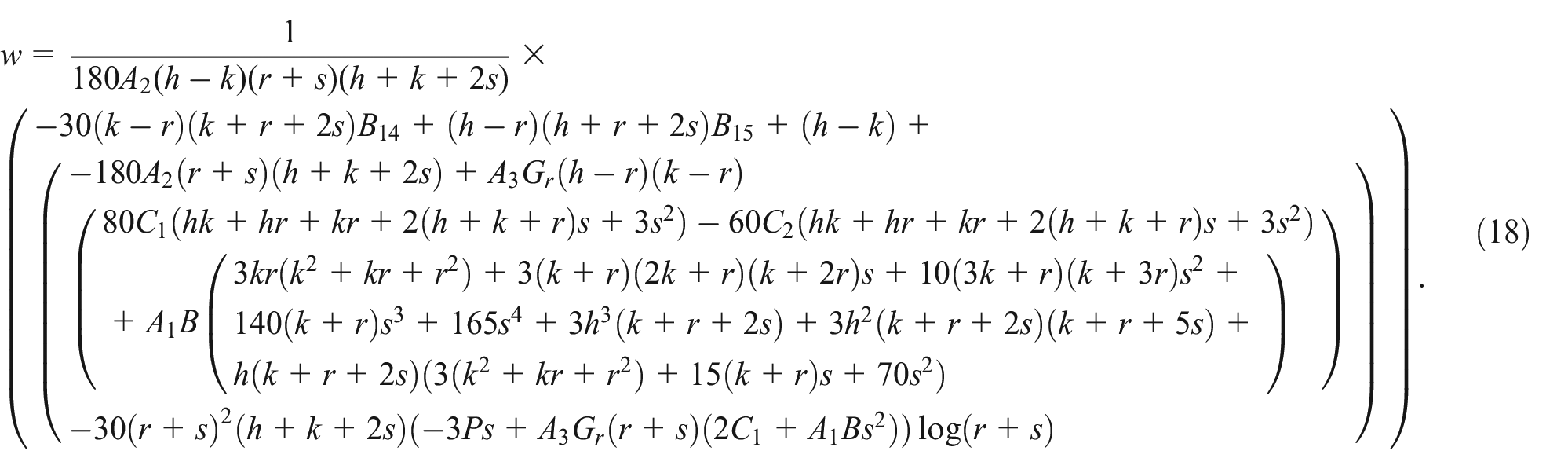
The summarized solution for equation (15) with appropriate conditions is:

where,


After few simplifications, the solution of equation (14) once again will be obtained integration technique with appropriate boundary conditions given in equation (16) through Mathematica software 11.0.
The rate of volume flow is given as:

The expression for pressure gradient is obtained by using equation (19) and given as:

Here

Results and discussion
The objective of this section is to address the graphical results against the dimensionless variables appeared for axial velocity, temperature, pressure gradient, pressure rise, and streamlines. The solutions of equations (9)–(11) have been obtained by DSolve command of Mathematica and are thus used to plot graphical results. In this investigation, the following parameter values are used for computations:
Thermo-physical properties of the base fluid and trihybrid nanoparticles.

The graphical analysis of the velocity profile is presented in Figure 2(a) to (d). Figure 2(a) shows the graphical outcomes of the velocity profile against the flow rate

Variation in velocity profile for (a) flow rate
Figure 3(a) to (e) shows the behavior of pressure gradient
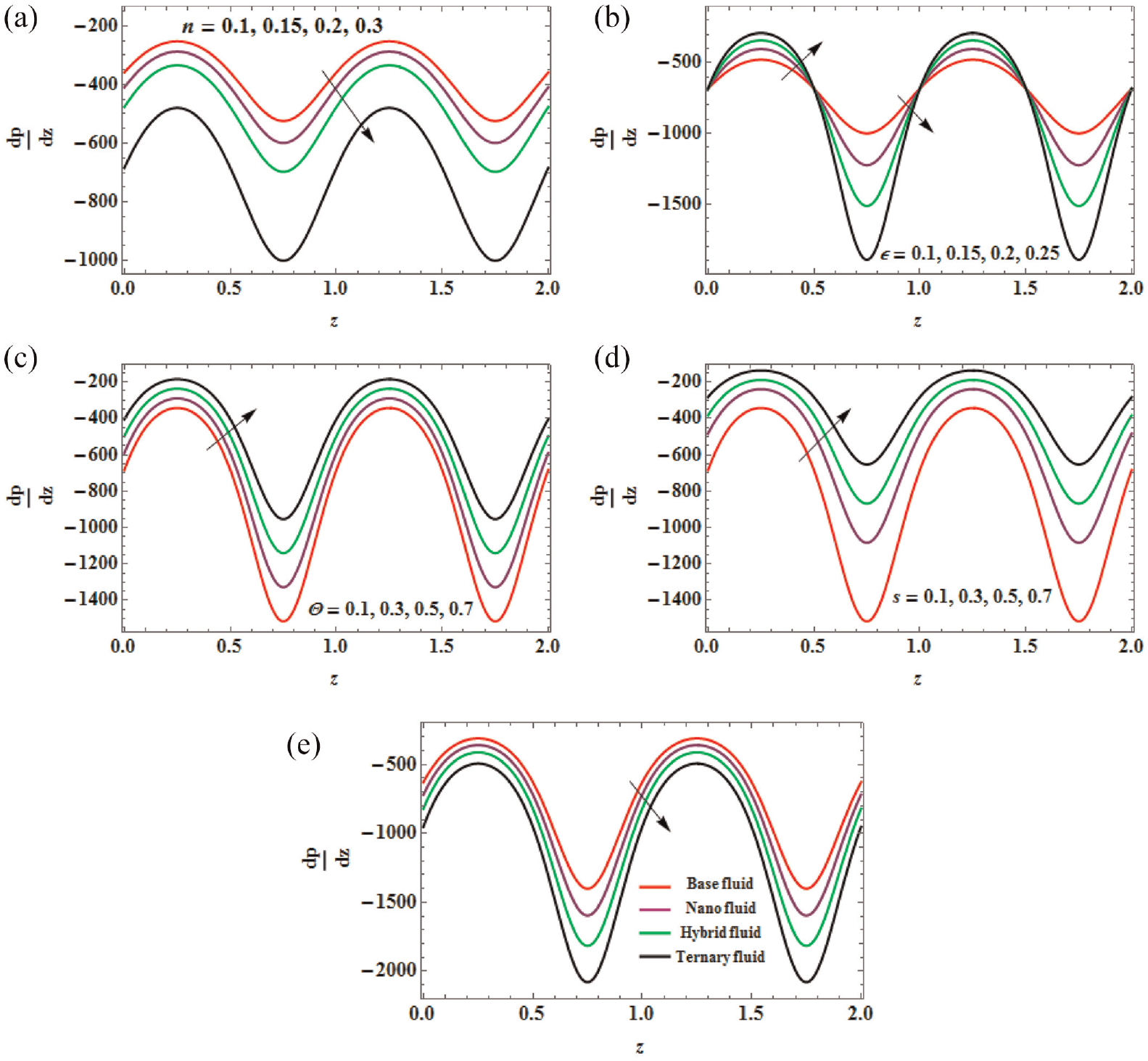
Variation in pressure gradient profile for (a) radius

Variation in pressure rise per wavelength
The quantitative effects of heat generation/absorption parameter, curvature parameter, and nanoparticles on temperature distribution are inspected through Figure 5(a) to (c). The effect of the heat generation/absorption parameter
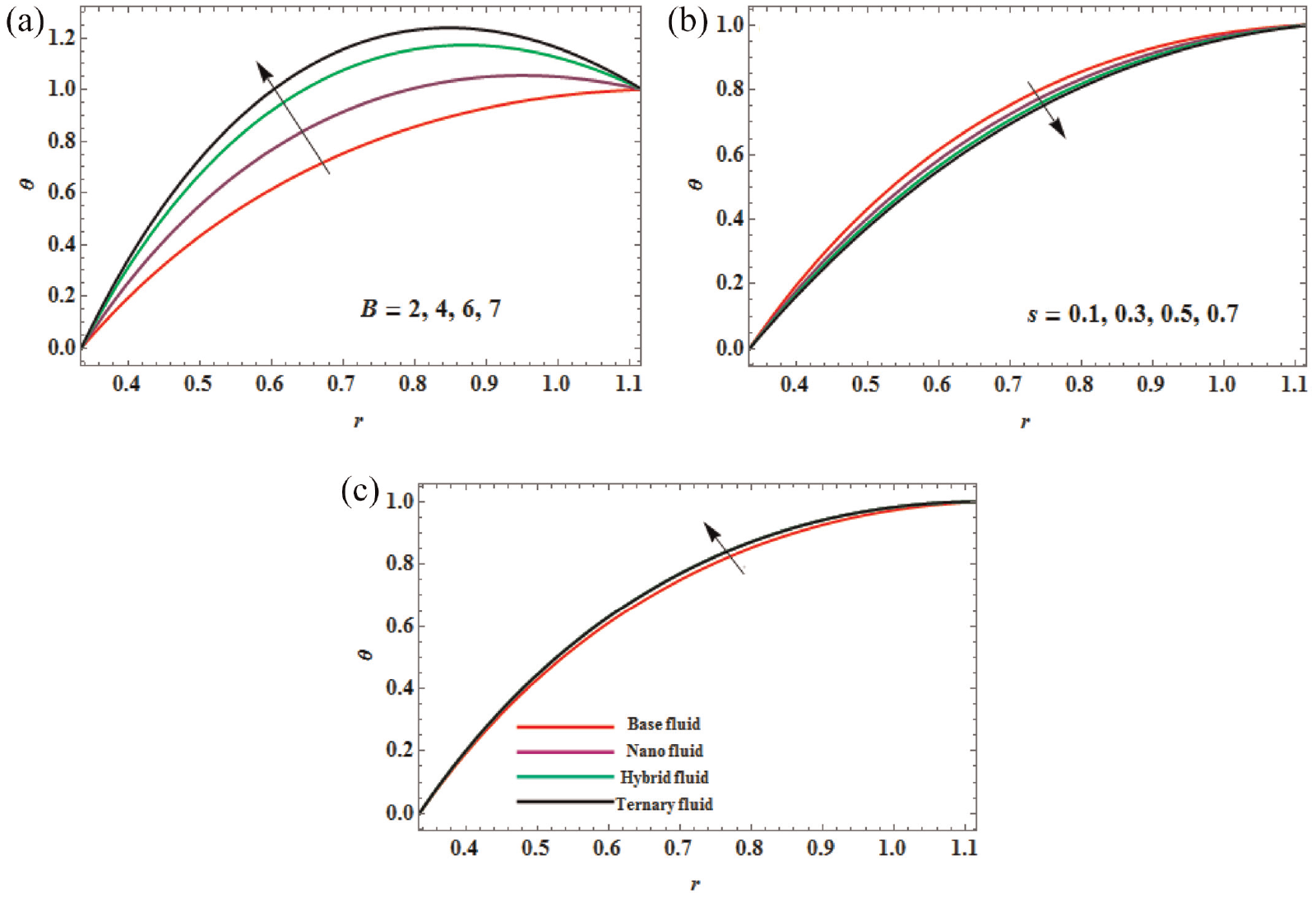
Variation in temperature profile for (a) heat source parameter
The trapping phenomenon is the most important topic of peristaltic motion. The narrowly formed streamlines of the liquid bolus that circulate forward and inwardly with peristaltic waves are what cause the trapping phenomena. The graphical results of the streamlined plot for amplifying flow rate

(a–d) Variation in streamlines for volume flow rate

(a–d) Variation in streamlines for curvature parameter
Validation
The purpose of this section is to check the accuracy of our outcomes. To verify obtained results, a comparison of limiting case of the present investigation for the velocity profile by neglecting the ternary hybrid nanofluid model with the results reported by McCash et al. 32 as shown in Figure 8. This graph indicates that both findings are in good agreement.

Comparison of limiting case of the present study with the results of McCash et al. 32
Conclusions
The peristaltic transport of mixed convective flow of ternary hybrid fluid two sinusoidally deforming lubricated curved concentric tubes is investigated. The hypothesis of lubrication theory is utilized to simplify the normalized equations. We discussed the concluding remarks on the current problem. The main conclusions are as follows:
The velocity profile declines by enhancing the values of volumetric flow rate and curvature parameter but velocity reverse impact is noted for enhancing Grashof number.
The pressure gradient increases by increasing the values of amplitude ratio, volumetric flow rate, and curvature parameter and decreases for radius of peristaltic endoscope.
The pressure rise increases for higher values of
The temperature profile rises for higher values of heat generation/absorption parameter and decreased curvature parameter.
Trapping decreases with the outer sinusoidal wall of the curved tube but increases with the peristaltic endoscopic wall by enhancing values of curvature parameter.
Footnotes
Appendix
Handling Editor: Chenhui Liang
Declaration of conflicting interests
The author(s) declared no potential conflicts of interest with respect to the research, authorship, and/or publication of this article.
Funding
The author(s) received no financial support for the research, authorship, and/or publication of this article.
