



Abstract
The dynamic characteristics of rubber isolation pad (abbreviated as RIP) after service under the high temperature thermal oxygen aging and the variable preloads have preload dependence and thermal oxygen aging dependence, which is a crucial problem for matching the vibration isolation system of air conditioner compressor to reveal the dynamic characteristic mechanism of the RIP with different preloads and thermal oxygen aging conditions. The Peck model is first introduced to characterize the thermal oxygen aging factor, the fractional derivative Kelvin-Voigt thermal oxygen aging-perturbation model (FDKVTPM) and the Coulomb frictional thermal oxygen aging-perturbation model (CFTPM) are established to describe the frequency dependence and the amplitude dependence, respectively. The thermal oxygen aging-dynamic characteristic model of the RIP is built by considering the influence of variable preloads, the model parameters under different preloads are further identified, the validity of the model was examined by the experimental data. The concepts of the stiffness transition point (STP) and the stiffness transition frequency (STF) are innovatively proposed to better describe softening effect of the RIP under variable preload and variable amplitude working conditions. The results show that the static stiffness of RIP increases by 20.7%, the dynamic stiffness increases by 9.3%, and the loss factor decreases by 35% after thermal oxygen aging under different preload conditions, which can lay a theoretical foundation for in-depth study of the stiffness matching and optimization of air conditioner compressor with the RIP.
Keywords
Introduction
As the requirement for quiet comfort environment increasing, vibration and noise have an important effects on comfort and quietness. However, the vibration isolation system designed for comfort is mainly focused on automobile suspension, automobile seat, railway vehicle, and so on.1–4 Wang et al. 5 compared the influence of sound and vibration on ride comfort of electric vehicles and combustion engine vehicles through experiments, providing theoretical guidance for the research and development of ride comfort of electric vehicles. Xiu et al. 6 and Zhang et al. 7 both proposed to use a seat suspension model with negative stiffness structure to improve riding comfort, the results show that using a negative stiffness structure model with air spring can better improve the driver’s riding comfort. At the same time, in the aspect of automobile suspension research, Shen et al. 8 established the dynamic model of automotive mechatronic ISD (inerter-spring-damper) suspension by using fractional differential method, and verified the effectiveness of the model, which enriched the dynamic characteristics modeling methods in other fields of vibration isolation.
The RIP is the core component of the vibration isolation system of air conditioning compressor. Its design and optimization have important significance for calm and comfortable air conditioning. The inside temperature of the outdoor unit of the air conditioner can be reached up to 108°C during the air conditioner compressor operating process. In the high temperature conditions, the thermal oxygen aging phenomenon of the RIP can occur,9,10 resulting in the dynamic characteristic evolving with the change of the aging degree, and a gradual increase in the vibration and noise of the air conditioner compressor, which seriously reduced the comfort and quietness. At the same time, the different preloads on the RIP are produced by the air conditioner compressors with the different models and weights, which also results in the different evolution of the dynamic characteristics on the RIP. Therefore, it is necessary to predict the dynamic mechanical properties and evaluate the vibration isolation capability of the RIP under variable preloads and thermal oxygen aging.
Loh et al. 11 analyzed the vibration characteristic of the air conditioning outdoor unit piping system by finite element method, and the amplitude dependence and frequency dependence of the RIP were verified. However, the identification of the model parameters was inaccurate, resulting in insufficient accuracy of the model and no vibration isolation system relevant mathematical model has been established. Fang and Zhang 12 applied Transfer Path Analysis (TPA) to optimize the radial structure of RIP, which reduced the radial stiffness and natural frequency of the vibration isolation system and effectively improved the vibration isolation effect of RIP, but the corresponding mathematical model was also not established. Zuo et al. 13 proposed a new rubber bushing model superimposed by elastic unit, friction unit, and multiple Maxwell models in parallel into a viscoelastic unit, which can accurately describe the frequency dependence and amplitude dependence of the bushing at low frequencies, but the model produces large errors in predicting the dynamic characteristic of the rubber bushing at high frequencies.
The above analysis of dynamic characteristic rarely considers the thermal oxygen aging factor and the effect of preload on the dynamic characteristic for RIP. Lv et al. 14 conducted experiments and comparative analysis on the dynamic characteristic of hydraulic engine mount and rubber main springs under different excitation amplitudes, frequencies, and preload forces, which provided experimental support for dynamic characteristic study of rubber parts, despite their preload forces and operating frequencies were far from those of RIPs, and the influence of thermal oxygen aging factor was not considered. Zhang et al. 15 proposed a restoring force model applicable to stacked RIPs based on the double-spring model by conducting a hot-air accelerated aging test on stacked RIPs, but the model is only suitable for RIPs with linear restoring force, and is not applicable to RIPs with significant nonlinear characteristics. Ovalle Rodas et al. 16 established a thermal-viscous-superelastic constitutive model, which was validated by finite element method. It is shown that the constitutive model provides satisfactory predictions for both mechanical behavior and self-heating. However, changes in the force-displacement relation and the effect of ambient temperature on the thermal oxygen aging of the rubber were not considered.
In order to make up for the deficiencies in the above studies, the research group proposed to introduce the fractional derivative Kelvin-Voigt model and Coulomb friction model to simulate the rubber bellows of air spring in the previous study, 17 which provided a useful reference for modeling RIPs of air conditioner compressors. However, the effect of thermal oxygen aging on its dynamic characteristic was not considered. Thus, the Arrhenius model18,19 based on the accelerated thermal oxygen aging test is introduced 20 and the modification of rubber hardness 21 is added to characterize the thermal oxygen aging factor accurately in this study. Moreover, the thermal oxygen aging factor is further applied to construct the novel thermal oxygen aging-dynamic characteristic model of RIP under variable preload conditions, enriching the modeling approach of dynamic characteristics for RIP, carefully identifying novel model parameters under different preload conditions. In this paper, the new concepts of the STP and the STF are put forward to reveal the causes of softening effect under variable preload and thermal oxygen aging conditions, which provide a reference for practical engineering applications of the RIP under variable preloads and variable amplitudes after service. It also provides the theoretical guidance for stiffness matching and optimization of air conditioner compressors.
Experimental methods
The compressor of air conditioner equipped with RIP is shown in Figure 1, which is composed of the compressor, the RIP and the pipeline, and so on. In this paper, a RIP is taken as the test object, which of the main raw material is the ethylene propylene diene monomer (EPDM) and the structure is shown in Figure 1. EPDM has excellent aging resistance, ozone resistance, heat resistance, water resistance, and other aging properties, which can be used in the temperature range of −40°C to 130°C. The main test equipment includes the MTS microcomputer-controlled electronic universal test machine, the MTS831 elastomer test bench, the programmable temperature and the humidity test chamber, the Shore hardness tester and fixture, among others.

Installation diagram of air conditioner compressor.
Firstly, the same batch of the rubber was used to make up of the dumb-bell specimens, and the stress-strain data of the specimens in uniaxial deformation mode were obtained by the uniaxial tensile test. In addition, the relationship between the hyperelastic force and the displacement of the RIP was obtained by identifying rubber material parameters and using ABAQUS simulation analysis. Secondly, RIP samples were subjected to accelerate the thermal oxygen aging test and calculate the thermal oxygen aging factor as well. Finally, the static and dynamic stiffness tests were conducted on RIP samples with or without thermal oxygen aging, and then the thermal oxygen aging-dynamic characteristic model was verified by comparing the test values with the calculated values, the test procedure is shown in Figure 2.
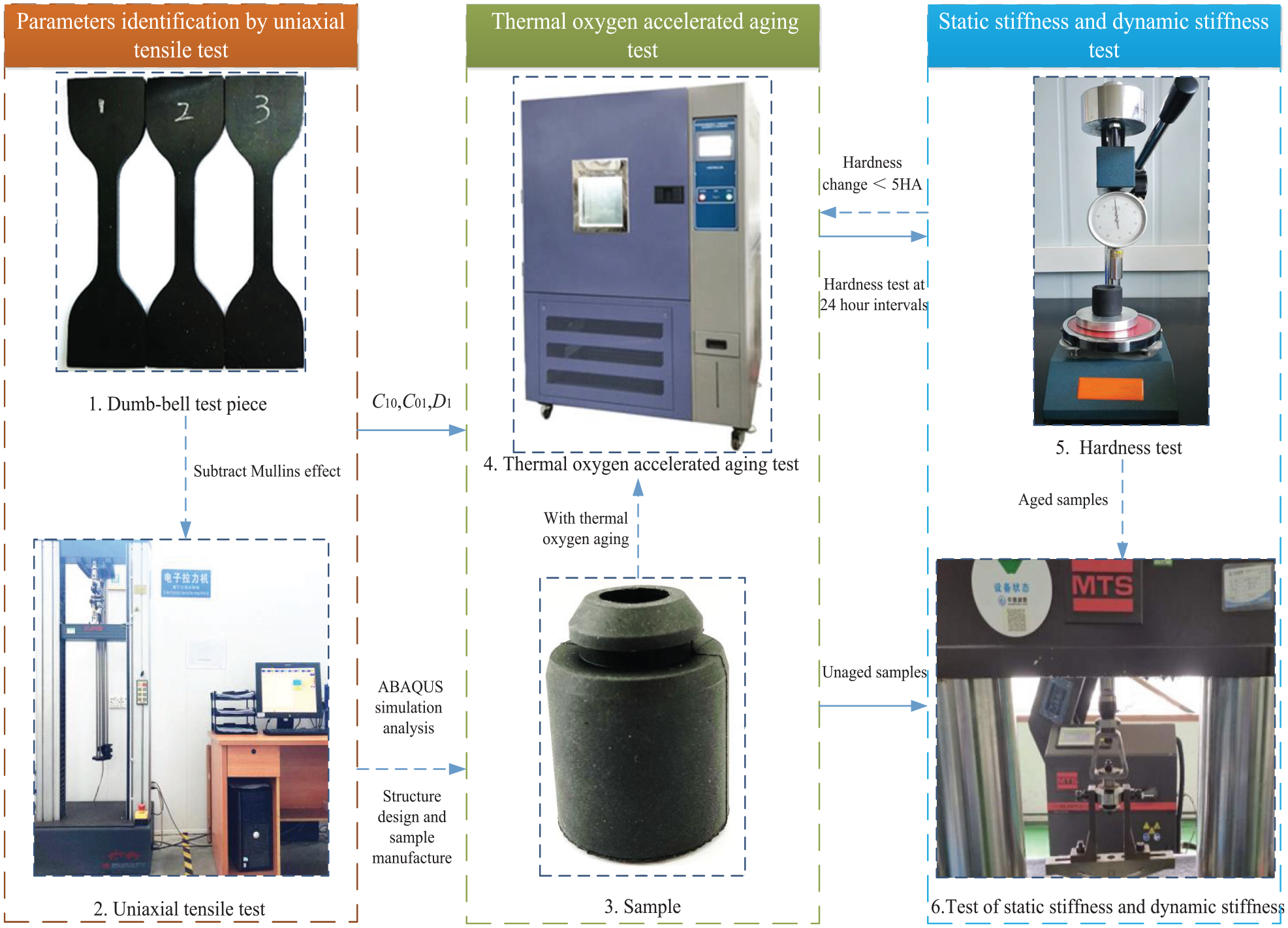
Test procedure.
The specific steps of Figure 2 are as follows,
(1) The same batch of EPDM was applied to produce dumbbell specimens, the size and shape specifications of 2 mm thick, 6 mm wide, 25 mm dumb-bell I type specimens are shown in Figure 2, to a group of three specimens for the uniaxial tensile test.
(2) The specific steps of the uniaxial tensile test were conducted as follows based on ISO 37: 2005 22 (Rubber, vulcanized or thermoplastic-Determination of tensile stress-strain properties), (a) the fixture was connected with the MTS microcomputer-controlled electronic universal testing machine. (b) The position of the limit block was adjusted by the position of the fixture to protect the sensor and the fixture. (c) The dumb-bell specimen was stretched at a speed of 500 mm/min after clamping the dumb-bell specimen to the fixture, and the dumb-bell specimen was loaded to a constant strain value of 3.0 and then unloaded to the initial position. The loading-unloading cycles were repeated three times, and the third results were recorded (Remove the Mullins effect).
(3) The rubber material parameters were identified by material stress-strain data obtained from the uniaxial tensile test. Structural determination and sample fabrication are then followed.
(4) The accelerated thermal oxygen aging process was executed strictly according to the ISO 188-2011 (Rubber, vulcanized or thermoplastic-Accelerated aging and heat resistance tests). 23 The variation of the RIP hardness to 5 HA after thermal oxygen aging is taken as the critical point for the accelerated thermal oxygen aging, based on the requirements of the thermal chemical industry. From the same batch to select 82 RIPs with the hardness of 32 HA after vulcanization, where two RIPs were reserved without thermal oxygen aging and other 80 RIPs with equally dividing were placed in the test chamber with the temperature of 90°C, 100°C, 110°C, and 120°C, respectively. Two RIPs were removed from each test chamber every 24 h and the hardness was tested with a Shore hardness tester after 24 h in room temperature conditions.
(5) The hardness test was performed according to the ISO 7619-1: 2010 (Rubber, vulcanized or thermoplastic-Determination of indentation hardness-Part 1: Durometer method (Shore hardness)). 24 The accelerated thermal oxygen aging test was terminated when the hardness of the removed sample changed by 5 HA, and the results of the accelerated thermal oxygen aging time under each temperature condition are shown in Table 1.
(6) The static and dynamic stiffness of the RIP were tested by the MTS831 elastomer test rig as shown in Figure 2. According to the different weight of the compressors and the actual force in operation of the RIP, a preload of 37, 55, and 70 N were exerted on the RIP, a speed of 10 mm/min, and the triangular wave signals with amplitudes of 0.1, 0.5, and 1.0 mm (represent the small, medium, and large amplitudes generated by the vibration of the air conditioning compressor during operation, respectively) were applied to perform the static stiffness test. The dynamic stiffness was tested by applying a sine sweep signal with amplitudes of 0.1, 0.3, and 0.5 mm, frequency range of 1–100 Hz, and the interval of 5 Hz.
Thermal oxygen aging time at different temperatures to 5 HA.

Thermal oxygen aging-dynamic characteristic model of RIP
The operating ambient temperature of the RIP increased with the internal ambient temperature of air conditioner and the generation heat during the operation process of the compressor, which can reach up to 108°C. The dynamic characteristic of the RIP will make some changes under the long-term and the high temperature operating conditions, which may increase the vibration and noise of the air conditioner.
In this paper, as the hardness of RIP increases by 5 HA with aging, the stiffness and damping characteristics predicted by the dynamic characteristic model of RIP at room temperature have a large error compared with the test value. Therefore, according to the characteristics of Peck model, the thermal oxygen aging factor is introduced into the dynamic characteristic model of RIP, and the FDKVTPM & CFTPM are constructed to establish the model of thermal oxygen aging-dynamic characteristic for the RIP. Where, the fractional derivative Kelvin-Voigt model and Coulomb friction model 25 are shown in Table 2.
Fractional derivative Kelvin-Voigt model and Coulomb friction model.

where, Khe is the hyperelastic model stiffness, Fv0 is the viscoelastic force generated by the fractional derivative Kelvin-Voigt model, α is the fractional derivative order, b is the fractional damping parameter, Dα denotes the fractional order differential form, Kv and δv denote the fractional derivative Kelvin-Voigt model dynamic stiffness and loss angle, respectively, Ff is the Coulomb friction model generated force, (Ffs, xs) is the initial reference point of force and displacement, which initially takes the value of (0, 0), ζ = Ffs/Ffmax, Ffmax is the maximum friction force, x2 is the displacement corresponding to half of the maximum friction force when it is reached, x0 denotes the amplitude of the input excitation, Kf and δf are the stiffness and loss angle of Coulomb friction model.
Formulation of thermal oxygen aging factor
Basing on the Arrhenius model, the thermal oxygen aging factor and the Peck model are applied to describe the dynamic characteristic of the RIP after aging and characterize the thermal oxygen aging factor taking into account the effect of hardness in this study, respectively. Peck model can be expressed as follows, 21

where P(T) is the reaction rate, HA is the Shore hardness, C1 is the acceleration factor related to thermal oxygen aging, Ea is the activation energy, R is the molar gas constant, and T is the thermodynamic temperature. Based on the Peck model, the thermal oxygen aging factor of the RIP can be described as follows,

where t is the thermal oxygen aging time, μ is the thermal oxygen aging factor, and t = 0, μ = 1 at room temperature.
Formulation of thermal oxygen aging-dynamic characteristic model
Since the deformation of rubber is linear behavior when the strain is small, 26 the test data of stiffness and hardness change with or without aging accord with linear increasing trend. 25 The thermal oxygen aging factor μ when the hardness of RIP increases by 5 HA at different temperatures is linearly introduced the dynamic characteristics prediction model of RIP. Therefore, the thermal oxygen aging-dynamic characteristic model consisting of the CFTPM, the hyperelastic thermal oxygen aging-perturbation model (HTPM), and the fractional derivative thermal oxygen aging-perturbation model (FDTPM) in parallel can be shown in Figure 3.
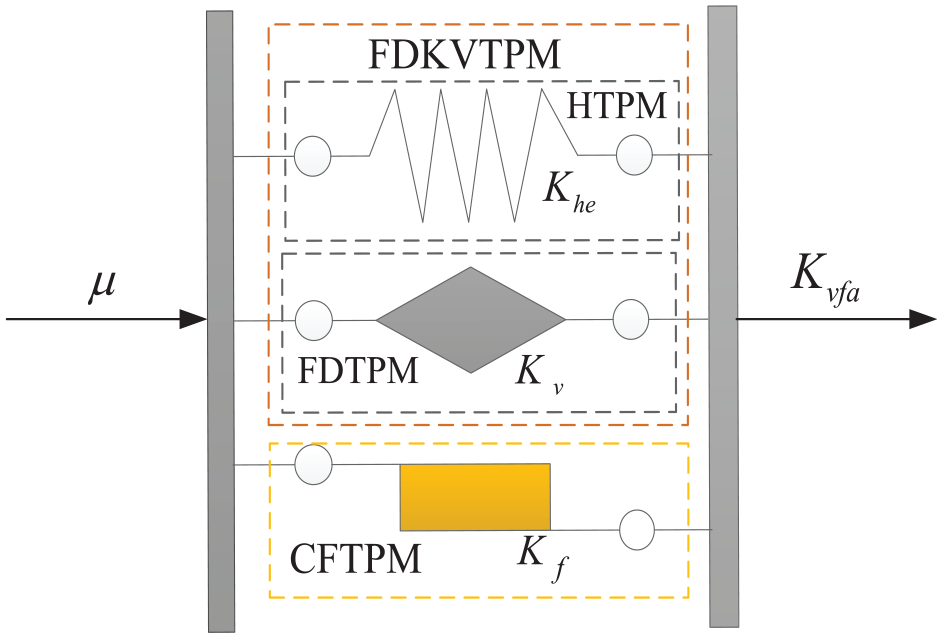
Thermal oxygen aging-dynamic characteristic model.
The relationship between the force and the displacement of the HTPM can be written as below,

where, ts is the time of compression or stretching, and x(ts) is the displacement in the process of compression or stretching, and μ(t) is also a function of time, t >> ts, so the thermal oxygen aging factor μ can be viewed as a constant. In order to simplify the parameters and accurately characterize the variation trend of the viscoelastic force of the RIP under thermal oxygen aging, 27 the linear material parameter γ is also used to improve the prediction accuracy of the viscoelastic force. The viscoelastic force-displacement equation of FDTPM can be expressed as follows,

Combining equation (3) with equation (4), the force-displacement relationship of the FDKVTPM consisting of the HTPM and the FDTPM in parallel is obtained as below,

Dynamic stiffness and loss angle of the FDKVTPM can be obtain by Fourier transform of equation (5) as follows,


Similarly, the thermal oxygen aging factor μ can be viewed as a constant in Fourier transform and the force-displacement relationship of the CFTPM is expressed as follows,

Then the stiffness Kfa and loss angle δfa of the corresponding CFTPM can be expressed as below,


Combining equations (6)–(10), the complex stiffness, dynamic stiffness, and loss factor of the RIP with thermal oxygen aging can be written as follows,


where K*vfa is the complex stiffness of the RIP with thermal oxygen aging, Kvfa and tanδa are dynamic stiffness and loss factor with thermal oxygen aging, respectively.
Parameter identification and experimental verification
Parameter identification
Parameter identification of the hyperelastic model
The Mooney-Rivlin constitutive model 26 is used to fit the material parameters for establishing the finite element model due to the error still exist between the linear elastic model and the experimental data. Since the compression displacement of the RIP is less than 100% during working, it belongs to a linear stress-strain relationship with small strain, so the Mooney-Rivlin constitutive model can better simulate its mechanical behavior. The strain energy function can be expressed as below,

where I1, I2, and I3 is the strain invariants, Cij, dk, and N are the material constants.
Since the rubber material is incompressible, binomial third-order expansion of equation (14) can be written as follows,

The relationship between Kirchhoff stress tensor (tij) and Green strain tensor (γij) can be obtained as belows, 27

The relationship between the principal stress ti of rubber material and its principal elongation ratio λi can be expressed as follows,

where P is the arbitrary hydrostatic pressure.
For the uniaxial tension, t2 = t3 = 0,

Then equation (19) can be derived from equations (17) and (18) as below,

The identified parameters are shown in Table 3, and the relationship between the hyperelastic force and the displacement curve of the RIP is obtained by using ABAQUS simulation analysis as shown in Figure 4.
Values of C10, C01, and D1.


Force-displacement curve.
Figure 4 illustrated the comparison results of the hyperelastic model with the experimental data are closer than the linear elastic model. The larger errors are mainly concentrated in the displacement interval of −0.8 to −1.0 mm and 0.8 to 1.0 mm, and the error values are shown in Table 4. The maximum error calculated by the linear elastic model is 12.8%, which is reduced to 2.8% after the correction of the hyperelastic model. In order to modify the linear elastic model, the correction stiffness Kc is introduced in this paper, and the value is equal to zero at the displacement zero point. The hyperelastic stiffness can be obtained as follows,


Absolute error between calculated and experimental values of two models.

Identification of thermal oxygen aging factors
During the thermal oxygen aging process at the different test temperature of 90°C, 100°C, 110°C, 120°C, respectively, assuming that the RIP is uniformly aged, and the mechanism of the thermal oxygen aging at the test temperature is the same as well, where the activation energy of the reaction Ea remains constant and can be obtained by the method given in the literature. 28 From equation (1), the reaction rate at the different temperatures is written as below,

where, p = t0/ta, t0 is the thermal oxygen aging time of the reference temperature (90°C), ta is the thermal oxygen aging time of 100°C, 110°C, and 120°C respectively, and the thermal oxygen aging reaction rate ratio at the different temperatures are shown in Table 5. R and T are constants, the fitting curves of lnp and 1/T are shown in Figure 5.
Thermal oxygen aging reaction rate ratio at the different temperatures.


Regression and extrapolation results of activation energy.
From Figure 5, it can be seen that lnp is linearly related to 1/T at 90°C, 100°C, 110°C, and 120°C, and its slope characterizes the activation energy Ea at each test temperature consistently. It means that the thermal oxygen aging mechanism of the RIP is consistent at each test temperature as well, so the thermal oxygen aging factor μ can be obtained through experimental data, which also verifies the reasonableness of the previous hypothesis. The acceleration factor C1 at each temperature can be obtained based on equation (1), and corresponding parameter is shown in Table 6.
Parameters of Peck model.

Parameters identification of the CFTPM and the FDKVTPM
The hysteresis loop between the friction force and displacement was obtained by applying a triangular wave excitation signal with a speed of 10 mm/min, a preload of 37 N, and an amplitude of 1.0 mm by using the MTS831 elastic test bench as shown in Figure 6. The excitation frequency is about 0.04 Hz during the static stiffness test, where the Coulomb friction force is the dominant role because the effect of viscoelastic force can be negligible.

Force-displacement relationship (hysteresis loop).
According to the hysteresis loop obtained in Figure 6, the maximum frictional force Ffmax and the linear elastic stiffness Ke and Kmax can be determined by the graphical method, 29 where Ke can be obtained from the slope of the tangent line before reaching the maximum amplitude. The intersection value of this tangent line with the vertical coordinate represents the maximum frictional force Ffmax. The slope of the tangent line after reaching the maximum amplitude denotes the maximum stiffness Kmax. According to equation (14), the friction displacement x2 can be determined by the following equation,

Therefore, under the different preloads (37, 55, 70 N) and the excitation amplitude of 1.0 mm, the hysteresis loops are plotted by using the experimental data and calculated values of static stiffness of the RIP with or without thermal oxygen aging as shown in Figure 7. The Ke can be obtained as 32 N/mm and the Khe can be calculated based on equation (20) with equation (21). The linear elastic part is independent of the different preloads and the energy loss is zero, while the parameters of the CFTPM are affected by the different preloads. 29 The identified parameters of the CFTPM under the different preloads are shown in Table 7.

Hysteresis loops with or without thermal oxygen aging under different preloads (amplitude 1.0 mm): (a) preload 37 N, (b) preload 55 N, and (c) preload 70 N.
Identified parameters under different preloads.

Figure 7 shows that the hysteresis loops of the RIP with or without thermal oxygen aging overlap at a displacement of 0 mm. The tendency of the hysteresis loop after aging is tended to tilt upwards, producing the phenomenon of counterclockwise rotation. At the same time, the maximum of static stiffness increases by 20.7% under three different preloads and the thermal oxygen aging conditions. Before the thermal oxygen aging, the static stiffness at the preload of 70 N and the preload of 55 N increased about 10.2% and 6.2% by comparing with the preload of 37 N, respectively. After the thermal oxygen aging, the static stiffness at the preload of 70 N and the preload of 55 N increased about 10.7% and 8.5% by comparing with the preload of 37 N, respectively. It is found that the experimental data and calculated values of the hysteresis loops with or without thermal oxygen aging conditions of the RIP is approximately consistent, and the maximum of relative errors are less than 2.6%.
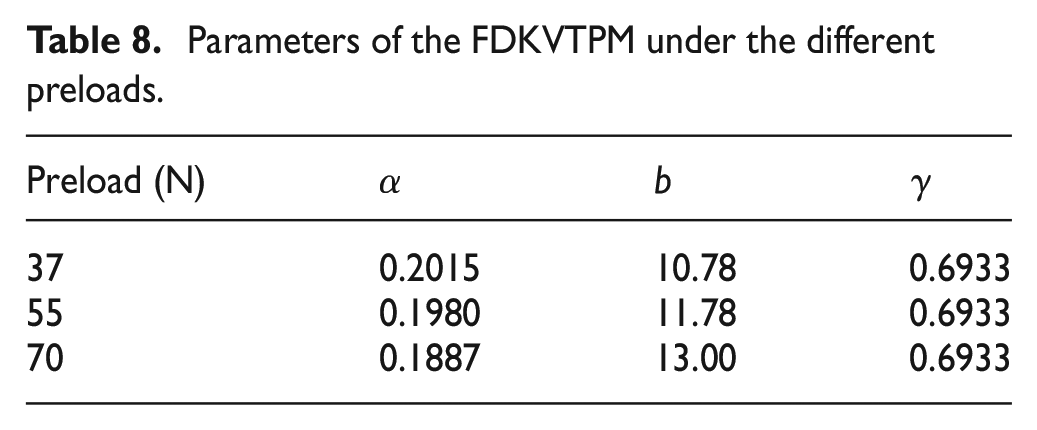
In order to minimize the influence of the Coulomb friction, the dynamic stiffness test of the RIP should be conducted with the low amplitude signal as much as possible. Therefore, a set of sine sweep signal with an amplitude of 0.1 mm and a frequency range of 1–100 Hz with an interval of 5 Hz are applied in the experiment. According to the dynamic stiffness data under the different preloads of 37, 55, and 70 N, the fractional derivative order α, the damping parameter b, and material parameter γ can be obtained by the least square method, which are shown in Table 8.
Parameters of the FDKVTPM under the different preloads.
Model validation
The dynamic characteristics of the RIP with or without thermal oxygen aging show the different evolution laws due to the different excitation amplitudes and preloads. In order to verify the prediction accuracy of the evolution laws of the dynamic characteristic for the RIP under the different preloads by thermal oxygen aging-dynamic characteristic model, the comparison results of the dynamic stiffness and the loss factor of the RIP with or without thermal oxygen aging under the different preloads (37, 55, 70 N) with an amplitude of 0.5 mm are shown in Figure 8, and the changes of the dynamic stiffness and loss factor are shown in Table 9.

Dynamic stiffness and loss factor with or without thermal oxygen aging under different preloads (amplitude 0.5 mm): (a) dynamic stiffness under preload 37 N, (b) loss factor under preload 37 N, (c) dynamic stiffness under preload 55 N, (d) loss factor under preload 55 N, (e) dynamic stiffness under preload 70 N, (f) loss factor under preload 70 N, (g) unaged dynamic stiffness under different preloads, and (h) aged dynamic stiffness under different preloads.
Changes of dynamic stiffness and loss factor with or without thermal oxygen aging under different preloads.

As can be seen in Figure 8, either with or without thermal oxygen aging, the dynamic stiffness and the loss factor have a frequency dependence, and an increasing trend with frequency under the different preloads. It can also be found that the slopes of the dynamic stiffness curves and the loss factor curves decreases and increasingly flatten out more and more with the frequency increasing. When the excitation frequency is in the low frequency range of 0–20 Hz, the influence of the excitation frequency on the dynamic stiffness and the loss factor is performed obviously, and appears the rapid growth phenomenon. The low-frequency operation of the compressor is mainly in the start-stop phase, where the amplitude of the vibrations is usually large and can easily damage the pipes connected to the compressor. If the initial stiffness of the RIP is well-matched, the matching reasonableness will be destroyed by the thermal oxygen aging effect, which increases the stiffness and reduces the loss factor in the start-stop phase. In addition, the compressor vibration will be increased and then affects the reliability of connection pipeline. When the compressor is operated above 20 Hz at the medium and high frequency, the effect of the thermal oxygen aging will be gradually decreased, and the growth of the dynamic stiffness and the loss factor is relatively flattened as the frequency increases, and the frequency dependence is gradually decreased.
As shown in Figure 8 and Table 9, the dynamic stiffness gradually increases to a certain degree with the hardness of the RIP increasing by 5 HA after thermal oxygen aging. The stiffness curve with and without the thermal oxygen aging are intersected to form a STP, which of the frequency of the STP is referred to as the STF. As the excitation frequency continues to increase beyond the STF, the dynamic stiffness of the RIP with the thermal oxygen aging is less than that without the thermal oxygen aging, so the softening effect appears, as shown in Figure 8(a), (c), and (e). The dynamic stiffness of the RIP with aging maximally increased by 9.3% compared with that without aging before the STP. However, the maximum decrease of the dynamic stiffness is 2.5% after the STP. The experimental values of the loss factors with or without the thermal oxygen aging are basically consistent with the calculated values and are not affected by the preload. Because the values of loss factor are small and the exerted preload is much smaller than the range of the test instrument (maximum 100 kN), the overall trend of the loss factor is a slow upward growth, and the experimental values exists a certain fluctuation. The test results show that the relative error between the calculated and experimental values of the dynamic stiffness with or without the thermal oxygen aging does not exceed 5%, which verify the accuracy and validity of the identified parameters of thermal oxygen aging-dynamic characteristic model under the different preloads.
In Figure 8(a), the crossover phenomenon of the dynamic stiffness with or without the thermal oxygen aging does not appear in the frequency range of 0–100 Hz, which appears after 100 Hz. In Figure 8(c) and (e), the STF value gradually decreases with preload increasing is about 81 and 51 Hz. The change of the dynamic stiffness before or after the STP can be shown in Table 9. The loss factor is reduced by a maximum of 35%, 25.7%, and 30.7% by comparing with that without aging in Figure 8(b), (d), and (f). And in Figure 8(g) and (h), the dynamic stiffness of the RIP increases with the increase of the preload with or without the thermal oxygen aging, and the hardening phenomenon exists with the preload increasing.
In summary, it can be seen that the dynamic stiffness and the loss factor with or without thermal oxygen aging have an increasing trend with the frequency of the occurrence of the stiffness crossover at the STF. When the excitation frequency does not reach the STF, the dynamic stiffness with the thermal oxygen aging is larger. The STF gradually decreases with the increase of preload, which results in the phenomenon of left shift of the STF and early aging of the RIP (hardening phenomenon), it indicates the preload dependence of the STP. When excitation frequency exceeds the STF, the dynamic stiffness with the thermal oxygen aging is slightly smaller than that without aging, and the RIP appears a slight softening phenomenon.
To explore the amplitude dependence of the STP, the dynamic stiffness and the loss factor of the RIP with a load of 55 N and amplitudes of 0.1, 0.3, and 0.5 mm are shown in Figure 9.
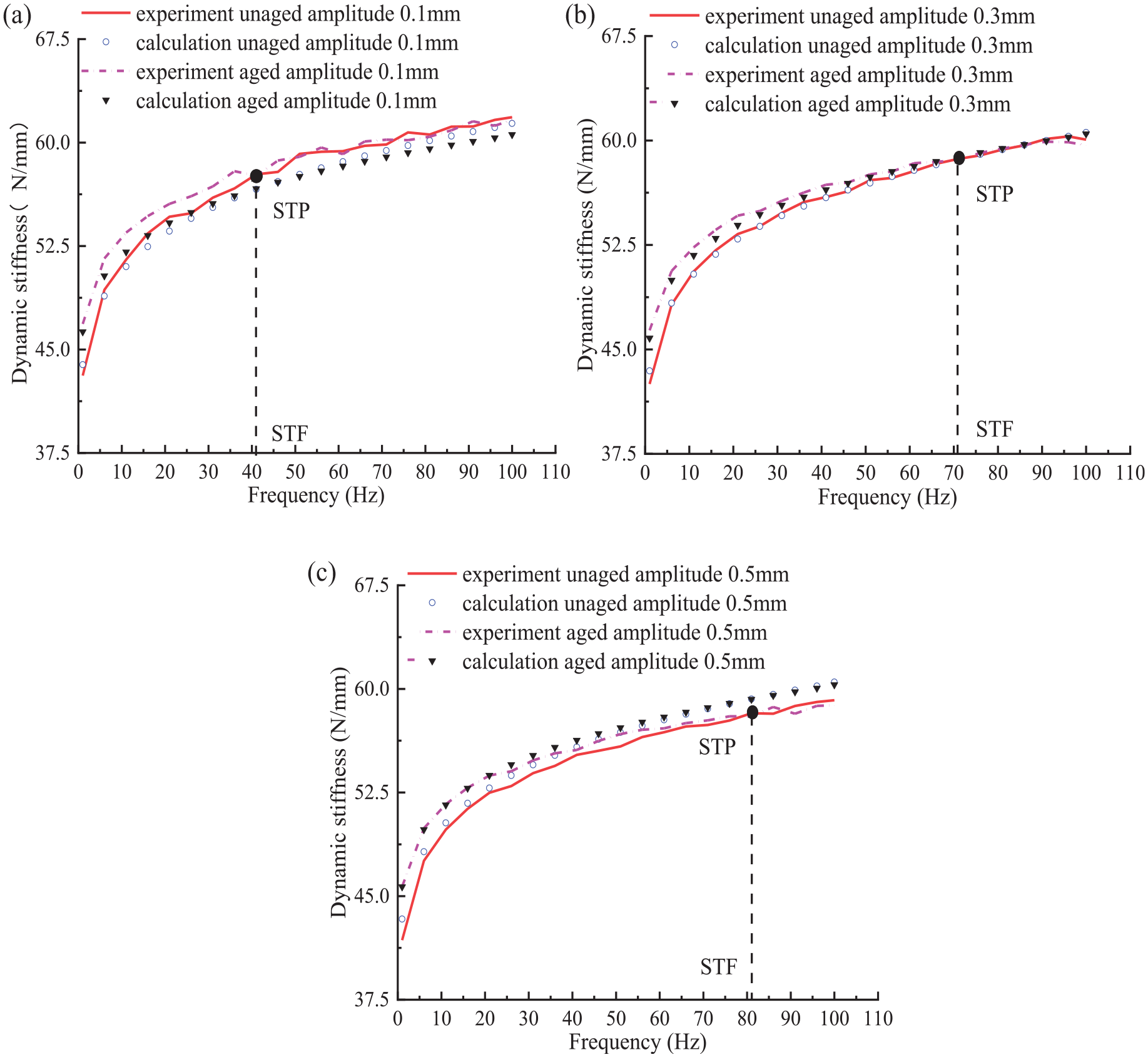
Dynamic stiffness with or without thermal oxygen aging at different amplitudes (preload 55 N): (a) amplitude 0.1 mm, (b) amplitude 0.3 mm, and (c) amplitude 0.5 mm.
As can be seen from Figure 9, the dynamic stiffness with or without the thermal oxygen aging decreases with the increase of amplitude. The STF value is about 41, 71, and 81 Hz in Figure 9(a) to (c), respectively. The STF increases with the amplitude increasing and the STP appears to right shift phenomenon, which indicates that the STP is amplitude dependent.
In summary, the thermal oxygen aging-dynamic characteristic model, which takes into account the thermal oxygen aging factor, can accurately describe the thermal oxygen aging-dynamic characteristic mechanism of the RIP at different excitation frequencies, different excitation amplitudes, and different preloads, which provides theoretical guidance for stiffness matching and optimal design of the RIP. The working frequency of the air conditioner compressor is often between 20 and 70 Hz, so the STF of the RIP with aging can be designed to be between 20 and 70 Hz and as close as possible to 20 Hz. The softening effect of the RIP can be used to extend the softening frequency range of the RIP after a period of thermal oxygen aging so as to improve the vibration and noise level of the air conditioner.
The above research results show that the vibration of the air conditioners can be improved by choosing compressors with the reasonable weight and the amplitude levels, and the initial stiffness of the RIP can be appropriately tuned by using the same air conditioner compressor for stiffness matching. Therefore, the stiffness value of the RIP is designed to be slightly less than the optimal matching stiffness value within the acceptable performance, which is equivalent to indirectly increasing the preload, and the RIP’s stiffness in the early service increase to reach the optimal value of the stiffness matching. The RIP can continue to maintain or close to the optimal matching stiffness due to thermal oxygen aging and softening effect after using a period to optimize the performance of the matching design and indirectly extend the service life of the RIP.
Sub-models impact analysis
The dynamic stiffness results based on the before and after the thermal oxygen aging under the different preload conditions with an amplitude of 0.5 mm are taken as examples to further investigate the effects of each sub-model (HTPM, FDTPM, and CFTPM) inside thermal oxygen aging-dynamic characteristic model on the dynamic stiffness of the RIP under the different preloads and the thermal oxygen aging conditions, 30 as shown in Figure 10 and Table 10. The CFTPM is hardly affected by the preload and thermal oxygen aging due to the preload is small, and the maximum stiffness ratio only increases by about 3% under the different preloads. HTPM is also almost unaffected by the small preload and frequency, but the stiffness increases by about 4.5 N/mm with the thermal oxygen aging from Figure 10(a) and (b). In Table 10 the combined softening effect eventually leads to an increase of about 7% in stiffness for the HTPM. The dynamic stiffness of the FDTPM increases with the increase of frequency and preload, which reflects the frequency dependence and the preload dependence. However, the dynamic stiffness with aging is lower than that without aging, which leads to the decrease of 7.65%–9.39% in the dynamic stiffness ratio of the FDTPM in Table 10 and forms a softening effect. In general, the increase of the stiffness of the HTPM and the decrease in the proportion of dynamic stiffness of the FDTPM jointly make the stiffness of the FDKVTPM increase at first and then decrease with aging as shown in Figure 10(c) to (e), which leads to the emergence of the STP of the FDKVTPM. As a result, a softening effect appears after the STF of the FDKVTPM. At the same time, the proportion of the stiffness of the FDTPM increases with the increase of the preload and the softening effect increases, which leads to the decrease of the influence of the CFTPM on the total stiffness. The left shift of the STF of thermal oxygen aging-dynamic characteristic model is produced with the effect of the FDKVTPM increasing. The distance between the STP and the STP of the FDKVTPM has been shortened with the increase of the preload. Therefore, the nature of softening effect is caused by the decreasing stiffness of the FDTPM.

Dynamic stiffness of each sub-model of the RIP under different preloads with or without aging (amplitude 0.5 mm): (a) without aging, (b) with aging, (c) dynamic stiffness under 37 N, (d) dynamic stiffness under 55 N, and (e) dynamic stiffness under 70 N.
The proportion of dynamic stiffness of each sub-model under different preloads with or without aging (amplitude 0.5 mm).

In summary, a relationship between the molecular theory for predicting the macroscopic behavior of certain viscoelastic media and the empirically developed viscoelastic fraction calculus method is established by the FDTPM,31,32 and the viscoelastic properties of these polymer solids is described by the Molecular theory. The side group oxidation reaction of the RIP occurs under the combined action of thermal oxygen environment and preload. Internal molecular chains will be further cross-linked, with the end of the chain segment being a cross-link point or an entanglement point with other chains, the position of which is not fixed. When the RIP is compressed, the impact of heat and load on the RIP is stronger as the frequency increases, and the position of the entanglement point is slipped due to heat and vibration, 33 and the entanglement point is shifted by the chain segment to the position of the less force, the storage energy in the deformation of the chain segment will also be reduced and the stress will be reduced. It can be obtained that the stress relaxation phenomenon is caused by the migration of the molecular entanglement points in the rubber. Thus, the microscopic nature of the STP and the softening effect can be explained by the stress relaxation phenomenon, which is caused by the migration of the molecular entanglement inside the rubber. Consequently, the ratio of the viscoelastic materials in the rubber formula can be increased within the acceptable performance range so as to increase the migration of the entanglement in the rubber and increase the effect of the stress relaxation on the dynamic stiffness. It will improve the ability to reduce the vibration and noise, and lay the theoretical foundation for the optimization of rubber formulation of the RIP.
Conclusions
In this paper, the Peck model is used to construct the thermal oxygen aging factor. A novel thermal oxygen aging-dynamic characteristic model for RIP considering the different preload effects and the thermal oxygen aging factor is presented, and the identification method of the model parameters under the different preload conditions is also obtained. The softening effect of RIP with thermal oxygen aging was found. The main conclusions are as follows:
(1) The Peck model is introduced in this paper to characterize the thermal oxygen aging factor, and the FDKVTPM and CFTPM are connected in parallel to establish the dynamic characteristic model of RIP under variable preload. The accuracy and effectiveness of the model are verified by experiments, which enrich the modeling method of the RIP.
(2) It is found that the stiffness of the RIP presented cross-over characteristics after thermal oxygen aging, and the concepts of stiffness transition point and stiffness transition frequency are proposed to describe the softening effect of dynamic stiffness of RIP under varying preload and amplitude after service. The selection of the compressors and the design of initial stiffness of the RIP provide theoretical guidance for the optimization design of the RIP.
(3) The softening phenomenon caused by the reduction of dynamic stiffness of the FDTPM with aging has been identified, which is essentially a stress relaxation phenomenon due to the migration of molecular entangled nodes inside viscoelastic solids. It is beneficial to improve the vibration isolation performance of the RIP and lay the theoretical foundation for the optimization of rubber formula.
Footnotes
Appendix
Acknowledgements
The authors express thanks sincerely to Xiangkun Zeng, Guangdong Polytechnic Normal University, and Jianjun Chen and Weizhong Wang, Bonderra Industries Co., Ltd., for sample design, manufacture, and experiments. The authors also thank sincerely to the editors and reviewers for their delicate work.
Handling Editor: Chenhui Liang
Declaration of conflicting interests
The author(s) declared no potential conflicts of interest with respect to the research, authorship, and/or publication of this article.
Funding
The author(s) disclosed receipt of the following financial support for the research, authorship, and/or publication of this article: Authors would like to acknowledge the support by the National Natural Science Foundation of China (Project No. 51905240 for supporting the establishment of thermal oxygen aging-dynamic characteristic model for the RIP), and Jiangxi Provincial Natural Science Foundation (Project No. 20224BAB204039).
