



Abstract
The sensitivity analysis model is frequently used to express the influence of conditional elements on structural reliability. However, the traditional sensitivity analysis model is limited to a few influencing factors, and has a small scope of application. In this paper, a modified sensitivity model is proposed by combining the optimal polynomial response surface function with the Sobol sensitivity algorithm. And the sensitivity calculation approach was combined with coupling factor test design, range verification, multi-body dynamics analysis and structural statics analysis, which enables to achieve the quantitative sensitivity value of the influence of conditional factors on structural reliability. Finally, a typical harvester structure is selected as a case, to verify the evaluation accuracy and effectiveness of the revised model. The results show that the sensitivity of threshing drum speed has the greatest influence, while the sensitivity of granary load has the least influence. The average quantitative prediction accuracy of revised approach is up to 97.36%. The revised model can accurately evaluate the sensitivity value of coupled influencing factors for industrial equipment.
Keywords
Introduction
The operation safety assessment of large mechanical equipment has gradually become an important link in the maintenance process, which is developing toward lightweight structure, uninterrupted operation and real time monitoring.1–3 Small damage may cause great harm to the equipment operation safety, with the working time increasing.4,5 At the same time, the combined effect of external random factors and operating condition parameters will directly affect the damage process, 6 and become an important factor affecting the operation safety of equipment.7,8 Therefore, quantitatively evaluate the relationship between influencing factors and structure reliability indicators is very important for further ensure the operation safety of equipment, which has become the research focus in the field of reliability.9,10 However, for industrial applications, there will also be internal coupling effect between the influencing factors, which will have a composite impact on the reliability index.11,12 Comparing with the influence of a single factor, the combination of multiple factors is more harmful to the equipment safety.13–16 For the reliability optimization of turbine blisk structure, Zhang et al. 17 considered the relation between the comprehensive reliability indicators and working conditions. Zhu 18 developed a hybrid iterative conjugate first-order reliability method for fuzzy reliability analysis (FRA) of the stiffened panels. Taking the dynamical mechanical parameters as the reference condition and considering the influence of other conditions, the measure of the fuzzy reliability index, boundaries of uncertainty interval of the panel were proposed. In addition, the feasibility and accuracy of the proposed approach are verified by the case study. Scozzese et al. 19 proposed an advanced Fluid Viscous Damper (FVD) model for the influence of the values of the safety factors for FVDs on the reliability of the structural systems. Also the accuracy of the proposed approach were verified by the case study. Gu 20 evaluated the influence of different factor on the performance of a microwave microscope. And the performance of the system in terms of measurement accuracy and stability is derived as a function of different setting parameters. The validation case also illustrated the computational accuracy. The above researches can realize the effect of influence factors on equipment performance. However, the quantitative sensitivity influence degree of coupled effects is needed for the in-depth study of equipment performance.
Sensitivity analysis, an approach to study the sensitivity state or output changes of a system. It can also used to determine which parameters have a greater impact on the system or model.21–27 Greco and Trentadue 28 proposed a reliability sensitivity evaluation model using the time domain covariance theory, through which the sensitivity statistics of different quantities of dynamic response with respect to structural parameters can be achieved. Zhang et al. 29 studied the sensitivity analysis based on the frequency reliability theory and Sobol’ theory. Through the direct integration of the sensitivity reliability model, the accurate first-order and quasi-failure probability sensitivity index of mechanical structure under dynamic excitation can be obtained.30–33
Jensen 34 proposed a simple post-processing step associated with an advanced sampling-based reliability analysis to quantify the impact of individual input variable on the output parameter, which also validated on two nonlinear structural models under stochastic ground excitation. Zhu 35 studied a response surface function Kriging model with Sobol’ sensitivity algorithm. Through the new corrected model, the impact of different factors on the structural reliability of port cranes are analyzed. The research results show that it has high prediction accuracy.
The quantitative evaluation of the influence degree between factors and reliability indexes can be realized, in the literature.32–35 However, the interaction between factors cannot be reflected in the analysis results, due to the lack of global sensitivit consideration.36–38 Therefore, it is very important to quantitatively evaluate the coupling relationship between reliability indicators and complex influencing factors precisely. Not only the local sensitivity, but also the global sensitivity should be taken into account.
Combining the Sobol’ sensitivity theory with the modified response surface function, a modified sensitivity analysis model of structural influencing factors is proposed in this paper, to investigate the structural reliability in a comprehensive way. Also taking the structure of the harvester as an example, the specific operation steps of the proposed method are introduced through the industrial case study. Finally, the feasibility and accuracy of the proposed method are verified.
Revised sensitivity model
This paper define that the spatial domain of the input factor in the model recognition parameter is k-dimensional unit volume

Where,
According to the Taylor expansion, any function

①

② The sub-items are orthogonal. The condition for the existence of the equation (4) is that

The equation (3) has a unique decomposition form, and each sub-item can be obtained through multiple integration.



In equations (6) and (7), there exist
The total variance of the proposed model is calculated as:

The variance of the sub-terms of each order in equation (8) is the partial variance of each order, and its s-order partial variance can be expressed as

From equations (2) and (9), the relationship between the total variance and the partial variance of each order can be expressed as

The sensitivity coefficient

Where, is the first-order sensitivity coefficient of factor
When many factors are considered to solve the sensitivity model, traditional Sobol’ solution approach is very computationally intensive and unstable.40–42 In addition, due to various factors and their obvious coupling effects, the reliability problem of the actual engineering equipment structure is more complicated.
To address these challenges, optimal polynomial response surface functions between structural responses and model parameters are constructed by fitting samples based on the optimal error reduction ratio. Sensitivity values can then be obtained by direct integration.
This method has high matching accuracy, is easy to integrate directly, can effectively avoid a large number of sample calculations, and provides the possibility to analyze the coupling effect between multiple influencing factors.
The optimal polynomial response surface function can be combined by the complete polynomial of the parameter, expressed as
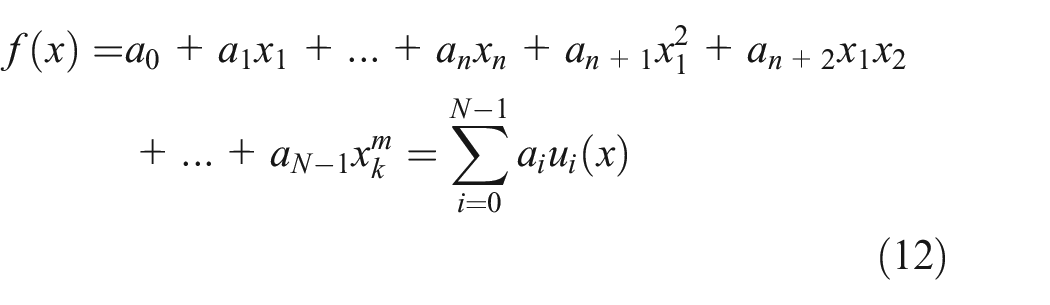
Where,

Equation (12) can be transformed into an orthogonal form, to determine the polynomial model coefficients, expressed as

Where,
According to the orthogonality of each item in equation (14), it can be deduced into

By using the Gram-Schmidt orthogonalization process,
43

And the coefficient

Define the error function Mean Square Error

Set the derivative of

Equation (19) is substituted into equation (18) based on the orthogonality of

And the maximum value of MSE can be expressed as

The contribution

Then, in order to quantify the contribution of each orthogonal term to the reduction of the error function MSE, the error reduction ratio
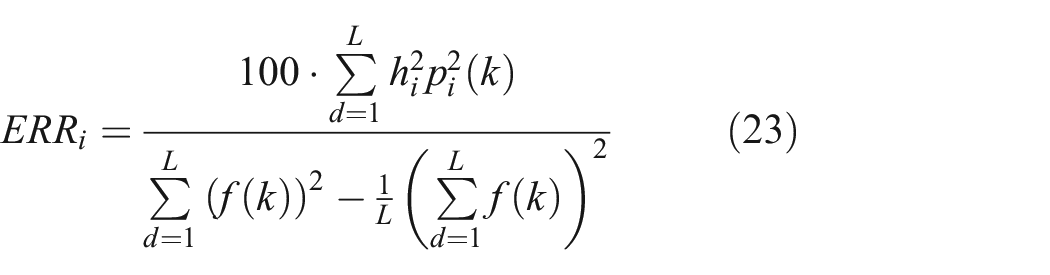
The contribution rate of the remaining items is solved by orthogonal transformation until the maximum


From this model, the coefficients of the polynomial optimal model and the target response function relative to the design parameters can be determined. The sensitivity of each parameter can be calculated directly by integral.
As shown in Figure 1, the limit function for structural reliability evaluation is established, and to identify the reliability influencing factors are included in the function. After that, the response surface function should be constructed, and the initial design points of which are defined. The least square approach is used to calculate the coefficients of response surface function, and based on which to solve the reliability index. After the solving process, the next generation design points should be constructed, and to generate all the design points, contain the experimental design points. Then the corrected coefficients of response surface function can be calculated, and the reliability index is solved again. Further, the response surface function can be solved by using the convergence judgment and loop calculation.

Flow chart for solving response surface function.
Case study
Impact factors of structural reliability based on the revised sensitivity model
The sensitivity analysis approach based on revised sensitivity model can be proposed by combining multiple analysis steps, the flow chart of which is shown in Figure 2.

Flow chart of the revised sensitivity model.
First of all, according to the working conditions of the equipment, the influence factors of the structure, the conventional value range of the influence factors, the number of sample points and variable space are studied. And the specific experimental scheme of various influencing factors can be made.
Then through the multi-body dynamics analysis, the load value corresponding to experimental group is calculated. And the load value of multi-body dynamics analysis is imported into the structural statics analysis step to accomplish the static analysis. Also the rationality of the experimental scheme is evaluated by the method of range verification. When the evaluation meets the requirements, the sensitivity value of each structural reliability factor are calculated, through the revised sensitivity model based on the response surface function. Then, the degree of influence of factors on reliability indexes and their coupling effects can be expressed quantitatively.
Experimental scheme
In order to verify the evaluation accuracy of the revised sensitivity model, a typical harvester structure is chosen to carry out the case study. In the context of considering the working environment for typical harvester structure, the controllable factors mainly include
50
: forward speed
The common value of influencing factors for harvester structure as shown in Table 1 are obtained, according to the existing experimental research data. Relying on the concept of orthogonal experimental design. 51
The design scheme of experimental factors.

This is an experiment with five factors and seven levels. If all experiments have been conducted, 57 = 78125 experimental combinations should be conducted. Therefore, the feasibility of comprehensive testing in practical applications is not high. At this point, orthogonal experiments are needed to determine the experimental combination. For tests with five factors and seven levels, there is an L49 (57) orthogonal table that meets the conditions. Based on this, a testing plan was designed, which only requires 49 test combinations to obtain inspection indicators for operating parameters. Rules for interaction and influence. Combine the above working conditions with orthogonal experiments to obtain the L49 (57) orthogonal experimental combination shown in Table 2
L49 (57) orthogonal test combinations.

Multibody dynamics analysis
The software ADAMS is used to perform the multibody dynamics simulation of the harvester. The input conditions and boundary conditions imposed on structure are shown in Figure 3. The load is mainly concentrated on the connected position between the reel and the header, the header auger and the header, the cutting knife and header. 52

Structural components and the loading conditions.
The boundary conditions are shown in Table 3. Also the driving function as shown in Table 4 are applied on the various pairs, in the software ADAMS. The obtained load spectrum at the reel, cutter, and auger are shown in Figure 4. Due to different working conditions, the three load values of the header structure show a fluctuating trend, among which the auger rotates the fastest, and its load value amplitude is the most obvious.
Boundary conditions.

Driving function program of case structure.

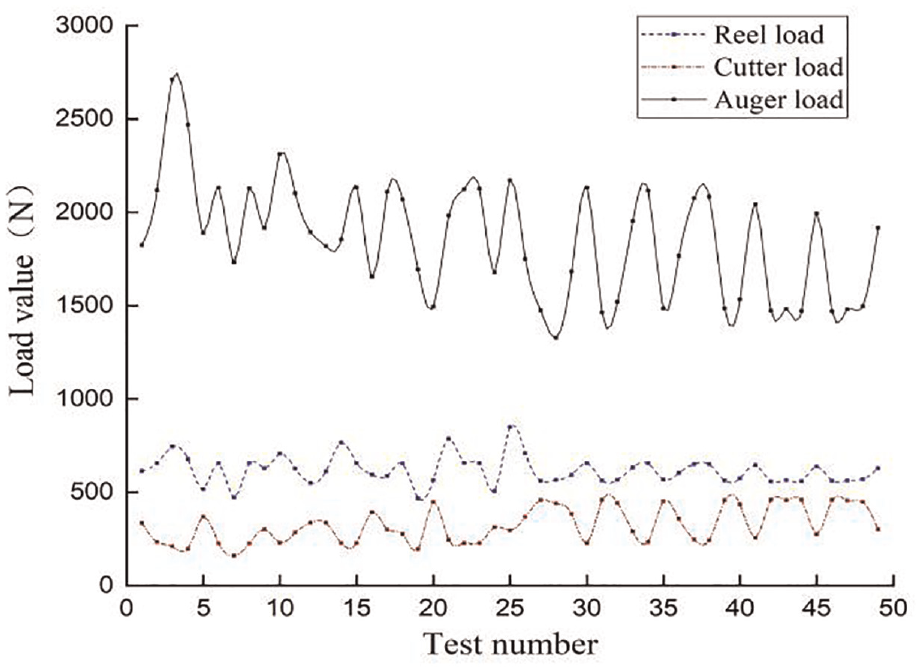
Load spectrum extracted from dynamic simulation.
Structural statics analysis
The 3D model is imported into the ANSYS software, and the loads at the reel, cutter, auger obtained from the dynamic analysis are set as the input parameters. Also the constraints are added at the feeding port. As shown in Figure 3, B is the load at the cutter, C and D are the load at the reel, E and F are the load at the auger, and fixed constraint is added at the feed port A. After the pre-processing is completed, 49 groups of data under the conditions of different matching influencing factors are input into the simulation process. Then the statics analysis cloud diagram under typical working conditions can be obtained, as shown in Figure 5. Among them, the test plan corresponding to working condition 1 is: the speed of the threshing drum is 280
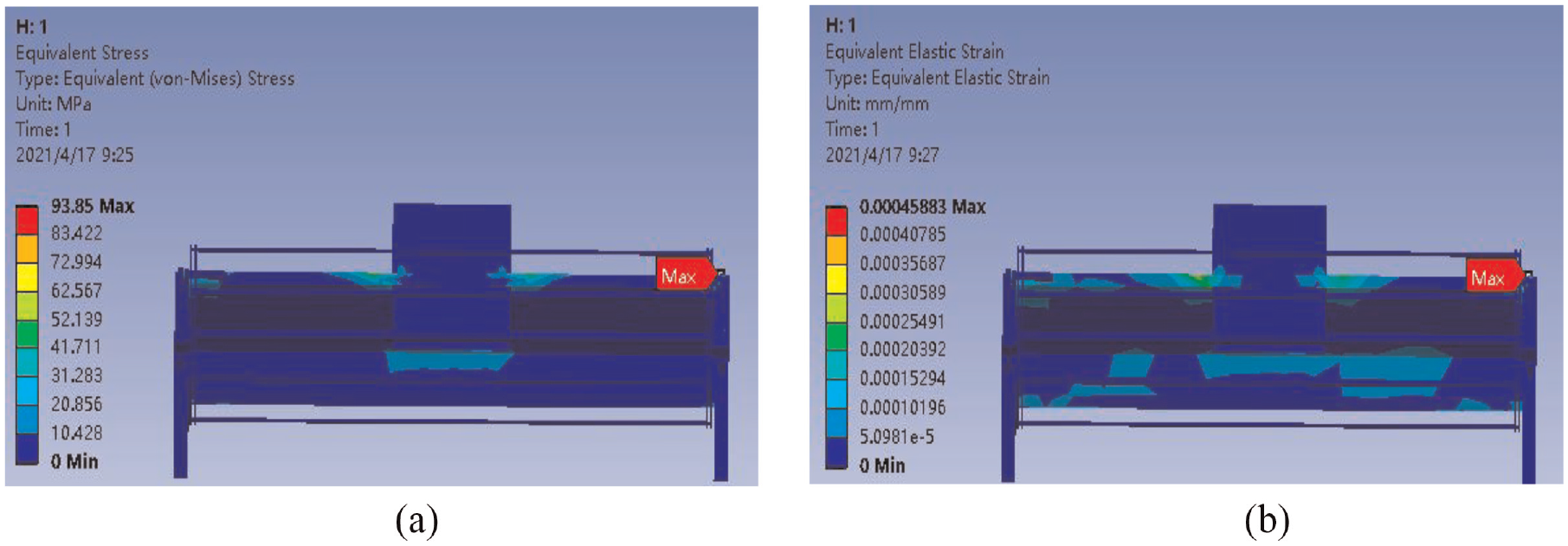
Statics analysis results under working condition 1: (a) equivalent stress and (b) equivalent strain.
The simulation results of 49 sets are shown in Figure 6. As shown in Figure 6. The average value of the test results are shown in Figure 6. The average prediction accuracy of the simulation results is 93.6%.

Statics simulation and test results.
Range verification
The stress solution result for the influence factor under j-th column and

The range analysis model is used to analyze the data in the Figure 6, and the range analysis results as shown in Table 5 can be obtained. As shown in Table 5, the descending order of sensitivity degree for five influencing factors are: threshing drum speed, reel speed, forward speed, stubble height, and granary load. When the reliability is the control objective, the optimum threshing drum speed E should be the seventh level; the optimum reel speed B should be the second level; the optimum forward speed A should be the third level; the optimum stubble height C should be the seventh level; the optimum granary load D should take the first level. So the level combination of influencing factors is
Range analysis results of various influencing factors.

Also nine groups of random prediction results shown in Figure 7 can be obtained, according to the range analysis results of various influencing factors, in which (a) is the simulated prediction value by the range analysis and (b) is the error rate. As shown in Figure 7, the stress corresponding to test number 17 is the largest, and its value is 154.79 MPa; the stress corresponding to test number 46 is the smallest, and its value is 84.15 MPa. The maximum error rate is 13.5%, which occurs in group 19. And the minimum error rate occurs in group 3, its value is 0.3%.

The prediction results of range analysis.
Based on the above multi factor experimental analysis, the response surface function error contour map between the two structural strength influencing parameters of the harvester was obtained. It is obvious that there is a coupling relationship between the structural strength and parameters of the harvester. The relative error between the reel speed and the drum speed is the largest, as shown in Figure 8(g), while the relative deviation between the stubble height and the grain bin load is the smallest, as shown in Figure 8(h).

Response surface function error fitting contour diagram: (a) error between F1 and F2, (b) error between F1 and F3, (c) error between F1 and F4, (d) error between F1 and F5, (e) error between F2 and F3, (f) error between F2 and F4 (g), error between F2 and F5, (h) error between F3 and F4, (i) error between F3 and F5, and (j) error between F4 and F5.
Sensitivity analysis
Local sensitivity analysis
The sensitivity analysis model mentioned above is used to calculate the sensitivity value of different influencing factors for the case structure. Then the results as shown in Table 6 can be obtained after the data summarizing.
The sensitivity for influencing factor of different level.

As shown in Figure 9, the sensitivity value of the drum rotation speed and the reel rotation speed shows an increasing trend with the change of level for single influencing factor, while the sensitivity value of forward speed shows a decreasing trend with the change of level for single influencing factor. Meanwhile, the sensitivity of granary load and stubble height are basically unchanged.
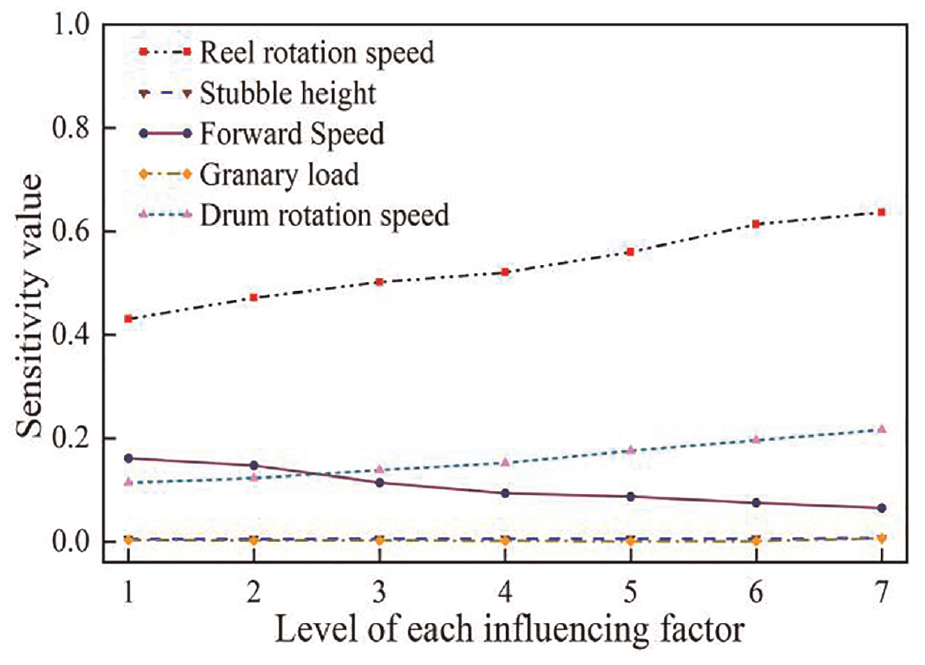
Sensitivity for single influencing factor.
The results can be obtained after the data summarizing, to quantitatively evaluate the sensitivity distribution interval of each influencing factor, as shown in Figure 10. As shown in Figure 10, the sensitivity value range of the drum rotation speed is the largest, and that of stubble height is the smallest.
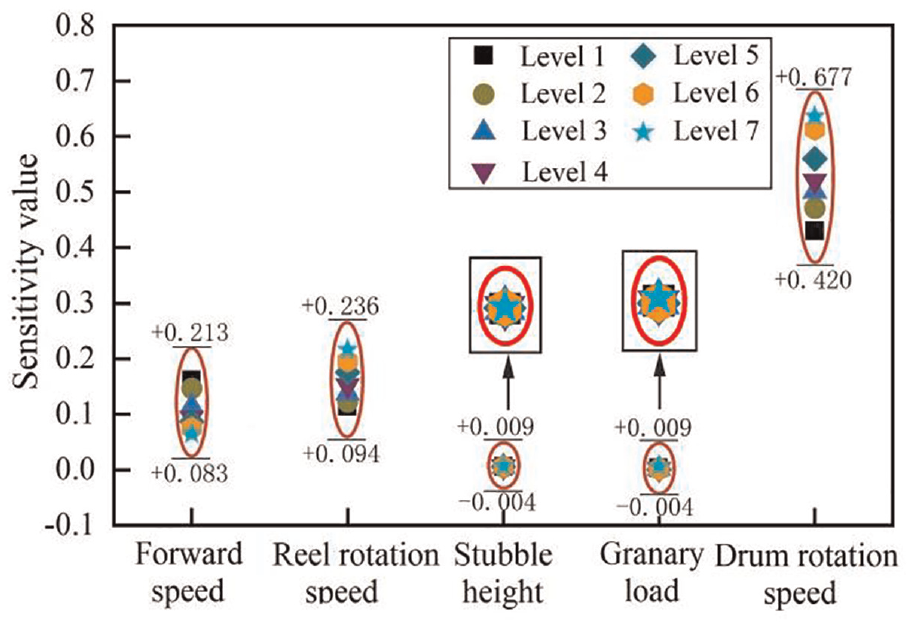
Sensitivity distribution range for single factor.
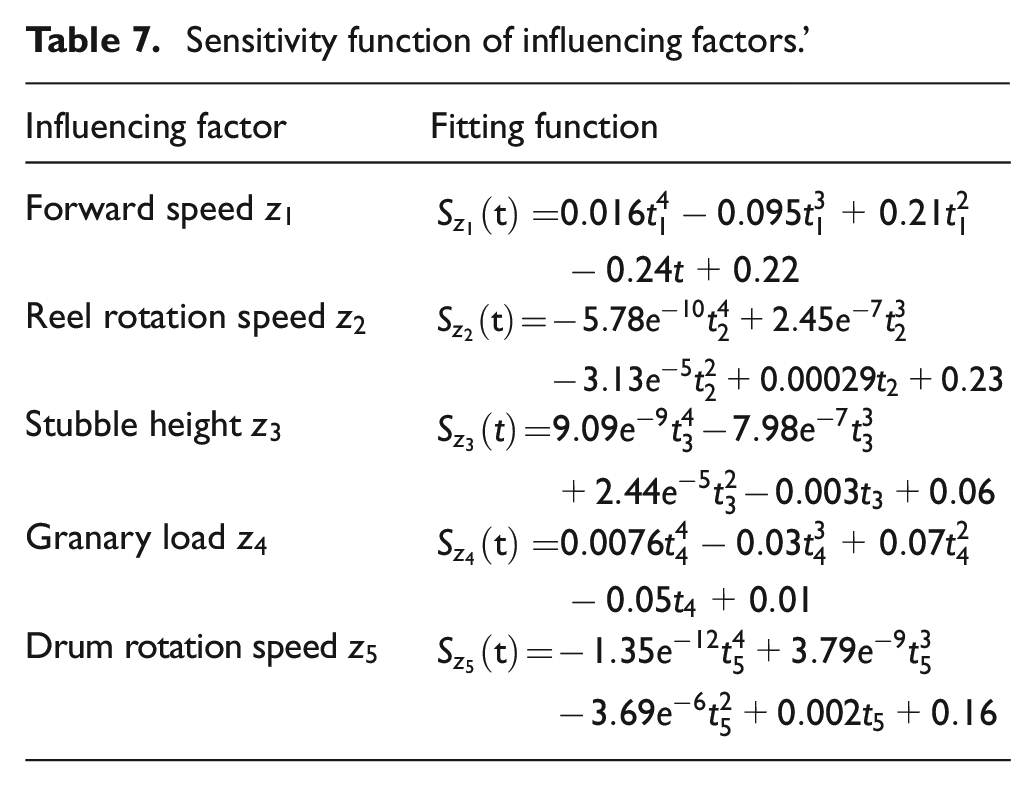
According to the results obtained in Figure 10, by fitting the sensitivity state distribution equation with Matlab, the sensitivity relationship functions of the five influencing factors shown in Table 7 can be obtained. Then the line diagram of sensitivity fitting function for the influencing factors can be obtained, as shown in Figure 11.
Sensitivity function of influencing factors.

Sensitivity fitting line for each influencing factor.
Global sensitivity analysis for the influencing factors
The local sensitivity analysis is usually used to judge the influence of single factor. 53 So the global sensitivity analysis and the multiple-order sensitivity result are needed, to effectively confirm the coupling degree between influencing factors. The first-order sensitivity coefficient and the global sensitivity coefficient of the five influencing factors as shown in Table 8 are obtained, based on the revised sensitivity analysis model.
Global sensitivity value of influencing factors.

Then the specific influence degree of different factors can be effectively identified. Further, the distribution of sensitivity value for different influencing factors can be obtained as shown in Figure 12.

Global sensitivity values of influencing factors.
As shown in Figure 12, the drum rotation speed and the reel rotation speed accounted for the largest proportion of sensitivity, the granary load and stubble height accounted for the smallest proportion. The sensitivity value of threshing drum speed is the largest, which further demonstrates that drum speed plays a leading role for the influence on case structure reliability. And the influence degree of the puller speed and the forward speed is different, which is mainly caused by the speed ratio of the puller speed and the forward speed. The load of the granary and the height of the stubble have little effect on the reliability of case structure during the harvester operation process.
The sensitivity prediction accuracy results shown in Table 9 are obtained by summarizing the simulation and test results. As shown in Table 9, the average value of sensitivity prediction accuracy of the case study is 97.36%.
The sensitivity prediction accuracy of factors.

Considering the different factors affecting harvester operation under the analysis of global sensitivity, the optimal operation parameter range as shown in Figure 12 can be obtained, according to the results of global sensitivity distribution and equation (27).

Figure 13 shows the best operation parameter ranges for different condition factors. As shown in Figure 13, the best operation parameter range of forward speed is between ±2.85% of K4f; reel rotation speed is between ±1.98% of K7r; stubble height is between ±2.97% of K1s; granary load is between ±3.32% of K7g; drum rotation speed is between ±1.71% of K1d.

The optimal operating parameters interval of case structure under first-order sensitivity revision.
Also the coupling relationship between different factors should also be considered, after analyzing the affection degree of single influencing factor. In order to further study the detailed sensitivity index, it is necessary to calculate the second order sensitivity value. The results shown in Table 10 are solved.
The second-order sensitivity of two-factor coupling.

And the sensitivity index distribution of the parameters can be obtained, as shown in Figure 14. The coupling degree between the reel speed and the stubble height is the most prominent, and the coupling degree between the stubble height and the threshing drum speed is the least prominent. At the same time, the analysis results show that the interaction between the influencing factors produces the total order sensitivity of the analysis.

Sensitivity distribution of coupling factors.
Considering the different degrees of factors affecting harvester operation under the analysis of second-order sensitivity, the optimal operation parameter range as shown in Figure 15 can be obtained, according to the results of global sensitivity distribution and equation (27). Figure 15 illustrates the best range of operation parameters for different condition factors. As shown in Figure 15, the best operation parameter range of forward speed is between ±1.77% of K4f; reel rotation speed is between ±1.70% of K7r; stubble height is between ±1.78% of K1s; granary load is between ±1.81% of K7g; drum rotation speed is between ±1.63% of K1d.

The optimal operating parameters interval of case structure under second-order sensitivity revision.
The distribution of optimal operating parameters interval under five order sensitivity revision can be achieved, as shown in Figure 16. With the increase of the order, the optimal value range is gradually reduced. With the increase of the order of the solution, the range of the optimal operation parameters is gradually refined. From the point of view of protecting the operation safety of the equipment structure, a more detailed range of operation parameters is beneficial.

The distribution of optimal operating parameters interval under five order sensitivity revision.
Conclusion
This paper has developed a response surface modified sensitivity model for local and global sensitivity analysis of multiple influencing factors, by integrating the optimal polynomial response surface function with the Sobol’ algorithm. Through the direct integration of the revised sensitivity reliability model, the accurate multiple-order sensitivity index of mechanical structure can be obtained. Not only the change of single factor, but also the mutual coupling between the factors are studied.
The industrial case shows that the proposed revised approach has a high prediction accuracy of 97.36%. The results reveal that the coupling induction between the reel rotation speed (L2) and the stubble height (L3) is the highest, and the coupling induction between the stubble height (L3) and the drum rotation speed (L5) is the weakest. Based on this method, other industrial cases can be analyzed, to get the coupling induction of different working conditions.
The distribution of optimal operating parameters interval under five order sensitivity revision are achieved. With the increase of the order, the optimal value range is gradually reduced. The revised approach may provide a good mean for the choose of the best operation parameters of equipment.
Footnotes
Handling Editor: Chenhui Liang
Declaration of conflicting interests
The author(s) declared no potential conflicts of interest with respect to the research, authorship, and/or publication of this article.
Funding
The author(s) disclosed receipt of the following financial support for the research, authorship, and/or publication of this article: This work was supported by National Natural Science Foundation of China (51805447), Natural Science Foundation of Jiangsu Province (BK20190911), Agricultural Science and Technology Independent Innovation Fund of Jiangsu Province (CX(20)3060), Natural Science Foundation of the Jiangsu Higher Education (22KJB460010).