This paper develops a block diagonal preconditioned Uzawa splitting (BDP-US) method for solving saddle point problems by generalizing the Uzawa splitting iteration method proposed by Li and Ma (Numer Math Theory Methods Appl 2018; 11: 235–246). A sufficient condition is then provided to ensure the convergence of the BDP-US method. Meanwhile, a preconditioner on the basis of the BDP-US method is proposed, the spectral properties of the preconditioned matrix is analyzed, and the choice of the parameters for this matrix splitting iteration method is discussed. Numerical results are provided to support the obtained results, and demonstrate the effectiveness of BDP-US method as well as the corresponding preconditioner.
Consider the linear system of the block structure:
where is symmetric and positive definite, with , , , , and denotes the mesh size. is the transpose of , and is the zero matrix of proper dimension. It is known that the linear system has a unique solution when is of full column rank (see Benzi et al.,1 Bai and Bai,2 Bai and Pan3).
Linear system of form (1) is called a saddle-point problem, and arises from many important applications in various fields of science and engineering, including computational fluid dynamics, optimization, optimal control, constrained and weighted least-squares estimation as well as many others.4–8 Then, designing effective algorithms to solve it has attracted researchers’ attention. In general, for a large scale problem (1), only iterative methods are computationally feasible due to excessive storage and/or computational cost. By using some algebraic properties and the structure of the coefficient matrix, many iterative methods have been developed to solve (1), such as Uzawa type methods,9–12 SOR (successive overrelaxation) type methods,13–16 HSS (Hermitian and skew-Hermitian splitting) type methods and its accelerated variants,17–20,28 and Krylov subspace methods with suitable preconditioners.21–24 In particular, Bai28 discussed the optimal parameters in the HSS-like methods for saddle-point problems, and provided the quasi-optimal parameters of the HSS iteration method.
Recently, based on the shift-splitting iteration method21 and the classical Uzawa method,9 Li and Ma25 proposed the following Uzawa splitting (US) iteration method
to solve singular saddle-point problem (1) with and being the rank of the matrix, where is a symmetric positive definite matrix, and are two positive constants. Even though this method is a special case of the parameterized inexact Uzawa (PIU) method,15 it has better performance than the Uzawa method and Uzawa-SOR methods.26 Moreover, this method is convergent when
where is the largest eigenvalue of the matrix . But, the US method might converge very slowly as the scale of the problem increases. In fact, at this case, the value of may become larger, which makes too large, or too small. For example, when , the given values of in Li and Ma25 are , , and , respectively. It should be mentioned that no strategy for selecting iteration parameters can be found in Li and Ma,25 and it requires to accurately solve a linear system with the coefficient matrix in per iteration of the US method. However, it is usually impractical to directly solve (1), and may be expensive to solve it by the conjugate gradient method without preconditioning when is large.
To overcome the above shortfalls, in this paper, we (a) develop a BDP-US method for solving the saddle-point problem (1) by generalizing the US method; (b) provide a sufficient condition to ensure the convergence of the BDP-US method; (c) present a splitting preconditioner and analyze the spectral properties of the preconditioned matrix; and (d) discuss the choice of the parameters for this BDP-US method. The proposed method includes the US method in Li and Ma25 as a special case. Numerical results demonstrate that the BDP-US method is effective and feasible for solving the singular saddle point problems (1). Moreover, the splitting preconditioner can improve the convergence rate of Generalized Minimal Residual (GMRES) method.
The remainder of this paper is organized as follows. In Section 2, the BDP-US iteration method is presented. The convergence properties of the BDP-US method and the spectral properties of the preconditioned matrix are analyzed in Section 3 and 4, respectively. The choice of the parameters for the BDP-US method is discussed in Section 5, and numerical experiments are provided in Section 6. Finally, we draw some conclusions in Section 7.
In the following, we denote by the identity matrix of order , by the real part of a complex number, by the superscripts the transpose of a matrix or vector, by the spectral radius of a matrix, by the vector and by the largest eigenvalues of a symmetric and positive definite matrix.
The BDP-US iteration method
In this section, we shall develop the BDP-US iteration method for solving the linear system (1).
Let
where and are positive definite matrices. Then by left and right multiplying the linear system (1) with and respectively, we obtain
which can be written as
Similar to Bai et al.,21 we can define the corresponding shift-splitting of as
where is a positive constant. For the available approximation , , the following iteration scheme is first applied to the first equations in (2) to compute the update :
Then the Uzawa iteration method is used to the last equations in (2) to compute the update :
where is symmetric and positive definite, and is a positive constant.
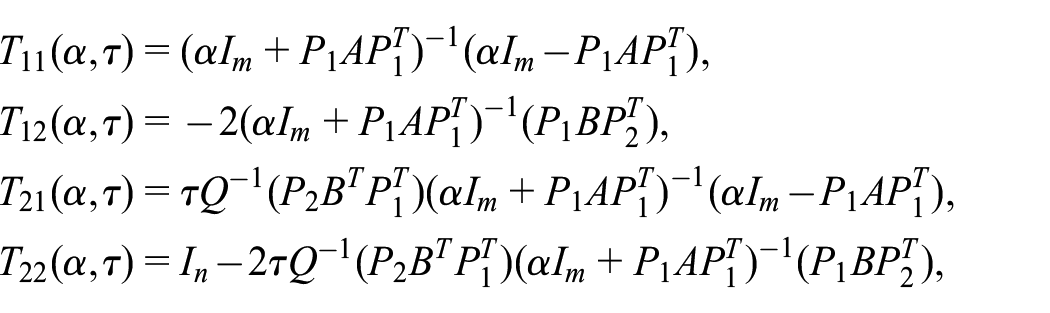
For simplicity, we denote , , and . Then the results in (4) and (5) suggest the following BDP-US method for the linear system (2):
or
where the iteration matrix
with
and
On the other hand, let
and
then we obtain a splitting , and
Overall, we can perform the BDP-US method as follows: Given an initial guess with and , two positive parameter and ; for , compute by the iteration scheme (6) until the iteration sequence converges. Thus we obtain the converged sequence with and .
Clearly, this BDP-US method reduces to the US method in Li and Ma25 by setting and , and different , and can be selected in actual computation.
Convergence analysis of the BDP-US method
In this section, we shall analyze the convergence of the BDP-US iteration method, and present a sufficient condition for its convergence. To this end, we need the following result.
Lemma 3.127Both roots of the real quadratic equation are less than one in modulus if and only if and .
It is well known that the BDP-US method (7) is convergent if and only if . Let be an eigenvalue of , and with and be the corresponding eigenvector, then
Namely,
This, (8) and (9) imply that
or
Lemma 3.2Assume that and are positive definite, and are symmetric and positive definite, is of full column rank, and . If is an eigenvalue of and is the corresponding eigenvector, then and .
Proof. If , then (11) becomes
From the assumptions, the coefficient matrix in (12) is nonsingular. Thus, and , which contradicts with the fact that since it is an eigenvector of . Therefore, it must be .
Suppose that . Then (11) becomes
Thus by , and the positive definiteness of . This is impossible since . Therefore, our result holds.
Now, we state and prove the convergence result of the BDP-US method.
Theorem 3.1Suppose that and are positive definite, and are symmetric and positive definite, is of full column rank, and . Then the BDP-US method is convergent if the parameters and satisfy the following condition:
where
In particular, when , the BDP-US iteration method is convergent if .
Proof. Let be an eigenvalue of and be the corresponding eigenvector. Then and by Lemma 3.2, and
by the second equation of (11). In the following, we establish the relationship between the eigenvalue and the parameters and in two cases.
Case 1: . Then by (15), and the first equation of (11) becomes
From and multiplying both sides of the above equation by , we get
where by the positive definiteness of . Thus, by .
Case 2: . Then substituting (15) into the first equation of (11) yields
where is defined in (14). Multiplying both sides of the above equation by yields
where due to the positive definiteness of .
From (17) and Lemma 3.1, we know that if and only if
That is,
Since , (13) implies (18). Thus our results are obtained.
Spectral properties of the preconditioned matrix
It is worth pointing out that the BDP-US iteration method, a stationary iteration scheme, provides a preconditioner defined in (8), which can accelerate the convergence rate of GMRES method when applied to the linear system (2). In this section, we shall analyze spectral properties of the preconditioned matrix .
As is known, when the preconditioner is applied to accelerate the convergence of Krylov subspace methods, one must solve an intermediate linear system
at each iteration, where and . This system consists of two smaller systems and is solved as follows: First, solve the linear system
then solve . Noticing that and , (20) can be solved by either the (sparse) Cholesky factorization or the preconditioned conjugate gradient method, and the much smaller can be solved by the Cholesky factorization.
Theorem below gives spectral properties of the preconditioned matrix .
Theorem 4.1Assume that and are positive definite, and are symmetric and positive definite, is of full column rank. Then the real part of any eigenvalue of is positive, that is, the preconditioned matrix is positive stable. Furthermore, if , where is defined by (14).
Proof. Let be an eigenvalue of and be the corresponding eigenvector. Then
by (9) and (10). This implies that is an eigenvalue of , and (17) holds at by the proof of Theorem 3.1, that is,
where , and since by Lemma 3.2. Thus
This, and imply that the real part of , when , and when since .
Furthermore, from (21) and Lemma 3.1, if and only if and , that is, . Thus the assertion holds by and .
The parameter choice
In general, the effectiveness of an iteration method depends largely on the choice of its parameters, and it is very important to find a good strategy for approaching the optimal parameters of the iteration method since it is very hard to find the optimal parameters. In particular, Bai28 provided the quasi-optimal parameters of HSS iteration methods to solve the large sparse saddle-point problems. Following the similar analysis as Bai,28 we shall give a strategy to select the iteration parameters of the BDP-US method for solving the linear system (2).
Let be an eigenvalue of and be a corresponding eigenvector. When is of full column rank, and by Lemma 3.2, and
by (17), where and . In the following, we analyze the choices for the parameters in two cases.
Case 1: . Then , or and , or and . So
a) . Then by and . Due to the linearity of with respect to and , at when , and at when .
b) . Then
by since . Since
is increasing and decreasing with respect to and , respectively. Thus, and attain the minimum when , which leads to .
c) . Then , and at .
d) . Let . Then
This implies that is decreasing and increasing with respect to and , respectively. Thus, at when ; and at when .
Case 2: . That is, . Then
In summary, at with , and at . Therefore, the best choices of and are .
Numerical experiments
In this section, a numerical example is provided to support the theoretical results and illustrate the effectiveness of BDP-US method. All experiments are conducted in MATLAB (R2015a) and terminated if the current residual
is less than or the number of iteration steps is greater than the prescribed number . In our computations, the initial guess is set to be zero, and the right-hand side is chosen such that the exact solution of the saddle-point problem (2) is .
Example 6.118Consider the following linear system, where
is the discretization mesh-size, ⊗ is the Kronecker product symbol, and .
To show the advantages of BDP-US method and preconditioner , we compare it with three iteration methods (Uzawa-SOR,26 Uzawa-Low,29 and one-parameter variant of preconditioned Uzawa (OVPU)30 methods) and their corresponding preconditioners. In all experiments, the parameter in OVPU method is optimal value, while the parameters in the other methods are set to the experimentally computed optimal ones, which leads to the least number of iteration steps.
Take , , and as shown in Table 1, and . Tables 2–4 report the numerical results obtained by these methods for two cases, where “IT” denotes the number of iteration steps and “CPU” is the elapsed CPU time in seconds. From Tables 2 to 4, we see that BDP-US method outperforms the other three methods, and BDP-US-I has a worse performance than BDP-US-II. Thus, the BDP-US method with suitable parameters , and is more efficient.
Choices of the matrices of , , and .
Cases
I
II
Numerical results for example 6.1 ().
Cases
IT
CPU
RES
Uzawa-SOR-I
(1.38,–,0.10)
159
0.0313
9.87E-08
Uzawa-SOR-II
(1.20,–,0.17)
128
0.0288
9.85E-08
Uzawa-Low-I
(1.50,–,0.13)
139
0.0307
8.88E-08
Uzawa-Low-II
(1.52,–,0.26)
87
0.0199
9.90E-08
OVPU-I
(0.4136,–,–)
81
0.0192
9.60E-08
OVPU-II
(0.4136,–,–)
79
0.0190
9.99E-08
BDP-US-I
(–,118,0.248)
68
0.0187
9.83E-08
BDP-US-II
(–,0.50,0.50)
49
0.0084
8.39E-08
Numerical results for example 6.1 ().
Cases
IT
CPU
RES
Uzawa-SOR-I
(1.41,–,0.032)
436
3.5673
9.80E-08
Uzawa-SOR-II
(1.25,–,0.056)
366
2.1211
9.69E-08
Uzawa-Low-I
(1.48,–,0.038)
418
2.3622
9.73E-08
Uzawa-Low-II
(1.48,–,0.075)
272
2.3017
9.78E-08
OVPU-I
(0.1529,–,–)
277
1.7060
9.82E-08
OVPU-II
(0.1529,–,–)
266
1.6631
9.27E-08
BDP-US-I
(–,237,0.137)
112
0.6171
9.30E-08
BDP-US-II
(–,0.308,0.308)
86
0.4954
7.90E-08
Numerical results for example 6.1 ().
Cases
IT
CPU
RES
Uzawa-SOR–I
(1.45,–,0.015)
831
22.8820
9.89E-08
Uzawa-SOR–II
(1.23,–,0.028)
711
18.5213
9.92E-08
Uzawa-Low–I
(1.46,–,0.019)
809
22.6989
9.22E-08
Uzawa-Low–II
(1.45,–,0.041)
520
17.2806
9.11E-08
OVPU-I
(0.0764,–,–)
602
14.0528
9.82E-08
OVPU-II
(0.0764,–,–)
569
12.4945
9.73E-08
BDP-US-I
(–,348,0.093)
154
5.1158
9.48E-08
BDP-US-II
(–,0.238,0.238)
114
2.7059
8.95E-08
Moreover, we accelerate the convergence rate of the GMRES(10) method by using the , Uzawa-SOR, Uzawa-Low, and OVPU preconditioners (denote by , , , and respectively). Tables 5 and 6 list the outer(inner) iteration numbers IT, the CPU and the RES for accelerating these iteration methods by GMRES(10) in two cases when , where IT, CPU, and RES are the same as Table 2. From Tables 5 and 6, we see that GMRES(10) with preconditioner requires less IT and CPU than that with the other three compared preconditioners, and Case II outperforms Case I. Thus, GMRES with the preconditioner achieves faster convergence rate.
Outer(inner) iterations, CPU(s), and RES of GMRES(10) for Case I when .
Preconditioners
IT
CPU
RES
Uzawa-SOR
13(9)
2.7271
9.46E-08
Uzawa-Low
13(7)
2.5116
9.34E-08
OVPU
18(9)
3.2805
7.94E-08
BDP-US
5(3)
0.8190
7.93E-08
Outer(inner) iterations, CPU(s), and RES of GMRES(10) for Case II when .
Preconditioners
IT
CPU
RES
Uzawa-SOR
12(8)
2.3917
9.50E-08
Uzawa-Low
11(9)
2.2694
9.36E-08
OVPU
21(8)
3.8201
8.01E-08
BDP-US
4(7)
0.6848
7.72E-08
To see more clearly, Figures 1 and 2 depict the eigenvalue distributions of the corresponding preconditioned matrices for two cases when . Clearly, the real parts of are all nonnegative, which coincides with that of Theorem 4.1, and the eigenvalues of are more clustered than the other three preconditioned matrices. Therefore, the preconditioner with suitable parameters is more effective than , , and when applied to solve large sparse saddle-point problems.
Eigenvalue distributions of the corresponding preconditioned matrices for Case I when : (a) Uzawa-SOR, (b) Uzawa-Low, (c) OVPU, and (d) BDP-US.
Eigenvalue distributions of the corresponding preconditioned matrices for Case II when : (a) Uzawa-SOR, (b) Uzawa-Low, (c) OVPU, and (d) BDP-US.
Conclusions
This paper develops a block-diagonally preconditioned US method for solving the saddle-point problems by generalizing the US method in Li and Ma25 and sufficiently utilizing the block diagonal preconditioning technique, and provides a sufficient condition to ensure its convergence. Then, a splitting preconditioner is presented, the spectral properties of the preconditioned matrix are analyzed, and the choice of the parameters for this iteration method is discussed. Finally, numerical experiments are conducted to demonstrate that BDP-US method performs better than some existing methods and the preconditioner can accelerate the corresponding Krylov subspace methods. Moreover, further explorations should be focused on finding optimal parameters of the BDP-US method and giving more accurate description for the spectral distribution of the preconditioned matrix.
Footnotes
Acknowledgements
The authors would like to thank anonymous reviewers for their valuable comments and suggestions for revising the paper.
Handling Editor: Chenhui Liang
Author contributions
The authors confirm contribution to the paper as follows: Bo Wu created the idea, performed the formulations and prepared this paper under the supervision of Xing-Bao Gao. All authors reviewed the results and approved the final version of the manuscript.
Declaration of conflicting interests
The author(s) declared no potential conflicts of interest with respect to the research, authorship, and/or publication of this article.
Funding
The author(s) received no financial support for the research, authorship, and/or publication of this article.
ORCID iD
Bo Wu
Data accessibility statement
All the data used in this paper can be obtained upon request to the corresponding author.
References
1.
BenziMGolubGHLiesenJ.Numercial solution of saddle point problems. Acta Numer2005; 14: 1–137.
2.
BaiZJBaiZZ.On nonsingularity of block two-by-two matrices. Linear Algebra Appl2013; 439: 2388–2404.
3.
BaiZZPanJY.Matrix analysis and computations. Philadelphia, PA: SIAM, 2021.
4.
ElmanHC.Preconditioners for saddle point problems arising in computational fluid dynamics. Appl Numer Math2002; 43: 75–89.
5.
GouldNIMHribarMENocedalJ.On the solution of equality constrained quadratic programming problems arising in optimization. SIAM J Sci Comput2001; 23: 1375–1394.
6.
BettsJT.Practical Methods for optimal control using nonlinear programming. Philadelphia, PA: SIAM, 2001.
7.
BjorckA.Numerical Methods for Least Squares Problems. Philadelphia, PA: SIAM, 1996.
8.
BaiZZ.Structured preconditioners for nonsingular matrices of block two-by-two structures. Math Comput2005; 75: 791–815.
9.
ArrowKHurwiczLUzawaH.Studies in nonlinear programming. Stanford, CA: Stanford University Press, 1958.
10.
LiangZZZhangGF.On block-diagonally preconditioned accelerated parameterized inexact Uzawa method for singular saddle point problems. Appl Math Comput2013; 221: 89–101.
11.
LiJCWangNNKongX.Uzawa-Low method and preconditioned Uzawa-low method for three-order block saddle point problem. Appl Math Comput2015; 269: 626–636.
12.
MiaoSX.A new Uzawa-type method for saddle point problems. Appl Math Comput2017; 300: 95–102.
13.
GolubGHWuXYuanJY.SOR-like methods for augmented systems. BIT Numer Math2001; 41: 71–85.
14.
BaiZZParlettBNWangZQ.On generalized successive overrelaxation methods for augmented linear systems. Numer Math2005; 102: 1–38.
15.
BaiZZWangZQ.On parameterized inexact Uzawa methods for generalized saddle point problems. Linear Algebra Appl2008; 428: 2900–2932.
16.
LiCMaC.The modified ASSOR-like method for saddle point problems. J Appl Anal Comput2021; 11: 1718–1730.
17.
BaiZZGolubGHNgMK.Hermitian and skew-Hermitian splitting methods for non-Hermitian positive definite linear systems. SIAM J Matrix Anal Appl2003; 24: 603–626.
18.
BaiZZGolubGHPanJY.Preconditioned Hermitian and skew-Hermitian splitting methods for non-Hermitian positive semidefinite linear systems. Numer Math2004; 98: 1–32.
19.
BaiZZGolubGH.Accelerated Hermitian and skew-Hermitian splitting iteration methods for saddle-point problems. IMA J Numer Anal2007; 27: 1–23.
20.
BaiZZBenziM.Regularized HSS iteration methods for saddle-point linear systems. BIT Numer Math2017; 57: 287–311.
BaiZZ.On spectral clustering of HSS preconditioner for generalized saddle-point matrices. Linear Algebra Appl2018; 555: 285–300.
23.
CaoYRenZRYaoLQ.Improved relaxed positive-definite and skew-Hermitian splitting preconditioners for saddle point problems. J Comput Math2019; 37: 95–111.
24.
ZhuJLWuYJYangAL.A two-parameter block triangular preconditioner for double saddle point problem arising from liquid crystal directors modeling. Numer Algorithms2022; 89: 987–1006.
25.
LiJTMaCF.Semi-convergence analysis of Uzawa splitting iteration method for singular saddle point problems. Numer Math Theory Methods Appl2018; 11: 235–246.
26.
ZhangJShangJ.A class of Uzawa-sor methods for saddle point problems. Appl Math Comput2010; 216: 2163–2168.
27.
YoungDM.Iterative solution of large linear systems. New York, NY: Academic Press, 1971.
28.
BaiZZ.Optimal parameters in the HSS-like methods for saddle-point problems. Numer Linear Algebra Appl2009; 16: 447–479.
29.
YunJH.Variants of the Uzawa method for saddle point problem. Comput Math Appl2013; 65: 1037–1046.
30.
YunJH.Fast one-parameter variant of preconditioned Uzawa method with a scaled preconditioner for saddle point problems. Appl Math Sci2016; 10: 109–117.