



Abstract
Some degree of inertia effect on the bearing film is inevitable for high density supercritical carbon dioxide (S-CO2) working as a lubricant in high speed rotor operating conditions. This paper aims to reveal the influence of inertia effect on static and dynamic performances of the S-CO2 tilting pad bearings. Numerical results demonstrate that inertia effect on the lubricating film of the top pad is more pronounced. The peak pressure of all pads is increased at a high reduced Reynolds number compared with the inertialess condition, while the influence of inertia effect on the dynamic coefficient is weak. The theoretical model including inertia effect presented in this study can more accurately evaluate the performance of high speed S-CO2 tilting pad bearings.
Introduction
Supercritical carbon dioxide (S-CO2) is one of the most thoroughly studied and widely used supercritical fluids. Compared with the conventional Rankine cycle, the S-CO2 Brayton cycle has high thermal efficiency for medium heat sources 1 and is among the most promising energy conversion technologies, especially as a critical technology for reducing the cost of solar thermal-power generation. 2 The high performance and parameters of the S-CO2 turbomachinery, which is the core part of the cycle system, impose high DN factor and stability requirements on the bearings. Using S-CO2 as a bearing lubrication medium can eliminate the pollution of oil leakage to the circulating system, reduce the overall volume of the equipment and simplify the rotordynamics. 3
For the purpose of ensuring the high speed operation of turbomachinery, the study of bearing technology applied in the S-CO2 power generation cycle has become essential. Several successful S-CO2 turbomachinery testing projects, including Sandia National Laboratory 4 and Tokyo Institute of Technology, 5 have used S-CO2 compliant foil bearings with a solid ability to accommodate deformation and misalignment. Shortcomings have also been identified, such as the generation of high frictional heat during the start-up phase and the low stiffness of the thin foil structure. Tilting pad bearing can form an oil wedge around the journal because each pad can tilt freely with different operating conditions and cannot support a moment. As a result, unstable forces are significantly reduced and bearings are no longer a potential source of rotor system instability. It has been successfully used in rotating machinery such as centrifugal compressors, pumps, 6 or gas turbines 7 and has great potential for application in S-CO2 cases.
The real gas effect, turbulence in bearing clearances, and complex thermodynamic properties of S-CO2 leave much room for improvement in the theoretical calculation of bearings. Many scholars have researched the hydrodynamic theory of S-CO2 bearings. Conboy 8 used the same size model of S-CO2 lubricated thrust bearing as in the NASA air microturbine and developed the Reynolds equation that accounts for variations in real gas properties and the influence of turbulence. Compared to air, carbon dioxide as a lubricant demonstrated greater load capacity, dynamic stiffness, and a significant frictional power loss. Kim 9 proposed a three-dimensional thermohydrodynamic analysis tool including real gas effect and simulated CO2 lubricated journal foil bearing with a diameter of 34.9 mm under a gage pressure of up to 40 bar. Dousti and Allaire 10 developed a semi-linear Reynolds equation for S-CO2 lubricated bearings and calculated static characteristics under various operating conditions. The low viscosity of S-CO2 resulted in less power loss at high speeds compared to oil lubrication. Mehdi and Kim 11 developed a hybrid S-CO2 lubricated tilting pad journal bearing (TPJB) computational model to evaluate its static and dynamic performance. The authors compared the hybrid S-CO2 TPJB with the pure hydrodynamic TPJB and found that the load capacity and stiffness coefficient increased significantly with increasing supply pressure. By introducing a complete variable perturbation, Bi et al. 12 improved the partial derivative method in calculating stiffness and damping coefficients to account for the perturbed density, and viscosity, as well as the perturbed turbulence coefficient. A set of corresponding perturbed equations were derived, and the stiffness damping coefficients considering the real gas and turbulence effects were calculated. And further, a numerical method of thermohydrodynamic of S-CO2 tilting pad bearing based on global thermal equilibrium was proposed. 13
S-CO2 has both liquid and gaseous properties, with a density close to that of a liquid. In the Brayton cycle with S-CO2 as the working medium, the rotor has a fairly high rotational speed. The rotor speed is 70,000 r/min in the 10 kWe-class S-CO2 medium power cycle developed by the Korea Energy Technology Institute. 14 The high density, low viscosity properties, and high rotor speed result in a high Reynolds number turbulent flow in the bearing film with CO2 as the medium, thus causing inertia effect that deserves attention. There are few numerical analyses of S-CO2 lubricated bearings, including inertia effect in the literature. Qin et al. 15 used the full N-S equation solver Elimer, developed by the University of Queensland, and the two-dimensional compressible Reynolds equation without inertia effect to calculate the performance of the S-CO2 foil thrust bearing, respectively. The influence of the centrifugal inertia effect in solving for high density CO2 was found to make the load capacity obtained from the Reynolds equation differ significantly from that obtained from Eilmer solver, indicating that the inertia effect is non-negligible in S-CO2 lubricated thrust bearings. There is no literature report on the compressible extended Reynolds equation with inertia term for S-CO2 lubrication, and the influence of inertia effect on S-CO2 tilting pad bearing is also worth researching.
Air lubricated bearings are usually in high speed operating conditions, but their density is much lower than that of S-CO2, and the corresponding inertia effect is generally not considered. The compressible gas characteristics and nonlinear thermodynamic properties of supercritical carbon dioxide make the Reynolds equation considering inertia effect complicated. The influence of oil film inertia on bearing performance has been extensivly studied. Banerjee et al. 16 first developed the extended Reynolds equation based on the nonlinear series method to incorporate inertia effect into hydrodynamic lubrication and assessed the impact of inertia on the performance of infinitely long bearing cases. Chen et al. 17 further analyzed the effect of inertia on oil lubricated finite journal bearings by numerically calculating the extended Reynolds equation including inertia effect. The side flow rate is increased by the fluid inertia, while the influence of attitude angle and load capacity of the finite journal bearing is low at a moderately reduced Reynolds number (representing the magnitude of fluid film inertia effect). Meng et al. 18 also employed the same form of extended Reynolds lubrication equation as Banerjee et al. 16 to evaluate the influence of lubricating film inertia on the thermohydrodynamic lubrication performance of the piston skirt. Numerical results demonstrate that film inertia at a large reduced Reynolds number can increase the piston skirt’s hydrodynamic friction and transverse displacement. Constantinescu and Galetuse19,20 proposed a method to express the inertia variables in the turbulent regime using the mean velocity gradient, thus simplifying the inertia Reynolds equation, and gave an iterative scheme including the inertia correction term. The inertia effect in a continuous lubricating film can be further neglected up to a reduced Reynolds number of 10, while the inertia at the entrance of the lubricating film has a more significant impact on the operation compared to other places. Dousti et al. 21 performed a dynamic analysis of oil film operating under both inertia and turbulent phenomena, where turbulence has a more critical impact on shifting the journal’s steady-state point than inertia, while the inertia effect contributes significantly to the stability of plain short journal bearings. Dousti and Fittro 22 further developed the extended Reynolds equation, including convective, temporal inertia effect, using Constantinescu’s approach for cylindrical water lubricated bearing under high axial supply pressure. It was found that fluid inertia increases the bearing load with a low impact on added mass values and damping. Lin et al. 23 proposed a generalized Reynolds equation, including the effects of turbulence, inertia, and cavitation, to calculate the static characteristics of water lubricated spiral groove bearing, where inertia reduces frictional torque at high speed conditions. The above mentioned scholars used numerical methods to calculate the modified Reynolds equation of inertia, and the convergence of the inertia equation has been a difficult problem. Some scholars have also calculated the magnitude of the effect of fluid inertia by the analytical method. Okabe 24 used a short bearing method and modeled the tilting pad bearing considering film inertia effect. Analytical results showed that the lubricating film inertia generated more load but had little impact on stiffness and damping coefficient. However, the incompressible conditions in the extended Reynolds equation for oil lubricated bearings cannot continue to apply in the S-CO2 medium, and the S-CO2 physical properties in the extended Reynolds equation vary with temperature and pressure. Therefore, further research is needed on the mechanism and characteristics of the inertia effect on S-CO2 bearing performance.
In this paper, the extended compressible turbulent Reynolds equation considering inertia effect and real gas effect is derived, and the corresponding numerical method is given for the theoretical analysis of the S-CO2 lubricated tilting pad bearing. The bearing stiffness and damping coefficients under inertia condition are calculated numerically using the velocity displacement increment method. Then the inertia effect on tilt angle, pressure distributions, load capacity, and dynamic coefficients are studied, and the degree of inertia effect on each pad under different reduced Reynolds number is investigated.
Mathematical model
Supercritical carbon dioxide lubricated tilting pad bearing
In Figure 1, an example of the S-CO2 lubricated tilting pad bearing studied in this paper is depicted, which consists of pivots and related pads. All other motions are ignored in the numerical analysis, which only considers tilting motions about pivots in circumferential directions.
25
Then the lubricating film thickness

Where

Geometric parameters of S-CO2 tilting pad bearing.
The extended compressible turbulence Reynolds equation
The governing equations of thin film lubrication theory, with inertia effect included, describing the constant flow of a lubricant were further simplified by scale analysis as follows:



In equations (2) and (3), the left side represents the contributions from inertia forces that are not considered in classical lubrication theory. The circumferential and axial coordinates are indicated by x and z, respectively, and y represents the film thickness direction. Then, the integral form of the continuity equation and the momentum equation over the film thickness is expressed as equations (5)–(7).





Where

The operating conditions of S-CO2 lubricated bearings are usually under turbulent conditions. According to Constantinescu and Galetuse’s model, 20 the influence of inertia term on the velocity profile is approximately negligible, and the inertia variables in the turbulent regime are


Equation (13) applies for Re in the range of 103–105. Further, the shear force is formulated in the turbulent regime as 20




A difference in shear stresses between two surfaces can be compared using equations (14) and (15). Dousti and Fittro
22
used equation (16) as a correction term accounted for in the Reynolds equation, while the
By bringing the above turbulent inertia variables into the momentum equation and combining them with the compressibility conditions of the gas, we can obtain the circumferential and axial mean velocities in dimensionless form.


Where


Where

Where
Numerical methods
Generally, a linear relationship is established between density and pressure when solving the Reynolds equation numerically considering density variation, and then the density is replaced by the pressure in the dimensionless equation. Such an approach is mainly seen in air bearings, where the number of variables is reduced using the ideal gas law equation. S-CO2 physical properties such as viscosity and density are nonlinearly related to pressure. Dousti and Allaire 10 employed different types of real gas Equation of States (EOS) that govern the nonlinear density-pressure relationship to calculate the journal Bearings lubricated with S-CO2. However, the Reynolds equation will become complicated when any expression of the real gas EOSs is included, making the calculation and analysis of the equation very difficult. The National Institute of Standards and Technology (NIST) provides the thermodynamic properties mapping program REFPROP to calculate the properties of various fluids. 26 Thermodynamic properties data of CO2 obtained by this method are more accurate and have been widely used in calculating various S-CO2 bearings.27,28
In this paper, the viscosity and density of the S-CO2 medium required for the calculation can be obtained by known ambient pressure and ambient temperature through mapping REFPROP program. The extended Reynolds equation (20) was in second order two-dimensional partial differential form, which the SOR iterative method was used to solve after being discretized into a five-point central difference scheme.

Where the iteration coefficients are expressed as:
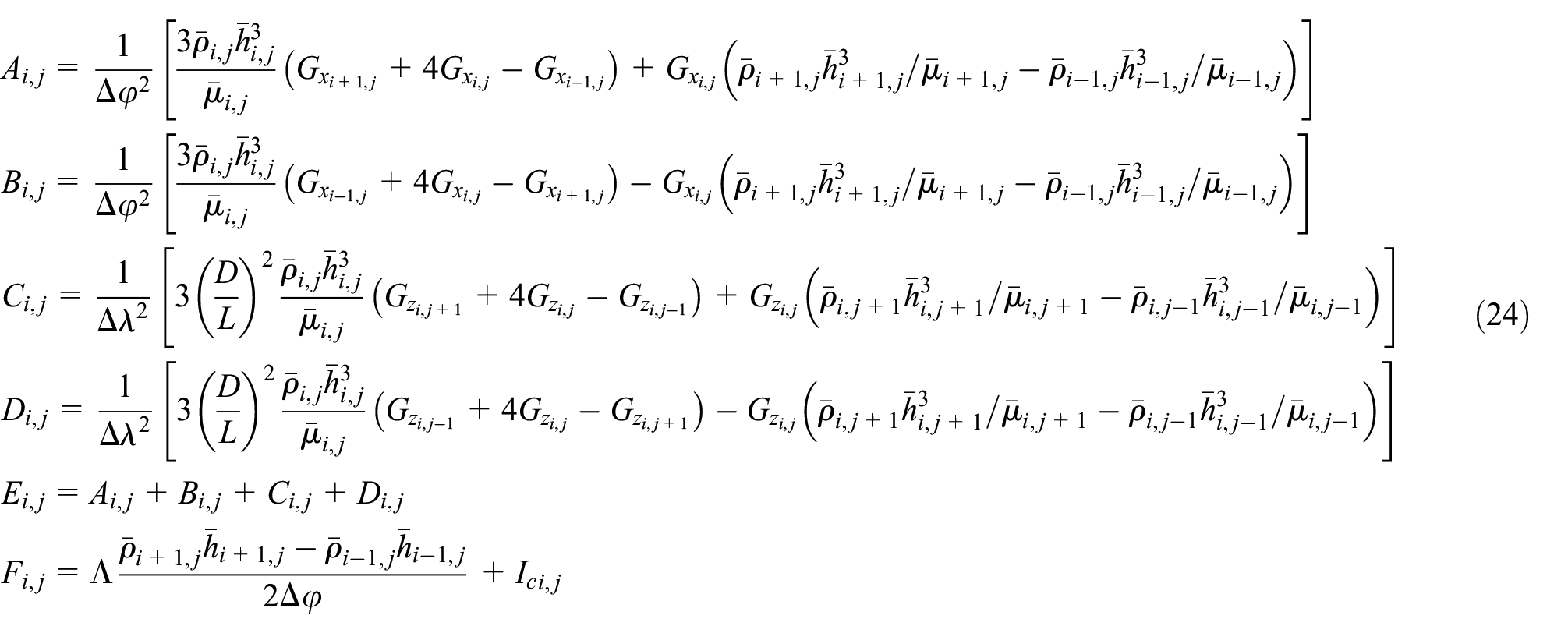
The inertia term

The following diagram illustrates the solution of extended Reynolds equation for S-CO2 tilting pad bearings while taking inertia effect into consideration.
Step 1. Enter the structural parameters and ambient temperature
Step 2. Let
Step 3. Update the values of
Step 4. Based on the initial value of the new pressure
Step 5. Repeat steps 3 and 4 above until the pressure distribution
In step 2, the tilt angle calculated under inertialess condition is used as the initial value to obtain better convergence in solving equation (20). The moment of pad in dimensionless form can be written as equation (26).

Where
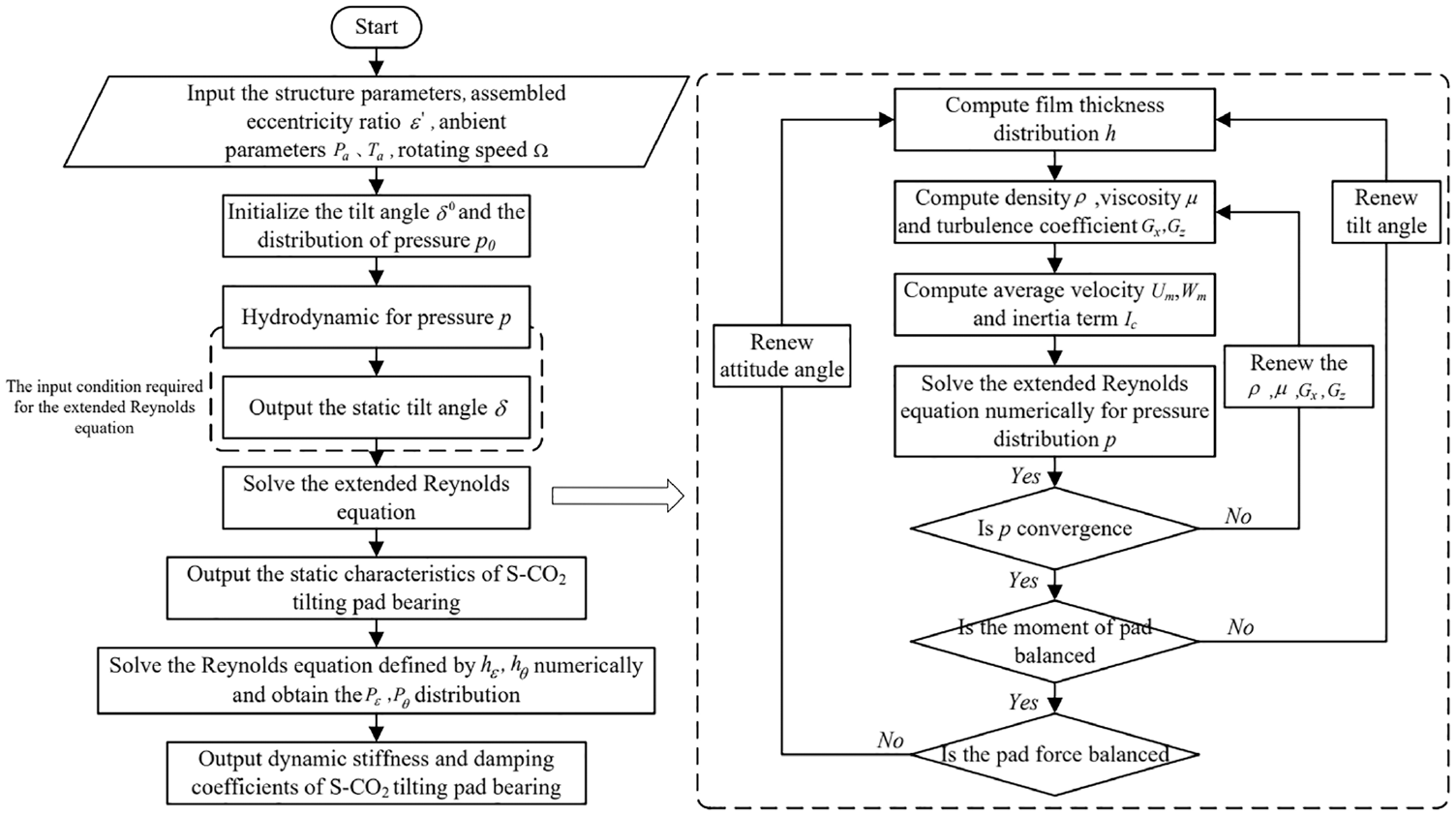
S-CO2 tilting pad bearing solution process considering inertia effect.
Dynamic stiffness and damping coefficients of tilting pad bearing
For the calculation of the dynamic coefficients of S-CO2 journal bearings, the displacement velocity increment method (IM) was employed in Bi et al.,
12
and the results of the complete variable perturbation method were compared. The results of the two methods are essentially the same when the partial derivative of density to time is neglected under perturbation frequency
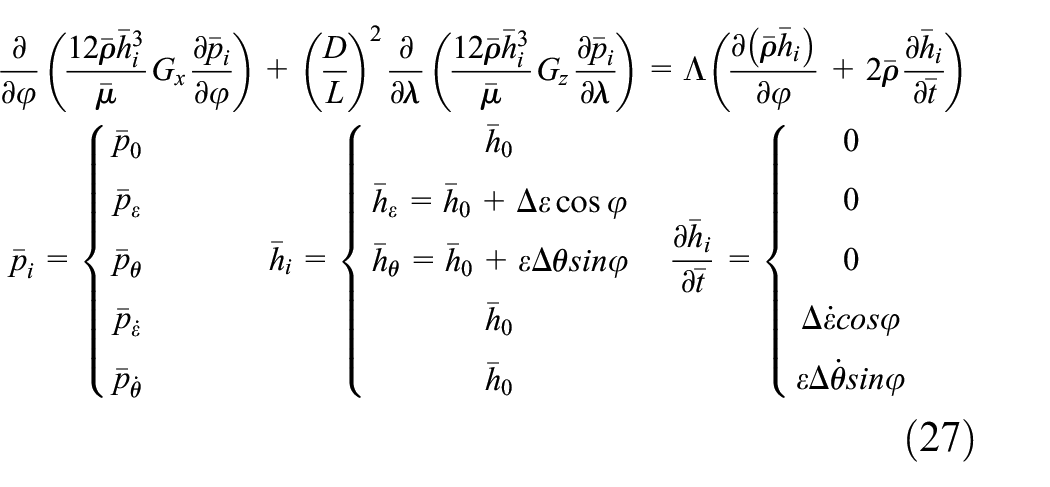


In this case, the transfer matrix

The procedure described above is also used to analyze the stiffness and damping coefficients of the remaining pads, and then a numerical summation of equation (31) can be used to obtain the dynamic coefficients of the entire tilting pad bearing with three pads.

Results and discussion
Verification of the theoretical model of S-CO2 lubricated tilting pad bearing
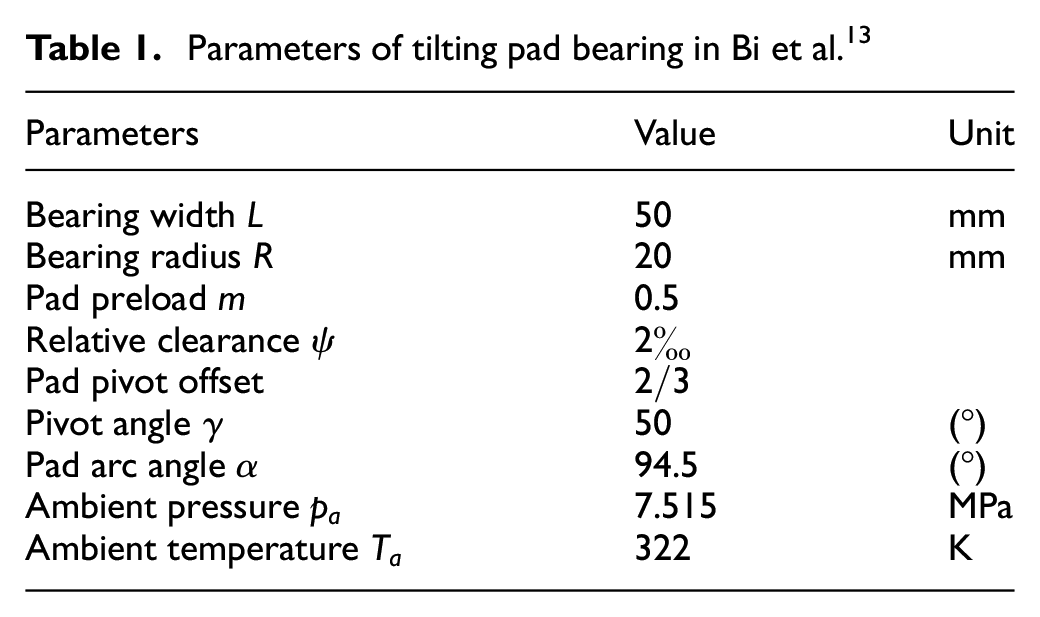
There are no published experimental studies on the performance of S-CO2 bearings, nor do there exist experimental data describing the characteristics of S-CO2 lubricated bearings. To check the correctness of the hydrodynamic model for S-CO2 tilting pad bearings, numerical results for the inertialess condition (
Parameters of tilting pad bearing in Bi et al. 13

Comparison of numerical results of pressure distribution.
The influence of inertia effect on pressure and load capacity
In this study, we research the influence of inertia effect on the S-CO2 tilting pad bearing characteristics and its influential mechanism. The numerical method presented in this study is used to calculate the dynamic coefficients and pressure distribution for the S-CO2 tilting pad bearing. Table 2 presents the structural and operating parameters of the S-CO2 lubricated tilting pad bearing calculated in this study. The ambient pressure
Parameters of S-CO2 tilting pad bearing.

Figure 4 shows the three-dimensional pressure distribution for different assembled eccentricity ratio

Pressure distribution considering inertia effect: (a) Re* = 5.23
Figure 5 shows the influence of inertia effect on the pressure distribution for different reduced Reynolds numbers (Re* = 1.75, 3.5, 5.23). The numerical results of the middle section of the S-CO2 tilting pad bearing are selected. Comparing the red dashed line with the blue line, it can be found that the larger Re*, the more significant the increasing trend of the thin film pressure distribution considering inertia effect. For the same assembled eccentricity ratio

The Variation of pressure distribution considering inertia effect at different reduced Reynolds number: (a) Re* = 1.75, (b) Re* = 3.5, and (c) Re* = 5.23.
The influence of inertia effect on the dimensionless load capacity of the S-CO2 tilting pad bearing is shown in Figures 6 and 7. Figure 6 shows that for the same

The influence of inertia on the load capacity with different reduced Reynolds number.

The influence of inertia on the load capacity with different assembled eccentricity ratio: (a) Re* = 1.75 and (b) Re* = 5.23.

The variation of the peak pressure deviation under inertia and inertialess conditions.
The influence of inertia effect on static tilt angle
Figure 9 shows the variation of the tilt angle

The variation of static tilt angle with assembled eccentricity ratio: (a) Re* = 1.75 and (b) Re* = 5.23.
Figure 10 illustrates the variation of the static tilt angle

The variation of static tilt angle with different pad preload: (a) pad 1#, (b) pad 2#, and (c) pad 3#.
The influence of inertia effect on dynamic coefficients
A comparison of stiffness and damping coefficients of the S-CO2 tilting pad bearing with different reduced Reynolds number Re* is shown in Figure 11, and the inertia effect has a similar regularity on each dynamic coefficient. At lower reduced Reynolds number Re*, the effect of inertia on dynamic coefficients is weak. With the increase of Re*, the dynamic coefficients considering inertia effect are higher than that under inertialess condition, which can be seen when the Re* is greater than 4.

The variation of dynamic coefficients with different reduced Reynolds number: (a) Stiffness coefficient and (b) Damping coefficient.
In the range at which the inertia effect increases the dynamic coefficients, it is less obvious that the inertia effect has an effect on stiffness coefficients than on damping coefficients. In Figure 11, the stiffness and damping coefficient maximum deviations are 4.2% and 8.3%, respectively, between the inertia and inertialess conditions.
Conclusions
The static and dynamic characteristics of the S-CO2 tilting pad journal bearing were analyzed numerically. Following are the conclusions drawn from the above numerical results:
For the application of high speed S-CO2 tilting pad bearings, the extended compressible turbulent Reynolds equation considering inertia effect is developed to characterize S-CO2 high density physical properties, and the corresponding numerical method is given and applied to analyze the S-CO2 tilting pad bearing.
The inertia effect has a certain influence on the film pressure and load capacity of S-CO2 tilting pad bearing, and the inertia effect on the top pad film is more pronounced than that of the loaded pads with the increase of reduced Reynolds number. The deviations of peak pressure and load capacity are about 1.7% and 4% respectively between inertia and inertialess conditions at assembled eccentricity ratio
The static tilt angle of the loaded pads become smaller due to the inertia effect. Lower pad preload coefficient produces more pronounced inertia effect, and the top pad remains the most affected by the inertia effect, with a maximum deviation of 9% in the static tilt angle between inertia and inertialess conditions when preload coefficient m = 0.3 and assembled eccentricity ratio
The dynamic coefficients considering inertia effect are slightly higher than that in the inertialess condition at high reduced Reynolds number Re*. In the range at which the inertia effect increases the dynamic coefficients, the influence of inertia effect on bearing stiffness coefficients is weak. At low reduced Reynolds number, there is no significant effect on bearing stiffness and damping.
Footnotes
Appendix
Handling Editor: Chenhui Liang
Declaration of conflicting interests
The author(s) declared no potential conflicts of interest with respect to the research, authorship, and/or publication of this article.
Funding
The author(s) disclosed receipt of the following financial support for the research, authorship, and/or publication of this article: The present work is supported by National Natural Science Foundation of China (Grant No. 52075311) and Shanghai Key Laboratory of Intelligent Manufacturing and Robotics.
